Category Archives: Biographical

You’re Not Going To Enjoy This Story

white (2)

I have some stories, many of which I won’t tell until some of those involved die. It’s not out of respect, though. I know I don’t get all the details right. Stories are certainly more complicated than I make them as I reduce and distill whatever swirls in my head when I share pieces of my life. Others attack the details and forget to defend the essential truth behind the story. I have dozens of anecdotes and stories I’ve written. Most of them are too raw or lacking a central focus. With many of them, I just concluded, “It’s time” and throw them out here as if they need to breathe. With some of my stories, it would be folly for the people involved to identify themselves. Their denials won’t age well. If you think I’m writing about you or someone you know, don’t ‘out’ yourself.

I wrote the initial version of this sometime in 2001. In reality, this encompasses several conflicting stories.

When I was in junior high, I had a few experiences which jarred me. A couple of them are closely guarded secrets. Because I could recognize violence in places most people saw few signs of such, there were a few times in which I was rendered floorless in recognition of how bottomless some people were. I now know that there are abusive people from all walks of life. Worse still, some are adept at recognizing children who are already at risk and then do further damage to them. Oddly, it took me years to realize that I also had a congruent weakness: I often failed to see the danger behind a smiling face. Many of the biggest monsters hide in plain sight, behind an easy laugh. Youngsters who are mistreated tend to be distrustful of everything, of course – but they also tend to contradict their instincts by responding with too much trust toward a smiling face or friendly demeanor.

Make no mistake, I encountered some incredible adults and teachers when I was young. Don’t make the mistake of thinking I don’t recognize the debt I owe them. Talking about the lesser people doesn’t denigrate the better people in my life. All are stories. Likewise, you must accept the reality that some of the worst human beings I’ve known were teachers, coaches, and other professionals. The positive examples outnumber the negative by a staggering margin. Not talking about the negative examples doesn’t help anyone, though. Regardless, I get amused when people call into question my motives for sharing. As Anne Lamott said, “You own everything that happened to you. Tell your stories. If people wanted you to write warmly about them, they should have behaved better.”

I was beyond the normal scope of ignorant when I was younger. My family life didn’t foster a broad worldview and often no expectation that I would live to adulthood. Each weekend brought dread, even as I found youthful distractions. Much of my life was wasted trying to bridge the gap between my home life and the one outside its reach. I loved school in so many ways; the greatest and most singular was simply that it was not home. I often say anywhere was safer than home, generally speaking.

At school, I had befriended someone who seemed like she might have a glimpse of my life, an overview I didn’t have to explain. I’ll call her Tammy. It’s important to note that this wasn’t a romantic relationship. After a while, I noted that she didn’t want me to notice her mood swings. After I met her parents, I made the mistake of asking if her dad liked to drink, followed by me seeing that her mother seemed to behave like my mom. I thought I was sharing a secret, one Tammy might reciprocate. I could not have been more mistaken. In the short term, I just avoided her as she became belligerent and angry after I told her about my family life. I don’t know why I thought my honesty would let her be able to confess her own dark secrets. I tried to explain it to her. It only made her angrier. She couldn’t get past the idea that I “knew” what happened at her house when no one was looking.

She told me that her dad was going to find me and give me a dose of what I deserved. She threatened me if I shared my ideas about her home life with anyone. When she said it, I knew that her dad had probably actually said the words, in part because of the details she provided. Her eyes lit up with crazy glee each time she’d mention that her dad was going to beat me. It sounds like an exaggeration, but she probably said that her dad was going to beat me at least twenty times. She seemed a little too focused on ensuring that I was at least scared. Though I don’t remember any of the details, it was evident that her dad had probably hurt a few people in his lifetime. Years later, it occurred to me that Tammy might have earned a temporary reprieve from her dad’s beatings by offering me as a sacrifice. Children living with violence learn techniques to avoid scrutiny and to give the abuser another target. It’s part of the reason they lose their confidence and ability to make rational choices in later life.

One day, after a school function at another school, I was walking out of the building to make my long walk home. In those days, I was accustomed to walking miles from events. My parents had decided they didn’t want kids after they had us. I saw Tammy getting into her dad’s ugly little car, and I made a full swing around the edge of the lot to avoid them near the exits. To my surprise, a few moments later, her dad pulled his car alongside me and stopped. The driver’s side tire missed me by an inch.

He glowered at me. He was a huge, overweight man. “Boy, do I have to get out of this car and kick your ass?” Keep in mind that I was in junior high, and he was a middle-aged adult, one with a good job. He went on, shouting as the volume of his voice rose and fell. I don’t remember the words, just the expectation that he was, in fact, going to exit the vehicle and hit me until whatever plagued him faded.

Some people were lucky and never learned the truth that adults could hit a child in those days and face no consequences. Not only did I experience it personally many times, but I also witnessed it too. I’m not sure which was worse.

(I erased seven specific anecdotes at this point, ones dealing with job title and/or names. Whether it’s cowardice, self-protection or a soft heart, I’m not sure. They are not positive or life-affirming examples, though. A couple of the stories tell an entirely different story about some of the adults we shared growing up in the same community.)

Tammy’s dad said some angry things. Tammy was in the back seat, her face full of satisfaction. I’ll never forget that ugliness and glee. Her mom cowered in the front passenger seat, her head recoiling a little each time her husband shouted. Because of my dad, I knew that there was no right answer for the anger, just as there hadn’t really been a cause. Abusers don’t seek justification for their anger or violence – just an outlet. Justifications only come in the rare event that they are held accountable for their behavior. I stood there, silent and stupid, until Tammy’s dad was done screaming and threatening me.

Much later, Tammy continued her effort to retaliate against me for knowing her family’s secret. She enlisted another student to threaten me. I’ll call him Eric. Tammy had told him all manner of lies to get him really angry at me. I tried to be friendly and to avoid a fight, which only seemed to stoke his anger. I was a master of evasion due to my dad’s years of training.

Because I realized that Tammy was crazy, probably through no fault of her own, I found her and politely told her to please leave me alone. A couple of classes later, Eric approached and said something like, “I told you to leave Tammy alone, you sick f%%k. Next time I see you,” he said as he put a gun finger to his temple. I didn’t answer him as he continued to throw insults. People generally are going to do whatever it is they’re going to do. I had no doubt that Eric would beat me to a pulp. What Eric didn’t know, though, is that I would likely remove a part of his body against his will during the process. Some people fight to win because they are able; people like me fought when they had to, with the goal of making the assailant not do it twice.

Later, my dad had punched me squarely in the jaw when I wasn’t expecting it, precisely with the stated goal of teaching me to be mean. When I got up too quickly, he hit me again to demonstrate his superiority. His excuse? I was running too much. He also enjoyed giving me impromptu lessons on manhood. I had started running in March of 9th grade and lost a lot of weight. After a particularly bad day of home and school, I just decided I was going to start running. I had dizzy spells for a while after the outburst leading to being punched twice in the face by my dad. Because of the second punch, I had fallen backward and hit my head against the native stone fireplace at the end of our trailer. I lived in Piazza Road in Tontitown at the time, just past where the pavement ended. That was one of the times I told my mom that something was seriously wrong. I was covered by phenomenal insurance through her work. Mom refused to take me to the doctor, even after I made the mistake of saying I wouldn’t mention what brought on the pain and dizziness. She made a point to tell my dad that I had wanted to go to the doctor. She made sure that Dad understood that I implied I had something I could say to the doctor if he asked. It sounds like lunacy now. Mom at times exceeded the symptoms of being a victim and joined in the sadism. When Mom told Dad that I needed to go to the doctor, he waited until I let my guard down a bit and grabbed me and swung me around and into the cheap wood panel wall leading to the bedrooms at the end. I felt the wall crack as I collided with it and fell backward onto the linoleum. I’m convinced I did at least fifteen cents worth of damage to the cheap panel wall that ran throughout the trailer. Dad was shouting drunkenly at me that I should keep my mouth shut about the dizziness.

The worst part was the look of crazy smugness on my mom’s face as she watched Dad be brutal to me. I jumped up, ran into the bedroom, and immediately climbed out the ground-level window of my bedroom. I don’t know how long I stayed outside in the dark. I do know that the next afternoon when I arrived home from school that I took one of Dad’s pistols from the closet in his bedroom and walked down the dead-end part of Piazza Road. Several hundred yards down, there was a small valley and a stand of trees. I threw the pistol as far as I could, over the barbed wire fence and into the brush and rocks there. Dad had a massive collection of guns; he’d eventually notice the pistol was missing. His drunkenness would prevent him from tying me to its loss. It was a stupid thing for me to do. It did, however, make me feel immensely better. Apart from the fact that I could have shot him, he’s lucky I didn’t toss ten of his precious guns into the valley by 4K farms. I did take several hundred dollars worth of specialty ammunition from dad’s stash and leave it next to the fence along the road, though. Dad was a convicted felon in more than one state; he wasn’t supposed to have firearms. Despite this, the police who infrequently visited never took any of his guns, even when people had been shot or shot at. Mom and Dad smoked a lot of marijuana when we lived on Piazza Road, too. I threw out a large clear bag of it after another beating. I was in the lower little shed under the back porch of the trailer practicing my French Horn. Dad grabbed my French Horn and hit me with it. The bells struck me in the nose. Surprisingly, it didn’t break. It did spew an amazing amount of blood for ten or fifteen minutes. I went upstairs and went into my parent’s room to get a bowl of marijuana they kept inside aluminum foil in mom’s dresser. Instead, I found a large bag of marijuana.

While I didn’t feel particularly angry, it must have been lurking inside of me. As dumb as it might sound, I was furious that I had trouble reading due to the dizziness. The libraries were my sanctuaries. Reading was my outlet into the world without needing people to explain it to me. It was also the only way I could remotely mimic the people around me. The librarians at the high school knew me well. One afternoon, I had darted over to the library to put a book in the drop slot and walked back across the narrow street to campus. Missing the bus was a real problem for me, and as a result, I generally wasted no time getting back to the bus pickup area.

Eric was parked along the road by Murphy Park and the Springdale library. He was leaning against his car and chatting inattentively with a girl. I walked up and put my books on the ground. Eric turned to me to mouth off. I said, “No.” As Eric began to speak, I hit him left-handed the way my dad had involuntarily trained me to hit. Eric didn’t even have time to get his hands up. Although I’m not proud of it now, I hit him as hard as I could. One of his teeth punctured my middle finger above the middle knuckle. Eric’s head snapped backward. I didn’t even wait for him to retaliate. Had I caved in his face, I don’t think I would have stopped punching him. Something about the unholy trinity of him, my father, and Tammy’s dad broke a circuit in my brain. When he tried to fall, I dragged him by the hair as he screamed. He had the classic feathered hair that so many people preoccupied with their looks used to have in the early 80s. I threw him in the grass on the practice field (where the track now resides) across from the public library. I then crouched down and put my knee across the back of his head. I didn’t have a plan. I didn’t know I was going to hit him until I did it.

A car with seniors inside pulled up and the girl Eric had been talking to told them an underclassman was kicking the crap out of Eric. They all piled out of the car and came around. Just as one of them started to grab my arm and pull me off, I jumped up and away, not saying a word. “You’re Mike’s brother!” said one of them. Another one of them said, “I don’t care who he is, I’m going to kill him.” Because I didn’t want to be literally killed, I said something smart such as, “I’d like to see you try, coc%@#$%^&!” and took off running. Did I mention I ran several miles a day back then? It paid off. They gave up trying to catch up with me in less than a minute, even though two of them ran all the way past the old tennis court area in a failed attempt to corner me. I gave them the high-bird salute with both hands, laughing. One of the people involved later tried to kick my French Horn as he walked by. My French Horn was not only a school-owned instrument, but it was sacred to me. A few days later, I poured a can of coke onto the front seat and dash of his beloved car. It was hot, so I imagine the cleaning process was delightful. It wasn’t a habit of mine to vandalize things. Once the idea was in my head, though, it was insurmountable. I felt terrible about the coke. I also kept reminding myself that the senior in question had hurt several people I knew, all weaker and smaller than him. He loved torturing other kids. I recognized the look in his eye and on his face when he was violating someone.

Eric? He made an effort to avoid me and to ensure that people were around him. Whatever else I had accomplished, I put the idea into his head that I could spontaneously dance on his head again.

I waited a while and went back for my books, which were surprisingly still in the grass. I don’t remember how I got home that day, as my family lived over by 4K farms in Tontitown. It’s hard to believe that it was over 7 miles from the high school to our trailer on Piazza Road. It seemed like 50 back then. My finger bled for quite a while, especially when I played my French Horn.

Years ago, I wrote a letter to both Eric and the girl he was talking to, to apologize. For the life of me, I can’t remember the girl’s name. Eric didn’t deserve to be punched so hard. On the other hand, he shouldn’t have persisted in terrifying someone he perceived as weaker. That’s a prescription for disaster. I do remember apologizing and also pointing out that the feathered kind of hair he used to maintain was basically begging for a beating, anyway. I was trying to be funny. I didn’t hear back from him. Wherever he is now, I assume he is nothing but a full head of luxurious feathered hair. In his version of the story, he probably thinks of himself as the protector. Even though I tried to explain to him that Tammy had lied to him, all he saw was a weaker victim in me.

Even though it doesn’t reflect well on me, I fear that if I could go back and retrace my steps, I would have been much less patient with bullies, regardless of whether they were my age or adults. Whenever I see a story about a victim responding with uncharacteristic violence, I always initially sympathize with the victim, no matter what he or she did to the person who had bullied them. Had my older brother not been around, it’s possible that the already common bullying would have been much worse. Even though I suffered through my dad’s abuse, I recognize that if the bullying had been worse in my earlier high school days, it is quite possible that someone would have been seriously hurt. That recognition is what sometimes lets me know that I was infected with the violence of my ancestors.

The next time I saw Tammy, I told her, “So much for my Eric problem. Seriously, leave me alone.” I showed her the deep cut on my left hand. It had finally dawned on me that whatever infected her dad had been passed down to her too and continuing to be nice was only going to add another year of hell to my biography. Her dad never materialized to administer his promised butt-kicking. From that point, I only had to contend with evil looks and whispered chatter. She made herself scarce for the rest of my high school tenure. She would be furious to hear me say that I felt terrible for her. I knew what she was experiencing at home. I suspect it might have been much, much worse than what I was going through. Tammy’s adulthood has been one marked by serious trauma. When social media started to gain ground, she reached out. It didn’t take me long to realize that she was truly crazy. Redemption was impossible. Her entire life was consumed by anger.

After high school, I finally managed to break free of much of the insanity of my youth. I changed my name. I wrote letters to several people, thanking them for being great people to me. I wrote a few to those who treated me otherwise. Some were anonymous. Some were not. With three or four individuals, I found them and told them directly that they had left a stain on me, much like the violence I grew up with. I was young, and stupidly thought I knew what I was doing. Again, things haven’t improved much regarding my ignorance, but I at least recognize my ongoing stupidity most of the time.

A couple of those I reached out to were teachers. I had some outstanding teachers. Like everyone else, I try to focus on their example instead of the malignancy of the bad ones. One of the people I confronted, an employee of the junior high I attended, screamed, “That never happened!” and ran away from me. We were in the Kmart parking lot. He bolted away from me. I waited 30 minutes for him to return. He didn’t. He was in great shape and could have easily thrown me ten feet in the air had he wished to do so. He ran, though, from the truth. He’ll get a chapter one of these days, especially if I outlive him. Whether anyone else believes it is their problem, not mine. He had no business being around children, of that I’m sure. I used to watch the news or search for a mention of him online; it seemed inevitable that he’d make an appearance in the Crime Beat section of the paper.

One of those people who I wanted to talk to face-to-face was Tammy’s dad. Her dad didn’t know it, but I had family and friends in common with him, mostly as a result of his job. Life has taught me that we all have a network of tendrils connecting us. What we do and say finds the most unlikely nests to rest in. Secrets are rarely kept, even as we fool ourselves into believing that they’re buried.

I asked around and discovered that the man’s past was more widely known than he thought. In those days, though, it was quite easy to conceal that sort of thing. A cousin of mine, then retired from public service in Springdale, had a lot to say about him. “Scoundrel” was his word for that sort of person. “He beats his wife,” my cousin confirmed. My cousin told me several stories of some of the horrific things Tammy’s dad had done, including ruining more than one person’s career. One of them included beating a neighbor’s kid for running through his yard. He wasn’t charged, of course. The kid in question suffered a broken arm trying to get away. There was never a record of it officially.

I waited for the scoundrel to come to meet me in front of his work. I had left a message at the desk to let him know someone was outside. There were other people around but I didn’t really concern myself with that. I’m paraphrasing what I said, and I’m the first to admit that many of the words didn’t ring out as confidently as I recount them. People are strange creatures; angry people are literally capable of murder in church without blinking.

When he came out, he lumbered and wheezed with the effort. “Do I know you?” he asked. “Yes, you do, sir.” Weirdly, I reached out my hand and shook his. His hands dropped to his side. “You threatened to whip my ass when I was very young. I was once a friend of your daughter. By the way, I know that you liked hitting your wife and kids. You’re an asshole. I’d like to give you the opportunity to fulfill your opportunity to whip my ass, right here and now.”  I took a step back and left my hands at my sides.

His eyes filled with literal tears, and he started breathing like he might not catch his breath. “I’m going to call the police. This is my place of work, and I’m not in the best shape to shut you up,” he said as he pointed his finger in my face. I stepped toward him, and he realized that I might actually strike him. “Do you want to call now or after I give you a dose of your own medicine? You’re not two feet taller than me now, are you?”

He shuffled back inside, looking behind several times until he was inside with the door closed.

Truth be told, I might have killed him had he tried to actually fight me. For some of those I confronted, I didn’t expect a visceral response. With Tammy’s dad, because I knew he was a violent abuser like my dad, I welcomed the chance to yank his shirt over his head and beat him like a third-rate hockey player.

I sat on the curb outside for ten minutes to give the police time to arrive. There was no doubt that what I had just said was a crime. No one came. No one ever came. Had the police come, I would have told them the truth, the one about a huge man who abused his family and tried to do the same with me when I was in junior high. It would have been an awkward police report and even stranger explanation in open court. His sort of person fears open exposure to what he’s done.

I see so many people make the mistake of kicking people when they’re down. It is a universal truth that it is unwise to threaten someone who has nothing to lose. I like to think that Tammy’s dad thought about me a few times before his life ended. It’s only fair. I’m not proud of this – but I can’t deny feeling that way. I wanted him to know that I could call him to account for what he did if I chose to.

He died a few years later. I saw his obituary in the newspaper. The obituary used a picture of him from about the same time frame as when he was threatening me. I have that picture in a folder on my computer. I don’t know why I keep it. Whether it speaks ill of me or not, I found myself wondering whether his eulogies were glowing, or if anyone had the nerve and impoliteness to tell the truth: he was a violent and angry man for much of his life. His death did not come soon enough to avoid staining the life of his family. A lot of people know, though, despite the glossy sheen provided by an obituary. Unlike in my case, Tammy probably still staunchly denies any abuse that happened to her. I’ve heard through the grapevine that her life didn’t get any easier. She stayed stuck, stagnant, and angry.

I went to visit the grave of Tammy’s dad. As I stood there, I couldn’t help but think about the number of people who’ve lived with monsters like him and kept their secrets. I’ve argued with people before: if you punch your children or spouse, you’re a monster, even when the scales slide off and old age catches up to you. No one stood up at my dad’s funeral to shout the truth. He died a saint, despite the invisible blood soaked through his knuckles.

I saw Tammy’s mom from time to time at her job. Tammy doesn’t know it, but I talked to her mom a year after her dad died. I didn’t know how to ask her politely, so I simply asked, “Do you remember me?” She said that I looked familiar but that she couldn’t place me. I told her I knew her daughter when I was younger and in the briefest way possible, explained that my childhood was abusive, too, and that I was sorry that she had to live her life with someone who couldn’t control himself. I thought she might respond with anger, but she didn’t. Her face flushed red, and she resumed her job. “Take care,” she told me as I walked away. She was smiling at me when I left her.

I don’t know what the smile meant.

I only know what I like to think it meant.

And I sometimes rest, uneasy, hoping my mistakes weren’t sufficient to summon the smaller gods of justice to repay me.

I’m not proud of confronting Tammy’s dad all those years later. I’m glad, though. My sin of vengeance was certainly lesser than his of being the abuser, especially of children.

I distrust easy stories, happy endings, and simple answers. We’re all complicated and each of our demons swirls inside of us.
 

Stolen Cars, Stolen Memories

666666


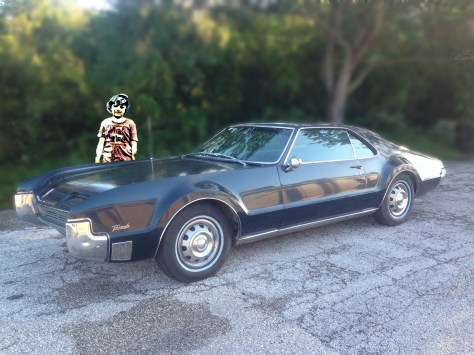
I stood in the parking lot, listening to my dad argue angrily with the stranger who drove the vehicle hauler to meet him. The stranger wore a ridiculously tall cowboy hat, black pants and shirt, and to complete his ensemble wore some type of brilliantly white tennis shoes. There were at least six vehicles stacked on the hauler. A couple were Chevy Cheyenne pickups, a particular specialty for my Dad. The others were cars, including one exotic black Oldsmobile Toronado. The exchanged words grew more intense as I attempted to back away surreptitiously from the two angry men. Though the ending is spoiled by me telling you that no one was killed that day, the anger I remember was as real as any I’d had the misfortune of experiencing. My dad had a gun tucked in the back waistband of his pants. That he was a convicted felon never slowed his tendency to carry a gun everywhere. It might be in the glove box, tucked under tools, or slipped under the seat. It might even be a sawed-off shotgun. Though we went without many things growing up, dad never shorted himself the right to have a few dozen firearms.

“I don’t give a good g-damn what you were told, Bobby Dean.” The stranger moved his legs apart. He was expecting a fight. Dad wasn’t going to throw a punch. Someone was going to get ventilated by gunshot. People knew all the rumors about my Dad’s legendary and violent alcoholic disposition. That was only half the truth. He was much more dangerous when he wasn’t drinking. While less likely to be violent when not drinking, if his temper was lit, he seldom controlled it.

I don’t remember whether we were in Siloam Springs or somewhere else along the border between Arkansas and Oklahoma. We drove most of the way via Highway 68, the precursor to 412. Most of my recollection revolves around riding too long in the bed of dad’s pickup truck. Why I was chosen to go with him wasn’t clear. Duke, Dad’s dog, accompanied me on the windy ride.

At least a couple of the vehicles were stolen. Dad worked for ______________, a family member with a car lot and a dealer’s license. Between Dad and my family member, they knew how to disguise a stolen vehicle as legitimate. I should know. They stole a Ford Galaxie from me in the mid-80s. As for the family member, I didn’t realize until years later that he was related to me by marriage. Dad committed arson for him at least twice that I know of. More than once I heard Dad brag that anyone could burn a house down using the water heater or the stove unless they were total morons. That last bit isn’t relevant but somehow seems important.

“I’ll give you $500 less than agreed. Anything more and you can go _____ yourself.” Dad seemed adamant on the amount.

“You’re going to have to drive the hauler to Springdale then. I’ll pick it up in a couple of days,” the stranger answered. Dad shook the man’s hand. All the anger seemed to have disappeared once the money issue had been settled. Dad handed the stranger his truck keys. It must have been honor among thieves which prevented Dad from worrying about his own truck being stolen.

Since I wasn’t going to witness a murder, I emerged from the other side of the hauler. Dad handed me a stack of papers, titles, and mechanic records. “Put’em under the driver’s side seat,” he shouted at me. He went to look inside each of the vehicles on the hauler. In a few minutes, Dad climbed into the vehicle hauler cab. “You’re not riding in the cab. Go ride in one of the cars on the trailer. And don’t let anyone see you.” I don’t know if he thought he was conferring a privilege or what. Since he wasn’t screaming, I didn’t question him. I wasn’t surprised that Dad’s dog was going to ride in the cab of the hauler on the way back while I was banished to the vehicle of my choice. There was no way I was going to try to climb onto the top level and ride the curvy highway back to Springdale with Dad driving. I have to admit, though, it was both a little scary and interesting sitting in the Toronado. The car looked sinister to me even then. I spent a few minutes searching through the glove box and under the seats of the car I rode inside as Dad drove the hauler. I pressed the cigarette lighter in at least two hundred times on the trip, watching the coil glow red. This was a cardinal sin around my parents, who treated smoking as the religion they failed to possess. They were unconcerned if I burned my face off with the electric lighters. Their only issue was to find themselves without a constant means to light a cigarette.

Dad pocketed the $500 he shorted the stranger who drove the vehicle hauler to the border of Arkansas. He told me to keep my mouth shut or get a broken nose when we stopped by the road in Tontitown. I wouldn’t have known if he hadn’t threatened me.

All the cars were sold as if they hadn’t been stolen. To make it easier, another cousin had a permit to do vehicle inspections, notary work, and many of other details needed to steal a car. He lived over near 40th Street. Dad was a mechanic by trade and could do welding, electrical, plumbing, and a thousand other things. Because I was uninterested in anything related to Dad, I didn’t pay a lot of attention to the conversations about stolen vehicles or stolen parts. There were a couple of  junkyards that had the dubious specialty of looking the other way on just about everything. Everyone involved had convinced themselves that they weren’t doing the stealing, so it was okay. I did ask once, “But if people like you didn’t buy them, who would they sell them to?” That’s the sort of question to earn a punch in the middle of the chest if I was lucky – and in the face if I wasn’t. It seemed likely that I shared a lot of history with the children of Mafia bosses.

Several years later, Dad made a few runs to pick up vehicles in other states. I can’t say with certainty that they were stolen, but those involved with the cars were being careful. One of those cars was a 1978 Dodge Cordoba, painted metallic green. I’ll never forget it because I had to sand every inch by hand. The Karate Kid had nothing on me for those countless hours of fun. Dad ‘gave’ the car to Mom and sold the one she had without asking her for her opinion. She gave it to him anyway, at high volume and under the influence.

P.S. I’ve never acquired a taste for cars. I admire an interesting one, though, especially some older ones I was able to see when I was young. The 1966 Toronado holds a place in my heart – and for all the wrong reasons.

From Horse Soup To Subway

Work today was like horse anus soup, a large, steaming bowl of it. I went to get the oil changed in Dawn’s car and then went to a Subway. (The food kind, not the subterranean kind.) There were several people in line waiting when I arrived. One of them was a spindly Latino man somewhere around 30 or 60 years of age. Although he had a case of akimbo teeth, his smile was wide. He awkwardly gestured for me to go ahead. “No, it’s okay,” I told him. “No English,” he told me, insisting that I move ahead. When I replied in Spanish, “None of these ______ speaks Spanish? Well, we can do better,” he looked like he found a spider in his underwear. I told him we’d make a go of it and learn in the process if he could tolerate my accent and sense of humor. I helped him with his order as I continued with mine. I hit him with a lot of jokes, such as the one when I told him the chicken plank was made from reprocessed cardboard. In my defense, it looks and tastes like it does. He didn’t know what to say when I asked him, “You want the WHOLE chicken on there? That’s crazy!” He laughed and pointed at the bland, lifeless plank of chicken breast. He now knows that the rotisserie chicken is a smarter choice, regardless, if you’re interested in eating shredded animal flesh under a pile of vegetables.

Because we were having a bit of fun with it, people in line and working there were all interested and listening. It sounds impossible, but we had a good time for those few minutes we interacted. Most of the time, standing in line at Subway at lunch is similar to the process of lining up for a firing squad staffed by cross-eyed gunners. We chose the other fork of the road, the one lined with shoeless singers and banjos, the road Robert Frost would have never taken unless he had a hit of LSD with him.

When he got his receipt, I pulled out the marker I invariably have with me and wrote, “+tomato+mayo” on it and told him to keep the receipt for his next order. He was beaming. I think I just gave Subway a lifetime customer and another human being a little bit of optimism about the rest of us.

Words For the Moment

Capture

I was driving the eastern fringe of Springdale, heading toward an even darker sky above the city. It was either 4:30 in the afternoon or 1959. Rainy January evenings magnify the monochrome world. Unlike most, I love rainy days and the unstated premise that they are authors of introspection. The drive seemed interminable and as if my car wasn’t advancing on the rain-slicked road. 412 was both busy and barren, much like the landscape on this side of town. It is not a place that welcomes vividness or easy admiration. Most of the inhabitants of Springdale instinctively know this, even as they uneasily attempt an explanation. I had driven way out of town in service to family. During the drive, I felt as if I were in a place outside of time. The rain obscured everything in my path and the landscape looked as it might have forty years ago when even the road was two digits. Honestly, my heart was a little heavy. I had witnessed a flash of loneliness in someone that was so profound that I wasn’t sure how to sidestep it. That recognition of the abyss in someone else is always a little destabilizing. It surprises me we don’t all succumb to the depths with a greater frequency. We’re supposed to bridge those gaps and help one another as these moments arise. Often, though, the paralysis of saying the wrong thing immobilizes us. Sometimes the momentary misery of life must be endured without expectations of a quick resolution. I changed the input on the radio and brought up a song on the USB drive plugged into the dashboard. As the chosen song filled the car, the fog of memory washed me away to only a place where good music can grant us entry. I turned the volume up even higher, as I turned down Friendship Road and let myself swim in the melody. Soon enough, I was once again at home, where the abyss faded into the background. I hoped that the loneliness I had witnessed had subsided in the person who owned it. While my words failed, I hoped that my presence at the moment had sufficed. It’s all we can hope for, as the moments continue to wash over us, a slow tide that advances despite our insistence that we might be immortal.

Avoidance

adam-wilson-6UIonphZA5o-unsplash


This is a personal post. It’s not designed to anger or offend. These are just words, written imperfectly by me without a great deal of redaction, except to protect people’s privacy, even when such protection isn’t warranted. For the gatekeepers who inevitably say, “Don’t put that on social media,” it’s likely that you’ll continue reading, anyway. We’re all voyeurs. Surprisingly, our lives are amazingly similar, no matter what veneer we cast to cover our craziness.

On another note, I’m writing this as myself. It’s my story and one that is mine to tell. Anyone who feels they have the right to question the content or motive of what I share should probably put on a life jacket and then go find a lake to jump into.

It isn’t easy to engage meaningfully with someone if you can’t determine if they are connected to reality or not. With addicts and alcoholics, it can be an exhausting exercise in futility to invest your time and energy communicating with them. I’ve dealt with angry alcoholism all my life. I’m still terrible being myself around it – if that makes sense. It’s one of my most profound faults. I know that the only rational choice is to jump away from this type of addiction due to the short length of time we each have to live. Knowing and doing are opposite sides of the canyon for me. I get irritated with myself when I forget the lesson I’ve learned at least a dozen times.

Like most people, I happily find that my phone rings less often. When it does ring, I find myself dreading to know the identity of the caller. If there’s a voicemail, I don’t even listen to it, all due to one caller. The stupidity of it all is disheartening. I don’t want to dread the call.

While it might be an excuse I differentiate between garden variety alcoholism and angry alcoholism. The impacts of the two kinds yield staggeringly different results. I’ve struggled with an abnormal number of angry alcoholics and rarely had issues with the boring ones. I suspect that most people know exactly what I mean, even if they can’t put it into sensible words.

The truth? I can’t stand angry alcoholics. They give regular alcoholics a bad name. Am I kidding? No, not really. I owe it all to the angry alcoholics of my youth. Each subsequent angry alcoholic stupidly things he or she has magically figured out something new or that he or she has everyone fooled.

If you don’t have a daily connection to the world around an alcoholic, as is the case with many of our friends or relatives who are elsewhere, it’s especially difficult to navigate the pitfalls of maintaining a real connection. We all recognize that we lose touch with the essential part of someone’s life and personality in the best of circumstances. Illness or addiction further erodes our connections. You can forget the idea that you can peacefully navigate someone’s alcoholism AND discuss and address their addiction out in the open. You’re going to get burned.

I’ve learned that anyone who can openly discuss their addiction, previous or current, is probably going to do well in life. Those who demand silence are the worst kind of addict. They’ll ruin your life to avoid dealing with their issue.

The very nature of addiction demands secrecy. Once you see past the curtain that addiction demands, everything you see is infected by that peek.

I’ve found myself in that position. I can’t get past the inability to know if I’m dealing with someone communicating with me authentically.

An alcoholic put me in this position last year. Only by accident did I discover that he’d fabricated an elaborate and false narrative around almost all of his life. He’d lost his job, his health, and his ability to be rational. By accidentally comparing facts with a family member of his, the complex web of falsehoods collapsed. It was a confirmation and revelation, one which still makes me feel guilty; initially, it brought up the anger from a few years ago, when the same alcoholic almost caused me to have a literal nervous breakdown.

Those of us with self-doubt don’t respond well when guilt is thrown into the equation. Because of the malignancy of the alcoholic’s need to maintain the façade of normalcy, I even doubted what was plain to me – and my instincts, which have been honed by a lifetime of exposure to such behavior.

The revelations that erupted from the mess changed the way I looked at the last twenty years. It corrupted my memories of anything that happened since I was a child.

When I tried to force a confrontation to get past it, it went to a very dark place. It’s one that I haven’t pulled myself out of in regard to the alcoholic. I spoke in anger – and righteous anger at that. It sounds unfair to say it, but righteous anger in the face of that kind of behavior is the most human response possible.

After a while, another family member of the alcoholic who was my touchstone for the alcoholic’s reality told me that there was no upside to keeping me informed. While I understood the family member’s fatigue of the melodrama that resulted from the collision between reality and fiction, it robbed me of my ability to distinguish the truth. They stopped bridging the connection between us. The alcoholic used deceit and misdirection to avoid real conversations about the consequences of his addiction.

The result of this, however, is that it’s been almost insurmountable for me to talk to the alcoholic, which makes me feel even guiltier.

My upbringing has damaged my patience in dealing with such behavior. It’s easier to stay sane and balanced by avoiding the spectacle of addiction consequences.

If I talk to the alcoholic, I’ve no way to know which parts aren’t true. Given the huge disparity between this,truth and fiction that I discovered last year, I’m convinced I’m still being “had.” While I can talk to the alcoholic, it almost feels like roleplay – and I’m an actor forced to adopt the role that I’m crazy and that the alcoholic is normal.

It pisses me off.

My guilt with the recognition of the abhorrence I feel toward having fake conversations makes me immobile. I can’t call – and I can’t answer calls from the person.

I would love to write the person in question and have him write in return. That option, though, is not available for reasons that don’t make sense. The alcoholic can read and write as an incident involving my blog proved.

So, I can superficially engage while struggling with my guilt and distress, or I can continue avoiding contact. Given that the family member of the alcoholic probably doesn’t want to expose old wounds again, I’m left with terrible options. All of them diminish me and diminish the alcoholic.

Many people, like me, have lesser lives because we’re forced to exorcise people from our lives to live with any joy in our hearts.

It’s an imperfect world.

I sit. I wait. I dread.
.
.

P.S. “Agreeing to things just to keep the peace is actually a trauma response. When you’re doing this you’re disrespecting your boundaries. No more making yourself uncomfortable for others to feel comfortable. You have control now. Use your voice. Take up space and use your voice.” – I close with these words because someone posted it on their social media around the time I was having the most difficulty with this issue. There’s no doubt that these words would evoke an anger response, for reasons that are complicated to explain.
.


Just Enough Truth To This

sfdsdffds.PNG


It was a hot Saturday late afternoon. Though the clouds were piled high in the west, no one actually expected the sky to bless us with any rain. That part of the state hadn’t received any real rain in over ten days. Uncle Charles went through the screendoor and outside a few minutes ago. As he left, he shouted, “Get your behind moving,” already whistling. He taught me to whistle, too, and I knew I’d be mimicking him in a few minutes. He had also taught me how to whistle while inhaling, a valuable trait, albeit annoying to anyone who disliked whistling. “Assholes” was the endearing name Uncle Charles had for people who disagreed with him, especially if he was whistling or enjoying a bit of humor.

I was busily shoving as many homemade pickles in my mouth as I could, chewing like a man who just left a hunger strike. My Aunt Margie didn’t think much of her efforts at pickle-making. She couldn’t have been more wrong, though. On more than one occasion, I had devoured an entire jar without any assistance. Unlike most people, I accidentally discovered that I liked the pickles most people found to be less flavorful, especially if they were bitter.

I poured myself a huge glass of Coke from the 2-quart bottle as I struggled to get the pickles all consumed.

I went outside as quickly as possible to conserve as much of the cool air as possible. Grandma didn’t cotton to people dilly-dallying at the door in the summer. She was ecstatic for company to come to visit. She would, however, let anyone who took too long going in or out know that the air conditioning wasn’t free. In the South, it was common to hear shouts of “Get in or out!” or “Close the door!” fifty times a day. For those without air conditioning, the same shout was offered in response to the endless squadrons of mosquitoes circling every living creature.

Grandma didn’t have any foolishness such as chairs on her long front porch. Grandma didn’t understand why someone would sit outside in the heat if air conditioning was available. There was a porch swing on the opposite end of the porch, and it invitingly faced the field adjacent to her old house. You could sit on the edge of the porch, too, or on the creosote-soaked steps made from railroad ties. I sometimes forget how artfully so many men practiced the art of crouching and leaning.

Uncle Charles was leaning against the far end of the porch, near the porch swing. He was drinking a glass of water, a fact that seemed strange to me, given that Grandma kept a well-stocked supply of Coke in the house.

He and my Uncle Harry were arguing about the weather. It was a free hobby, so they tended to participate as if their livelihoods depended on it. Neither were farmers, so it seemed a bit odd to me that the matter managed to lasso so much of their attention.

Uncle Charles took my glass of Coke for a second as I clambered up onto the swing. He handed it back when I was situated. I nodded and said, “Thanks.” He winked at me and then clicked the side of his mouth to let me know it was okay. He lit a cigarette and handed it to me. Just as Uncle Harry was about to protest, Uncle Charles reached back over and took the cigarette from me. “You’re too old to smoke. And you don’t want to sound like your Aunt Helen.” He winked again.

As the yellow jackets flew by, we sweated. In the distance, loud cracks of thunder would occasionally echo, causing the wall of unseen insects to momentarily suspend their buzzing.

I finished my Coke after fifteen minutes. I remained on the swing, watching the wind blow against the bean plants. Both Uncle Charles and Harry sat on the edge of the porch with their backs turned to me. Uncle Charles had lit at least four more cigarettes. Their conversation had turned to baseball at some point, a subject I found to be as interesting as licking a hot stove.

Even though the wind had picked up speed, I hadn’t noticed that the sky had dimmed considerably. As Uncle Charles flicked his cigarette to knock loose the ashes on the tip, a massive lightning bolt struck the ground about fifty yards away, near the small board bridge along Clark Road. The clap of thunder that normally follows after a delay boomed immediately. We could all see where the lightning hit the field. All of us were seeing the afterglow of lightning in our eyes.

“Holy crap!” shouted Uncle Harry as he jumped down off the edge of the porch.

Behind us, someone threw open the front door and shouted, “Get your butts inside. Yes, Nannie, I’ll unplug the television!” The first part of Aunt Helen’s shout was for us. The second was for Grandma, who believed that unplugging everything prevented lightning from hitting. I always looked up at the tall television antennae wired to the side of the house when she mentioned it.

Uncle Harry quickly walked around the edge of the porch, up the railroad-tie steps, and inside the house. He worked outside a lot. Being around lightning didn’t inspire him to be closer to nature.

“Are you coming or what?” shouted Aunt Helen to Uncle Charles.

“Naw, we’ll come inside in a bit.” Uncle Charles jumped off the porch and onto the grass below. “Come on,” he said, turning to me. Even though I was short, fat, and barefoot, I ran and jumped off the porch and onto the ground. Such delights are long behind me. More than most things, the absence of such abandon ails my soul.

Uncle Charles removed his shoes and tossed them onto the planks of the porch. “It’s going to rain,” he said and laughed. He was wearing black socks. As a lover of all things barefoot, socks seemed ridiculous. Black socks made less sense to me than keeping a snake in the underwear drawer.

A few random pops sounded from the galvanized tin roof. They came more quickly. The air temperature dropped several degrees. Then came the deluge. The drops were so heavy that they pounded against us. Uncle Charles walked the few feet over to the edge of the bean field and stood in the perimeter of dirt there. The dirt quickly became soaked and muddy. I followed him. The mud between my toes was a sublime pleasure.

As Uncle Charles stood next to the bean field with me, we both quietly watched as the edge of the rainstorm enveloped us, the adjacent road, then race away. The rain pummeled the metal roof behind us and everything in its path.

Uncle Charles put his hand on my left shoulder and smiled.

I witnessed the possibility of a life filled with small joys in the wrinkles of his face.

We stood there, even as Aunt Helen shouted from the porch for us to get our fool heads inside before the Lord could come to take us.

The rain. Us.

I don’t know for certain that I’m not still standing there.


My Apologies For The Troll(s)

zxczxczczxc arrow down


Friends:

Please accept my apology, one offered to all those who may have seen some particularly hateful commentary.

Someone I know is struggling with alcoholism and mental issues. The prognosis is such that it’s not going to improve. The truth is that I’m going to simply have to tolerate it until he’s no longer able to behave inappropriately. On the one hand, what he’s doing is completely objectionable; on the other, he’s often not in charge of his own faculties, so it’s difficult to hold him accountable like I would a normal person. While what he’s doing is a crime, I ask that you ignore anything bizarre that might appear in the comments for a short time. I’ll clear, delete, and block all the offending content as soon as it’s brought to my attention. I can block by email, name, and IP; as you know, however, these are not sufficient to thwart someone who actively seeks to inflict distress or inconvenience on another person.

If you see or hear anything crazy, threatening, or angry, please let me know. (Not from me – from him. You can ignore my stupidity and treat it as normal day-to-day craziness.)

I’m not posting this to draw sympathy, prayers, or well-wishes.

It’s literally to let you know that you might see some startling things across my blog and social media. I’ll correct them as soon as they appear. I’ve spent 50+ years adjusting to the insanity of anger and addiction; a little bit more probably won’t ruin the remnants of my own sanity. I have to admit the latest round of hatred and bile thrown at me was a bit over-the-top.

Thanks, X
.


A Party For My Mother-In-Law

20191102_105850

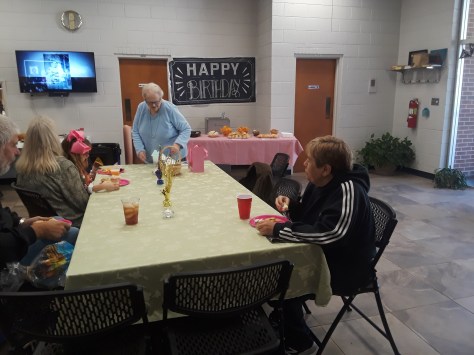
At my mother-in-law’s 80th birthday party yesterday, we all had a laugh. The church we invaded for the party is in Fayetteville, not too far from the U of A campus. About halfway through, some of us heard a loud bang, followed by immediate darkness in the church. Because the game was about to start, we could only assume that a higher power was expressing disinterest in the game rather than our party. We were without power for the last half of the party. As it turns out, the Razorbacks were without energy for most of the game themselves. We got the better end of the bargain, in my opinion.

20191102_110022.jpg
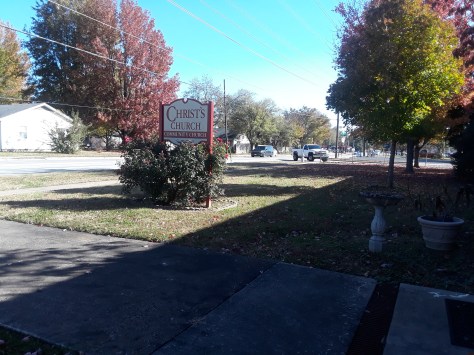
Christ’s Church of Fayetteville graciously gave us the run of the fellowship and church on Saturday when we held the party.

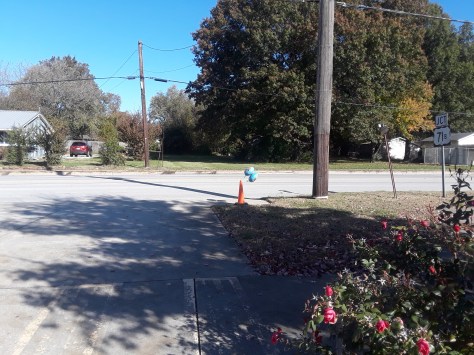
I was tasked with getting the balloons for the roadside for the party. I bought mylar balloons and triple-tied them to each other and to a large traffic cone at the roadside entrance to the church. About 45 minutes later, I glanced through the frontside vestibule doors. A man was walking past on the sidewalk. He was holding a colorful balloon similar to the ones I displayed. It occurred to me that the odds of an adult man coincidentally having a balloon similar in appearance to mine on an early Saturday afternoon were about zero. I went out the side entrance and walked around. It turns out that the odds were indeed slim. For reasons unknown to me, he had cut off one of the decorative balloons as he passed. He looked happy, so I can only assume that a balloon was just what this fellow needed to improve his day. Besides, I couldn’t imagine calling the police to report a stolen party balloon, especially if it improved the gentleman’s day.

20191102_105955.jpg
Here are the two remaining balloons.

.

.


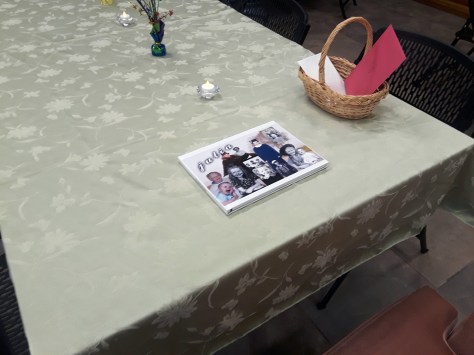
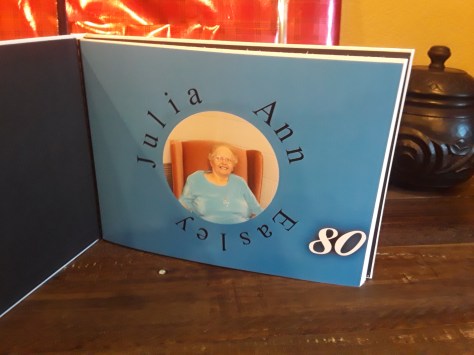
One of the surprises I made for Julia’s birthday was a 90-page bound book, stuffed with pictures of her life. Its contents did not reflect a life reduced to mere pages. Somehow, what filled it was greater than the sum of its photographs.

20191102_085435

.

.

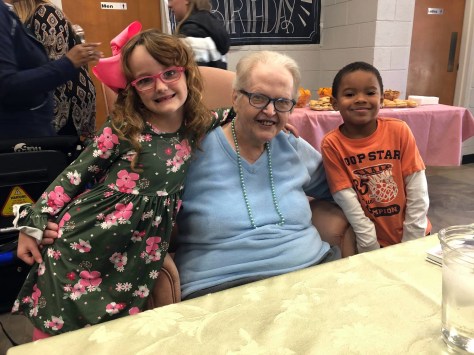
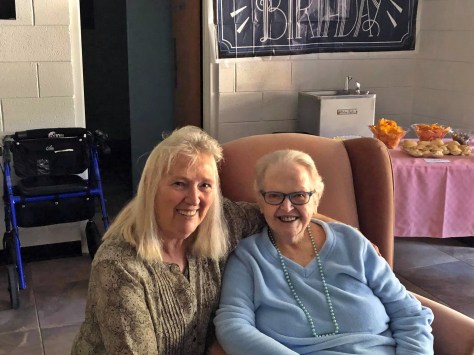
There is no greater juxtaposition in life than of age and youth unless it is the smile of each generation celebrating a year, a life, and fellowship. That one of the participants in the picture has a touch of frosting on his lips further proves the efficacy of a life of humor and good food.

I unabashedly stole the picture of Julia and Marie’s children from Marie, who I finally met after a long social media friendship. The picture best reflects the life I hope Julia has experienced and for the years awaiting her.


marie download julias party on nov 2 2019 (9)

.

.

20191102_114458
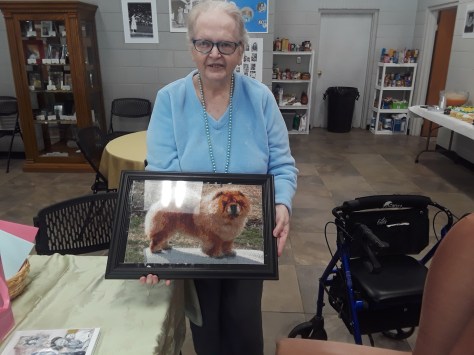
My mother-in-law with the diamond painting of her favorite dog, a Chow; my wife worked hours on the painting.

.

.

20191102_121204
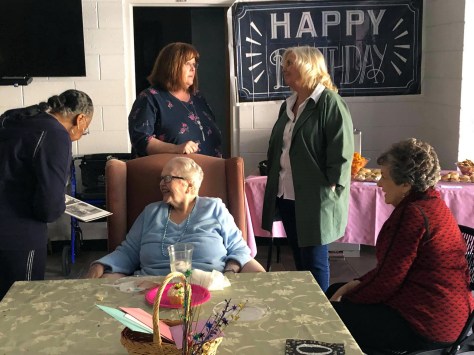
Julia happily looking her over surprises, as a slideshow of 300+ pictures of her life plays in the background.

.

.

marie download julias party on nov 2 2019 (2)
Another picture I stole from Marie, pictured on the left. This is her and Julia: cousins.

.

.

20191102_121226
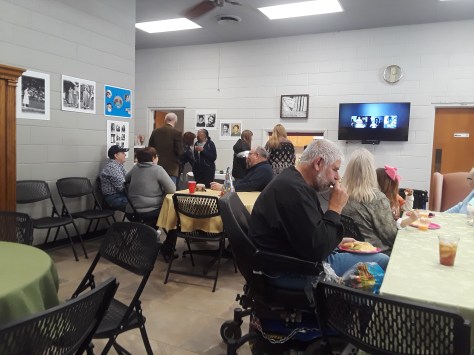
We had somewhere around 25-30 people show up. It’s difficult to plan parties anymore. Those who attended were all happy. Julia certainly was.

Given that the lights were out for half of the party, it was a success.

.

.

marie download julias party on nov 2 2019 (1)

A Personal Story


paul-gilmore-sKV_vD4dZnw-unsplash.jpg

This is a personal story. It explains a sensation that infrequently overcomes me. Maybe you’ll find something interesting in it.

I’m re-watching “Breaking Bad.” When the episode “ABQ” came around, it hit me like an anvil, exactly as it had during the first watch. Not only is the episode one of the best television episodes ever made, but it also resonates with me like a gong. It’s not just the contrasting complexity of circumstances in the show; it’s the familiarity I feel when I observe people around me as they incorrectly calculate risk and probability. On a long enough timeline or with sufficiently strange variables, darn near anything is likely to happen to any of us on a given day.

On Saturday, Sept. 28th, 1991, around 11:30 a.m., a plane crashed on the trailer I lived in. I was inside, watching a movie, and attempting to forget the fact that I had called in for the first time from work that Saturday. Like Walter White, I was deep inside my own head until the pilot crashed. I too looked up toward a crisp blue sky, seeing a jacket and parachute slowly descending toward the ground. It was surreal, unnatural, and moments passed before I saw the plane, followed by the pilot dead at my feet.

Every time I mention the story of pilot Joe Frasca crashing and dying, someone new comes forward with a crazy tidbit to demonstrate how intertwined we all are.

Because I watched “ABQ” again, I now find myself looking up like an OCD sufferer. It happens every time that something drags me back 29 years ago. The urge will pass, as it always does.

The concentric, albeit hidden, circles that surround us also bind us.

One lingering effect of the plane crash back in 1991 reminds me of the bewildering complexity of probabilities. It’s why I look at lotteries a little differently than most people.

We’re all on the timeline. Sooner or later, it’s going to happen.

Whatever ‘it’ is, it is coming.

Ready or not, the anvil awaits.

The Unknown Life

rwerwe


I was in a hurry, busily checking minor and mundane necessities off my mental checklist as I hurried through the building. The day was still unborn, and shadows blanketed everything that modern lighting couldn’t touch. To my right, a series of vertical windows rose above me. Ahead of me, someone sat in the shadows, in a small grouping of uncomfortable chairs, the type which serve their function but provide no real invitation to linger. His head was bowed, and his hands were clasped between his legs. His body language seemed to exude defeat. He seemed to be waiting for something unseen, an event to unfold, or for some greater force to expel him from his chair. The soft aura reflecting from the windows cast a curtain of gauze on the interior.

Despite my feet treading quietly on the institutional floor, his head rose, and he looked up. His eyes met mine. I noted a huge yellow, black, and discolored splotch around his right eye. His blond hair lay wildly around his features.

“Are you okay?” I asked, without even realizing I was about to speak.

“No,” he said, his voice cracking. Due to some triggered instinct, I realized that if he said a few more words, he’d likely either start shouting or sobbing.

I raised my left hand as if to stop him from speaking. “It’s okay.” I walked within two feet of where he sat.

“I think I need to leave before I react.” As he spoke, fifteen different scenarios filled the canvas of my mind. None of them were joyous explanations for his demeanor or appearance.

He fell silent in recognition of the fact that I knew what he meant without him saying the words of explanation. Because we’re human, it could only be one of four or five stories.

I removed my phone from my left front pocket. “Where do you need to be, other than away from here? By the way, my name is X.” I asked.

He told me. I typed the destination and found a ride that would be there in less than five minutes. I showed him the screen.

“I’m paying. Don’t stress it. I’ll go wait outside. When the driver shows, I’ll make sure he’s comfortable with it.” The young man nodded and didn’t speak.

As the sun burned the rim of the horizon, the driver pulled up. I handed him a tip and explained that someone needed a hand – and I was that hand. “No problem. He’ll get there.”

The young man slowly walked outside and opened the rear door of the waiting car. He did not look up, for which I’m glad. Seeing the side of his face again would undoubtedly cause me to commit the sin of asking questions.

“Thanks.”

Before he could say more, I said, “Pay it forward. You’ll remember this one day and have the chance to help someone.”

He shut the rear door and the car pulled away.

I don’t even know his name. But he knows mine. And that gives me hope.

An entire life, unknown and unknowable to me.

I fear we have things in common, though. I hope the young man’s journey is dotted with people interested enough to help him push forward.

P.S. I don’t deserve a pat on the back or words of encouragement. I needed this more than the young man did. Truth be told, my mind was filled anger that morning.