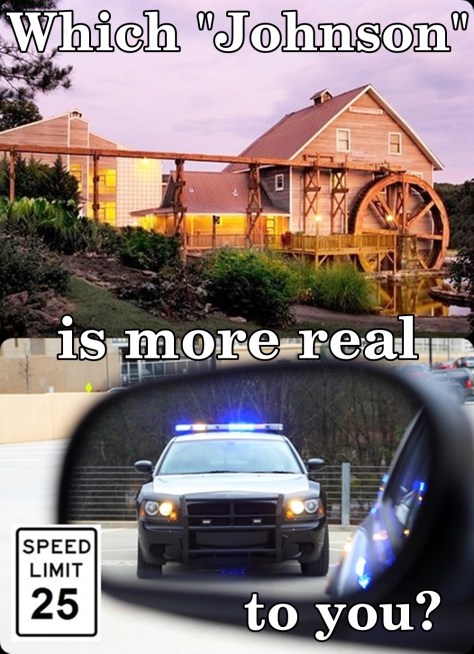
 (This post originally was for my personal social media. Last year, I got entangled in a routine traffic stop in weird circumstances. It cemented and amplified all my concerns with a particular small town’s police department and how it was still being operated. I interacted with the Chief of Police, which only served to muddy my views even further. This isn’t a “I don’t like tickets” rant; rather, it is an argument in favor of accountability and priorities.)
Recently, I made a comment on local news about a small town removing its entire police force. That comment garnered a staggering amount of appreciation. There is a lot of dislike for some of the small town local police – and it all can’t be attributed to a simple dislike of getting ticketed. People who reside in small towns often resent the reputations of their local police being tarnished, but some departments seem to suffer from tunnel vision and lose the ability to gauge when they might be damaging their reputations. The cliché of a small town police officer still lingers. When small towns employ great people, dedicated to helping one another and being fair and reasonable, it is truly a remarkable thing. When they forget that they exist to provide services and keep the peace, things begin to get complicated.
(Note: I haven’t been pulled over since last year’s fun and entertaining episode – but I have been hearing lots of stories from people.)
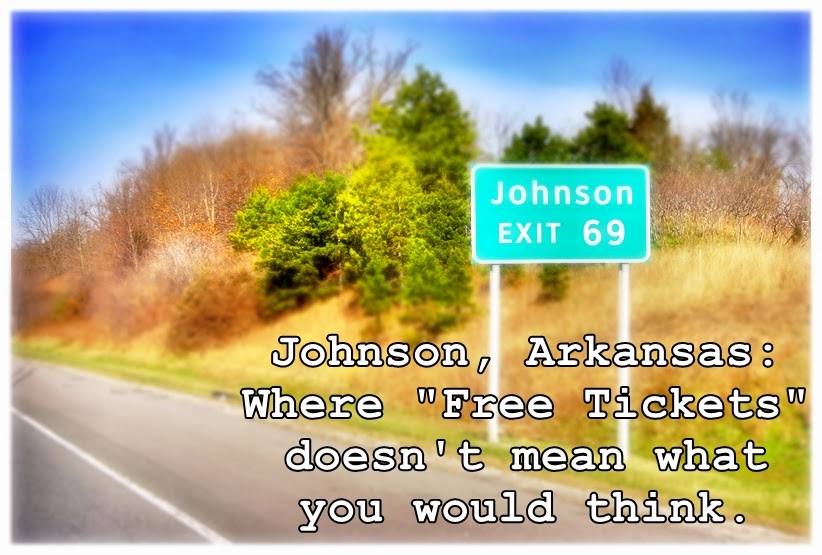
Johnson is a nice place, with much to be praised. The population increased 50% in the 2000s. Its location makes it almost ideal for living. But ask a cross-section of the metro area’s population to describe Johnson and I’m certain you will sense a dread similar to the first chapter of a Stephen King novel. It gets much of its traffic simply because it is in the way of one’s destination, not because people are clamoring to go to Johnson for business or pleasure.
After last year’s confusing interaction with Johnson police, I can’t tell you how many people told me their stories. Yes, some were irritated simply because they had to pay tickets. But many of those complaining had stories that went a little further into the reasons why some small towns should not have police departments. Several people I know avoid driving inside the limits of Johnson. Either these people are delusional or there is a problem. Some of these people are lawyers, nurses, doctors, and teachers. Not all of them are nuts like me. It’s easy to discount what I say, but some of these people who can’t and won’t let themselves drive in Johnson have credibility and stories to back up their reasons.
“It’s not me, Johnson, it’s you,” someone told me. A disproportionate number of tickets occur inside the Johnson limits. Many decided to break up with Johnson, agreeing to never drive there again unless some unimagined catastrophe obligates them. It’s an amicable divorce, especially since Johnson has very little valuable commercial activity to draw visitors.
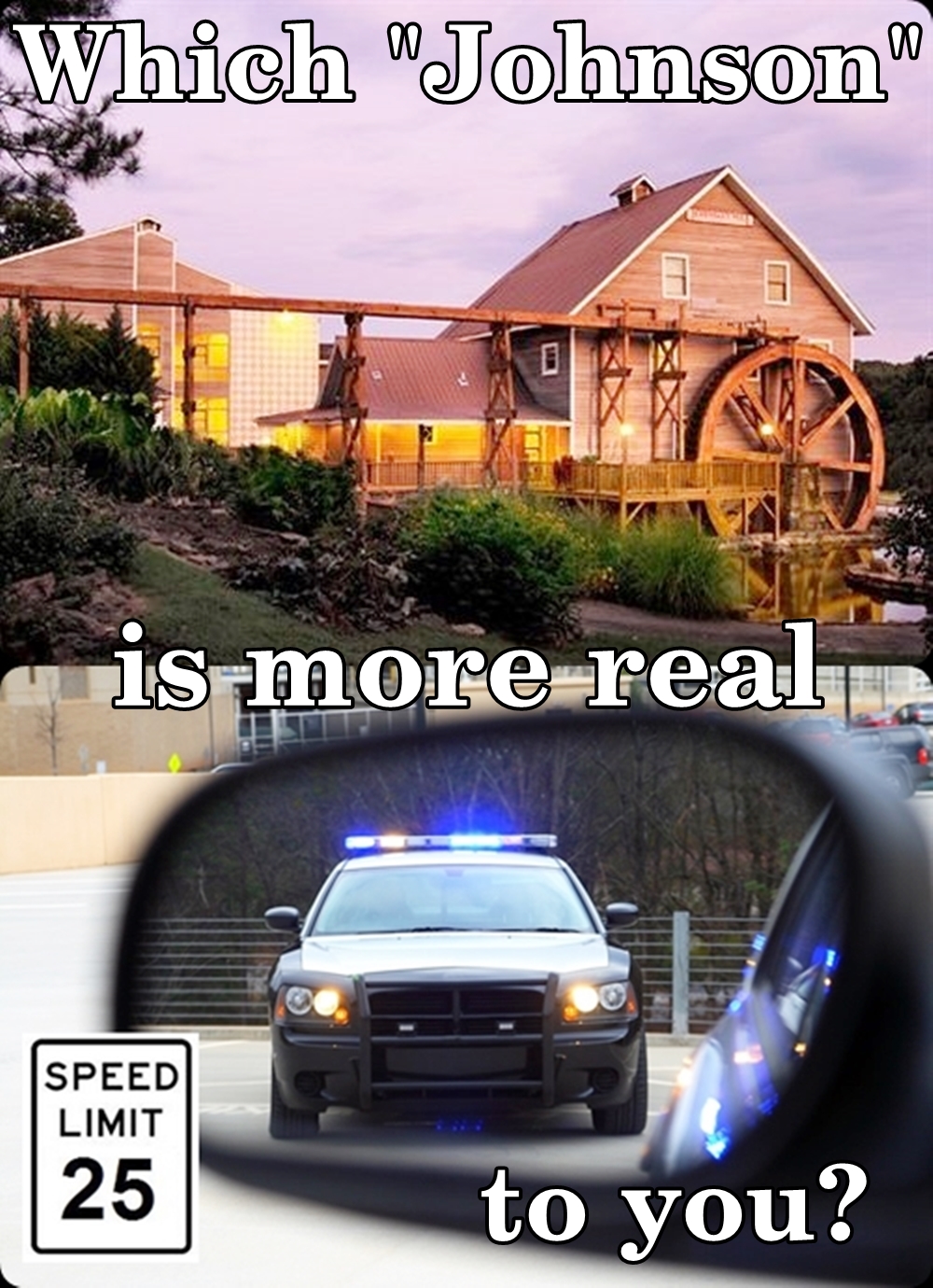
Here’s how I know I know there’s a problem: when I drive in Springdale, it never occurs to me that I will be pulled over for a crazy reason, even though I once was ticketed for something worth going to court over and talking about. With Johnson, however, even at 4 a.m. I have to talk myself into driving through it, even though it’s more convenient. I have to ride the brake, as some spots are only 25 mph. Sometimes, I feel like a cowboy in an old western, running the gauntlet of upraised tomahawks and clubs, as I suspiciously drive through Johnson: it’s not road conditions or traffic which worries me. No, I’m watching for the men in black, those who lurk behind the shrubbery in “cars” which cost more than my house. When I do drive in Johnson, I expect to see multiple officers in lavish, over-sized vehicles pouncing on people. I “feel” like I’m under constant watch there. It’s not rational and I dislike it, but it is always there when I’m driving in Johnson – but not anywhere else. When I see someone pulled over in a quiet cul-de-sac and two monstrous Johnson vehicles at the scene, lights flashing like a carnival ride, I don’t automatically wonder if they are finding contraband. I instead wonder how much hassle they are putting the driver through. I feel sorry for the driver, not protected by police. I don’t feel like they are making me safer on the roads. Most people feel the same disquiet as they drive by, knowing that it can and will be them, even when they aren’t doing anything unsafe.
My reaction is not fair to the officers, but it is an attitude that I’ve learned through interaction and observation. I met a few outstanding Johnson officers during a difficult time a few years ago – they were everything one could want in police officers. (The emails from the police chief didn’t dissipate any of my unease with the oversight and accountability of the police there, though.) I lived in Johnson for many years and was able to watch how many times a days people were pulled over, where it most often occurred and for what alleged reasons. It was fascinating, even as I watched the same tired story over and over.
For those who weakly and ignorantly argue “If you ain’t doing nothing wrong, you won’t get pulled over,” I wish that it were true. Using that logic, why not have every intersection armed with speed cameras, or your car equipped with speed-sending logging devices, or even cameras trained on the driver of every passenger vehicle in the county. Those efforts would also allow for ticketing – and if you aren’t doing anything wrong, you of course won’t mind total monitoring of every turn you make, each press of the gas pedal and so forth. Or put a traffic officer every two blocks – and use the fines generated from their presence to pay their salaries. I’m sure by now you see the stupidity of the “do no wrong” policy? Those who argue in favor of the “do no wrong” argument often use it to mask other, less savory, motivations for their view about enforcement.
If you hire 9 people to stand outside with hammers, it is fairly likely that most of them are going to start hammering something, even without any reason to do so. The same is true in small towns with too many officers doing traffic enforcement and an infinite supply of ticket books and time on their hands to fill them up. Yes, I am saying that the per capita ratio of officers doing traffic enforcement is too high in many small towns. I don’t see this as the case with any larger departments. I could be wrong, of course, but other departments don’t seem to have an unlimited supply of unmarked expensive black vehicles parked every block.
So, as Northwest Arkansas continues to grow, I ask for small departments such as Johnson to allow other jurisdictions to patrol their streets, saving money and hopefully dispelling the ongoing issues of reputation that plague you. Let economy of scale save us money by eliminating overhead and duplicated systems, courts, equipment, training, etc. I also ask that you not pour money into unmarked vehicles with the goal of traffic enforcement. Larger police departments have better oversight and resource allocation controls. Let Washington County or municipal police help your citizens.
(Or perhaps we could let other town’s officers patrol your streets and give you all the ticket revenue? That would be much better than the current system, with ‘oversight’ being in the hands of the very small towns. You keep the money – but let others decide what is worth bothering with. After all, your presence is allegedly all about safety and nothing to do with revenue. My proposal addresses both problems perfectly.)
Had my issue last year happened in Springdale or Fayetteville, it would have never escalated to a ticket, much less to an exercise in a lack of accountability or oversight, as was my case in Johnson. That’s the difference between a small town force thriving by ticketing and one focusing on protecting its citizens while using traffic enforcement as an additional safety measure instead of the primary one.
Springdale and Fayetteville are modern departments and perhaps it is their professionalism and dedication which, by comparison, steals the luster from Johnson. It isn’t my goal to malign the citizens of Johnson. But I continue to be surprised that people tolerate such an invasive presence under the guise of traffic safety.
P.S. Dear Johnson: I’m seeing an incredible amount of vehicles with extremely dark tint driving in your town. (I’m not talking about the police vehicles, which might as well be dipped in black paint, windows and all.) I’m talking about the army of citizens driving around with tint that is too dark. You could make a million dollars a week if you uniformly apply those incredibly important traffic laws. Oh, and it would be really awesome if all your vehicles were clearly marked in visible colors and insignias. You know, in case someone needs you for something important. Not to avoid a ticket, but because sometimes we want the police here to be like everywhere else in the world except in small towns. You’re welcome.



 P.S. Parenthetically Speaking