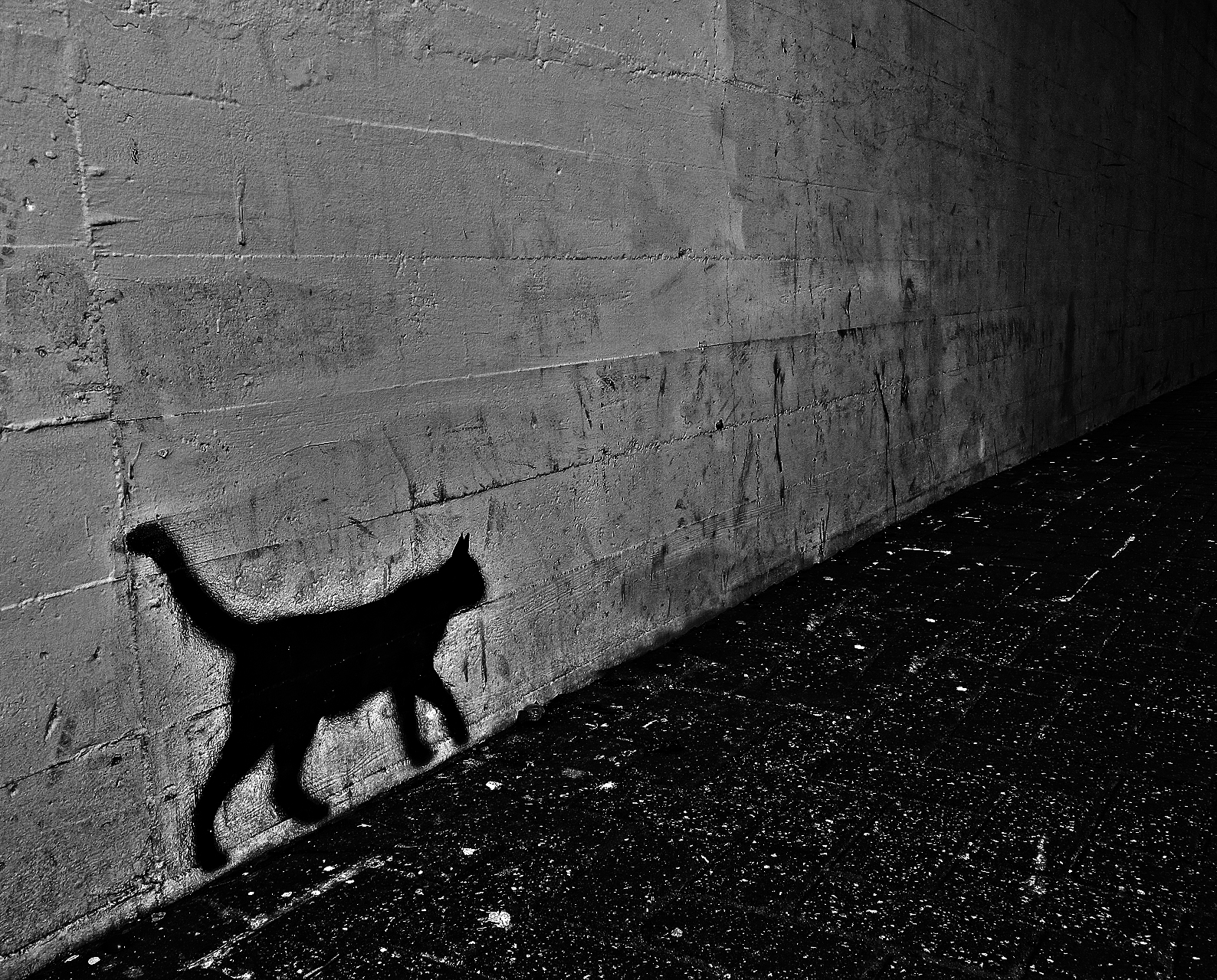
Alex sat in the nondescript sedan, huddled into the driver’s seat, hoping the shivers would soon subside, and cursing under his breath. Two hours standing against a wind-swept building in January made him question his choices. The man he was supposed to meet didn’t appear at 9 p.m. A friendly black cat kept him company, sitting at his feet as if it were waiting for someone as well. Alex waited another hour until the cold seeped into his joints. Knowing that texting their mutual acquaintance would be pointless, he carefully walked back to his borrowed car. As the car warmed, some of Alex’s ability to reason returned. He knew he would need to go back and wait, even if the person he was to meet took all night to make an appearance. So, he sat and felt the warmth of the vents surround him. Twenty years of this job made him cynical. And also practical. Five more minutes.
As he shut off the ignition and opened the driver’s door of his car, a gunshot echoed through the alleys of the nearby buildings. Unlike what happens in tv shows, Alex’s pulse quickened involuntarily, but he did not react. And he didn’t rush to hurry. Only fools or rookies barge into gunshots. Also, he knew in his gut that the man he was supposed to meet undoubtedly was the one receiving the bullet. Men like him invited such calamity. Alex calculated the odds of the police arriving in less than five minutes. He shut the car door and walked back toward the place he’d waited previously. As he neared the spot, Alex saw a body on the ground. A light above one of the stores’ rear doors provided enough illumination to see the body slumped against the bricks and cement. The friendly black cat sat a few feet away, watching. It didn’t surprise Alex that the gunshot hadn’t scared the cat. Like Alex, it had undoubtedly seen a lot.
Alex paused and listened for approaching cars, voices, or footsteps. Silence. He moved along the edge of the wall, face tilted down in case of clandestine cameras. He pushed against the slouched body with the tip of his right shoe. Dead. Alex crouched to his knees and carefully put on a nylon glove, which resisted stretching in the cold. Using his left hand, he pulled the torso of the body toward him and over.
For a few seconds, Alex’s mind went blank. Nothing in his twenty years of this crazy life prepared him for what he saw. He always considered himself prepared for anything. Alex remained crouched, staring at the face on the ground. It was his own face, detailed down to the bullet scar across the bridge of his nose. Alex reached down and inside the corpse’s coat. He removed the wallet and flipped it open. He saw himself in the driver’s license photo. Everything in the wallet looked identical to the same wallet he had inside his coat pocket.
Alex didn’t notice the approaching figure, stealthily moving behind him. He didn’t see the arc of the baton as it descended on the back of his head, knocking him unconscious. The cold cement welcomed him as he fell.
The black cat, having seen enough, meandered away into the darkness.
From somewhere across the plaza in the revitalized small-town downtown, the sounds of a soft piano wafted into the air. Alex shifted uncomfortably, without realizing the piano brought unwelcome anxiety as it reached him. He nervously took a large sip of his bitter coffee, burning his throat a little. He relished the distraction of the pain. Across from him at the nearest table, a couple sat quietly in the fading afternoon light. Neither had spoken for the last twenty minutes. He knew they were both wrestling with ending their marriage, though for different reasons.
Alex felt their pain. It gave him no comfort to know that he would end their stagnant conversation for them: the husband wouldn’t leave this place alive. Seventy thousand dollars in Alex’s bank account guaranteed that Steve wouldn’t walk away. Though he didn’t know the details, he studied Steve’s life just enough to understand that he had crossed the line with a business partner. His wife Kathy was blameless.
Alex and the couple were the last three people in the plaza. The approaching chill encouraged the others to leave. The restaurant attendant tasked with keeping the shared area clean moved to clear the remainder of the tables. Alex indicated that he could take his coffee cup and saucer, as well as the $10 bill for the tip.
Just as Alex prepared to stand up and do what he came for, Steve looked across the small table and said, “I love you, Kathy. I’m not having an affair. My partner Mark is embezzling. He’s ruined us.” Kathy unexpectedly reached across the table and grabbed her husband’s hand. “I’m so sorry! I love you.”
Alex rarely saw anything to surprise him. They still loved each other.
Alex stood up, stretched slightly, and walked over to the couple’s table. “Have a good evening, both of you. And great lives,” Alex said to them. They look at either confusedly, and then both said, “You too!” reflexively.
Alex walked across the plaza to find his car. His plans had changed. He would kill Mark, the partner.
He hoped Kathy and Steve would consider it a belated wedding present from an interested bystander.
It had been a typical Friday night until his cellphone rang. All calls routed through the office system caused his phone to ring with the sound of a baby crying. Sheriff Taylor learned through experience that the sound would wake him from the dead. If it failed to rouse him, it certainly woke everyone around him.
Sheriff John Taylor sat on his plush living room couch, with plans to stay there until the next morning. His wife Jamie often told people she’d find the Sheriff loudly snoring, with the television still playing an endless list of home improvement shows. It was true. The Sheriff loved all of them. He didn’t need the woods, bar, or a fishing pole, which suited Jamie just fine. Before coming back home to take the Sheriff’s job, John caused her many nights of worry.
Because his back and hip hurt a lot, sitting up to sleep sometimes was his only recourse. He knew if his cell was ringing that one of his deputies decided to ignore his do-not-disturb order for a good reason. Even Burt Reynolds, his bloodhound mutt, raised his head in protest of the cellphone ring. Dogs weren’t fans of babies crying, as it turns out. “Okay!” the Sheriff grumbled as he reached for his phone on the table.
“Go,” John said to the voice on the line. He nodded his head a few times as he listened. “Will be there in twenty.” Sheriff Taylor preferred concise work-related communications. Except for Deputy Barnes, all of his deputies diligently adhered to his taciturn way of speaking. Barnes graduated from college with a Master’s in English and Latin.
When the Sheriff pulled into the long driveway, he saw that two of his six deputies were parked on each side of the drive while leaving ample room for other vehicles. As he’d trained them, neither had their lights flashing. Unless someone was in danger, lights were a ridiculous distraction. Most days, the Sheriff didn’t even require that his deputies wear uniforms. They were fiercely loyal.
He walked up to the porch as Deputy Hensley told him the little bit he knew. “Call thirty minutes ago, anonymous. Gunshot. I arrived, front door open. Jimmy next to the kitchen table with a gunshot wound to the head. Dead.” The Sheriff nodded and went inside as he opened the screen door to the house. It banged shut behind him.
His other deputy took pictures as he walked around carefully inside the house. Jimmy was on the dirty linoleum floor. Blood pooled around his head and shoulders. The Sheriff noted the small hole in Jimmy’s left temple. He couldn’t see the exit wound. A dark spray pattern was visible across the fridge. Every inch of counter space contained dirty dishes and empty beer cans and bottles.
Deputy Barnes walked into the small kitchen behind the Sheriff. “Suicide?” He asked. “Or did Jimmy succumb to the unnaturally unkempt condition of his own residence?”
Ignoring Deputy Barne’s flowery language, the Sheriff said, “Too soon to say. But if it is a suicide, someone will have to explain why there are two other water rings on the ends of the table.”
Deputy Barnes looked at the table, surprised that he had missed that detail. He picked up the half-empty beer bottle from Jimmy’s presumed place at the table. A water ring formed there from the beer bottle’s condensation. “I surmise the bottles aren’t in the trash. Someone outwitted themselves, didn’t they?” The Sheriff nodded affirmatively.
It was going to be a long night.
Someone would have to find Jimmy’s dad, Tiny. They’d start with the dives and bar parking lots in Evansville. And the Sheriff would find a way to sober him up enough to tell him someone probably murdered his son. Jimmy was Tiny’s youngest son. Both other boys had died in the last eighteen months. Counting Jimmy, this was the Sheriff’s first murder case in his six years on the job. He was beginning to get a tickle in his brain, one that told him that Jimmy’s brothers might have been murdered too. The Sheriff never ignored those tickles in the back of his head. They saved him several times at his last job. The last time he ignored one, he got six bullets to show for his carelessness. Not to mention a furious wife. The Sheriff knew that the wife had been a more significant risk to his health than six bullets.
As the Sheriff turned to Deputy Barnes, the deputy said, “Protocols commenced, boss.”
~Two~
The night did indeed drag on. By the time Sheriff Taylor drove back to his own house, the sun was over the horizon, blinding him. His right hip flared with a pain that he couldn’t ignore. A dark sedan sat next to his mailbox, engine idling. The tint was so dark that he couldn’t see the occupant. The car screamed, “Federal Government.”
Sheriff Taylor exited his vehicle and pocketed his keys. Instead of going inside, he turned and walked back to the mailbox. Without seeing the occupant, he made the universal sign to “roll down the window.” The dark window slithered down, revealing a shockingly young face. The agent inside smiled, revealing brilliantly white teeth, the best that money could buy. He held up his identification card, one emblazoned with “Special Agent” on the front. “Agent Shatner. Get in.” He tilted his head quickly to the right, indicating that the Sheriff should get in the passenger side.
Instead of arguing and asking needless questions, the Sheriff walked around the front of the car. As he did, he looked up to see his wife Jamie watching from the porch. He motioned that he was going to be a while longer. Jamie waved and went back inside. Years of being married to a mercurial cop taught her to conserve her commentary for later.
The Sheriff opened the door and climbed inside, shutting the door behind him.
Agent Shatner put the car in gear and accelerated away. “It’s better for you to see this first, Sheriff Taylor.” The agent was surprised to see that the Sheriff only nodded and remained quietly watchful from the passenger seat. They drove in silence for ten minutes. Agent Shatner turned off Highway 47. As they neared Hunnington Creek, Sheriff Taylor noted that a red pickup truck was parked near the bridge on the creek’s Evansville side. Beyond was Hunnington County, outside the Sheriff’s jurisdiction.
Agent Shatner pulled over, turned off the ignition, and climbed out. The Sheriff followed suit. A man dressed in blue jeans and a Georgia Tech t-shirt got out of the red truck as they did. “No issues, Agent,” he said and nodded to the creek. Agent Shatner wordlessly walked to the bridge.
“That’s going to be a problem, Sheriff,” he said, as he pointed to the opposite creek bank.
When the Sheriff peered over, he saw two dead bodies, men at least forty years old. He recognized neither of them.
Because Sheriff Taylor didn’t believe in coincidences, he asked, “These two murdered Jimmy last night?”
Thursday afternoon, Kerry sat in the convenience store parking lot, watching the neon letters as they faltered in their luminosity. He stared at the four tickets in his right hand, each emblazoned with the Powerball logo. He bought the tickets Monday afternoon after work. He handed the clerk a $20 bill. When she attempted to give him the $8 in change, he declined. “That’s for you.” She made eye contact and smiled. “Well, thank you! That’s generous!” Kerry found himself avoiding places that didn’t allow their employees to be tipped.
2020 reaffirmed his promise to tip the clerks as much as he could. Typically, any winnings from his winning tickets served as tips too. Admittedly, there were days when his tips were a bit excessive. Everyone walked away with a smile, though, Kerry first among them. Though Kerry wasn’t a believer in karma or being rewarded for good acts, the idea did cross his mind each time he bought lottery tickets. If such behavior earned rewards, Kerry paid his dues in the year of Covid. Probably hundreds of dollars. Indeed, many clerks said “Thanks!” or “Have a good afternoon!” to him with enthusiasm after buying tickets. Even if he failed to win, his choices left people with a smile.
A few times, Kerry waited weeks to check his tickets. The idea of unknowingly walking around for days without knowing he was rich was compelling. On a few occasions, he was one number away from a big win. In those instances, he ensured that the money went to people who needed it. He shocked a few people. His mental notebook slowly filled with moments of surprise. That’s what he thought the lottery would do for him; fill him with the possibility of a creative life instead of the constancy of necessity. Kerry wasn’t one to dwell on material things.
Unlike his contemporaries, Kerry told people that if he were to win one of the outrageous prizes, he would reward dozens of people. His win would result in a gaggle of millionaires. And although he wasn’t much on the idea of being rich, he was a huge fan of options. Few people outside his close circle thought he might be telling the truth. Everyone claims they will reward those closest to them. Kerry planned to reward both friend and foe. Not in equal measure, but enough to create happiness and to clear his ledgers.
The year of Covid drew to a close without a significant win. Kerry didn’t falter in his enthusiasm, though. For him, it was about continuing the tradition of rewarding people unexpectedly. As long as he stepped up to the plate, his swing might reward him. And if it did, he knew that the world around him would change for a lot of people. He didn’t plan on giving it away to preach an example. He wanted to give it away to make happiness.
At work on Thursday, Kerry avoided the water cooler chatter about who might have won the Powerball the night before. Kerry’s four tickets were folded in his billfold with several previous tickets that were still unchecked. He stopped at the store on the corner with the friendliest clerks. As he turned off the engine, the hair stood up on the back of his neck. He went inside and bought tickets for the Friday and Saturday night drawings. Instinctively, he opted to avoid the self-service ticket checker to the right of the cashier station.
He returned to his car and searched for the winning numbers for last night’s drawing. Fundamentally, he already knew what he’d find. On the third ticket, he saw it: 15 21 40 64 66 03. He won $790 million, half of which he would share with another winner. On a certain level, it failed to surprise him. He simply knew. His smile widened, one years in the making.
Kerry exited the car once again and went inside. He handed the clerk the $200 cash he had hidden in his billfold. “I’ll be back soon. Write down the name of every clerk who works here. Thanks!” The clerk stood speechless as Kerry left without waiting for a reply.
As Kerry started the car to drive away, he was trying to figure out how many people he could reward with $220 million.
Karma was in his heart.
He couldn’t wait for the mayhem of infectious joy to spread around him.
But first, he would live a few quiet days with the secret swirling inside him.
I never thought of her as pretty. Or interesting. She snarled even when saying, “Hi.” In the same way some people exude enthusiasm, for her, it was a startling disposition and a propensity to snark. Chatting her up was like trying to interrogate an irritated detective on his way to the dentist. If first impressions always proved right, I imagine that I crossed Lisa off my list within five minutes. We spent many weeks pointedly ignoring one another, much in the same way that two hyenas avoid the water hole when the other approaches.
Three months later, I realized I was wrong.
I sat at my desk, several cubicles away from my other coworkers. I heard the most vibrant and laugh I’d ever heard. It sounded like a warbling bird being driven over a series of speed bumps at a high rate of speed. Without realizing it, I started laughing. As the laughter from the other cubicle continued, I laughed harder and louder. Seconds later, I was crying from the effort and turned away from the cubicle entrance. As my laughter subsided, I swiveled my chair back to face my desk.
To my horror, Lisa stood at the entrance to my cubicle, hands on hips, snarl glued to her face. Her hair fell over her blue eyes. I realized that it had been Lisa’s laugh chirping all over the office.
“Something to share, Lenny?” She tapped her foot in impatience.
“Uh… listen. I’m sorry. Your laugh is awesome, Lisa.” I don’t know why I blurted out the truth in such simple terms.
“Haha, very funny, Lenny! Laughing with me, right? Not at me. Jackass.” Lisa started to march off, probably to recite my list of defects to our other coworkers.
“Wait, Lisa. I’m sorry. Your laugh is infectious. I mean that. I never heard you laugh before.” I stopped talking.
“I’ve been told that my laugh is life-threatening,” Lisa said and marched away. The snarl never left her face.
Her comment lingered in my head. Something inside me tingled.
*
A couple of hours later, my desk phone rang. Expecting a call from accounting, I picked it up immediately.
“Lenny. This is Lisa. Here’s what’s going to happen. You’re going to take me out to eat at that Italian place, the new one. Saturday, at 6.” I started to answer her, but the phone went dead.
Confused, I hung up the phone. From a distance, I heard Lisa’s high-pitched warbling laugh. She probably had someone else listen to our brief conversation on her end. Involuntarily, I smiled as her laughter echoed across the row of cubicles. She won that round.
On the way out that day, I stopped at Lisa’s cubicle, something I’d never done. She looked up, her hair still falling across her blue eyes. The snarl was already up and locked.
“I’ll pick you up at 6? On Saturday?” As I asked, the snarl fell away from Lisa’s face. Her eyes lit up. For the first time, she smiled at me.
“I’d love that, Lenny. Bring someone good-looking with you for me to look at, will you?” And she laughed. The cubicle filled with her laughter. I laughed too. “Yeah, as long as you bring a hat the reaches your chin.” We laughed harder.
Lisa’s closest work friend Antonia looked over the cubicle, probably wondering if she were in an episode of the Twilight Zone. She looked from Lisa’s face to mine, then back again as she shook her head.
As Antonia ducked away from sight, Lisa looked at me. “For real, though. 6.” She took a slip of paper and noted an address on it. Presumably, hers, although it would be impossible to know.
*
A year later, we were married. During the vows, Lisa broke out in laughter. As the pastor’s face recoiled in surprise at the raucous laugh from Lisa, I joined her.
Of all things blowing through the wide alley as he walked hurriedly past, he found the pages of someone’s hand-written manuscript to be the most beguiling. He could only imagine who might have written the pages, each filled with tiny, perfect cursive lettering. What might be contained in the scrawls also remained a mystery. He enjoyed imagining such things. All the billions of people loose in the world, each trapped in the prism of their mind. He’d witnessed innumerable people with something to say rendered silent by the sheer force of fear; fear of sharing, fear of ridicule, fear of exposing one’s ignorance. For all the reluctance, he also knew that everyone shares the fundamental fear of expression. Silence is the most comfortable choice. As he neared the mouth of the alley and the dirty street beyond it, more pages blew past. An entire universe swirled across the dirty pavement. He didn’t notice the dirt—just the possibility. As the wind picked up, he walked faster. He had places to go.
Rhonda and Chris swayed together in the middle of the softly-lit bedroom, his hands across her hips. Neither danced well, but their movements were effortless and graceful. Chris found himself unable to look away from Rhonda’s face.
A few feet away, Rhonda’s phonograph whirled as it played “Like a Bandaid On a Bullethole.” She bought the vinyl album a couple of days before, hoping it would unlock more secret rooms in her heart. For the longest time, she kept the rooms locked; in time, she forgot they existed. When she looked at Chris, she found herself mentally flinging all the doors in her heart open. For the first time, she wanted to throw them open.
Over the last months, Rhonda took the time to make the room her own again. All the past relics slowly diminished and disappeared until one morning, she awoke to realize that the space was now entirely hers. Her grandfather’s table, the lamp she made, now entwined with fairy lights, and her wall of hats, each of these things shouted her singular name.
When Chris asked her if she wanted to go on a date, she said, “No. Come over. We’ll cook together, drink some coffee, have a glass of wine, and laugh.” Chris laughed and said he’d like nothing better. And the night had unfolded as effortlessly as one between two close friends. They made pasta, each contributing to the messy process and both doing the dishes afterward. They discovered that they already had a shorthand for movement.
Rhonda took the time to explain her aloofness and reluctance. To her surprise, Chris already knew. “Hurt creates space,” he told her. They looked at each other, smiling, knowing they just had an entire conversation in one sentence.
They sat at the kitchen table, the most unromantic of places, and drank a cup of coffee. Both felt as if they’d done so a thousand times before. Their eyes danced and queried each other as they sipped. Rhonda got up from the table and reached over for his cup, placing both cups in the sink. She reached out with her right hand for Chris to give her his hand. She led him through the living room into her bedroom. She stepped away and placed the needle on the vinyl album. Music flooded the room.
Neither spoke as Chris stepped toward her, already swaying.
As the song ended and the scratchy interim played, “Me On Whiskey” began to play. Rhonda nodded at Chris, who bent his head to kiss her for the first time.
In this new room, surrounded by a new life, and more importantly, new hope. And they danced, in all the ways that two people discovering each other do.
The letter he wrote to her sat on the upper level of his desk like an accusation.
Blake shook his head in irritation. Who was he kidding? He wrote the letter ten years ago on January 1st. The New Year had unexpectedly filled his heart with optimism. He guessed he had picked up the envelope at least twice a day, almost every day, in the interim. For the first month, he opened the envelope carefully and read the letter out loud. Afterward, there was no longer any need. The words were etched in his heart. The outside of the envelope had no address. It merely said, “Karen” in his best block writing.
Everyone laments the things not done, the words not spoken, and the embraces not ventured. Few people have to experience the agony of knowing they’ve taken people and circumstances for granted. That agony could find no worse residence than in his heart. Though the calendar marked the passing of each day, Karen lingered on the fringes of his mind. As a writer, her memory plagued him.
For ten years, he brought a fresh cup of bitter coffee into his private office on the far side of the large house. He sat down in his swivel chair each morning to touch the envelope. Often, he found himself tracing the name Karen with an index finger. His Siamese cat heard him whisper the name Karen so frequently that he sometimes mistook it for a request for him to stretch and jump up into Blake’s lap. Blake was oblivious to the fact that he often said her name like a prayer.
Afterward, he would spend anywhere from an hour to six hours writing the pages his publisher requested. When he finished, he stood up, touched the envelope lightly, and left the room. His next-door neighbor Cassandra, the eccentric lady who cleaned for him, knew to leave the envelope untouched. She asked him about the letter once. Blake shook his head and said, “I can’t talk about her, Cassandra. I just can’t.” She must have noted the melancholy in his voice because she never ventured another inquiry. Cassandra was wealthy in her own right. Blake had no idea why she offered to clean his house twice a week.
Today, Blake sat in his chair, happy that he had avoided the pull of invitations to celebrate the New Year. He picked up the letter, and though he hadn’t done so in a long time, he gave voice to the words contained therein:
… ~Karen~ I know we were just children when we fell in love. I am so sorry that I didn’t recognize the light you brought to my life. I am writing this letter to you on New Year’s Day because I’m tired of living a life where I forgot to tell you that I still love you. This poor heart has no right to ask that you find a way to ask yourself if you would like a life of appreciation and wonder. I don’t know what your life holds. I hope you are happy and loved. If not, I will wait as long as you need, even if the day stretches into a lifetime. I’ll take the possibility as a gift more generous than the certainty of mediocre love. Love, Blake. …
The urge to see the words gripped him. He couldn’t remember the last time he opened the wrinkled envelope. As he pulled the page out, he knew something was wrong. The folded page inside the envelope was a blank sheet of linen paper taken from his box by the dusty typewriter. For a full minute, he sat dumbfounded and stared blankly. “Cassandra!” he thought.
Blake forgot his cup of coffee as he left the private office. He found a jacket in the closet in the expansive mudroom and exited the side door near the large garage. The front door was irrelevant to him. It didn’t occur to him to call Cassandra, not even as he walked across the broad lawn between the houses and knocked on his neighbor’s solid oak door. He then rang the doorbell to the right. Inside, the chime echoed in the tall vestibule. Cassandra’s house was both beautiful and empty. She spent most of her waking hours reading. Blake had no idea that he was her favorite author.
A few moments later, Cassandra opened the door. “Come in!” she said as if Blake made it a habit to knock on her door at 6 a.m. on each New Year’s Day.
Ignoring her politeness, he said, “Where is it?” His voice was surprisingly aggressive.
Instead of asking what he meant, Cassandra simply replied, “I mailed it three years ago, Blake. To Karen.” She smiled.
“You mailed it? How do you know who Karen is? What gives you the right?” Blake’s voice went up another octave.
“I read the letter five years ago, Blake. I was about to stop cleaning your house and figured, ‘What the hell.’ I mailed it three years ago and have been waiting to see what happens.” Cassandra laughed as she said it. “I shouldn’t have done it, I know. But imagine if she had read it and came to you? My, wouldn’t that be a story?”
For an instant, Blake’s mind went blank at the idea of Karen reading the letter he wrote all those years ago. He fought the urge to lash out at Cassandra as he shouted, “Go to hell!” He walked out her front door, leaving it open to the cold January wind.
Blake returned to his kitchen to make another cup of coffee. He absently petted the cat as he stood next to the island, wondering what had possessed Cassandra to invade his privacy. Deciding he couldn’t find an answer, he went back to his office to write.
He sat at his desk for five hours, ignoring the grandfather clock’s chimes as it announced each hour. Both cups of cold coffee sat to his right, ignored, and forgotten. Even the cat gave up hours ago. It was now curled against the heat vent across the room.
As the clock chimed noon, Blake looked up at the envelope holding the blank sheet of paper. From the other side of the house, he heard the doorbell for the side entrance ring. Only Cassandra used that door. Good. He expected some sort of apology. That is what happens when you hire a rich person to be your housekeeper.
Blake took his time walking down the long hallway and through the kitchen. Without bothering to put on his houseshoes, he flung open the door to give Cassandra another piece of his mind. Instead, Cassandra was walking away from him hurriedly, her head braced against the light wind. “Cassandra!” he shouted. She turned and bowed slightly. She then extended her right arm as if beckoning someone.
Cassandra waved goodbye as she continued back to her own house. She laughed loudly.
Blake found himself unable to breathe. Her hair was the same, with more grey. Her face was lit with a smile. She wore a pair of blue glasses. Karen. Walking toward him.
He stood immobile as she walked to him. She wrapped her arms around him and put her head against his chest.
As he looked down slightly, Karen tilted her head to meet his. “Yes,” she said as she kissed him lightly on the lips.
After a moment that defies measure, Karen took Blake’s right hand and led him inside and out of the cold. Forever.
Mary sat at her writing desk, one particularly suited to her eclectic style. Every exposed inch was initially covered with ornate, floral wallpaper based on black and gold, followed by hundreds of notes and reminders. The few tears she managed to cry earlier were long dried, salty patches that slightly itched. She hadn’t bothered to wipe them away. By a certain age, you learn that another set will inevitably follow. There were times she expected to see a series of wrinkles on her face forming a dry riverbed.
For fifteen years, she passed countless hours at her desk, her fingers flying furiously and fluently across the remote keyboard in her lap. Though her life was mundane, an unseen muse inside her continuously provided her with an onslaught of romance and flowery language. Those words fueled the fantasy lives of people she’d never meet. They also came from a place she couldn’t quite define. Her words paid the bills, though the skill was accidental. Her muse was her humanity, and she’d never found her own well to be empty.
Until four interminable days ago.
*
The officious hospital administrator relented and allowed her to go to the hospital’s fifth floor to accompany her best friend, Ashley. Her husband of twenty years was dying, dwindling more each day. Ashley managed to keep her wits for a couple of weeks. The idea of her husband dying made her immobile. “I’ll go with you,” Mary blurted out to Ashley. Ashley grabbed her and hugged her until her arms grew tired.
As they entered the room, Mary’s eyes scrutinized the alien medical monitors, tubes, and devices crowded around the bed. Ashley’s husband Mark seemed like a doll in the sheets. Mary found herself being led to the bed by Ashley, who gripped her right hand fiercely. As Mary neared the bed, she was surprised to note that it smelled like plastic in the sun or a recently-opened shower curtain.
Mark was immobile, having spoken his last known word four days ago. As Ashley leaned over him, he said, “Phoenix.” The nurse standing by the head of the bed on the opposite side raised an eyebrow, asking without really asking. Ashley smiled at her, though tears were clouding her face. “It’s where we promised to go to spend our last few years together. We’ve never been.” The nurse nodded. There was no right or wrong response, but her mouth wouldn’t open. Even the most seasoned and hardened heart sometimes couldn’t pierce the silence, lest they risk losing control of the mass of emotion lying behind the wall they created to protect themselves.
Mary stood next to Ashley for several minutes, her arm across the small of her demure back. Ashley leaned in precariously to touch the exposed cheek of Mark’s face. Her glasses slid from her face and fell to the bed. As she bent, a few minor beeps began to ping and buzz. Anyone there could discern a crescendo building in their warning. In moments, a nurse strode into the room.
Mary watched the nurse’s face as she inspected the monitors. The nurse looked across the bed. Ashley’s eyes were riveted on her husband’s face. As the nurse’s eyes locked with Mary’s, Mary saw the fleeting sorrow that passed across her face.
The nurse pressed a small disk at her neck and said, “It’s time. Room 5234.” She stood by the bed, waiting. Moments later, another woman entered the room and stood next to the nurse. Mary whispered, “Ashley, they need to talk to you.”
Ashley raised her head.
“As we discussed, Ashley. Do you want to do it, or do you want one of us to?” The doctor waited patiently.
Mary stood frozen, realizing that she was there to bear witness to Mark’s passing for Ashley.
“You,” Ashley said, surprisingly confident.
The nurse and doctor busily began to press buttons, move sliders, and close off fluid and oxygen flow.
It didn’t happen as it does on television. No monitor marked the decline of functions taking place. The doctor and nurse stood by the bed for another few moments. Finally, the nurse said, “We’ll be outside when you’re ready.”
It was Mary who sobbed when she heard the words, not Ashley.
Ashley reached and found Mark’s right hand and gripped it. She kissed her hand and then pressed it to his face, quickly and lightly. “Okay,” she whispered.
Ashley stood up and hugged Mary. She stepped away and walked toward the door.
“Where are you going, Ashley?” Mary asked, her voice hollow and lifeless.
“Phoenix, for both of us.” She smiled as she said it. *
Four days later, Mary still sat at her silent desk, the words not flowing, the imagined love-filled lives she effortlessly created all stopped.
In a flash, the image of Ashley’s face as she left the room flooded her mind. She was smiling. In all that pain, she knew she had to find a way forward or crawl into the bed with Mark and die with him.
Mary turned slightly in her chair, placed her nimble fingers on the keyboard, and began to write a new love story, one grounded in an appreciation for a love monumental enough to fuel optimism in life. Her inability to create a life with words was already behind her and forgotten. .
Fletch sat restlessly in a booth near the back of Joe’s diner, a place with food that was close to inedible. He loved the owner, though, a small, wiry woman who seldom hesitated to remind everyone that she was from Alaska. She hurled insults like candy. Today, he was glad to see she wasn’t cooking. She ranked dead last in cooking ability compared to anyone.
“What will you have? Something on the light side? Your pudge is a bit pronounced, Fletch.” In case her words weren’t barbed enough, she pulled at her imaginary love handle on one side.
“I’m meeting someone, so just coffee for now, Ellie. Thanks.” He ignored her insult. He did smile and shake his head, though.
“You’re meeting someone? Didn’t the last girl show you up? I’m going to start charging you booth rental.” She walked away before he could reply. She was a terrible cook but amazingly fast and efficient. He assumed she went to bed at night fully clothed.
Fletch indeed had lousy luck with women. The last two women no-showed, and the last one didn’t call, email, or even pretend to explain. “Ghosted” was the phrase his co-worker offered. At least a ghost has the courtesy to haunt you, he thought. Over the last two years, Fletch lost most of his enthusiasm. At forty-five, love was a picture of a menu inside a window he couldn’t even reach. He endured several dates, horrified looks of surprise when he asked someone out, and empty inboxes and swipes on the two dating websites he foolishly attempted to use. He was outclassed at every turn. He joked that he lost his touch being married for twenty years. The truth was that he never had the touch. His wife asked him out, told him they were getting married, and then failed to tell him she was in love with her dentist. He found out the hard way by finding them on the picnic table in the back yard on July 4th. He hated that picnic table already. Seeing his wife on it in that position convinced him to make firewood out of it.
Ellie returned in five minutes. She put a cup of coffee on the table in front of him. Then, she put a plate of hashbrowns and a hamburger patty with grilled onions next to it. Before he could ask, she said, “Who are you kidding? She ain’t coming. And you’re like clockwork with the patty and onions. And I didn’t cook it!” She placed a finger against her lips to tell him to be quiet. As before, she pivoted, push the empty food tray next to her hip, and marched off. “Hopefully to Alaska,” Fletch whispered.
On a whim, Fletch decided he wanted to try Sriracha on his burger patty, so he got out of the booth and made his way around the “L” of the diner and went to the waitress alcove where most of the good extras were stored. As he passed the register, he heard the doorbell’s chime and the other waitress murmuring with the new customer.
Going back to his booth, he held up the Sriracha bottle to show Ellie, who rolled her eyes at him. “You better have insurance if you’re going to eat that, old man!”
As he neared his booth, he could see that a woman sat with her back toward him in the next booth. She wore an absurd purple hat. Her reddish-blond curly hair cascaded down past the collar of a bright blue jacket. She held a purple cellphone against her right ear. Scooting into his booth, he thankfully realized he could barely hear her soft voice.
He squeezed the Sriracha onto the plate in an optimistic tiny mountain. As he did, he realized he could make out the words of the woman in the booth behind him. “Remember to send a card to Raymund. And another to his Mom. Find the antique desk Joyce wanted tomorrow before you forget again.” Fletch guiltily tried not to listen. Her voice was soft and sweet, like someone who never raised her voice. She continued to murmur for another thirty seconds until Ellie approached.
“Hey, Sarah! Stole another hat, didn’t you?” Ellie was the same with all of her customers. “Do you want decaf this time? I know you get a bit nervous.” Fletch heard Sarah laugh softly. He tried to guess her appearance. He couldn’t imagine based on her voice.
He listened as Sarah and Ellie traded barbs back and forth like an elaborate tennis match. Sarah was getting the best of Ellie, something Fletch thought to be impossible. When Sarah asked her, “Can I buy you a gallon of Oil of Olay, Ellie? Those small bottles aren’t working out for you,” Fletch couldn’t help himself. He laughed loudly and involuntarily.
“Oops!” Sarah said behind him.
Ellie stepped forward a few steps and said, “Eavesdropping, huh? I would have never figured that being a peeping Tom wasn’t enough for you.” She went back to Sarah and apologized for the rude intrusion. They both laughed. Fletch felt his face get hot.
When Ellie marched off, he was surprised when Sarah asked from the other booth, “What’s your name? Is Ellie your mom or what?” Fletch laughed again.
“I wish,” he said. “I’d love to inherit this terrible diner when Ellie dies. It is my dream to serve terrible hashbrowns.” This time, Sarah laughed.
“Oh? How much does being a food critic pay? I’m interested in getting paid for doing what I already do.” She paused to give him a second to consider his reply. Fletch could tell she was accustomed to rapid-fire wit.
“What do you do? The message you left was all over the place.” Fletch instantly realized he admitted to hearing her entire phone call.
“Believe it or not, that message was for me. I’m a stern boss. I find hard-to-find items for people. And they pay me. Can you believe it?” He could hear the smile in her voice.
They continued to talk until Ellie returned with Sarah’s food.
Surprisingly, Ellie put the plate and cup of coffee down in front of Fletch. He arched an eyebrow. “Hold on, buster,” she told him.
She went to Sarah’s booth.
“Sarah, I’d like you to meet Fletch. He is a good guy but got showed up for another date. Besides being the world’s best cook, I am a renowned matchmaker. So, save all of us some trouble and sit and eat with Fletch. The food’s on me, especially since Fletch will try to duck the check anyway.” Sarah laughed loudly. Fletch already loved her laugh.
He felt her weight shift away from his back on the other side of the booth seat. In a couple of seconds, he felt a hand on his shoulder. “Oops,” Sarah said and laughed nervously when she accidentally put her hand on his shoulder instead of the edge of the booth. Sarah smoothly swung herself into the booth.
Fletch looked across at her. She was smiling. He didn’t mean to stare, but her eyes seemed to be smiling at him, too. An awkward pause stretched into several seconds. Finally, Fletch looked away. “I don’t bite,” Sarah said. “Not at first.” Surprised by her joke, Fletch looked back up at Sarah’s face and laughed.
Ellie, who still stood there, said, “See? I told you. I’ll leave you to it.” She walked away. She turned and looked at Fletch. “But I expect to be invited to the wedding.” She cackled in glee as she marched off.
“Tell me about this awesome date you had lined up, Fletch,” Sarah said, still looking at him intensely.
Thirty minutes later, Ellie returned to see that their plates were cold and untouched.
Six months later, she laughed when she opened the envelope to find an invitation to the wedding.
.
.
.
.
.
{Joe’s Diner was in another story I wrote. I wrote a novella about the owner and the place but couldn’t give it the life it deserved. Now, I visit it in my mind.}







 P.S. Parenthetically Speaking