
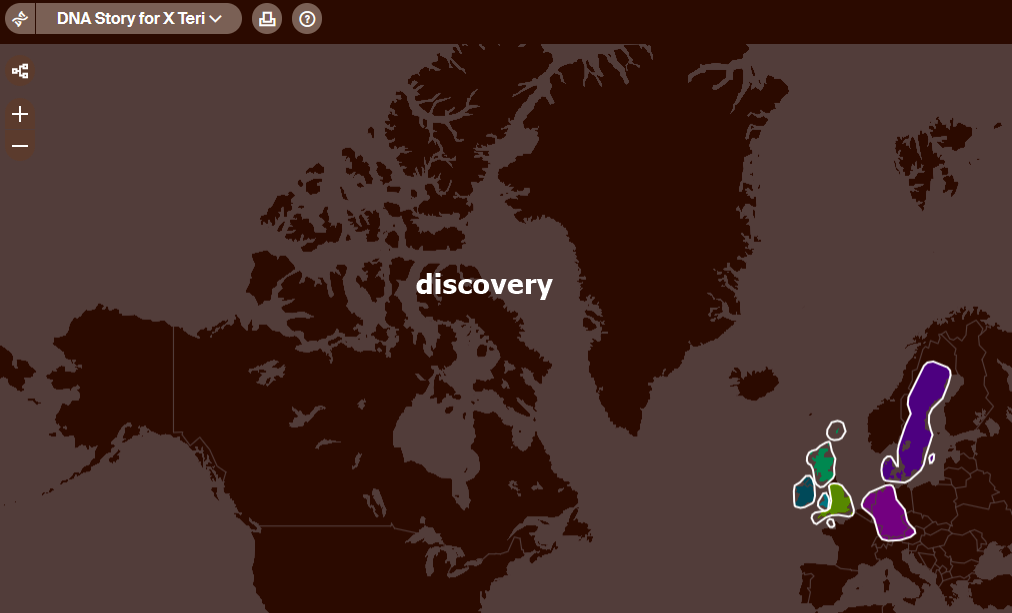
I start these kinds of posts by saying, “I’m a liberal, but…” Every person needs to be DNA profiled at birth. Not just for paternity but also for identification. We all submit fingerprints and other biometric data, as well as register for selective service. Of course, such data can be misused. Everything can be misused and often is. I still participate in GEDmatch, the service which law enforcement uses to compare DNA for crimes. My DNA allows investigators to triangulate relatives across generations and an incredible number of people. Obviously, this is a problem for people who mistakenly believe they avoid detection due to choosing to have no DNA samples taken. DNA belongs to all of us, whether we like it or not. For example, if they can guess someone’s age within a few years, they can identify almost everyone by taking a random DNA sample from anything. Anonymity is a smokescreen, just like privacy.
It’s also spectacular to see archaic/ancient DNA family members, such as the Neanderthals 49,000 years ago. What’s fascinating is that Erika and I overlap with almost all the known ancient DNA samples. It is wild to think that we have common ancestors 2000+ generations ago who moved across the continents and started new lineages that once again converged. This is true for most of us. We usually only think of the last few hundred years for ethnicity. The reality is not so short-sighted; most of us derive from the same vast gene pool hidden in the shadows of forgotten and unrecorded history.
Rarely does a day pass when I don’t think momentarily about the satisfaction of knowing my suspicions about my family were true. My relatives kept secrets for their own selfish reasons, blissfully unaware that technology would soon rip the ability to conceal truth and people from the rest of us. I missed decades of knowing a sister was out there, that my cousin Jimmy had a daughter he would have loved to get to know. I am certain there are other surprises and people on the fringes of being discovered. I waited almost a decade to find my sister.
As gigantic as my family tree is, I still have several ‘floaters’ who escape placement. When I first started, I had my grandma’s family tree back for hundreds of years. It was obvious by five or six generations that somewhere along the line, the parents attributed to them were not biologically related. I deleted dozens of generations from my family tree branches as a result. I still love family trees. The research, the triangulation, and the discovery. But none of it compares to the black magic science of DNA, the stuff that literally codes us. It also makes the inevitability of one day having a billion-person family tree a reality. With incredibly sophisticated computers, not only will everyone’s DNA be codified, but each of us will be woven into the most complex family tree ever imagined.
In theory, each of us has 128 5th-great grandparents. I have only about 1/2 in my family tree, and a portion of those are due to DNA only. Due to pedigree collapse, this is often not the case. (A fascinating concept in itself.) Going back further into history, our trees were not coned-shaped. Due to the mule rule, most marriages happened within the range of 2nd cousins or closer. Most people lived their lives in a 5-mile radius. You can’t trust family trees based on paper trails and documents. At least a 1/3 of such trees become inaccurate by the time your great-grandparents are involved. This is true even if the best researcher in the world does your family tree. DNA steps in to fill gaps you didn’t even realize were there. I don’t look at family trees like I once did thanks to this. They simply are not reliable.
Intermittently, the databases used to calculate ethnicity get updates. More people participate, and science gets increasingly more exact. It’s the perfect analogy for science; what you think you know evolves with new information. Whatever you identify as it’s usually an agreed-upon and arbitrary association when you factor in the span of modern human history.
I am in awe of the science. I’m certain that as our curiosity builds in tandem with technology we’re going to find even more striking revelations built into the tiniest components of the cells of our body. For many, this is troublesome. Not for me. It’s a revelation of discovery.
Love, X
 P.S. Parenthetically Speaking