Category Archives: Politics

The Ghosts of Our Ancestors

oliver-plattner-524304-unsplash


*Note: this post might make you uncomfortable.

A recent viral video of a black man giving a speech regarding gun rights at a city council meeting struck me as odd. In the video, he passionately discusses what the founding fathers meant when they wrote the constitution. His speech was shared countless times.

This post isn’t about gun rights at all. It’s about the underlying history of our country, one which was based on denial of rights to large segments of society.

If you get distracted by the mere mention of a gun, you’re missing the entire point.

I can’t get over the fact that the constitution and many who wrote it didn’t see the speaker in question as a person at all, much less one with the right to address a political body, own property, vote, or own a firearm of any kind.

I feel uneasy about the gentleman’s reasoning and my surprise at the arguments he used. He used his status as a law-abiding citizen as a foundation for his speech. This, too, presents problems, as being law-abiding has at times in our past required us to honor the right of some to own other human beings, segregate schools, force citizens into concentration camps, deport American citizens, and to sit idly as many in our population were treated as lesser human beings. “Law-abiding” is such an intolerably low threshold for us. The law serves as a framework for us, but it has also allowed all manner of atrocious conduct among citizens.

I dislike arguments appealing to the intent of the founding fathers. That all of them were men is itself part of the problem. Wealthy men of privilege, no less. Their intent isn’t relevant to our modern right to governance, although it still mostly resembles our modern government. We have the right to amend or deviate from any and all intentions of the rich men who wrote the constitution, without deference or adoration.

If we are not responsible for the sins or omissions of our ancestors, neither are we accountable to their norms and failures. We are free to draw on this map of ours in any matter we see fit.

I don’t revere documents, especially ones which codify ideas which contradict much of what we now esteem. Instead, I observe the arc of history and wonder what we might choose for ourselves if we weren’t saddled with the tired arguments of the ghosts who preceded us. More importantly, how might we choose if reason itself were truly the ideal we cherished above all others?

It’s a scary thought for many to consider that our constitution was built with the concept of amendment. We can choose to change course, even as many fight all attempts toward progress. We can’t make America great again until we’ve managed to live a century without engaging in barbaric behavior. It’s dishonest to claim that we’ve done so.

It’s precisely that reason that the black speaker in question was able to address his representatives, own firearms, and be a full citizen. Without the process of change and amendment, such expression would not have been possible. There are wide swaths of our modern United States in which I am certain that the speaker in question would not have been welcome to speak publicly.

The speaker in question demanded his constitutional right to bear arms, all the while failing to see the quicksand of incongruity on which his argument rested. The founding fathers did not believe that the constitution applied to him. Even as the speaker used the constitution to demand his right to freely own firearms, he missed the contradiction that the same document originally prohibited him from being included among those with such rights.

One change granted him citizenship; another might overtake him.

And so, we march forward, uneasily wondering what change will greet us.

Some of us want more, for all.

Others, the same, as before.
.
The Roundabout Proposition

osman-rana-313798-unsplash

“No matter how significantly a change might improve our lives, there will always be a section of our population who will immediately dislike it; their dislike is immune to enlightenment.” – X

Roundabouts are traffic control devices used to replace traditional intersections. Chances are, you’ve driven through one, and probably at 5 mph the first time you used one. All of us know at least one person whose hatred of roundabouts is so insurmountable that it borders on the comical.

Roundabouts, like so many other developments, tend to be controversial during implementation due to a variety of factors, not the least of which is user uncertainty. As people, we are generally dense and tend to reluctantly accept change.

Many drivers are unable to overcome their initial dissonance regarding roundabouts.

The evidence is clear, however: roundabouts drastically reduce the frequency of accidents and more importantly, have a huge impact on the severity of the accidents which do occur. Two factors have a disproportionate effect: speed and angle of impact with other drivers. One benefit of roundabouts is they also allow for considerably more traffic flow than a traditional stop-and-go system.

Why is this a social and political issue?

No matter how you present the strikingly clear benefits of roundabouts vs. traditional intersections, there will always be one person (or group of them) in the back of the room or in comment sections spouting off such generalizations as, “If it ain’t broke, don’t fix it.” Or, “These things are dangerous.” People love being told that the old way was probably best. After all, they survived, so why can’t everyone else? Showing them that roundabouts will prevent crashes, save lives, and increase traffic flow will only make them scowl harder and grunt more loudly.

You’re can’t argue them out of a position they weren’t argued into. You’ll probably try, though, because you sometimes are a bonehead, just as I am. We all fool ourselves into thinking facts will overcome stubbornness.

Right now, someone is reading this and becoming very angry. That’s how you know that cognitive dissonance works: it blinds you to contradiction and inevitably evokes an emotional response to new or challenging information.

This is part of the reason that expertise is so often met with skepticism and irritation. The folksy anecdotal experiences of the people who don’t want to learn anything new will often derail any attempt to make things better.

Additionally, because many of these people aren’t familiar with or engaged in the day-to-day business of government or society, they don’t understand or appreciate the massive machinery of moving parts and people that function to keep our society whirling. For many, the solutions seem obvious and simple. It’s easy to forget that if a simple solution were available, we would have adopted it already. I’ve learned to beware all opinion which preaches ‘simplicity’ in their solutions. Roundabouts are just another one of those things which makes our lives better; they require a little learning and adjustment, though.

Often, we all lose an opportunity to do things differently because the people who won’t listen to reason will have a disproportionate effect on our ability to implement change. Additionally, while a smaller portion of our society is actively engaged with issues and addressing them as part of their daily lives, most people sit on the sidelines and only begin to shout when something interrupts their focus, or a fringe voice clamors for action.

And so, expertise and better ways to live are drowned out.

It’s important that you understand that I’m not saying that just because you dislike roundabouts that you also tend to automatically resist potential social change. I’m simply using the subject as a comparative example most people can relate to. My guess is, however, that many will jump to this erroneous conclusion precisely because cognitive dissonance triggers an emotional reaction in most people, one which disarms their ability to distinguish nuance and subtlety. I am saying, however, that many who dislike roundabouts simply won’t listen to reason in their regard.

The Roundabout Rule refers to the mentality wherein no amount of rational or reasoned explanation will change a person’s mind. The person afflicted has a fixed opinion and data will not sway him or her. Additionally, it’s likely he or she will be unable to distinguish fact from opinion or weigh the overall impact to society as a group. It is the antithesis to, “My opinion changes with new information,” which is the foundation of education and maturity.

I think most people will read this and focus exclusively on the issue of roundabouts, rather than the underlying premise of the rejection of new ideas. This probability fits nicely with the premise.

In a roundabout way, of course.

Attire Is a Method of Political Control

6789.jpg

Before I begin, I’m assuming you understand that I’m discussing normal, everyday people and the prevailing mode of dress. It’s important that I remove arguments toward the exception from the conversation before I elaborate.

Forgive my tone and insistence.

Though I might be wrong and you might not agree, the older I become the more I find this issue to be a problem for me.

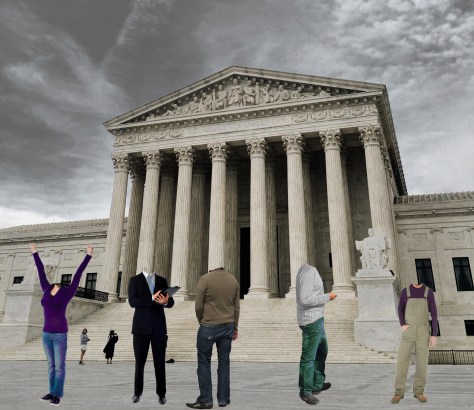
If you are in a public governmental space and anyone demands that you dress formally, you can be certain that the forces behind it aren’t interested in democratic representation and equality; title and formality do nothing except to distance us from those who work for us. Beggar, plumber, and lawyer alike are equal where government is concerned.

All requirements of dress are artificial ways to insist that there are hierarchical distinctions between those served and those serving: servant and master, or at minimum, superior and inferior. In governance of a democracy, no such distinction should exist.

All government officials work for us, even judges and senators. They are our employees, appointed or chosen based on qualification of résumé rather than worth. In a democracy, we are all equal, even to those who would claim elevated status. While it tends to be a more conservative point, almost all government officials are our employees or representatives; hired, chosen or assigned to perform a job.

Observing so much of the process and methodology of our government, I’m always surprised that citizens grant illusory privilege to those we choose to govern or judge our disagreements. That we extend this privilege in such a manner that allows them to feel able to sanction us for our clothing is arrogance on their part and idiocy on ours. Whether it’s a judge who irately demands that you put on a tie or never wear open-toed shoes or a senator who won’t allow you to speak to your representatives because you’re wearing mechanic’s coveralls, it’s wrong and wrong-minded.

We owe our respect and allegiance to our collective agreement of justice and equity, not to the fallible men and women who often forget that they serve for us rather than over us. The title or robe do not bring reverence and if you demand it you are not worthy of either the robe or the title. I can think of no practical reason to demand that fellow citizens follow a dress code in the presence of the operation of any facet of governance or judicial determination.

Whether I wear a tie, slacks or dress shoes in no way determines my attitude regarding the service rendered. If the place holds no intrinsic honor and the title is assignable based on qualification, to whom then do we bow to when we acquiesce to the unreasonable and undemocratic demand that we conform our appearance to an arbitrary standard they choose.

Fashion and attire are subjective; they are not factors any reputable government servant should weigh, much less censure. It’s not your job to demand conformity in attire or ours to fear your displeasure.

Simply put, sir or madam, I’ve given up the pretense. If you insist that my attire doesn’t do justice to the place you were appointed or chosen to work, it is you who needs to be removed or sanctioned. We are human beings in the presence of government officials, seeking that you do your job as assigned. Our reverence is toward the law and our democracy, not those who imperfectly bend it to human caprice or avarice.

If you choose to elevate yourself through requirements of attire, please be aware that we as voters can and should pass laws to require you to wear common clothing of our choosing.

Those who fear the mob or accountability to the masses know that dress codes are almost always motivated by a misguided demand to be honored, whether deserved or not.

In the presence of the execution of any government duty, no one should take into consideration the garments on the citizen’s back. This is especially true where our individual interests can be harmed or infringed.

Move Over Russia, Here I Come

I went through the process to be vetted to run political ads and content on Facebook’s platform. (Which, as you may or may not know, isn’t limited to the site itself.

Because of the fallout from the 2016 debacle otherwise known as the election, Facebook instituted some exacting rules to ensure that people and organizations are whom they claim to be – and live where they claim to. The rules don’t affect what you post on your private pages; rather, they affect what you post on pages you control and advertising platforms you access. Facebook reaches a couple of billion people. In some respects, it is the biggest communication platform in our shared human history.

Regardless of what content is on Facebook’s platform, it is our responsibility, not theirs, to use our brains in the way they were designed. We don’t adopt attitudes or prejudices at gunpoint; we are the guilty party in almost every case in which advertising is claimed to have been misused. It’s too glib to blame Russia or Facebook for undue influence. We own our collective stupidity.

The 2016 election proved that voting sometimes has less power when compared the reach of a determined voice, even if the voice is shouting disinformation. You can get your opinion and voice heard more effectively than by voting or arguing in a closed system. Even though we know that shouting doesn’t work to change minds, only cement them, we still do it, instead of using appeals to humor, persuasion, and targeted communication.

The most persuasive voice is another human presence, one of open mind and ear. The only sermon or speech which spreads your message is one of example. As we learned from the last election, the next best thing is a communication platform which allows anyone to reach a staggering number of people. The effect is amplified when people are engaging with passion at the expense of their intelligence.

You’ve read my words and creations in other places, many times without realizing that they were mine. You shouldn’t assume that they were the ideas, words, or images you would expect from me, either. None of us is the imagined version in the minds of others.

In an open society, that’s perhaps the best way. The best idea should be given consideration, even if it is disruptive to the beliefs and certainties we all cling to. Buried in the illusion of tribal affiliations of today, we automatically flinch and recoil away from the opportunity to hear new information. Our motto should always be: “I change my mind with new information.” This tendency is necessary for learning and growing. The greater our tendency to fight against flexibility, the more likely we’ll experience a breakage. 7 billion people in the world demand that we stop seeing ourselves as the torchbearer for truth.

I rarely share anything from another source on social media. It’s almost exclusively mine, even if it only my opinion, full of error and disinterest. Much of the problem with social media is that it is too tempting and too easy to use others to give voice to our presence. Much of the time, the voice we choose is whispering – or shouting – information which is slanted, incorrect, or completely false.

This is part of the reason why it is amusing to think that I now can anonymously sway your opinion across the entire platform of social media. The last election demonstrated the power and reach of interactive content. Why hack the vote when we can convince large groups of people that up is down or that everyone falls into neat categories of political and religious ideology? Obviously, most of us don’t recognize that we are being swayed or led astray – that’s precisely why it is such a powerful tool. All of us feel immune to it. Reality proves otherwise.

All of us, every day, see information on social media that we know isn’t true. We think, “What an idiot!” We rarely stop to consider that the idiot in our scenario is often us in the other idiot’s mind.

P.S. Facebook has trusted me to access your eyes, ears, and minds. Good luck to you all. It’s my turn to be the idiot. You’ll find me all over the internet, thanks to the largest communication project ever created. You’re welcome.