Category Archives: Springdale

Sporadic Moments

20170908_151836.jpg


There is no point to this post, no more than any other thing in our daily lives.

This morning, I sat gleefully rewarding the little finches in the cool morning air with little pieces of Cheerios. They seemed confused by the texture. I heard a foot scrape repeatedly with an unusual syncopation on the stones of the path. As I looked up, I locked eyes with an older gentleman. His hair was uncombed and his face was grayed and scruffy. His eyes were deeply shrouded in what I can best describe as a hard life. I imagined I could see his past behind his eyes, years of harsh unexpected surprises queueing behind him. His clothes were torn and his pants were covered in grime, the kind you seldom see on Tide commercials, the ones inhabited by bright, cheery folks with ample time to devote to pristine laundry. I nodded and said, “Good morning, sir” to him as he crossed in front of me, even as he held my gaze for a longer second than I expected. Then, I smelled his passing and I felt about as bad as anyone could feel for the next few seconds as I watched him shuffle his way out of my sight. Out of my life, he went. Something about his eyes reminded me of my dad at one of his low points. The birds were still chirping, though.
.
.
I went to eat Tex-Mex for lunch. Really, I went to eat a mound of pico de gallo cleverly disguised as a meal. The place my wife and I chose was Acambaro, the one with the interior uglier than my sister and with service so inconsistent that its rhythm would be impossible to transform into a musical. Despite the ceilings evoking an abandoned drug house, the pico de gallo there of late rivals the plates served at Olympus.
.
.
On our way back home from my culinary indulgence, we traversed Butterfield Coach Road, a wide, expansive multi-lane busy street on our side of town. A rider sans helmet was atop a rickety moped, trailing a long rope which had apparently been used in the 1920s for nefarious purposes. Attached to it was a young male striding a skateboard, wearing stylish sunglasses but also no helmet or protective gear of any kind. The moped was pulling the future organ donor at about 35 mph. Apart from the brazen illegality of it and the sheer audacious stupidity, I made a note to nominate these two citizens for a Darwin’s Award upon my return home. In their defense, they were certainly demonstrating the unholy trinity of carpe diem, Yolo, and narcissism. I can’t say I didn’t laugh or admire their total brazenness. My wife and I both had a chuckle at the idea of a Springdale policeman rounding the curve behind us and seeing the duo as they proudly gave him something to do.
.
.
Later, I drove over to the Willie George Park by the Tyson Parkway. I had never walked this part of the area in the daylight, which means I had something in common with Edward Cullen. I turned South and walked toward the terminus of Hylton Road where it was unpaved. I began to smell it as I neared it: a house that easily could be the predominant example for Hoarders. This house has so much detritus of cars, boats, furniture, and treasures in the yard that it seemed as if a tornado had thrown the contents of an entire backwoods flea market into its yard. The smell was a combination of mold, failed genetic experiments and bad dreams. I am not one who can be described as having a weak stomach. With the blistering sun overhead though, I felt my stomach preparing to file a formal written complaint if the smell didn’t lessen. I didn’t attempt to look into the windows, in fear that something other than a human face might appear from inside. The dirt road didn’t seem to be welcoming to visitors. That house had all the appeal of a recently-cooked bag of rats. I’ll wager that no adherents to any fringe religion had dared traverse the complexity of that house’s yard – and if they had, their skeletons still remained there, in limbo.
.
.
I walked back toward the car and then remembered that I had also never visited the canopied trail area on the far side while the sun was overhead. I walked around and stood on the trail, listening to the million tiny cymbals of noise the insects created for me. I had the trail entirely to myself. Walking back, I stood in the middle of the vast sports field with no one nearby, as the sun watched me from overhead. I couldn’t believe that Springdale continued to create these spaces for me to witness.

Surely other people know that these worlds exist in the middle of their lives.

September’s Ancestors

20170906_18042522222


I’m not sure how meaningful my words might be, coming from someone who loathes the idea of burial but loves cemeteries and their connections to history. It’s a cliché to point out they serve as reminders to us, in part because we so seldom feel the urgency they offer. When we do, it is usually because we feel the icy fingers of oblivion as subtle symptoms in our bodies or when it reaches out to visit someone in our private circle.

On rare occasions,  people we’ve never even met get a moment of remembrance, as is the case with this story.

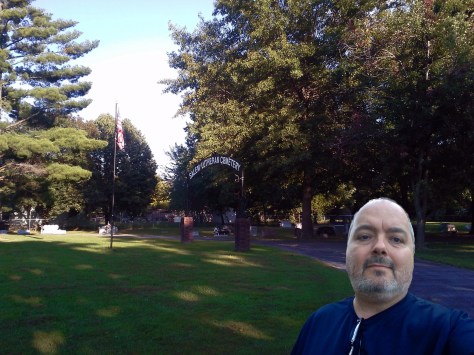
As is frequently the case of late I found myself with a few stolen moments and chose to walk a long serpentine path along Huntsville in Springdale. As I walked along, I looked up and noticed I was approaching a cemetery that I had not visited in probably 20 years and certainly not since the road had been widened. The last time I had been there, almost everything about Huntsville was awaiting transformation into a multicultural artery on that side of town. Normally I would have walked past, my eyes gauging the sights as I moved on. Perhaps in part to the relative chill in the September air and the declining sunlight, I instead turned and opened the latch to enter the shady cemetery grounds. It then it occurred to me that I had just researched someone laid to rest there. So with a little more anticipation, I walked the outside perimeter and without even searching happened upon the graves I had seen in my genealogy searches.

I found Daniel Lemke’s headstone. He was born on the eastern edge of Poland, in a small place named Chelm, almost into Ukraine. He came to the U.S. in 1901 and chose Wisconsin as his first home here. His son Martin Julius was born there and moved to Northwest Arkansas 70 years ago. Daniel died 72 years ago, or 27,317 days ago. His son passed 14 years ago, some 5,455 days ago.

I find it difficult to put myself in the place of someone who would travel so far around the world to land in an unknown place, with new exotic words to learn. It’s fitting that Daniel’s great-grandson would find himself in a similar situation, on another part of the planet, forging an entirely new life for himself. I imagine, though, that these places here in Northwest Arkansas have a pull on his heart. He can always return here and sit by the fire, remembering his life on the other side of the world.

While it’s likely that my path crossed with Martin in the way that almost all proximate lives do, a complex intertwining mesh of ‘almost,’ I don’t have any claim to knowing his presence. But thanks to the prism of time, I can see where his path led and look back through the footprints of those who came after him. Because of him, I learned of a place called Chelm and its part in history. I wonder how much our footprint will be memorable and not simply because of our safe choices.

I think that sometimes history’s bell rings more deeply when the hour grows later and the air turns chill. The grass inside the cemetery grounds was bright green, still waiting for the arrival of frost mornings. There’s something about these times and these moments.

It was a pleasant sensation to be standing in such a contemplative place, thinking back to the lives of people unknown to me. As the busy avenue continued unabated behind me, I alone possessed the refuge of that cemetery, even as it possessed me.

20170906_180401


Barbed Wire, Safety, and Assholes

Barbed wire?

By now, I imagine most people in NWA heard about the 72-year-old man who was badly injured when a strand of barbed wire across the trail in South Fayetteville caught him in the neck as he rode his bike.

Lately, I’ve been doing a lot of trail walking in the dark. While I’ve walked primarily along Springdale’s incredible portion, I’ve spent some time on some of Fayetteville’s trails, too. I’ve joked about the endless spider webs across the trails on some early mornings, so the idea of hitting wire does give me pause. But only for a brief second.

It’s always a possibility that someone will misbehave. In fact, it’s likely. I know I run the risk of booby traps, nails, or weirdos (weirder than me, even!) accosting me as I enjoy the trails. Barbed wire is a particularly criminal item to use to hurt those who walk, run or cycle. There are situations where I would never see it as I approached, especially at 3 a.m.

As for Springdale, I routinely see patrols on the trails. I’m not sure how it is managed in Fayetteville, but anyone alleging that Springdale isn’t doing a great job of maintaining visibility isn’t paying attention. Even with the best vigilance, though, it’s impossible to guarantee that lesser people won’t attempt all manner of shenanigans. The police can’t be everywhere – but we can.

Yesterday, as I walked around part of the new George Park complex, I surprised a family sleeping in a white sedan. Based on the what I saw, they were probably homeless and using their car to park in less obvious places. When I came upon them, I had just emerged from the blackest part of the trail in that area, the one I wrote about a few weekends ago. When I was going through it, it went through my mind that someone could have put up 147 strands of barbed wire and that some anonymous person might find me crawling out the next morning, looking like Rambo after round 11. As for that family, it didn’t occur to me to react to them with suspicion, just an appreciation that the weather wasn’t an additional discomfort for them.

On the other hand, two weekends ago, I almost stepped on someone who was sleeping inside the covered bus area in front of the public library, after I walked past a large man who was intoxicated as he haphazardly ambled along the pond at the park. I wasn’t nervous, as the only danger he presented was the one he did to the English language as he tried to speak to me as he passed me. People are generally great. It’s up to us to follow through when we see things. People walking while intoxicated are amusing, not threatening, even if they look like defensive linemen.

Which brings me to my poorly-written point…

I’ve walked mile after mile in the last few months, seeing so many sides of this great city. As you might have noticed, I’m a huge fan of the trail system and of all the changes in Springdale.

However, there’s a lot to be done here. In my own neighborhood, I watched as a 4-wheeler careened around my little corner of Springdale. He jumped the curb, rode the sidewalks, and made a car come to a screeching halt as he cut in front. Kids were walking home from school at the time, as the buses had just emptied at the side entrances to the neighborhood. It’s not the first time he’s done this. A family down the street gets on dirt bikes and rides at 80 mph, doing wheelies down the middle of the street. Another neighbor drinks and drives. A few weeks ago, I watched as an obviously drunk driver tried to use his clutch ran over the curb and stalled his Honda. (I wrote about that, too, as a humorous anecdote.) Dozens of people witness the idiots such as those on the 4-wheeler, motorcycles, or careening vehicles. Until we stop looking the other way and tolerating them, it can’t get better.

I could list more, but you get the idea: people are going to be assholes. It’s up to us to let the police know there’s a problem. Before you ask, yes, I’ve called the police when I observe these things – and not anonymously, either.

One final anecdote, if you don’t mind. I wrote a story one afternoon this week, one about the futility of insisting that one area is safer to walk than another, or that it’s better to walk in the daylight. I didn’t post it, though, because I struggled with the implied prejudice of it. There are some beautiful places near my house and I love walking them. But to say that it is ‘safe’ to be anywhere is simply not true. The opposite side of Friendship road isn’t within Springdale city limits. There are some strange residents on that side, ones dedicated to a life of crime, if not mayhem. Some of them are the “AFTER” posters you would see during a drug PSA. A driver, for whatever reason, decided that he was going to spew his venom on me as he exited the Springdale city limits. He thought I was Latino, and I think he hesitated from escalating his anger because he might not have been sure who I really was or if I was armed. I might have had to throw him across the field, WWE-style if he attacked me, or run away, screeching. Those who know me well can imagine how ridiculously fast I would have been running through the field at that point.

I don’t look at the angry driver or the minor idiots and lessen my view of people. We’re always going to have miscreants and assholes making our life more difficult. Safety and security are the goals of those we pay to protect us. Safety, though, is an illusion. I’m as likely to get injured on the sidewalk outside my own house as I am to be decapitated by barbed wire on one of our excellent trails – and probably by that biscuit-eating idiot on the 4-wheeler.

For those who asked, I’m not concerned about barbed wire along the trails.

If you recall, I had a plane crash on my residence almost 30 years ago, on a clear Saturday, September morning.

You can’t take it personally when life drops the anvil on your cartoonish head.

You can, however, let someone know if you see someone putting the anvil up in a tree.

A Memory Overcomes Me


werwerwe.PNG

As the sun beat down and the creek noisily flowed away from me, I glanced up to see the array of monuments to lost mortality on the bluff to my right. It’s deceptive how the trail sprints like a careless runner through the middle of things. I pictured Jimmy standing up there, waving, telling me to keep walking even if they sun cooked away my enthusiasm. That’s how time works sometimes, hurling the most pleasant of hallucinations upon us.

There’s no lesson or moral to this story, just an observation about the overlap of memory. Maybe it’s because Jimmy is up there on that bluff, his own rock and etched tooth raised against the August afternoon breeze. He wouldn’t waste his time lecturing me; he’d turn up the radio and let the music waft through the air. As I walked past, Cristian Castro sang, “…que el tibio abrazo que no volverá …” It wasn’t Jimmy’s kind of music, but he’d laugh and say, “Whatever floats you away, dude.”

Springdale & Brinkley Hold Lessons

This post evolved from a simple comparison of my geographical past. It grew to encompass parts of me and as such, is very personal. If you will pardon my generalizations and laziness toward exact writing, you might find something interesting.

I didn’t come to Springdale until the early 70s. My dad dragged our recently reconstituted family up here for the promise of a steady job, away from the geography which took the blame for so much of my dad’s heartache. His time in prison in Indiana and his involvement in the death of one of my cousins (unrelated to prison) had broken him of some of his desperate need to remain in his hometown. My dad had a brother here, my Uncle Buck, as well as a few cousins. Our move was prior to the miracle of the interstate reaching its tentacles up to Northwest Arkansas, so all trips to NWA were long, winding escapades. It seemed like we drove for days to reach the mountains of Springdale. I didn’t understand what a ‘hillbilly’ was. All I knew were the fields of Monroe County and the places my grandma and grandpa called home. Being with my dad was the last thing on my wish list.

Years take on a different meaning when I stop to consider that soon enough I will be exactly halfway between 1970 and 2070. Springdale and I both have changed immeasurably since I was young. The area of the Delta from which I came has continued a generally languid, shuffled march toward annihilation while NWA has become a beacon for commerce and lifestyle. It was sheer luck that my dad’s terrible fortune planted my feet here. And while the Delta was once the powerhouse of agriculture but found no clear footing to advance, Springdale and surrounding areas used agriculture as a springboard from which to dive into a diversified future. So many of us here live in houses situated on plots once adorned with grapes, apples, strawberries and all manner of other foods.

It wasn’t until I was much older that I realized that the interstate running through Brinkley wasn’t always there, a fact which should have been immediately obvious. In Brinkley’s case, though, the interstate seems to have provided a convenient escape for the younger generation, as they ventured out and realized that the state had more to offer in other places. In Arkansas’ early history, roads were intensely local, often built to connect small town agricultural markets. For the affluent parts of the state, the interstate gave people and commerce alike the way to merge interests. While lifelong residents of Brinkley might wish to disagree, it is obvious that good roads shone a beacon toward better opportunities in other parts of the state. Brinkley could have been one of the jewels of this state, given its location. Even as I sometimes forget that I once loved the flatlands there, I will admit to its austere beauty.

I also forget that many parts of my early life are inexplicably entwined with those people who I deeply loved and those who were violent caricatures of real people. Geography mixes in my head and sometimes paints an unfair picture of those places, simply because the people walking across my stage were broken people. As we all do, I carry pieces of these broken people in my head, as such slivers are difficult to excise. I can hold the image of standing near a rice field near Brinkley, up to my ankles in mud, laughing; I can also imagine walking alongside a pungent Tontitown grape vine in August, my fingers cleverly stealing unwashed grapes and eating them like candies. I’m not sure which place or memory is more valid, but I do know that being surrounded by people with love in their hearts can make any geography welcoming, while immersion in the minds of lesser people will reduce the world’s brilliance regardless of where one’s feet might be. It’s how City View might have been a place of low resort for many, and a welcome mat for others.

Because of the reduced crucible I survived as a kid, on the one hand, there was so much about this town which remained unknown to me. My life was incredibly small. I could sense that it was an interesting place, though. My family moved over twenty times by the time I had reached adulthood. So many places around Springdale became familiar to me. In many ways, I feel as if this was advantageous to me, giving me a different perspective than someone who was lucky enough to remain fairly rooted in the same place growing up. In my family’s case, our ongoing moves concealed the array of abuse and violence camouflaged inside each respective new residence.

When I was in 2nd grade, I remember asking Mom what it was like attending school with black children in Monroe County. She looked at me like I had been hit with a shovel and said, “I didn’t. We were segregated.” (It was probably a lucky thing for them, though.) I wondered why Springdale was segregated, too, given that there were no black kids in class with me. How was I supposed to know that there were so few minorities living here? I was so naive. Even trying to understand that one of schoolyard buddies Danny was actually from Chile was beyond my comprehension. That’s how reduced my life was without education. Had I been born 100 years ago and remained in Monroe County, I could easily see myself in the role of unapologetic racist. My family would have raised me to believe that it was a certainty.

It’s funny now, my ignorance. In my early youth, I had never heard the word “segregated” except as a muttered curse. For most of the whites in the Delta, segregation was a word equated with government distrust. When I started learning history, it astonished me that there was such a short jump between our Civil War and WWII.

My dad took us back to Brinkley for my 3rd-grade year, to attempt to run a gas station in the no-man’s land on Highway 49 outside of Brinkley. While my home life was a slow-moving mess, school was fascinating. Just as I got acclimated to flat lands again, Dad’s failed business drove us back to Northwest Arkansas.

I remember my Uncle ___ saying that he was jealous of my dad, Bobby Dean because Springdale didn’t have ‘the plague’ of so many blacks. Other family members said the same and I only share this memory reluctantly. Perhaps it’s not wise or fair to generalize about my recollections of prejudice. On the other hand, they are my stories and as a sage once reminded us, perhaps people would behave more appropriately if they knew an observant writer was living amongst them. Truth be told, racism took a back seat when contrasted to the casual violence of my dad. I had a couple of god-fearing aunts and uncles who remind me that we should never be surprised by the sheer hatred some racists harbor in their hearts. One of the prevailing lessons they taught me was that religion could easily be twisted to justify and condone all manner of hate, all the while sitting behind a pearly-white smile and opened Bible. When I was young, I endured many a comment from them regarding my views on homosexuality, race, and language. When I grew up and realized that they were simply unadorned racists, their arguments dried up. The revisionists in life will insist they were great people and in many ways, they were the product of their times; in another way, though, they deliberately refused to change their minds, even as they paid pretense to the societal demands that they keep their boring and unimaginative racism mostly closeted.

Even though so much became second-hand to me, Springdale itself began to break away from its parochial roots; languages and color slowly entered and once inside sufficiently, kicked the door in and changed the fundamental nature of everything here. Even as I learned the town’s geography, it was already changing rapidly around me. In 1970, Springdale’s population was around 17,000. In 2015, it was on the high end of 77,000. (My hometown lost 1/2 of its population in the same time period, by comparison.) No road escaped the necessity of bulging outside of its small borders, and many signs became incomprehensible to the earlier residents. I was lucky enough to be present during many fits and tirades from Springdale residents insisting that hating the presence of another language wasn’t a sign of prejudice. They seem ignorant to almost everyone now, but the angry spew of their spittle was a sight to behold back in the day.

Springdale was akin to a debutante sent away to school in some exotic location; upon her return, she was unrecognizable as the same person. But almost everyone could look upon her and admire the changes. It’s almost impossible to turn back once someone or somewhere has caught a glimpse of the vastness of the world.

I’ve heard many people refer to Springdale as once being a Sundown Town. I don’t remember seeing such signage. On the other hand, I didn’t need to. My family provided all the exclusionary language anyone would ever need. Their distrust for minorities was amplified by our move to a white community. As strange as it is, I remember when my mom started working for Southwestern Bell (AT&T) in Fayetteville as an operator. She often came home, angrily ranting about blacks in her workplace. It was the same language she used in Monroe County except now she had a home base to retreat to, one which seemed to encourage her racism. Mom was an angry person most of her life, so the language was a symptom of her defect more than any commentary on her surroundings. Both my mom and dad fled back to Monroe County in the late 80s, after a long succession of disappointments.

Before I forget to mention it, my mom’s last job was as a custodian for Brinkley schools. The person who treated her the most kindly there was one of the black teachers there, proving that truth is stranger than fiction. Like so many racists, Mom’s racism tended to intensely situational. She couldn’t understand why I, as a white person, would ever stoop so low as to learn another language, much less love its differences. Her life was reduced by her prejudices.

The differences between the racism of Springdale and Brinkley were striking. It wasn’t until I was much older I surmised that Springdale didn’t need to be overtly racist. The whiteness of the faces walking the streets communicated a clear message as to the population. Springdale was a town waiting to be changed both monumentally and one person at a time, whether it saw the tidal wave approaching or not. It confused me how two places in the same state could be so markedly different, yet both have residents generally fixated on differences based on skin color. I’m generalizing of course, but I know that you understand the distinction I’m drawing. Most of Springdale’s residents weren’t prejudiced, of course, just unsure as to how to accommodate the changes to their towns. Racism tends to discolor a disproportionate number of people around it, giving it a larger circle than reality warrants. This circle of influence sometimes gives the wrong impression of tolerance toward prejudice and many of those practicing it become adept at hiding under its umbrella.

It’s strange to me that both Springdale and Brinkley had so much to build upon. Frankly, Brinkley had the advantage when I was young, and if a few visionaries had the temerity to act upon it, it would be flourishing now. Instead, Northwest Arkansas seized these opportunities.

Against the backdrop of economy and money, Springdale acquired deep populations of Latinos, Marshallese, and other minorities. Most of us who were paying attention and curious were amazed at the changes brought to us by different cultures. Since I’m naturally curious, I loved the overlap of cultures and couldn’t wait for it to become entrenched. Others, though, peered at it through narrowly-turned blinds, wondering if the small town they grew up in was gone forever. Thankfully, the answer was ‘yes.’ Change brought a greater viability to our town. The overlaps of other culture became so large that in many cases people felt conflicted about which culture was their primary one. That is the ‘melting’ we claim to honor as a country. The melting works much better when it is in both directions, with those who were here first welcoming the inevitable changes brought by new faces.

The same didn’t happen for Brinkley, despite it attempting a few rebrandings. The remaining base shifted out from under when it lost its Wal-Mart. People continued to flee, even if meant they’d be exposed to a greater variety of cultures elsewhere. For those who left, many have an idealized memory of what it once was. The truth, though, is that it was never really that place. People voted with their feet and the results are the only conclusion which needs no clarification. One day, hopefully, Brinkley will discern a path toward revitalization but all such paths are dead ends without new faces and new opportunities.

Springdale, albeit with a few hiccups still to come, is a place which can be a foundation for everyone to look back upon and feel a sense of community. It defies an easy definition, precisely because other groups came here to stay.



Early Morning Delights

To all those who followed me later on the trails, you’re welcome. I didn’t do the spider dance voluntarily but I did it repeatedly and with great enthusiasm on the dark trails, most of which was carpeted with a dank tapestry of leaves from last night’s torrential rains. I’m assuming the spider dance counts toward one’s cardiovascular regimen. There were 2 or 3 spots where the fallen leaves hid the dimly-defined edges of the trail. These were particularly laden with spider webs. Some of these spiders are enormous and when they have the time to do their work without interruption, their webs become as thick as my grandma’s favorite thread.
 
The only other vehicle or person I encountered the entire length of my walk was a patrol car exiting an access road leading to a school as if the officer had returned to brush up on his ABCs. (‘A’ is for arrest, ‘B’ is for breaking and entering…) Had the officer seen me a few minutes before, doing my spider web electrocution dance, he or she might have stopped to ask if me I was alright. As it was, I was probably just a silhouette in the eerie darkness.
 
I parked my car at was once Silent Grove Church. The church has long disbanded, once a hub for fervent locals to share their community gospel. One late night, over 3 decades ago, I parked my Dodge Fury there and ran for miles, so many that I could barely lift my legs when I finished. This was before the road was anything except a serpentine and narrow road which was sparsely populated before Springdale had aspirations of even reaching its municipal tentacles to those places on the periphery of anything substantial. The thought of a trail access in that area would have been ridiculed by everyone except the most visionary back in those days. When I finished my run, I laid across the hood of my car and somehow fell asleep, as it was probably 4 a.m. or later on that night so many years ago. The next morning, the sound of a honk and a school bus door swishing open awakened me. I’m sure I was quite a sight to the kids on the bus; the driver certainly was wondering whether I was dead, drunk, or dead drunk.
 
I recognize my privilege. I have the good health to walk, a car which gets me to these new places, and energy leftover from working, and a city which grew out its parochial insistence toward maintaining the imaginary “what-once-was.” These trails and places would not have been possible if those who demanded allegiance to the past had been the most effective voices.
 
Now that I’m older, I find myself laughing at the ease with which I could fall asleep in strange places. (Before my back began to groan like a dissatisfied older lady waiting at the store register, her 16 items stacks neatly on the counter, waiting for her impatient turn to question the cashier about each and every item.) As we age, almost all of us demand our nightly rituals, with each pillow fluffed just so, the fan at the exact speed to comfort us, and our world categorized around us. Our affluence estranges us to adventure.
 
This morning, there was no meteor shower nor anything particularly eventful – just an array of small delights: the sliver of a slowly rising crescent moon on the horizon, the rush of the creek underneath, an immense tree fallen next to the bridge, probably having surrendered to the insurmountable push of water yesterday evening, the feeling or smooth and yet uncertain footing across an infinite number of fallen leaves. The air was so heavy with moisture that I could trick myself into believing that it was pushing back against me as I walked.
 
Out there in the darkness, there was an absence of bickering saltines, no one making fatuous arguments regarding predatory relics in our evolving midst, no pointing fingers of superiority toward other beliefs. Just the methodical hum of a billion insects and feet moving forward, step, step, step. I walked much further than I intended to. The miles, though, seemed to accumulate without notice.
 
Alone, with my thoughts, wondering and with wonder.

Confederate Stones, Withering Trees, and Change

Observing the long view of history and social forces:

“A city or town isn’t the past, who founded it, or who once lived here. It’s who is here now and the children they’ll have. Those who were here first have no greater say in its disposition than those who moved here to be one of us. It’s one of the most overlooked lessons of history. A family changes as it accepts new members and towns can be no different. Roots grow into trees and those trees must adapt to the changing environment or wither to become the firewood for those who need it.

You can fight change with all your vigor or you can understand that all things perish, even ones carved in immortal stone. The things that we hold dear are not things at all. They are flesh and blood, love and hope, compassion and intellect. Those things which do not advance us and bind us together must be willingly set aside in favor of the great invisible.

Nostalgia for the way things were is the most human of traits. But we must always remember that we share these fields and places with those who look upon us with new eyes. Even our children will one day peer back with wonder at the things we valued over one another as people. As we are renewed, so too must our attitudes flourish, blossom and envelop those who do not share our history and culture.”

Peace

Meteor Shower Surprise in Springdale

20170812_061836.jpg

Thanks again, Springdale. This morning, I walked along the Razorback Greenway on the north side of Backus, near AQ. It was a fortuitous choice.

I was incredibly lucky because not only did I have the entire trail to myself again this morning, but as I walked north, a portion of the Perseid Meteor shower put on a show for me. Frankly, I had forgotten about the possibility of seeing anything. As I reached one of the beautiful steel bridges crossing Spring Creek, the trees relented and the sky opened above me and I stopped and stared as a meteor slashed across above me. The moon was bright and behind me, but no other lights invaded the wide spot afforded by the bridge and the creek beneath me. At 5 a.m., it was a delight to assume it would be the only meteor. Two more brilliant flashes arced across the sky above me. I had the urge to turn and say, “Did you SEE that?” but all the sane people were in bed, dreaming of their own fascinating sights.

So, it came to pass that I stood alone in the midst of nature, watching the sky drop burning reminders of the vastness of space. As I walked back, happy to have been witness to it, I saw a cat on the edge of the trail, walking ahead of me. I picked up my pace to see if it would spook. I turned on my flashlight app on my phone and lo and behold it was Pepé Le Pew, bright white-striped tail now raised in alarm. I stepped back so quickly I think I traveled back in time, laughing at the idea of me returning home smelling of skunk.

When I returned to my car, I walked over to the new pavilion next to the old Heathman building and sat watching as the edges of the sky slowly brightened. Two more bright meteor falls greeted me. I wondered how many early risers might have witnessed these with me. Then again, I remembered that the city of Springdale had built all these places solely for me, to be discovered in singular succession. I will hoard these memories.

As I headed back east, toward home and my disoriented cat, a deep fog rolled in from the hilly terrain, blanketing my approach. As I write this, everything seems to have been draped by the most diaphanous of gauze. Had I not stood in the middle of the beautiful nothing and witnessed the meteors, I would have thought I had dreamed it.

20170812_054939


Razorback Greenway Interactive

X Explore Springdale

16601694_956268747806136_4192424022985209909_o

I’m not quite sure how to take it. The Springdale Chamber of Commerce revised the horrid waffle-fry logo and made a variant for the Springdale Advertising Commission: Explore Springdale. It is a similar logo, except the crazy waffle-fry base has been morphed into two overlapping Xs. I’m really going to miss seeing the waffle-fry logo so often because those seizures it elicited were becoming my best friend. I’d apologize to Springdale for mocking the design logo, except that it was done on purpose instead of as a result of a lost bet, as I had originally speculated.

Here’s the FB page: https://www.facebook.com/ExploreSpringdale/

Here’s the website: http://explorespringdale.com/

As a citizen of Springdale and the only resident legally named X, I give the double-X variant two left thumbs up. It’s phenomenally better as a logo than the crisscross polychromatic nightmare known as the waffle-fry.

Before I forget to say something useful, Explore Springdale is an informational page for tourism and goings-on in our fair city. These are the same folks who sent the last Mayor to Mars and also promised to give a free taco lunch to each resident of Springdale twice a year. I made those last two claims up but since I received a cease-to-exist letter, I can no longer pretend to be the spokesperson for any city official of Springdale. (They took my company car away from me, too.)

You can also follow Team Springdale: https://www.facebook.com/teamspringdale/, Downtown Springdale: https://www.facebook.com/DowntownSpringdale/, and Springdale Stories: https://www.facebook.com/Springdale-Stories-1763247583924…/…

Keeping up with all the activities here is quite a task, even if you have two secretaries like I do.

Springdale is no longer the town I grew up in, thank goodness. It’s better by almost every measure. As much as I chide the logo debacle, it’s looking spectacular out there these days.

PS: The obvious “X” in this logo is much appreciated. I keep joking that you are building me trails and new sights – just for me personally. This logo variant certainly adds evidence to my positive paranoia.

An Early Morning Walk in Springdale

23422343

When I went to bed last night, I instinctively set both alarms. Dawn double-checked, both due to her infallible nervous condition and the fact that she has an allergic reaction to klaxons blaring at 4 a.m. on a Saturday morning. (She also dislikes bagpipes and trumpet practice at that hour, too – a lesson I learned the hard way.)

Regardless, the feline alarm started meowing at 3:30 so any concerns about the alarm clock accidentally waking us were misguided. As I was practicing my dedication to the slumbering arts, I foolishly attempted to ignore the cat the first few times he attempted to rouse me from my horizontal and stuporous state. Ten minutes later, Güino upped his game by adding involuntary massage via cat paws to his repertoire. He’s been known to gnaw on exposed toes if necessary. One of these days I’m going to coat my toes in cayenne pepper to surprise him.

I decided to get up and take a walk earlier than I wanted to. I drove and parked near Emma Street in downtown Springdale. It was sublime. Again, I had the feeling that most of the inhabitants of the place had been whisked away by an unseen hand, leaving me the entire run of the place. The new Walter Turnbow park by Shiloh Square is spectacular enough during the day; seeing it without people before the sunrise was both eerie and interesting. I walked the trail in both directions, and only toward the end of my long walk did I meet any other souls on the dark trail. A motley group of youths was long-boarding the long incline toward the rear of the fire station. I could hear the crescendo of the wheels on the concrete long before I could discern their silhouettes approaching against the distant lights. Their laughter and jabber approached and just as quickly swept by, retreating to a whisper.

If you’ve never walked the trails in the dark, they are spectacular, especially the portion running near Bluff Cemetery. It never occurs to me to feel unsafe, either for the unlikely presence of uneven pavement or from nefarious passersby. French fries are a greater danger to me than walking in nocturnal environments could ever be.

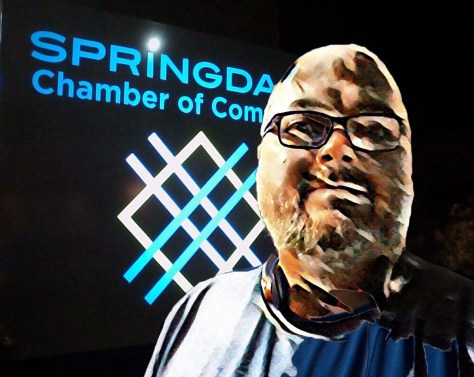
I stopped and took my picture by the Chamber of Commerce sign facing Emma Street as my backdrop. The hideous logo adopted by Springdale a while back openly mocked me as I did, its alien crisscross of bizarre tic-tac-toe still reminding me that there is no accounting for taste. (Note: Springdale has done an amazing job these last few years, one worthy of frequent mention. The logo, however, is as inspirational as getting one’s face spritzed by underarm perspiration on a languid summer day.)

So far, each time I’ve chosen to walk somewhere different, I’ve found a little corner of Springdale that had been concealed to me. I appreciate all these people working to make these new places for me.