If you don’t know the phrase, “better and bitter angels,” you should add it to your vocabulary. Most of us talk about the devils on each of our shoulders. The truth is that it is our intentions, motivations, and convictions that run us afoul more often than the whispering devils. In our public life, we judge others. In our private secrets moments, we judge ourselves most harshly. A little grace for all of us is much needed.
P.S. And a bit for you if you’re looking backward with an unkind eye for yourself.
Often, the only way forward is to give yourself a laughing pass for the things you have most definitely said and done. And twice that for the things you imagined you are guilty of.
A friend posted a version of the “what is your name backward?” quiz. My name is not only the shortest possible palindrome, but it is still my name no matter how you turn the letter. Also, no matter where I go, maps have an “X” on them, and state, “You are here.” It’s like they KNOW. X is not only the antepenultimate letter of the alphabet, but it is also the third-least used, which explains why dates were so hard for me to come by when I was younger. In math, X is an independent and unknown variable. (Which also explains my dating issues when I was younger.) On the plus side, I rarely had to do math, because the teachers instructed my classmates to “solve for X.” X has also become a non-binary gender identifier, indicates buried or hidden treasure, used to indicate a signature and/or illiteracy, can be used as a multiplier, indicates Voiceless velar fricative (that’s a literal mouthful), an axis in the Cartesian coordinate system, is a stand-in name for people undergoing spiritual conversion, the number 10, and also indicates that a work is the result of a collaboration between two artists. Though it inexplicably angers some, the X in Xmas stands for Christ from its Greek roots. When I picked the simplest possible name, I missed the boat!
After I wrote my Rip-Shirt story, someone messaged me to tell me she knew who the person was I taught to stitch. And then she gave me the gift of sharing a few anecdotes about the time she spent with him. My memory didn’t keep any recollections of them being close. But I take pride in knowing that my little story, the one about a sliver of my life, took her back to another time. I did that. And she felt comfortable enough to share bits of herself with me – someone who is a hack but loves personal stories.
I think we all crave personal stories if we can stop worrying about language or our words being misconstrued. Who are we kidding? We don’t understand ourselves, not really, so the expectation that others conform to an idea of our self-image that we don’t even possess is a bit preposterous.
I love to think that every once in a while that I write something that triggers a memory and hopefully a fond one. While we should not get anchored in the past, there are few greater pleasures than using our nostalgic eyes to wander in time. As we age, we change around the static memories. It’s our gift. For anyone lucky enough, our memories soften and gauze our eyes to the harshness that pervades people.
As for the man I taught to stitch in my story, I have a couple of stories that are simply hard to believe. One of them is either incurably romantic – or breathtakingly odd. The overlap of both possibilities is what makes me remember it. I don’t remember all the details, but I’ll try to write the story in a future post in such a way so that no one gets in the crosshairs about it. Other than the man in question, only one other person knew it happened. I used to think I understood his motives clearly. Age taught me that I was mistaken. I wish I had known then that piece of his heart. Though you don’t know of which story I’m writing, I laugh and admit that the day I’ll write about would definitely have ended differently.
For now, I just wanted to share that I feel like my rip-shirt story pushed several people back in time to consider people they loved. People wrote to me on my blog, too. Sewing is an activity that most people predominantly feel echoes from their childhood.
Each time I share such stories, many of them seem to take on a life of their own. Others see them and realize that they too are connected to me in intangible ways. Whether it is a plane crash on a clear blue day, an untimely death, that some of our family are not who we think, the closets of secrets so many of us carry in our front pockets as we live our lives, we each are capable of surprising ourselves and others.
The coincidences and unlikely overlap of our lives should no longer surprise me.
But it does. And whatever regard for other’s people stories I have, they envelop me.*
This post isn’t a thread post. Please forgive me for just writing. Though I rarely do so, I compared this using the plagiarism tool. I was astonished at the variety of disparate sources that appeared.
One of the phrases I once employed often at work was, “Ma’am, are you a Christian?” I only used it when someone simply wouldn’t listen to reason – AND also lashed out in a way that made the person being spoken to feel lesser. Often, it made the person angrier, mostly if they recognized their brutality. This phrase was one of the quickest ways to penetrate someone’s attention. I’ve started saying it again. We endured a horrible election and still struggle against the worst modern pandemic. We have no business treating people as lesser. Those who found someone they call Savior should always take nine steps back before using their job as a reason to demean someone else. We are all going to fail at this – and that’s okay. But we have to shut up and realize we’re doing it if someone calls us out. If we can’t fail and still do that, none of us are worthy.
Meanwhile, the coronavirus has roared back to unavoidable significance. Working around it, I see the people’s faces as it impacts them without regard to how they’ve lived their lives. Good? Bad? The virus deflects and arbitrarily inflicts its harm. All of them had hopes, dreams, plans and found themselves confronted with a dagger that didn’t exist a year ago. I will not forgive the world if the virus that has surrounded me all this year kills me. I’ve got plans.
I’ve decided to start referring to many of my moments as “Lemon Moments.” I find myself able to help someone who didn’t request it or push someone back into their human form by triggering something sublime in them. Without peering too closely at my selfish reasons for doing random and not-so-random acts of kindness, I’ve found that these moments do more to reflect who I would like to be than much of the bulk of my life. So much of our lives is spent moving the bits of our lives from point A to B. In reality, they pass unnoticed. The Lemon Moments? They echo and create a pull to do more of them. The more I do them, the more I want to share them.
I love diet tonic water. I also love sugar-free sweet ‘n sour mix. Duh. I just figured out I love the lemony backwater taste of the two of them combined. Genius, right? If I were the type to frequent bars, I think I’d laugh if I walked up to the bartender and said, “Give me a diet tonic water and sugar-free sweet ‘n sour shot.” I imagine him or her responding, “I could just pee in your mouth, sir. Get out of here!”
This morning, I had a hell of a time reconciling myself to something. But my physical reaction to a realization told me that dissonance had infected me. I’m not sure my body would have sent a perceptible signal of this a few weeks ago. Painful though it was, I learned from it. I have written before how I don’t think I knew my own mind well until my late 40s. Today was another such surprise for me. Did I mention how uncomfortable the realization was? It is a sharp toe to the face to know that my certainty isn’t that of another person, no matter how furiously I rub the magic lamp and work to make it so. I don’t know ultimately what the takeaway lesson of it was, but I do know it shook me. As we do, I will be thinking about this for a long time to come. I hope grace finds me as I search for it.
I also created the hashtag #hunkcloset to force myself to accept that there will always be more interesting, attractive, and available people in the world. It’s best to just jump into the bitter truth of it and wallow in it for as long as necessary. And when you get up, do the dishes – because this sort of thinking is self-destructive. It’s impossible to guess what people will find worth cherishing. Some people hide their scars. Some love them on others. Others? No matter how you insist that you find something endearing or beautiful? They won’t believe you, and sometimes that is because they can’t see it.
When I started trying to eat healthily, I threw out all the expectations of counting calories. Instead, I opted for a letter grade. I had As, Bs, and Cs until October 17th. October 17th was “Ham Day,” as I’ll always remember it. My two favorite people in the world came through Springdale to visit. Every day since, I’ve earned an A – and not by fudging. I stopped even recording the grade manually. Instead, I decided to note only the rare days I might do worse than expected. Over 30 days later, it hasn’t happened. I can’t say I’ve managed that in 15 years.
Also, I’ve hit the level where I am starting to feel significantly lighter. It’s only about the equivalent of 3 gallons of milk (8lbs each, more or less), but when I’m laying down, I feel bones that I haven’t for a long time. The bones at the base of my sternum feel alien. I catch myself running my fingers there as if I expected there to be no bones underneath the weight. I did it about 15 times while driving home today from work. When I stand and look down toward my feet, I still can’t understand where my belly went. I still have a stomach, to be sure, but it is fleeing the scene of the crime with speed I dared hoped it would. I sit down and don’t feel cramped. I am appalled I didn’t heed my body as it warned me over the years. I can’t fix my past stupidity. I can only use it to remind me. Being able to move toward a normal body is a gift that I don’t see myself squander.
It’s amusing. My foot is substantially less painful, too, even on workdays when I walk a lot of miles. I can only hope that continues.
I picture myself at 185 and can’t imagine how I lost the love of being lighter. 185 is still heavy. I probably should weigh 160-165 to be in the normal range. That is 60 lbs lighter than when I started this. I’ve made it past the 1/3rd mark. Even if I stop at 185, I’m more than halfway there. While I don’t weigh myself that often, the number 200 has been on my horizon and on my mind. It’s an artificial milestone, but I already know it will give me a boost. Maybe it wasn’t healthy to lose 25 lbs in 6 weeks, but it certainly hasn’t hurt me any. It might be the only thing that has allowed me to work as I have.
Yo-yo weight also causes a bit of a problem with clothes. Because I wear black slacks as work pants, I’ve had to cyclically buy a range of sizes to match my runaway appetite. Over the last few days, I sorted through my needlessly non-minimalist array of pants. The pile to go away kept increasing. “You could put them away until you’re sure.” No. I’m sure. I am never going to be that weight again. It’s not a boastful claim. I’m not going back. I am as sure of this as anything I’ve ever known in my life. That part of me broke a few weeks ago. I give you permission to mock me mercilessly if I fail. Last weekend, I bought a pair of benchmark pants. The waist is a size that seems impossible to me a month ago. My permanent maximum size will still be 2-4″ inches smaller than that. Because my inseam is 29″ or 30″, it will be hard to find pants that ‘just fit’ at that size. But that is a first-world problem that I welcome – laughingly so. All the work shirts that are now too big were returned to my supervisor. “Oh, bragging, are you?” he teased me. “No. I’m not going back.” I smiled. He’s a believer this time around.
I don’t want congratulations for doing this. I remind you that I’m only benchmarking myself against where I should have been all along for any praise I might get.
Meanwhile, I am dedicated to paying forward as many Lemon Moments as I can squeeze into my life for the pounds that evaporate. It’s the only appropriate way to repay the spirit of lightness of being I’ve been given.
You’ll be seeing less of me. Also, more me in the reflection of the invisible part of me that I find more pride in.
It is astonishing how opening a dormant or neglected part of yourself makes you seethe and hunger for a buffet of it.
And if you see me rubbing the bottom of my sternum with a look of wonder on my face, mind your business. That s#$t is crazy!
Today, I used a phrase that I used to say often: “Fingers crossed. Elbows oiled.” I wrote it without even remembering that I ever stopped, though the divide now exceeds 15 years.
It’s supposed to convey that you’re hoping for the best but prepared to do the hard work with elbows flying if needed.
I don’t know why I stopped saying it. I love the expression.
Watching people understand what it means in real-time is also a pleasure.
“Are you ready?” “Yes. Fingers Crossed. Elbows Oiled.”
This story zigzags like my life. I apologize for having no consistency.
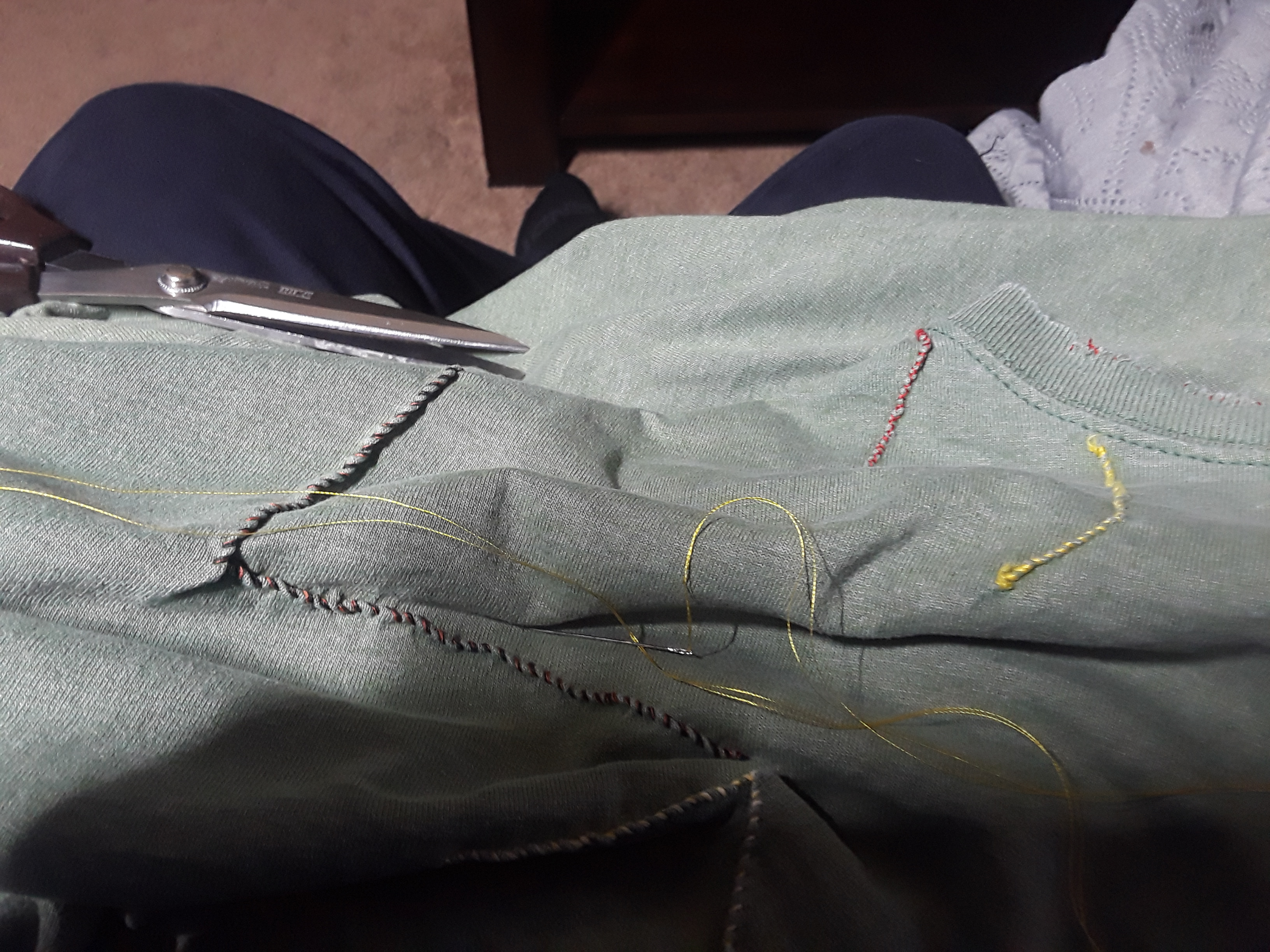
I generally have a rip-shirt in the closet. The current one is somewhere between 15-20 years old. The vivid color of the shirt has faded, and the fabric is stretched past its intended shape. But I keep fixing the rips and frayed edges because that is what life is. I’ve done every activity you can imagine in that shirt. (Don’t overthink that.)
Because I have always sewed, I sometimes dabble with a variety of things that require it. My Grandma Cook taught me to do a stitch when I was very young. I loved sitting at her feet on the rough floor and sewing anything she handed to me. And often, my fingertips. Thimbles were available but made poor guides for novice sewers.
My Dad and brother loved mercilessly teasing me about my penchant for making non-bunching pillows many years ago; my favorite kind involved going to a fabric store or department and choosing something appropriate for the intended v̵i̵c̵t̵i̵m̵s̵ recipients. Sewing has always been meditative for me. I’m not GOOD at it, of course, but you know what I’m going to say: I don’t care. No one in their right mind would ever invite me to a quilting circle for my sewing skills unless they needed comic relief.
In my early 20s, I started doing what I call rip-shirts. Some of them took me 100 hours to make. Simply put, I choose a shirt, usually of a distinctive color, then spend hours sewing stitch patterns all over it. Part of the fun is using a wide variety of threads, especially of different colors. It’s supposed to be garish. It’s possible to do intricate monograms this way, too, which I’ve done. I gave away many of these for years. One of the key advantages of such a shirt is that it becomes almost impossible to distinguish if it should be discarded, as all subsequent rips, tears, and issues can be restitched and become part of the resulting pattern. One of my shirts had over 500 hand-stitched lines on it. For another, I sewed a difficult-to-see curse word cleverly hidden in the stitch lines. That one amused me greatly.
Later, I discovered Kintsugi’s idea, where breaks and defects in bowls and cups are repaired using lacquer and gold dust. Theoretically, such repaired bowls can be fixed repeatedly and still be both useful and beautiful.
Rip-shirts fulfill the same purpose for me. They are each unique.
As the fabric wears, it becomes softer and more comfortable. If you rip the shirt, you can just sew it back. Unless you tell someone, they’ll assume all the stitches were purposefully placed.
When I was 30, I made a shirt for someone I initially thought was mocking me. He pulled me aside to correct me and told me that the idea was perfection to him. Because he was a large black man, I chose a very large shirt. I monogrammed his nickname along one sleeve and put hundreds of stitch lines on it. It was the only time that I worked hard to get the stitches perfectly aligned. When I handed him the shirt, he teared up. “Wow. I bet this took twenty hours to make, X!” I shook my head. “No, it took fifty.” He couldn’t believe that I spent so much time making him the shirt. He died much too young a few years later. What breaks my heart when I think too long about it? I told him I could teach him to do basic stitching in less than 15 minutes. So it came to pass that I sat in an industrial office in a vast poultry plant patiently showing another grown man how to stitch. It occurred to me how strange the idea would have been to my Grandma.
I indeed caught a fair bit of mockery for wearing these shirts. Likewise, I also wore my clothes inside out for fun, too, or made exotic and ridiculous headbands, sewed on a long-sleeve to a t-shirt, and a wild variety of stupidity. I went inside what is now First Security on Emma. The plant manager for the company I worked for had a wife who worked there. I went to the next teller, and it was the plant manager’s wife. I’ll never forget the look on her face when she realized that my t-shirt had the sleeve of a long-sleeve button-down dress shirt sewed on it instead of a standard t-shirt sleeve. She laughed so hard that a bubble came out of her nose. The look of mortification on her face was etched in marble. And then she laughed more. The person in charge of the tellers walked over to see what the problem was. The plant manager’s wife was crying from laughter and trying to tell her what the joke was. Looking at the floor manager in the eye, I said, “I got robbed, and they did THIS to me!” – and I pointed at my sleeve. The plant manager’s wife and I both laughed for another full minute. The floor manager walked away, shaking her head.
I made several rip-shirts for younger kids, who were fascinated by the concoction of stories I created to go along with them. Kids take a bit longer to lose their sense of adventure or categorically reject something interesting.
Somewhere around 2000, I was at the store wearing a rip-shirt, and a gentleman asked me where I bought the shirt. I think I was at Hastings Records. “I didn’t buy it. I made it.” He seemed genuinely interested. That particular shirt had a lot of neon threads in it. I grabbed the hem of my shirt, pulled the shirt up and off, and handed it to him. “Here,” I told him as I stood there shirtless near the main entrance. He didn’t argue or hesitate. “Thanks, Man!” You would have thought I handed him my wallet. At least fifty times that year, I bragged that I was willing to give someone the shirt off my back.
As my eyesight naturally worsened, I began to sew less often. That was a mistake.
I wonder where some of the rip-shirts ended up or if they still exist. Each of them was made by my imperfect hand. Each one of them is a literal tapestry of the moments I spent making them. They are not for everyone.
I don’t remember when I tried Pop Chips for the first time. I don’t remember the 2500th, either. But I could fill all the pickups at a NASCAR race with the chips I’ve eaten since.
They are only 100 calories a bag. Under the “Anything that opens is just one serving” rule, these keep me from the insanity of opening a large bag of baked chips and discovering a large blob of regret at the bottom.
More importantly, though – the texture is perfection. Yes, the flavor is perfectly proportioned. It’s the texture that makes these chips sublime. When I eat them, though they aren’t heavy, they make me feel like I’ve eaten something substantial, much in the same way you’d lose your appetite if someone put a small frog in your mouth while you’re chewing. Except in a good way.
I eat mine with tuna, soup, lettuce, and would probably brush my teeth with them if I could figure out how to do it.
Sams Club sells a case of 30 for $12. I usually just run in, throw money at the manager, and scamper out with several cases. I’ve considered hijacking a semi-trailer full of them. So far, they keep varying the routes, so it’s hard to pick a suitable robbery location. Having a mask on all the time only exacerbates the whim to do this.
P.S. If you overeat this item, it does have the curious side effect of making you want to dress like a handmaiden. Adjust your expectations accordingly.
I waved hello to the girl standing at the end of the trailer. Though the trailer had probably seen its last tenant, the little girl would grow up to touch thousands of people. She didn’t understand that the voice in her head was incapable of silence. As happens in so many similar places, the cauldron’s circumstance made it difficult for her to talk above a whisper. She would leave the place. Such places and the people who inhabit them touch us deeply and rob us of our ability to flourish.
I waved again, though decades of intervening history lie like a chasm between us.
Because no good act goes unheard in a just world, my small voice and gesture caught her attention. Time became diaphanous.
She looked up inquisitively. I felt her as she saw me wave.
Impossibly, she began to shout. The silence was no longer her prison.
I stood at the edge of the rural road, looking north. Because I knew another road once met the edge of the one I stood on, I could see the subtle difference in the ground and the trees’ varying thickness ahead that the forgotten dirt road left behind. Up until 1965, the road led to the Chowderwick house, once home to a prosperous family. It had likely fallen in now and was probably a pile of boards and tin cups somewhere back in the dense trees. It was likely that no one would remember that a house once proudly stood back there in a generation. Such places litter the South.
From the confines of my mind, I saw an image of Lilly Chowderwick when she was 6. In 1964, the Esper community went into shock when they heard Lilly had been abducted and likely murdered. Sheriff Brimley found blood along the floorboards near the wood stove in the front room and along the porch that comprised the entire length of the front of the house. Dogs lost the scent at the edge of the porch. To him, such things indicated that whoever did the crime had planned on not being caught.
Sheriff Brimley conducted as thorough an investigation as was possible in the South in those days. He concluded that Lilly was likely dead and that someone would slip up and say something incriminating one day. Or, more likely, someone would stumble upon a hidden set of bones somewhere within the rural boundaries of Maylean County.
Lilly’s dad Jeffrey inherited a good fortune. It included a store along Main Street as well as some mining interests across two counties. He didn’t inherit the savvy or patience that Lilly’s grandfather used to build a small fortune. By the early 1960s, the Chowderwicks had retreated to the acreage along the road on which I stood. Jeffrey was rumored to beat his once beautiful wife, Lilian. Lilian often disappeared from public view for days on end. Esper, like all small towns, whispered and gossiped each time. After Lilly’s murder, Lilian fell into a trance and seldom spoke. It seemed like she was waiting for her turn.
Sheriff Brimley brought in Jeffrey for questioning. Jeffrey insisted he had nothing to do with Lilly’s disappearance. Although the Sheriff believed his story, he arranged a trunk interrogation a week later. Two of his deputies grabbed Jeffrey as he walked on the edge of the town drunk. They deposited him in the trunk of one of their cars and drove him a few miles to a barn. After convincing Jeffrey he would likely die in that barn that night, they decided he hadn’t abducted or killed his daughter. He was capable of it, though. He confessed to beating his wife repeatedly.
In 1965, Jeffrey died when he drank too much and walked out onto the main road on a cold Wednesday night. A truck loaded with lumber crushed him as he stumbled out onto the road. The driver said he never saw Jeffrey. The accident happened where the swamp and creek encroached on the farmland adjacent to it. The trees often leaned and overhung the road.
Within months, Lilian left without saying goodbye. Everyone assumed she moved out west where distant cousins once lived. No one knew for sure.
I had promised to tell no one the secrets of Esper or Lilian and Lilly Chowderwick. Fifty-five years later, I knew that DNA would out their family secret. I knew what no one else did: that little girl had not been abducted or killed. Lilian murdered her husband. She endured countless beatings after the burial of the empty coffin that should have held her daughter. When the time was right, she killed Jeffrey and put his body on the road. I helped.
Despite my promise, I can finally say that I know all this because I’m the one who drove little Lily out of town in May of 1964. If she had stayed, her father would have continued to abuse her or worse.
My confession must include that I am an accessory to several crimes.
I’m not sorry, and I don’t apologize.
In a few minutes, Lillian would drive down this road and meet me in the place she swore she’d never see again. And with her would be Lilly, now 61 years old, a grandmother in her own right, with a full life that remained a mystery to me. At that age, we decided that she should know that we killed her father.
Though the air was filled with dust, the tears on my face came from a place of nostalgia.
There are hidden roads everywhere if you know where to look.
Obviously, reasonable people get their culinary advice from me. I didn’t go wrong with the plant-based alien-skin bacon, did I?
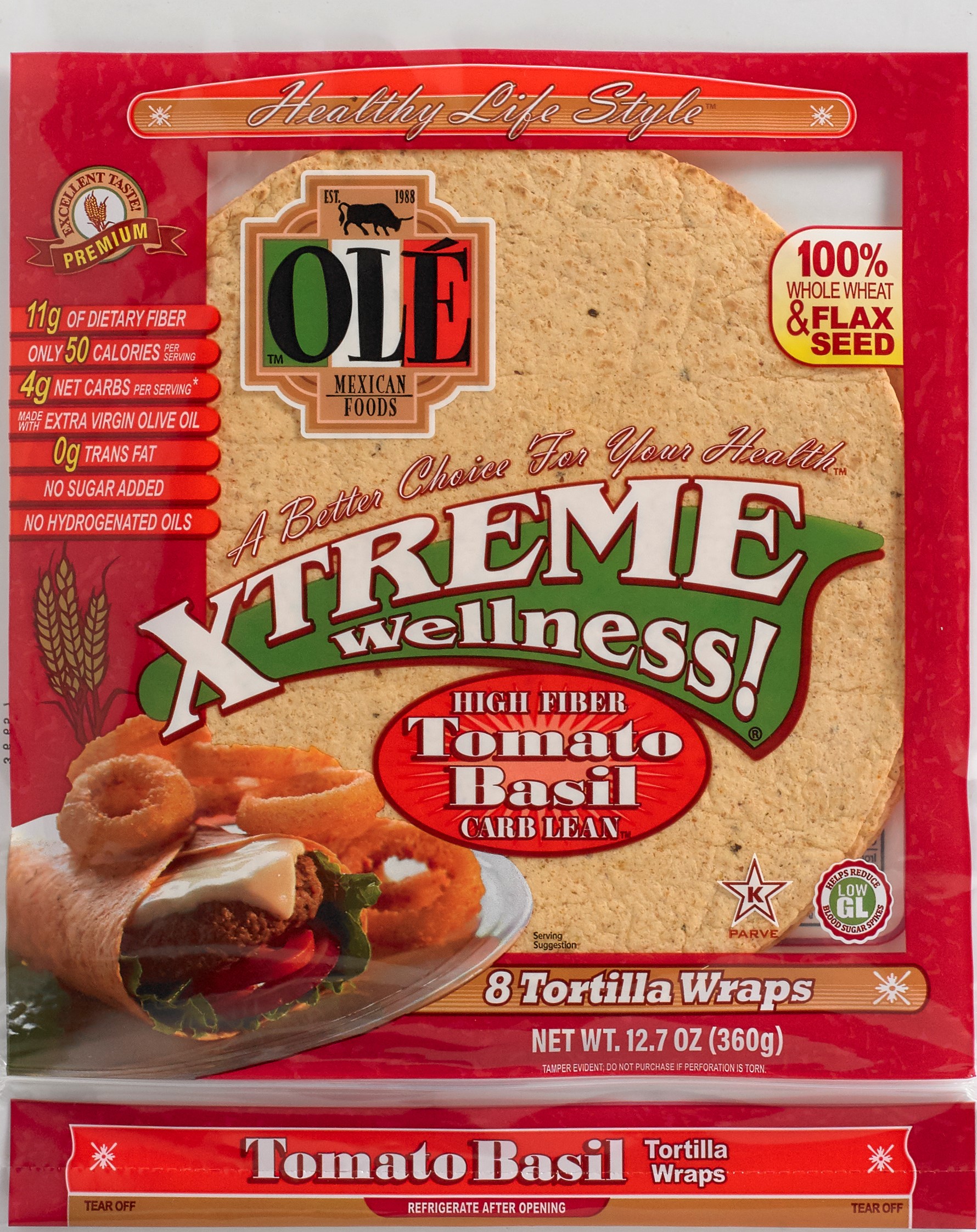
These tortillas are available in tomato, spinach, regular, and dirty cardboard flavor. The last one isn’t true. Not that I care. With the right spices, a lot of things suddenly acquire a new flavor and texture. Dogs bark for a reason.
Although not related, I think any product high in fiber shouldn’t attempt to use the word “regular” in its description. You’ll be regular.
Each tortilla is only 50 calories and each contains 38% of the recommended daily fiber you need. Most of us don’t even eat half the fiber we’re supposed to. If you’re not sure whether you are getting enough, eat two of these and sit patiently on the couch. You’ll have your answer sooner or later. Otherwise, have a big bowl of brown beans and sauerkraut. While it may not work for you, eating a lot of fiber has helped me in ways I wasn’t expecting – not the least of which is people now approach me with considerably more caution.
Unlike many of the other healthy alternative tortillas, the texture for these is normal. Normal by normal standards – not normal by mine, which present another range of potential issues.
I’ve been taking fiber supplements for several months. I’ve also eaten at least 100 packs of these tortillas this year. They allow me to eat less, more quickly, and feel full.
Just don’t start eating them until you discover if you normally eat enough fiber.
Or, ignore me and find out creatively. Go ahead and apologize to your family first, though.
Since I’m shouting out an opinion, I love these. They taste great and have a normal texture.