Category Archives: Biographical

Mistaken Feline Identity

I was in the bathroom trying to shave, a doubtful enterprise at best, especially after being sick and deciding that my appearance was even less important for several days. My neck resembled a cheese left long-forgotten in the bottom drawer of the fridge.

My wife Dawn energetically opened the bathroom door, regardless of my current state, and breathlessly asked, “Why is Güino outside?” (Güino is our tuxedo cat and our current landlord.)

My mind began racing, attempting to imagine the scenario wherein the cat dematerialized and passed through a wall – or in a more sinister fashion, learned how to open the front door.

Dawn raced to the living room window facing the street and peered through the blinds. “He was looking at me through the office window!”

Just as I decided that I foolishly let him escape through some unimaginable series of events, Dawn exclaimed, “That’s not Güino!”

I almost regret that Dawn figured out the bewildering puzzle before cat-whispering the outside doppelganger strange cat into the house, only to be face-to-face with Güino.

What a strange tale we might have told, as our house morphed from a solo to a duet, cat fur flying in the background, one of the rarest cases of mistaken feline identity.

P.S. Dawn already wears glasses.

Living in a Glass Castle

This isn’t simply a review of the movie “The Glass Castle,” nor is it simply a biographical reflection. It is, however, an unsettling hybrid of a portion of myself and the movie. Like all things observed, our own peculiar perspective discolors the content of what we occupy ourselves with: our own face and temperament are reflected in the things we deceive ourselves into believing to be mere entertainment. While I was entertained by the movie, I was also stabbed in a way that few movies can achieve.

I knew the movie preview was slightly misleading and that it had artfully avoided showing the underbelly of what pervaded Jeannette Wall’s life. To be honest, I had forgotten the memoir, even though it was a book that I very much wanted to read a few years ago. After seeing the movie, I can appreciate just how much of the grime, horror, and shock was dropped from it. People love great stories but often recoil when the truth is laid bare. When a good writer is determined to be both honest and unflinching, some stories become too overwhelming. It’s quite the art to begin telling a story that people want to hear, but cringe as they lean in to hear the words they know will hurt them in a way that’s difficult to see.

Perversely, I was relieved to know that my instinct about the movie being sanitized was accurate. Much of the nuance was powerful and authentic; as a student of family violence, a couple of the scenes seemed disjointed to me. Perhaps it is madness to expect continuity in craziness but once you’ve filtered out the normalcy, even lunacy has its rules.

In the movie, Woody Harrelson as the dad is arguing with his daughter, insisting that she’s a revisionist to history. This pathos is one I’ve long held close to my own heart in my adult life. While I sometimes fail to steer away from revisionism, I at least know that I’m not impervious to the tendency. So many others, though, they cling to their idealized fantasies about people in our lives. They frequently take out their acquired masks and repaint them, all to tell themselves that the monsters in their past weren’t really monsters, just tormented and troubled people. People who do their best to tell their stories and to unmask their monsters are a threat to their self-identity. I want to see the monsters, both in my own life and in the lives of others. It does no one an injustice if you are sharing a piece of yourself. Each one of us owns our stories, even those pieces which darkly silhouette our lives.

I’ve written before that sometimes I observe the world and am amazed that most people seem to be unpoisoned by their own secret boxes, the ones some of us have managed to swallow, surpass, and mostly overcome. In my case, I judge most other people to be novices regarding human violence. Knowing the box is there at all robs me of a portion of my ability to live freely. It’s ridiculous to assert otherwise. If you don’t have such a box, feel glad, rather than doubtful that others had the necessity of constructing one to avoid fragmenting into incoherence.


After the movie and during the credits, the dad Rex was shown in grainy black and white, peering out of an abandoned building’s window, ranting about capitalism and property. It was clear that he was much angrier, unmoored, and detached than the movie would have us assume. My wife wouldn’t know it as she sat mesmerized beside me, but it was a visceral punch for me. The flash of recognition I experienced in seeing Rex as he really was versus Woody Harrelson’s impersonation of him almost untethered me. Seeing his as a ‘real’ person somehow unmasked the subtleness and veneer of the movie. Gone was the pretense of nobility or great acts. I could only see the residue of a base life, like the yellowish tint which permeates a smoker’s life. No matter what good Rex Hall might have done in his life, he was a part of what allowed children to be damaged. That any of them took this stew of disaster and emerged with great lives is a testament to our creativity and resolve.

So many of us had family members who would only marginally fit our definitions of what it means to be human. We individually adjust, trying to come to terms with the insanity of anger, knowing in our own hearts that some people are permanently damaged. We fight against the ignorance of others, the ones who insist that forgiveness and acceptance are on our plate and must be consumed. We know that anyone who hasn’t been in a room with a family member and suffered the inconvenience of knowing that our loved one truly might kill us in that moment cannot ever be reached on an emotional level. Until you’ve felt the metaphorical knife, the blade is just a vague unknowable threat.

One of my demons in life has been my aversion to a return to the crucible of anger and those who live there. I’ve been happiest when I’ve been able to reject such associations and cut the strings, and in some cases to stretch them. It’s always a fight, though, because those still melting in the crucible fight to keep you tethered to it as well. I no longer judge as harshly as I once did. Each of us decides for ourselves how our lives should proceed. Seeing the strings is all too often the first step to either severing them or ignoring them. I don’t take kindly to the angry insistence that I pay homage to the monstrous portions of my own past. I’m well aware that I have more than a few people who would gladly bash my head against a stone if it would mean they could resume believing the fantasy that my stories expose as untruths.

I know that intelligence forces us to do strange things with horror and mistreatment. Most of us buttress our sanity by converting these things into humor. It’s a skill I’ve honed for a few decades. As the credits rolled, I watched as Jeannette’s brother joked about his father’s memory, even as he sat at a table with his siblings who shared his past. I can’t speak for him. I do note, however, the brush of nostalgia in his words. Time is what grants us peace and the ability to laugh. Because life goes on, the fists and shattered bottles on the kitchen floor fade. We count our scars, both seen and unseen, and put one foot in front of another.

And sometimes, we watch a flawed movie that somehow reaches a talon inside our clenched hearts and ruptures a piece of what we’ve imprisoned away from the light. Because I know that the author of “The Glass Castle” had a life which was much worse than the movie revealed, my memory is slightly more forgiving. It makes me glad that the grandmother’s legacy has been forever stained and that some things were allowed to slither out from under the rocks to be viewed.

That a memoir such as “The Glass Castle” was written warms my heart. Jeannette Walls overcame and used her gift to sling arrows out into the world. Arrows are both weapon and tools, and she has done a great service to her own survival. The discomfort people might feel is an acknowledgment of how much suffering happens in the world. Next door, across town, wherever people live and breathe.


Family History is Literally What I Choose To Make It

This post has no point, no moral or objective. It’s just a fact.

My paternal grandmother had just turned 14 when she was married. When she married, my grandfather was much older than her. Grandmother had just turned 14 and although she needed a signatory to marry, even the marriage license states she was older than was true.

Even in Arkansas, it seems, people were always concerned about a scandal. When I was very young, I knew my dad wasn’t in Alaska, even though he told me this more as a drunken joke than an explanation. He was in prison in Indiana, for what amounted to a minor crime compared to a few things he had done, one of which resulted in someone’s premature demise. The amusing thing is that my Grandmother Terry was petrified of gossip about her and her family.

I’ve written from time to time about it and other family stories. Like so much of the family lore, I learned of the existence of hidden secrets via hushed silences, sideways glances, and anger when direct questions were asked.

As I grew older, I knew that one day research and DNA would ‘out’ much of the stories some family members didn’t to be revealed. Most of those family members have died, leaving a tantalizing list of questions that might never be answered.

But I do know this: much of what made them nervous under scrutiny were legitimately embarrassing stories and behavior. Their refusal to be honest is a much bigger problem than anything they tried to conceal.

Lately, I’ve seen so many stories which skirt the edges of my grandmother’s story. Some of the same people who seem shocked by the revelations in the public realm are the very same who worked so tirelessly to conceal the truth in my family’s foggy past. They “cluck” at others, all the while knowing their own past is littered with much worse.

Isn’t that the way it always seems to be?

The danger some of my departed family seems to not understand is that by failing to divulge some of the family secrets, they have left their legacy in the hands of someone like me.

If I don’t get answers, I’ll make it up, based on what most likely happened. Given the trajectory of what I do know, that gives me license to go in any direction, no matter how dire, without possible complaint from those who constantly shouted, “Hush!” at me.

Family history, it seems, is literally what I choose to make it.

Guest Post: Erika Saboe – A Musical Memory

1918212_98537153930_885248_n


When I was 15 I had a very emotional time. I was horribly sad. Enough so that I asked my parents to commit me. What I was going through seemed so insurmountable I could not fathom working through it. My parents did not ignore my plea. And for a month I was institutionalized.

It was almost like a twisted resort of sorts… I had a private room but a shared bathroom, I didn’t mind that. My days were scheduled for me. When meals occurred, when activities happened, etc.

When you arrived you were stripped of all boons. No music or pleasantries you were used to. This was before cellphones or internet. My makeup was taken away. One could break the mirror in a compact or the the glass a nail polish bottle was made of and use it as a weapon or device to cause pain. The bathroom mirror was a sheet of metal to allow us a way to see ourselves and ready for the day without being dangerous.

Walkmans were big then. Cassettes. We didn’t have cd’s at this point. They were a privilege. So any kid who checked in lost theirs until they earned it back. You did well you raised a level and got privileges.

For some odd reason…. they did not find mine when checking my luggage. They took everything else but… my Walkman was still there with one cassette in it.

What did I do when seeing so? I stood on my bed and lifted the ceiling tile. Put it above me. Every single night while I was there I would elevate, push my fingers and lift that tile. Pull that Walkman out and listen to Crosby Stills & Nash. I have no idea how they didn’t catch me but I am so thankful they didn’t.

This song, it played so much it has become a trigger for the memory.

I’m aware now, as an adult, that the world is a painful place even when usually comforting. Sadness… it is nothing more than an emotion we feel every day.

Nonetheless this song I wear close to my sleeve due to the memory shared.

Crosby, Stills & Nash – Helplessly Hoping

Guest Post: Erika Saboe – A Cigarette Memory

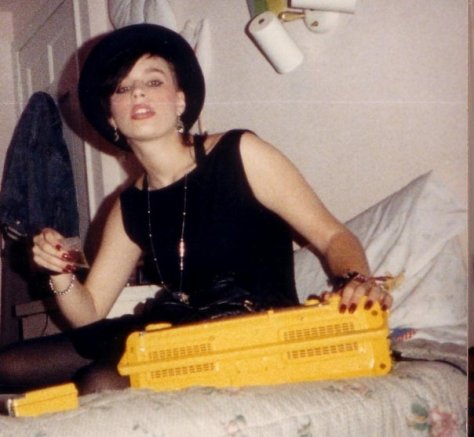
erika recess smoke.jpg


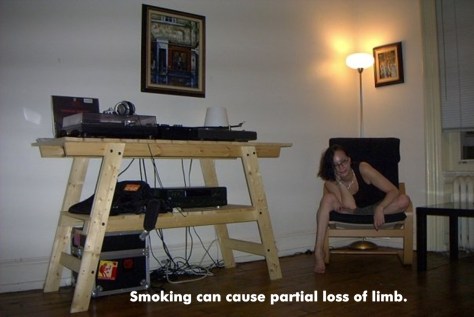
The following is a social media post by one of the best personal essay writers I’ve encountered. This one was written without any idea it would be retransmitted elsewhere. I can only imagine how vivid the words would be if she didn’t write casually. The pictures are ones I made to help her see humor in her struggle to stop smoking.

I’ve been a smoker the majority of my life. I grew up in an era of it being perfectly acceptable. I can remember being 11 or 12 and walking to the rinky-dink gas station across Old York Rd and buying a pack for about a dollar. Smoking on the porch of the lunch commons at my high school. I actually remember smoking on an airplane!!!

My father was diagnosed with stage IIIB lung cancer in 1999 or 2000. I was living in Memphis at the time and probably smoked about 2 or 3 packs a day. This was when you could smoke just about everywhere still without stigma. I didn’t know what IIIB meant, had to look it up on the interweb I had on my Sega Dreamcast (ha!). Then I really got it, like a cinderblock to the face.

My dad asked me to quit and it was a no brainer. I stopped that very day. Was there ever a better reason? NO. I also chose to end my relationship at the time and haul ass home to care for him while he was sick. I spent the next 6 or so months by his side until he passed. And after stayed smoke-free for a good long time. Years.

One day I saw an old friend I hadn’t had the pleasure of hanging with for a long time. He smoked. I threw an ashtray on my table and said, “I’ll have one with you for old time’s sake.” Stupidest idea ever. It started me smoking again for another 15 years. I tried many times to quit. It never took.

I always said, “How will I find a better reason than the first time when my dad was told he was going to die and asked me to quit?” And anytime I tried to quit it seemed impossible. Nothing was enough to make it stick more than one day.

I hated smoking but loved it. I rationalized that it was one of the few vices I had that gave me momentary peace and comfort, but what a line of bullshit that was to simply give me an out to not try. I thought about quitting again all the time. No day was ever right, no reason ever great enough.

I was at the tail end of a work week. Got a fabulous new job a month or so before. Told myself when THAT happened it was my sign to quit but even then I couldn’t. Not a big enough reason to my psyche I guess lol.

Anyway, I was running low on smokes and had this crazy idea to just not buy any more when they ran out. I was already contemplating heading to the convenience store to get another pack when I realized it was Mother’s Day. Thought to myself, “let’s give mom a gift she will really appreciate and stop.” I’ll admit I wasn’t 100% sold but figured I would give it a try.

And shortly after was about out the door to replenish after weakening when I saw what the date was on my watch. It hit like a prize fighter’s knockout punch. It was also my late father’s birthday. Wow. What a crazy coincidence… or was it? I kept looking for a big enough reason to stop again and never could, but it was Mother’s Day and my dad’s birthday all at once. Could the stars align any better to tell me it was the day without being as tragic as the first time? No.

It has been 4 months. 4 months after 15 years of smoking since the 1st quit. 30+ years of smoking total. I haven’t caved once and while at times walking by someone smoking smells delicious (while also repulsive) I have no desire aside from Pavlovian urges brought on by ingrained routines.

It was so hard to quit for so long. And then a day presented itself. That’s really all it takes. Finding the day or reason that flips the switch. When that occurs it becomes the easiest thing imaginable.

If you want to smoke I don’t judge you. It was a vice I loved for a long time. As I said there was an age where it was par for the course. I hope for the people I know who still do and want to stop that they keep their eyes open for the perfect day, and I really want it to be bittersweet like my most recent, rather than tragic and traumatic like the first.


3228_74583998930_6591299_n

organge yellow really big.jpg

A Snortee For Someone Encountered

aaa uncle buck scanned (88)

A few days ago, I was at the liquor store. (These are places which sell alcohol, for those who’ve never heard of such a thing.) I had heard an almost-familiar voice as I wandered the aisles, searching for the things which I already knew to be in their places. I looked to the side and saw an older gentleman, wallet out and open, fingering his money. He had a couple of tens and a few ones. He had a bottle of wine perched on one of the shelves. It was a nice one, a happy medium between cat urine and the kind one might drink at a million dollar wedding. Like men of his generation, he was carefully dressed, his white hair cut short and his shirt without a wrinkle.

Seeing him and hearing his voice reminded me so much of my Uncle Buck, who could be as jovial as a box of delighted kittens. To be frank, he also died from complications resulting from alcoholism. He and my aunt had decided a few years before his death to engage in a race to the bottom of their shared bottle. He won. But as troubled as his life was, he gifted me the word “snortee,” his humorous way of saying ‘a small drink.’ It was only after he retired that alcohol became his consuming passion. Yes, I recognize the incongruity of the word ‘snortee’ for someone who passed in this manner.

I told the cashier that I was going to pay for the elderly gentleman’s wine in addition to mine. Rarely do I question my impulses to pay it forward; so often they’ve rewarded me with reminders of the incredible overlapping of our lives.

“Are you friends or acquaintances?” she asked.

“No, I’ve never seen him before. But I bet he’s going to be tickled when he finds out someone bought his bottle for him.”

After ringing me up, the clerk toggled the conveyor and dragged the gentleman’s bottle forward and scanned his bottle.

“Hey, miss, that’s mine,” the man said.

“This man bought your bottle for you,” the clerk said and smiled, pointing at me.

The smile started at the older man’s chin and stretched halfway across the room. “Well, I’ll be. I never thought of getting a surprise at the liquor store, but I thank you and will most assuredly pay it forward!” He was beaming.

As I left, I turned to watch as the man strode with pride from the liquor store, as best as he could given his age. To my surprise, he opened the door to a minivan exactly like one my aunt and uncle had owned.

I’m not certain why I know it, but I am certain that the encounter pleased him and that he was contemplating it as he drove way, his life bifurcating away from mine.

Uncle Buck would have loved to share a laugh with that gentleman, in another life. In some small mundane yet wonderful way, we all saluted one another, even though one of us had long passed beyond this place.
.
.
.
.
.

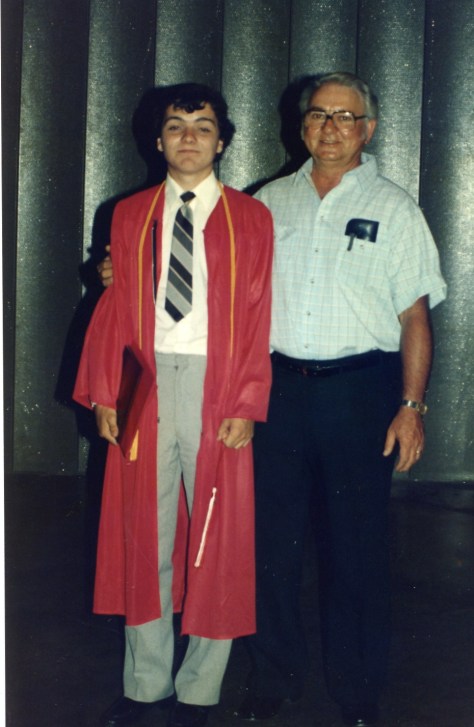
The picture is of me on the left and Uncle Buck on the right.

A Lesson in “Taking Care”

aaaa

Recently I briefly wrote about an English teacher who trusted me with his original novel. His name was Harold McDuffie, an unassuming-looking man with what I would call a policeman’s mustache. While his teaching style was dry, I could see that he appreciated literature. His love for words didn’t translate well, not in terms of enthusiasm or charisma. I think in part this might be because high school students weren’t his ideal audience. These opinions are all mine, of course. For all I know, he might have anticipated each day to interact with young people. Works by Melville or Faulkner, however, tended to be at the bottom of the playlist for the average high school student.

One day, without much fanfare, Mr. McDuffie stopped me and asked me if I would be interested in reading a novel he had written. He warned me that it had some mature content and that I needed to be careful with that aspect of it. I think he knew that my home life had exposed me to things beyond the contents of his novel, but he was smart enough to know that it was a risk, one that I would not expose him to. I was flabbergasted and honored. Reading the words someone chooses to put on paper inevitably lets us get to know them better and connects the mechanics of translating ideas to words and content.

After I wrote a lengthy interpretation of a book, Mr. McDuffie had asked me why I had not shortened my homework. I told him that I thought writing was easy. All one has to do is to put pen to paper and not stop. (Later, Steve Martin stole my idea for the New Yorker and one of his books.)  “What about the mistakes?” Mr. McDuffie asked. “There aren’t any if you refuse to see them that way.” It turns out this is a common life theme for many of us.

Later, he brought in a printer’s box full of several hundred linen sheets of paper. I had never held an original unpublished work before, and the effect was mesmerizing. The title of the book was “Taking Care,” and the main character’s name was Budd Clevenger. The plot involved a drunk-driving death and the cycle of vengeance that followed. Drunk driving was a topic woven all through my childhood: my father had killed a cousin of mine while drunk, I had been in a few accidents involving alcohol, and my parents had each been rewarded with multiple DWIs. They were also involved in the DWI “fixing” scandal that sent a notable lawyer to prison.

As many things as I’ve forgotten, I will always remember the excitement of taking the novel home, opening the box, and starting on page one with the inside cover sheet. I had to carefully pick out each sheet, read it, and lay it face down on the other side of the box. Despite the book’s length, I read it in one evening. One thing about the novel that caught me was that it was one which took place in Northwest Arkansas, traversing places I might have known.

Even as a work of fiction, Mr. McDuffie did as so many authors had done before him: he secreted away little slices of himself into his novel. While I had no way to know which pieces might be fiction and which might be the truth, it opened my eyes to him as a real person struggling with the same life issues that everyone else had. He was a descriptive and gifted writer.

Over the years, I have done deep web searches to see if McDuffie’s novel ever made it to the shelves or to a screenplay adaptation. His book deserved such a chance. While it was no work by Faulkner, it was worthy of being shared and read; because it wasn’t Faulkner, though, it would have appealed to a broader range of interested readers.

That I remember the title of the book and so much about it should indicate the level of attention I gave to the novel. While I read many books in Mr. McDuffie’s class, I read those with a casual indifference granted to schoolwork; as for his original, unpublished novel, I gave it the reverence it deserved. It would have been sinful to have not shown appreciation for the gift of sharing that my English teacher granted me.

Beyond the act of sharing the book, he shared a moment with me. It turns out to be one which lingers. Thanks, Mr. McDuffie.

(PS: I also have some stories about good and strange times I had in his wife’s classes, too)

That’s Still Not My Name…

werwe.PNG

 
As you read this, give me the benefit of the doubt, just as I strive to do as often as possible. I’ve got the respiratory crud and my usual sweet temperament leans toward riotous today. The errors are all mine, as always, especially since I’m both increasingly blind and lazy about proofreading.

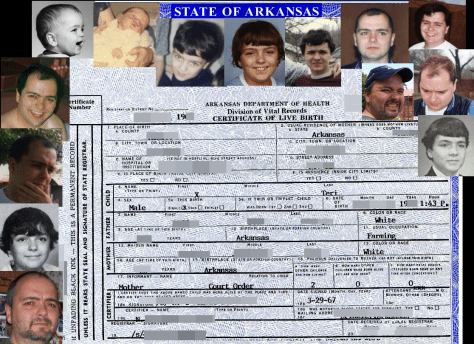
I’ve shared a volume of stories about my past, about my birth name, and about the process I used to change my name and I how I chose it. I hammered a large nail in the coffin of my previous life when I changed my name. I got a whole new set of documents to go with the rejection of my former life, including a new birth certificate, passport, driver’s license, and school records. (No, I wasn’t actually in Witness Protection, although I’ve told a lot of people that one.) I haven’t always handled well those who used my old name like a dagger; overall, however, I’m confident I gave most of them more benefit of the doubt than they deserved. Had I to do it all over again, I would’ve adopted the final season Walter White persona to deal with them. Much of the nastiness leveled against me made for great stories. I can’t have those stories without having been on the receiving end of the behavior – life provides stories most often when things don’t go well, as you know. Sharing those stories put the spotlight on those very people who hated being illuminated.

PS: (1) Due to the Malcolm X movie in 1992, I literally got a truckload of free merchandise with my new name on it: shoes, socks, shorts, gym bags and at least 50 t-shirts. (2) When the radio station 104.9 The X came online, I had a lot of fun, too, and another round of free stuff. (3) I landed on the no-fly list for a while, just as much for my crazy politics as my name. (4) For a couple of years, I lived in Apartment X, which confused EVERYONE who thought it was a joke. (The complex of 4-unit duplexes used letters in lieu of numbers on their units.) Changing my name resulted in several great stories, a more interesting life, and a better outlook for me. My name in and of itself announced to all to stop expecting someone normal to be the face associated with the name; many thought I was black or a member of the Nation of Islam. (If it made for good fun, I would encourage such erroneous conclusions). I’m sure that my name closed a few doors to me as well, to be honest, but those doors were not ones I was particularly interested in anyway.

At least I didn’t have a large leg/arm/neck/face tattoo to startle people. I guess I could have put a large “X” on my forehead like Charles Manson did. I embraced my weirdness and if I could repeat those steps, I’m afraid I would have embraced weirdness earlier and with much more aggressive creativity. Most of the truly happy people I know somehow learned to disconnect the fuse that connects their self-worth to the outside world and the judgment which accompanies it.

The common element that flows through it all is that my birth name was and is a symbol of abuse and ignorance. As young as I was when I opted to change my name, I waited too long. While I came to a place of acceptance about my dad, I never once enjoyed my birth name or the thought that I shared such a bond with a person who demonstrated such brutality. It’s not within my ability to convince you that it was the right thing for me to do; it was the only thing that got me past the lingering nonsense of my youth. Absent a childhood and story similar to mine, you can’t bridge that gap without losing something in translation.

If you can imagine having a name that you loathed, one that caused you to cringe or want to hide away in a dark corner each time you heard it, or one that causes actual pain, that’s the feeling elicited by the name my parents threw on me.

I’ve been X for way more than 1/2 of my life now. I rarely see my old name and hear it even less. And when I hear it, it’s because I am probably back in the cradle of the indifference and passive-aggressive hostility that spawned me. I alternate between irritation of those who ignorantly insist on using it and pity for the lack of understanding on their part. I try to give people the benefit of the doubt. The decades that have shot by should have eradicated any reasonable attempt to use my old name.

It is obvious that I’ve spent an inordinate amount of time explaining to people why I hated my name and that it is the equivalent of verbal ammunition when used against me. I can’t force people to be good, compassionate considerate people; only they can lead themselves to that course of action.

As for my family, time has marched past most of them, leaving me to fend off a few stragglers. As they age, their logic weakens and their actions belie the prejudice toward me that failed to conceal their contempt for me and my choices. I mostly chose the person I became, while they became victimized by their own pettiness. I suffer the infrequent flare-up of derision. Now, though, I am adept at using the tools in the family toolbox to hold a mirror to such ignorance. It is true that much of our shared time was wasted arguing about something that was not for them to decide. I tried to get them to see that but haughtiness and arrogance held them to their attitudes.

I also have a couple of people who lash out in my defense at those who still want to be asses about my name change. My wife is one of them. She knew me when I was young and still had my birth name. It angers her that people can be so petty. There are times when I almost fail to notice or worse, don’t have the energy to pick up the battle-ax and fight on a particular day.

Here’s a list of acceptable reasons to call me by my birth name. This list is one a friend objectively and half-jokingly wrote for me:

1) You don’t like me and using my old name is a means to backhandedly express it.
2) You haven’t seen me in forever and your brain used its old pathways. No harm!
3) You are writing my biography and your mind slipped for a second. No harm!
4) You don’t like my name and you think that using my old name somehow not only negates my life choices but also allows you to use it without coming off a little mean-spirited.
5) You just forgot accidentally, which can happen to anyone. No harm!

As always, though, the cardinal rule is this: if you are asked to stop doing it and don’t, it’s not a failure to communicate; rather, it is a failure to emancipate – to let everyone be who they are.

Regards, X


One of Several Older Blog Posts About My Name

Aunt Barbara


She was always her voice, a timeless southern drawl that caught your attention, rarely raised in anger but often seeped in laughter or surprise. I should have more easily forgotten that she witnessed the part of my life I consider to be the most base. It was a perplexing part of my life to know someone so kind in all the ways people should be good could be capable of looking sideways; only as an older person did I even begin to see how foolish much of my insistence toward oversimplification stripped her of her own individuality. She, like me, lived her life with the gifts she had available; unlike me, she did it with more openness.

It is without rancor that I say that she mounted an offensive for family, always being the cohesion against the twin foils of her siblings who provided either raucous debauchery or aloof superciliousness. When I changed my name almost 3 decades ago, it was she who demonstrated one of the deepest wounds, though she of all people knew in her compassion-filled heart that my motivation was one of self-preservation.

She lived a great life, even when tempered by my strangely fluid definitions. Laughter, family, and even tragedies came and went; and yet, her sense of humor tempered every peak and valley. She stayed in the small hometown that both defined her and amplified her. Such a small place of diminishing returns certainly will be less bright without her.

If this world were to have more of her, there would be more happiness and more hands on shoulders, and even more glasses of iced tea in the summer. (Because while iced tea wouldn’t cure your ills, it would always give you something to enjoy in life, if someone were there to accompany you as you drank it.)

The video was taken in her yard on a July day some 21 years ago, out on the edge of Monroe County, in a place almost everyone speeds through to get from one place to another.

Not her.

She was always where she needed to be, just as she is now.

Her voice lingers on the edge of highway 49, though, evoking the gentlest reminder that so many great moments can be found where you are.

I can hear her voice now, drawling out a slow and welcome ‘hey, y’all.’ .

The Casual N-Word

A personal story… I was asked to write or post something personal. I finished this one reluctantly, as although I’m sharing my life, there will be people who misinterpret or ‘add’ meaning not present in the words I’ve put on paper. I wrote most of this extemporaneously, so treat it like a conversation.

First, let me remind you that I can laugh at the most horrendous things. I can be as macabre as anyone walking the face of the earth can. I can ignore accidental slights and laugh – mostly because I’m as guilty as the next person. Laughter or levity about any subject comes easily to me.

I believe in the power of words, even though I use them like a blind lumberjack holding an ax. Many words can be used in a manner that strips them of their weaponized usage, especially in private contexts, wherein no group or person is being targeted in anger, blame, or belittlement. (Trump gave us the ability to say a lot more of these words in public, it seems.)

In my writing, I’ve talked often about growing up in the South, around those who used the N-Word like verbal placeholders; or worse, as bullets. I heard the N-Word so often from my parents that I began to wonder if it wasn’t a specific, lazy, much-hated person they shared in their life, sort of like an elusive or invisible neighbor always just out of sight. Friends and family used it in ways that displayed their bigotry and prejudice. They defended their usage in all the familiar ways – and if questioned, lashed out in anger that only intensified their bigotry. Some used to the Bible to justify their hate while others blamed it on “the truth,” or “it’s always been that way.”

Bear in mind that I’m not talking about saying the N-Word in a benign context. I’m not defending its usage in that way, just drawing a poor distinction. For me, saying the N-Word when you are expressing hatred, anger, or irrational derision toward someone of another color is the problem. I heard it used frequently as a benign adjective or noun. In those contexts, the word was an indication of upbringing, education, and understanding – or lack thereof. Using that way was stupid, but not motivated by racism – just ignorance.

I’m also not talking about racist actions – just language and attitudes.

When I was very young, I used racist language. I was stupid, ignorant and a captive in a family that unilaterally despised most of what I find valuable in life. I learned and moved on.

Through the years, most people have learned to stop using the N-Word, at least in public, whether they are motivated by true insight into why it is a problem, or whether they don’t want to pay the social price for its usage. As everyone has observed, the word is declining in usage as the generations pass. It’s easier to overlook from those from older generations. It might not be fair, but I love a couple of people deeply who will never overcome the word in their lifetimes. Likewise, I hold some of the people in my life more accountable, as they should know better due to education, profession, and age.

As we’ve seen, “thug” or other thinly disguised code words are on the rise, as it allows those harboring prejudices to vent them openly and claim innocence. It is possible to use “thug” properly, without prejudice, but if you are using it in a certain context, it is questionable – and you probably know it. The more angrily you insist otherwise leads most people to assume you’re concealing deeper prejudices. Using questionable language gives people the ability to attack your motives. There are better words at our disposal.

As for the other part of my story, no one will know to whom I’m referring in this post. No one. (So, if by miracle you are that person, don’t reveal yourself. It’s not my brother or sister, by the way…) Nevertheless, I know a person from the same South that birthed me. I’ve known him all my life. He’s educated and has a position that should indicate that he doesn’t use harsh stereotypical language or words with malice. That indication is wrong.

Recently, I talked to him.  I predicted I would hear the N-Word several times. It’s difficult to count efficiently when the other person is doing a serious impression of Archie Bunker. It takes a lot of work to say the N-Word  repeatedly.

My acquaintance would be self-righteously furious if he knew that I pity him for his inability to grow up. And no matter how much I give him the benefit of the doubt, I still wonder how much racism creeps into his life, the last place you would want racism traveling to. He’s blind to it on a personal level so it is logical to assume it is a moving infection.

Granted, his problem isn’t a “thinking  thing.” He is so blind to his prejudice that he will never voluntarily come to understand that he’s a big part of the problem. You can’t convince him of any of the greater social or economic issues at play, or of cognitive dissonance, or any of the other issues at play in his case.  No matter how elegantly I could present the issues to him, his brain would literally be unable to accept a new dialog.

Like so many other people with questionable worldviews, he also uses the trite, “Everyone is racist” argument as if it’s written on granite in the Book of Truth. He does so in part because it is one of the most recited expressions among those who need to justify it.

Minorities don’t have more rights than the majority but they do have one thing others don’t: the right to point out that once you have eaten at the table of the lesser long enough, it’s hard to overcome the expectation that others see you as sitting at the table voluntarily. When white people use racial slurs, they are doing it from the position of historical fear, no matter how feebly they try to argue otherwise. Their usage is worse than that exhibited by those who are angry at being mistreated. This argument is one so many bigots dance around, avoid, or scream about.

When you’ve got everyone outnumbered, you’re the bully.

If you think you can be racist because a minority can, there’s no amount of conversation that will change your mind. “You can’t reason someone out of a position they didn’t reason themselves into.” Calling everyone else a racist is a poor argument on several fronts, but I’m not going to note them at this point.

As I think about my conversation overstuffed with the N-Word, I wonder how openly many people are going to proudly display their prejudice.

And scream with spittle-filled lips that they themselves aren’t prejudiced.