If you listened to the radio much between 1976 and 2009, at some point, you no doubt heard Paul Harvey’s distinct voice say those words. It was his way of kicking off his segment covering news of the day, personal commentary, and possibly a tidbit of some sort to make your life easier. His syndicated program was heard by millions of Americans every weekday for decades, and he had credibility and influence with his listeners.
How much credibility and influence he had became apparent when I saw him get three teetotalers to consume what I’ll call drunk grapes. To be clear, these folks believed—hands down without a doubt—alcohol is not to be consumed in any form unless you’re taking communion at church. No sip of wine with dinner; no beer while watching a ballgame. One tiny sip of inexpensive communion wine once a month was the only allowable type and amount of alcohol.
On a trip to my hometown in the mid-90s,I pulled into the driveway at my parents’ house one Sunday—-late morning. The folks were still at church, so I headed next door to my grandma’s house.
There I noticed but didn’t think much about, a mason jar on her kitchen table filled with clear liquid and globs of shriveled golden raisins.
Later, in my parents’ home, the same type of jar filled with clear liquid and raisins sat perched on top of the refrigerator. Neither of these jars had been in place the month before during my visit, so I had to ask.
Turns out, that week on his radio show, Mr. Harvey had touted a new remedy for relieving the pain of arthritis. In fact, the recipe might even be the answer to several ailments.
The recipe was simple: Pour a box of golden raisins into a large glass jar and fill it with gin. Let the raisins soak in the gin at room temperature for a week. After that, eat ten raisins each day. In about two weeks, your various pains should be significantly relieved – if not completely cured.
While it sounded a bit odd to me, stranger miracles have happened, so I made a mental note to check back during the next visit home.
First, though, I had to ask how this all came together…
Getting raisins was easy enough; Mom simply added them to that week’s grocery list. But how on earth did these three non-drinkers get the gin?! Mamma didn’t drive, so that option was out. Dad himself wasn’t an option because he wasn’t a fan of the unknown and going into a liquor store alone was far beyond the boundaries of the comfort zone he liked to inhabit. It was, as usual, up to Mom to do the heavy lifting or, in this oddest of cases, picking up the spirits.
One of the small town’s numerous liquor stores was situated on the route my mother took to and from work daily, so it seemed the logical choice. But my mother did not relish the possibility of being seen parking at and walking into such an establishment. A plan eventually was finalized. Mom would watch the pattern of occupancy at the package store, and Dad would drive her there during a day in the week with less auto and foot traffic. He would park at the side of the store in hopes they were less likely to be seen by people they knew (even though the side parking offered two directions from which to be seen just as the front did). Mom would go in to purchase the gin.
The chosen day came, and nerves tingled as Dad eased the large, white car alongside the building being careful not to block the drive-up window.
Mom gets out and purposefully, but quickly, marches to the door. An old-fashioned bell clangs as she pushes the wooden door open and steps inside to an expanse of potent potables.
The clerk behind the well-worn counter looks up to see an unfamiliar face and asks if he can help her find something.
She hesitates briefly but knows it is useless to look for it herself – she will never find what they need if she doesn’t have help. Yes, she says in a voice that fakes confidence in what she is doing. Yes, I need some gin.
Stepping around the end of the counter, the clerk throws a wrench in her business. What kind of gin, he asks. Kind? Her mind freezes for a second. There are different kinds of gin? She throws the wrench back. The kind that’s good for soaking raisins. Her firm answer implies “of course” at the end of her sentence, but she knows as the last word comes out how ridiculous it sounds. It is the clerk’s turn to be surprised. Mom can’t help but smile a half-smile at the situation. The clerk laughs and says “Well, let’s see what we have. You say it’s for soakin’ raisins, right?” Mom laughs and answers “That’s right!” before she adds that Paul Harvey said gin-soaked raisins are a cure—or at least a help—for arthritis pain and several other ailments, and they think it’s worth a try.
By now, they are standing before a selection of gins with a variety of prices. As with many things in life, Mom figures you get what you pay for, so she skips the cheapest and the clerk helps her pick a middle of the road gin. They return to the counter where the clerk totals the purchase, bags the gin, and accepts the cash Mom slides across the counter. Mom thanks him and turns to leave as he waves and wishes her luck with her raisins.
She closes the door behind her and notices the bell’s muffled jangle. She thinks that wasn’t so bad. She rounds the corner and notices Dad scrunching low in the seat looking furtively in every direction.
She marches to the car clutching her once in a lifetime purchase, grabs the handle, and hops into the passenger seat. Simultaneously, she says that didn’t take too long as Dad grumbles what took so long; he thinks someone they know saw him.
The engine roars to life, and Dad pulls as quickly as possible onto the street and drives home the back way.
And now the gin and golden raisins are hanging out together in glass jars waiting to be medical miracles.
A month later, I arrive home for another visit. The mason jar at my grandmother’s is gone. I ask if the raisin and gin “medicine” had worked to banish her aches and pains.
“Not sure bout that,” she said, “but it was really a dose!” The emphasis on “dose” was so heavy, I couldn’t help but laugh before saying it was too bad the taste wasn’t what she had hoped for.
At that point, I decided not to even ask my parents about their treatment as I could already imagine their reactions. The thought of the entire situation, all these years later, still makes me laugh and the line “it was really a dose” has become a fun and regular phrase in my vocabulary.
It’s apparently true after all. Sometimes, the cure really is worse than what ails you.
And, in the words of Paul Harvey, “Now you know the rest of the story… good day!”
A wise woman once told me anyone can be a father, but it takes someone special to be a daddy.
She spoke from experience having been raised from the age of three by a man who wasn’t her biological father but who loved her as if she were his own.
He was a man of the land; a farmer who sweated in the cotton fields of Monroe county and hunted in the area’s woods. He took his family to live for a time in California during the Depression where he worked as a carpenter and where one of his children was born before the family returned to its roots in the soil of the Arkansas Delta.
Before that, he had a wife and children he loved. When the youngest of them was still a baby, his wife became ill, and the family needed help. A young woman needing work came to the house each day to care for the younger children, cook, clean, and tend chickens while the man worked the fields and cared for his wife. Tuberculosis was common in those days, and it robbed many families of their loved ones. With her passing, the man was left a widower with children. He and the family still needed the young woman’s help, and, to keep things “proper,” they wed so she and her small daughter could move into the house full time. What surely began as a marriage of necessity turned to a marriage where love lived and grew, and they added four more children to the family. The number of grandchildren grew, too, over the years.
For many of them, memories of him included how he rolled his own cigarettes—carefully pulling a thin cigarette paper from its packet and holding it between several fingers of one hand while tapping tobacco from a Prince Albert can with the other. He then rolled the paper, licked to seal it, and twisted the ends. If asked, he allowed whichever grandchild had climbed into his lap to watch the fascinating process lick the paper for him. It was a thrill beyond thrills, and only a granddaddy wouldn’t mind a child’s spit on his cigarette. He loved his grandchildren, and the honest summary of their high energy visits was a simple “I love to see them come, and I love to see them go,” as he smiled.
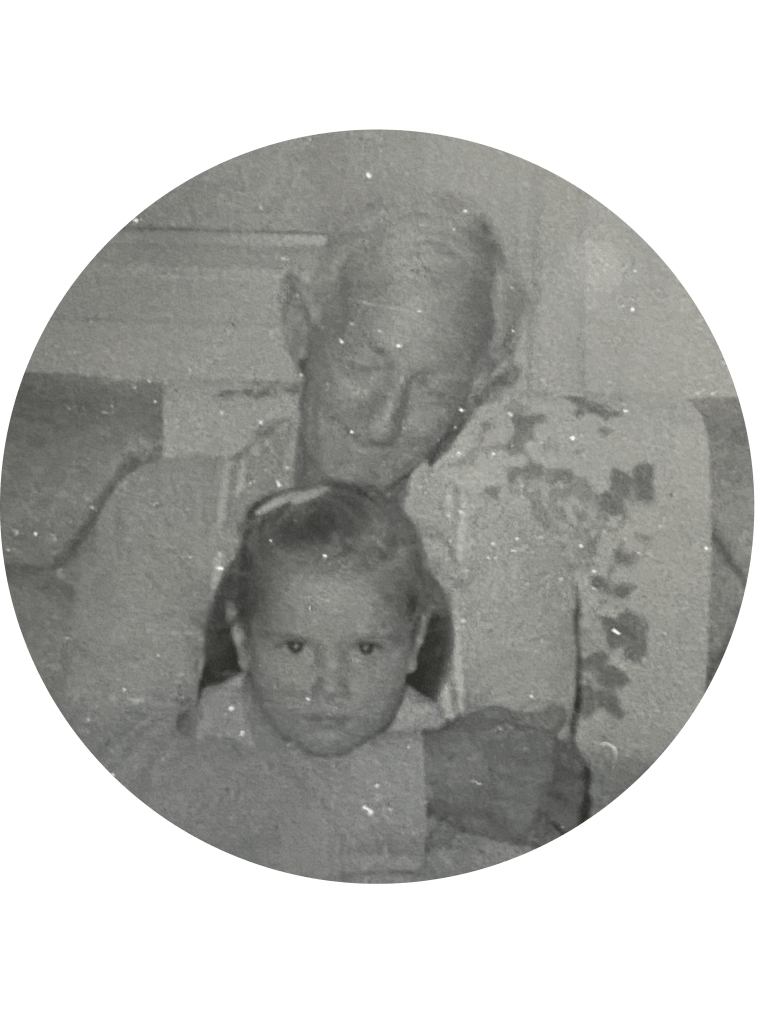
He was a quiet man, but his eyes and facial expressions spoke volumes. You can take my word for it, or you can look at his expression in this photo—the first photo taken by my sister on her first camera. Its value can’t be determined by a number for it is priceless to me as it is the only known photo to exist of this elderly man and young child, and he only lived a few years longer after it was taken.
Most folks called him Lawrence; his wife called him Lun. Turns out the wise woman mentioned at the beginning of this memory was right. Anyone can be a father or grandfather, but it took someone special to be the man I call Granddaddy.
I know most of you know that a lot of people reach out to me and share personal stories. Most of them who do so respond to my fling-it-to-the-wall method of personal sharing, I’ve yet to find a single person who doesn’t have a couple of jaw-dropping stories.
In the last year, I would say the strangest and most incredible story someone shared with me was the one shared by a woman about her sister, thought to have died during birth – but was actually stolen by a doctor here in Northwest Arkansas and given to a well-to-do family.
A while back, I wrote a post about not using a clothes iron. (I also don’t own anything that requires dry cleaning, either.) It was a little piece of fun writing. Shortly after, I received a note from someone who told me an interesting story. As with the baby-stealing doctor, I was fascinated but was held to secrecy regarding the people involved. She told me she couldn’t think about irons of any kind without thinking about her grandmother.
Here it is, with some redaction:
My grandmother was born dirt-poor. She didn’t really know what her birthday was because she was born between fields. Her great-aunt told her she was born in 1912. She remembered it was the year that Wilson won the presidency and that it was a leap year. The leap year fact stuck in her head because her uncles kept joking that they had been given an extra day to work. Everyone in her family worked the fields and farms, no matter how old they were. Until WWI, they barely survived. My grandmother Edna remembered her father going to serve along with his two brothers. Only one brother returned alive. His name was Henry, and he was an alcoholic and a violent man. Even though Edna was only 8 or 9, she knew she had to hide from Henry when he was drunk. Her mom Ethel married Henry to survive. Four children were too many to care for.
When she was 12, Edna was working as an adult woman. She spent her days cooking, cleaning, doing laundry, and working in the fields. Her other sister worked with her and neither went to school past the 4th grade. After a late-night of drinking, Henry came home and grabbed Edna. He later claimed he didn’t know it was Edna rather than Ethel. Edna fought and clawed until Henry collapsed on the floor. He broke several of her fingers during the fight. Her mom fixed her fingers on the back porch but offered no consolation or words of compassion for her daughter. Years later, she found out that her mom had been abused by someone for several years. The fact melted her heart and turned most of her anger to bittersweet understanding.
Weeks later, Edna hatched a plan to get rid of Henry. She stoked the stove in the living room with more firewood late in the evening instead of letting it burn down to ashes. She put one of the fire-irons into the red coals and closed the stove door as much as possible. After all the lanterns were extinguished in the two rooms used for sleeping, she lay awake, waiting. Before too long, she could hear Henry’s raucous snoring from the room next to hers and her siblings. She climbed from the sunken bed and walked across the freezing-cold floorboards of the cheaply-constructed shotgun house. She searched in the dark for the clothes she’d arranged under the dresser, tucked out of sight. All the doors creaked like the floor as she passed through.
As she entered the living room, she listened to the crack of the stove and the wind-up clock behind her.
Before losing her nerve, she used three rags to pull the red-hot fire-iron from the stove. Walking quickly, she went into the room where Henry and her mom Ethel slept. Henry’s snoring told her he was asleep. Before she could talk herself out of it, Edna pulled back the thick covers from Henry. She put the fire-iron, tip down, across his stomach and legs, as best as she could manage in the dark. She threw the covers back on top of her stepfather. In a few seconds, the snoring stopped, and then a loud scream erupted from Henry. She couldn’t see him grab the iron, but he screamed again, probably as he grabbed the brutally hot iron with a bare hand. A loud thud hit the wood floor. Her mom Ethel began to shout, asking what was wrong. Back in those days, the bedrooms didn’t have light bulbs, or if they did, they were a single hanging bulb awkwardly danging in the middle of the room in shotgun houses. You had to get up and relight the lantern. Her mom, still hollering, shuffled around and struggled to light one of the long matches next to the oil lantern on the table across from the bed. She managed to light the lantern and turn the wick up. As she turned to see what had happened, she saw her daughter Edna standing by the door with her hand over her mouth. Henry was gasping and clawing at his stomach and lower half. The iron had burned away his underclothes from just below his belly button to his upper right leg. Edna had misjudged the iron a little bit; otherwise, Henry would have been reminded of her each time he went to the bathroom. He looked as if he’d been burned by an absurd branding iron.
As Edna looked at Henry writhing in pain, she knew he’d never abuse anyone again. She also knew she couldn’t stay. She ran out of the house into the cold night. She didn’t go back. A second cousin offered to let her stay with her if she agreed to work with her at the store she and her husband owned a town over.
The sheriff visited Edna a few days after she moved. “Henry isn’t pressing charges. What did he do to you to make you do that to him?” The sheriff seemed as if he suspected. “What did he tell you?” Edna asked.
“He didn’t say much, other than he didn’t ever want to see you again.” The sheriff shook his head and left. “I expect you won’t be causing any more trouble, will you?” Edna shook her head “no.”
Edna’s new family immediately started referring to the incident as “the incident.” Before long, they jokingly referred to her by the nickname “Incident.” A few months later, Edna’s sister moved to live with her. Both sisters were adopted in the family and started attending school again. Though they didn’t go to court, as people often didn’t do in those days, they changed their names to honor their new family.
Both sisters became teachers and lived their lives without further felonious undertakings.
The woman who wrote me told me she discovered the story after doing a DNA test. Luckily for her, some of the surviving family shared all their stories with her, several of which she’s written for everyone to share.
*
As with the stolen baby story that happened here in Arkansas, the fascinating details aren’t mine to share. If it were my story, I would proudly tell it as a story of a woman who figured out that sometimes fire is a better solution than words or hope.
“Hurry up and close the screen door! You’re letting flies in!” If I heard that phrase yelled at one of us kids once, I heard it, by conservative count, at least 32,760 times in my life. If the phrase had to be said more than once, the lollygagger was likely to be threatened with being locked out for a while; a punishment my brother figured out could be short-circuited by popping the door right where the hook went through the eye sending the hook flying up and over to dangle uselessly.
Keeping the screen door closed was important. We lived behind a grocery store in a small town. Its dumpster was straight across the street from our driveway and the screen door. My mother hated having the back of that store as the view from her kitchen window. In fact, she hated everything about that store.
Store employees and management dumped all kinds of expired food, including meat, in that dumpster. In the winter, it wasn’t so bad. But in the hot summertime, it became unbearable. The stench from rotting meat, produce, and milk could almost gag the maggots that formed on it. It was a common sight to see my mother marching across the street and pouring a jug of bleach all over the bin’s contents. She had talked to management time and again simply asking that they not throw away raw food items until the night before or the morning of the sanitation truck’s arrival. Sometimes, they would do as she asked. More often, they didn’t. As a result, they lost all of our business, as my mother began driving across town to the Kroger store near the interstate. The amount spent by my mother on groceries each week was substantial as she fed our family of five (including a male teenager who could pack away a lot of food easily).
Apparently, my mother’s example taught me as a child that not being able to beat them didn’t mean you had to join them. To this day, I will boycott a business in a heartbeat based on principle alone.
Aside from the smell in the summer, having a grocery store as a neighbor wasn’t so bad for us kids in the neighborhood. Really, it couldn’t get much better if you could scrape together enough change to buy a fudgsicle or a tiny container of ice cream with its own wooden spoon attached. If that much money couldn’t be found or begged from an adult, sometimes we had enough for a pack of candy cigarettes or a package of wax paper wrapped Now and Later candy (as if any of it was ever left for later).
Sometimes when money was scarce but supplies were available, we got our parents’ permission to make lemonade and sell it in the parking lot to earn candy money. Yep, for a kid, the positives of the store outweighed the negatives by far.
My mother rejoiced the day the grocery store’s owner closed the store. It stayed vacant for a while but eventually was converted into a maintenance shop and parking area for the school district’s buses. Life became a lot more peaceful – especially on the weekends when the shop sat empty waiting for school again on Monday.
Several decades have passed since then. The shop remains though the school district is shrinking as the town’s population shrinks. The house, however, now sits empty, its latest occupant having deserted it for reasons unknown to me. The kitchen windows stare blankly – one window partially broken.
It’s not much to look at, that house, but on the rare occasion I do, I can still hear “Hurry up and close the screen door! You’re letting flies in!” And I smile.






 P.S. Parenthetically Speaking