Category Archives: Psychology

(An Odd Zen Realization)

Every path comes with a price.

Decisions narrow your options. 

You can’t travel to two places simultaneously.

To choose one thing lessens your ability to do others. 

To choose one person is an exclusionary decision.

Specializing in one job means you can’t work elsewhere. 

Setting aside time for a hobby reduces the time, energy, and concentration for others. 

The contradiction in life is that unlimited choices aren’t real. 

Once you’ve chosen, the battle is appreciating the hobbies, the people, the job, the place you live, and all the results of narrowing your options. 

In all things, be as enthusiastic as possible in the choices you’ve made.

Happiness results from freely choosing and doubling down on what you’ve chosen. 

Freedom is the ability to make those choices. 

Money can’t buy happiness but it definitely provides options. 

Perversely, most people do not take fruitful advantage of the options that money provides and instead insist on accumulating more wealth. 

What would your life look like if  your financial situation could never improve?

Make your choices deliberately and wisely.

Time is limited. 

Avoid passive choices or paths you didn’t take on purpose.

What approaches us will likely greatly reduce our ability to make choices. 

Chaos is inevitable and you need to understand that even if you do everything correctly, you can still fail by whatever measure you judge by. 

We live our lives independently, but each of us is subject to a myriad list of things out of our control.

Each of us will need to adopt a new attitude and find ways to do more than merely survive. 

If you can’t be creative and find a way to live meaningfully when things get tough, you will needlessly suffer.

There should be no shame or regret if your choice is to live in the moment.

X

.

The Danger of Uncertainty

One of the reasons apocalyptic shows and books are so fascinating is that they share the themes of human morality. When deprived of food, comfort, or stability, our prefrontal cortex surrenders to the amygdala, the lizard part of our brains. One of the truths of human nature is that much of our morality is built on the foundation of having our basic needs met. When your brain overwhelms your critical thinking, it takes a massive effort to overcome the instinctive response that results. People underestimate how complex our instinct mode is – or fail to appreciate how our brains misinterpret danger signals, even in everyday life. In short, you can’t think about goodwill toward men or write poetry when your belly growls.

The above partially explains why judging someone is easier when things get complicated.

This is one reason massive social change is a losing bet. While people might be fed, they lose their sense of continuity, security, and stability. Going hungry pulls the nail out of human decency. Too much change takes away people’s ability to cope. This is true even if the changes are favorable. It’s no accident that rapid technological change and its consequences bring anxiety. Because we’re all sitting in the same soup pot, we frequently fail to see the bigger picture because we focus on the symptoms rather than the central issue.

This is obvious to those of us who were threatened by the absence of our needs being met growing up—those who haven’t don’t experience the same reality. Your body and brain don’t forget the trauma caused by feeling threatened or in danger.

If a person or people in society reach the tipping point toward helplessness, things get ugly quickly. The 4% rule stipulates that only a tiny portion of the population can trigger massive social movements or react to sudden changes. It’s as if our collective subconscious realizes that the status quo isn’t working. We often seek a resolution, even a bad one, over continuing in the current state. We sometimes burn down the house to get rid of the houseflies.

This is another valid argument for ensuring that we care for everyone’s basic needs. If we do not strive to meet people’s basic needs, chaos will bubble up – and often universally trigger a volatile reaction.

Some are blind to the ideal of the American Dream that most of us grew up believing: work hard and be rewarded. Or that government is the cohesive force behind it all to provide stability. Current events have put these components in jeopardy. You can’t effectively destabilize the government without hitting the hornet’s nest of societal upheaval. If you monkey with the stability variable, you’ll get some nasty results. People will set their metaphorical houses on fire instead of rationally attempting to adjust to what feels like uncontrollable chaos.

It’s fascinating to watch the younger generations react. They are the critical ones, watching and learning invisible lessons. It falls to them to decide what will become of the mess the dinosaurs of today are creating. They don’t see themselves as the future because, like us, they mostly grew up thinking that society’s undefined “adults” had things in check. We do not. We are winging it and ignoring the dangers of continuing on this path of uncertainty.

These are just thoughts that not everyone understands.

X
.

Fool’s Wish

Praying isn’t going to help my helpless and hopeless friends
God slept through the Holocaust, so I doubt he cares how this ends
He might have put all this in motion, but he’s left the building

Though you think you’re on the side of righteous
The other side thinks you’re completely wrong
Ain’t no use competing with deafness and fervor


We have to run and jump in the water no matter how deep we find it
Some of us are going to get pushed and experience confinement
But that’s going to happen anyway, even if we keep our hands at our sides

What you don’t know about bullies is that they don’t need an excuse
They’ll punch you even if your arms are at your sides
It’s a lesson learned by millions of women throughout history

Some people need enemies no matter how they find the world
Others take pleasure in inflicting harm and constant pain
You can’t placate or talk them down from their thrones

Bullies are hard-wired to respect nothing but violence
It takes a greater force to shut them up for good
Waiting for someone to step in is a fool’s greatest wish

No logic, compassion, or love will reach them
Wishing it won’t make it so
The only thing understood is karmic retaliation

God slept through the holocaust, so I doubt he cares how this ends


Blessed Be The Fruit

Blessed Be The Fruit

People are discussing the complexity of the human capacity for collective evil. Whether one section of the population likes to acknowledge it or not, Germany’s example constantly pops up.

How can so many people stand by and watch the country descend into madness?

The best way to visualize this capacity is to watch the movie The Stanford Experiment. If you’re even slightly interested in the psychology of collective misbehavior, this is the easiest shortcut to benchmark how things go astray so deeply, even with intelligent and otherwise kind people.

The same effect applies to police, the military, or even people making decisions in business.

Anyone who’s never experienced the environment of a production line might not understand it. Each employee is present to earn a living and mostly do a good job. Those who own the production line want to profit while providing a living for those who work there. An interesting thing often happens, especially in poultry and similar industries.

The need for profit puts those in charge of the environment, the efficiency, and the speed of the production line often blurs the line of humanity by increasing the demands on those working it. It becomes hard to perform the job safely over time. People suffer the indignity of sometimes being able to exit the line long enough to take care of their basic bodily needs. For some, it becomes easier to dehumanize those who perform the jobs in order to be profitable and efficient.

The above can’t be explained to someone who hasn’t experienced it.

The same effect applies throughout our society. We justify less than a living wage, even though we know these jobs are necessary and that our collective decision to fail to pay sufficiently to live even a basic life is causing misery. All of this is based on economic concerns rather than the primary focus of human happiness and dignity. It is a them problem rather than an us problem.

We don’t provide universal health insurance, even though doing so would cost less than our current system. But this does not stop us from passively watching as millions of people suffer from a lack of health care or go bankrupt.

We put on our hats of authority and often forget the results of callousness. It’s our job, we think. Society apparently wants it to be that way, or we would have intervened to change it. We make decisions without consideration for how they impact people, or we are put in a position to be powerless to change things.

We marginalize certain groups. Over time, this gives us a silent yet undeniable tendency to view others as lesser. This justifies our collective behavior that often results in denigration or harm to the people in those groups.

My upbringing gave me an unholy understanding of the possibility of violence inside people. Even the pious in my family found ways to justify turning a blind eye toward what can only be called evil. Family who could observe a child being hurt and find ways in their minds, especially based on the societal norms around them, to fail to act to protect them, were they evil? Or were they just the product of their environment? Several of them held dear their holy books – and did not react well when I grew up and became confrontational about the disparity between their alleged message of love and kindness. That message had justified their deliberate choice to do nothing.

People in history are no different from us, even if we want to think they were. This gives us a pass and carte blanche to continue to behave inhumanely, even if we are technically just doing our job or fulfilling our role as citizens.

Love, X

October Surpries

“Sorry about all the dust,” he said.

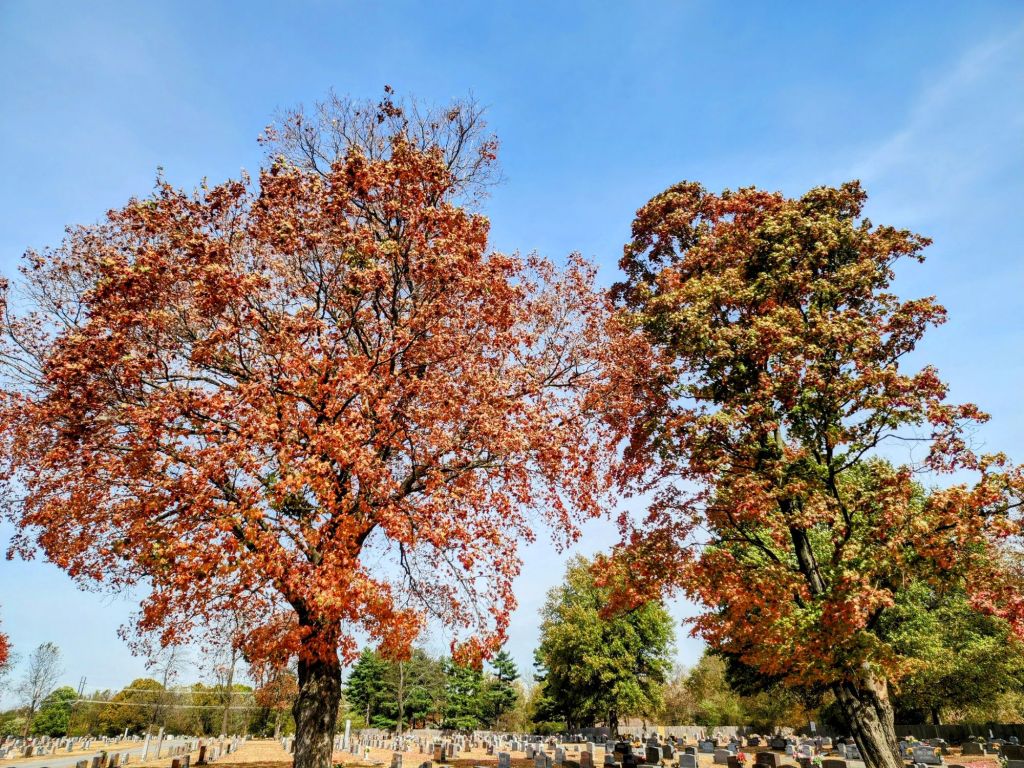
The park crew was clearing brush and trees from the creekside end of Bluff Cemetery. We’ve been weeks without substantive rain. 

Because the amount of dust reminded me of an empty field before and after the crops of my youth, I told him, “A little grit in the heat never hurt anyone.” 

Because of the elevation of the cemetery and the exposed expanses of ground at the cemetery, the effect of the high wind carrying and eddying the dust and leaves was quite beautiful despite it covering me as I walked through it. 

It was shortly after noon during my visit. The sky looked like a summer sky even though the browning trees frowned at me for such a thought. 

I can’t visit a cemetery without viscerally feeling the irony of loving cemeteries for their history and emotional anchors, yet having always disliked the ritual of burial. 

I have several family members at Bluff. Several contemporaries and people I’ve known also dot the landscape.

After meandering, I took a photo of a random grave. Someday soon, I’ll use the information to find out more about the person using my research skills. It may seem foolish to some for me to do this. But every time I do it, I learn something. I like to think that a random stranger’s attention might float up into the after and ether and hit a hidden chord of memory in the universe. 

Before exiting the property, I pulled my car over and parked. I chose a tree along the periphery and did my best to climb it. My pocket was loaded with a length of wire and a beautiful prism. I left it hanging up there. In the days to come it will become more exposed as the tree gives way to November. 

Ashes to ashes and dust to dust. 

The prism is a reminder that sunlight is not only the source of all life here on Earth, but also provides the only way we can experience beauty with our eyes.

No matter what your views are of the afterlife, many forget that we are supposed to squeeze life while we’re here. Some of us produce lemon juice and others nectar. 

We all breathe the same air and for different lengths of time.

PS I hope some of you got to enjoy the leaf tornadoes that seemed to be everywhere today.

Love, X

.

October Wonder

The exuberant blush of the chilly October morning passed. My arms were heavy from relentless push-ups, ones executed to silence my imagination and mind. The fleeting and mercurial chance to venture out and sit among the mountains of scattered fallen leaves passed as the shadows of the morning disappeared. The chance to hold a hot cup of coffee and share the absurdity of humor as the crows called. I grew tired of my mind, wanting only presence. So I sat and watched the gentle breeze move the remaining green limbs of the trees. The accompanying sun attempted to pierce the gauzy Autumn clouds. It was a reverie that inevitably concluded when I put on my practical shoes. The magic of the morning that I love evaporated into the ether. But still my mind wandered in the cavern contained and concealed inside of me. It’s one of the consequences of living in boxes. Swooping high above, there are a million boxes and each one contains a universe of self-contained minds. Sonder strikes differently on fall mornings. It is the interconnectedness of us that makes it worthwhile. If it feels lacking, not much effectively works as a distraction. 

And I’m floating.

.

PS I wrote the above words yesterday morning. I listened to Spencer Sutherland wail “Alive.” And though I shared these words, I’m frustrated that I’m experiencing the same disconnectedness this morning. The easy fix evidently stretches too far for some. It’s obvious I don’t lack the words or the ability to communicate. So, I blasted “Alive” again and reminded myself to be grateful for what I do have instead of that which lacks. I remind myself that it’s human nature to fail to appreciate the 80% to chase the 20%. The problem is that the magic tends claim residence in the 20%.

Love, X

.

Enthusiasm?

I felt clever because somebody challenged me to define enthusiasm.

I fake-stroked my beard and answered, “Imagine you’ve asked a friend to come over Friday or Saturday for dinner. If they say, ‘Of course. Let’s talk about what day or time,’ you get a definite feeling. If they say, ‘We’ll see’ or ‘Maybe,’ you get another feeling. The gap between those two is enthusiasm.”

X
.

This

Communication is key, or so they say. It’s comprehension that’s the objective. People’s minds often don’t speak the same language. If you can see a color that others can’t, it takes incredible simplicity to describe it. The Dunning-Kruger affect adds levels of complexity because the other person is unaware of what they don’t know – and overestimates their grasp of what they think they do. I walk around in the world and observe people not only oversimplify the complex, but double down by erroneously speaking as if they understand. It’s like walking around with glasses that add a yellow tinge to everything. They won’t be open to new information or to the idea that they might be wrong because the first step is to take the glasses off and objectively take a second look. Most of us are stuck because we are damn sure reluctant to realize the limits of our understanding. Our brains are organic filters that have their own self-imposed limits. I still caution people to start with the premise that they might be mistaken. Anyone spending any time around people in the world or on the internet knows the folly of assuming that people will willingly change what they believe to be true. Even against a mountain of evidence or their inability to express what they believe or why they believe it. It’s both fascinating and horrifying at times. It doesn’t matter if it’s politics, religion, humor, or even the best way to load the dishwasher. 

Love, X

.

What Was Will Once Again Be (A story)

I looked across the bright blue tablecloth the staff used for decoration and practicality. Behind the older lady sitting uncomfortably slouched in a wheelchair across from me, attempting to eat between coughs, I saw him standing there.

When I looked over the lady’s shoulder, he hadn’t been there three seconds before. He was an older man dressed impeccably in a dark green suit. His eyes were wrinkled yet sparkling. The tall windows behind him didn’t seem to add any illumination to his profile. I could see the sun shining brilliantly down between the wings of the care facility.

When my eyes met his, I didn’t need to be introduced to know who he was. He nodded and smiled, which, under different circumstances, might have made me uncomfortable.

I nodded back, but I didn’t return his smile. Only time softly converts the repeated truth of reality into recognition, if not acceptance.

The older man looked at the framed picture in front of me. “What was will once again be,” he said, although his lips did not move.

It didn’t surprise me that I heard him in my head.

“You’re not here for her, at least not yet,” I insisted.

“No, but I’m always here. I am everywhere to untie the bind when it’s time for each of them.”

“She needs a little more time,” I answered in my head.

He shook his head. “No. Once the mind opens and self-awareness occurs, every moment is borrowed. Do you see the sunlight behind me? Smell the food in front of you? Do you not feel it when you hug her?”

“Yes.” I already knew the point. It had periodically been hammered into me throughout my years. Many of my worst moments were when the lesson slipped from my mind.

“What was will once again be. Take the pleasure and the people around you, and let it be enough. Looking forward or listening to the sounds of the grains in the glass is folly. Just as looking backward too long focuses you on what’s lost. You are here. Now.”

I closed my eyes briefly and listened to the myriad voices around me.

When I opened them, I lifted the soup spoon and gingerly fed it to the woman I was visiting.

There would always only be this moment. A long succession of them experienced individually.

For some, more. For others, fewer.

The voices, the smells, and presence.

We are all the same story, written in different verses and distinct melodies.

It is enough.

When I looked toward the window, the man was gone. The windows were dimmer, but a piece of me felt brighter. Truth is its own luminescence if we let it shine even into the dark corners of our lives.

Love, X
.

True

That which lacks, preoccupies. 

We tend to sacrifice the 80% to chase the 20% we lack. 

Negative feelings suffocate positive ones. 

Apathy is far more dangerous than hate.

Hunger and unsatisfied appetites of any kind yield undesirable behavior. 

Loneliness drowns hope. 

Powerlessness inevitably leads to hopelessness. 

Not now is synonymous with never. 

Procrastination is a loan against your future energy. 

Postponement is denial and the arrogance of borrowing from an uncertain future. 

Arguing politics with the uninformed is a folly of ego. 

Attempting to be right is your zipper down in church. 

Every substance you ‘need’ is not a friend; it’s a foe.

Certainty is the path to error and it makes us drowsy toward learning. 

Intelligence is not what you know. It’s recognizing what you do not. 

Humor and wit seldom dwell where unhappiness or anger reside. 

Beauty is everywhere, regardless of circumstance. So, too, is despair. 

This dance requires smiles in anguish and pain, even in love. 

On a long enough timeline, entropy awaits you and every accomplishment you find pride in. 

Anger reveals the content of thought quicker than explanation. 

Truth cannot be explained to he who doesn’t want it.

No elegant word can penetrate the defense of blind certainty. 

Gratitude is the missing spice from most people’s tables.

The best answer for anger is silence; fires do not burn without fuel. 

Where grief abides, only presence matters. 

All good things come to an end, yet our troubles only continue because we nourish them with attention and regret. 

We double down on bad choices when surrender serves us. 

Graves should be sermons to us; instead, we waste ourselves with distraction. 

Let go of the handlebars.

Love, X