Category Archives: Personal

A Token, A Remembrance, An Echo of Melody

antiques-bicycle-bike-247929

Because I’m not inclined to have a defined path, prepare yourself to leave with uncertainty, much in the same way you climbed from your bed this morning. You assumed the floor would still lie below to meet your feet as you started your day. No matter your plan or itinerary, the day you’re living doesn’t align with what greeted you in your slumber last night. This post is primarily for one person. Even so, the truth is wherever you find it.

This isn’t about “The Dictionary of Obscure Sorrows,” although it rips a webpage from its book. If you’re not familiar with it, I envy your initial discovery. The entries with video are sublime. Here’s a link to the introductory video: Dictionary of Obscure Sorrows. Some of the ideas contained therein are familiar with you already if you know me. Words like onism, morii, zenosyne and most of all, sonder. Their existence is in part responsible for my joy of language and aversion to anything which presupposes a rigidity in its structure or usage. It gave me greater power in knowing that I own this language and its forms are not preordained.

I have a custom metal piece of bird artwork above my back door, one attuned to the concept of onism. Once you grasp the idea, you’ll see why it gives me pause from time to time as I find myself trapped in the cocoon of a typical and confining day, especially as I peer through the slats of the window on the door. We’re always peering through slats into the external world; it’s just that we forget that we’re doing it. This post also isn’t so much about onism or existential moments.

I’ve created several words myself. Disvidisia might be my favorite. Observing people who complain of boredom or express disinterest in ideas or works people share evokes this feeling in me with regularity. This post isn’t about that, either, although it authentically encompasses the reaction many people will have to it.

Given enough time and depth of experience, some people and places ebb and flow in their importance. The tumblers which lock and prevent our understanding find themselves without a connection for years – and one day, when our eyes are averted and our minds distracted, an insight or epiphany strikes. More often than not, by the time we understand what we’ve missed or misunderstood, the cliché of ‘too late’ pains us. It’s difficult to fight realizations which germinate in our own minds.

As for what this post is about, it’s a response to a flash of recognition a few days ago. While we’ve diluted the meaning of the word token, I realized that I needed to make one. In its strongest form, a token is a tiny portion of the original and a keepsake harkening to a greater whole. Once you’ve read this post, go to this link: Avenoir. You’ll learn a new word and perhaps peer inward for a moment. Toward the end, at about three minutes, you might see or feel the token of connection that I’m referencing. For those with strong family ties, especially ones which bond with you even after a death, I suspect that the recognition of the images in your mind will break you into pieces – even if just for a moment or in the tiniest of ways.

There are no new things to see, just our own reflections as we scramble to remember what brought us to these places, even as some of those on the journey with us transform into echoes and invisible companions. We can live in reverse through memory if we can row our boats while seated in the wrong direction.

I’ve made you such a token, for inscrutable reasons that are elusive in their complexity and simple in their expression. The picture in this post isn’t the token, although if you examine it carefully you might find a clue. It should arrive in the next few days.

With remembrance.

Avenoir.


Ice Water & Nostalgia, All With a City View

999999999999999999999

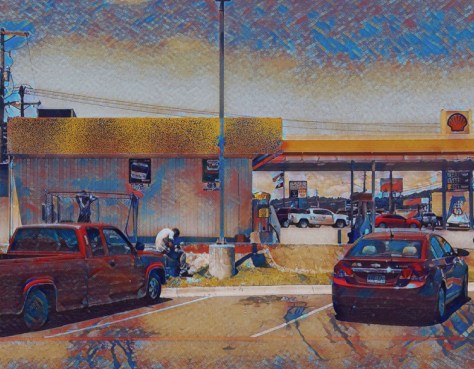
The picture isn’t real, much like each of our collective sets of memories. That’s my dad standing next to me, though. The power of memory and photography grants me the ability to recreate an imperfect idea.

This story, although difficult to believe, is true. Or true-ish. It’s true enough to make you nod your head in recognition of the people and places mentioned. Since I suffered two almost-fatal head traumas when I was young, I’ve learned to sometimes distrust my grasp of the details but also simultaneously cling to the mood that nostalgia brings. I’m averse to taking the direct route, so if you’re seeking linear fulfillment, it’s probably best that you scamper over to something else to amuse you. Young people don’t appreciate the agony of becoming old and being unable to simply tell a story. Stories worth sharing fail to conform to plot development. In my youth, there were no disinterested bystanders. We were all either in the action or trying to hide from it.

This story takes place somewhere around 1978. Even then, we thought the world was moving too fast, as whispers of new highways and industry were everywhere. Springdale had just reached 20,000 people, a 1/4 of what it is today. Out in the world, many things happened that year, yet few touched the residents of Springdale. Inside City View Trailer Park, though, the world was further reduced to minutes, dollars, and wondering what life was like out in the real world. For many years, it was timeless, stagnant and visceral. Faces changed, to be sure, but the circumstances of those living there hinged on the same calculations people still make today when they might run out of money before days in the month. Most little towns have their own versions of City View. It appeared in the newspaper with startling frequency, usually near the words “Police Beat.” My best friend’s mom was immortalized in the Police Beat section, because burglars broke into their trailer and stole some of their belongings in July 1976. It was strange to find it in the newspaper so many years later. I found hundreds of mentions of City View – none of them had positive headlines. No Nobel Laureates sprang from its loins. As in all places, a few great people lived there and avoided being infected by its lunacy.

For those who aren’t familiar with City View, it was a place a family could find an immediate place to live. It consisted of more than a hundred trailers, set on a mostly quadrangular grid with three main streets and two connecting end loops. The further inside your family lived, the more likely you’d find yourself questioning your ability to make good choices, especially on the drinking nights. If you’re picturing a house with a fireplace or windows that were guaranteed to work, you’re being too lenient on the definition of the word. As long as you weren’t concerned about insulated walls or normalcy, City View always answered the eternal question of “How little can I pay and still claim to live on the inside of a building?” In my later years, I often joked that it was impossible to feel the pull of loneliness there because the roaches were always there to keep us company. We all could hear each other’s business, even as we pretended to hear and see nothing.

I didn’t know it at the time, but the principal owner of the City View trailer park was quite wealthy. He bought the Faubus House in Madison County at one point. When I was diving into the details of this story, I discovered he owned trailers very near where I now live and that a tornado had hit the east end of Emma in 1977, damaging trailers he owned there. To be clear, I’m not faulting him for City View’s problems. He could have done much better, of course, but places like City View are almost necessary.

It’s important that you understand two contradictory things. City View Trailer Park could be a hellish place to live, especially if keeping your stuff from being put in the trunk of someone else’s car was important to you. On the other side of the equation, it was a small community on the east side of Springdale, one cloistered from much of the rest of the little town. Close quarters create an intimacy that’s difficult to replicate elsewhere. It was just as easy to make a lifelong friend as it was to be both witness and participant in a brawl at 2:30 p.m. on a lazy Sunday afternoon. Despite proximity to one’s neighbors, it might as well as have been supervised by the Mafia. All manner of questionable human activity transpired there. Despite it all, many families lived there and walked the straight and narrow path. Its areas were inevitably crawling with children and their adventures.

Looking back, I see that the concentration of poor people tricked many of us into believing that all the craziness happening there with a monotonous regularity had more to do with the place than the inhabitants did. As wild as the place could be, it’s no surprise to anyone who knows me that I frequently mention that my parents were almost ideal for the confines of City View. While we lived there, much of the shouting had my trailer at its epicenter. We only left City View because either the terrible wiring of our trailer failed, or my mom burned yet another residence because of smoking. To say that my mom smoked is akin to saying a volcano tends to emit a bit of ash. She burned down several residences in her life. I’ll never forget the sight of approaching the palatial grounds of City View on that early November afternoon to see a plume of smoke. Everyone on the school bus was shouting, both wanting to go see whose trailer burned and in hopes that it wasn’t his or hers. No one died in the trailer that day, but several million cockroaches were rendered homeless. I lost my connection to my best friend that day, too, as quickly as the smoke rose and vanished.

City View was near the skating rink on highway 68 (Robinson Avenue), the one near the airport. I didn’t realize until I was older than one end of the park was directly south of the airfield’s path. Back then, the airport had houses along three sides. 68 morphed in 412 as the dollars changed hands and progress moved along the corridor. There weren’t convenience stores on every corner back then, or easy restaurants on that side of town. The Spe-Dee Mart was the best attraction nearby if you excluded the Pepsi Distribution Center that sat on the corner closest to City View. When I looked up “Spe-Dee Mart” to write this story, the very first story that popped up in the newspaper was from 1977, when a man robbed that very store at gunpoint. I have to admit that I laughed upon reading the words. The cliché of imagining that the man who robbed the store probably lived at City View made me laugh even more. I knew it was dangerous to walk or ride a bike along the highway but for someone as poor as I was, it seemed like another world. In my defense, it was just as likely to be dangerous at my house as it was to be around total strangers in the dark, all of whom were armed with questionable motives. One night, back when Springdale had concrete medians, I had ventured all the way to the intersection of 71. A drunken man in a pickup had pointed a shotgun at me in irritation. He didn’t appreciate that I laughed at him and rode away.

Honestly, there wasn’t much ‘town’ on that side of town, either. There were no trails or sidewalks and all the streets in and around City View all looped and connected back to Powell Street. Even the roads were trying to tell us to leave. On the farthest end, a large polluted pond sat, hoping to trick uninitiated youngsters into foolishly wading into its dark water.

Near that pond, a trailer away, a friend of my dad’s lived with his wife and two kids. Like my dad, he was a rough man. His pleasures were fishing and drinking. Unlike my dad, his laugh came easy and though he worked hard, it was difficult to rouse him to anger. Jerry wasn’t the only inhabitant of City View that I knew. I had a couple of cousins, many school classmates, and the only real friend I made as a kid.

I’m not sure why my dad was home when the school bus dropped me off. He was a mechanic by nature but had learned a dozen trades and done countless jobs. I dreaded reaching the small rickety set of steps leading up to the door. It was impossible to open the door to that trailer without it emitting a high scream of metal protest. I knew it was likely that dad was drunk and that said drinking had probably soured his less-than-stellar mood. I sat on the porch a few minutes and petted my dad’s dog, Duke. My dad owned a long line of Dukes, all of them dark German Shepherds.

Cradling my books like a shield, I flung open the front door. Dad was sitting at the kitchen table with a partially consumed bottle of something in front of him. It was probably Old Charter. I’m sure that in those days, it was distilled from cat urine. I’m basing that only on the intense and penetrating stench it released when the lid came off. He immediately started talking to me in his language of Mumblecorn. If you’re not familiar with Mumblecorn, it’s a dialect of mostly English spoken by people who already mumble, spiced with words in no discernible order. As bad as my dad’s mumbling was, it was a capital offense to be unable to understand him and comply with whatever nonsensical order he might throw my way. In this case, I understand the word “Jerry” and nothing else. I walked down the narrow hallway, tossed my books on the floor, and returned to the kitchen.

Dad unsteadily stood up, grabbed his bottle by the neck and said, “Come on, let’s go see Jerry.” He either said that, or “The world is a paradox, unknowable in its complexity.” It’s impossible to be sure, though I imagine the former is more likely. At any rate, I had to put on an Oscar-worthy performance and pretend to understand his alcohol-induced word salad.

Dad stepped outside and missed the steps directly in front of him. He fell in one long step, all the way down. He didn’t drop his bottle or lose the cigarette, which perennially dangled from his lip. His ugly brown beast of a cowboy hat also didn’t tilt off. I knew better than to assist him up. If I made that error, someone would have to pick me up after he knocked me down. Many times, I would simply disappear by darting around a corner or hiding. It was a relief to discover how often he’d forget me if I weren’t in his direct line of sight.

I climbed over the tailgate of his truck and dropped inside. Duke jumped over, too, and lay down along the cab side of the bed. There was no way I was going to get inside the cab with my dad. Not just in fear I might laugh at him fumbling for the keys and the keyhole, but in fear he’d challenge me to drive, smoke his cigarette, or take a long pull from his whiskey, all of which was a common development with him. I sat in the back, hoping we were heading to the other end of City View instead of out into the world. Being drunk rarely stopped my dad from driving.

Thankfully, we turned to the east. Dad gassed it, screeching the tires, and didn’t relent until we hit the first speed bump. He loved doing that if he had a victim in the back. In my dad’s mind, the back of a truck was tantamount to the back seat of an SUV in today’s world. I rode hundreds of miles, even through the mountains in summer and winter sitting in the bed or clutching the sides in terror. When people post those stupid memes of kids in the back of pickups, declaring, “We survived,” I’d like to punch them in the throat. I had the joy of being in the back of one on a 4th of July when dad wrecked on an embankment going at least 50 mph, coming back from the coldest swim hole in the area, Blue Hole in Tontitown. To be clear, I loved riding in the back of a pickup if a sane person was behind the wheel. With my dad driving, though, any kid in the back would find himself praying to any and every god imaginable in hopes of surviving the trip.

We made it to the end of the trailer park where Jerry lived. His truck was parked in front of his trailer. People like my dad and Jerry didn’t walk if a truck was nearby. Even the idea of walking for pleasure would’ve confused them. I jumped over the back and stood just out of dad’s sight. Dad climbed the steps and pounded on the door. When no one answered, he began shouting, “Jerry, you b@#tard, open the door!” He turned around to find me and I made the mistake of looking in his direction. He waved his arm to beckon me to the door. As bad as the neighborhood was, many people didn’t routinely lock their doors. With people like Jerry and my dad, it would have been unwise anyway. Guns were tucked everywhere, and usually loaded. The door was locked and later I figured out why.

Dad stepped off the porch and walked a couple of steps to the window. He put his bottle on the ground and pushed against the cheap window. It slid up. “Come on. I’ll push you up,” he told me.

I stepped up on dad’s knee as he bent and then lifted up to grip the window. Just as I was about to clear the edge, I heard dad laugh. Before I had time to react, he forcefully shoved me through the window without warning. I hurtled inside and knocked some things off a little table by the recliner in the living room. I got up and opened the door for dad. I could hear noise from the other end of the trailer. By the way, if you didn’t know, using windows as doors was completely normal, and not just because so few of the windows at City View had screens.

Dad looked in the bedroom directly off the living room. He then turned and walked across the living room, then the kitchen, then down the long hallway on the far side of the trailer. He came back, a horrible smile on his face. He took a Camel cigarette from his striped shirt pocket and lit it.

“We’re gonna have us some fun, son.” He then laughed as Roscoe P. Coltrane might have and whooped. I was glad he was laughing because this indicated a shift in mood. The problem was that it was impossible to know how far my dad might go. “Reasonable” was a fake word to him when he was either drinking or pulling pranks. Some of the stories I tell about him sound impossible to me, too.

Before proceeding, it’s important that you understand several other details about daily living. First, many men like my dad and Jerry often kept a pitcher or jug of tap water on the counter or in the fridge. Filters and bottled were unheard of back then. You simply drank directly from the jug. Everyone in the house knew that it was forbidden to put your lips on the jug or pitcher of the man of the house. Second, most trailers didn’t have showers back then. Most had small bathtubs. Bathing wasn’t meant to be comfortable. You were lucky to get your own bathwater. Kids knew the agony of their moms washing their hair for them. At times, we were convinced our moms were ripping our scalps off as they squeezed our hair. As an adult, you had no real choice except to almost lie down on the floor, placing your torso on the narrow lip of the tub and then bending your neck unnaturally under the protruding faucet. Third, most men like my dad and Jerry had guns everywhere, intended for shooting things outside of one’s house.

As dad puffed on his cigarette in the small kitchen, I could see the wheels of mischief churning in his head. He went into the living room and hunched down near the couch. He reached under it and pulled out a short barrel shotgun. I think it was a .20 gauge, though I can’t be certain. He pumped it to see if it was loaded. Indeed it was. My blood ran cold for a second as I realized dad was going to shoot the gun. Based on experience, I knew that it was just as likely he’d do it inside as outside. He put the gun back under the couch and then went back into the kitchen. I stood, watching.

He opened the old yellow fridge door and reached inside. He pulled out a mostly-full pitcher of water. “A-ha. Here it is. This will teach him to lock the door and wash his hair.” Dad was unstoppable at this point.

By the way, I forgot to mention that I wasn’t sure that Jerry had ever actually washed his hair. It was difficult to imagine him having the time or patience to crouch so uncomfortably and waste his time doing so. I know it didn’t make sense for me to believe this. In my defense, most people didn’t consider the fact that a grown man might fire a gun inside someone else’s house.

I didn’t follow dad down the hallway. I did watch in disbelief as he threw his cigarette in the sink, grabbed the sloshing pitcher of water, and then marched down the hallway to the bathroom to say hello to Jerry. I had connected the dots.

Within half a second of my dad darting into the open doorway of the bathroom, I heard both the simultaneous slosh of water as dad threw the entire contents at an unseen target in the bathroom and the most inhuman scream I’d heard to that point in my life. Believe me, I had heard and memorized some ungodly screams of terror and anger. The scream, which poured from the bathroom, could only be accurately measured against the Richter Scale if it were recalibrated to measure both agony and volume. Almost immediately, another scream and a thud filled the trailer

Dad backed out of the bathroom, empty pitcher in hand, laughing and pointing.

“Go##damnit, Bobby Dean! I’m bleeding everywhere!” Jerry’s voice was piercing.

Since dad was laughing, I risked going past him. Jerry was naked, now sitting on the toilet, and had a towel against the back of his head. Blood was on the edge of the tub, on the floor, and running down his back.

“Where are you bleeding?” I asked. He was lucky I personally had a couple of hundred head stitches of my own when I was 6 or 7 – and had felt the inside of my own scalp when it was almost ripped off my head. I’d seen enough blood to know that if I were looking at it while it was coming from someone, no one had been killed. Yet.

“It’s my head. That faucet caught my head after Bobby Dean threw the ice water on me!” Jerry sounded like a wounded mountain lion. My suspicions had proven to be true: dad had thrown the entire pitcher of water directly across Jerry’s rear-end as he hunched over the edge of the bathtub, washing his hair.

I don’t remember exactly what I said, but I said something like, “Aren’t you glad he threw the water on you instead of firing your .20 gauge in this bathroom?”

The look on Jerry’s face seemed to indicate that neither sounded very reasonable to him. He told my dad to stop laughing and to go jump in the pond behind the house. His language was a little more colorful, though, full of words which surpass mere English.

Jerry, of course, didn’t go to the doctor. Back then, you only went to the doctor if you lost an arm and couldn’t find it. He soaked a towel and a shirt in blood as it slowed. He put a ripped piece of a shirt over the flap of scalp and put a ball cap over the top of that to hold it in place. Wherever he and my dad had planned to go was forgotten. They sat in the living room, drinking beer and sips of whiskey. Occasionally, Jerry would idly threaten to kill Bobby Dean. Dad would laugh and ask Jerry if he could get him another glass of ice water, or “ass water,” as he jokingly referred to it.

I’m not sure which had hurt him worse: the huge cut on his head as the faucet scraped all the way to his skull as he jumped up with a buttcrack full of ice water or his back, from attempting to jolt him upright from what amounted to a prone position under the faucet. If Jerry washed his hair for a while, I’ll wager he locked the front door, all the windows, and the bathroom door, too.  And maybe hid all his guns, too.

After a while, I walked back up to the trailer I called home and probably hid in the closet to read.

So, please forgive me as I sometimes forget the idea of scale or appropriateness. My barometer for evaluation was damaged.  Prehistoric man had to be cautious of predators and being gutted while sleeping. Modern men exposed to my dad had infinitely more difficulty attempting to navigate the prognostications of what he might or might not do. “If you dream it, they’ll come” is a well-known mantra of the baseball player. “If you can imagine Bobby Dean doing it, he’s already on his way over,” would be the mantra for my dad.

Based on the scream Jerry produced at the moment the ice water contacted his backside, I’m going to have to say that sinister government agencies should replace water-boarding with ice water crack attacks.

You’ll never forget those screams, even if you had the chance to live in City View Trailer Park, back when time sometimes stood still.

Time eventually started its march once again, even for City View. Springdale mercifully stepped in and vainly attempted to correct some of the living conditions there. For good or ill, it touched thousands of people. For me, it fills a spot in my mind similar to the one occupied by my dad. All the people and places that I called home color everything that I am. City View changed its name, just as I did.

Humor is in the eye of the beholder and time always renders translucent the fondest of memories – and the toughest of circumstances.

Love, X


Happiness And the Flimsy Bath Towel

20181230_080809

Oddly, one of my biggest Christmas surprises this year was a gift that arrived a few days late. My wife Dawn managed to find the most horribly perfect set of bath towels, ones so flimsy that they can be used as Confederate flags of surrender. Naturally, I love them. Unlike normal people, I prefer smaller, non-plush towels. Some people use hand towels bigger than these bath towels. The towels are white with a single blue stripe on them, similar to what you might find at a really bad massage place or in a bathhouse frequented by savages. The towels probably shipped with a little white slip of paper marked, “Failed by Inspector 456.”

Years ago, I used a similar set until they were so threadbare that you could play tic-tac-toe in the threads. I had visited Tulsa, staying at a Ramada Inn near downtown. After showering, I was amazed at how small and flimsy the towels were. Naturally, I wanted a bunch of them, no matter what the cost. The housekeeper had left her cart down the hall and I took a stack of them. I left an outrageous amount of money on her cart, to let her know that they were in payment for the towels I had no intention of returning – or a tip for her. Later that afternoon, as we passed in the hallway, she smiled a huge and knowing smile at me. I just nodded, a happy co-conspirator. I’ve forgotten almost everything about that trip to Tulsa except for the handsome set of hotel towels. I’ll also bet that the housekeeper in question remembers the crazy hotel guest who paid her $50 over cost for the worst towels ever made.

Once those towels turned into loose threads, I’d catch myself asking at places like Target, “Do you have anything THINNER?” The clerks invariably looked at me like my cheese had slid from my cracker. “Uh…no,” they would utter. I’d reply, “These are too plush and comfortably large. Anything smaller?” These conversations tended to go badly, as the average person thinks towels are supposed to be as plush as bed comforters and fit four per dryer load. Over the years, I gave up hope of ever finding a suitable set of replacements. I forced myself to use good towels, even as I cursed the universe for my first world problem.

I threw in the towel, in other words.

I won’t bore you with arguments regarding ease of use, storage, cleaning, or laundry bulk. The truth is I don’t care about any of the utilitarian arguments in favor of using smaller, thinner towels. I just like them, like burned toast or popcorn, or dry fruitcake.

My wife Dawn solved my problem, though. This new set of towels is so perfectly thin and small that I shall delight in their use. As you foolishly use the equivalent of your grandmother’s quilt after your shower, I’ll be laughing and enjoying the worst towels in human history.

The picture is of all 6 of them, stacked no higher than a plate of Waffle House pancakes. It’s a thing of beauty, isn’t it?

Most of you will look back and remember your new television or instapot. Not me. I’ll be nostalgic for this beautiful stack of horrid towels, the ones which made me instantly happy.

I think I need another dozen of them, though, just to be safe.

No Worse For The Wear (Or Non-Wear)

This is a true story, one which makes me proud. After you read the story, you’ll be proud to know me too.

This evening, as the darker clouds rolled in to meet the deepening sunset on this beautiful day, I stopped at one of the local liquor stores. (Which, for the uninitiated, is a place one might purchase alcoholic beverages.) My wife remained in the car, probably anticipating more antics from me. Plausible deniability is a virtue after so many years of marriage.

As the magical automatic double glass doors slipped open upon my approach, I entered with a smile. Three employees were near the rear left side of the store. All three proclaimed an enthusiastic version of “Hey, how are you?” to greet me.

Per my usual custom of saying something stupid, I used my cliché “Terrible!” as my reply.

The youngest of the three visible employees, a fresh-faced and enthusiastic man, laughed and said, “You don’t look any worse for the wear, though.”

Smiling even deeper and preparing to raise my voice, I half-shouted back: “You should see me NAKED!”

The younger employee stood with a stupefied expression on his face. The wizened veteran at his side burst out laughing as I continued walking.
.

“Smallfoot” Was My Bigfoot Legend

joe smallfoot tshirt


It’s interesting that there’s a movie named “Smallfoot” in theaters.

It looks like that I missed a chance to capitalize on the name “Smallfoot” and the marketing revenue that would have accompanied it.

For years, I’ve told stories about the ‘real’ Bigfoot: Smallfoot. The main story I’ve told: that Bigfoot is real, except that he’s exceptionally tiny and evades detection through his diminutive status. Everyone’s running around in the dark, desperately seeking a large creature when, in fact, Bigfoot is a tiny animal hiding in plain sight.

About 5 years ago, I created a Facebook page for the “Smallfoot” community. I filled it with the legends and sightings of a really small Bigfoot.

I even created a website (which I never took live) and made t-shirts. I had a REALLY large size t-shirt made for my co-worker Joe Buss. I made fake publicity stills and even wrote studios such as A&E to generate either buzz or confusion in their minds. For a while, I had a lot of fun with it.

I let it go and never went live with the website. Joe still has his t-shirt, though.

There’s no point to this post other than to say that I misjudged how much I could have taken advantage of my really dumb idea. Whether the studio saw my original nonsense or came up with it independently, I was first. Some of my friends and social media friends probably recall my flirtation with notoriety.

It turns out that my dumb take on the old legend wasn’t dumb at all.


Older Blog Post About Smallfoot

A Day

On my return walk home, heading south, not too far from the intersection of Emma and Butterfield Coach Road, I had reached the point in Il Divo’s song “Passera” when the Valkyries and angels began to lift the singers impossibly higher in their harmony. To my left, the high tree-filled mountainside was palely illuminated by an unseen light. Atop the hill stood a single solitary tower, its light blinking impossibly red. Above me, a billowy blanket of clouds was rolling in, barely overlapping the moon. The moon, in response, glowed with a corona of diffused rainbow colors. Slightly below, Orion’s belt and Betelgeuse vividly shone through. Venus and Sirius lurked on the horizon, brighter than normal. As I peered upward, a meteorite streaked down. And another. Even as I lost track of my footing, I laughed out loud, a lone cackle in the pre-dawn nothingness. I wasn’t expecting meteorites this morning and their arrival brought unexpected laughter. I laughed even harder, remembering the old cliché that the most dangerous laugh emanates from someone alone, in the night.

There are times when you know the day cannot possibly be improved, no matter who or what fills the hours of it. Perhaps I’m wrong, though, and a mystery as of yet not fully developed will greet me as the sun rises.

For now, though, I’m going to look out the window and listen to my cat tell me his story in a language I can’t understand, full of purrs and growls.

Just a Moment

20180812_055918

Because I skipped walking the day before, I loaded an unintentionally melancholy playlist on my phone instead of listening to TED or anything noteworthy. The hour was too early and my enthusiasm was too high but the darkness was beautiful. I walked the width of Springdale, down Emma, and a circuitous path toward nowhere in particular.

Someone I once knew too well called yesterday and told me that his days were now numbered and that he was tired of the pain and mediocre tenor of life. Like these things always do, it left a bruise on me that wasn’t readily apparent.

So, I left for a long walk this dark morning.

I found everything I wasn’t looking for.

I walked so far that I texted my wife to see if she was up. 30 minutes later, I tried Uber to discover that no one wanted to drive around Springdale at that hour. Another 30 passed and I decided that I would wait for Uber’s system to either get me a ride or kick me off the system. A driver pinged me in less than 5 seconds. My legs were numb at that point, so I leaned against the utility pole on the street and watched the sun come up above the skyline somewhere near the roofline of AQ Chicken.


20180812_064424

As I sat in the back seat of the stranger’s car, I was surprised by how far I had walked, mile after mile. The raccoons had greeted me across from the Apollo Theater, and someone’s tiny tuxedo kitten ran and jumped on my side as I warmly rubbed it and whispered to it. I left him purring underneath the front bumper of his owner’s truck. A solitary worker moved in the darkened interior of Neal’s Cafe. Several empty storefronts looked out upon me as I traversed Emma.

20180812_063403.jpg

20180812_055149

In the distant geography beyond, I knew that the person who called me yesterday was awake and restless, shuffling through his memories and attempting to reconcile his time.

There are no easy answers and no direct path to peace. But, there is time enough to walk and to look out upon the unknowable expanse of people and places around us.


Read With Caution – But This Story Doesn’t End In the Manner You Imagine


I’m writing this story in one sitting, one draft, and without polish.

I don’t know who they were or where they were from, the couple that forced my day into an uncomfortable U-turn. I’m still a little nauseated, an hour later. When I came home, I immediately took a shower and did my best to avoid throwing up. The perfume or cologne of the couple is still on me, even after. My “What Would You Do” moment did call me to action, though. It also exposed my hardened view of so many things. The older man of the couple demonstrated an incredible amount of patience in the moments we shared. I am hesitant to tell any part of the story as even the most gently expressed truth often wounds people in ways which are unintended.

My wife and I capriciously decided to find a Mexican food place to eat today on the 4th. We drove by several and found all to be closed, one of which we missed by 30 minutes. On a whim, I turned at the last moment to check Las Palmas. My wife and I smiled at each other when we saw the mismatched cars aligned in the parking lot.

While we were eating, a woman and her children were behind us. The older boy regaled his table with stories involving vomit, bathroom misadventure, and the sort of thing one would expect from such a tender idiotic mind. Dawn was especially taken with the stories, given that the back of her head was a foot away from the mouth sharing the stories as fajita-scented smoked wafted in the air.

The restaurant had some unusual characters in it. The oddest was an unlikely couple seated in front of me and to the right, back against the bathroom area. The man seemed to behave almost like a caregiver. The woman, a painfully thin middle-aged woman, sat with her face mostly turned away from me. She was wearing a summer dress and several things seemed not quite right about her. In front of her was an almost empty margarita glass, the frosted and salt-rimmed kind one typically finds in Tex-Mex places. Toward the end of my meal, the antics seemed to grow more pronounced, much like a play in which the actors start to feel the audience respond to their comedy. I watched as the woman tried several times to get the straw of her drink to connect with her mouth. I was wrestling with the question of whether the woman had a mental condition. The margarita seemed incongruous to such a hopeful conclusion, however.

As Dawn sat across from me telling me stories, I found myself increasingly looking past her at the strange couple by the bathroom. I watched in horror as the woman tried to stand, much like a confused flamingo might do if its frail legs were tied to bowling balls. The man with her grabbed her as she started to pitch forward into the basket of chips of the Latino man seated nearby. He had her purse in one hand and somehow managed to grab her like a striking cobra.

“She’s going to fall!” I fiercely whispered to Dawn. “Don’t look,” I added, as she, of course, turned her head to look. (It might as well be a law in these situations, much like the involuntary cringe in one’s neck as someone shouts, “Watch out!”) I didn’t know it, but I was finished eating for the day.

After six or seven additional dramatic steps, the woman simply collapsed onto the hard tile floor, her male companion helpless to stop her. It sounded like a half-empty bag of potatoes as she hit the floor. My heart stopped for a second.

I locked eyes with the Latino man who had been seated near them. He looked down and away. Because I didn’t want John Quiñones and his crew from “What Would You Do” to jump out of the pantry and stick a camera in my face, I jumped up and ran over to help lift the woman. I didn’t know that my call to action was going to be so graphic or consuming.

“She’s got a bad leg and is going to have surgery on it,” the man told me. My heart hurt for him a little bit at that moment. I could feel his pain. I knew then that the woman was drunk and probably had a little pharmacological help mixed in.

Being careful of my back, I helped pick her up. I wanted to sit her in a chair for a moment and to give her time to get her bearings. The man with her forged ahead, trying to walk her, so I continued to lift and assist. Everyone inside was now looking at us. The restaurant had come to standstill.

We somehow managed to get her near the door despite the constricted walkway between tables. We were basically carrying her by this point. I wanted to sit her on the door side bench while the man went for the car. Instead, he said he’d never get her back up if she sat down there. Despite the voice in my head threatening me to continue, the man and I kept walking and made it outside. It’s hard to change course once you’re swept up in what seems to be impossible momentum.

I assumed his vehicle was the one two spaces from the door, given the woman’s condition, one which I assumed was normal for her. “Is this one yours?” I asked him.

“No,” he replied. “You’re not going to believe this, but THAT one is mine.” He pointed to the literal edge of the parking lot. The vehicle was some type of conversion Jeep, and the bottom of the door was more than two feet from the ground. I should have run. If I could go back in time, I’d go back and slap myself for not doing so.

The woman continued her best to succumb to gravity and fall to the pavement as we fought against it, moving slowly across the parking lot. She mumbled incoherently as the man continued to ask her to use her legs, to hold herself up, to move forward. I assumed everyone in the restaurant was pressed against the tinted windows, watching us do the impossible. I could hear the opening bell of Rocky in my head. My back sent warning shots to my brain. I couldn’t put the woman down, though, because the pavement was incredibly hot. The man seemed relentlessly insistent on marching to his vehicle, even if he had to drag all of us there by sheer willpower.

As we neared the Jeep, I got one arm from her and opened the door. It was going to be impossible to get her in there given the access available past the door. I knew then that the woman was most certainly not in such dire straits before her meal. Whatever medical condition was present before her arrival was at most responsible for no more than 10% of our current predicament.

We tried everything to get the woman up. She stopped responding to basic motor commands. At one point, the man ripped the belt from his cargo shorts in an attempt to fashion a lifting harness for her hand. We lifted her up and down no fewer than ten times. It was blistering hot in the parking lot. I knew it was burning the woman with each attempt, if not breaking her legs. I asked about an ambulance and should have insisted on calling one.

Honestly, though, I cannot express the pain I felt for the man as he struggled with a total stranger like me. He struggled to maintain his composure and sanity as the situation became more and more outrageous. I knew how sharply he was feeling the concern for the woman, while simultaneously being embarrassed and upset. He told me I could leave and that he appreciated the help. It made me wince even more.

On our last attempt, the woman’s sundress went completely up to the waist, leaving her exposed. I could not imagine a worse predicament for either the man or the woman. The woman, though, wouldn’t know it had happened unless someone tells her later.

After a long interval, Dawn came outside and watched as we continued to struggle. I wanted to both run and burst into tears. The man agreed that he might have to call an ambulance, even though I knew as he said it that he wouldn’t, for a variety of reasons.

The woman was curled into an unnatural ball in the passenger seat and floorboard, her limbs in seven distinct directions. The man was pushing at the small of her back, trying to keep her inside. He couldn’t do anything about her dress being around her waist.

“I’m not going to call an ambulance if you don’t want one, sir,” I told him, putting my hand on his back. He was in great shape for being in his late 50s or early 60s; It probably explains why he was still making the attempt.

We gave one more try to push the woman far enough inside. It looked impossible, but she was ‘inside’ in the most loosely defined way possible. The man told me he’d pile her in there like a spilled bag of oranges if he had to. Without exaggeration, I think about 15 minutes passed between the first time I picked the woman up from the floor and leaving.

I said a few things to get him to reconsider. I don’t remember exactly what I said because I was upset, whether I showed it much or not. As Dawn and I left, we drove around the lot so that I could see that the man hadn’t dropped her. Thankfully, he was standing by the Jeep, looking at the ground, a look of despair on his face. I was trying to picture what it might look like when he got her back to her house or his house or wherever they would end up.

I turned right and went the long way around, trying to convince myself to go ahead and call the police or an ambulance. If a police officer had been patrolling, I would have. None was to be seen. It was a relief in a way. Those two people have unimaginable problems in their lives. I don’t know who they are – or even the man’s name.

Dawn told me as we drove away that the woman walked into the restaurant without assistance. It confirmed my suspicion that alcohol had mixed with something else.

I can’t tie this story up into a neat little bow yet. I’ll let you know how mad I become at myself for helping. I’m glad I helped when someone needed it. I feel a deep sadness for the man who was put into that situation. I know nothing about who he is or his relationship to the woman. The not knowing makes it easier for me to avoid anger at the woman. My youthful exposure to so much alcoholism and addiction sometimes brings up a vengeful eye in me and it is something I struggle with when I’m around the consequences of someone who desperately needs help but won’t accept it.

I forgot to mention one key detail: it was an unfortunate choice of days for the woman to fail to wear underwear.

Of Love’s Comprehension

hhh7788999

Nothing is entirely real, not even much of our memory. We revisit the places of our past and often find our footing slightly unfamiliar.

Emotion and bias tinge everything, a spreading patina of ink from a single drop. The more desperately we cling to our version of events, the less firm is our ability to live a life worthy enough to satisfy us. The emotional context which surrounds us shapes our ability to recall objectively what precedes us.

My parents were a volatile mix of temper and tantrum and no one could be an innocent bystander. To be a witness meant participation was mandatory and choosing sides wasn’t optional. There was no Switzerland in the households of my youth.

Yet, my parents chose to marry each other again, despite their long and violent history and while ignoring incredulous scrutiny from friends and family. Both had married other people during their marital hiatus and neither found adversaries willing to suffer and share their scarring.

I’m guilty of allowing my own history with them to cloud my ability to see that somewhere out of my reach, they shared a connection with one another. While it was forged in years of anger, it was real to them. Alcohol, jealousy, and unhappiness were the fuels of their mutual fire. Both of them were adept at stockpiling these lesser tendencies for the upcoming fires that would rage. None of us was equipped with the right tools to combat their wildfires. Each of us tried and failed.

Mom and dad married on Feb. 12th, 1964 and again on Feb. 12th, 1993. Dad died 9 months later, once again with mom in his life and while trying to make his dream work, in a rural little gas station on the edge of highway 49. The gas station is gone and a field has enveloped even its memory. If my father has a ghost, these greening acres along a nondescript highway are one of its homes. Most of these stretches of rural America certainly feel as if they are inhabited by lost souls.

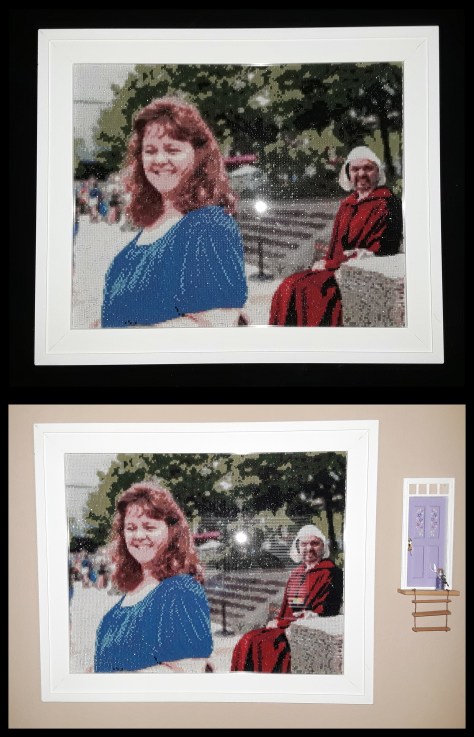
This picture is of us in 1993, at a small Lutheran church that still manages to survive today. Mom and Dad had just exchanged vows for the second time. Although Dad was visibly uncomfortable in the suit he was wearing, he was at home with mom once again in his corner. Twenty-five long years have intervened. The church sits defiantly and almost directly across the road from the gas station dad attempted to make successful during two tries in his lifetime. Small communities need churches to bond them, serving both spiritual and mundane connections. Many of us in this world converged upon that small church in different stages of our lives; most of us have at least a few memories that are rendered opaque and wistful by having done so.

None of the facts has changed, but I have. I’m a stranger in the lands of my memories and I take comfort in my distorted reflection.

Somehow, experience has wrapped me in its strange embrace and violently shaken me. Not only is the sum of my parts now more than whole, but things I knew and things in my field or ignorance have exchanged residency.

I’m not certain of anything anymore.

Yet, paradoxically, I think that it might bring me greater happiness to see a fuzzy world instead of one sharply focused by my own opinions and experience.

The gas station and church both left footprints somewhere inside me, just as my parents did. I struggle with the same forces now that tormented me when I was younger. I learned ways to mitigate the disaster of my upbringing. There was no easy road or prolonged escape from the lessons I learned involuntarily.

I can see immeasurable violence in those whispering the word ‘love’ openly in the world and compassion in the eyes of someone with snarled lip and ready fist. I saw both in Carolyn and in Bobby Dean, the people who played the roles of my parents.

Love’s mystery is that it flourishes at all, as we teeter on the edge of loss at every moment.

Love, X
.
.