Category Archives: Springdale

We Hold These Truths

I started out writing another story but was pleasantly sidetracked by discoveries I made about little pieces of family history today.

Over the years, as I’ve laboriously uncovered pieces of evidence, a fuller picture of some of my life has emerged. After a childhood filled with constant shushing and shouts of “Don’t talk about that!” I’m relieved to know that the historical record left breadcrumbs in the world. Some of them aren’t the smoking guns I would have hoped, but as circumstantial evidence, they provide an undeniable trajectory for some of my stories.

Not too long ago, by accidental fortune, I discovered newspaper articles regarding my Dad’s imprisonment in Indiana when I was younger. Before that, I finally found a mention of the accident in which my drunk Dad killed a maternal cousin of mine. Not only did they fill in the blanks for several unanswered questions I had growing up, but they told me part of the story in an impartial voice. So much of what I was told was a lie or misdirected.

On Father’s Day last year, I found out that I have a half-black sister. Her color is only mentioned because of the irony of her existence, given the racism of many of my family. I’ll take a DNA revelation over a document or historical piece of evidence any day. I’ll take my corroboration anywhere I can get it, though.

.

.

crash dddddddddddddddddd

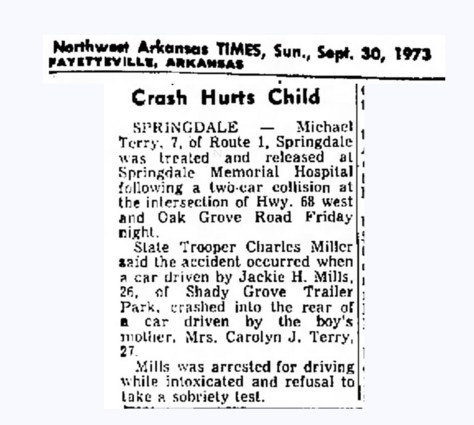
This accident happened after Mom and Dad had a huge fight at my Uncle Buck’s house. Mom left in the car. She was drinking heavily, of course. We were very close to turning left onto our road from Highway 68 (412). What fascinates me about this article I found today is that if you were a historian or researcher, you would mistakenly think Mom wasn’t at fault in the accident, especially because Mom was hit from the rear. There are a lot of assumptions at play here. You’d have to know that it’s possible Mom could have forgotten to turn on her lights – or that she thought the car behind was following too closely and slammed on her brakes – or that she was so drunk she was about to miss her turn off the highway – and so on. I don’t know what was in the report of the accident. I do remember clearly that everyone at the scene knew that Mom was drunk and that she was shouting in anger at everyone, especially the police. She took the time to use her specialty curse words, too. I don’t remember whose name Mom invoked, but whoever it was resulted in no ticket for her or questions about the open Budweiser can in her lap at the time of the accident. Mom had several accidents at this intersection, two or three of which involved other vehicles. Because part of Dad’s job at the time involved a car and body repair, he fixed the vehicles at no charge. He knew how to game the system to extract a bit of extra cash from the process, too. Northwest Arkansas had places one could go for stolen parts.

In case you didn’t read it in my other posts, my Mom and Dad paid off several DWIs illegally. It was a common practice, as most residents in Springdale should remember. Money could make problems go away. My family was strikingly poor at times yet when necessity demanded it, money miraculously appeared to be used as kickbacks, bribes, or payoffs.

.

.


white (2)

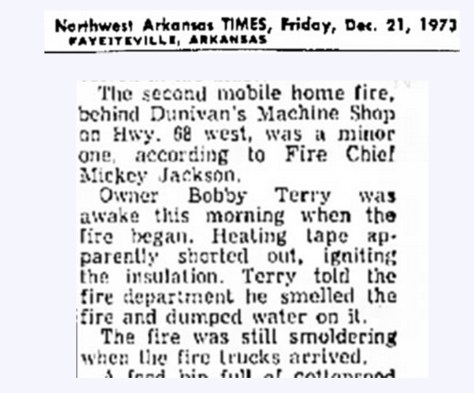
For the picture above, I remember the fire only because it happened around Xmas. I’m not convinced it was started by heating tape. Mom and Dad both smoked. Dad often did things shoddily. I’ve written before about the number of houses and trailers that burned during Mom’s lifetime. I do remember that my Mom and Dad fought like hornets after this fire. Anytime people with authority intersected with our lives, mayhem ensued.

.

.


wwewerrwewe

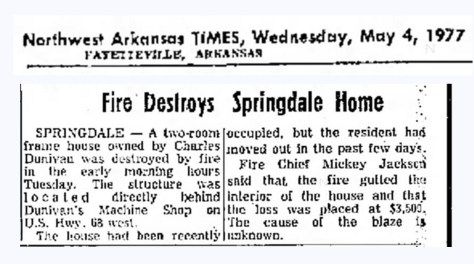
This is the first residence we lived in on the same long corner of 48th Street and Highway 68, now 412. The house was very small and green and sat the south end of the property just a few feet away from the pasture behind it. The next two residences were trailers placed in the same general place perpendicular to the narrow road. I know too much about this fire. My family was the last one to live in it. My died burned it down on purpose. He used the water heater to ignite the rest of the house.

I found these tidbits accidentally today while looking for a picture of the frontage along highway 68  in the early 70s.

I’ve been trying to write or finish several interconnected stories regarding the time my family lived in the area where Denny’s, La Quinta, and the Springdale Convention Center now sit.

The common thread to these is the increasing and overwhelming certainty that the story I’ve tried to tell in increments is true. It’s a story that no one else would have ever told.

.

.

Click below, if you’re interested…

Discoveries About My Dad in Indiana

A Story About My Dad

If you have Facebook, this is the version of the above link that drew an incredible amount of messages and commentary… A Story About My Dad, social media version


A Dart In The Foot

Capture

Years before the interstate crossed western Springdale, my cousin owned a big chunk of land where the Springdale Convention Center, Denny’s, and La Quinta now stand. (Little did he know how valuable his land would one day become.) He had one of the region’s largest machine shops there. (If such things matter for the story, he technically was ‘the husband of a 1st cousin 1x removed.’)

Along the road, his parents, Goldie and Ellis, owned a house, followed by a trailer and another little house further down. Pasture framed the property in a large “L.” Like much of the area, it was rural and Highway 412 was a slender ribbon known as 68. 48th Street cut across the highway, uninterrupted by the interstate like it is now. It’s interesting that Springdale is now reconnecting across that area with Gene George Blvd. On our side of the highway, 48th Street was a narrow road to almost nowhere. Close to the road stood several massive oak trees, a couple of them towering high about the landscape. There were pear and apple trees dotted all over the property, as well as a couple of walnut and pecan trees, one of which almost literally killed me, but not for the reason you might imagine. That’s a story for another day. My cousin Jimmy and I both narrowly avoided being blinded near there, which is also a story for another day. My family lived in two trailers and a very small house on the property.

I don’t remember how we ended up in the jon boat sitting in the grass near the trees in front of Goldie’s garage building. It was there for a while, so you had to careful about jumping into it without inspection. Otherwise, you might find yourself jumping right back out with a snake or other critter attached to you.

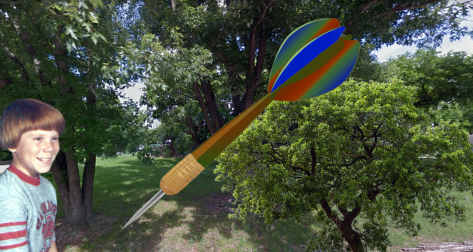
My cousin Jimmy found a few large darts somewhere. Time has stolen the details about where they originated. While they weren’t the infamous lawn darts that came later, they were larger than standard throwing darts that we’ve all tossed and hit the wall accidentally with, even as we tried to conceal our errant misses.

More than once, I said, “Watch out with those darts, Jimmy!” He was younger than me. He was also was protected by a strange force field of superiority. He was almost Kevin Costner untouchable. Jimmy laughed and threw another one with even more recklessness. It thudded into the wood bottom of the boat. “Darn it, Jimmy, you better not hit me!”

Jimmy stepped several steps further back and, without pausing, launched the heavy dart high into the air, in a long parabola of unknown destination. Naturally, I did the only thing possible: I covered my head and winced. I doubt Jimmy expected me to duck.

It turns out I didn’t need to concern myself with being hit in the head with the dart.

It landed directly on the top of my foot, impaling my left foot almost all the way through. I had a Jim Carrey moment, one in which I stared at the heavy dart impaled in my foot. My brain was taking a bit of a break to process this.

Suddenly, my foot cramped.

Jimmy’s face made an absurdly round “O” as his mouth fell open, as I writed a little bit in agony.

For once, I believed he didn’t intentionally do the thing that just happened. That is what happens when you indiscriminately toss heavy darts above people’s heads, though. That’s a helpful note if you find yourself indiscriminately tossing darts high into the air around other people.

All at once, the pain of the large dart being stuck through my foot reached my brain and I screamed like someone put a firecracker in my open mouth.

Jimmy ran away, already hollering that I was beating him, when in reality I was sitting in the boat with a dart stuck in my foot. I pulled it out without thinking very long about it. It took several seconds for the hole to begin oozing blood. I did not run after him. For the time being, I didn’t care if he had season passes to Dogpatch and free ice cream for me.

After several minutes, I hobbled around the trailer on the backside and tried to go inside. “You better not get blood in here, you little sh!t,” Mom told me between puffs on her cigarette. I went back outside and around to the front of the trailer. Dad was sitting there with Uncle Buck.

My Dad, often the comedian, yelled “Bullseye!” at me. I assumed Jimmy finally admitted he threw a dart into my foot. I still didn’t see Jimmy.

Uncle Buck, in the role of a caring human being, told me to wash the wound out.

“Nonsense,” Dad opined. “Put some ash on it.” Dad unsteadily stood up and with his drunken swagger approached me. He grabbed charcoal out of the burn pile and motioned for me to approach. He smashed it in his fist and rubbed it on top of my foot. I stood perfectly still, hoping his attention would shift so that I could get away. I knew better than to flinch or cry. “Bullseye,” Dad repeated and laughed.

I hobbled away. I found Jimmy a few minutes later sitting on a low branch of one of the apple trees between Goldie’s house and the rear of the machine shop. I didn’t hit him. He was Jimmy – and Jimmy did only what Jimmy did best. I think he found it difficult to relax if I had a dart in my hand, though.

The Whole Hogg Episode

X cargill ID


In the 90s, I worked at Cargill in Springdale. Much of the work was dehumanizing. Oddly enough, the proximity and close quarters also made it possible to interact with a wide swath of people. Despite the brutality of the job, some of us managed to make use of our shared time there. We shared jokes, insulted each other with the skill of a French sailor, and learned each other’s language. The racists lurking among us didn’t. They despised the fact that Latinos willingly applied to work the line jobs. As many faults as I had with the job, I was able at times to see the job from the viewpoint of someone who would have worked any job, even with gritted teeth, for the rest of his or her life. I was lucky to get the job. During the annual layoff at the end of the year, I signed up to work on the other side of the plant instead of drawing unemployment, with the goal of seeing what other jobs were available. It turns out, a lot were. I never returned to the Jeffrey Dahmer side of the facility.

I started on the turkey evisceration line. It is nothing like you would imagine. Unless you are imagining a bloody, violent mess, in which case, bingo! you’re right after all.

On Fridays, it was common for the supervisors to walk down the interminably long line of employees as we worked with vacuum guns, scissors, knives, and bare hands. We wore high boots, smocks, plastic aprons, and a variety of other things to make us as uncomfortable as possible. As they walked, they would go through their pile of checks and find each employee’s corresponding check and put it in our pocket. Some people would have them placed in the back of one of their boots. This was usually a strategic mistake, as the work environment was filled with water, blood, and an assortment of internal organs that shouldn’t be flying around.

Based on the moisture component, I was one of those who objected to the check being put in my boot. In my case, I didn’t care if the supervisor wanted to lift my smock and find an outside pocket to jam the check into. It didn’t threaten my fragile masculinity.

At this point, I’d like to mention that it was ludicrous that checks weren’t handed out on our hour-long break. That’s an argument for another day. Many women didn’t appreciate the check system at all, for obvious reasons.

Back to the story… some supervisors would ignore your request and jam the check into your boot despite your objections. Given that you’re standing in front of a fast-moving line filled with increasingly stripped-down recently deceased turkey carcasses, it’s hard to step away from the line.

One supervisor, in particular, was named Robert Hogg, with a double ‘g’ in his surname. For whatever reason, I loved yanking his chain. Looking back, he was comparably great as a supervisor. The fact that he didn’t hang around as long as many spoke highly of his character. Robert and I engaged in a tit-for-tat game of oneupmanship about many things. One thing I liked about him was that he could issue an edict from management and simultaneously acknowledge the absurdity of it – while letting me know I needed to do it, regardless of how stupid we agreed it was. I could respect that. I still do.

After a couple of Fridays of Robert trying to jam my check into the back of my boot, I hatched a foolproof plan…

It’s worth noting that I was prone to zaniness when I was young. I would wear mismatched shoes, my shirts inside out, or draw and paint on my clothes. Anything I could do to cause a bit of commotion or eye-rolling was something I was interested in furthering. As an example, one of my fondest memories was after we had a big meeting regarding drug use and policy. There were hundreds of us working on the evis side of the plant. I entered the bathroom and opened 4 or 5 packets of sugar alternative. I wiped it all over my top lip and across my nose. As I exited, one of my conspirators literally screamed, “Hey, you have something under your nose!” Naturally, about half the heads in the breakroom turned to look at me, some managers included. I pretended to be caught off guard and wiped crazily at my nose and sniffed loudly. After an awkward pause, most of the breakroom laughed. “I picked a bad week to stop snorting cocaine,” I said. (One of the managers took the time later to seriously inform me that while he thought it was a great prank, that I should take appearances into consideration before doing anything similar in the future. “Have you seen my face? I asked him. My question didn’t help, now that I think about it.)

Before the next Friday, I went to a flea market and bought some pants and then a variety of safety pins. I cut the pockets off the pants and then sewed all the pockets closed. During our first break, I cut my boots down to ankle height with a pair of scissors.

After our first break, Robert steadily went down the line, inserting paychecks. As he neared, it was difficult for me to keep a straight face.

Robert lifted my smock and started to put my check into my boot. Which weren’t there. Rather, they were cut too low to put anything there. He then pulled my smock higher to expose my pockets.

“What the…” he started to say.

He looked around the sides and noted I didn’t have pockets at all. Finally, it dawned on him that my pants were inside out. I had used safety pins to create belt loops to hold my belt (and pants) up while I worked.

Robert laughed for several seconds.

“Okay, you got me!”

It’s still a victory I count as one of my fondest.

.

.

P.S. When this ID card was printed, I only had 1 legal name, like Cher or Madonna. People often called me other names, ones unbecoming for polite society.


Random Act of Ice Cream

alvin-mahmudov-vKuEhorbvYI-unsplash-removebg-preview

Random Act of Kindness: I stopped the ice cream truck as it slowly trolled the neighborhood. I handed the driver a pile of money and told him to give the neighbors down the street a few houses on the left whatever they wanted. I don’t know the family, but there were 6 or 7 young children outside playing. The woman watching the passel of kids reluctantly approached the ice cream truck as he waved and said, “It’s free!” I heard one of the kids scream, “Papi! Free ice cream!!” All the kids ran en masse toward the van, dancing and singing as only young children can. Mom and Dad ended up with ice cream too. I went back outside a couple of minutes later to see the children still excitedly comparing selections and laughing with complete abandon.

I didn’t do much today, but I managed to give a few children a moment of complete joy. Not only did they each unexpectedly get a treat, but they were able to choose whatever their heart desired. Despite my age, I can remember what such a rare treat felt like when I was young in heart and body.

P.S. I teared up a bit.

Nothing To See Here, Just Commentary

The absurdity of some people is astonishing. Earlier in the day, I entered a popular non-essential store. Not a single person wore facial protection. Most didn’t pretend to observe safe distancing. My post isn’t about that, though. At best, such stores have shown a compliance rate of 1 in 5.

It’s about the huge store packed with people. Outside, a disinterested man stood stoically and tapped his tablet as each person entered and exited. The stacks of carts were marked “Disinfected,” even though I could see that they hadn’t been. Human boredom and lack of interest had caught up with the process. It’s only natural. The guy collecting empty carts was doing so without any PPE, and pushing the dirty carts into the holding area. I watched as he started a new line and pushed it all the way through to where the customers could grab them. The zombie hitting his tablet observed him doing it, but said nothing. Customers would assume that the signs saying “Disinfected” were in fact clean. They weren’t. I said nothing because this store does not welcome commentary.

Inside, signs were everywhere, warning of the necessity of maintaining social distancing and practicing safety first. About 1 in 4 or 5 wore facial protection, including employees. A customer stood 2 feet away from the deli attendant, leaning over to within a foot. Neither flinched as they engaged in an animated conversation. Along the back, where the slaughtered animals lay packed in small packages, a woman with a small girl in her cart passed, coughing openly and without a facial covering – and without bothering to cover her mouth.

At one of the registers, the clerk wore gloves. She used the same pair of gloves across customers, touching their groceries, coupons handed to her, as well as reaching over to handle their cards and press buttons on the self-pay kiosk at the station. She handled cash, handing it across without sanitizing her hands. The customers were mostly doing the same.

Waiting for my wife, I watched the behavior of both employees and customers. Other than the number of signs, it was no stretch to imagine we were back to normal. I could make a list of no-nos. You get the idea, though.

Waiting in line, I noted the blue tape on the floors, spaced 4 feet apart. (Not 6) Of the customers ahead of us, 1 wore a mask. None of the others did. I watched our cashier handle things handed to her by the the customer. The cashier handed one back and then put her fingers inside her mask and pulled it down, then run the back of her left arm across her face and nose. She reached back up and pulled the mask up as the customer handed her more items. A manager was called as the light flashed above. The cashier pulled her mask down again, hooking her fingers inside her mask. She wiped her hand across her face again. The manager pulled her mask down and handled the same items handed over by the customer. She leaned in and repeated herself a few times. Her face was 2 feet from the customer and even closer to the cashier, whose mask was down. They finally figured out the coupons and how to ring up the items separately. She pulled her mask back up and left.

I began to load my things on the conveyor. The cashier didn’t throw a separator on the belt. I moved around within the 4 foot sections of tape. “Sir, can you move back?” the cashier hissed at me. “Yes, of course,” I replied as I retrieved the separator and moved back around, shaking my head at the stupidity of her focus.

In the next line back, a woman with a small boy was simultaneously hollered at by the cashier. I had seen them twice earlier in the store. At one point, the woman carefully reminded the boy to keep his distance to avoid touching things.

The people currently at the cashier weren’t wearing facial protection. The cashier pulled her mask down by putting her gloved fingers inside her mask and hollered, “Move back!” The woman apologized. The man behind her, fed up with the charade the store offered, cursed and said, “Just check the f%%% out already. No one is covering their face and you’re sticking your fingers inside your mask and using the same gloves on everyone, so what exactly are you doing correctly?” Stunned, that cashier went back to work. The woman with the small boy, although embarrassed, nodded in appreciation to the man. Note: when the man reached the register where the other cashier had hollered, he politely asked her to use sanitizer on her gloves before handling his groceries. She reluctantly complied.

My cashier kept looking over her shoulder, trying to get a good look at the man who had admonished the other cashier, even as she checked out my items. I had no doubt she was going to say something mean to him. I made eye contact with her to let her know it would be wise for her to say nothing. Had she done so, I was going to say something that would have really angered her. While she checked us out, I observed her reach inside her mask twice and scratch her face. I knew she had barked at me because she was unhappy that someone required her to wear a mask. It’s easy to bark at customers. It’s a mistake to bark at those of us who’ve made the extra effort.

The entire store is a testament to the folly of viral safety. Though there practices and protocols in place, the people who are supposed to enforce them don’t. I observed employees without masks, employees failing to wipe carts (as promised), stick their fingers in their masks, constantly pull them down, stand much to close to both one another and customers, wear gloves across multiple people, fail to use sanitizer on hands/gloves, and handle items across the customer-employee barrier.

Two weeks ago, I (correctly) predicted there would be an increasing rush to back away from isolation protocols.

I’ve witnessed the push grow. Stores here in Arkansas are great places to observe customers and see whether they think the protective measures should be followed. Lowes, Home Depot, furniture stores, Dollar Tree, Dollar General, and many grocery stores have driven home the observation that our compliance rate was always low.

I’m out in the world everyday and have been since the virus started. My job requires me to be out in it.

Even before the virus, I had many problems with people in my profession failing to practice basic contact precautions. Even with the virus, I’ve continued to witness what can only be called ongoing stupidity.

I’m not making a case for whether our protocols are warranted, or even that I know the answers. I’ve many instances of perplexity in confusion as I watched employers and public institutions wing it as the virus made its demands.

I am saying, though, that our single biggest problem is that we’re more committed to the idea of safety theater than actual safely. Human sloppiness will always derail our efforts to protect the public safety.

It’s always been that way. And always will.

Proper safety costs money. It costs effort. And most of all, it requires consistency.

The Window

94138148_2476405372669976_6650897728488341504_n

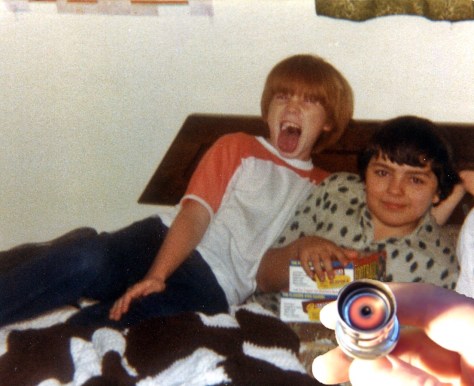
A friend (and writer, though she fights the label) sent me a picture from her childhood. She snapped a picture of the old orange photo with her phone. I removed the orange tint from it, knowing that greater revealed detail might cause surprising observations. The hand originally seen holding the picture as she quickly snapped it is almost 40 years older than the innocent face smiling at us in the picture.

As I looked at the picture, for a brief second, I felt disembodied and as if I’d traveled back in time to City View Trailer Park and glanced briefly through the cheap window of the trailer. My eyes crawled across the scene; my friend in the background was smiling because she was asked to by her mom, the photographer, while her stepfather wrestled with a sibling on the bed.

In that instant, the moment became frozen forever, also disembodied and ethereal. My friend’s smile could be authentic happiness or adopted camouflage. It’s easy to take pictures and memories out of context. Due to the convergence of so many aspects of my friend’s life and mine, I can look at such pictures and interpret them in the harsh shorthand we learned separately.  Such preconceptions can be wrong.

Her life has arced away from the world contained in the picture. Such victories are unheralded. She is excavating her truth from all the stories inventoried in her head. Despite what we’re told, memories are fluid, often refusing to take solid form. Who we are at the moment drives our focus toward the conflicting elements in our memories and pictures.

Because I shared most elements of family in common with my friend, I too can hear the cacophony of anger and control, even as I feel my heart swell with some moments which escaped the discoloring of the lesser parts of my life.

She’s looking through a long series of windows, trying to balance the tapestry of fact against emotion and her loyalty to those who shared her path when she was younger. It’s a delicate tiptoe and seldom leads everyone to agree.

It’s possible to be momentarily happy and yet inexplicably ruined. We don’t understand our lives until they’ve made an aged trajectory. Even then, our glimpses into the window make us feel traitorous to our own lives. It is as if we owe ourselves an explanation, even though we know we’re blameless for choices we didn’t make.

So, in turn, I peer into my own childhood. I feel the cheap paneling against my back as I lean against the wall in the narrow closets. I hear the shouts from other rooms. And sometimes, I recall the joy of stolen moments, ones which do not fit comfortably with the mythology of my recalled violence.

In those same closets, I opened books and dreamed of other lives – and momentarily forgot that my life was diminished and small.

I look at this picture through my window and see the smile as a captured moment, fragmented away from those in the photograph.

It All Started at Taco Tico

Capture


“It all started at Taco Tico,” is perhaps the best opening line for a personal story that’s ever been written.

When I was younger, I was a band geek. It probably saved my life – and not just in the sense it gave me relief from an otherwise certain depression and the ability to get away from my house.
On one occasion, it helped me avoid a beating.

Because my parents were negligent to a degree almost unequalled, I walked more than the average student. Until near the end of 9th grade, you would have undoubtedly failed to believe this, as I was fat, and not in the humorous Weird Al way.

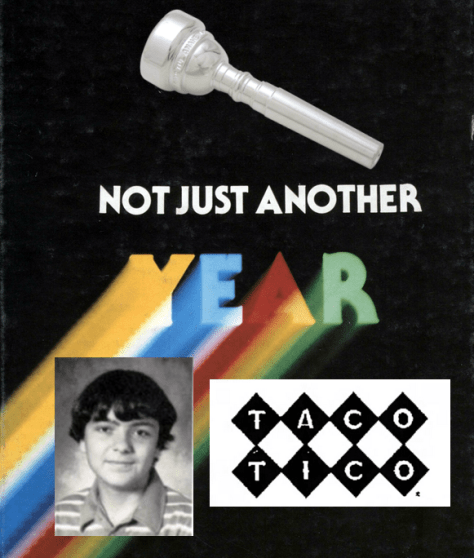
After some event after school, my mom and aunt failed to materialize to pick me up. They were probably worshipping on Budweiser’s altar. I had two choices: invent Uber or start walking. On the way across the practice field, I found someone’s trumpet mouthpiece and put it in my pocket. For those souls denied exposure to band, such a mouthpiece is made of solid metal and a few inches long. I put it in my pocket so I could try to return it to the owner the next day. Unlike me, trumpeters had to pay for their own mouthpieces and instruments.

I walked up to highway 68 (now 412) and westward. By some miracle, I had two dollars in my pocket. I  went to Taco Tico, a restaurant that once was legendary among some of us in the community. The building is across from Susan’s restaurant. Everyone in Northwest Arkansas has stories about events and food at Taco Tico. I could get 4 rice tacos for a dollar. I sat and ate the tacos. This sort of thing was a luxury for me. I left to walk the rest of the way to my cousin’s house on Ann Street.

As I crossed in front of Taco Tico, something whizzed past my head and hit the pavement with a thud. I turned to see some sports car (they were all the same to me) go past, with an arm and upraised middle finger for my inspection. By the time I was crossing Carley Road across from K-Mart and in the area where Walgreens now stands, I heard someone revving an engine loudly. The corner was a gas station for years, a cracker crust pizza place, and a gaming business that seemed to be in trouble constantly.

The same reddish-colored sports car that had greeted me earlier was in the parking lot. Two idiots sat in the front with the windows down, both shouting clever insults at me. Both of them were upperclassmen. I didn’t know their names, but both were football players for Springdale.

It was obvious they weren’t on their way to a Mensa meeting. They looked like a happy couple.
I walked as close to the edge of the lot as I could. The driver gunned his engine and rolled ahead of me to block me. As I started to walk around, the driver jumped out and called me a f*g. If I were in that place and time again, I would undoubtedly tell him it was more likely he and his passenger were, given they drove around randomly at all hours, and that they looked like a happy couple. When I didn’t answer him, he took a couple of steps and punched me in the stomach and then shoved me as hard as he could. I fell backward and to the ground. I had learned through my Dad’s violence that sometimes faking a more severe reaction might save me a punch or twenty. The driver spit in my direction and headed back to his car. Not that it was important at the time, but I wondered why so many males thought that spitting added any machismo to their personality.
I started to grab a rock but instead remembered the mouthpiece in my pocket. I took it out and threw it as hard as I could manage. My terrible aim somehow disappeared in that split second as the mouthpiece left my hand and arced with incredible speed toward the car. It thunked against the small rear passenger window. The glass immediately splintered. Admittedly, I threw the mouthpiece with the intent of hitting the bully driver directly in the face.

The driver froze, and his mouth fell open. “What the…,” he started to say. Without thinking and without hesitation, I ran directly toward him. It surprised him, and as he reached out to grab me, I ducked sideways and darted around the front of the car and kept running. The driver ran after me instead of jumping into the car. I could hear the passenger yelling. Within a few seconds, I was outpacing the football player by a huge distance. I turned, running backward, and told him he should run his legs more and his mouth less.  I knew the area well and ran directly to the barbed wire fence and hurled myself over it.. I turned to see that the driver had abandoned his pursuit. He had to run back to the car before he could pursue me. I ran through the field, angling away from Carley road. It took me quite a while to run back to my aunt’s house, as I couldn’t be sure that the two idiots weren’t going to follow the roads and find me.

Despite me fearing for my life the next day at school, I had no options. Bullies were a big part of school life for students. It was pointless to tell anyone. Football players were mostly untouchable. I’d made the mistake a couple of times in junior high and then during high school of trying to “tell on” football players for some fairly dangerous behavior. It didn’t go well for me. It is part of the reason I don’t hold any of the coaches in high esteem, even those with huge scoreboards or statues with their names emblazoned on them. I don’t care that everyone seems to have other, higher opinions about the people we shared in common.
At the end of the year, the driver of the car pretended to lunge at me in the hallway. Although I flinched, I immediately and regrettably said, “I’m not your type,” as I dodged away. He wasn’t amused. The other droolers with him looked at him in almost shock. I walked away,  certain I was going to be tackled in the hallway.

On The Tip Of Your Tongue, You Said?

1xfamilyscan (237)


Although modern vehicles still retain the round 12-v holes in which to plug in adapters for power, people of a certain age all recall the magic of the spring-loaded cigarette lighters of yesteryear. Back in the day, everyone smoked, even people using oxygen, priests, the doctor who delivered you (while delivering you, no less), and the irritated waitress bringing you overcooked hash browns at the Waffle Hut. (There were no food returns, only “Get the hell out!” requests if you complained about your food, or ashes in your grits.)

Adults, however, could not be without a cigarette lighter for over ten minutes. Before we removed the clause from the Declaration of Independence, all adults were required to smoke at least a pack of cigarettes a day. My mom, for example, showed her patriotism by sometimes smoking a literal carton a day. It seems impossible. She often rose from the bed with a lit cigarette, bathed with a cigarette, and smoked all day as she sat in the operator’s chair for Southwestern Bell. There were times when our house on wheels looked like the polluted skies over an industrial factory. If we were in the car, the windshield seemed opaque from all the smoke. Having the windows down was a bit of a relief, but we all remember the clotted gasp of discovering that a butt thrown out the window had reentered to find itself in our mouths and throats. My mom didn’t believe that throwing a lit cigarette out of the car was a problem. If Smokey The Bear had been standing beside the road, she would have flicked it directly into the pocket of his shirt in an attempt to catch him on fire.

Adults who smoked treated the car cigarette lighter as if it were a religious relic, one to be admired, worshipped, and never touched by the undeserving hands of a child. (Unless we were told to light the cigarette for the adult, who undoubtedly was struggling already to pop the beer can open, the one cradled in the cheap koozie used to hold it.)

Unrelated to the story: the word ‘koozie’ is one of the ugliest words in the English language.

I don’t know how old I was for certain. My cousin Jimmy and I were in one of my dad’s and his cousin Tom’s jalopies for sale. Jimmy was spoiled, but sometimes lit up with mischief and humor. We sat in the front seat of some aged old car, honking the horn and ducking below the dash to avoid being seen. I’d get a beating if caught. Jimmy would have received a smile. Jimmy kept pressing the cigarette lighter in, waiting for it to startle him as it popped out, its insides glowing red. He acted like he was going to touch it with the tip of one of his fingers. “Don’t!” I yelled, despite my extensive Shakespearean training in the vocal arts. Jimmy laughed.

“Oh, it won’t hurt so bad.” He seemed sure. I was 100% certain he was wrong, having been stupid enough to do it myself. More than once and probably fifty times up to that point. I noted that my burned fingertips didn’t smell like pepperoni, either.

“I’ll give you 5 bucks if you touch it to the tip of your tongue,” he told me, smiling. 5 bucks was the equivalent of a fortune for me.

I considered it. I pulled the lighter from the sheath and watched it as it glowed red and hot. When I got it closer to my mouth, I could of course feel the heat radiating off it it.

“Get it hot again,” Jimmy insisted, so I popped it back in the ashtray that contained the plug in.

In a few moments, it popped back out. Jimmy grabbed it and handed it to me.

I unwisely brought it up to my face and stuck out the tip of my tongue. The heat was too much. At that precise moment, Jimmy slapped my left hand unexpectedly and the hot coil hit the tip of my tongue. Luckily, it came away immediately as I reacted and pulled it away. A bit of my skin came away with it. I could smell it burn and hear a slight hiss and sizzle as it cooked my disconnected skin.

I didn’t scream, but I did whimper as I coiled my tongue into my cheek. I could feel it burning. I think it was saying “Idiot” to me in the only way it knew how. Jimmy was doubled over and laughing. His eyes were teary as he peeked to look at the horrified expression on my face.

Because I was poor and my mom refused to let us use the excellent insurance she had through her work, my concern was the possibility of needing medical care. Dad would have opted to slice off the tip of my tongue with one of his hunting knives, or push me into an open septic tank.

Sidenote: the house I lived in, one off of Powell and near Hatfield Street, and opposite the old City View trailer park, had a secret. There was a round garage on the property that Dad used for his mechanic business. The property had a well and a septic tank instead of city water and sewer. We had been bathing in – and drinking – water contaminated with sewer waste from a faulty septic tank for over a year. We kept complaining that everything tasted like sh*t. We weren’t wrong.

This is a true story.

Without going into the details, it’s why to this day I have to concentrate to take the first bite of ramen noodles.

Jimmy finally stopped laughing. My eyes cleared up enough for me to tell Jimmy I was going to sneak up on him while he was sleeping in his waterbed and put a snake under the covers with him. The idea of snakes on him while sleeping terrified him. He begged and pleaded for forgiveness.

My tongue hurt for several days. I had to play the French Horn. Each time my tongue punctuated a note against my lips or the mouthpiece, I’d cringe a little. I felt like a little poodle on the verge of wetting myself.

I never put a snake in the bed with Jimmy. But I thought about it. A million times.

You’re Not Going To Enjoy This Story

white (2)

I have some stories, many of which I won’t tell until some of those involved die. It’s not out of respect, though. I know I don’t get all the details right. Stories are certainly more complicated than I make them as I reduce and distill whatever swirls in my head when I share pieces of my life. Others attack the details and forget to defend the essential truth behind the story. I have dozens of anecdotes and stories I’ve written. Most of them are too raw or lacking a central focus. With many of them, I just concluded, “It’s time” and throw them out here as if they need to breathe. With some of my stories, it would be folly for the people involved to identify themselves. Their denials won’t age well. If you think I’m writing about you or someone you know, don’t ‘out’ yourself.

I wrote the initial version of this sometime in 2001. In reality, this encompasses several conflicting stories.

When I was in junior high, I had a few experiences which jarred me. A couple of them are closely guarded secrets. Because I could recognize violence in places most people saw few signs of such, there were a few times in which I was rendered floorless in recognition of how bottomless some people were. I now know that there are abusive people from all walks of life. Worse still, some are adept at recognizing children who are already at risk and then do further damage to them. Oddly, it took me years to realize that I also had a congruent weakness: I often failed to see the danger behind a smiling face. Many of the biggest monsters hide in plain sight, behind an easy laugh. Youngsters who are mistreated tend to be distrustful of everything, of course – but they also tend to contradict their instincts by responding with too much trust toward a smiling face or friendly demeanor.

Make no mistake, I encountered some incredible adults and teachers when I was young. Don’t make the mistake of thinking I don’t recognize the debt I owe them. Talking about the lesser people doesn’t denigrate the better people in my life. All are stories. Likewise, you must accept the reality that some of the worst human beings I’ve known were teachers, coaches, and other professionals. The positive examples outnumber the negative by a staggering margin. Not talking about the negative examples doesn’t help anyone, though. Regardless, I get amused when people call into question my motives for sharing. As Anne Lamott said, “You own everything that happened to you. Tell your stories. If people wanted you to write warmly about them, they should have behaved better.”

I was beyond the normal scope of ignorant when I was younger. My family life didn’t foster a broad worldview and often no expectation that I would live to adulthood. Each weekend brought dread, even as I found youthful distractions. Much of my life was wasted trying to bridge the gap between my home life and the one outside its reach. I loved school in so many ways; the greatest and most singular was simply that it was not home. I often say anywhere was safer than home, generally speaking.

At school, I had befriended someone who seemed like she might have a glimpse of my life, an overview I didn’t have to explain. I’ll call her Tammy. It’s important to note that this wasn’t a romantic relationship. After a while, I noted that she didn’t want me to notice her mood swings. After I met her parents, I made the mistake of asking if her dad liked to drink, followed by me seeing that her mother seemed to behave like my mom. I thought I was sharing a secret, one Tammy might reciprocate. I could not have been more mistaken. In the short term, I just avoided her as she became belligerent and angry after I told her about my family life. I don’t know why I thought my honesty would let her be able to confess her own dark secrets. I tried to explain it to her. It only made her angrier. She couldn’t get past the idea that I “knew” what happened at her house when no one was looking.

She told me that her dad was going to find me and give me a dose of what I deserved. She threatened me if I shared my ideas about her home life with anyone. When she said it, I knew that her dad had probably actually said the words, in part because of the details she provided. Her eyes lit up with crazy glee each time she’d mention that her dad was going to beat me. It sounds like an exaggeration, but she probably said that her dad was going to beat me at least twenty times. She seemed a little too focused on ensuring that I was at least scared. Though I don’t remember any of the details, it was evident that her dad had probably hurt a few people in his lifetime. Years later, it occurred to me that Tammy might have earned a temporary reprieve from her dad’s beatings by offering me as a sacrifice. Children living with violence learn techniques to avoid scrutiny and to give the abuser another target. It’s part of the reason they lose their confidence and ability to make rational choices in later life.

One day, after a school function at another school, I was walking out of the building to make my long walk home. In those days, I was accustomed to walking miles from events. My parents had decided they didn’t want kids after they had us. I saw Tammy getting into her dad’s ugly little car, and I made a full swing around the edge of the lot to avoid them near the exits. To my surprise, a few moments later, her dad pulled his car alongside me and stopped. The driver’s side tire missed me by an inch.

He glowered at me. He was a huge, overweight man. “Boy, do I have to get out of this car and kick your ass?” Keep in mind that I was in junior high, and he was a middle-aged adult, one with a good job. He went on, shouting as the volume of his voice rose and fell. I don’t remember the words, just the expectation that he was, in fact, going to exit the vehicle and hit me until whatever plagued him faded.

Some people were lucky and never learned the truth that adults could hit a child in those days and face no consequences. Not only did I experience it personally many times, but I also witnessed it too. I’m not sure which was worse.

(I erased seven specific anecdotes at this point, ones dealing with job title and/or names. Whether it’s cowardice, self-protection or a soft heart, I’m not sure. They are not positive or life-affirming examples, though. A couple of the stories tell an entirely different story about some of the adults we shared growing up in the same community.)

Tammy’s dad said some angry things. Tammy was in the back seat, her face full of satisfaction. I’ll never forget that ugliness and glee. Her mom cowered in the front passenger seat, her head recoiling a little each time her husband shouted. Because of my dad, I knew that there was no right answer for the anger, just as there hadn’t really been a cause. Abusers don’t seek justification for their anger or violence – just an outlet. Justifications only come in the rare event that they are held accountable for their behavior. I stood there, silent and stupid, until Tammy’s dad was done screaming and threatening me.

Much later, Tammy continued her effort to retaliate against me for knowing her family’s secret. She enlisted another student to threaten me. I’ll call him Eric. Tammy had told him all manner of lies to get him really angry at me. I tried to be friendly and to avoid a fight, which only seemed to stoke his anger. I was a master of evasion due to my dad’s years of training.

Because I realized that Tammy was crazy, probably through no fault of her own, I found her and politely told her to please leave me alone. A couple of classes later, Eric approached and said something like, “I told you to leave Tammy alone, you sick f%%k. Next time I see you,” he said as he put a gun finger to his temple. I didn’t answer him as he continued to throw insults. People generally are going to do whatever it is they’re going to do. I had no doubt that Eric would beat me to a pulp. What Eric didn’t know, though, is that I would likely remove a part of his body against his will during the process. Some people fight to win because they are able; people like me fought when they had to, with the goal of making the assailant not do it twice.

Later, my dad had punched me squarely in the jaw when I wasn’t expecting it, precisely with the stated goal of teaching me to be mean. When I got up too quickly, he hit me again to demonstrate his superiority. His excuse? I was running too much. He also enjoyed giving me impromptu lessons on manhood. I had started running in March of 9th grade and lost a lot of weight. After a particularly bad day of home and school, I just decided I was going to start running. I had dizzy spells for a while after the outburst leading to being punched twice in the face by my dad. Because of the second punch, I had fallen backward and hit my head against the native stone fireplace at the end of our trailer. I lived in Piazza Road in Tontitown at the time, just past where the pavement ended. That was one of the times I told my mom that something was seriously wrong. I was covered by phenomenal insurance through her work. Mom refused to take me to the doctor, even after I made the mistake of saying I wouldn’t mention what brought on the pain and dizziness. She made a point to tell my dad that I had wanted to go to the doctor. She made sure that Dad understood that I implied I had something I could say to the doctor if he asked. It sounds like lunacy now. Mom at times exceeded the symptoms of being a victim and joined in the sadism. When Mom told Dad that I needed to go to the doctor, he waited until I let my guard down a bit and grabbed me and swung me around and into the cheap wood panel wall leading to the bedrooms at the end. I felt the wall crack as I collided with it and fell backward onto the linoleum. I’m convinced I did at least fifteen cents worth of damage to the cheap panel wall that ran throughout the trailer. Dad was shouting drunkenly at me that I should keep my mouth shut about the dizziness.

The worst part was the look of crazy smugness on my mom’s face as she watched Dad be brutal to me. I jumped up, ran into the bedroom, and immediately climbed out the ground-level window of my bedroom. I don’t know how long I stayed outside in the dark. I do know that the next afternoon when I arrived home from school that I took one of Dad’s pistols from the closet in his bedroom and walked down the dead-end part of Piazza Road. Several hundred yards down, there was a small valley and a stand of trees. I threw the pistol as far as I could, over the barbed wire fence and into the brush and rocks there. Dad had a massive collection of guns; he’d eventually notice the pistol was missing. His drunkenness would prevent him from tying me to its loss. It was a stupid thing for me to do. It did, however, make me feel immensely better. Apart from the fact that I could have shot him, he’s lucky I didn’t toss ten of his precious guns into the valley by 4K farms. I did take several hundred dollars worth of specialty ammunition from dad’s stash and leave it next to the fence along the road, though. Dad was a convicted felon in more than one state; he wasn’t supposed to have firearms. Despite this, the police who infrequently visited never took any of his guns, even when people had been shot or shot at. Mom and Dad smoked a lot of marijuana when we lived on Piazza Road, too. I threw out a large clear bag of it after another beating. I was in the lower little shed under the back porch of the trailer practicing my French Horn. Dad grabbed my French Horn and hit me with it. The bells struck me in the nose. Surprisingly, it didn’t break. It did spew an amazing amount of blood for ten or fifteen minutes. I went upstairs and went into my parent’s room to get a bowl of marijuana they kept inside aluminum foil in mom’s dresser. Instead, I found a large bag of marijuana.

While I didn’t feel particularly angry, it must have been lurking inside of me. As dumb as it might sound, I was furious that I had trouble reading due to the dizziness. The libraries were my sanctuaries. Reading was my outlet into the world without needing people to explain it to me. It was also the only way I could remotely mimic the people around me. The librarians at the high school knew me well. One afternoon, I had darted over to the library to put a book in the drop slot and walked back across the narrow street to campus. Missing the bus was a real problem for me, and as a result, I generally wasted no time getting back to the bus pickup area.

Eric was parked along the road by Murphy Park and the Springdale library. He was leaning against his car and chatting inattentively with a girl. I walked up and put my books on the ground. Eric turned to me to mouth off. I said, “No.” As Eric began to speak, I hit him left-handed the way my dad had involuntarily trained me to hit. Eric didn’t even have time to get his hands up. Although I’m not proud of it now, I hit him as hard as I could. One of his teeth punctured my middle finger above the middle knuckle. Eric’s head snapped backward. I didn’t even wait for him to retaliate. Had I caved in his face, I don’t think I would have stopped punching him. Something about the unholy trinity of him, my father, and Tammy’s dad broke a circuit in my brain. When he tried to fall, I dragged him by the hair as he screamed. He had the classic feathered hair that so many people preoccupied with their looks used to have in the early 80s. I threw him in the grass on the practice field (where the track now resides) across from the public library. I then crouched down and put my knee across the back of his head. I didn’t have a plan. I didn’t know I was going to hit him until I did it.

A car with seniors inside pulled up and the girl Eric had been talking to told them an underclassman was kicking the crap out of Eric. They all piled out of the car and came around. Just as one of them started to grab my arm and pull me off, I jumped up and away, not saying a word. “You’re Mike’s brother!” said one of them. Another one of them said, “I don’t care who he is, I’m going to kill him.” Because I didn’t want to be literally killed, I said something smart such as, “I’d like to see you try, coc%@#$%^&!” and took off running. Did I mention I ran several miles a day back then? It paid off. They gave up trying to catch up with me in less than a minute, even though two of them ran all the way past the old tennis court area in a failed attempt to corner me. I gave them the high-bird salute with both hands, laughing. One of the people involved later tried to kick my French Horn as he walked by. My French Horn was not only a school-owned instrument, but it was sacred to me. A few days later, I poured a can of coke onto the front seat and dash of his beloved car. It was hot, so I imagine the cleaning process was delightful. It wasn’t a habit of mine to vandalize things. Once the idea was in my head, though, it was insurmountable. I felt terrible about the coke. I also kept reminding myself that the senior in question had hurt several people I knew, all weaker and smaller than him. He loved torturing other kids. I recognized the look in his eye and on his face when he was violating someone.

Eric? He made an effort to avoid me and to ensure that people were around him. Whatever else I had accomplished, I put the idea into his head that I could spontaneously dance on his head again.

I waited a while and went back for my books, which were surprisingly still in the grass. I don’t remember how I got home that day, as my family lived over by 4K farms in Tontitown. It’s hard to believe that it was over 7 miles from the high school to our trailer on Piazza Road. It seemed like 50 back then. My finger bled for quite a while, especially when I played my French Horn.

Years ago, I wrote a letter to both Eric and the girl he was talking to, to apologize. For the life of me, I can’t remember the girl’s name. Eric didn’t deserve to be punched so hard. On the other hand, he shouldn’t have persisted in terrifying someone he perceived as weaker. That’s a prescription for disaster. I do remember apologizing and also pointing out that the feathered kind of hair he used to maintain was basically begging for a beating, anyway. I was trying to be funny. I didn’t hear back from him. Wherever he is now, I assume he is nothing but a full head of luxurious feathered hair. In his version of the story, he probably thinks of himself as the protector. Even though I tried to explain to him that Tammy had lied to him, all he saw was a weaker victim in me.

Even though it doesn’t reflect well on me, I fear that if I could go back and retrace my steps, I would have been much less patient with bullies, regardless of whether they were my age or adults. Whenever I see a story about a victim responding with uncharacteristic violence, I always initially sympathize with the victim, no matter what he or she did to the person who had bullied them. Had my older brother not been around, it’s possible that the already common bullying would have been much worse. Even though I suffered through my dad’s abuse, I recognize that if the bullying had been worse in my earlier high school days, it is quite possible that someone would have been seriously hurt. That recognition is what sometimes lets me know that I was infected with the violence of my ancestors.

The next time I saw Tammy, I told her, “So much for my Eric problem. Seriously, leave me alone.” I showed her the deep cut on my left hand. It had finally dawned on me that whatever infected her dad had been passed down to her too and continuing to be nice was only going to add another year of hell to my biography. Her dad never materialized to administer his promised butt-kicking. From that point, I only had to contend with evil looks and whispered chatter. She made herself scarce for the rest of my high school tenure. She would be furious to hear me say that I felt terrible for her. I knew what she was experiencing at home. I suspect it might have been much, much worse than what I was going through. Tammy’s adulthood has been one marked by serious trauma. When social media started to gain ground, she reached out. It didn’t take me long to realize that she was truly crazy. Redemption was impossible. Her entire life was consumed by anger.

After high school, I finally managed to break free of much of the insanity of my youth. I changed my name. I wrote letters to several people, thanking them for being great people to me. I wrote a few to those who treated me otherwise. Some were anonymous. Some were not. With three or four individuals, I found them and told them directly that they had left a stain on me, much like the violence I grew up with. I was young, and stupidly thought I knew what I was doing. Again, things haven’t improved much regarding my ignorance, but I at least recognize my ongoing stupidity most of the time.

A couple of those I reached out to were teachers. I had some outstanding teachers. Like everyone else, I try to focus on their example instead of the malignancy of the bad ones. One of the people I confronted, an employee of the junior high I attended, screamed, “That never happened!” and ran away from me. We were in the Kmart parking lot. He bolted away from me. I waited 30 minutes for him to return. He didn’t. He was in great shape and could have easily thrown me ten feet in the air had he wished to do so. He ran, though, from the truth. He’ll get a chapter one of these days, especially if I outlive him. Whether anyone else believes it is their problem, not mine. He had no business being around children, of that I’m sure. I used to watch the news or search for a mention of him online; it seemed inevitable that he’d make an appearance in the Crime Beat section of the paper.

One of those people who I wanted to talk to face-to-face was Tammy’s dad. Her dad didn’t know it, but I had family and friends in common with him, mostly as a result of his job. Life has taught me that we all have a network of tendrils connecting us. What we do and say finds the most unlikely nests to rest in. Secrets are rarely kept, even as we fool ourselves into believing that they’re buried.

I asked around and discovered that the man’s past was more widely known than he thought. In those days, though, it was quite easy to conceal that sort of thing. A cousin of mine, then retired from public service in Springdale, had a lot to say about him. “Scoundrel” was his word for that sort of person. “He beats his wife,” my cousin confirmed. My cousin told me several stories of some of the horrific things Tammy’s dad had done, including ruining more than one person’s career. One of them included beating a neighbor’s kid for running through his yard. He wasn’t charged, of course. The kid in question suffered a broken arm trying to get away. There was never a record of it officially.

I waited for the scoundrel to come to meet me in front of his work. I had left a message at the desk to let him know someone was outside. There were other people around but I didn’t really concern myself with that. I’m paraphrasing what I said, and I’m the first to admit that many of the words didn’t ring out as confidently as I recount them. People are strange creatures; angry people are literally capable of murder in church without blinking.

When he came out, he lumbered and wheezed with the effort. “Do I know you?” he asked. “Yes, you do, sir.” Weirdly, I reached out my hand and shook his. His hands dropped to his side. “You threatened to whip my ass when I was very young. I was once a friend of your daughter. By the way, I know that you liked hitting your wife and kids. You’re an asshole. I’d like to give you the opportunity to fulfill your opportunity to whip my ass, right here and now.”  I took a step back and left my hands at my sides.

His eyes filled with literal tears, and he started breathing like he might not catch his breath. “I’m going to call the police. This is my place of work, and I’m not in the best shape to shut you up,” he said as he pointed his finger in my face. I stepped toward him, and he realized that I might actually strike him. “Do you want to call now or after I give you a dose of your own medicine? You’re not two feet taller than me now, are you?”

He shuffled back inside, looking behind several times until he was inside with the door closed.

Truth be told, I might have killed him had he tried to actually fight me. For some of those I confronted, I didn’t expect a visceral response. With Tammy’s dad, because I knew he was a violent abuser like my dad, I welcomed the chance to yank his shirt over his head and beat him like a third-rate hockey player.

I sat on the curb outside for ten minutes to give the police time to arrive. There was no doubt that what I had just said was a crime. No one came. No one ever came. Had the police come, I would have told them the truth, the one about a huge man who abused his family and tried to do the same with me when I was in junior high. It would have been an awkward police report and even stranger explanation in open court. His sort of person fears open exposure to what he’s done.

I see so many people make the mistake of kicking people when they’re down. It is a universal truth that it is unwise to threaten someone who has nothing to lose. I like to think that Tammy’s dad thought about me a few times before his life ended. It’s only fair. I’m not proud of this – but I can’t deny feeling that way. I wanted him to know that I could call him to account for what he did if I chose to.

He died a few years later. I saw his obituary in the newspaper. The obituary used a picture of him from about the same time frame as when he was threatening me. I have that picture in a folder on my computer. I don’t know why I keep it. Whether it speaks ill of me or not, I found myself wondering whether his eulogies were glowing, or if anyone had the nerve and impoliteness to tell the truth: he was a violent and angry man for much of his life. His death did not come soon enough to avoid staining the life of his family. A lot of people know, though, despite the glossy sheen provided by an obituary. Unlike in my case, Tammy probably still staunchly denies any abuse that happened to her. I’ve heard through the grapevine that her life didn’t get any easier. She stayed stuck, stagnant, and angry.

I went to visit the grave of Tammy’s dad. As I stood there, I couldn’t help but think about the number of people who’ve lived with monsters like him and kept their secrets. I’ve argued with people before: if you punch your children or spouse, you’re a monster, even when the scales slide off and old age catches up to you. No one stood up at my dad’s funeral to shout the truth. He died a saint, despite the invisible blood soaked through his knuckles.

I saw Tammy’s mom from time to time at her job. Tammy doesn’t know it, but I talked to her mom a year after her dad died. I didn’t know how to ask her politely, so I simply asked, “Do you remember me?” She said that I looked familiar but that she couldn’t place me. I told her I knew her daughter when I was younger and in the briefest way possible, explained that my childhood was abusive, too, and that I was sorry that she had to live her life with someone who couldn’t control himself. I thought she might respond with anger, but she didn’t. Her face flushed red, and she resumed her job. “Take care,” she told me as I walked away. She was smiling at me when I left her.

I don’t know what the smile meant.

I only know what I like to think it meant.

And I sometimes rest, uneasy, hoping my mistakes weren’t sufficient to summon the smaller gods of justice to repay me.

I’m not proud of confronting Tammy’s dad all those years later. I’m glad, though. My sin of vengeance was certainly lesser than his of being the abuser, especially of children.

I distrust easy stories, happy endings, and simple answers. We’re all complicated and each of our demons swirls inside of us.

 

Stolen Cars, Stolen Memories

666666


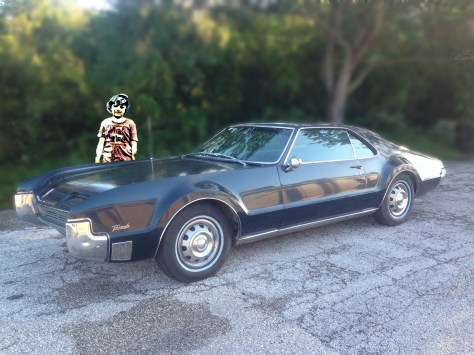
I stood in the parking lot, listening to my dad argue angrily with the stranger who drove the vehicle hauler to meet him. The stranger wore a ridiculously tall cowboy hat, black pants and shirt, and to complete his ensemble wore some type of brilliantly white tennis shoes. There were at least six vehicles stacked on the hauler. A couple were Chevy Cheyenne pickups, a particular specialty for my Dad. The others were cars, including one exotic black Oldsmobile Toronado. The exchanged words grew more intense as I attempted to back away surreptitiously from the two angry men. Though the ending is spoiled by me telling you that no one was killed that day, the anger I remember was as real as any I’d had the misfortune of experiencing. My dad had a gun tucked in the back waistband of his pants. That he was a convicted felon never slowed his tendency to carry a gun everywhere. It might be in the glove box, tucked under tools, or slipped under the seat. It might even be a sawed-off shotgun. Though we went without many things growing up, dad never shorted himself the right to have a few dozen firearms.

“I don’t give a good g-damn what you were told, Bobby Dean.” The stranger moved his legs apart. He was expecting a fight. Dad wasn’t going to throw a punch. Someone was going to get ventilated by gunshot. People knew all the rumors about my Dad’s legendary and violent alcoholic disposition. That was only half the truth. He was much more dangerous when he wasn’t drinking. While less likely to be violent when not drinking, if his temper was lit, he seldom controlled it.

I don’t remember whether we were in Siloam Springs or somewhere else along the border between Arkansas and Oklahoma. We drove most of the way via Highway 68, the precursor to 412. Most of my recollection revolves around riding too long in the bed of dad’s pickup truck. Why I was chosen to go with him wasn’t clear. Duke, Dad’s dog, accompanied me on the windy ride.

At least a couple of the vehicles were stolen. Dad worked for ______________, a family member with a car lot and a dealer’s license. Between Dad and my family member, they knew how to disguise a stolen vehicle as legitimate. I should know. They stole a Ford Galaxie from me in the mid-80s. As for the family member, I didn’t realize until years later that he was related to me by marriage. Dad committed arson for him at least twice that I know of. More than once I heard Dad brag that anyone could burn a house down using the water heater or the stove unless they were total morons. That last bit isn’t relevant but somehow seems important.

“I’ll give you $500 less than agreed. Anything more and you can go _____ yourself.” Dad seemed adamant on the amount.

“You’re going to have to drive the hauler to Springdale then. I’ll pick it up in a couple of days,” the stranger answered. Dad shook the man’s hand. All the anger seemed to have disappeared once the money issue had been settled. Dad handed the stranger his truck keys. It must have been honor among thieves which prevented Dad from worrying about his own truck being stolen.

Since I wasn’t going to witness a murder, I emerged from the other side of the hauler. Dad handed me a stack of papers, titles, and mechanic records. “Put’em under the driver’s side seat,” he shouted at me. He went to look inside each of the vehicles on the hauler. In a few minutes, Dad climbed into the vehicle hauler cab. “You’re not riding in the cab. Go ride in one of the cars on the trailer. And don’t let anyone see you.” I don’t know if he thought he was conferring a privilege or what. Since he wasn’t screaming, I didn’t question him. I wasn’t surprised that Dad’s dog was going to ride in the cab of the hauler on the way back while I was banished to the vehicle of my choice. There was no way I was going to try to climb onto the top level and ride the curvy highway back to Springdale with Dad driving. I have to admit, though, it was both a little scary and interesting sitting in the Toronado. The car looked sinister to me even then. I spent a few minutes searching through the glove box and under the seats of the car I rode inside as Dad drove the hauler. I pressed the cigarette lighter in at least two hundred times on the trip, watching the coil glow red. This was a cardinal sin around my parents, who treated smoking as the religion they failed to possess. They were unconcerned if I burned my face off with the electric lighters. Their only issue was to find themselves without a constant means to light a cigarette.

Dad pocketed the $500 he shorted the stranger who drove the vehicle hauler to the border of Arkansas. He told me to keep my mouth shut or get a broken nose when we stopped by the road in Tontitown. I wouldn’t have known if he hadn’t threatened me.

All the cars were sold as if they hadn’t been stolen. To make it easier, another cousin had a permit to do vehicle inspections, notary work, and many of other details needed to steal a car. He lived over near 40th Street. Dad was a mechanic by trade and could do welding, electrical, plumbing, and a thousand other things. Because I was uninterested in anything related to Dad, I didn’t pay a lot of attention to the conversations about stolen vehicles or stolen parts. There were a couple of  junkyards that had the dubious specialty of looking the other way on just about everything. Everyone involved had convinced themselves that they weren’t doing the stealing, so it was okay. I did ask once, “But if people like you didn’t buy them, who would they sell them to?” That’s the sort of question to earn a punch in the middle of the chest if I was lucky – and in the face if I wasn’t. It seemed likely that I shared a lot of history with the children of Mafia bosses.

Several years later, Dad made a few runs to pick up vehicles in other states. I can’t say with certainty that they were stolen, but those involved with the cars were being careful. One of those cars was a 1978 Dodge Cordoba, painted metallic green. I’ll never forget it because I had to sand every inch by hand. The Karate Kid had nothing on me for those countless hours of fun. Dad ‘gave’ the car to Mom and sold the one she had without asking her for her opinion. She gave it to him anyway, at high volume and under the influence.

P.S. I’ve never acquired a taste for cars. I admire an interesting one, though, especially some older ones I was able to see when I was young. The 1966 Toronado holds a place in my heart – and for all the wrong reasons.