*At the risk of being shot, this is tongue-in-cheek.
I woke up this morning to a flood of avatars on Facebook.
Some are great, some are humorous, some are realistic. Some, however, are as far from reality as an alligator playing banjo on Mars.
As someone who has done a lot of photoshop or alternate pictures for years, I knew the day would arrive when Facebook would drop a bomb of avatars to its site. It was inevitable.
We’ve endured the misuse of softening filters for a couple of years. They have their place. Mostly, though, they obscure reality. It can cause grief when people use them and don’t realize they look a bit ‘off’ when using them. We have to pretend their baby isn’t hideous, so to speak, even as we wonder whether they’ll win the Halloween costume contest without the use of a mask.
Maybe I’m being judgmental. I love pictures – and I’ll take them any way I can get them.
The avatar fad that just exploded onto Facebook is a good thing overall. Anything that distracts people with a bit of fun or interest can’t be a bad thing.
It’s just that we all collectively share the same observations when people aren’t being realistic. If my avatar isn’t balding or fails to have a gut, it’s not realistic. It’s true I could simply use a Danny Devito gif to represent me, but that leaves him without a good one to use for himself.
The above song is old by modern standards. It did, however, predict the rise of avatars.
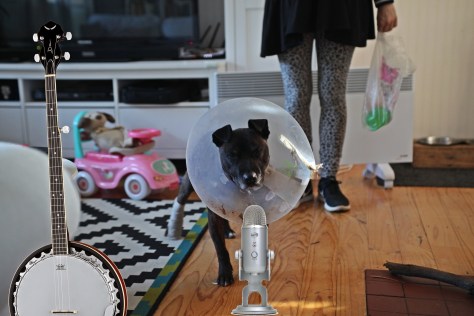
Because I knew she’d like it, I made a png cutout of her avatar so that it would include a bulldog, a symbol that best represents what she’s all about.
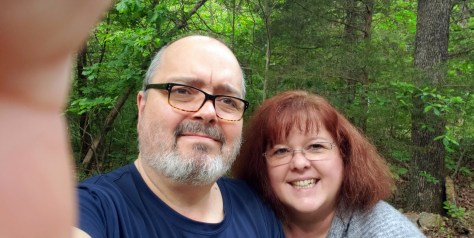
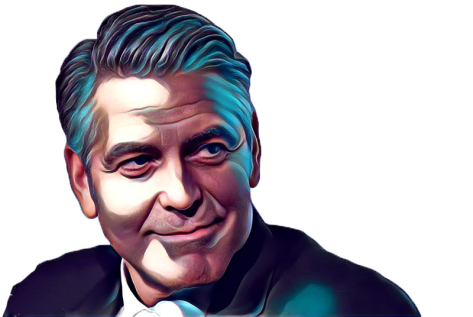
To be an idiot, I made a George Clooney png avatar for myself. When people compare me to others, George Clooney is somewhere around the 5,000,000,000 mark on the list of my possible doppelgangers.
Now that I’ve contradicted myself, I have to go make a mass of crazy avatars and pictures for other people. Some will challenge their notions of reality.
Before starting this story, I’d like to mention that a friend wrote to me two days ago to tell me about her memories of the area over by old Highway 68 and where the interstate now crosses 412. Because I didn’t get to see pictures of the area as I’d hoped, I had to rely mostly on my memory. I know that photo collections exist, but they aren’t publicly shared, which is a terrible fact to me. I’m the first to admit that I sometimes get a detail spectacularly wrong. My friend remembered the duplexes across the street, mainly because one of her best friend’s father owned them. I don’t remember the Afghan Hound breeder who lived nearby either, even though it sounds very familiar, like a half-forgotten dream. I enjoy the idea of my interconnectedness with people. We shared memories and places without realizing it. For her, the place I write about was full of interest and friendship. Truthfully, were I with other adults who cared for me, I would have discovered the same carefree love of the place. It was a beautiful area and one perfect for children with a bit of freedom and adventure on their minds.
This story isn’t exactly how I wanted it. Instead of worrying about the tone, mixed messages, or errors, I’m sharing it, just as I’ve shared anything else.
In one of my recent stories, I wrote about living where the interstate crosses Highway 412 now. We moved to Springdale after my 5th birthday; I don’t recall exactly when. I skipped kindergarten, though. Grandma made a cake for me for that birthday and my cousin Michael Wayne helped me demolish it. Had I known it would mark the end of my childhood, I would have escaped through the empty fields around us. We had lived in several places in Brinkley after Dad reunited with Mom. We lived in Wheatley because I remember being very sick on Xmas day. We lived past S. Grand until the house caught on fire. We also lived somewhere near the intersection of Pine and the main drag through Brinkley, as well off Highway 39 near the intersection of Highway 49. I’ve written before that we lived in more than a couple of dozen places as a family. I don’t count the other places or otherwise, the count would be up to forty.
After a couple of intervening places in Johnson and Springdale, we moved to a very small house owned by my cousin. As my Dad got a job at his shop, we lived close to where he would work.
48th street was a narrow pasture road to nowhere. Along the street were a couple of huge oak trees. Having spent a bit of time considering the details, the tallest one was definitely 70-80 feet tall. I could use the edge of a protruding gas pipe to lift myself up to the first horizontal branch. I loved that tree. Its branches were spaced almost perfectly for a reckless boy to climb them. Around 50 feet up, it took a bit of actual deathwish to get past a couple of the branches. I often used the tree as a refuge. The apple and pear trees were much thicker and harder to climb. The oak tree near the road also provided me with a bird’s eye view of a great deal of land. I was a better climber than my siblings, despite being more rotund at times and certainly less agile.
One evening, my family was at Goldie and Ellis’ house a bit further up the road toward the highway. By way of preface, my immediate family never played games together, unless you count hide-and-seek due to fear of actual death. We did not have “Family Nights.” Most of our social lives revolved around my Uncle Buck and his wife, Aunt Ardith. Uncle Buck was my Dad’s older brother. A few nights through the years, we went up to Goldie’s house and played board games at their table. I was completely out of my element. I didn’t know how to react. I certainly failed to understand how the two people playing the role of Mom and Dad could behave so shockingly different around other people. Because Goldie was the mother of my Dad’s boss and otherwise regarded as superior, expectations were different for her and her house. Given that these were never spelled out until after the fact, there were often misunderstandings. Misunderstandings involving children in my immediate family always resulted in physical violence while being shouted at incoherently; there was no discernible lesson nor clear tea leaves to read.
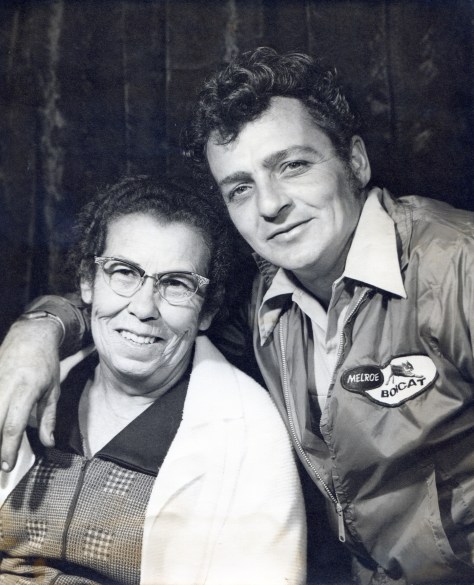
This is a picture of Goldie on the left, with my Dad, Bobby Dean. It was taken while he worked for my cousin who owned the machine shop. The cousin also was one of the first Bobcat dealers.
Though it might strike you an incongruous, Dad loved Goldie in a way he couldn’t express to his own family. Goldie had experience with alcoholism due to her husband Ellis. Dad, even when not drinking, could demonstrate affection for Goldie in a way that confused me. In the case of his immediate family, familiarity did indeed breed contempt.
One of my favorite memories was one Friday or Saturday night when we were at Goldie’s playing Sorry!. It’s hard to believe that actually happened – that members of my family engaged in playing a board game. Our supper had been cut short due to Mom and Dad needing a drink before they went to Goldie’s house next door. Mom made some kind of horrible meat that night and nothing to go with it except bread. Since mustard sandwiches were a favorite of mine, I ignored the meat and made myself a mustard sandwich. For a reason that will never be known, this enraged my Dad. He back-handed me across the face and I fell to the floor. Everyone pretended I hadn’t just been smacked in the face. I waited a minute to determine if Dad was finished with his tirade. It was impossible to know. I ran outside and sat under one of the trees near the front of the trailer.
While we sat around Goldie’s kitchen table, Goldie asked me if I would like a bite of something. Goldie, being older, loved feeding children. I smiled and said, “Yes ma’am. Thanks!” She pointed toward the fridge and said, “Get yourself all you want.” I stood up and walked over to the fridge to open it.
I heard my mom say “Bobby Dean! Look at him!”
I knew my life was about to end but couldn’t determine why. I recognized that horrible and vengeful tone of my Mom’s voice. That tone was as hateful as any Nazi in WWII.
I froze.
Without understanding specifically, I was about to be punished for daring to open the fridge at someone’s house, even after being invited to do so. The truth is that my only real crime was having survived to that point and to be available for my parents to use me as a vessel on which to pour their enigmatic wrath.
Goldie said something I don’t remember. I’m sure it was similar to, “Bobby Dean, leave that boy alone. He’s just hungry and I invited him.” The tone of her voice as she spoke was filled with kindness and with the opposite of my Mom when she invoked Dad’s attention to me.
Behind me, I heard a chair scoot back and boots hit the floor. Just as I was about to wince, Dad grabbed me by the neck and pushed/dragged me outside. Since it was dark outside, I couldn’t imagine what I would be hit with. The answer was nothing. My dad grabbed me by the neck and top of my pants and picked me up and threw me off the end of the porch into the gravel of the driveway. It stunned me as I hit the gravel. I didn’t move. Dad threw me several feet into the air and across a decent distance. Even in pain, I knew that to play dead was my best option. Dad pulled a Camel from his shirt and lit it. He paced as he smoked. When he was done, he flicked the cigarette out into the dark without saying a word to me and went back inside. For all he knew, my neck had snapped when he threw me like a bag of trash.
I considered running and climbing the tree but knew the subsequent beating would only be worsened by my doing so.
I waited and sat on the bottom riser of the porch steps. A few minutes later, Goldie opened the door and said, “Come here, I have something for you.” I went to the door as she handed me a glass of tea and a piece of what turned out to be some kind of delicious cake. “Leave the glass out here when you’re done.” She smiled at me and went back inside.
I’m still at odds over how my parents handled our presence at other’s houses. Not that we had the opportunity very often, of course, but we were scared children who assumed that imaginary rules dictated our behavior. Regardless of how well-behaved we were, we still remained incredulous at some of the behavior of our parents. They could literally break the front door in anger on Friday night, while threatening to kill the host in a fit of anger, yet act as if wanting a soda was the same as defecating on the living room floor in front of all the guests. No matter what we did, punishment was likely. Growing older, it was a shock to realize that all of this resulted from a character flaw in both of my parents and actually had nothing to do with me as a child.
.
.
A few days later, I was in the machine shop where Dad worked, waiting to see if he would assign some random and horrible work for me to try to do. With his mumbling, instructions were scarce at best. I’d take a furtive look around and steal a couple of sugar cubes from the coffee area. My cousin exited the shop floor where Dad was restoring another Chevy Cheyenne pickup. “Hey, how are you doing? Get you some sugar cubes if you want them.” He laughed. He knew I’d been pilfering the sugar cubes. He wouldn’t mind if ate one hundred of them provided he had some for his next cup of coffee.
Dad came into the office and lit a cigarette. “You can sweep the chat off the floor.” Miraculously, I understand his mumble. I went into the machine shop and grabbed a floor broom and starting pushing it. My right arm was killing me. The broom was a bit long for someone my height and the fact that my arm hurt made it cumbersome.
Dad and my cousin exited the office area and entered the expansive shop area where I was sweeping. My cousin good-naturedly said, “What’s the matter, did a girl whip your butt?” Because he was speaking to me in humor and kindness, I must have dropped my guard and lost all sense. “Nah, I got thrown off a porch.” I said it as a joke without any intent to bring up the incident at Goldie’s house.
Dad said something in anger. I knew he was coming for me and despite the fact that another adult was witness, I wasn’t sure I would survive. Acknowledging Dad’s violence, even in front of people who’d witnessed it a dozen times, was a crime punishable by excessive violence. When I watch shows wherein the villain threatens to kill all the hostages if the person says anything to the police, I find instant credibility in the storyline; it echoes perfectly the atmosphere of my Dad’s outlook.
I ran through the painting area in the back and out the back access where cars could be driven in and out to be sand-blasted, sanded, and painted. I never ran from Dad. Running always accelerated Dad’s timeline for violence. I didn’t look back. I ran to the left, turning where the walnut or pecan tree stood. (I can’t remember which it was. I should remember: it’s where I almost died and had an injury so bad I had almost 200 stitches in my head. That’s a story for another day) I ran across the expanse of yard and field, past the long garden toward the add-on attached to the back of the trailer. I turned to see Dad angrily striding across the grass. I ran around the end of the trailer and bee-lined it to my favorite tree. I climbed as high as I could possibly go. As comical as it sounds, I probably could have jumped and the top of my head would have popped through the top of that 70-80 foot tall tree.
A few minutes later, Dad stood at the bottom of the tree, screaming angrily at me. I pretended I couldn’t hear him. I wasn’t worried about him climbing as high as I was. I should have been. But that part comes later. Dad walked over toward the gravel to find rocks. He picked up a few larger ones and began to throw them as hard and high as he could in an attempt to hit me. To be honest, I know he was hoping to hit me. If I had fallen, he would have justified it easily as a case of a disobedient son. None hit me but several crashed through the foliage near me and below me.
I waited for at least an hour after Dad left. I climbed down a few feet every so often until I was sitting on the bottom limb. Scarily, Dad did not say anything to me for the rest of the day. I had no choice except to go inside and face the wrath. It did not come. That day.
The next afternoon, Dad said, “Go outside.” Knowing he was going to beat me to death, I went outside the trailer and down the steps. I followed him to the road and stood near the tree. “I put one of your toys at the top of the tree. Climb up there and get it down.”
I couldn’t imagine saying “No.” If Dad said a beating would be worse if I cried or objected, he felt it was his manly duty to literally flay skin strips from me to prove he was not to be trifled with. Anger that was slowly boiled always was more dangerous. To be clear, I cried, ragged tears of fear. There was no right course of action. I knew Dad was going to throw rocks at me as soon as I climbed the first branch.
Barely able to see and shaking like a leaf in the tree above me, I grabbed the branch and tried to climb as quickly as possible. After the first limb, I moved partly around the trunk to make the angle of Dad’s aim more difficult. As predicted, Dad started throwing rocks when I reached about twenty feet from the ground. I kept climbing. At about thirty, one of the rocks hit my leg. It didn’t hurt much. It gave Dad more motivation to throw the rocks harder and begin to scream at me. From across the street, a man walked out on to his driveway. I have another story about him later.
“What the hell is going on here?” He shouted at Dad. I knew two things: he knew Dad was throwing rocks at me and he also knew Dad was violent. There’s no way he hadn’t witnessed many of the domestic violence episodes at our house and then two subsequent trailers there. I kept climbing.
Dad turned toward the man across the street: “Mind your f%%ing business if you know what’s good for you.” Dad turned back and ignored him. Somehow, he knew the man would go no further.
He kept throwing rocks. I looked up and could see that Dad had placed an empty whiskey bottle way up in the tree. I couldn’t imagine him climbing that high. Had I watched him while he did so, I would have caught myself praying that gravity would take him down to his death. No matter who is reading this, I can’t apologize for the certainty of the fact that our lives would have significantly improved by his absence. I would have mourned his inability to see another path in life, yet also simultaneously recognized the possibilities created by his absence. When he was in prison in Indiana when I was very young, I experienced life free from his volatility.
As I reached a point about ten feet from the highest point I’d ever climbed and grabbed the bottle. I threw it out of the tree. “I said to bring that f#$ing thing down!” Dad screamed. Without realizing it, I knew he was going to beat me regardless when I made my way down. For a second, I thought about throwing myself out of the tree the way I had thrown the bottle. It wasn’t a suicidal thought; it was the type of perverted self-preservation that abused children consider to be logical. It’s difficult to train oneself out of it as an adult.
However long it took me to get down from the tree, Dad’s anger built. Dad dragged me into the trailer, a sign he needed privacy to teach me a lesson. For his worse beatings, rarely did someone outside the immediate group of family hostages witness them.
It wasn’t the last time he tortured me with trees or even visits to abandoned houses and barns in the dead of night. Often, his whimsy was self-attributed to humor and prank. A few times, it was. Others, though, were dark indicators of the vast well of illness and unhappiness he suffered from.
As horribly as Dad beat me, he never beat the love of that tree out of me. In it, I could see above, beyond, and through the places around me, just as the cedar tree at Grandpa’s had done on a smaller scale.
Though it may be unfair, it is my turn to throw different rocks all these years later. My Dad is deceased and unable to defend himself. I’m older now by a few years than he ever was. The little boy I was held no grudges. Just fear, and confusion. Those have been replaced by an appreciation for the absurdity and frequency of what I lived through. My story is one of thousands of children, even today. I try to focus on the humor my Dad could sometimes display. If he sat beside me today as I write this, he would call me a co#$su#$ker and laugh. He ran out of road before he could make amends. I like to imagine that my Dad could have been able to climb the beautiful oak tree with me and share the view of the world above Springdale in 1974.
I started out writing another story but was pleasantly sidetracked by discoveries I made about little pieces of family history today.
Over the years, as I’ve laboriously uncovered pieces of evidence, a fuller picture of some of my life has emerged. After a childhood filled with constant shushing and shouts of “Don’t talk about that!” I’m relieved to know that the historical record left breadcrumbs in the world. Some of them aren’t the smoking guns I would have hoped, but as circumstantial evidence, they provide an undeniable trajectory for some of my stories.
Not too long ago, by accidental fortune, I discovered newspaper articles regarding my Dad’s imprisonment in Indiana when I was younger. Before that, I finally found a mention of the accident in which my drunk Dad killed a maternal cousin of mine. Not only did they fill in the blanks for several unanswered questions I had growing up, but they told me part of the story in an impartial voice. So much of what I was told was a lie or misdirected.
On Father’s Day last year, I found out that I have a half-black sister. Her color is only mentioned because of the irony of her existence, given the racism of many of my family. I’ll take a DNA revelation over a document or historical piece of evidence any day. I’ll take my corroboration anywhere I can get it, though.
.
.
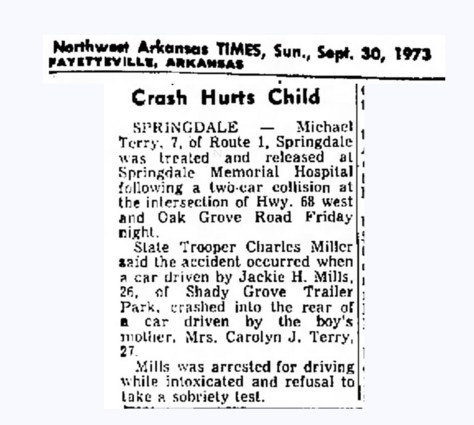
This accident happened after Mom and Dad had a huge fight at my Uncle Buck’s house. Mom left in the car. She was drinking heavily, of course. We were very close to turning left onto our road from Highway 68 (412). What fascinates me about this article I found today is that if you were a historian or researcher, you would mistakenly think Mom wasn’t at fault in the accident, especially because Mom was hit from the rear. There are a lot of assumptions at play here. You’d have to know that it’s possible Mom could have forgotten to turn on her lights – or that she thought the car behind was following too closely and slammed on her brakes – or that she was so drunk she was about to miss her turn off the highway – and so on. I don’t know what was in the report of the accident. I do remember clearly that everyone at the scene knew that Mom was drunk and that she was shouting in anger at everyone, especially the police. She took the time to use her specialty curse words, too. I don’t remember whose name Mom invoked, but whoever it was resulted in no ticket for her or questions about the open Budweiser can in her lap at the time of the accident. Mom had several accidents at this intersection, two or three of which involved other vehicles. Because part of Dad’s job at the time involved a car and body repair, he fixed the vehicles at no charge. He knew how to game the system to extract a bit of extra cash from the process, too. Northwest Arkansas had places one could go for stolen parts.
In case you didn’t read it in my other posts, my Mom and Dad paid off several DWIs illegally. It was a common practice, as most residents in Springdale should remember. Money could make problems go away. My family was strikingly poor at times yet when necessity demanded it, money miraculously appeared to be used as kickbacks, bribes, or payoffs.
.
.
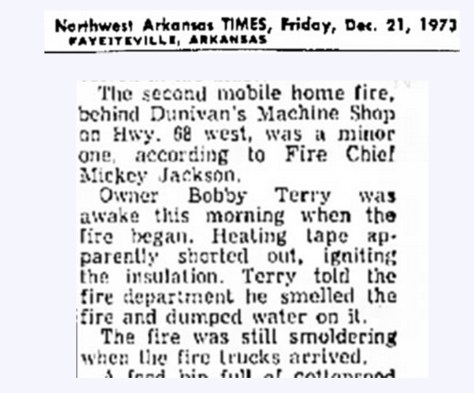
For the picture above, I remember the fire only because it happened around Xmas. I’m not convinced it was started by heating tape. Mom and Dad both smoked. Dad often did things shoddily. I’ve written before about the number of houses and trailers that burned during Mom’s lifetime. I do remember that my Mom and Dad fought like hornets after this fire. Anytime people with authority intersected with our lives, mayhem ensued.
.
.
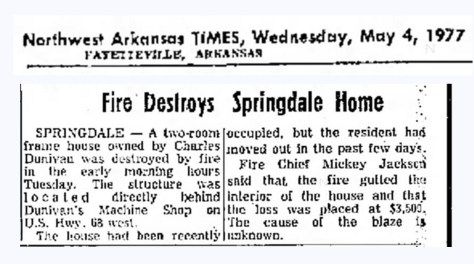
This is the first residence we lived in on the same long corner of 48th Street and Highway 68, now 412. The house was very small and green and sat the south end of the property just a few feet away from the pasture behind it. The next two residences were trailers placed in the same general place perpendicular to the narrow road. I know too much about this fire. My family was the last one to live in it. My died burned it down on purpose. He used the water heater to ignite the rest of the house.
I found these tidbits accidentally today while looking for a picture of the frontage along highway 68 in the early 70s.
I’ve been trying to write or finish several interconnected stories regarding the time my family lived in the area where Denny’s, La Quinta, and the Springdale Convention Center now sit.
The common thread to these is the increasing and overwhelming certainty that the story I’ve tried to tell in increments is true. It’s a story that no one else would have ever told.
Years before the interstate crossed western Springdale, my cousin owned a big chunk of land where the Springdale Convention Center, Denny’s, and La Quinta now stand. (Little did he know how valuable his land would one day become.) He had one of the region’s largest machine shops there. (If such things matter for the story, he technically was ‘the husband of a 1st cousin 1x removed.’)
Along the road, his parents, Goldie and Ellis, owned a house, followed by a trailer and another little house further down. Pasture framed the property in a large “L.” Like much of the area, it was rural and Highway 412 was a slender ribbon known as 68. 48th Street cut across the highway, uninterrupted by the interstate like it is now. It’s interesting that Springdale is now reconnecting across that area with Gene George Blvd. On our side of the highway, 48th Street was a narrow road to almost nowhere. Close to the road stood several massive oak trees, a couple of them towering high about the landscape. There were pear and apple trees dotted all over the property, as well as a couple of walnut and pecan trees, one of which almost literally killed me, but not for the reason you might imagine. That’s a story for another day. My cousin Jimmy and I both narrowly avoided being blinded near there, which is also a story for another day. My family lived in two trailers and a very small house on the property.
I don’t remember how we ended up in the jon boat sitting in the grass near the trees in front of Goldie’s garage building. It was there for a while, so you had to careful about jumping into it without inspection. Otherwise, you might find yourself jumping right back out with a snake or other critter attached to you.
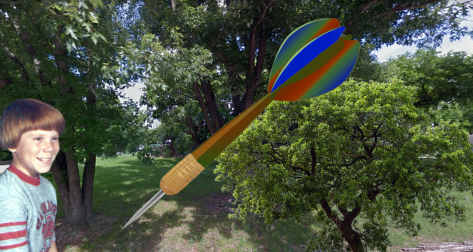
My cousin Jimmy found a few large darts somewhere. Time has stolen the details about where they originated. While they weren’t the infamous lawn darts that came later, they were larger than standard throwing darts that we’ve all tossed and hit the wall accidentally with, even as we tried to conceal our errant misses.
More than once, I said, “Watch out with those darts, Jimmy!” He was younger than me. He was also was protected by a strange force field of superiority. He was almost Kevin Costner untouchable. Jimmy laughed and threw another one with even more recklessness. It thudded into the wood bottom of the boat. “Darn it, Jimmy, you better not hit me!”
Jimmy stepped several steps further back and, without pausing, launched the heavy dart high into the air, in a long parabola of unknown destination. Naturally, I did the only thing possible: I covered my head and winced. I doubt Jimmy expected me to duck.
It turns out I didn’t need to concern myself with being hit in the head with the dart.
It landed directly on the top of my foot, impaling my left foot almost all the way through. I had a Jim Carrey moment, one in which I stared at the heavy dart impaled in my foot. My brain was taking a bit of a break to process this.
Suddenly, my foot cramped.
Jimmy’s face made an absurdly round “O” as his mouth fell open, as I writed a little bit in agony.
For once, I believed he didn’t intentionally do the thing that just happened. That is what happens when you indiscriminately toss heavy darts above people’s heads, though. That’s a helpful note if you find yourself indiscriminately tossing darts high into the air around other people.
All at once, the pain of the large dart being stuck through my foot reached my brain and I screamed like someone put a firecracker in my open mouth.
Jimmy ran away, already hollering that I was beating him, when in reality I was sitting in the boat with a dart stuck in my foot. I pulled it out without thinking very long about it. It took several seconds for the hole to begin oozing blood. I did not run after him. For the time being, I didn’t care if he had season passes to Dogpatch and free ice cream for me.
After several minutes, I hobbled around the trailer on the backside and tried to go inside. “You better not get blood in here, you little sh!t,” Mom told me between puffs on her cigarette. I went back outside and around to the front of the trailer. Dad was sitting there with Uncle Buck.
My Dad, often the comedian, yelled “Bullseye!” at me. I assumed Jimmy finally admitted he threw a dart into my foot. I still didn’t see Jimmy.
Uncle Buck, in the role of a caring human being, told me to wash the wound out.
“Nonsense,” Dad opined. “Put some ash on it.” Dad unsteadily stood up and with his drunken swagger approached me. He grabbed charcoal out of the burn pile and motioned for me to approach. He smashed it in his fist and rubbed it on top of my foot. I stood perfectly still, hoping his attention would shift so that I could get away. I knew better than to flinch or cry. “Bullseye,” Dad repeated and laughed.
I hobbled away. I found Jimmy a few minutes later sitting on a low branch of one of the apple trees between Goldie’s house and the rear of the machine shop. I didn’t hit him. He was Jimmy – and Jimmy did only what Jimmy did best. I think he found it difficult to relax if I had a dart in my hand, though.
This is my infrequent post about what’s been said and written before.
If we are doing things right, we change. It usually happens incrementally and may pass unnoticed. At times, we also change in precipitous upheavals.
Our opinions, our underwear, our hair, and our viewpoint.
Those of us who share what we’re thinking run a much greater risk of what we’ve said being used to bludgeon us later – even if we no longer believe what we once did. In some cases, we never believed it.
Thinking out loud is impermanent; writing out loud leaves a traceable mark.
Even when we’re being authentic and unafraid of scrutiny, what we say and write is routinely perverted into its opposite.
I’m a moving target. It’s not because I’m being obtuse or evasive. Okay, obtuse maybe.
I learn new things. I change, adapt, and surprise myself. One thing that doesn’t surprise me is my ignorance because it is the default state for humans. We’re blank slates. We learn. We unlearn. What we continue to believe is a choice of action or inaction.
If we’re lucky.
I’ve been wrong a lot in my life. It will happen again. I’ll change my mind.
What once seemed so damned obvious is now clouded and obscure. Things I ‘knew’ as right now seem ludicrous. This process won’t change, not if I’m lucky.
If that bothers you or disarms your ability to point accusingly at me, I’ll buy you an ice cream cone. You can either enjoy it or put it on top of my head. It’s your choice – just as it’s your choice to embrace the fluid nature of what we know, believe, and put into practice.
“What’s wrong for being weird just for weird’s sake? Plenty of people are being normal for normal’s sake. And they look anything but normal in the process. Normal isn’t a thing and it never has been. It’s a fraud masquerading as an ideal. We have people putting fake fingernails on top of their real ones, injecting fat into their lips, acting like their human emotions and reactions should be repressed in favor of whatever the prevailing notion is. Worse, we have people who don’t recognize what real humor is or the difference that motive makes in regard to everything we do and say. Be authentic. That’s normal. If you want to shave one eyebrow off, do it. It’s no weirder than having painted on eyebrows – or gluing fake eyelashes onto your real ones. The next guy can put a quarter-size hole in his earlobe or another hole in his nostril but thinks he has the right to tell you that you can’t say “Hello” in Klingon if you damned well want to? Get your banjo and play it as loudly as you want to, even if you sound like you’re being electrocuted.”
Hey, Mr. Impersonal Retailer: today, I erased the damage you did to one of your customers.
On the way home, I listened with interest to the NPR story regarding the necessity of human contact, especially in contrast to the demands of the pandemic. Without much thought as to whether I needed to go inside, I pulled into a store. The story was still very much on my mind as I made my meandering way about the store. I wandered like one of Trump’s sentences.
Mr. Magoo helped me at the self-checkout. I had an item that needed approval. I was focused on being kind to him, as Mr. Magoo and I have a storied history. In the past, he upset Dawn a couple of times. He is a fervent follower of the anti-customer credo: “He’s not happy until the customer isn’t happy.” Because of my history with him, I try to remind myself to be as neutral as possible when interacting with him. Without going into specifics, I’ve repaid my debt to him by way of several pranks.
On the opposite self-checkout belt, less than 3 feet across from me, I saw a dark-haired woman quickly step back from her cart. Another cashier, one I often refer to as Mrs. Molasses, had left her customer to approach the dark-haired female customer. If people had floating icons above them, the cashier’s would be a languidly flashing “E for Empty” icon. From the other side, another worker approached, trapping the customer near the belt and between the two employees, both of whom were very close to the customer.
As I’d made a couple of passes through the store, I noted that no one seemed to feel any urgency. I’m not blaming them; I’m just commenting on the overall atmosphere of the store. For whatever reason, I had two employees who seemed to have suddenly acquired an unnatural interest in the female customer across from me. I assumed she was trying to steal something.
They were inside her personal space, despite the coronavirus, despite the floor markings and signs, and despite the fact that they were too close even for precovid society. Regardless of their motivation to be so close, they were ignoring the bigger issue of what prompted the fluid rules regarding purchases in the first place. Whatever triggered their sudden enthusiasm, it caused them to ignore all the social distancing protocols.
The customer had already stepped back. Her body language told me she was upset. To my surprise, Mrs. Molasses admonished the woman for having two cans of Lysol in her cart. The other employee, on the other side of the cart, berated the customer for ignoring the ‘one per customer’ signage. She had two 6-packs of toilet paper. Their tone suggested she had killed a puppy on Aisle 7.
“I’m so sorry, there’s so much toilet paper, even huge packs of 36 rolls. And the Lysol was all on clearance. I didn’t think it mattered,” she said, looking back and forth between the two employees. Her eyes were teary, and her voice sounded alarmed.
I won’t say precisely what one employee said as she grabbed one of the 6-packs from the customer’s cart to put it out of her reach. The other employee grabbed the Lysol from the customer’s cart. The customer cringed and flinched as they did so.
The Lysol can was huge, I’ll admit. It had a clearance tag on it and was marked down to slightly under $5. The 6-pack of toilet paper was much smaller than the 12, 18, or -36 roll packs still on the shelf. I made a pass through the toilet paper aisle during today’s retail adventure.
Regardless, the employees were enforcing the ‘1-per-customer’ rule literally. That the Lysol was marked for clearance or that the woman could have said, “Please exchange my two 6-packs for one 36-pack,” was completely ignored.
It wasn’t what each employee said that mattered, not really. It was their body language and tone. They saw an opportunity to express their authority. I don’t know what prompted them to be so needlessly harsh.
Because the employee grabbed the toilet paper so quickly, I didn’t have time to react to what prompted the tirades. I did, however, have time to say, “Miss, might I have that can of Lysol?” She looked up at me and at the can in her hand. She was weighing telling me “No.” I couldn’t imagine what might be her reason. Instead, she said, “I can’t give it to you. You’ll have to pay for it.”
I bit my tongue, as four or five clever things to say sprang to mind.
“Uh, okay, given the nature of commercial transactions, I’ll offer money in exchange for the can of Lysol.” The employee only grew more confused.I had to spell it out. “Yes, that’s fine.”
It provided the female customer a brief moment to collect herself.
I waited inside the double entrance. I saw Mr. Magoo looking over at me a couple of times, even though I was about fifty feet away. I think he knew what I was up to.
In a couple of minutes, the female customer who’d been accosted approached.
“Ma’am, I bought this fine large can of Lysol and suddenly realized I no longer need it. I’d like to give it to you as a gift, if you don’t mind.” I probably sounded crazy, especially since I was wearing my mask.
The woman reached out and took it. “Why, thank you. This means a lot.” She trailed off, uncertain of what to say.
I jumped in. “I apologize for the way those employees treated you. If they’re so interested in safety, they’d require everyone to wear masks. And everyone noticed how they invaded your personal space at the register. That was uncalled for. They are officially on my prank list.”
The woman’s eyes teared up. She was about to cry.
“I can’t thank you enough. I don’t know what to say,” she told me.
“Then say nothing and have a good day. Put those assholes out of your mind and focus on the people doing it right.”
Way behind the customer, I could see Mr. Magoo gesticulating in dismay to one of the employees. It was obvious he was communicating that I bought the female customer the can of Lysol. I waved and smiled. Perversely, I hoped that Mr. Magoo would make the mistake of trying to approach me and reprimand me for doing the horribly unjust thing of buying a can of Lysol for another person. He’s learned the hard way that I am very unpredictable.
The female customer and I left the store, both now happier than when we’d entered.
It cost me $5.
I’m not sure how close to edge the female customer was before I intervened.
When she left, I knew she was happier and that what I’d done had lightened her mood drastically.
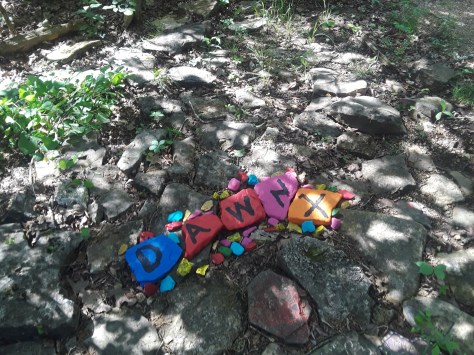
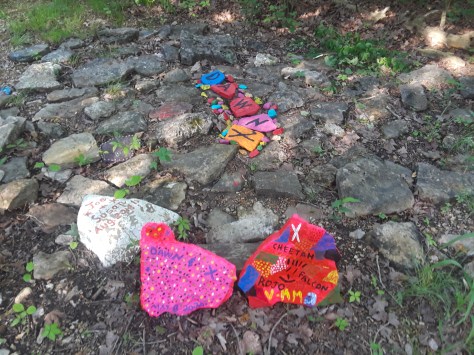
Dawn wanted to take pictures using her phone; her camera is significantly better than mine. She handed me the phone as she said, “Here, you can take them better.” She said that despite the years of insurmountable proof that the opposite was true. ” Thus, two of the best photos are obscured by my inexpert fingers. They are my favorites, of course.
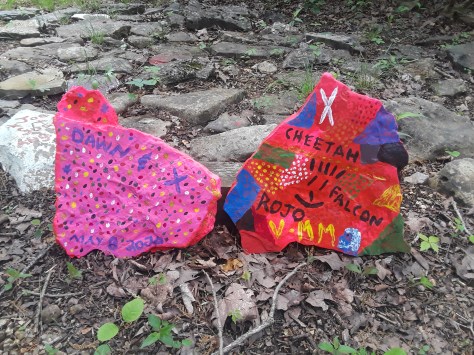
After painting a couple of rocks, something Dawn said that triggered a thought in my head, which is usually a dangerous sign. We were outside the cabin admiring the rocks that had surprisingly survived months (and even years) exposed to the elements. One of our previously ambitiously executed projects was somewhat intact but missing a couple of elements.
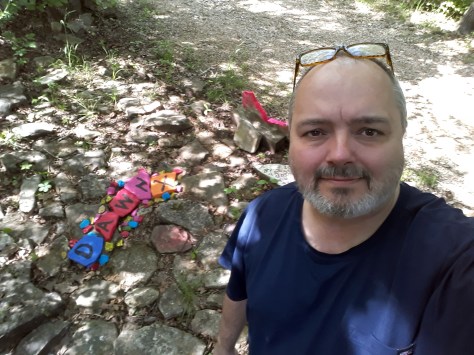
Because I had exhausted the obscenely bright neon color as the base of the two large rocks, I had an inspiration. Because I had a surplus of gloves, I opted to collect 5 medium rocks and approximately 50 small rocks. I sprayed a huge glob of several colors on aluminum foil and used my hands to roll the rocks around in my hands and paint them that way. Luckily for me, my unreplenished grab bag of paints contained about three dozen bottles of varying paints. It was a bit of overkill. Once we painted the large number of rocks, it looked quite striking against the backdrop of the surrounding forest and subdued colors nearby.
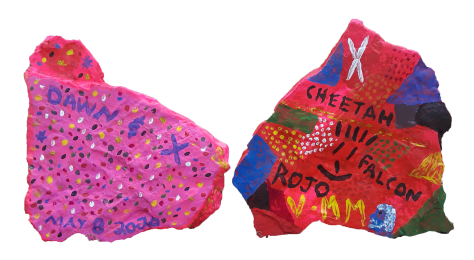
I made the png cutout version to better see the first two rocks we did. Not wanting to be outdone, I completed mine a nod toward my two favorite cousins, Beth and Lynette. I added a face on the bottom that was supposed to register surprise. I hope they don’t mind that I might exposed their secret identities again. Visitors to the cabins will drive up and see the two neon rocks and undoubtedly question what “X, Cheetah, Falcon, and Rojo” have to do with a getaway cabin. I challenge them to exceed my creativity and/or weirdness.
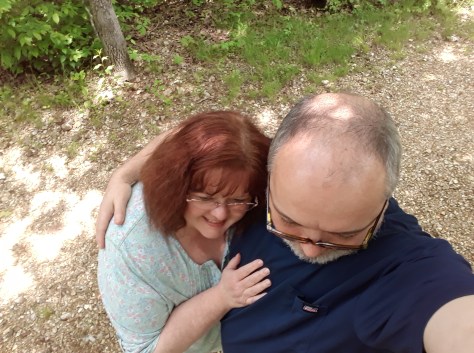
I took one from over the top of our heads, in case anyone needed to see such a picture.
When we arrived back to our normal lives here in Springdale, we went to see my in-laws. While the adults talked, I took the time to build a little town from what I could find in the yard. (Plus my invaluable index cards, of course.) You have to find your fun wherever it may be found.
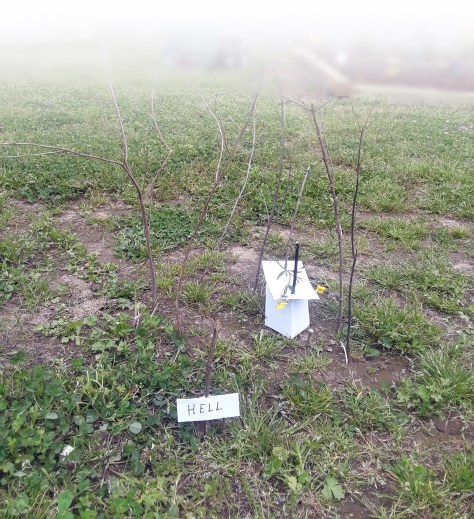
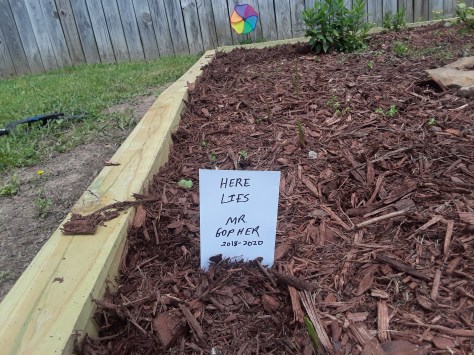
This picture is when Hell broke loose, pun intended. It was implied that I couldn’t leave my creation standing. For that reason, I had to pretend a tornado hit Hell and demolished it. I hope everyone is okay.
About leaned against a rough tree in the deep darkness, his breath coming in huge, ragged gasps. About wasn’t born with the name. His dad argued and fought to name him Beauregard, after a civil war general who later spent his life advocating for black civil rights. About’s dad died the day after he was born, however, when a tree fell the wrong way and crushed him. “That’s enough of that name,” his mom had solemnly pronounced and told everyone that his name was “About.”
His friends back in his small Kentucky hometown high school nicknamed him “About Dead,” after a line drive hit him in the chest while playing second base as a freshman on the varsity team. About was one of the best baseball players anyone had witnessed. When the ball hit him, his heart stopped for four minutes. While resuscitating him, his Uncle Desi, who was also the volunteer coach for the team, died of a heart attack himself. About’s story briefly made the national news, probably due to the incongruous death of his Uncle while reviving him. The day About got out of the hospital, his mom drove him directly to the cemetery to bury her brother Desi. About never played another sport.
His breath slowing a little, About estimated he ran for twenty minutes, ignoring branches tearing against his shirt, arms, and face. There was no illuminating moon in the night sky, and the light was dim. The dozens of small cuts on his face and arms itched with a fiery intensity.
About survived a mass shooting in 2005. A bullet shattered three of his ribs, and another traveled from his left armpit and exited near his spine. About was at Eastern Kentucky University to give one of his friend’s kids a ride back to school after a holiday break. He stopped for a cup of coffee near the university after dropping Christine off near the common eating area. He sat by the window to people watch. Across the street and not too far away, a disgruntled ex-employee of the university opened fire with a gun he stole. Because About was nowhere near the shooter, no one inside the diner initially understood what had happened. A policeman who sat in an unmarked car near the scene fired four shots. His report book remained unfinished in his lap. One of the bullets instantly killed the active shooter when it entered his left eye and exited the back of his head, even though the officer fired from a seated position inside the car. Two other shots miraculously traveled across the street, exploded through the coffee shop window, and hit About as he sipped his coffee. About was in a coma for ten days afterward, during which time the officer who stopped the shooter killed himself. The fourth bullet he fired struck and killed a woman sitting on the low wall on the edge of the street. In a coincidence, the policeman had been on duty just two days since a paid suspension following a shooting during a domestic violence call. The victim in the home shooting was the Aunt of the woman sitting on the wall near campus. As for About, he no longer believed in coincidences.
Five years later, when his truck was hit from behind by an unseen drunk driver, he went off the side of a steep valley road, tumbling end over end for fifty feet. He lay there bleeding for four hours until a passing local driver noticed the missing guardrail and investigated. Two surgeries later, scars traversed his back and right arm. He was whole, though. Many nights he lay in his restless bed wondering what force saved him. As he lay in his truck at the bottom of the ridge, he hallucinated and talked to someone or something he couldn’t quite see. While in the hospital, he vividly dreamed whatever it was at the bottom of the holler followed him to the hospital, too. The voice insisted it wasn’t his time to depart. Six months later, the drunk driver turned himself in to the Kentucky State Police. He was already dying of pancreatic cancer. About told him and the Staties that he forgave him and to let him live the rest of his life in peace. The drunk driver died of electrocution five days after reporting to prison.
People laughed at his nickname. “What do you mean, ‘About Dead,’ is your nickname?” Almost everyone asked. He politely recited the fact that a freak accident in boot camp almost killed him. It did, however, kill six new recruits and the drill instructor who’d served twenty-seven years in the Army. His friends became superstitious when he came back to his hometown to recuperate. The Army sent a Colonel to ask him to accept an honorable discharge on medical grounds. Truthfully, the Army was superstitious about the incident and didn’t want About back for reasons unrelated to his injuries. His friends dropped the ‘Dead’ part of his nickname. Kentucky grandmothers have preached for generations that it’s best to not jest at the things we don’t understand. Afterward, depending on how much interest the other person showed, he’d list off the other near-misses. Most people became uncomfortable. If he noticed their discomfort, he had a litany of jokes to appease them. He often said, “You can find me in the “About Section,” he’d say and laugh. If he was feeling particularly humorous, he would tell them that he was the brother of “Mostly Dead,” a joke he stole from The Princess Bride.
A year ago, About abruptly left his hometown and moved to another Kentucky town, one with about twice as many people as his hometown. He couldn’t tell his few remaining friends that he’d seen something in his peripheral vision. Often, as dusk approached, he could feel its long shadow behind him. He’d look, only to see the encroaching greyness of night. There were nights he lay motionless in bed, slowing his breathing, and waiting for an hour with his eyes closed to slits. Though he could see movement in the dark and shadows, he never spoke to it or acknowledged that he was aware of it. Whatever it was, it followed him to the middle of Kentucky, not too far from Mammoth Cave National Park. Because of his previous injuries, he had a full-body scan. This eliminated the possibility of a physical cause for his hallucinations. About would have preferred a definitive physical reason for his hallucinations.
As insomnia took its toll, About asked his co-worker Styles if he could stay in his cabin the following weekend. “Sure! It’s about time. You’re going to love it. Nothing but deer, fish in the creek, and a million trees to keep you and whoever you’re taking with you good company,” Styles said good-naturedly. He knew About didn’t have a girlfriend. “Watch out for bears, though. They don’t talk much.” Styles was rich due to his parent’s wealth. He still worked in the County Clerk’s office to keep himself busy. No one could believe that someone so friendly could be so rich. Coincidentally, Styles had the entire county map memorized, as well as almost every song written between 1980 and 1988.
After work Friday About drove the back roads across Highway 70 and Joppa Ridge. Style’s cabin was at the literal edge of the dense treeline. It seemed to be all porch. It had a hanging porch swing on one end and a netted sleeping area on the other. Styles often slept on the porch or out on the ground in a sleeping bag thrown near the firepit about twenty feet from the cabin. About noted that Styles had kept his promise; there was a massive pile of firewood and fallen tree limbs to feed the sizeable firepit. About took his supplies out of the back of his truck and carried them inside. He didn’t need much to keep him sustained. The fridge was well-stocked.
Around eight o’clock, About poured himself a few fingers of scotch from the kitchen cupboard and grabbed a bag of Style’s homemade beef jerky. He went out on the porch and sat on the stone steps. He left the gun inside. He couldn’t imagine how he’d need a gun. He knew that wildlife would not approach the cabin. Not tonight, anyway. The shadow would keep them at bay. About no longer felt foolish for thinking that way.
As the light faded, About sipped from his glass of whiskey and took another bite of the delicious beef jerky. Somewhere in the distance, a loud crash echoed. About didn’t flinch. He knew it was just letting him know it was out there. About downed the remainder of the whiskey and put the bag of jerky behind him. He clasped his hands and listened. Every few minutes, a crisp breaking of a limb would echo. The sounds made a long arc to his left. They stopped. About realized he had almost entirely stopped breathing. For at least an hour, no sound stirred. Forests are not dead places, even at night. Something is always on the hunt for food. No fireflies blinked across the expanse of grass leading up to the dirt road. The quiet was total and intoxicating.
As the ice settled in his whiskey glass, About jerked back to consciousness. He couldn’t shake the feeling that the shadow was behind him in the total darkness, sitting on its haunches near the door. Just as the thought coalesced, a board on the long porch groaned and settled. About felt the ridges of his scars light up with goosebumps.
About stood up slowly and then gingerly stepped forward down the steps and toward the firepit. He fished a lighter out of his pocket and flicked it. The light seemed unimaginably bright in the total darkness. He bent in the windless night and put the flicker of flame against the kindling and grass under the wood piled in the firepit. Immediately, a whoosh of flame shot up. About stepped back, but did not turn. Within a couple of minutes, the fire was going intensely. Careful to avoid turning his head toward the cabin, About threw more wood on top of the wood already in the firepit. He continued to throw it on, even as the ends began to hang over the wide edges. The fire roared.
About circled the edge of the firepit, away from the cabin. He kept his eyes downcast. Somehow, he sensed looking at it directly would provoke it. He picked up the longest remaining limb as he edged around the firepit. The fire continued to grow in intensity. It cast shadows of its own, as sparks crackled and made their way upward to disappear. On the opposite side of the firepit, About used the long limb to push and cajole the limbs and fire to an even greater height.
About dropped the limb on the fire. As he did, he looked up, squinting between the flames reaching upward. Through the fiery tendrils, he saw it. As his heart leaped, it saw him. Moments later, About realized that he was running. His ears filled with the screech of the shadow. He didn’t decide to run. His body took control. Twenty minutes later, he was panting in the forest, leaning against one of the million trees around him, weirdly remembering the baseball game that almost killed him.
Behind him, something cracked and broke.
About stood up and turned.
It was time.
He had always been in these woods, forever, a shadow of his own making.
*
If you visit Mammoth Cave National Park, build a fire and sit beside it. As the night encroaches, listen.
Did you know that being generally unhealthy makes you more prone to other diseases and infections?
A team of researchers in Switzerland spent 19 years investigating the link between underlying health issues and onset diseases. On March 23rd, 2018, Dr. Wayne Kerr was inventorying the medical literature section of Barnes & Noble in Lucerne. Suddenly, he found it, the proof his team spent 19 years and millions of dollars investigating. He stood up, screaming for one of his research team members, who was also in the store.
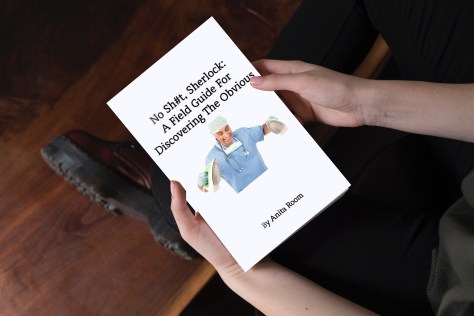
As Dr. Leigh King ran up to him, Dr. Kerr held up the book he discovered:
“No Sh#t, Sherlock: A Field Guide For Discovering The Obvious.”
.
.
.
.
.
P.S. I wrote this after reading someone’s post on social media. His post was rather smart, a fact that amplified my mirth at the idea floating around in my head as a result…
Did you know that being generally unhealthy makes you more prone to other diseases and infections?
A team of researchers in Switzerland spent 19 years investigating the link between underlying health issues and onset diseases. On March 23rd, 2018, Dr. Wayne Kerr was inventorying the medical literature section of Barnes & Noble in Lucerne. Suddenly, he found it, the proof his team spent 19 years and millions of dollars investigating. He stood up, screaming for one of his research team members, who was also in the store.
As Dr. Leigh King ran up to him, Dr. Kerr held up the book he discovered:
“No Sh#t, Sherlock: A Field Guide For Discovering The Obvious.”


![[000426]](https://xteri.me/wp-content/uploads/2020/05/000426.jpg?w=474)