
If motivational quips and posters were designed by realistic drug manufacturers…

If motivational quips and posters were designed by realistic drug manufacturers…
It is an immutable law that the universe within you will seldom be recognized by those who know you best.
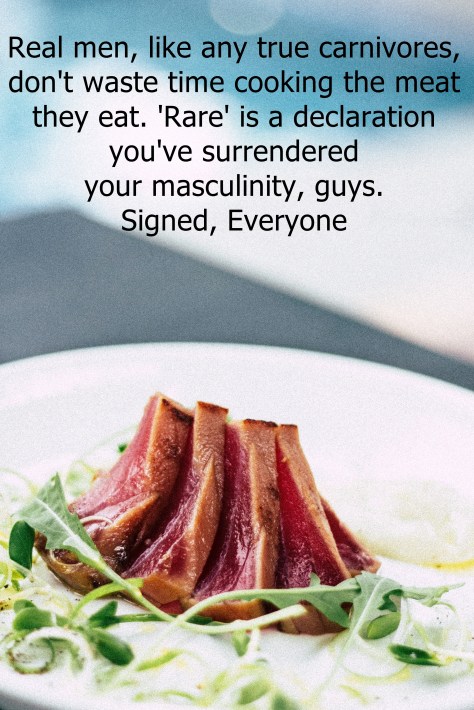
Worse than hearing about another person’s views is the blathering many men exhibit when boasting about how rare they prefer their meat -as if superiority or bragging rights are somehow conferred based on the observable blood volume of what’s being consumed.
Liking raw or rare meat is a bias based on arbitrary and variable individual human preference and therefore is covered by the “Food Opinion Edict.” (Summarized as, “All food is opinion.”)
Note: I’d rather lick the toilet in a bus station bathroom at noon on Saturday than eat under-cooked flesh.
All food is an opinion. – X

You don’t need my permission, of course. You certainly don’t need my approval, either. Likewise, you are entitled to roll your eyes in derision, mockery or contempt at anyone who corrects you for your punctuation or grammar in a text message. Unless your relationship is based on inequality, you should also expand this idea to include all private messages.
I’m not advocating total disregard for decorum – it’s not an invitation to use the ceiling fan to shave your back hair. Rather, my point is that anyone who takes the time to admonish you for informal text communication is a bigger nuisance than any perceived wrongdoing from sloppy language.
If the other person is chiding you good-naturedly, it doesn’t count as snobbery, so try to let those instances slide without a street duel. I’m not advocating that you be an ass to light-hearted cajoling or ridicule. What I am asking is that you take charge of your life and stop worrying about grammar and content when you are informally communicating. We didn’t vote on this concern – so ignore it.
It’s amazing how much of your life can be lived in this manner. Even a life perfectly lived will draw criticism, right down to the style of pants you wear or how you like to eat your french fries.
Those who relish correcting grammar can’t be stopped, so it’s best to adopt the position that they all suffer from the incurable disease of Grammar Tourette’s Syndrome, except their affliction stems from the mistaken idea that they are arbiters of grammar, spelling, and usage and this status compels them to lash out in self-appointed glee.
Sidenote: English doesn’t have a committee to decide usage or structure. It’s a fluid, evolving mass of ridiculous logic and rules. It belongs to all of us. Standard English is a myth we strive for without pausing to consider that it’s a moving target. Even if we understand the rules, they certainly don’t hold sway in our intimate private lives.
Life is short. Using tools for rapid, convenient communication should not be an ordeal or an exercise in English 101. Be as vigilant as you find it necessary to be and adjust accordingly. But if your blurbs to others are treated with a hostile eye, assume that the person complaining is a bit of an ass and go about your life as if his or her presence in no way determines how you’ll live. That part is most certainly true.
One of life’s greatest pleasures is knowing the rules and ignoring them. No matter how vigilant you are with language, you’re going to make mistakes. Even when you’ve followed all the rules, there will still be disagreement, even among the most educated and learned individuals. Language is not science, nor will it ever be. Since it’s always evolving, become a deliberate part of that process and reject all the components and obligations which don’t serve you.
Take a moment and really, really piss off a language purist. Write as you will and laugh when the sputtering objections commence. If they’ve taken the time to let you know how irritated they are by your lack of adherence to the ‘rules,’ you owe it to yourself to help them get over their unnatural affliction.
Get out your phone and text someone now. Pretend that you’re drunk and can’t spell any word longer than ‘eel.’ You’ll thank me for it.
K?
Your welcome
C U later.
.

.
.

.

.
.
.
I don’t care if Dolly Parton removes the “Dixie” from her Branson show. It’s the horses**t that bothers me. #notwhileeating
.

.
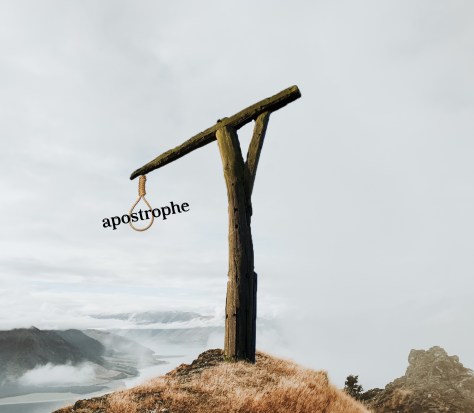
Apostrophonies: a word to describe those dedicated to the linguistic contortions of logic and denial to justify the continued existence of the apostrophe.
After years of watching the apostrophe debate ebb and flow, I’m voting that we eliminate it. Most of our communication occurs verbally and we’ve survived centuries without needing to wave our arms when an apostrophe is needed.
The grammar brigade can gnash their teeth in protest as they make the tired argument that tradition trumps utility or that our collective language will lose some of its elegance. It’s snobbery to decry nonstandard usage and it bemoans the history of every single change to our language.
Elimination of the apostrophe isn’t a capitulation to the myth of uneducated misuse or modern texting; it’s an overdue necessity. Our language has continuously evolved, and usage determines its structure. We have no arbiter of official usage; “Standard English” is a myth perpetuated by those whose livelihood depends on it, comprising a cabal of dusty minds looking backward.
To make matters worse, many people don’t realize we have a verb to describe the insertion of an apostrophe: apostrophize. Or ‘apostrophise,’ if you’re in the country in which our language was birthed.
One can make subtle arguments regarding those instances when an apostrophe MIGHT reduce vagueness, but if this is your argument, you can’t turn a blind eye toward the other 3 dozen ways in which English contains aberrant structures which inhibit clear understanding.
Contractions, plurals, plural possessives, apostrophes-of-omission, and all other usages have exceptions which don’t further the objective of language or increase its beauty.
Like it or not, we can literally change the language in any manner we see fit. We’ll either rid ourselves of the apostrophe or worsen its usage as people struggle against its ongoing and needless usage in our language.
The apostrophe should get its coat and make a graceful exit before we kick it in the seat of the pants.
Purists might miss it but I’m certain they’ll find another rallying cry of illogic to focus on. Those insisting on tradition always do.
Please remember that I love language but despise the focus on mechanics. Language should not be an obstacle to expression.
P.S. Remember that I’m not advocating for a free-for-all in regards to all rules, so please cook up a better point about what I am NOT saying.
for he, for him, for she, for her
forsake, forsook, partake, partook

After reading a friend’s post about the perplexity of inattention for an artist, especially in this golden age of social media, I began to wonder whether a precise word exists for the sensation she was attempting to describe. I volunteered to create a word to encompass the described melancholy or resigned sensation, regardless of which method of expression the artist chooses.
Before going off on a wordy tangent, here’s my paraphrasing of what she was describing:
“…the untethered feeling a creative person gets when they see that an acquaintance shows deep interest in the happenings in some far-flung place or in the life of a distant stranger, acreage they’ll never traverse or people he or she will never meet and whose trajectory may as well be that of an alien star, often regarding some mundane subject, while turning a blind eye toward their expression, one which germinates in their own backyard…”
I think writers and artists might be the most prone to experience this detachment.
It’s ridiculously easy to share what others have created, to choose words and media designed to urge us toward an emotional reaction. Creating anything is an invitation to criticism; honest artists often share themselves.
Prophets are seldom appreciated in their own communities. Authors, painters, and musicians tend to be ignored until they become substantial; proximity stymies allure. “Familiarity breeds contempt” is a cliché with truth. We tend to need an outsider to tell us what we already know or we will reject the truth from those around us.
So many creative minds experience disconnectedness prior to recognition and when it comes, those same people comprising his or her initial disinterested audience clamor for reciprocity. It’s easy to overlook the fact that all those we find valuable once started with small voices, drawing, singing, writing and acting in small places. (And most of the time were labeled as eccentric or untalented.)
The biggest surprises come from the strangest places.
Doors to familiar houses seldom open to new rooms.
Disvidisia
This is a modified version of a post I wrote in September of last year. It struck a chord in many places – and not all were harmonious.
 P.S. Parenthetically Speaking