“The house you paid for and waited for is gone. You had it for a day. Why are you smiling?”
William laughed and looked at Robert.
“Are you kidding? I spent a day on the porch and went to sleep in a room exactly like the one I slept in when my Grandpa was alive.”
“You’re strange, ” Robert said. “But I understand.”
William flipped the retrieved nail in his fingers.
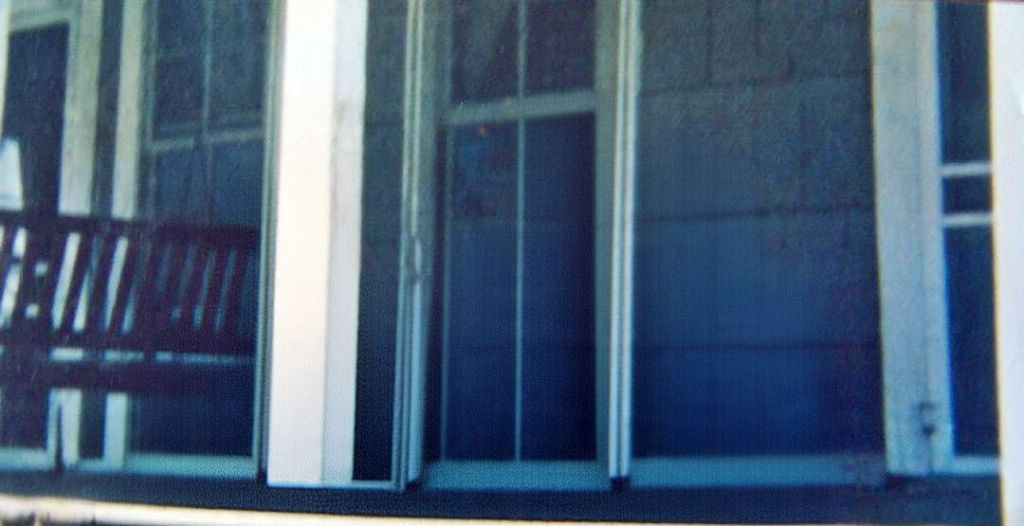
They stood in the carbon and ashes of what was the front porch. Even the creosote soaked railroad ties that served as steps were reduced to ashes. Behind them long strips of galvanized steel lay twisted and burned on the ground. Concrete pylons poked out from the burned remnants.
Both of them looked out across the cotton field and watched the dragonflies against the sunset.
“Sometimes a day is a lifetime,” William whispered into the baked air of the Delta.
This is personal. I’m not overthinking these words. I just want to get them out.
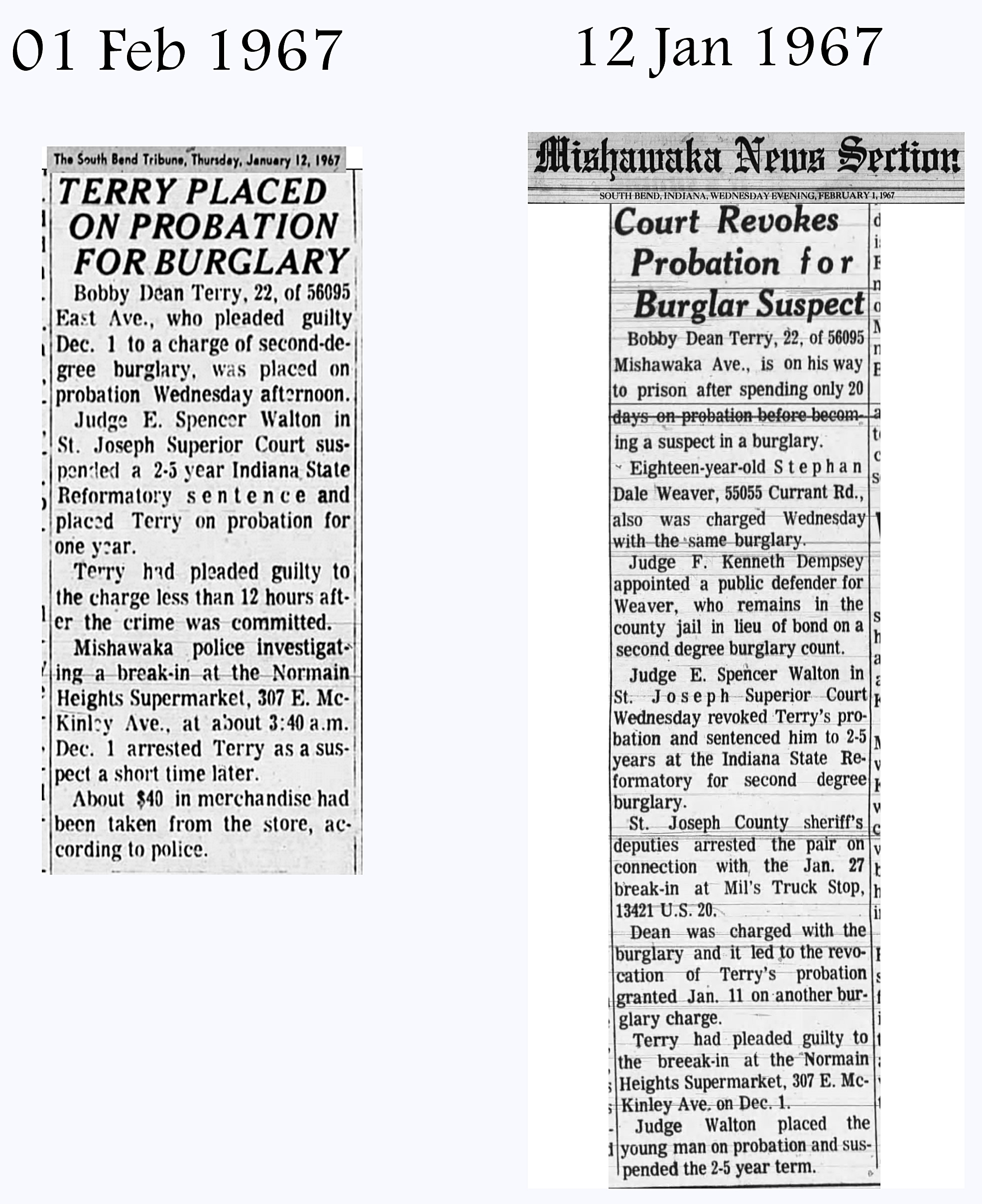
I’ve written about some of this before. My dad was in prison in Indiana. I heard so many different stories when I was younger. The Terry family was cemented into compulsory silence about this and many other things. (Such as the fact that I had another sister until a few years ago.) To find any truthful reference to ‘why’ my Dad was in prison, I had to do it the hard way: I searched THOUSANDS of pages of newspapers across Indiana. I’ll never forget that feeling of finding specific information. I had a cousin who probably knew most of it correctly. But she opted to adhere to the family code of silence. That’s why I had to do it the hard way. When she didn’t provide the information, I told her that I was patient and that I would find it.
I don’t disclose these things to shame members of my family. Apart from the fact that you can’t shame someone who is no longer alive, facts don’t bring shame. They bring revelation. I’ve proven time and time again that anyone who stays at it will uncover most truths. That’s how I used DNA and a decade to find my sister. It’s also how I kept at it to substantiate the details of some of my dad’s life.
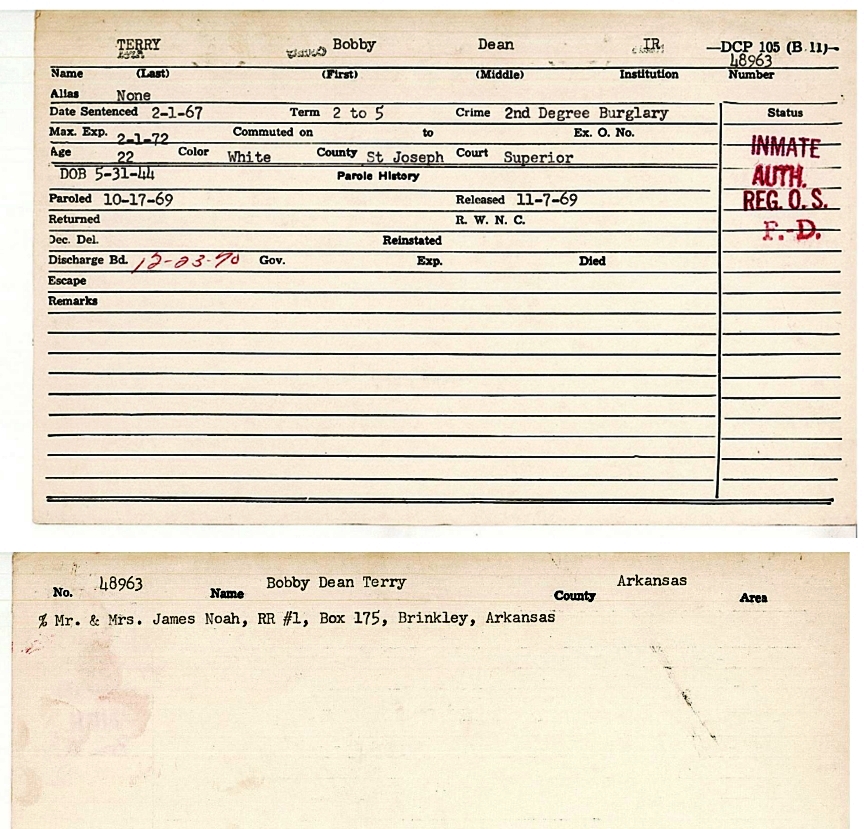
I received the Indiana Reformatory index card out of the blue today. The prison stopped maintaining most old mugshots. But in those few lines of information, there are massive implications.
I was born in March 1967. My dad was imprisoned on February 1st, 1967. He was in prison for two years, ten months, and six days. That’s a lot longer than anyone ever mentioned to me when I pressed them for information. Dad was living in Indiana before his arrest, which is the first documented proof that my parents were not living together. Dad joked that he had been in Alaska. He didn’t make the joke often because being in prison wasn’t something he talked about unless he was drunkenly telling people.
Less than four months after being released from the Indiana prison, my dad was involved in the death of a maternal cousin during a DWI incident. My Dad didn’t suffer any charges for this. Regardless of how people feel about me saying so, connections kept him out of trouble. Monroe County, Arkansas, was a different place then. The Terry family didn’t hesitate to use those connections to quash any concerns. Had my Dad been held accountable, it might have caused him to return to an Indiana prison. His parole wasn’t discharged until almost eight months after the DWI death.
When I’m thinking about my life or talking about it, I mention that I lived with my maternal grandparents while Dad was in prison. I wonder what life might have been like had he not returned. Whether his presence would have been substituted for another man of similar temperament. It’s all speculation. I wouldn’t have my other sister had Dad not returned, or if he had been put back into the system.
After the DWI death of my maternal cousin, Dad jumped into a highly questionable affair. It took me years to piece together that one of my earliest memories of standing up in the back seat was one in which I accompanied my Dad to Clarendon beach with his affair partner. Mom said that I couldn’t possibly remember it. Normally, I’d agree. Growing up that way tends to erase a lot of memory. But that memory stuck with me.
After that affair debacle, Dad engaged in another affair, one that led to the birth of my sister. I didn’t realize until I met her that her birth explained my family’s sudden departure from Dad’s beloved Monroe County to Northwest Arkansas. Away from my grandparents and some of my maternal family, who would have altered the trajectory that Dad’s behavior brought upon us.
I’m sharing this because I feel vindicated for finding more pieces as time passes. I’m not revealing anything that should not have been disclosed to all of us. The foolishness and false family honor of those who demanded secrecy still bother me. Then again, I’ve come to learn that this tendency governed their lives. Several of them were completely different people than their demeanor indicated.
“Cicadas are gross,” she said. That’s because she didn’t experience the magical connection of hearing them out in the wide fields of Monroe County during her formative years. The insects of that area are already formidable and should be considered true citizens, counting in the billions. Anyone who has driven on the county roads in the evening knows the folly of attempting to use windshield wipers to remove them. I don’t recall which year I happened to be with my Grandpa and Grandma to experience the cicadas. It was deafening at night because we slept with the windows open, surrounded by fields filled with them. Hearing the cicadas now evokes buried memories, all tied to wonder and childhood experiences.
I have the same reaction upon smelling creosote, especially when it heats up. It reminds me of things I can’t quite remember. Diesel and gas are inextricably tied to my dad’s attempts at operating a gas station on Highway 49. Or my Grandpa, who insisted that the smell warded off the torrent of mosquitoes. The trains humming in the distance. The area of my early childhood owed its existence to railroads. Brinkley was once called Lick Skillet, a name that should have been preserved. The topography conspires to have the train horns and rattling metal echo for miles. Those who’ve not lived in the flatlands don’t understand why people refer to it as haunting. Grandma’s house in Brinkley on Shumard Street was close to the railroad. My apartment is less than 50 yards from one, too.
Years ago, I drove in the late evening on Highway 70 from Little Rock to Brinkley. There were millions of small frogs. They coated the road and the low Geo Prism, so much so that the uneven road became slick and hazardous. My deceased wife, a native South Dakotan, was initially horrified but soon fell quiet in awe of the spectacle. She later told the story to her family. They were convinced she was exaggerating. Had we chosen the quicker route of the parallel interstate, we wouldn’t have had the moment.
Since I’m being nostalgic, yesterday I got out of one of my bottles of burned seasoning. It’s a delicious mix I make myself, but that’s another story for another day. Dabbing it on my tongue, I felt like I was tasting Grandma’s salt pork again. Salt pork is the antithesis of what I normally would prefer to eat. Because of my upbringing, I tended to avoid eating most meat. My dad’s proclivity toward forcing me to eat vile things almost at gunpoint soured me considerably. But if time travel were possible, it is what I would like to return to first. Opening the screen door of Grandma’s house and smell the aroma of her cooking bacon and salt pork. A wall of memory.
Since this post is titled, “All Over The Place,” something that I’ve mentioned before seems much more significant now. I never concealed that I wet the bed much too often when I was younger. When I started therapy, I did a workbook online. I didn’t know that most people barely write a page. I wrote at least fifty pages. I rarely wet the bed at Grandma’s. Of course, I now know that it wasn’t because laundry was much more of a chore for her. It was because I felt safe. Don’t get me wrong. Grandma could be stern. But she never once arbitrarily shouted at me or threatened to box my jaws off unless I wasn’t listening. While not actually boxing my jaws, I knew better than to tempt her. I did not, in fact, ever want for her to follow through on her promise to snatch me bald-headed, either.
Sometimes, Grandpa would tell me not to fear things in the dark or glinting eyes through the screens on the windows. He told me often that the only real danger was things walking on two legs. As mean as he was when he was younger, by the time he had me to call him Grandpa, he protected me. Quite often those who needed a reminder were the two people who came to pick me up at the end of the summer.
In a few short minutes, the train will speed by me on the other side of the road. I’ll be on the landing, cicadas buzzing. And if I were so inclined, I could walk over and touch my hand to the rails. They are connected, reaching the fields of Monroe County.
I undoubtedly awoke with all this on my mind because before going to sleep last night, I stood at my kitchen window, listening to the roar of the cicadas. I dreamed of fields and imaginary stories. Waking, I recalled none of them. Just the tendrils of fading geography and bygones.
I sat to write words of memory this afternoon. No matter how I tried, I kept returning to the places surrounding the person who departed Monroe County, Arkansas, yesterday. Though she lived in Memphis for a time, she came back to Holly Grove and lived a long life. She had the iron in her bones to outlive her husband, Poor Bob. She shared that almost indomitable spirit with my Grandma Nellie. I could write a volume about how much I misunderstood my aunt when I was younger. My childhood was both an enclave and a firestorm. When I was very young, she stood ready to voice her opinions loudly. Her gaze unnerved me. It wasn’t until I was older that I realized how fierce her sense of humor was. She needed it to do battle with my mom. My aunt was a hard worker and had iron in her hands that my mom didn’t.
Monroe County no longer exists, but it’s still on the map. Citizens still dot the places within with their presence. But it is a place largely holding its breath and studiously peering away from its dwindling ranks. From 2010 until 2022, it lost 19.3% of its population. In that same time frame, it lost 1/3 of its 35-49 age group. Brinkley, Roe, Clarendon, Fargo, Holly Grove, Indian Bay, Blackton, Smales, Pine Ridge, Dixon, and Keevil; all these places sit in careful silence, awaiting their turn to be memories and names of places once filled with people living their lives. They’ll survive as census notes. I’ve learned more about them as an adult than I ever did as a child living there or as an adult returning to visit.
I did not appreciate the beauty of those small places until much later. To me, Monroe County was where my grandparents lived. Truthfully, Monroe County could have been almost anywhere in the delta, on either side of the Great River. Most of the places share a similar heartbeat and footprint. The odd asphalt roads, the infinite number of dusty dirt roads, miles of telephone wire stretching lazily across the flat land, interrupted by crops, mosquitoes, swamps, and irrigation ditches. Community was everywhere, regardless of the distance between neighbors.
Although I better understand it now, the prejudices seemed disconnected. I didn’t know that the same small town that held my aunt in its embrace was also the crucible for a sister that I hadn’t known for almost five decades. Now, Monroe County has a citizenship rate of almost 100% and no household reported being secondarily English-speaking. Monroe is not a place to go to; rather, it is a place to leave or retire and await one’s fate. For those who love the places of Monroe County, they feel it in their bones and wish their bones to rest there.
I cannot observe a storm without recalling the austere beauty of watching the weather move in across the open spaces, the towers of lightning and clouds visible for miles. I cannot sit on a swing without remembering summer nights. Nostalgia mostly erases the agony and buzz of mosquitoes.
Now? The last of those in my family who followed the beacon of Monroe County have gone to visit other places, ones to which we cannot tread. Not yet, anyway.
Monroe County now has one less to claim as a citizen.
But if you tally her voice and character, it lost something precious in her that is hard to define. People might be easy to come by, but there are so few remaining who, upon hearing them speak, evoke in us the spine and vitality of the places that are becoming shadows.
I can’t return to my hometown of Brinkley or Monroe County, which holds a place in my head. The same winds blow, and the same crops withstand the blistering sun. There is some wisdom that only older age can provide. Among that knowledge is that you carry some places so deeply inside you that you can’t quite identify what’s missing until you take the place of your ancestors, remembering what once was.
You can return and stand next to a recently plowed field. Or up to your knees in growing cotton. The only thing that has changed is everything.
One less.
With some, we lose more than one with their passing.
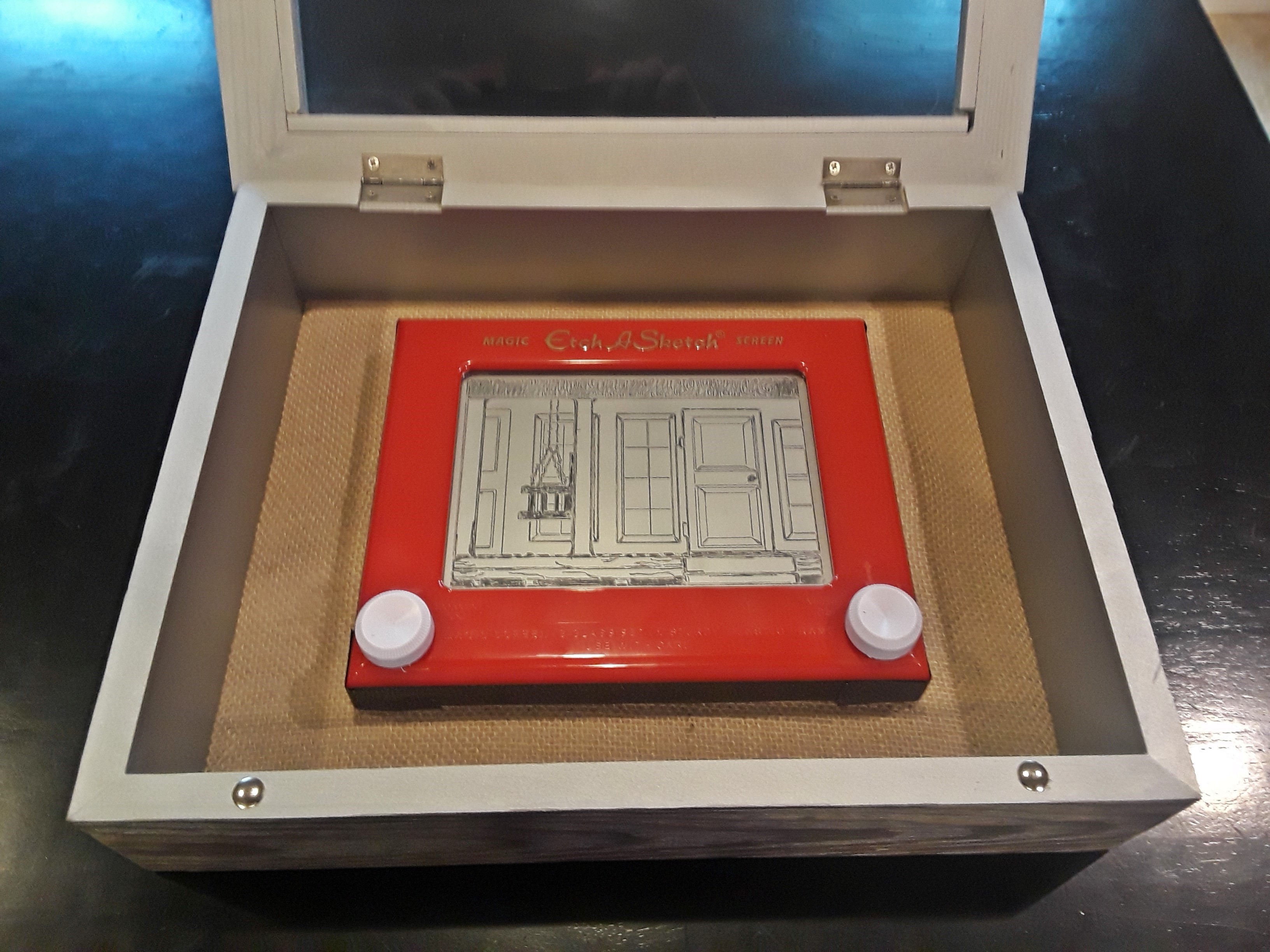
My favorite cousin and a friend conspired to make me this etch-a-sketch rendition of my grandparent’s porch. It was a beautiful and creative piece of work, one which I loved. Such personalized gifts are rare indeed in this life.
It was destroyed in a fit of anger. Not by me, of course. That I would dare to write about it might trigger a couple of people. It’s my tarnished truth to share.
The strange thing is this: I’m different than most people. A memory of a thing is just as precious as the ‘thing’ itself. The destruction of this beautiful gift only amplified the memory. That someone let anger gain so much control of them is unfortunate; they were possessed by the demon of a lesser god. I didn’t feel anger when I saw that someone had destroyed it. I felt only disappointment. It’s a reminder that anger is relative and that its justification is a sign of a larger problem. No matter what someone has done, it is very hard for me to imagine letting myself destroy something so personal and precious to spite another person. Or let someone else do so. Even if I deserved it or – or even if they do. Anger is the worst filter for reason. It justifies everything in its wake. It is one of the slippery slopes of life. I watched as my parents and a few other family members allowed that to consume them.
Regardless, the loss of this reminded me that everything is transitory. We don’t really own anything, no matter how many decades we clutch them close. It will also be lost, destroyed, or left behind when we depart this world.
All of it.
No eternal monuments can or ever will be erected because the Earth itself is limited by the laws of physics.
I still have the picture of the shadow box and etch-a-sketch.
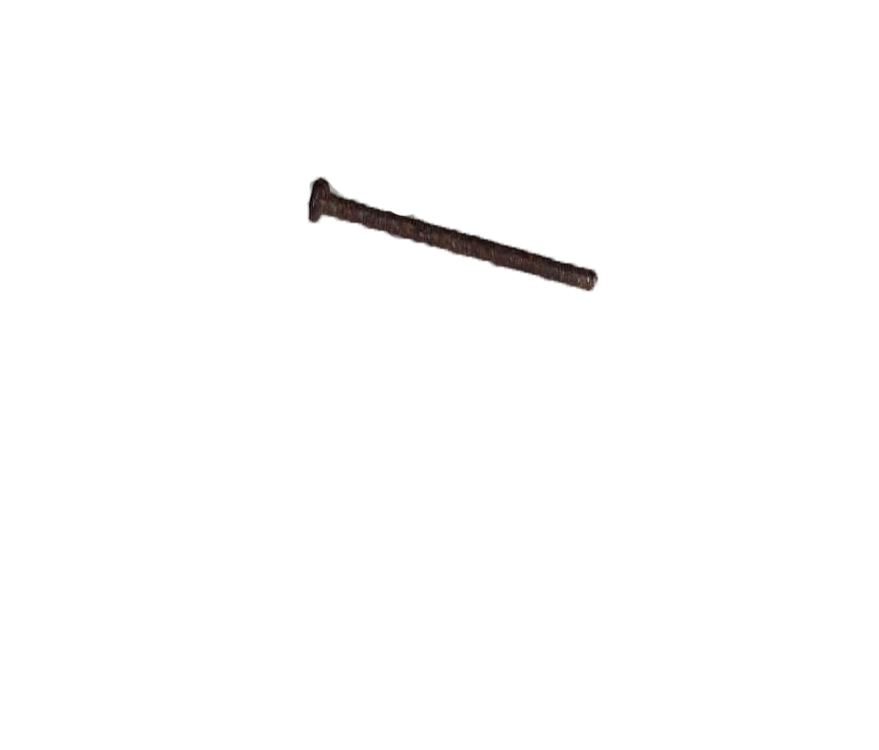
Until recently, after a couple of near losses, I still had the rusty nail. It grew to become my most prized keepsake and possession.
Now, I have a picture of it.
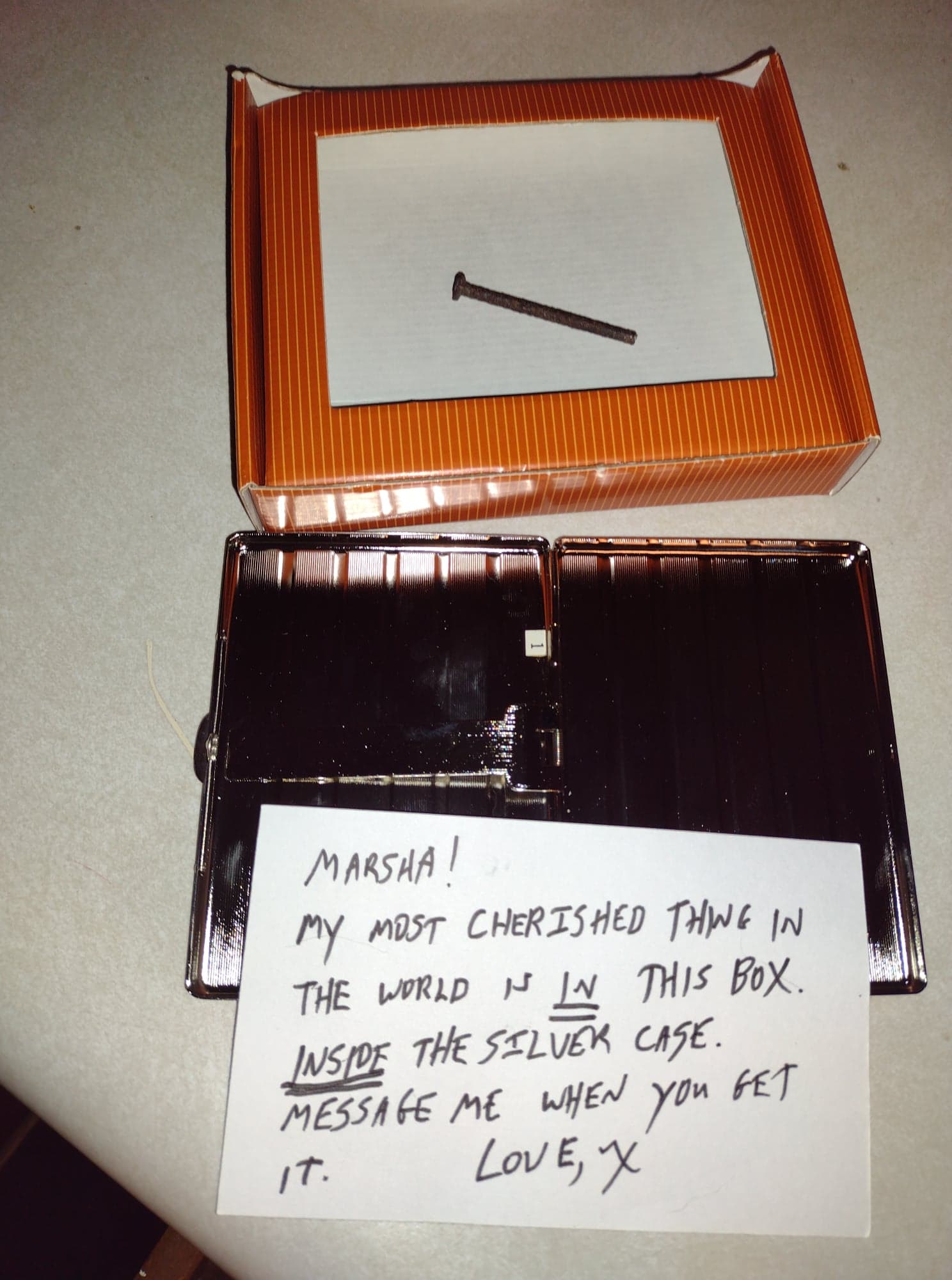
I have passed it along to someone who might appreciate the depth of my giving it away. I placed it inside a collectible silver cigarette case, one which was salvaged and saved from the wreckage and the remains of another life. A cigarette case in itself has meaning to the person who is receiving the nail.
I did the same with my hand-transcribed copy of Ecclesiastes and a couple of other of my remaining treasures.
I don’t plan on departing soon. That itself is part of the lesson. I will one day, perhaps tomorrow. All the things that I find to be precious will be treasured no more. None of my precious things were valuable per se. Their worth only exists because I see it and experience it.
I’m passing along the rusty nail to my sister Marsha. She’s had a rough life. Even if she doesn’t treasure the nail and its anchor into my memory the same way that I did and do, I will release it into the world for it to find new appreciation or not.
I have this picture of the nail, one I will treasure. It’s not the nail. But the nail itself wasn’t the experience I shared when grandpa and my uncles put the porch swing up.
I hope she understands that it truly represents everything in myself that I find to be worthy.
Grandpa was an incredibly hard man when he was younger. I didn’t know him when he was full of piss and vinegar. And alcohol and violence.
It’s just a nail.
It will soon be in the hands of my sister Marsha.
I’m just a man.
But everything is so much more than the simple sum of us.
I don’t want to preach the idea of minimalism and appreciation for moments and people and fail to live it.
It’s all an illusion. Things are not us.
We need each other more than we will ever need a house filled with gadgets and keepsakes.
Love, X
P.S. My wife who died, Deanne, years ago while I was working one Saturday, she decided to clean. Though the nail was in a special box, she threw it away. I had to empty the dumpster for an entire apartment complex to find it. That too became part of the long story of “the nail.”
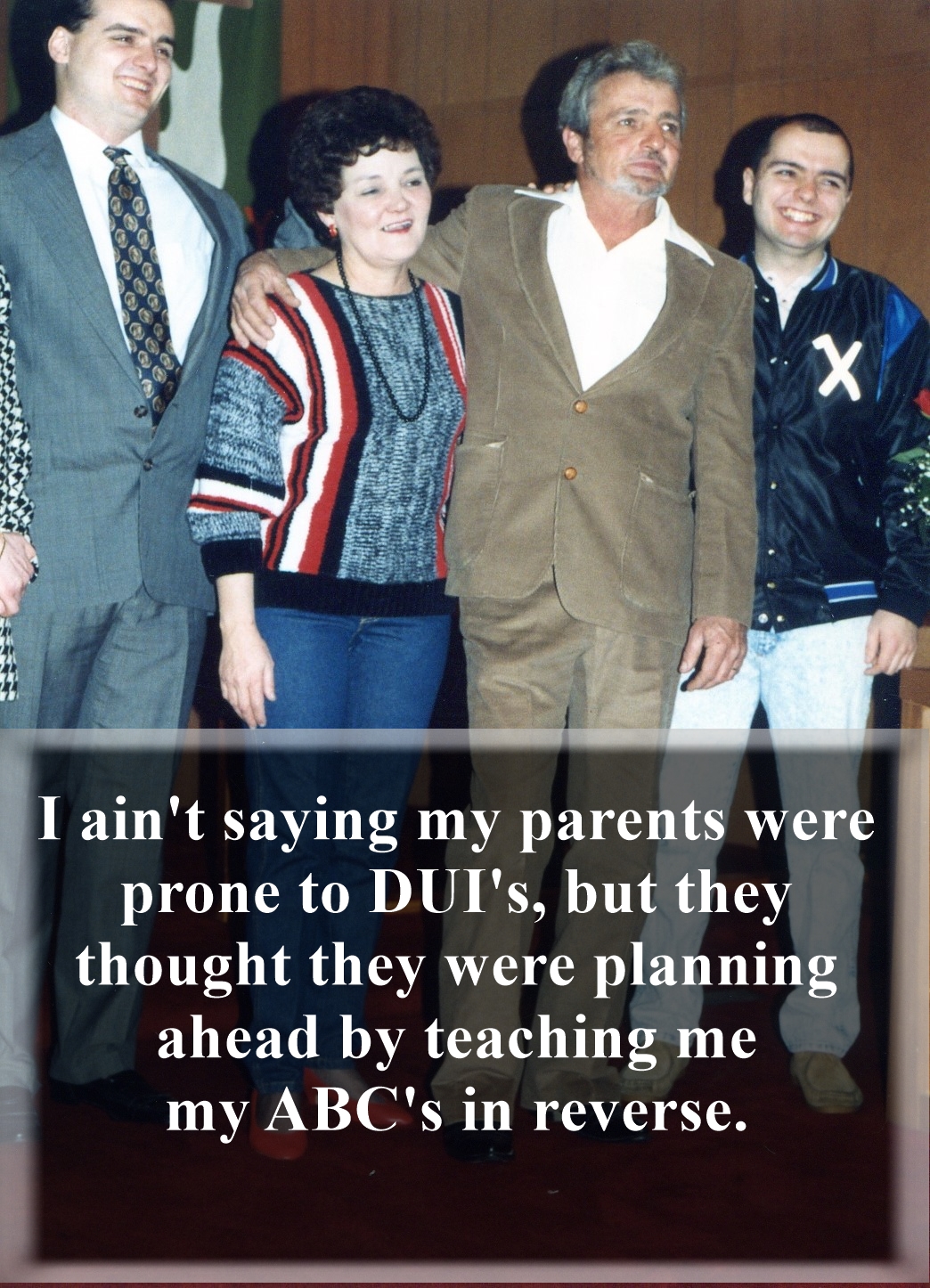
The fool on the far right with the fluorescent ‘X” on his jacket is me. I was the flower girl when my Mom and Dad remarried each other. They remarried exactly 29 years after their first marriage. 10,483 days have passed since this picture was taken.
My parents really were experts at drinking and driving. But for this moment, no matter how terrible the road behind them, they were happy. Dad died nine months later. Mom was not charged. (That last sentence is supposed to make you laugh.)
It is the only picture I know of where everyone was smiling. Even my brother Mike was smiling with glee. I wish I could always remember him, and Carolyn and Bobby Dean, like this.
Everyone in the picture is dead now – except for me. Dad died at 49, Mike at 54, and Mom at 67.
Though I start by talking about a movie, these words aren’t really about the movie. Most of the things that strike a chord in us are really about recognizing something magical or true in ourselves as if we’re hearing an old truth in a new way.
“Arrival” is already a thought-provoking movie about language, time, and destiny. I loved that the main character was seeing her own bitter future and lived it anyway.
Last night, I watched “Arrival” again, this time in Spanish. I intended to spend just a few minutes immersed in it. Instead, I watched a movie that initially fascinated me in its approach to language. Ingesting it in Spanish lit my curiosity zone on fire. Before I knew it, the film was over. I curled up with my bear Azon as my cat Güino laid next to my hip, an unusual place for him. Dreams hit me like an avalanche.
All of the evenfall (another word I love) and the penumbra of the night held me captive, my dreams bursting in Spanish. In one of the best parts, my Grandma Nellie and I sat in her house on Shumard Street in Brinkley, both of us speaking only Spanish. She’d scoff at the idea of her ever speaking another tongue. But our conversation was about life and love and a little bit about salt pork and bacon for breakfast. (She was one to concern herself that no one was starving in her house – or so full we could barely walk to the front door, for that matter.) Though I knew I was dreaming, my heart sang as I sat with her. She died in 2000, at 91. It’s been a while since I dreamed about her or heard her voice so expressively in my head. Though she would have never done so in life, she asked me to drive her to Monroe to see the old haunts. As we drove, my dream shifted to early morning. As we neared Rich and Monroe, I noticed that we’d moved in time, too, traveling through an odd mix of several decades. Monroe was once again a bustling place, with farmers and passersby everywhere. We stopped at the Mercantile, once a hub of life in the small community. “I’m going to get out here if you don’t mind. I need to visit. Call me when you get home!” she said, always one to insist that we let her know we’d arrived at home alive. “If I’m dead on the roadside, how will I call you?” I asked her. It was an old joke that I loved telling her.
When Grandma exited the car and shut the door, I woke up. A few tears pooled in my eyes. It was 12:15 a.m. I felt like I’d lived a year in the dream. Güino was still next to me, his body heat oddly comforting.
This morning, I wandered around the apartment, my brain still in a slight fog, listening to my internal voice whisper to me in Spanish.
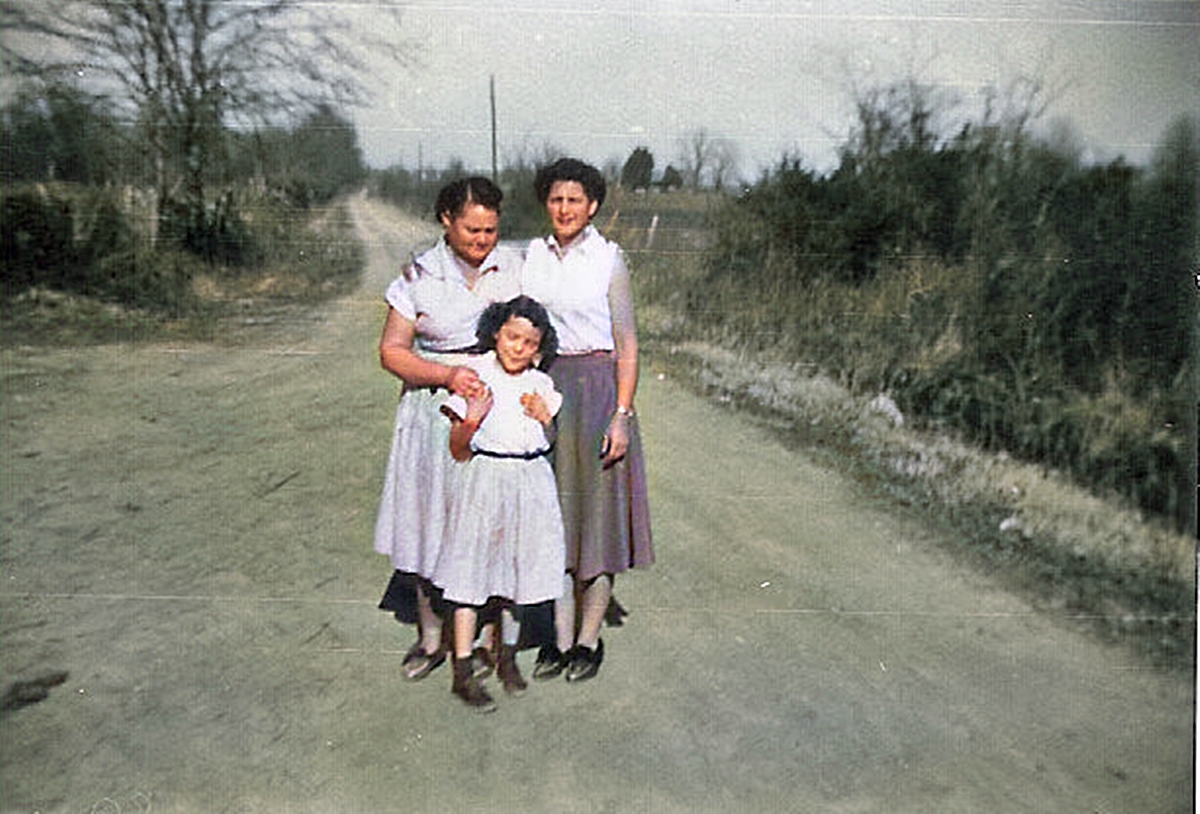
Even though I did so inexpertly, I attempted to colorize a picture of her and my Aunt Betty. I love that it’s not complete; it’s an evocative mix of black and white and color. I let my imperfections have the last word. But Grandma’s face is revived, so many decades later. The picture was probably taken 60 or 70 years ago. For a moment, last night, time became a bridge, and I walked across it.
I feel like a little bit of me is still back there in the imaginary place where time and geography became fluid.
I sat on the steps of the porch, feeling the boards against my back. I was barefoot and wearing cutoff shorts, the official uniform of Southern boys. The porch was a stack of large railroad ties. Each section had at least two hundred nails driven in it. If the summer sun were shining on them, the nails became unbearably hot against your legs. The narrow highway was about thirty feet away, its tan hue rendered black in the early morning. No car was parked in the driveway because my grandparents didn’t drive, a fact that still surprises me. Later in the day, Aunt Betty or Aunt Marylou would come, and we would go to the store, probably to the Mercantile in Monroe. Grandma would let me pick out one of the cheap toys hanging on a rickety metal carousel. In a few minutes, one of the robins that preferred the protection of the cedar tree by the ditch would begin to call.
The days of the summer of 1973 filled with Watergate, and one of my favorite books, “Jonathan Livingston Seagull,” was a best-seller. Both of these facts might as well have been part of another world, one only remotely attached to Monroe County. I came back for the summer. My parents had precipitously decided to move to Northwest Arkansas the year before. I skipped kindergarten and went to first grade. Coming back to be with Grandma and Grandpa probably saved my life that summer. I didn’t know until I was over fifty years old that my Dad fled his hometown because he had another secret, one which was unacceptable to many people in that part of the state. He could kill someone and pay no price, but he couldn’t escape the pressure of violating an unwritten social norm. Mom and Dad spent many of their nights beating one another into reality. I was a couple of hundred miles away that summer before the interstate crept into Springdale. Because school used to start later, I had about three weeks to enjoy the summer. Three weeks at that age might as well have been a year. And time in the rural areas of the South slowed to a pace that most modern people couldn’t accept easily.
Because it was early August, Grandpa would come outside sooner than usual. He might cut a plug of tobacco but would probably wait until after breakfast. Grandma’s Saturday menu invariably included sausage or salt pork and toast with butter. Years later, I thought it strange that everyone didn’t have extra biscuits or toast leftover in a pan on the stove or table.
Sitting on the porch, I knew that just a few minutes separated night and day for everyone in the house. All the windows were up because the night was hot and dense. Being outside, I could hear the fans whisper against sheets and mosquitoes. As the day lengthened, I knew Grandma would be in the living room, asking herself what time she could seal up the small area, turn on the window air conditioner, and feel the chill of a small victory against hot summers. Much of my day would be spent digging in the ditch along the road or sitting on the floor near Grandma, cradling an infinite glass of Coke and crushed ice Grandma often made for me, using a hammer and hand towel. It’s a recipe you won’t find on The Food Network. It’ll never taste the same anyway because its alchemy includes water from old ground and love from one’s Grandma.
I knew I wasn’t there again, even as I smelled the dark earth of the surrounding fields fade from me. Monroe County receded and dissipated, leaving me to awaken in 2021, imagining August 3rd, 1973.
In a minute, I’ll get up, peer through the blinds at the backyard, and wonder about the intervening forty-eight years. I’ll make a strong pot of coffee, and as I take the first sip from my green Pyrite cup, I will invoke the misty morning I left behind.
I don’t dream of my summers before Grandpa died with much frequency anymore. When I do, though, I find it takes me a few minutes to shake away the idea that some part of me still sits on the edge of the porch.
If you listened to the radio much between 1976 and 2009, at some point, you no doubt heard Paul Harvey’s distinct voice say those words. It was his way of kicking off his segment covering news of the day, personal commentary, and possibly a tidbit of some sort to make your life easier. His syndicated program was heard by millions of Americans every weekday for decades, and he had credibility and influence with his listeners.
How much credibility and influence he had became apparent when I saw him get three teetotalers to consume what I’ll call drunk grapes. To be clear, these folks believed—hands down without a doubt—alcohol is not to be consumed in any form unless you’re taking communion at church. No sip of wine with dinner; no beer while watching a ballgame. One tiny sip of inexpensive communion wine once a month was the only allowable type and amount of alcohol.
On a trip to my hometown in the mid-90s,I pulled into the driveway at my parents’ house one Sunday—-late morning. The folks were still at church, so I headed next door to my grandma’s house.
There I noticed but didn’t think much about, a mason jar on her kitchen table filled with clear liquid and globs of shriveled golden raisins.
Later, in my parents’ home, the same type of jar filled with clear liquid and raisins sat perched on top of the refrigerator. Neither of these jars had been in place the month before during my visit, so I had to ask.
Turns out, that week on his radio show, Mr. Harvey had touted a new remedy for relieving the pain of arthritis. In fact, the recipe might even be the answer to several ailments.
The recipe was simple: Pour a box of golden raisins into a large glass jar and fill it with gin. Let the raisins soak in the gin at room temperature for a week. After that, eat ten raisins each day. In about two weeks, your various pains should be significantly relieved – if not completely cured.
While it sounded a bit odd to me, stranger miracles have happened, so I made a mental note to check back during the next visit home.
First, though, I had to ask how this all came together…
Getting raisins was easy enough; Mom simply added them to that week’s grocery list. But how on earth did these three non-drinkers get the gin?! Mamma didn’t drive, so that option was out. Dad himself wasn’t an option because he wasn’t a fan of the unknown and going into a liquor store alone was far beyond the boundaries of the comfort zone he liked to inhabit. It was, as usual, up to Mom to do the heavy lifting or, in this oddest of cases, picking up the spirits.
One of the small town’s numerous liquor stores was situated on the route my mother took to and from work daily, so it seemed the logical choice. But my mother did not relish the possibility of being seen parking at and walking into such an establishment. A plan eventually was finalized. Mom would watch the pattern of occupancy at the package store, and Dad would drive her there during a day in the week with less auto and foot traffic. He would park at the side of the store in hopes they were less likely to be seen by people they knew (even though the side parking offered two directions from which to be seen just as the front did). Mom would go in to purchase the gin.
The chosen day came, and nerves tingled as Dad eased the large, white car alongside the building being careful not to block the drive-up window.
Mom gets out and purposefully, but quickly, marches to the door. An old-fashioned bell clangs as she pushes the wooden door open and steps inside to an expanse of potent potables.
The clerk behind the well-worn counter looks up to see an unfamiliar face and asks if he can help her find something.
She hesitates briefly but knows it is useless to look for it herself – she will never find what they need if she doesn’t have help. Yes, she says in a voice that fakes confidence in what she is doing. Yes, I need some gin.
Stepping around the end of the counter, the clerk throws a wrench in her business. What kind of gin, he asks. Kind? Her mind freezes for a second. There are different kinds of gin? She throws the wrench back. The kind that’s good for soaking raisins. Her firm answer implies “of course” at the end of her sentence, but she knows as the last word comes out how ridiculous it sounds. It is the clerk’s turn to be surprised. Mom can’t help but smile a half-smile at the situation. The clerk laughs and says “Well, let’s see what we have. You say it’s for soakin’ raisins, right?” Mom laughs and answers “That’s right!” before she adds that Paul Harvey said gin-soaked raisins are a cure—or at least a help—for arthritis pain and several other ailments, and they think it’s worth a try.
By now, they are standing before a selection of gins with a variety of prices. As with many things in life, Mom figures you get what you pay for, so she skips the cheapest and the clerk helps her pick a middle of the road gin. They return to the counter where the clerk totals the purchase, bags the gin, and accepts the cash Mom slides across the counter. Mom thanks him and turns to leave as he waves and wishes her luck with her raisins.
She closes the door behind her and notices the bell’s muffled jangle. She thinks that wasn’t so bad. She rounds the corner and notices Dad scrunching low in the seat looking furtively in every direction.
She marches to the car clutching her once in a lifetime purchase, grabs the handle, and hops into the passenger seat. Simultaneously, she says that didn’t take too long as Dad grumbles what took so long; he thinks someone they know saw him.
The engine roars to life, and Dad pulls as quickly as possible onto the street and drives home the back way.
And now the gin and golden raisins are hanging out together in glass jars waiting to be medical miracles.
A month later, I arrive home for another visit. The mason jar at my grandmother’s is gone. I ask if the raisin and gin “medicine” had worked to banish her aches and pains.
“Not sure bout that,” she said, “but it was really a dose!” The emphasis on “dose” was so heavy, I couldn’t help but laugh before saying it was too bad the taste wasn’t what she had hoped for.
At that point, I decided not to even ask my parents about their treatment as I could already imagine their reactions. The thought of the entire situation, all these years later, still makes me laugh and the line “it was really a dose” has become a fun and regular phrase in my vocabulary.
It’s apparently true after all. Sometimes, the cure really is worse than what ails you.
And, in the words of Paul Harvey, “Now you know the rest of the story… good day!”
A wise woman once told me anyone can be a father, but it takes someone special to be a daddy.
She spoke from experience having been raised from the age of three by a man who wasn’t her biological father but who loved her as if she were his own.
He was a man of the land; a farmer who sweated in the cotton fields of Monroe county and hunted in the area’s woods. He took his family to live for a time in California during the Depression where he worked as a carpenter and where one of his children was born before the family returned to its roots in the soil of the Arkansas Delta.
Before that, he had a wife and children he loved. When the youngest of them was still a baby, his wife became ill, and the family needed help. A young woman needing work came to the house each day to care for the younger children, cook, clean, and tend chickens while the man worked the fields and cared for his wife. Tuberculosis was common in those days, and it robbed many families of their loved ones. With her passing, the man was left a widower with children. He and the family still needed the young woman’s help, and, to keep things “proper,” they wed so she and her small daughter could move into the house full time. What surely began as a marriage of necessity turned to a marriage where love lived and grew, and they added four more children to the family. The number of grandchildren grew, too, over the years.
For many of them, memories of him included how he rolled his own cigarettes—carefully pulling a thin cigarette paper from its packet and holding it between several fingers of one hand while tapping tobacco from a Prince Albert can with the other. He then rolled the paper, licked to seal it, and twisted the ends. If asked, he allowed whichever grandchild had climbed into his lap to watch the fascinating process lick the paper for him. It was a thrill beyond thrills, and only a granddaddy wouldn’t mind a child’s spit on his cigarette. He loved his grandchildren, and the honest summary of their high energy visits was a simple “I love to see them come, and I love to see them go,” as he smiled.
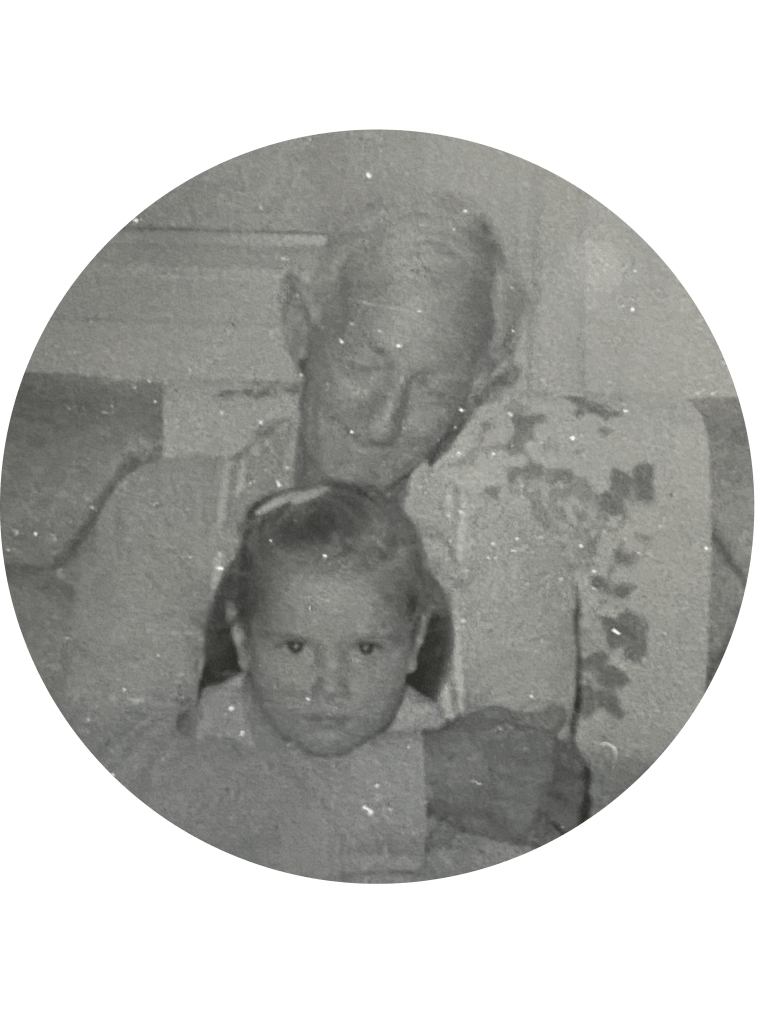
He was a quiet man, but his eyes and facial expressions spoke volumes. You can take my word for it, or you can look at his expression in this photo—the first photo taken by my sister on her first camera. Its value can’t be determined by a number for it is priceless to me as it is the only known photo to exist of this elderly man and young child, and he only lived a few years longer after it was taken.
Most folks called him Lawrence; his wife called him Lun. Turns out the wise woman mentioned at the beginning of this memory was right. Anyone can be a father or grandfather, but it took someone special to be the man I call Granddaddy.




 P.S. Parenthetically Speaking