Category Archives: Family

You’re Not Going To Enjoy This Story

white (2)

I have some stories, many of which I won’t tell until some of those involved die. It’s not out of respect, though. I know I don’t get all the details right. Stories are certainly more complicated than I make them as I reduce and distill whatever swirls in my head when I share pieces of my life. Others attack the details and forget to defend the essential truth behind the story. I have dozens of anecdotes and stories I’ve written. Most of them are too raw or lacking a central focus. With many of them, I just concluded, “It’s time” and throw them out here as if they need to breathe. With some of my stories, it would be folly for the people involved to identify themselves. Their denials won’t age well. If you think I’m writing about you or someone you know, don’t ‘out’ yourself.

I wrote the initial version of this sometime in 2001. In reality, this encompasses several conflicting stories.

When I was in junior high, I had a few experiences which jarred me. A couple of them are closely guarded secrets. Because I could recognize violence in places most people saw few signs of such, there were a few times in which I was rendered floorless in recognition of how bottomless some people were. I now know that there are abusive people from all walks of life. Worse still, some are adept at recognizing children who are already at risk and then do further damage to them. Oddly, it took me years to realize that I also had a congruent weakness: I often failed to see the danger behind a smiling face. Many of the biggest monsters hide in plain sight, behind an easy laugh. Youngsters who are mistreated tend to be distrustful of everything, of course – but they also tend to contradict their instincts by responding with too much trust toward a smiling face or friendly demeanor.

Make no mistake, I encountered some incredible adults and teachers when I was young. Don’t make the mistake of thinking I don’t recognize the debt I owe them. Talking about the lesser people doesn’t denigrate the better people in my life. All are stories. Likewise, you must accept the reality that some of the worst human beings I’ve known were teachers, coaches, and other professionals. The positive examples outnumber the negative by a staggering margin. Not talking about the negative examples doesn’t help anyone, though. Regardless, I get amused when people call into question my motives for sharing. As Anne Lamott said, “You own everything that happened to you. Tell your stories. If people wanted you to write warmly about them, they should have behaved better.”

I was beyond the normal scope of ignorant when I was younger. My family life didn’t foster a broad worldview and often no expectation that I would live to adulthood. Each weekend brought dread, even as I found youthful distractions. Much of my life was wasted trying to bridge the gap between my home life and the one outside its reach. I loved school in so many ways; the greatest and most singular was simply that it was not home. I often say anywhere was safer than home, generally speaking.

At school, I had befriended someone who seemed like she might have a glimpse of my life, an overview I didn’t have to explain. I’ll call her Tammy. It’s important to note that this wasn’t a romantic relationship. After a while, I noted that she didn’t want me to notice her mood swings. After I met her parents, I made the mistake of asking if her dad liked to drink, followed by me seeing that her mother seemed to behave like my mom. I thought I was sharing a secret, one Tammy might reciprocate. I could not have been more mistaken. In the short term, I just avoided her as she became belligerent and angry after I told her about my family life. I don’t know why I thought my honesty would let her be able to confess her own dark secrets. I tried to explain it to her. It only made her angrier. She couldn’t get past the idea that I “knew” what happened at her house when no one was looking.

She told me that her dad was going to find me and give me a dose of what I deserved. She threatened me if I shared my ideas about her home life with anyone. When she said it, I knew that her dad had probably actually said the words, in part because of the details she provided. Her eyes lit up with crazy glee each time she’d mention that her dad was going to beat me. It sounds like an exaggeration, but she probably said that her dad was going to beat me at least twenty times. She seemed a little too focused on ensuring that I was at least scared. Though I don’t remember any of the details, it was evident that her dad had probably hurt a few people in his lifetime. Years later, it occurred to me that Tammy might have earned a temporary reprieve from her dad’s beatings by offering me as a sacrifice. Children living with violence learn techniques to avoid scrutiny and to give the abuser another target. It’s part of the reason they lose their confidence and ability to make rational choices in later life.

One day, after a school function at another school, I was walking out of the building to make my long walk home. In those days, I was accustomed to walking miles from events. My parents had decided they didn’t want kids after they had us. I saw Tammy getting into her dad’s ugly little car, and I made a full swing around the edge of the lot to avoid them near the exits. To my surprise, a few moments later, her dad pulled his car alongside me and stopped. The driver’s side tire missed me by an inch.

He glowered at me. He was a huge, overweight man. “Boy, do I have to get out of this car and kick your ass?” Keep in mind that I was in junior high, and he was a middle-aged adult, one with a good job. He went on, shouting as the volume of his voice rose and fell. I don’t remember the words, just the expectation that he was, in fact, going to exit the vehicle and hit me until whatever plagued him faded.

Some people were lucky and never learned the truth that adults could hit a child in those days and face no consequences. Not only did I experience it personally many times, but I also witnessed it too. I’m not sure which was worse.

(I erased seven specific anecdotes at this point, ones dealing with job title and/or names. Whether it’s cowardice, self-protection or a soft heart, I’m not sure. They are not positive or life-affirming examples, though. A couple of the stories tell an entirely different story about some of the adults we shared growing up in the same community.)

Tammy’s dad said some angry things. Tammy was in the back seat, her face full of satisfaction. I’ll never forget that ugliness and glee. Her mom cowered in the front passenger seat, her head recoiling a little each time her husband shouted. Because of my dad, I knew that there was no right answer for the anger, just as there hadn’t really been a cause. Abusers don’t seek justification for their anger or violence – just an outlet. Justifications only come in the rare event that they are held accountable for their behavior. I stood there, silent and stupid, until Tammy’s dad was done screaming and threatening me.

Much later, Tammy continued her effort to retaliate against me for knowing her family’s secret. She enlisted another student to threaten me. I’ll call him Eric. Tammy had told him all manner of lies to get him really angry at me. I tried to be friendly and to avoid a fight, which only seemed to stoke his anger. I was a master of evasion due to my dad’s years of training.

Because I realized that Tammy was crazy, probably through no fault of her own, I found her and politely told her to please leave me alone. A couple of classes later, Eric approached and said something like, “I told you to leave Tammy alone, you sick f%%k. Next time I see you,” he said as he put a gun finger to his temple. I didn’t answer him as he continued to throw insults. People generally are going to do whatever it is they’re going to do. I had no doubt that Eric would beat me to a pulp. What Eric didn’t know, though, is that I would likely remove a part of his body against his will during the process. Some people fight to win because they are able; people like me fought when they had to, with the goal of making the assailant not do it twice.

Later, my dad had punched me squarely in the jaw when I wasn’t expecting it, precisely with the stated goal of teaching me to be mean. When I got up too quickly, he hit me again to demonstrate his superiority. His excuse? I was running too much. He also enjoyed giving me impromptu lessons on manhood. I had started running in March of 9th grade and lost a lot of weight. After a particularly bad day of home and school, I just decided I was going to start running. I had dizzy spells for a while after the outburst leading to being punched twice in the face by my dad. Because of the second punch, I had fallen backward and hit my head against the native stone fireplace at the end of our trailer. I lived in Piazza Road in Tontitown at the time, just past where the pavement ended. That was one of the times I told my mom that something was seriously wrong. I was covered by phenomenal insurance through her work. Mom refused to take me to the doctor, even after I made the mistake of saying I wouldn’t mention what brought on the pain and dizziness. She made a point to tell my dad that I had wanted to go to the doctor. She made sure that Dad understood that I implied I had something I could say to the doctor if he asked. It sounds like lunacy now. Mom at times exceeded the symptoms of being a victim and joined in the sadism. When Mom told Dad that I needed to go to the doctor, he waited until I let my guard down a bit and grabbed me and swung me around and into the cheap wood panel wall leading to the bedrooms at the end. I felt the wall crack as I collided with it and fell backward onto the linoleum. I’m convinced I did at least fifteen cents worth of damage to the cheap panel wall that ran throughout the trailer. Dad was shouting drunkenly at me that I should keep my mouth shut about the dizziness.

The worst part was the look of crazy smugness on my mom’s face as she watched Dad be brutal to me. I jumped up, ran into the bedroom, and immediately climbed out the ground-level window of my bedroom. I don’t know how long I stayed outside in the dark. I do know that the next afternoon when I arrived home from school that I took one of Dad’s pistols from the closet in his bedroom and walked down the dead-end part of Piazza Road. Several hundred yards down, there was a small valley and a stand of trees. I threw the pistol as far as I could, over the barbed wire fence and into the brush and rocks there. Dad had a massive collection of guns; he’d eventually notice the pistol was missing. His drunkenness would prevent him from tying me to its loss. It was a stupid thing for me to do. It did, however, make me feel immensely better. Apart from the fact that I could have shot him, he’s lucky I didn’t toss ten of his precious guns into the valley by 4K farms. I did take several hundred dollars worth of specialty ammunition from dad’s stash and leave it next to the fence along the road, though. Dad was a convicted felon in more than one state; he wasn’t supposed to have firearms. Despite this, the police who infrequently visited never took any of his guns, even when people had been shot or shot at. Mom and Dad smoked a lot of marijuana when we lived on Piazza Road, too. I threw out a large clear bag of it after another beating. I was in the lower little shed under the back porch of the trailer practicing my French Horn. Dad grabbed my French Horn and hit me with it. The bells struck me in the nose. Surprisingly, it didn’t break. It did spew an amazing amount of blood for ten or fifteen minutes. I went upstairs and went into my parent’s room to get a bowl of marijuana they kept inside aluminum foil in mom’s dresser. Instead, I found a large bag of marijuana.

While I didn’t feel particularly angry, it must have been lurking inside of me. As dumb as it might sound, I was furious that I had trouble reading due to the dizziness. The libraries were my sanctuaries. Reading was my outlet into the world without needing people to explain it to me. It was also the only way I could remotely mimic the people around me. The librarians at the high school knew me well. One afternoon, I had darted over to the library to put a book in the drop slot and walked back across the narrow street to campus. Missing the bus was a real problem for me, and as a result, I generally wasted no time getting back to the bus pickup area.

Eric was parked along the road by Murphy Park and the Springdale library. He was leaning against his car and chatting inattentively with a girl. I walked up and put my books on the ground. Eric turned to me to mouth off. I said, “No.” As Eric began to speak, I hit him left-handed the way my dad had involuntarily trained me to hit. Eric didn’t even have time to get his hands up. Although I’m not proud of it now, I hit him as hard as I could. One of his teeth punctured my middle finger above the middle knuckle. Eric’s head snapped backward. I didn’t even wait for him to retaliate. Had I caved in his face, I don’t think I would have stopped punching him. Something about the unholy trinity of him, my father, and Tammy’s dad broke a circuit in my brain. When he tried to fall, I dragged him by the hair as he screamed. He had the classic feathered hair that so many people preoccupied with their looks used to have in the early 80s. I threw him in the grass on the practice field (where the track now resides) across from the public library. I then crouched down and put my knee across the back of his head. I didn’t have a plan. I didn’t know I was going to hit him until I did it.

A car with seniors inside pulled up and the girl Eric had been talking to told them an underclassman was kicking the crap out of Eric. They all piled out of the car and came around. Just as one of them started to grab my arm and pull me off, I jumped up and away, not saying a word. “You’re Mike’s brother!” said one of them. Another one of them said, “I don’t care who he is, I’m going to kill him.” Because I didn’t want to be literally killed, I said something smart such as, “I’d like to see you try, coc%@#$%^&!” and took off running. Did I mention I ran several miles a day back then? It paid off. They gave up trying to catch up with me in less than a minute, even though two of them ran all the way past the old tennis court area in a failed attempt to corner me. I gave them the high-bird salute with both hands, laughing. One of the people involved later tried to kick my French Horn as he walked by. My French Horn was not only a school-owned instrument, but it was sacred to me. A few days later, I poured a can of coke onto the front seat and dash of his beloved car. It was hot, so I imagine the cleaning process was delightful. It wasn’t a habit of mine to vandalize things. Once the idea was in my head, though, it was insurmountable. I felt terrible about the coke. I also kept reminding myself that the senior in question had hurt several people I knew, all weaker and smaller than him. He loved torturing other kids. I recognized the look in his eye and on his face when he was violating someone.

Eric? He made an effort to avoid me and to ensure that people were around him. Whatever else I had accomplished, I put the idea into his head that I could spontaneously dance on his head again.

I waited a while and went back for my books, which were surprisingly still in the grass. I don’t remember how I got home that day, as my family lived over by 4K farms in Tontitown. It’s hard to believe that it was over 7 miles from the high school to our trailer on Piazza Road. It seemed like 50 back then. My finger bled for quite a while, especially when I played my French Horn.

Years ago, I wrote a letter to both Eric and the girl he was talking to, to apologize. For the life of me, I can’t remember the girl’s name. Eric didn’t deserve to be punched so hard. On the other hand, he shouldn’t have persisted in terrifying someone he perceived as weaker. That’s a prescription for disaster. I do remember apologizing and also pointing out that the feathered kind of hair he used to maintain was basically begging for a beating, anyway. I was trying to be funny. I didn’t hear back from him. Wherever he is now, I assume he is nothing but a full head of luxurious feathered hair. In his version of the story, he probably thinks of himself as the protector. Even though I tried to explain to him that Tammy had lied to him, all he saw was a weaker victim in me.

Even though it doesn’t reflect well on me, I fear that if I could go back and retrace my steps, I would have been much less patient with bullies, regardless of whether they were my age or adults. Whenever I see a story about a victim responding with uncharacteristic violence, I always initially sympathize with the victim, no matter what he or she did to the person who had bullied them. Had my older brother not been around, it’s possible that the already common bullying would have been much worse. Even though I suffered through my dad’s abuse, I recognize that if the bullying had been worse in my earlier high school days, it is quite possible that someone would have been seriously hurt. That recognition is what sometimes lets me know that I was infected with the violence of my ancestors.

The next time I saw Tammy, I told her, “So much for my Eric problem. Seriously, leave me alone.” I showed her the deep cut on my left hand. It had finally dawned on me that whatever infected her dad had been passed down to her too and continuing to be nice was only going to add another year of hell to my biography. Her dad never materialized to administer his promised butt-kicking. From that point, I only had to contend with evil looks and whispered chatter. She made herself scarce for the rest of my high school tenure. She would be furious to hear me say that I felt terrible for her. I knew what she was experiencing at home. I suspect it might have been much, much worse than what I was going through. Tammy’s adulthood has been one marked by serious trauma. When social media started to gain ground, she reached out. It didn’t take me long to realize that she was truly crazy. Redemption was impossible. Her entire life was consumed by anger.

After high school, I finally managed to break free of much of the insanity of my youth. I changed my name. I wrote letters to several people, thanking them for being great people to me. I wrote a few to those who treated me otherwise. Some were anonymous. Some were not. With three or four individuals, I found them and told them directly that they had left a stain on me, much like the violence I grew up with. I was young, and stupidly thought I knew what I was doing. Again, things haven’t improved much regarding my ignorance, but I at least recognize my ongoing stupidity most of the time.

A couple of those I reached out to were teachers. I had some outstanding teachers. Like everyone else, I try to focus on their example instead of the malignancy of the bad ones. One of the people I confronted, an employee of the junior high I attended, screamed, “That never happened!” and ran away from me. We were in the Kmart parking lot. He bolted away from me. I waited 30 minutes for him to return. He didn’t. He was in great shape and could have easily thrown me ten feet in the air had he wished to do so. He ran, though, from the truth. He’ll get a chapter one of these days, especially if I outlive him. Whether anyone else believes it is their problem, not mine. He had no business being around children, of that I’m sure. I used to watch the news or search for a mention of him online; it seemed inevitable that he’d make an appearance in the Crime Beat section of the paper.

One of those people who I wanted to talk to face-to-face was Tammy’s dad. Her dad didn’t know it, but I had family and friends in common with him, mostly as a result of his job. Life has taught me that we all have a network of tendrils connecting us. What we do and say finds the most unlikely nests to rest in. Secrets are rarely kept, even as we fool ourselves into believing that they’re buried.

I asked around and discovered that the man’s past was more widely known than he thought. In those days, though, it was quite easy to conceal that sort of thing. A cousin of mine, then retired from public service in Springdale, had a lot to say about him. “Scoundrel” was his word for that sort of person. “He beats his wife,” my cousin confirmed. My cousin told me several stories of some of the horrific things Tammy’s dad had done, including ruining more than one person’s career. One of them included beating a neighbor’s kid for running through his yard. He wasn’t charged, of course. The kid in question suffered a broken arm trying to get away. There was never a record of it officially.

I waited for the scoundrel to come to meet me in front of his work. I had left a message at the desk to let him know someone was outside. There were other people around but I didn’t really concern myself with that. I’m paraphrasing what I said, and I’m the first to admit that many of the words didn’t ring out as confidently as I recount them. People are strange creatures; angry people are literally capable of murder in church without blinking.

When he came out, he lumbered and wheezed with the effort. “Do I know you?” he asked. “Yes, you do, sir.” Weirdly, I reached out my hand and shook his. His hands dropped to his side. “You threatened to whip my ass when I was very young. I was once a friend of your daughter. By the way, I know that you liked hitting your wife and kids. You’re an asshole. I’d like to give you the opportunity to fulfill your opportunity to whip my ass, right here and now.”  I took a step back and left my hands at my sides.

His eyes filled with literal tears, and he started breathing like he might not catch his breath. “I’m going to call the police. This is my place of work, and I’m not in the best shape to shut you up,” he said as he pointed his finger in my face. I stepped toward him, and he realized that I might actually strike him. “Do you want to call now or after I give you a dose of your own medicine? You’re not two feet taller than me now, are you?”

He shuffled back inside, looking behind several times until he was inside with the door closed.

Truth be told, I might have killed him had he tried to actually fight me. For some of those I confronted, I didn’t expect a visceral response. With Tammy’s dad, because I knew he was a violent abuser like my dad, I welcomed the chance to yank his shirt over his head and beat him like a third-rate hockey player.

I sat on the curb outside for ten minutes to give the police time to arrive. There was no doubt that what I had just said was a crime. No one came. No one ever came. Had the police come, I would have told them the truth, the one about a huge man who abused his family and tried to do the same with me when I was in junior high. It would have been an awkward police report and even stranger explanation in open court. His sort of person fears open exposure to what he’s done.

I see so many people make the mistake of kicking people when they’re down. It is a universal truth that it is unwise to threaten someone who has nothing to lose. I like to think that Tammy’s dad thought about me a few times before his life ended. It’s only fair. I’m not proud of this – but I can’t deny feeling that way. I wanted him to know that I could call him to account for what he did if I chose to.

He died a few years later. I saw his obituary in the newspaper. The obituary used a picture of him from about the same time frame as when he was threatening me. I have that picture in a folder on my computer. I don’t know why I keep it. Whether it speaks ill of me or not, I found myself wondering whether his eulogies were glowing, or if anyone had the nerve and impoliteness to tell the truth: he was a violent and angry man for much of his life. His death did not come soon enough to avoid staining the life of his family. A lot of people know, though, despite the glossy sheen provided by an obituary. Unlike in my case, Tammy probably still staunchly denies any abuse that happened to her. I’ve heard through the grapevine that her life didn’t get any easier. She stayed stuck, stagnant, and angry.

I went to visit the grave of Tammy’s dad. As I stood there, I couldn’t help but think about the number of people who’ve lived with monsters like him and kept their secrets. I’ve argued with people before: if you punch your children or spouse, you’re a monster, even when the scales slide off and old age catches up to you. No one stood up at my dad’s funeral to shout the truth. He died a saint, despite the invisible blood soaked through his knuckles.

I saw Tammy’s mom from time to time at her job. Tammy doesn’t know it, but I talked to her mom a year after her dad died. I didn’t know how to ask her politely, so I simply asked, “Do you remember me?” She said that I looked familiar but that she couldn’t place me. I told her I knew her daughter when I was younger and in the briefest way possible, explained that my childhood was abusive, too, and that I was sorry that she had to live her life with someone who couldn’t control himself. I thought she might respond with anger, but she didn’t. Her face flushed red, and she resumed her job. “Take care,” she told me as I walked away. She was smiling at me when I left her.

I don’t know what the smile meant.

I only know what I like to think it meant.

And I sometimes rest, uneasy, hoping my mistakes weren’t sufficient to summon the smaller gods of justice to repay me.

I’m not proud of confronting Tammy’s dad all those years later. I’m glad, though. My sin of vengeance was certainly lesser than his of being the abuser, especially of children.

I distrust easy stories, happy endings, and simple answers. We’re all complicated and each of our demons swirls inside of us.

 

The Curtains Must Open

murphy 5th great-grandfather

Absent pedigree collapse, which occurs when the same genetics overlap in one tree due to noodling between relatives, I have 126 5th great-grandparents. Pedigree collapse is why our family tree pyramids are amazingly flatter than we would conventionally expect. Historically, about 80% of all marriages involved 2nd cousins or closer, due to geographical limitations. Most children resulted from people living inside a 5-mile radius. Modern people cringe at the idea, but proximity inevitably leads to relationships.

Life will find a way, as Malcolm said, whether it’s dinosaurs or people.

Because of the thousands of people in my main family tree and the fact that I’ve been using DNA for many years to trace my lineage, my DNA trail is remarkably old for some of my family tree branches. (And demonstrably absent for other alleged branches.) Occasionally, I encounter tree owners who hide or keep their ancestry tree private, which might be useful or warranted for current generations to protect their privacy. Still, it is 100% pointless to do it past one’s grandparents. Even if you’re not willing to pull the curtain back, the statistical likelihood that another descendant will do so approaches 100%.

The number of people using DNA results exponentially grows past three generations. Whereas paper trails and family history can be manipulated, expunged, or hidden, DNA is the math that draws a map directly to one’s ancestors. As more participants share their DNA, the tapestry of everyone’s relationships becomes incredibly detailed. Our ability to use algorithms and computers has rendered secrecy to be moot.

In the case of the example pictured, my DNA and family tree draw me through 7-8 generations, with multiple confirmations across hundreds of people. For whatever reason, I have a gap with my 4th great-grandfather Murphy, thanks to those who think hiding the identity of the person to be valuable.

Due to DNA, however, I can easily ‘ignore’ the missing 4th great-grandfather and jump up to the next generation with my 5th great-grandfather Murphy. This happens because of many people related to the cousins and siblings of my unidentified 4th great-grandfather having shared their DNA results. Using census, marriage, and other records, it is straightforward to use the process of elimination to identify the ‘secret’ ancestor. If it is someone unexpected, such as the mailman, it is likely that multiple DNA sources from other family lines have identified their overlap.

Given a large enough sample, no one currently alive escapes multiple points of intersection with our living DNA map. In case you’re wondering, it takes only a small percentage of people to finish a complete DNA map for every person alive today.

In other words, as I’ve said many times before, DNA will always ‘out’ a person’s intention to keep their family secrets hidden. People might not talk, but DNA is the hidden voice that lies in plain sight.

Unlike many, I find this to be a comfort. It’s probably a good thing, too, if for no other reason than I am powerless to do anything about it, regardless of my opinion.

DNA, in combination with my insistence on personal transparency, led me to discover a new sister. It didn’t allow me to force my search onto her; it allowed her to make the same choice and meet in the middle. Using my example, it is possible that one of her children or family members eventually would have come forward anyway, resulting in a similar discovery of new siblings. It just would have happened later or after my death. Whether we are comfortable with the idea, our DNA roadmaps are subject to the whims of those we’re related to, as the Golden State Killer famously discovered.

Yes, of course, DNA information can be abused. Using the possible negative consequences to justify a knee-jerk reaction is more a symptom of our inability to be responsible citizens and govern ourselves maturely than it is of a warning against using DNA at all. You leave DNA everywhere you go. Even now, your body is shedding your entire genetic structure into the air, on the floor, and on almost everything you touch.

My DNA experience also confirmed that some of my aunts and uncles had reason to be fearful of my dedication. Though most of them are now departed, their harsh demands about the silence of some of our family history are soon dispelled. Some of the secrets seem tame now. Others belie something unsettling. Their demands actually created a stronger desire to find out what all the fuss was about. Thanks to them, I have a specific list of questions that strike directly into their concerns.

People with nothing to hide also tend to welcome sunlight. If someone seems overly concerned, you should always assume it’s a sign you’re looking in the right direction. It’s not always the case. It is, however, logical.

Regardless of how we interpret uncovered facts, they don’t alter the truth they reveal. It’s an ongoing fascination of mine to observe the reluctance of some people to see their stories mapped and visited by other eyes.

For me, for now, forever, I embrace the universal nature of DNA.

May the curtains be forever opened.

A Snapshot of Memory

75252873_10156885297468931_1405832985999048704_n

*Guest Post

In this day of phones, digital cameras & easy(easier) photography the world is full of portraits & life-changing memories artfully posed, beautiful for sure yet simpler to catch. Engagements, births, holidays, moments in time long ago not as spontaneous if caught on film.

Back in my childhood photos of the ilk were less common unless you sat in a photographer’s studio- not as accessible to the working folk. You snapped a pic, waiting for the roll of film to be finished, brought it in to be developed, and usually, you got an envelope full of crossed eyes, blurry shots, laughable seconds. Few and far between were photos remarkable.

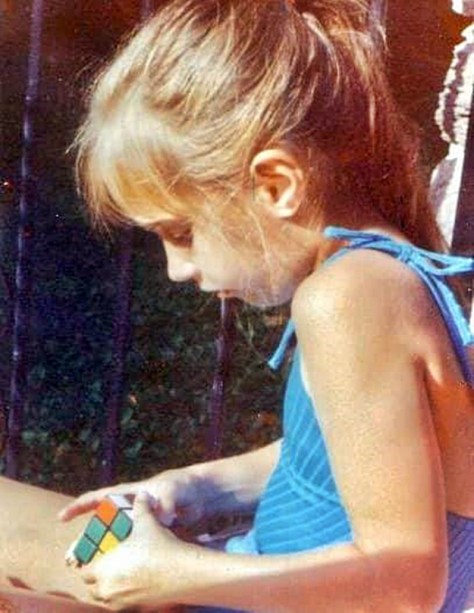
While we were not the kind to sit in a studio for a portrait, have on the walls framed photos of our time vacationing or spending a holiday, this one moment in time my father took of me is as artfully placed to be one.

Summer, on my front porch, resplendent in my bathing suit ready for running through the sprinklers. That, as I recall, was quite a looked forward to part of any sun-shiny moment then. Playing with my Rubik’s Cube- must’ve been 1980 or so.

I don’t remember much of this day, but I do remember (hindsight, mind you- as a kid I couldn’t register this) my dad got this sort of inspired look on his face and asked me to sit on the steps, against the column of the porch, and try to solve it. So I did. And he took this picture.

No digital cameras, no immediate pics to edit. Just a simple photograph on a camera with film he had to wait to develop to see if it turned out.

I think of this as my “portrait” to this day. It was a good moment. I’m thankful for that second in time captured. I think it still resembles me, captures the person I am inside. Sometimes the spontaneous becomes immutable…


65383380_622477088278788_2957919933528276992_n

A Party For My Mother-In-Law

20191102_105850

At my mother-in-law’s 80th birthday party yesterday, we all had a laugh. The church we invaded for the party is in Fayetteville, not too far from the U of A campus. About halfway through, some of us heard a loud bang, followed by immediate darkness in the church. Because the game was about to start, we could only assume that a higher power was expressing disinterest in the game rather than our party. We were without power for the last half of the party. As it turns out, the Razorbacks were without energy for most of the game themselves. We got the better end of the bargain, in my opinion.

20191102_110022.jpg
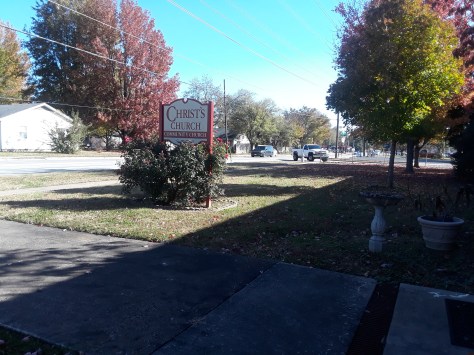
Christ’s Church of Fayetteville graciously gave us the run of the fellowship and church on Saturday when we held the party.

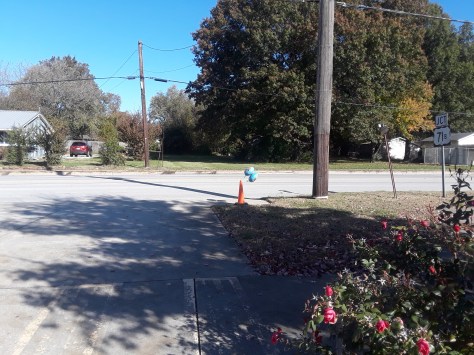
I was tasked with getting the balloons for the roadside for the party. I bought mylar balloons and triple-tied them to each other and to a large traffic cone at the roadside entrance to the church. About 45 minutes later, I glanced through the frontside vestibule doors. A man was walking past on the sidewalk. He was holding a colorful balloon similar to the ones I displayed. It occurred to me that the odds of an adult man coincidentally having a balloon similar in appearance to mine on an early Saturday afternoon were about zero. I went out the side entrance and walked around. It turns out that the odds were indeed slim. For reasons unknown to me, he had cut off one of the decorative balloons as he passed. He looked happy, so I can only assume that a balloon was just what this fellow needed to improve his day. Besides, I couldn’t imagine calling the police to report a stolen party balloon, especially if it improved the gentleman’s day.

20191102_105955.jpg
Here are the two remaining balloons.

.

.


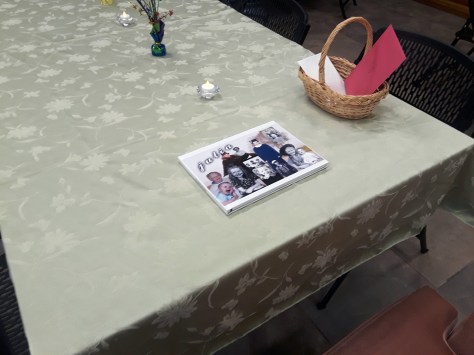
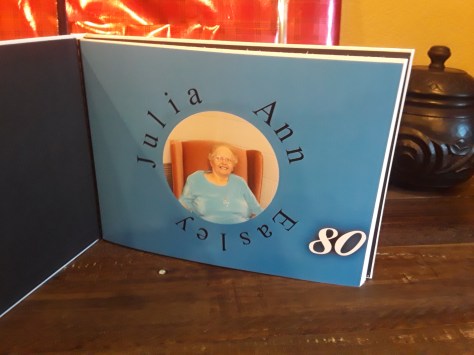
One of the surprises I made for Julia’s birthday was a 90-page bound book, stuffed with pictures of her life. Its contents did not reflect a life reduced to mere pages. Somehow, what filled it was greater than the sum of its photographs.

20191102_085435

.

.

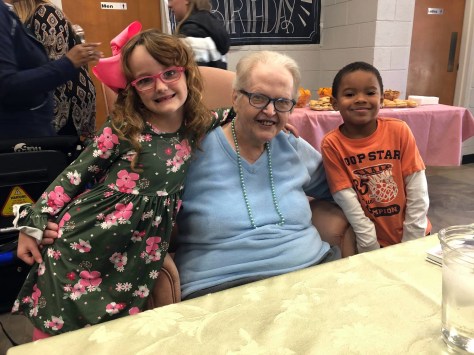
There is no greater juxtaposition in life than of age and youth unless it is the smile of each generation celebrating a year, a life, and fellowship. That one of the participants in the picture has a touch of frosting on his lips further proves the efficacy of a life of humor and good food.

I unabashedly stole the picture of Julia and Marie’s children from Marie, who I finally met after a long social media friendship. The picture best reflects the life I hope Julia has experienced and for the years awaiting her.


marie download julias party on nov 2 2019 (9)

.

.

20191102_114458
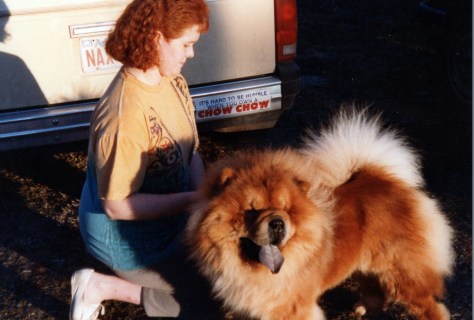
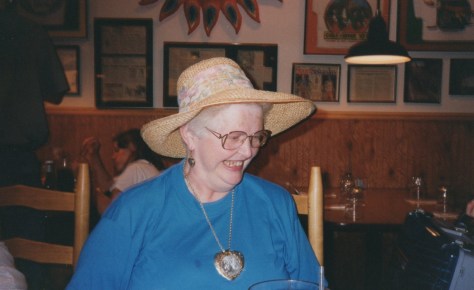
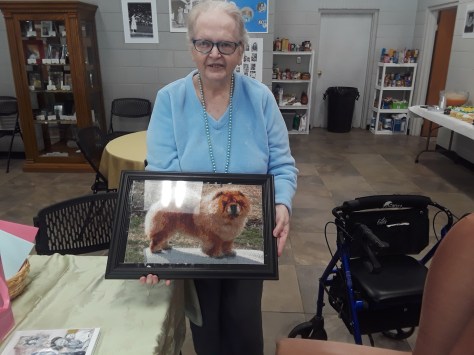
My mother-in-law with the diamond painting of her favorite dog, a Chow; my wife worked hours on the painting.

.

.

20191102_121204
Julia happily looking her over surprises, as a slideshow of 300+ pictures of her life plays in the background.

.

.

marie download julias party on nov 2 2019 (2)
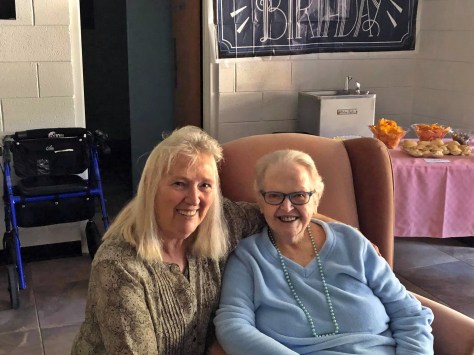
Another picture I stole from Marie, pictured on the left. This is her and Julia: cousins.

.

.

20191102_121226
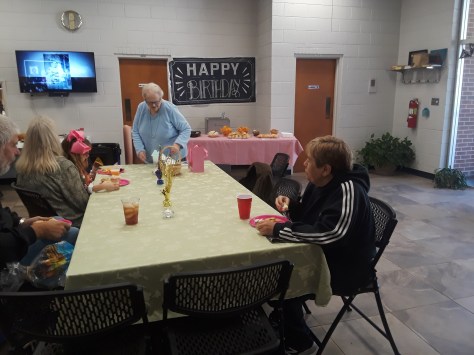
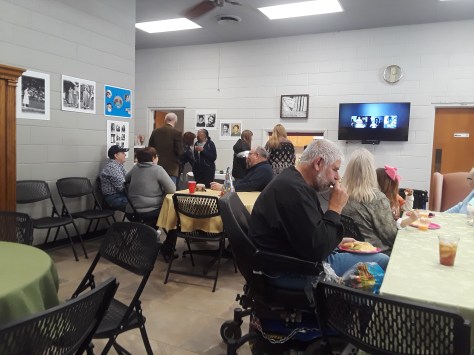
We had somewhere around 25-30 people show up. It’s difficult to plan parties anymore. Those who attended were all happy. Julia certainly was.

Given that the lights were out for half of the party, it was a success.

.

.

marie download julias party on nov 2 2019 (1)

Forgotten Days in Tontitown


1
This picture is of my brother, me, mom, and dad. I’ve written before how ambivalent I am about this picture. On the one hand, I’m glad that the picture exists. On the other, it is horribly misleading because it might convince bystanders that we were a happy family.

Before highway 412 modernized us, we intimately knew highway 68. Before its expansion and encroachment all along the yards lining it, it was a typical narrow road passing through NWA. It was a vital artery connecting the small towns that dominated our corner of the state. It’s “Old 68” now, truncated and lost to failed bridges that isolate it from its replacement. I once knew parts of the old 68 with precision. There were many times I would ride back to our home with my drunken dad, praying to the silent god who presumably watched over idiots like him. On the other hand, I knew such hopes were truly childish because Dad had killed a cousin of mine in a DWI accident. This knowledge invalidated the whispers of hope I had. Sometimes I’d pray for a horrible crash to engulf us and put an end to the uncertainty; other times I’d wish to just get home in one piece.

The land over on the far side of Tontitown was simply beautiful. I find myself forgetting this at times. Rolling hills, thick trees, creeks crisscrossing where the land permitted, and open expanses of fields filled the area. For the most part, property owners weren’t aware of kids traversing their land. As long as we respected their property, those that were aware simply chose to ignore us as we did what kids do best. There were times where we’d set off walking and have no idea where we were heading. Chiggers, mosquitoes, and snakes often accompanied us. When you’re young, you assume that such things are a required tariff in order to enjoy life.
Because my family moved more often than a pack of unwanted nomads, I lived in Tontitown more than once in my youth. The first long stretch followed our trailer in City View Trailer Park in Springdale burning down, rendering both at least 100,000 cockroaches and us homeless. We moved to the western fringe of Tontitown, near the bend where the new 412 first veers away from the original 68. When 68 was rerouted and renamed 412, it cut across Road 852. Technically, it wasn’t and isn’t Tontitown – but everyone considered it to be so. It was not too far from the infamous and now-defunct Blue Hole swimming spot, home of the coldest water imaginable. When I was young, I didn’t even realize that Blue Hole Road was a real name.

We moved to Washington County Road 852 to stay with Leta, the widow of a paternal cousin. Dad had a penchant for sleeping with a variety of people, and choosing from the woodpile didn’t deter him. It took me several years to pinpoint precisely how Leta fit in the family tree. Her husband, my dad’s distant cousin, had died a few years prior. Leta had an interesting life, and despite all the other surrounding confusion, I now know that I would be fascinated if I could go back in time and have an adult conversation with her. She wasn’t a warm person; on the other hand, I didn’t understand how much of an interruption we might have been to her life.

I’ve written before about the place being the perfect alignment of isolation, anger, and addiction. Highway 68 ran across the north, leaving the land below it pristine and only accessible through a complex series of dirt roads. I was in 7th grade, and because of the fire, I had lost everything. The house was small, and even the so-called bedrooms were nothing more than imaginary boundaries inside the old house. We all shared one bathroom and a clawfoot bathtub. Ancient box fans provided most of the airflow into the house. The outside of the house was covered in tan brick-theme tar paper, similar to what was commonly found in the area where I was born. While we lived at Leta’s, Dad spent time filling the inside of the house with dark paneling. We shared one console television in the living, very close to the front door, connected to an old tv antenna outside.

My parents often fought, as they were prone to do regardless of the impermanence of their residence. My dad had several affairs, including the notorious relationship with Leta who owned the house. The adults around me drank more per capita than any household in Tontitown. The alcohol-fueled many days and nights of violence and terror. It also sometimes granted us too much freedom. At times, I forget that because Leta worked at the Venetian Inn at night and Mom worked split shifts and unusual hours at Southwestern Bell, our presence at the house overlapped in a crazy Venn diagram.

As much as I vilify the players in the drama in that period of my life, I am the first to admit that there were some spectacular adventures. The geography allowed for us to trek miles in several directions, to explode a ton of fireworks with a total disregard for human safety, fire a variety of pistols, rifles, and shotguns, and to escape the lunacy the adults brought to the table. I could go outside and climb on top of the barn past the gated fence, or if I was really ambitious, crawl up onto the roof of the house or clamber up one of the ten million trees. The house also had a simple covered front porch, bordered on one side by a massive pile of firewood. We dreaded the surprise announcements that we were going to have to help our Dad cut firewood. I have an entire book of stories about some of those mornings. I could sneak away across the barbed wire and read, as long as I could suffer the bugs and snakes inhabiting the area. It was at Leta’s that I found her copy of “Your Erroneous Zones” by self-help guru Wayne Dyer. It was a revelation and seemed to describe an attitude and life that seemed impossible. I could take my french horn down into a dense valley and sound like I was summoning the Valkyries. It was possible to walk and fill oneself with many grapes picked off the vines or find patches of blackberries thick with both briars and berries.

At night, the area seemed to revert to a time centuries ago. Dark was genuinely dark, and animals of all kinds inhabited every nook and cranny of the fields and forests. There was a couple of times that my Dad forced us to walk across the darkened fields and leave proof of our visits inside an abandoned house, once part of a now-forgotten community. My cousin Jimmy was unnaturally afraid of the dark and everything it might contain. We were more afraid of my Dad, though. One of those forced walks in the dark is now one of my most cherished memories. The house stands epically in my memory and its silhouette is still etched in my mind and often used as a comparison to measure foreboding. Had my parents been more normal, it could have been a paradise. My appreciation for the land of that area has only grown as I’ve aged. The land owes me no apology for the people who stained its beauty.

As much as I knew about the area, I knew much less than my brother who had more friends and didn’t hesitate to go out and work in the grapevines or tomato farms. When the trailer burned, it burned my connections to the friends I had at City View. Sometimes, though, old friends, especially my brother’s friends, would visit and the shenanigans would commence. There’s a reason we universally look back and hold dear those memories of such adventures. They encapsulate so much of the joy of being a boy and having the freedom to experience small pieces of the world.

We often had mega-barbeques, fish fries, and feasts. They were raucous affairs, of course, and many ended with fisticuffs, shouts, and blood-soaked shirts. On one occasion, the party ended because my dad threw an entire box of ammunition in the wood fireplace in the living room. I took advantage of those times by eating barrels of salad soaked in Viva Italian dressing, or bag after endless bag of Venetian Inn salad and rolls. Leta worked at the Venetian Inn and brought home a treasure of food from there each day she worked. I, of course, loved pasta. After eating several miles of it, though, I usually opted for endless salads. We would walk the long dirt road home, rain or shine, from the nearest school bus stop up near Mitchell’s service station. (Those walks home after school would dissuade anyone from choosing a large band instrument to learn.) I’d often eat a king’s meal of rolls, salad and sometimes 2 or more chicken breasts. I could make a pot of coffee and drink it all. I sampled a variety of wines, too. Leta didn’t mind. She knew that we were going to be unable to overcome our curiosity. Don’t be too concerned about the bit of wine. I had access to unlimited alcohol and a few drugs, which didn’t interest me.

I’m only reminiscing because one day not too long ago, someone online answered a comment about that area and Brush Creek, which lies not too far away. Another commenter mentioned the massage parlors in the area. It made me laugh, reading the comments of those who claimed they were all fables and made-up urban legends. Where men walk, you can be assured that vice follows.

For those who don’t know, Tontitown once harbored several houses of ill repute, stills for moonshine, and a bit of weed for those wishing to find them. It’s topography made it ideal for concealment while also not being so far out of the way that it was prohibitive to find it. The hills and hollers made intrusion unlikely. Not too far from where I lived out on the dirt road, one of the residents had a decent plot for marijuana growing, with a water well off the road, powered by an illegal electric connection that was off the grid. He resembled the actor Brett Gelman if he never shaved. He also looked exactly like Leta’s son, who was the personification of an ex-Vietnam hippie. Leta’s son struck me as crazy, but he was always kind to me and talked to me like an adult. I remember once when we drove to Timbuktu to visit him, and he was in the front yard, totally naked, taking a shower under a hand-made system of water hoses. It was hilarious.
Even though the accusation will make some people defensive, many of these unsavory places were known to law enforcement. I’m not alleging conspiracy, of course. People do crazy things often enough with the necessity of making outrageous claims. Someone I know very well loves telling the story of her dad, who was a Springdale policeman at the time, giving protection to someone involved. My dad was known to payoff DWIs under the table, not to mention bribing people to look the other way. It was common. I’m not telling the story to paint someone negatively; it was just the way many things were done. Monroe County, the place where I was born, was a significant conduit for all manner of vice, too. Everyone knew it. Dad had a temperament and way of finding the most clever places to get into trouble. “Friends in low places” would describe his circle. Regardless, though involved in the shady businesses never interfered in other people’s business and expected reciprocity in return. Minding your own business granted every mutual safety.
The massage parlor sat near 68, hidden in plain sight in a nondescript tan trailer. There were, of course, no signs or indications that nefarious goings-on could be experienced within. I used to amuse myself by imagining that some industrious and brazen entrepreneur would put up a huge flashing neon sign indicating “Sex Shop” near the place. Google Streetview hasn’t visited the road in over ten years. I know that many people got lost looking for the massage parlor because I remember Leta and others telling stories about the faraway neighbors getting late-night knocks on their doors, demanding to be let in.

Because Dad would drink to excess, he would mouth off, often without realizing he was spilling the beans. One evening, he had driven by the trailer with his bottle of Evan Williams between his knees. “That place will make a man out of you,” he said, as he punched me on the side of the head. I don’t remember why I was in the cab of the truck with him. I would choose the bed of the pickup even during a lava storm to stay away from Dad when his mood could shift.

Sometime after, Dad had pulled in to the small driveway next to the trailer. I was surprised because I was in the back of the truck. Dad’s dog Duke and I remained in the back of the pickup. A little bit later, Dad came out and proudly drank some of his whiskey and coke and drove home. I overheard him talking about the place to more than a couple of people.

It took me a bit to connect the dots. There was a cookout at Leta’s one Sunday, and someone said something about the convenience of having a massage parlor up the road. Mom threw her cigarette at the person joking about it and then hurled her half-finished beer into dad’s face. She shouted her favorite “MoFo” curse repeatedly as she left. (Many get-togethers ended that way.) Dad didn’t rush after her as everyone expected. He drank until the sun descended into the valley before reminding Mom of how dangerous he was. I don’t remember whether I cowered out of sight or managed to escape outside and down the road or through the surrounding landscape.

There were times when Mom would drink and then decide to go hunt for my Dad. She’d drive by the Red Door and all the other usual places that might contain him. I think after finding out about Dad’s presence at the massage parlor that she always took a moment to look over the area around it in hopes of seeing his truck. I’m not sure how many times I was forced to prowl with Mom. I do know that she had no business driving most of the time.

Or being married, now that I think about it.

I’m not sure how long this particular massage parlor stayed in business. (Long enough to increase Dad’s chances of getting his head caved in, though.)

If you missed it in a previous post, we moved after Mom discovered that Dad and Leta had been having an affair for a long time. I found them together one night, which is why I can state with such certainty this isn’t a figment of my mom’s fabled anger and imagination. Weirdly enough, we moved to a place very close to where I now live, to a tiny trailer on the road that would one day become part of the Don Tyson Parkway. That place was indeed a crucible of violence. Mom knew that Dad was unfaithful. Proof of it, though, inevitably started a predetermined sequence of weekend tirades.

Now that I know so much more about Dad’s inability to behave like a normal husband, it would be interesting to know whether Mom would kill my Dad after learning the new information. The breadth of my Dad’s infidelity goes much deeper and further than I suspected – and that’s quite a feat.

I have several stories that I’ve never told. Some of my reluctance arises from the involvement of other people who still walk the earth. While it is my right to share these stories, I’ve not done so because some of the unflattering biographies aren’t entirely in my control.

I don’t have a great record of our time out there on the western edge of Tontitown. I’ve mentioned before that my family simply didn’t own a camera. We relied on others to document our lives. There are pictures of our time there, but very few.
.
.
.
P.S. I wrote this story without stressing the storyline. I didn’t know how to create a central theme, so I didn’t. The story and words stand ‘as is;’ take from it that which you will.


2
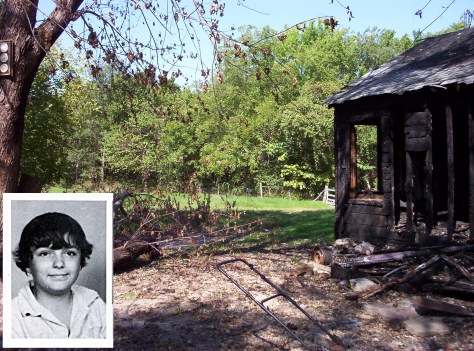
The picture is one I took in 2006 after the house in Tontitown burned. I haven’t lived there for almost 40 years. It’s an unimaginable and detached amount of time. The inset picture is of me from around the time I lived in the house.


3
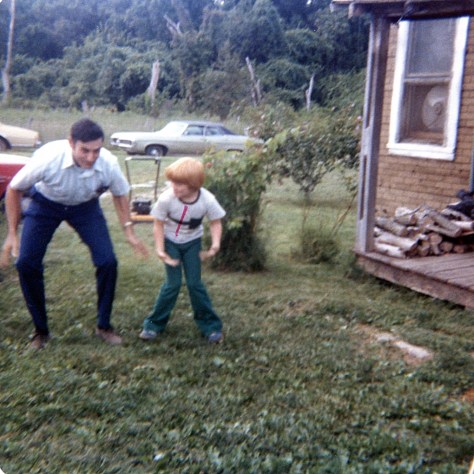
This picture is of Uncle Beb and my cousin Jimmy doing the Hambone dance. This picture shows the corner of the house that’s also in the picture of the house after it burned. You can see the wilderness near the road in the background.


5
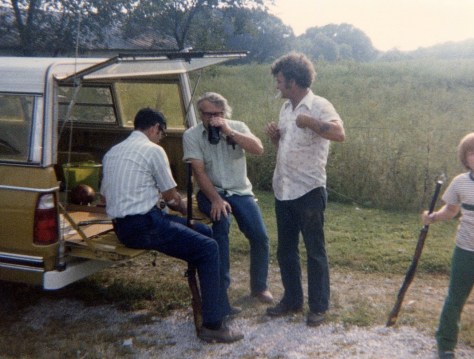
This picture captures a common activity: everyone armed and shooting. My Uncle Bed, Uncle Buck, dad, and my cousin Jimmy. In the right circumstances, these gatherings were joyous.


6
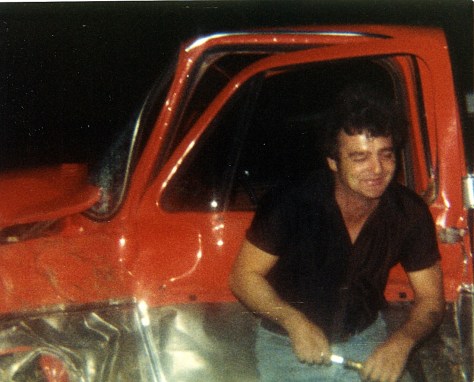
The picture in the first comment is a picture one of my dad. He’s three sheets to the wind. He’d just rolled his beloved truck down into one of the deep hollers near our house late at night. He was oblivious that night. The aftermath and days after were violently unpleasant.


A Eulogy For December Moments

1111111111111


I’m holding my breath and waiting for his swan song. Though the stanzas of our lives are numerous, some of us race with abandon toward the long silence. He’s among those. Even if we cover our ears to drown out the notes, the subdued and reduced scales will still flow and ebb all around us, whether injurious or nostalgic.

There will be no melodic crescendo nor applause-laden curtain call, of that I’m sure. His symphony will abruptly cease, and the echoes of his efforts will radiate quickly into oblivion. I can feel the tempo and its accelerando, racing impatiently toward the inevitable.

A life will have ended. Each of us who knew him will have our own arrangement, filled with annotations, corrections, and commentary.

As is often the case, many will have reached conclusions and coda without understanding that his life filled with the burden of secrecy. Lives, like harmonies, often gain depth through filter and perspective.

Our facades conceal our secrets; they also conceal us.

We can only make decisions with the information we have. I tried. I failed. But it’s not my failure to own.

I don’t hold myself to accountability, either, in part because his addiction demanded secrecy, anger, and retribution for those peeking inside the fortress of denial.

It’s difficult to stand near the fire without wincing in pain – even in December moments. We draw close to the light for warmth. As we walk away, the warmed fabric which protects us burns.

Life will go on. We’ll claim to have learned our lessons from his exaggerated example. We’ll reflect, hope, and dedicate ourselves to avoiding the same mistakes.

We’ll make them, however. Our humanity requires an ignorant allegiance to forgetfulness. Collectively, we have only a few vices, ones which we ceaselessly abuse to our own detriment.

We’ll recall his presence. Perhaps, in time, even as it fills us with fondness. His melody will be a problematic reminiscence.

Those who lose their arguments with their lesser selves tend to bequeath a series of discordant and minor shards of broken glass for us to decipher.

Walk among them at your own peril.

To he, to him, to me, to we, to us, to you.

Love, X

In Memoriam Of The Truth


1xfamilyscan (143)
Deanne at her confirmation…


This post needs a preface. My last wife died suddenly over a decade ago. I was ten years older than she was. She came from a large family, one like so many others; dysfunctional and complicated. Deanne was the youngest of many siblings. Like so many of us, she made some terrible choices when she was younger. Her family mostly failed to adapt to the fact that she grew out of much of her youth. The church and religion were two separate entities in her mind. One, rooted in the practical and loving faith of her paternal grandmother in South Dakota, and the other, insistent on concealment and manipulation. Because of something that happened when she was young, Deanne’s appraisal of the church as a whole was marked by suspicion and lack of trust.

I posted this to Deanne’s ancestry records so that her truth would be preserved – and possibly outlive the revisionists who will read the words and be unable to resist lashing out against the truth I’ve shared. It’s uncomfortable hearing someone revise history or mischaracterize someone’s life. The purpose of my addition to Deanne’s posthumous biography isn’t to harm. The truth never harms unless those who hear it don’t wish to accept it.


Deanne Cordell was baptized in the Catholic church in Sioux Falls, South Dakota, on Nov. 28th, 1976, when she was two days old. Much of both sides of her family were Catholic. As she often joked, “I didn’t have a say in whether I was baptized, but I have a say about going to church.” Deanne loved her paternal grandparents, especially her grandmother Jessie Gosmire Cordell. She admired her faith and the way she lived it. Deanne often talked about how much she wished that people could have an open, honest, and compassionate faith like her grandmother. As for most other people, she had an intense impatience with their hypocrisy and lack of compassion toward those in need or those making mistakes. She’d look back at their life and see all the craziness and wonder how they didn’t recognize themselves in the lives of others, even as they criticized them. It caused friction with many people in her life.


I have no way of knowing what she was referring to or whether it was about her own life, but she knew a girl who had experienced some kind of abuse at the hands of clergy. She said that the girl had told her mother about it and had been punished repeatedly for lying about the church. It had a substantial impact on her views about the church. I tried to circumspectly discover the identity of the girl in question over the years. “It’s not a part of my life now, so it doesn’t matter,” she’d say. I knew it mattered, though.


By the time Deanne was an adult, she had grown to dislike the church intensely. She was unhappy with church politics, its policies, and also the way it concerned itself more with public relations than honesty. As an adult, she only attended church when mass was part of a Catholic wedding or funeral. Otherwise, she preferred to live a secular life. A great deal of her dissatisfaction with the church was the way so many had responded to her choices in life, some of them with great anger and disapproval. She found no holiness in their attitudes.


Oddly enough, had she remained in South Dakota or moved back as an adult, to be nearer her grandmother, I know she would have attended church with her. Her grandmother was her connection to faith, while her own mother was the wedge that distanced her from it. Her grandmother never held religion as a weapon and certainly didn’t sharpen it at people’s expense. Deanne admired that relentlessly.


Before she died, she talked about how ridiculous some of her family member’s ideas regarding religion were. One in particular was regarding cremation. She was fond of pointing out that those with the strongest views about cremation seldom managed to pay for their choice before departing, leaving other family members to bicker about the issue. When my Uncle Raymond died about a month before Deanne, it allowed us to talk about her own choices. She thought her mom’s antiquated ideas about cremation and Catholicism were ridiculous. She was adamant that she wanted to be cremated and not buried or memorialized in a Catholic church or cemetery. She was equally adamant that her middle name not be used. Given that I had legally changed my name, it was one of her wishes that she eventually change hers, too, and rid herself of the name. We joked a lot about choosing an entirely different name for herself, as I had done. Given enough time, I’m certain that she would have and I think she would have chosen “D” or “DeDe” as her first name. I had made and placed hand-painted “D” letters in a couple of places in the place we lived.


In my commentary, I’ve held back from the overt negativity Deanne had toward the church. She struggled to come to terms with her own beliefs, as most of do. She also struggled with her mom’s attitudes about religion, as they seemed to trigger her distaste for religion like nothing else. I’d laugh and talk her down from being angry about it. It’s part of the reason I still sometimes wonder whether Deanne was the girl she knew who had the story to tell about clergy.


Deanne has living family who would vainly attempt to revise my recounting of her attitudes. I was closer to Deanne than any other person in her life. No one knew her as an adult as I did. I married her when she was 20 years old. She died at 31. Many thought of her as the “kid” of the large group of siblings and half-siblings. They carried their prejudices about her youth into her adulthood and often discounted her opinions about life, whereas I only began to know her when her adulthood was starting. I had no preconceptions.


In the last year of her life, I attended a variety of different churches, trying to find one which might be worthwhile, despite my agnosticism. Deanne wasn’t interested in joining me. She was, however, interested in what I had to say about religion and the things I learned. Much to the surprise of many of her family members, she knew a great deal more than they realized. Many were simply too busy ignorantly trying to correct her instead of listening.


I write this in part because a few people have remarked that she was Catholic. She most certainly was not Catholic, despite the revisionist wishful thinking of some of those who knew her. Whether it is fair or note, Deanne would have much preferred a world without the church, or organized religion at all. One thing is certain: she believed that anyone involved in a sex scandal at church should not only be exposed and punished, but anyone protecting those who did so should be doubly punished.


I have no agenda to hide the truth or tarnish her image. Truth is its own reward, even as it leaves a bitter taste in some mouths.


X Teri


It’s Personal, With Love

Painnt_Creation_2019-06-16_091109

This is not a Father’s Day post.

On the other hand, it is. I just found out this morning that my dad had another child. Were he still alive, he would have found out this morning, too – and I would have been the person telling him. Life is a series of kicks in the face.

All my life, I’ve resisted the revisionist tendencies of much of my family. I revolted against the idea of secrecy and shame. Each of us makes our own decisions and is responsible for the consequences. People misbehave and make terrible decisions.

For the first time, this morning, I wrote, “every person in my immediate family has struggled with the demons of alcohol, drugs, or violence.” Some of their stories weren’t mine to tell, even as the consequences boiled over and tainted my ability to live a good life. Over the last year, I learned that my brother, despite his stunning intelligence, has been a victim for much of his adult life. On the Terry side of my family, every person in my immediate family has led a double life. Many have died prematurely as a result. Just writing this paragraph might have earned a beating in the not-so-distant past. The revelation that some of us lead secret lives (or smaller lives) controlled by our lesser natures is one that seldom gets a warm embrace. We prefer to hide our shadows away from questioning eyes.

None of this is a secret. Everyone close to those family members knew, of course. That’s part of the corrosiveness of alcohol or addiction. Part of my adult fight was trying to reconcile the fact that so many people stood by on the sidelines and angrily pushed me away as I tried to be open and honest about my parents and their brutal hidden lives. It’s my story to tell because I have an equal right to share my steps.

Since I was little, I’ve joked that I must have brothers and sisters out in the world. My dad was unfaithful in every sense of the word. He had notorious affairs with several people. I knew that one day I would be able to say with certainty, “I told you so,” even as a couple of my aunts and uncles angrily told me to shut up. “You ought not to talk about that!” Equally true is the fact that my father ought not to have behaved that way. People close to me have heard me say that my genetics are an infection. I don’t say it with disrespect toward my brother and sister; it’s a fact that is sustained by the carnage of our lives.

Years ago, I started genealogy. I didn’t think it would be interesting to me, even though I love to research. It opened a world to me. I helped many people find lost loved ones, discover their birth certificates, and unlock countless mysteries. Many of those mysteries were buried – or so those involved foolishly thought. I participated in the DNA system early and with optimism. DNA is the blueprint of truth that people can’t control. It is the genie which relentlessly tells us the truth, despite what those who preceded us might have written as history. Alongside DNA, I began to discover the historical record that buttressed my claims about my past. Much of the record contained people’s accounts of crime, abuse, violence and sometimes proud moments. Several of my aunts and uncles died before I compiled a record that would make them wince.

History devours all of us incrementally.

As the unofficial family historian, I’ve never shied from directly admitting what happened behind closed doors. It’s caused some discomfort and anger.

And so…

After years of relentless diligence, it finally happened: through DNA, I discovered that I have a half-sister out in the world. This discovery just happened. It’s raw and fresh in my mind. I can’t imagine what my half-sister is experiencing. I have a million questions, of course. Luckily for her, she can use my ancestry treasures and written accounts to jump right into the lives that she wasn’t able to experience. I warned her that demons possessed my father. I’m not one to gloss over the terrain that makes people uncomfortable. I’ve given my dad a long eulogy, one punctuated by bitter truth.

Her mom was very young when she was with my dad. The liaison happened in the early 70s after my dad was in prison and had returned to Monroe County, Arkansas. He’d barely survived a DWI accident that killed my cousin. I know nothing about my new half-sister’s mother or other family. It’s probably best at this point as she comes to terms with unintentionally finding an entire family in the world.

I don’t have all the details. Part of the uncertainty is that the woman in question didn’t expect to ‘find’ relatives, much less someone like me with a full arsenal of DNA results and extensive family history for her. I don’t even know her name yet.

Ironically, I found confirmation on Father’s Day, a holiday that was no more real than a unicorn in my family. My dad died over 25 years ago. He would laugh. Whether that makes him human or a monster I’m not sure.

I am both confused and happy. Most of my glee is for my half-sister who found the road she was seeking. What she does with it is entirely her choice. That’s entirely the point of DNA and family history. None of us had a choice regarding who brought us to this world, and many of us would desperately love to be able to change those choices. It’s not our fault. Whether our parents were doctors or assassins, we are guiltless in our existence.

I wish I could grant amnesty to all those children who grow up feeling responsible for the people behind them.

For those of you who have good families, it probably seems a bit exotic to think about these situations. Many of us flee in self-protection from our family. All of us would prefer the warm embrace of people who value and love us. Unfortunately, much of the world operates on a stranger wavelength.

It’s no insult to say that my original sister and I are incompatible. I’m not one for anger, drama, and instability. It might make her angry to see this truth written out – but it is true in a way that no one can deny. As for my brother, he wisely moved away when he was younger. Over the years, our connection lessened. A few years ago, we went through an intense and disruptive episode that broke something in me. I didn’t know at the time how much he was suffering from addiction. I knew but didn’t ‘know,’ much in the way that each of us later wonders how all of us avoided connecting the painful dots.

Now that the day has come that I might have a connection to another sister, it is news that I can’t share meaningfully. Mom and dad are both dead. My sister is in exile for my sanity, and my brother is struggling merely to live another year.

You might say, “None of that is your place to say, X.” You’re wrong, though. I have earned the right.

I don’t know what, if anything, will come of my discovery of a new half-sister. I wish my brother Mike were in his right mind, though. We share a deep and incisive bond of dark humor and irony. Since he’s been at the brink of death, he has passed a lot of time with me recounting the old stories. Shared history acquires a more profound meaning when you realize that your time in it is diminishing rapidly. In the last few months, Mike has read all my family lore and stories and relished them. He knows how strongly the gravity of what we came from has affected us.

I hope that my new half-sister waits a long time to meet my original sister. While I am by no means able to claim normalcy, I’m foolishly confident that I am the best ambassador to the family.

To anyone reading this, I hope each resists the urge to ‘find’ my new half-sister. She gets the right to decide when or if she opens the door. I wish her peace regardless of her timeline.

To the new half-sister I don’t even know by name, I wish that Father’s Day were one of joy for you. I wish that life had been different for us all and that all of us could sit at a table and wonder about what might have been. Each paid the price of our common ancestor. We never stop paying.

We also never stop hoping, though, either, not if we share a common humanity.

There Are No Small Deaths

miguel-bruna-655204-unsplash.jpg

This post is in defense of those who have connections with other people we don’t understand. As I hope we’ve all experienced, it’s possible to meet a person and ‘get’ them, as if we are estranged best friends. Some of these bonds are stronger than those of family. It’s possible to feel closer to one’s fourth cousin than one’s grandmother. Bit players in our lives often morph into the main actors. By living in reverse, we don’t see their importance until they’ve stepped out and away from our lives.

Only the person experiencing the feelings of loss at a person’s passing knows to what depth those feelings reach. Tendrils of connection are often invisible, incomprehensible, and unknowable. It’s important that we abandon the false expectation that we understand the loss someone else is processing.

There are no small deaths.

Even with my best arsenal of words and passion, I sometimes struggle to describe the nuances of another person and their importance accurately. That’s the best-case scenario even when I’m communicating with someone who shares a great deal of humanity. It’s a fool’s errand with those who lack a common understanding.

When a person commits suicide, it’s human to question all your choices, as well as your attention to the person who has left us. Even without the shadow of self-harm, we tend to experience a depth of introspection when we lose someone.

Whether it’s fair or not, suicide strikes us an accusation. We have to give space to those who need more time to find first gear again. Implying that the loss isn’t a reason to grieve is an unacceptable reaction.

Because of the invisibility of many of these connections, one of the most traitorous acts you can do is to doubt or question whether the relationship was real when another person is suffering from the unexpected rupture and loss. “Did you know him or her very well?” or “Were you ‘friend’ friends?” both serve to undermine and accentuate the pain of the other human being you’re inadvertently demeaning.

“Only the spoon knows what is stirring in the pot” is one of my favorite clichés precisely because it reminds me that I’m not privy to all the information contained in a situation or between people. I’ve committed the error of assuming I know. Worse, I’ve judged people based on what I perceive as only imagined depth. Because I’m human and stupid at times, I fear that I’ll do it again.

A typical example of callousness is when someone says, “It was only a dog” in reaction to someone’s disabling sorrow at losing a pet. Such shallow and meaningless comments only serve to highlight the accuser’s fractured self. We should feel compassion for them, as they’ve been deprived of a pleasure in life that they’ll never understand. It was indeed ‘only’ a dog. The greater truth is that a human being had a deep love for that dog. You’re not demeaning the dog; instead, you’re demeaning another human being’s choices and authentic feelings. From the right perspective, such an attitude is monstrous.

Likewise, when people are involved, the callous person can’t know the person they doubt shared a bond with you. The connection isn’t measurable. We can’t see the swell of your heart or the yearning you wish upon the Earth to have this person inhabit your space again. Grief makes even the best of people uncomfortable. As you learn with age, it also unhinges people who have no foundation to come to terms with the helpless sorrow they see from other people.

Perhaps the person who passed once took a moment and literally reached out to let you know that you were seen, measured, and appreciated. Whether you were indeed at your rock bottom, their outstretched hand and openness pulled you out of the abyss. These moments create a bond that’s difficult to inventory – and treasured forever. Because these moments are often private and held close, those left behind are often the only witness to their measure.

As people die, it’s important to remember that grief is terrible, personal, and unknowable. Each time we’re the one experiencing the loss, if we are lucky, we suddenly remember the lesson of connection.

Time, with its caress and embrace, imperceptibly diminishes our pain, even as it prepares us for the next dark surprise.
.
.
*…written for someone struggling with friends who don’t understand the loss…
.

The Poppaty Prerogative

99999


Pictures of people, please and thank you.

“We are who, remembering when.”

Another person recently discovered the agony of finding out that the opportunity to take pictures with their departed friend has expired forever. He has only a few photos of his times with his friend. Because he’s not proud of his appearance, his ability to drop his guard and allow spontaneous capture of his image dwindled to insignificance. Even on the last trip they shared, no pictures document their overlapping joy. His memory still thrives, to be sure, but just as the recollection of a song cannot accurately measure the depth of beauty of hearing the melody, a memory pales alongside the vivid undeniability of a picture to amplify it. It explains why we can so spontaneously burst into tears or feel the literal swell of our heart when we see the presence of people who have mattered to us.

In the specific and linear moments of our lives, we easily overlook the magic and sublime nature of being alive. As time propels us, we look back and can’t help but to focus our eyes on the apparent wonder of what we didn’t appreciate when it was another backdrop in our present moment. It’s our curse. We find it impossible to perceive the zen essence of an otherwise dull moment.

As Andy from “The Office” said, “…I wish there was a way to know you’re in ‘the good old days’ before you’ve actually left them. Someone should write a song about that…”

The moments which tend to echo and call our name tend to be ordinary while we’re living them.

As people begin the ritual of finding new places to experience their lives, so many choose to photograph the static locales and places in their paths. In our data-filled lives, we have so many sources to find beautiful pictures of every single place on the globe. We can virtually drive down the streets of our favorite places without leaving the computer. We can take in the detail of any painting as it hangs on the gallery wall, no matter where that wall might be. There is both truth and beauty in such pictures. To those who say, “Aha! But those aren’t real,” I would point out that memories are only real to those who lived them. Pictures remain a testament for everyone.

We are, however, a world of people. We’ll remember places more for the moods they evoke. People grant us our identity, while places serve as our stage.

We are who, remembering when, imperfectly.