NSFW due to a wild mix of subject matter and personal commentary…
My brother Mike died without fulfilling my desire that he write a book. He absorbed the false honor narrative of some of my family members. He was a big man, my brother. I took these rules from conversations that Mike and I had on the phone when he was winding down. I’ve shared pieces of them before. My brother Mike had an interesting life. He was a great writer. We both recognized that between the two of us, we might be able to capture the horror, dark humor, and insights that we experienced. Of all the things that piss me off about the way he went out, it’s that he didn’t have enough clarity to see that he should pull up and find a way to live a few more years. Had he chosen to find a way, the resulting book we would have written would have been an irreverent mixture of Pat Conroy and Stephen King.
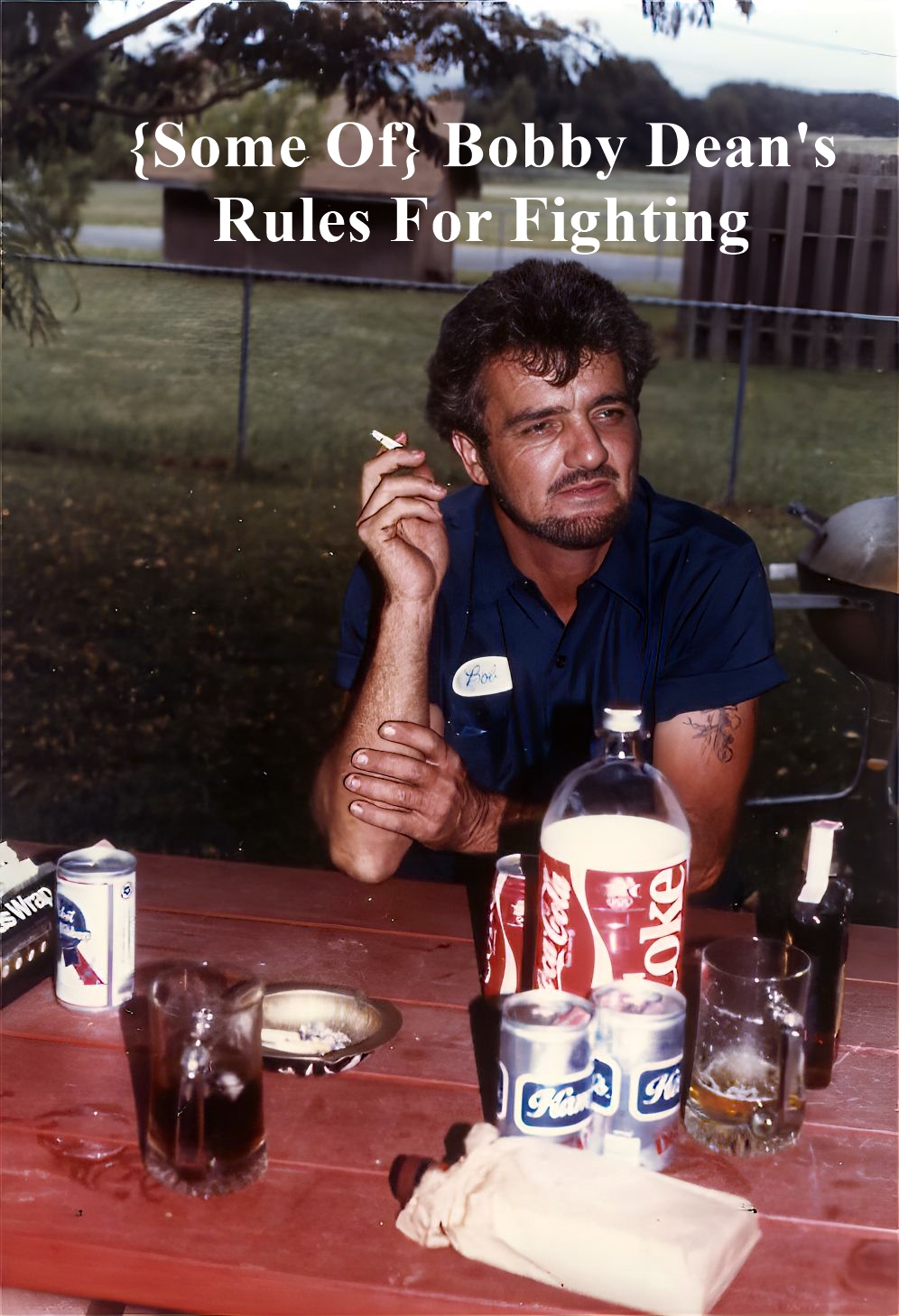
I’m paraphrasing my dad: “You’re going to get punched in the f mouth. There’s no doubt about it.”
My brother Mike saw a few fights that I didn’t. While I did witness my dad getting his ass whipped, Mike saw a few more of these than I did. Dad had whiskey courage. He read a few too many Westerns and got the wrong lesson out of most of the movies.
Take them for what you will. My dad was a walking contradiction. I despise a lot of what he did. But I understand it a hell of a lot better as I get older.
Rules:
If you’re going to drink in a bar, you’re going to need to be deaf or have a thick skull.
If your buddy is getting his ass whipped, you have to get your ass whipped too.
If someone threatens you… There are no rules, no warning. Do not think about it. Start hitting.
If someone says they’re going to whip your ass, don’t wait for them to prove it.
If they’re close enough to hit you, hit them first. Don’t stop hitting until they’re down.
The most dangerous man is never the loudest.
Don’t punch them more than you need to. But if they are intent on killing you, don’t walk away when they’re on the ground.
If they dress like a dandy, they will not want to get dirty. If they wear a tight shirt, it’s a sure sign that their muscles are for show. Except if they have dirty, scruffed-up boots. You don’t mess around with people who work hard for a living.
Nuts, throat, nose. If those don’t work, bite anything that gets near your mouth.
There’s no such thing as fighting dirty. If they are coming for you, everything in the room is fair game.
If you deserve to get punched, let them hit you in the face. If they attempt to give you more than what you’ve got coming, remind them that you’re a dirty bastard.
Once you’re done fighting, men have a drink. If you can’t have a drink with a man you just fought with, you’re not worth the hat that sits on your head.
… Dad tried to make a man out of me. Whatever that means. He had his demons. A great deal of his alleged teaching resulted in me choosing the opposite. I never could get my head around that kind of violence. But if you ask me if I understand it, the answer is yes. Especially so when the universe fails or when people fail to honor the fact that violence should never be out of proportion to what caused it. Dad scrambled my brains a few times, but one thing that came out of it was that I learned that many fights come out of nowhere. And a few people who should have scared me didn’t. That’s a part of the Bobby Dean legacy that fills me with contradiction.
I’m forgetting a few of his rules. Despite some of the negative things I have to say about him, he surprised my brother and me many times with how he phrased things. I sometimes forget that he was smart. I would snarkily mention that he often failed to incorporate his intelligence into his behavior. But I’m tired of getting hit by a bolt of hypocritical lightning.
I’ve confessed before that my brother and I actively thought about killing my dad more than once. I’m not proud of it. But if Dad had survived a few more years, he would have appreciated the dark humor of this truth a lot more. Mike realized when we got older that it probably would have been me who would have done it because I experienced and witnessed a lot more of the violence. When my brother Mike got older, Dad looked at him much differently. Mike would have hurled him through the kitchen window like firewood.
Knowing them both, I am 100% certain that one of them would have pulled out the whiskey bottle and poured the other a shot.
They were the kind of men I did not aspire to become. Whatever dark streak ran through them has luckily remained mostly dormant in me. I’d love to have the devilish prankster spirit. I wouldn’t tie someone to a hunting camp tree stump and light it, but I would enjoy making someone think it could happen. There is a fine line between lunacy and free-spiritedness.
I’m sharing this because it’s supposed to be a tip of the hat. It’s not an accusation. The history is there, written as fact in my mind. One of the crazy lessons of ambivalence is that you can witness a tornado but fall in love with how the lightning looks across the sky. Life can be appreciated similarly, even if you would rather flip the light switch off for some moments.
Some days, there are so many triggers I feel like I’m at a gun show. I wish I had the capacity and audacity to consistently see the truth in my reflection. It’s one thing to intellectually know that the past is a shadow behind you in the mirror and another to nod at it and give it the finger. It’s true that the past is our shadow. That’s all it is. A phantom and needless stone that we carry in our pocket instead of putting it down. I often think of the movie Eternal Sunshine of the Spotless Mind. I know each day often gives us the miracle of a new attitude if we simply decide it. People are going to carry in their heads an image of you that no longer exists. Fighting it is idiocy. If you can accept that is truth, you should be able to accept that swatting away the shadow in your head is equally possible. I think a lot about my sister because her scenario highlights the hypocrisy I practice. All she can do is stay on the new path and let time do the rest. I call myself a hypocrite because I catch myself judging her against the backdrop of her previous life. It’s a natural and normal reaction but one that serves no one. The optimistic people among us know that radical change is possible. The practical side of us nods towards the idea that we know it’s not likely in many cases. We’re all going to fall down in the mud. It really does boil down to whether we will wipe it off and keep going. There’s not a day that goes by that I don’t listen, hear, or see someone managing to salvage their life or sanity. Some days are the opposite scenario. The same circumstances turn one person into a cynic and another a saint. All we need is Rocky music playing in the background when these things happen. X .
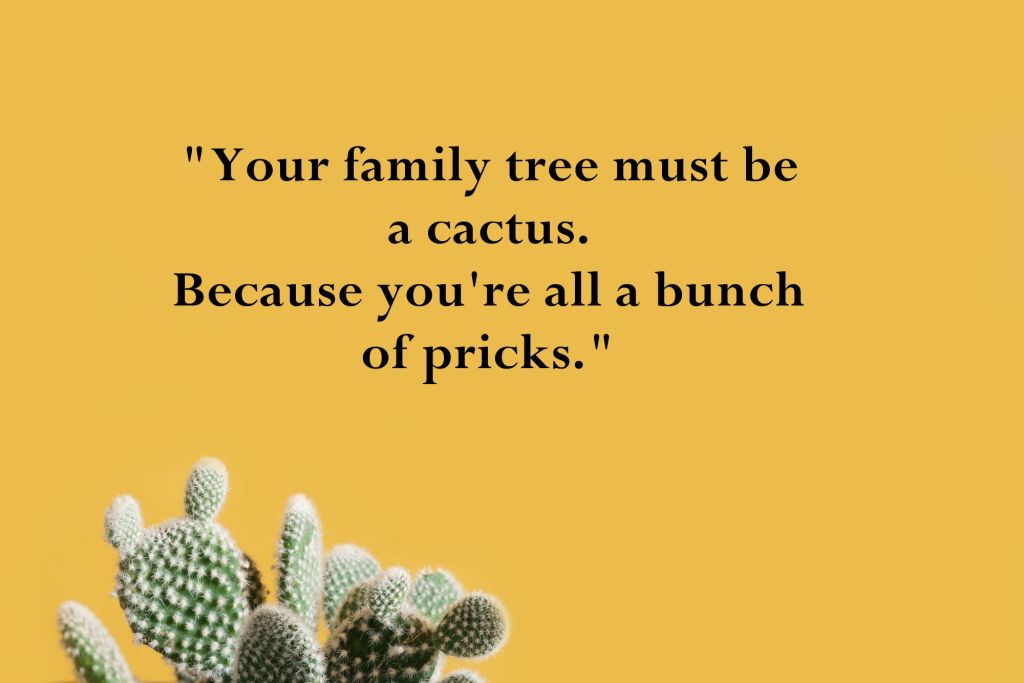
The picture is intended to be funny. Someone reached out to me and asked me to find their dad. And I did. I told them that their family crest was a cactus tree. The dad turned out to be exactly who was expected. But I softened the blow with a bit of humor. Not every quest and search ends happily. But answers bring their own peace. Love, X .
Because brevity is impossible for me, this is in two parts; I can’t tell the “click” story without a long preamble.
This story concerns false memory and my dad’s mercurial sense of humor. Of all the things I loved about my violent Dad, his sense of humor profoundly affected me. So many times, I retell some of my Dad’s exploits, and I can see disbelief on the faces of those listening. He fired a shotgun into the trees while I was climbing them. He helped tie someone to a huge stump at deer camp and set it ablaze with the unfortunate butt of the joke tied to the stump while it burned. He stole a crop duster airplane once; rather, he borrowed it, much to the owner’s horror. When he ran the gas station, he put ignition-fired fireworks under the hood of strangers’ cars. He did it more than once to my Aunt Elsie. He did it to the Sheriff and more than one deputy or police officer. The more they screamed or objected, the funnier it became. He lay underneath unsuspecting friends’ trucks as they started to climb inside, only to fire a shotgun or pistol between their feet, sometimes in total darkness, to hear their high operatic screams of terror. If he were in the swamps and marshes with my Uncle Preacher or Uncle Buck, he’d grab the overhanging tree limbs to knock snakes out into the Jon boat with them. He loved grabbing a snake and walking into Aunt Barbara’s house to make her shriek. I loved hearing someone shout, “Goshdamnit, Bobby Dean!” It was a sign that the happy-go-lucky mayhem version of my Dad was on stage. Luckily for me, I was not afraid of snakes. I hated eating them, though; Dad forced me to attempt eating them a few times. More than once, he tossed an entire box of gun shells into a fireplace. People who could barely walk became Usain Bolt in an attempt to escape. (He loved doing this at deer camp, too.) Because he had access to dynamite to blow rice field dams, he used a stick of it to wake people up more than once. More than once, people not only choked on their cigarettes when they exploded but also had more than a few singed eyebrows. He’d grab someone’s dentures and stick them crazily in his own mouth. He loved putting people’s rear wheels up on blocks, especially at the local taverns, so that when they got in, they’d floor the gas, only to be stupefied that they weren’t moving. If he were feeling really adventurous, he’d let them floor it and rock the truck off the blocks so that the vehicle would suddenly fly into gear at an unknown, uncontrollable speed. I’ve written before that it was impossible to play Chicken with him. His motto was “Never veer.” More than one poor soul discovered the hard way that it didn’t matter if Dad was driving a truck, a tractor, or a motorcycle, you dared not challenge him unless you were prepared to meet Jesus. Dad loved putting spiders, snakes, and frogs in mailboxes. My Uncle Preacher and Uncle Beb also worked for the postal service. More than once, Dad got ahead of them and loaded mailboxes with surprises. He loved having shotgun shells loaded with too many grains of powder or adding colorant to them. Adding black powder to the ashes of a fireplace was another surefire way to elicit a scream from the person attempting to light a fire. Another one of his favorite tricks was to sneak up on someone in a tree stand and fire his gun below them. He once spent hours rebuilding a nice Chevy truck, devising a way to put an incredibly small and low horsepower engine in it. The owner got in and attempted to drive away. It took him about sixty seconds to get to 50 mph. The amount of work Dad devoted to the joke made it that much more delicious to him. I’m certain that the man told that story a thousand times during his lifetime. I have a million such anecdotes.
Over the years, I briefly remembered my dad, Bobby Dean, my brother Mike, and I saying “Click,” followed by a laugh. Most of the time, I couldn’t remember why it was funny. The inside joke became its own reward. Like any kids, my brother and I loved Saturday mornings. No matter how violent our house was the night before, we usually found a way to use the expanse of Saturday morning to glean at least a little freedom. During the fights, it was rare for a TV to get damaged. It wasn’t because TVs were expensive so much as the fact that TV was one saving grace in our lives. My Uncle Buck was an electronics tech at Montgomery Ward. He taught me how to spice into cable wires and experiment. My brother Mike wasn’t interested in any of it. But sometimes, it paid off, as it did when we lived in City View in Springdale.
We cherished the tiny little black and white TV we had in our bedroom; being poor makes such things become gold. Back in the day, when an additional cable line required only splicing ability, a curious kid like me could add channels with nothing except scissors and extra cable. Between you and me, it was also easy to get or give cable service to anyone just by running a cable across the short distance between closely stacked trailers. Though Uncle Buck showed me how to connect RCA cables properly, people usually cut and twisted the two internal wires (one mesh and the other copper). It made mowing problematic without cutting the illegal connections, but the fix was cheap and fast.
When my brother began to decline rapidly, I did my best to get him to share stories and remember things of our past. It was a way to reconnect with him. Mike’s memory once was the stuff of legend. Later, his memory became a false narrative, one tempered with an insistence on concealment. Years later, I understand it much better now. It was the inevitable consequence of alcoholism and secrecy colliding.
During one of our telephone conversations, we rapidly exchanged witty barbs. Mike said, “Click!” and pretended he’d hung up, which made us both howl with laughter. When our laughter subsided, Mike asked me if I remembered the genesis of the joke. I didn’t. Twice during the rest of the conversation, he’d shout “Click” and literally hang up, leaving me to wonder what happened. Which made my brother Mike laugh even harder.
This is paraphrasing what Mike said. Part of it is completely wrong in his retelling:
“We lived in City View, and at the time, we didn’t have that tiny TV in our shared bedroom. The Saturday morning in question, we got up and were scared to death that we’d go out into the trailer’s living room and find someone dead. We quietly turned on the console TV with the sound down. After a few minutes, Dad came out of the bedroom to our left. He smelled like a distillery. We were both scared and knew better than to run for the hills. Last night’s fight was one of the typical ones wherein Mom had provoked Dad relentlessly until they both began to punch and hurl things. Dad laid down on the couch and grunted for us to turn up the volume. Looney Tunes was on. You and I sat on the floor, wanting to enjoy the cartoons but afraid we’d move or say something to set Dad off. After a bit, we both looked at each other in shock. Dad actually laughed at one of the jokes. We were relieved; humorous Dad was somehow active after a night of anger. Bugs Bunny ran downstairs to escape Yosemite Sam, both of whom had baseball bats. Each turned off the lights with a ‘click’ at the top and bottom of the stairs. Yosemite Sam attempted to run downstairs and hit Bugs Bunny with the bat. After a couple of attempts, instead of turning off the lights, Bugs Bunny said, ‘Click,’ sending Yosemite Sam back up the stairs. He turned off his switch in confusion and headed down, at which point Bugs Bunny hit him with the bat in the dark. To our shock, Dad howled with laughter. We had laughed, too, but our laughter was tempered by the urge not to draw attention to our presence or remind Dad that we were in the room. Dad continued to laugh, which prompted us to laugh harder. “Click!” Dad began to say repeatedly. And laughed even harder. We listened in amusement as Dad repeated, “Click!” and laughed for several minutes. It had been a long time since we heard him laugh so hard during a moment of normal living. Over the next few months, Dad would randomly shout “Click!” and pretend to shut a door, close a cabinet, or pop a shotgun closed. Then we’d all laugh. If someone asked him to turn on a light, if he didn’t tell them to get their ass up and do it themselves, he would reach for the switch, say “Click,” and pretend to flip the switch.”
“Click” became an intermittent running joke among the three of us. Even though the joke’s origin faded, there were times when one of us said “Click,” and we could laugh. No matter how crazy the home life around us was. If Mom were hungover, she would bitch and complain if it resulted in us laughing. Laughter in the presence of anger or resentment results in unfortunate backlash. For those of you without such a dynamic to witness, some of the best moments happened when Mom was in a horrendous, scorched-Earth mood and Dad did all manner of things to annoy her further. How he avoided being tied in the sheets and beaten with greater regularity is still a mystery. Almost always, Mom later appreciated the jokes, no matter how angry she was then. An example is when Dad filled her hair spray with sugar water in an attempt to attract wasps and bees. When Dad was in a good mood, nothing stopped his pursuit of humor. Though I might sound crazy to say it, if Dad were drunk but possessed by his dangerous sense of humor, he was a delight. The ongoing problem was the impossibility of knowing which version of Dad might emerge once sufficient alcohol passed his lips. But if he were possessed by the drunken angels of his nature? Mayhem could ensue – the kind of mayhem and humor that perhaps only half-feral young boys could relish.
After Mike told me the story, I searched for it online. I kept Googling “Bugs Bunny + Yosemite Sam + Stairs + Click.” No results. After Mike retold the anecdote, I remembered the cartoon clearly, just as he had recounted it. One day at work, I did the “Click” joke on a co-worker and howled with laughter. Though my brother Mike had died, finding the original cartoon consumed me.
Searching diligently, I found the video “The Windblown Hare,” featuring Bugs Bunny and a wolf. Yosemite Sam was nowhere to be found in the cartoon. I watched the video repeatedly and laughed as Bugs Bunny cleverly said, “Click,” leading to the wolf getting bashed with the bat.
Mike’s version of the memory had become mine, too. The important element was a shared lifelong joke among the three of us. Though it wasn’t “Ah’m the rootin’ tootinest gunslinger this side of the Pecos!” Yosemite Sam in the cartoon we watched decades ago in our ugly living room, it certainly was a sublime moment of unforgettable humor.
To my Dad: “Click.”
My lights are still on, though both you and Mike have departed. Writing this brought a bouquet of emotions, a few of which were the equivalent of snakes falling from the trees and waking up when you flipped the entire bed over on top of us for failing to get up like newly enlisted Army recruits.
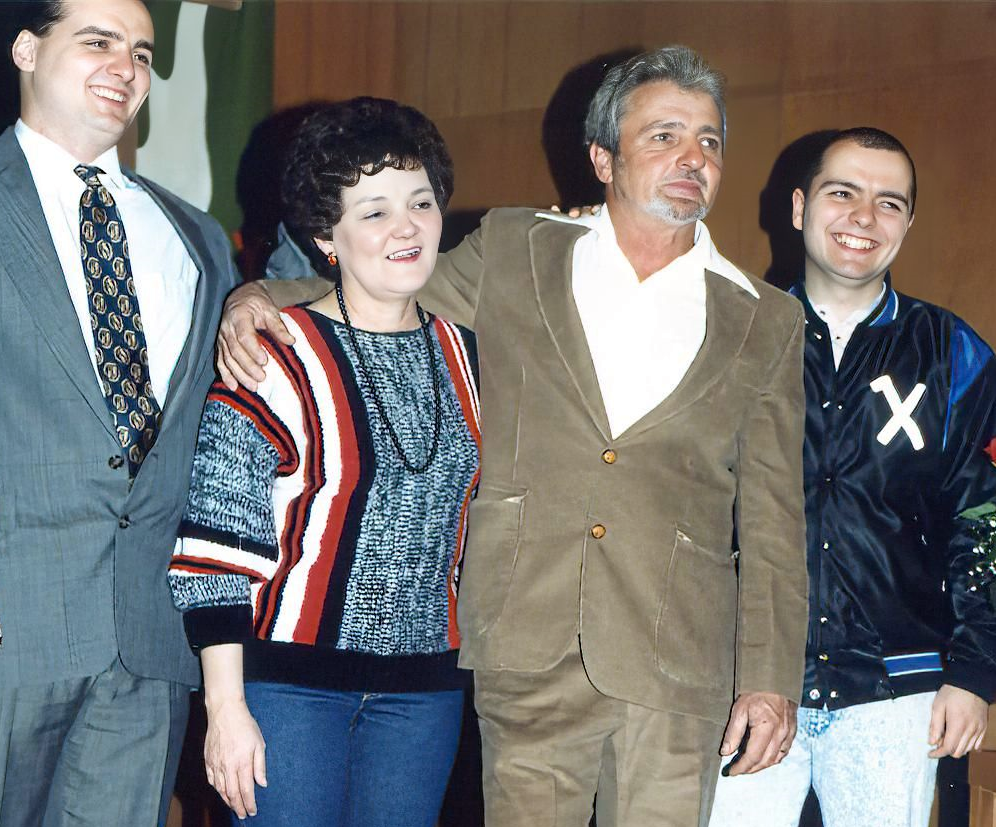
PS I remastered the picture. Working on photos and realizing I’m the only participant still alive is still sobering. To have a picture of everyone smiling is a testament to impossibility.
Love, X .
The video in question begins around the one-minute mark…
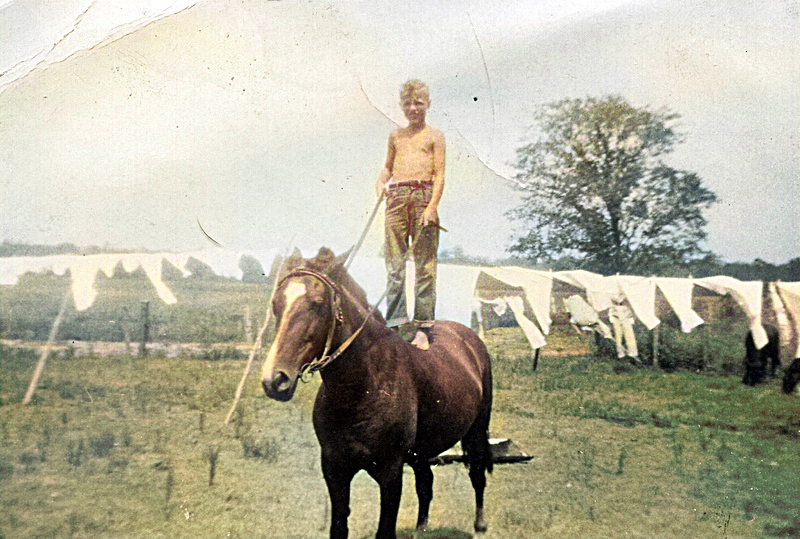
The picture is of my Dad, Bobby Dean, standing on a horse. Of course. I poorly colorized it a few years ago.
One day, I’ll abandon safety and climb my last tree- but I won’t know it’s the last time I’ll do it. I’ll laugh as I look down at the people passing below me. I’ll feel the wind blow over me among the branches. A squirrel might chatter at me for being too close to its nest.
Well-meaning people sometimes chastise me for my avocation of ascending trees. They are right. There is a risk. But I don’t know of any other adults who take the time to climb trees. It’s unlike skydiving, where the risk is primarily virtual and unlikely. Those who cluck at me for enjoying it don’t understand the sublime moments of being in the trees.
I might fall and break an arm. I might fall and crack my neck.
One day, though, I will look back on my last time in the trees and want to trade an arm for the chance to be there again.
And that’s true for so many things in life. Whether it’s being barefoot in the cold creeks, walking through the grass where unseen reptiles slither, or ordering a bitterly acrid cup of coffee, one so rich that my teeth will blacken momentarily. I’ll have my last kiss. Enjoy my last walk.
So, if you see me in the trees, take a moment to quell the urge to remind me that gravity could pull me out of it. Traffic might be my demise. My arteries might invisibly pass a clot and knock me silent to the ground. An unlikely second plane might find me unexpectedly as it spirals. A shadow in the dark early morning might demand my wallet.
The last tree I’ll climb started growing decades ago. It all started with the pine tree and gnarled other trees along the drainage ditch in front and behind my grandparents’ modest house in Monroe County. Grandpa didn’t care if I climbed trees – or even found my way to the tin roof. To him, boys climbed things, and sometimes, a working man lost fingers in the long cutting belts of the dangerous lumberyards.
Because I was asked to frame my life as an outsider, here’s something I wrote:
“Half of my family beat the gong of appearances, even though the shadows and secrets would inevitably be revealed by anyone dedicated to discovering them. My other half, possessed by similar other demons, revealed their flaws visibly. I came to understand that behavior not concealed by appearances has its own bitter yet revelatory honesty. And that I would choose openly displaying my demons over the betrayal of the insistence of family honor. There is no honor in secrecy or turning one’s head away from the past. A family cannot put to rest its emotional inheritance by denying that it happened.” X
I parked my car and walked barefoot down the trail. I knew I needed an unfamiliar spot today. So I walked much longer than I intended, passing people who took second glances at my bare feet and rolled up pants. It seemed as if they looked more frequently than they had yesterday when I had a billowing (but wet) blue cape on my back. I encountered a dirt path mostly hidden in the trees. Not knowing where it led and not caring either way, I followed it. It led down to the creek and I followed the stones and sat on one of the protruding ledges, sticking my feet deep into the rocks and mud under the water.
The cascade and babble of the water combined with the cloud cover and bird song had to have been aligned and created just for me at this moment.
Three years later and I still wrestle with whether the bell which sounded in my head on an October morning was correlation or causation regarding my brother’s death. My ex-wife would roll her eyes and attribute it to sheer craziness. No matter what the cause or how much my brother’s death affected me subconsciously, something in me broke. The breaking left me with a profound certainty of several things. And most of it was the realization that excuses and rationalizations are easy. The bell in my head brought both joy and pain. My new confidence brought consequences I hadn’t expected. Part of which had to be arrogance. It taught me the definition of limerence and of the meaninglessness of intentions compared to consequences. But it also taught me that most of my limitations are self-imposed. All I need is an idea, even more than motivation. Motivation and willpower are for procrastinators. If you get in motion or set things in motion, it is amazing what simple routine consistency will give you.
Since I was not familiar with this part of the creek, I walked carefully, even through the deeper pockets of clearwater. Countless lightning fast crawdads faced me as I approached, only to flutter backwards so quickly that it was impossible to see them move. There’s always a chance for snakes, but none made their appearance.
The weather is going to shift soon. The days will be colder and likely result in the pads of my feet softening again. I’ll continue to come out here for a while no matter how cold the air or water is. It’s impossible to argue with nature.
The brother of my youth would have loved to be here. It’s true that he probably would have picked me up over his head and thrown me into one of the deep pockets of water. Or we might have even had a rock fight, him promising to not pelt me in the head. Given his size advantage, had he been careless in his aim, there’s not much I could have done about it. We used to spend a lot of time out in the fields having dirt clod fights. It sounds archaic and crazy to anyone who didn’t experience the agony and ecstasy from both ends of a nicely sized dirt-clod bashing someone unexpectedly in the neck or chest. We didn’t invent the rules. They’ve been handed down for generations among kids growing up and playing with the things at their disposal.
Having said the above, if my brother were here today, there is no question that he would look me dead in the eye and ask, “When are you going to stop being so damn fruity?” I would reply, “Probably about the same time you smarten up and stop being an old conservative hag!” No matter how such a conversation played out, I would lose. Because if my brother couldn’t win through words, he would achieve victory by throwing either me or a table. That’s what happens when the universe mistakenly combines debate-level intelligence with a hulk of a person.
Somehow in the crucible of our shared DNA, I luckily inherited the introspective yet expressive gene. He inherited the introspective part, but all too often trapped himself in his own head. That’s the worst place for anyone of such intelligence to be.
Mike was right. Maybe I am a bit too fruity. But whether through alchemy or luck, I’m the one standing in the creek getting the last word.
Since I’m long-winded exactly like my brother, I’ll loop back to my initial causation versus correlation comment. It’s obvious to me now that the bell that rang in my head three years ago would have remained silent were it not for my brother having consequences catch up to him. Which ironically likely would have led to me having a major health setback myself.
The good and the bad may not be best friends, but they definitely sleep in the same bed.
Prepare yourself for turbulent oversharing. Some wounds get exposed again, revealing dark, unmanageable emotions. These words are supposed to be about addiction, alcoholism, and generational anger. I apologize in advance to anyone who thinks I am saying too much or to inflict pain.
I don’t want “I am so sorry” or any words of encouragement. Instead, I would much prefer that you read these words. And if they ring true for someone in your life, find a way to act before it’s too far down the road to turn back.
People often forget that I became an unwilling expert in abnormal psychology because I lived in an intermittent crucible inhabited by some of the most versed, angry people. For most of my life, I told people I believed my DNA must be infected. Though others couldn’t recognize it, I did. Though I now call it the “Bobby Dean,” the sinister recognition that my family’s maternal and paternal sides gifted me with the lesser side of humanity plagues me.
Like anyone without children, I sometimes mourn the choice to have none. Since life taught me that intelligence has little to do with the odds of giving in to anger and addiction, I remind myself that it’s possible that I would have given in to the lunacy passed down through my family. At fifty-six, if I had treated my children like others, there would have been little choice other than to end myself. I’ve hurt other people callously. But I at least can swallow my ‘what-ifs’ and know that I didn’t hurt my children and continue the generational trauma that populates the world with damaged adults. Ones who carry invisible wounds, anger, self-doubt, and the handicap of attempting to be happy and prosperous, even though they were mentally beaten into submission.
Nothing new happened recently to rip the bandage off. However, I was forced to learn further details of how nasty the effects of this anger and addiction were to people in my family. Because of geography and shared secrecy, it turns out that the imagined and partially confirmed psychopathy passed to the next generation was much worse than I knew.
Alcoholism amplifies monstrous behavior. It might not create it, but it unleashes it. The whisper of the disinhibiting lover in a drunk’s head becomes a shout. The person you once knew gets trapped and silent inside the shell of the alcoholic. As it worsens, the person you once knew becomes a faint echo. The new version will say and do things that increasingly become impossible to live with. You are tethered to the person who once was. As a result, you attempt to deal rationally with the effects of addiction.
Meanwhile, the person possessed by it will do anything to guard their ability to keep drinking. They’ll gaslight you, lash out, and create clusters of people who assume that the version of the truth they are being told is valid. People with no ill feelings toward one another become manipulated pawns, initially acting out of honest concern. But what results is another level of toxic behavior, all hinged on the central person. It is drama and chaos. Because of the secrecy and generated toxicity, people’s relationships get ruined.
One of the most significant pieces of advice I can give people when they are attempting to coexist in an addict’s world is to talk. Talk to everyone. I guarantee that the addict curates everything you do and say to make you a monster because addiction requires secrecy. Intelligent addicts learn the behaviors of narcissists.
People sometimes ask me what makes me so well-versed in narcissism. (Not the generalized version of it prevalent in social media.) Anyone raised or living around addicts inadvertently learns the behaviors. The hallmarks of narcissism always bubble up with addicts and alcoholics. They must deny reality. They become delusional to the effects of their behavior. They enlist everyone and everything to perpetuate their ability to keep drinking.
Recently, I met someone who triggered my “Bobby Dean” response. I knew immediately upon meeting them that they were evil. I hate to use that word. Nothing outwardly about them gave a clue, not directly. The bells went off in my head. I was right about them, of course. And then you’re left with the impossible task of coexisting with them. Such people thrive on chaos and the emotional distress of people around them. Since most people are genuine, they get stuck in a loop of the foolish desire to mitigate the narcissist. It can’t be done.
In the same way, most of us think we can win over an alcoholic with love, words, and compassion. It’s not true. You’re not dealing with a real person until you can slap the bottle out of their hands. They are an angry parody, possessed by a demon demanding nourishment. Replace the word ‘alcohol’ with ‘heroin’ and you’ll realize that until you get rid of the heroin, you can’t move forward. The addict can’t attempt to be themselves and regain their humanity until they eliminate the invisible straightjacket of addiction. Addicts put you in the position of helpless anger. Anger with yourself and anger with them. We each know that a person trapped in addiction isn’t being themselves. But that knowledge does not give us any comfort. We find ourselves screaming. It’s reactionary abuse.
My goal isn’t to tarnish my brother in this post. He was older than me. I loved him and knew early on that he was among the most intelligent people I’d ever known. We survived our parents. He got the worst of it from Dad. Perversely, it turns out he got the worst from Mom, too. As he got older, I tried to give him the benefit of the doubt. Obviously, the anger he’d inherited from our family poisoned him. I thought it must be me, that I was somehow doing or saying things wrong. Toxic people don’t take the time to doubt whether they are wrong. I became the opposite of my brother in so many ways. And he hated being wrong. It was one of his defining behaviors. Because he was so smart, he was seldom wrong. But when he was wrong? He doubled and tripled down on it. From there, he justified saying and doing anything to keep it that way. The alcohol perverted him into someone who could behave and speak in ways that the younger version of himself could not have imagined.
He was particularly vile to me when I changed my name. At that point in his life, he still pretended to carry the torch of family honor. He’d grown up with the Terry side of the family. They were true experts in horrific secrecy. When I changed my name, I wrote them all letters. There was no way to avoid them knowing that I rejected everything my name held within the letters that formed it. They got their revenge when my dad died. Their secret hatred was so intense that they refused even to list me by my legal name in his obituary. That’s the best example of expressed passive-aggressive behavior that I can cite. When I think of self-righteous hypocrisy, I imagine their example. It does not mean I don’t have good memories of them, too! But the older I get, the more I concentrate on knowing they were well aware of what was happening in our violent private lives. They preferred to stay out of it, even though they knew what was happening. Family honor and secrecy held more value than protecting children who were getting damaged right under their noses. It invalidated every religious idea that they allegedly cherished. I can’t imagine doing that. It makes sense that they hid my sister from me for almost fifty years. That she wasn’t white must have been the biggest threat to their false family honor that they could imagine. I would hate myself if I’d become the secret racists that they were. I’d write more about this, but that part of the story isn’t mine to tell.
I made the mistake of attempting to lovingly help my brother a few years before he died. I was all in. It was the worst possible move. He retaliated by lashing at me and everyone around me. He scorched the Earth to keep his addiction. I was rightfully convinced that he might actually kill me. He spent a great deal of time detailing how he would do it. Had he wanted to, he easily could have. Life had geared him up with the tools to do just about anything. Some of the family pretended they couldn’t imagine he was doing and saying those things, even though they could see the emails, listen to the voicemails, and read the texts. Each of them had spent decades enforcing family silence. Why would it be any different with my brother? Had this not happened with my brother, I might not have decided to cut off ties with my Mom not long after. It was just too much. Two of the world’s best alcoholics take a massive toll on a person’s sanity. It struck me how similar they were, each insistent on maintaining their addiction at any cost.
My brother was lucky. Though he left a trail behind him, even professionally, he was forced to retire and avoid the consequences that would have befallen anyone outside law enforcement. I hope anyone he encountered at work didn’t suffer as much as I imagined. People in that stage of alcoholism behave in ways that they never would absent the addiction. It is no secret that law enforcement suffers more from addiction than the general population. (As they do domestic abuse.)
No one was safe. No one ever is around an end-of-run alcoholic.
My brother had the chance to retire and enjoy a full life. To make amends. To admit his transgressions, to replace spiteful words with love and hugs, and to reject the poison of our DNA. He chose otherwise. It’s a story I have witnessed repeated too many times. It is agony for all of us to prefer to tell the good stories and push back the bad ones. Who wouldn’t want to honor the good times? There were many. My brother could have written several of the best books ever written. I would likely have helped him. Anyone and anything can be forgiven if they are open to it. Alcoholism demands everything. It reduces people to their worst common denominator.
A couple of years ago, I scrapped a lot of my shared history and records of my brother. After his death, I thought I could move on and continue to work to remember the good things about him. Some of it was incredible, an irrefutable dissertation on how crazy his addiction made him. He created entire fantasy worlds, each independent of the other, all designed to alienate people and render them unable to interfere with his addiction. Addiction requires secrecy. And as it progresses, it forces the addict to silence those who challenge it. It is exactly like a demon facing exorcism. It will destroy the world in the pursuit of its existence, even if it kills the host.
I write this because the newest revelations force me to confront that he created a world of pain for people. Those people are left with the immense struggle to be good people. It can be done. The first step is to no longer worry about people knowing. Sunlight gives breath. You have to talk about it, acknowledge it, and work to silence the self-doubt that the toxicity of alcoholism demands.
I damn well know that we all have addicts or alcoholics in our lives right now. The cycle is endless. If you think it is manageable, you’re wrong. It will worsen. You’ll look back and understand that if you could return to when it started, you’d do almost anything to stop it.
If you have an addict or alcoholic in your life, whether you think it is true or not, you must start talking to people first. They need to know you are dealing with an addict. You must rob the alcoholic of their secrecy. It is the critical component that precedes every other consequence and behavior.
I can add anger to my reaction recently. Anger can motivate if channeled. If you’re dealing with an addict or alcoholic, I recommend anger as a defense. Let them experience the consequences of what they’ve created. If you do nothing, you’re going to be angry anyway. It might be more effective than compassion.
I’m telling you this as an unwilling expert.
A piece of my heart will always be broken. To discover that people now gone still creates shockwaves in the hearts and minds of those who are still here. It is a recurring wound, and one opened periodically by reminders by those who remind me of myself when I was young.
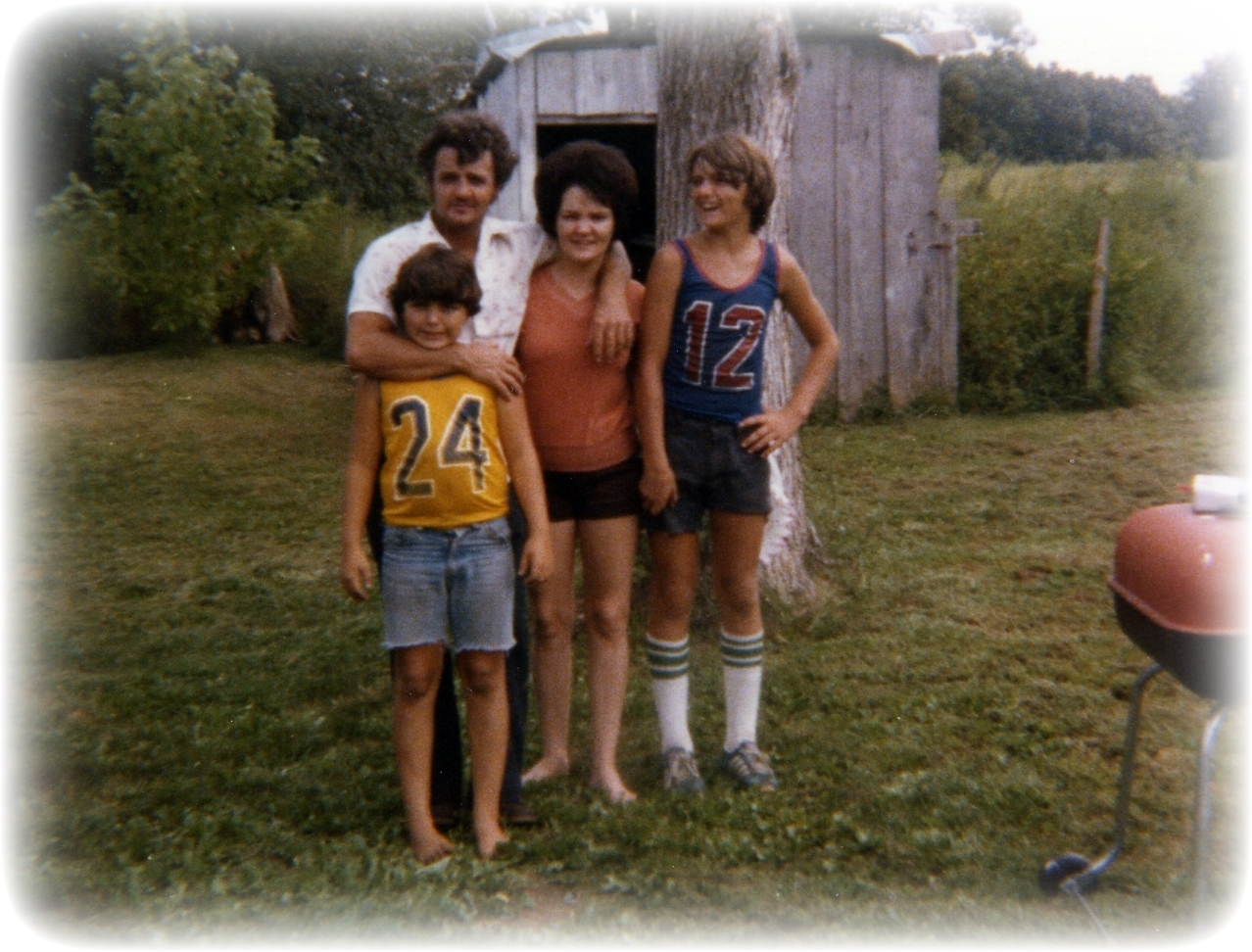
PS Pictures don’t lie. But they do conceal, just as most of us do as we live our daily lives. Just remember, I had many great moments as a kid. And as an adult with my brother. But behind it all…
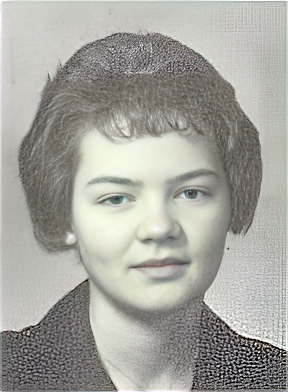
I can’t control how such admissions paint me. I rarely memorialize my mom’s death like I do others. She died ten years ago today. I found a picture of her today, one I might have seen decades ago but haven’t since. I inexpertly sharpened it today. My favorite grandmother died on the 6th, while my wife died on the 4th; different years, different circumstances. I spent a year not talking to my mom. I’d spent decades attempting to bridge the gap of anger and alcoholism with her. Like so many children of such parents, I was convinced that I could talk and behave in a way that would earn me normalcy as if I were the one with the deficiency. Drinking didn’t kill her. But it infected so many parts of her life. The infection of it spread to other people. It wasn’t her intention. She learned the skill from others. Like all other close family members of mine who were alcoholics, she died with an insatiable urge to drink until anger consumed her. Recently, suspected truths of another member of my family blossomed. He’s gone now. No second chances, no new learned behavior, no sitting on the porch as the sunset approaches. The familial infection he acquired in his youth overpowered him, once again proving that addiction has nothing to do with intelligence. Addiction and anger stain the people around those who suffer from it. And he unfortunately passed the ball and burden of consequences to other innocents. I don’t have any superpowers which shield me from the tendency to drink or drown myself in a fog. If I did have them? I would hand them to the people who I recently discovered to be needing them.
When I write things such as this, I trigger people. For much of my life, my brother was the vanguard of family honor, demanding silence. It was a habit he absorbed from the paternal side of my family. I discovered very late in life that their cabal hid many secrets, even people, from me. I’ve yet to find an addict who can move freely in the sunlight; their behavior demands secrecy and closed lips. In most of these cases, some of those lips will be bloodied because addiction inevitably exacts the price of violence, one way or another. Either to oneself or to everyone in the bubble nearest them.
That is exactly the power of addiction, the whispering lover that only the addict or alcoholic hears, blossoms.
I shared a quote by Annie Lemott twice last week: “You own everything that happened to you. Tell your stories. If people wanted you to write warmly about them, they should have behaved better.” I don’t write to inflict further harm. On the other hand, silence is self-inflicted violence. If we are to judge people, it must include their shining moments, too. I have good memories, and I share some of those, too. It’s fascinating to watch people as they listen to my stories; some only selectively note when I say anything they perceive as an accusation or something best not discussed. None of the people who later suffered from the afflictions of addiction and anger were born with the intention to slide into the abyss while terrorizing their friends and family. The filtered truth I share in no way alters history or changes who they were. They had their moment on stage. As it will for all of us, the curtains will close, and our time will end. Your time to live your story fits narrowly inside that timespan.
Secrecy. Silence.
Time is short. Live your life under your own banner and within your own control.
This is a personal story. Some humor, some violence – but most of all, it contains a thread of nostalgia for people no longer walking the earth with us.
My brother Mike is no longer here to add the details to the story. He was older and larger than me. He reminded me of this easily observable fact quite often. For some reason, he was at the bar with Dad. I’m 92% sure it was the Red Door. During a relatively short stretch of time, Mike often accompanied Dad to the bar during one of our several residencies in Tontitown. Mike was trying to do his homework. Mike used to like to tell the story of how the barfly would hit on him. His account of her appearance was hilarious. Whenever he brought up the story I would ask him, “Yeah, but if she had been good-looking, you would have acted differently.” Sometimes he would punch me in the arm and sometimes he’d say, “Duh. I’m dumb but not stupid. But there’s no way I’d engage with someone who might have been with Dad.” Mike often told a repertoire of versions of this story, full of detail and exaggeration. The bones of the story are true, though.
Dad was drinking too much, which is like saying don’t wash your dishes in the washing machine. I don’t know Tiny’s real name. His nickname derived from the allegedly hilarious observation that he was the exact opposite of diminutive. He probably weighed 350 lb and was about 6 ft tall. Tiny was at the bar, which was a rarity. He preferred to drink an entire case of beer at home. Mike surmised that he and Dad undoubtedly had been working on a truck at some point in the day. And ran out of liquor. In Dad’s world, that was as serious as skipping seven consecutive dialysis visits.
A couple of rednecks came into the bar. They weren’t regulars. Their faces were anything but regular too. Mike liked to quip that both of them could have been a carnival attraction based solely on their faces. Dad was playing pool and acting like a fool to amuse himself. The rednecks wanted the pool table. Back then, we didn’t have Appleby’s, where you could drink too much and pick on an urbanite for amusement. Dad called them his favorite word: “++++suckers.” One of the rednecks came up behind him and knocked him down with a pool cue. When my brother Mike turned around to take another look, he saw Tiny pissed off and getting up from the bar. Tiny was probably more pissed off that he had to leave his beer unattended than he was about my dad BobbyDean getting clobbered. The redneck swung the pool cue at Tiny. Tiny raised an arm and took the blow across his forearm. In a move regarded as one of the most foolish in human history, the rednecks did not take the opportunity to run out of the bar. Tiny walked towards them both. They both started swinging at him. Tiny pushed one of them so hard that it looked like an invisible tether yanked him backward. He grabbed the other redneck by the arm and swirled him around. Despite Tiny’s size, he grabbed the raucous redneck by the belt and picked him up, and threw him in the general direction of the other redneck. He bent down and helped my Dad get back to his feet. Mike did add that Tiny was breathing really hard but otherwise hadn’t changed expression during the entire altercation.
The rednecks took their time getting up. Nobody had anything broken. Dad was bleeding a bit but since it wasn’t gushing, the old rule of “If you can stand up, it ain’t that bad” applied. It’s a version of “Walk it off” that parents told people of our generation – even if an arrow protruded from our thigh.
When the two interlopers had regained the ability to understand English, Dad told them if they would stop acting like Mississippi refugees, he’d buy them both a shot. It’s anybody’s guess whether they accepted the offer for fear of another round with Tiny, or they understood that that was the way these things were supposed to be handled.
My brother Mike ended up sitting at the bar, surrounded by two redneck strangers, Tiny, and Dad. They acted like old friends who just finished trying to kill each other. Mike noted that the barfly was still making geriatric eyes at him. I’m sure that on some nights, Mike probably had a drink, whether he’d easily admit it or not. Knowing Dad, he probably insisted on it. It was a violation of his code of conduct for anyone claiming to be a man to decline a drink in the presence of other men. Later in life, Mike adopted the same outlook, for better or worse. Dad often required me or Mike to drive us all home if he was particularly drunk. We never understood what gauge determined this, as Dad drove even when his breath was flammable.
I’m sure Mike learned more from observance that night than he ever could by staring at his textbook. Mike was brilliant but also brutal in his approach to certain situations. If you doubted him, he’d bend your thumb backward or hit you precisely in the neck in such a way that you were immobilized long enough to regret it.
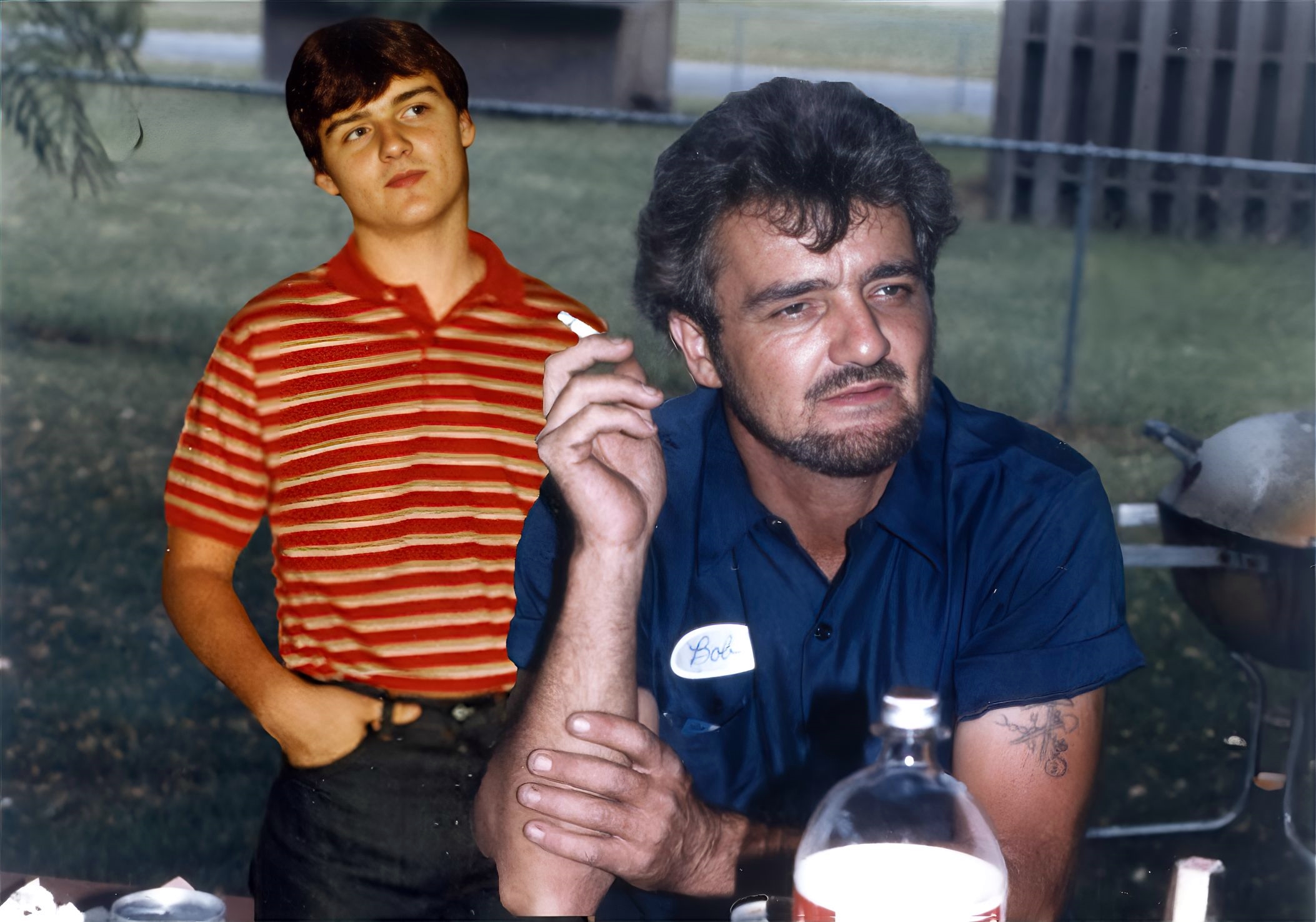
PS The picture is a composite of their approximate appearance at the time.



 P.S. Parenthetically Speaking