Category Archives: Nostalgia

An Unexpected Jump

Recently, a friend posted about kayaking on Lake Elmdale. He also mentioned that many people seem to be unaware of its existence. (The lake, not kayaking – although I do wonder if such people who kayak really exist.) I tend to agree with him. Lake Elmdale is an artificial lake built in 1953. It derives its name from a mix of the names for Elm Springs and Springdale communities. I think they missed their chance by not naming it something extraordinary, like “Devil’s Tooth Lake,” or even “Drowning Hole.” Arkansas already boasts Nimrod Lake, named after Noah’s grandson. (Sorry, but the word “Nimrod” was forever redefined by Looney Tunes.) 

Since I have your attention, in 1950, Springdale had a bit over 5,000 people. Ten years later, the population doubled. Elm Springs started at 217 and, by 1960, added a whopping 21 additional people. 

I have dozens of stories from my youth involving this body of water. Many from my early childhood are fishing stories involving my Dad and Uncle Buck or a rotating series of misfits called friends. Other stories are from the time when I lived in Elm Springs in the mid-80s.

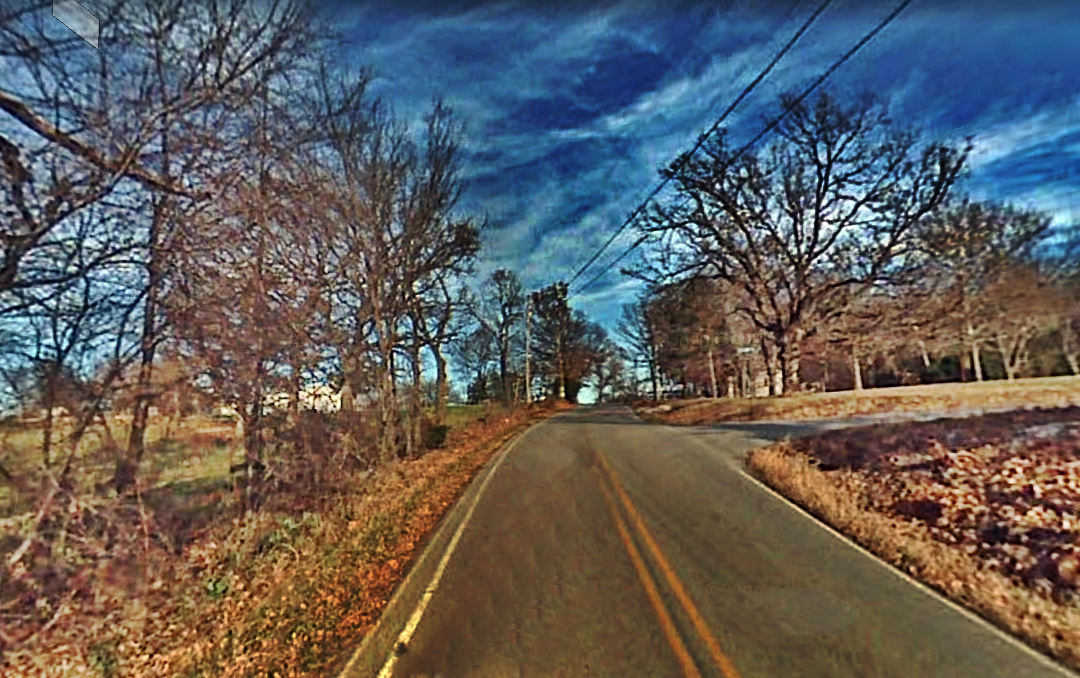
If you look at the picture, you can see one of the lake access roads on the right, about halfway up. Just a short drive beyond, and you can take a left on Lakeview and quickly reach Elm Springs road. Continuing on the circuitous route past the lake entrance, and you’ll emerge on Elm Springs Road further east and headed to what is now I-40. This story is really about the roadway’s right side, where the lake access ramp road intersects with E. Lake Road. 

(36°12’02.6″N 94°12’56.8″W 

36.200713, -94.215790 

(GPS coordinates if such things interest you.)

My Dad loved a good scare while driving. Whether it involved turning off the headlights at any random moment, cutting unexpectedly through a field (fence or not), jumping out of the vehicle if it were going slowly enough, leaving the wheel to whoever might be both inside and paying attention, shooting a pistol or shotgun from inside the cab, playing chicken with unsuspecting people dumb enough to be on the road at the same time, driving on railroad tracks (sometimes suspended) over creeks, marshes, and rivers, or hitting things for no discernible reason, my Dad often had no limits. 

I know that the last sentence is intolerably long. I wanted to pile it all out there to give you an idea of the level of crazy that might Dad exhibited. Sometimes, it was scary. Looming death tends to be that way. Other times, it was fun – but after the fact. Surviving such ‘fun’ colors the ability to laugh about it. 

My apologies for taking so long to get to the point. Before this picture was taken, the road was less maintained. Edges weren’t graded appropriately, and erosion and run-off worsened already bumpy or uneven roads. This specific spot was no exception. 

While I don’t remember the first time Dad revved his truck to 50+ mph and fly across the edge of this entrance as he passed, I remember coming off the cab’s seat and floating for the briefest instant. Whether the vehicle had a solid axle or good suspension had a say in managing the landing. If you’re thinking of the Dukes of Hazzard reading this, you’re not far off the mark. Though you might think I am exaggerating, Dad once convinced me and my brother Mike that he would do it at 80 mph. He did, after telling us he was going to for a long approach. Our butts were clenched until the point we realized that Dad wasn’t bluffing. Afterward, I felt that Dad would have regretted doing it had he not been three sheets to the wind. When I tell the story, I usually say, “I could see Kansas from up there.” It’s a joke. It was decently dark when Dad took that last quarter of a mile stretch before hitting the bump at 80 mph. After keeping the truck in the road, he hit the brakes and skidded to a full stop. He took the Camel cigarette out of his mouth with a flourish, looked at Mike and me cowering against the other door panel, and said, “Which one of you wants to drive and do it again?” Dad took the same jump, albeit slower than 80 mph, while we were in the back of the truck in the bed, too. We failed to determine whether clutching the truck’s side was safer or to lay against the tailgate. 

At times, Dad doing this sort of thing would involve Mom being in the car or truck with him. Mom’s reaction to being scared like this can best be described as “murderous rage” or by one of her signature phrases, “Go# Da## It, Bobby Dean!” shouted at ear-piercing levels. If it lands me in hell for saying so, I’ll admit that hearing her squawk like that was amusing as long as we weren’t witnessing the oft-overlooked attempted murder aspect of many of our weekends. 

If you are wondering if Dad ever wrecked, broke an axle, or blew out a tire doing these things, the answer is “yes.” Likewise, if you wonder if any of us ever suddenly experienced bladder control issues, you’d be right for questioning. 

On one occasion, Dad drove with his boss back to his house in Elm Springs. The truck was a Cheyenne or Chevrolet truck of some sort, one of their favorites to restore. In those days, rednecks often stated with confidence, “I have to blow the cobwebs out.” Being young, I didn’t understand the cliché but did know that it roughly translated to mean, “I’m going to go incredibly fast and possibly die in this vehicle.” Dad wasn’t drinking. I was in the bed of the truck with Duke, Dad’s german shepherd. Charles sat upfront up with Dad. He had a cigar in his mouth as he often did. Charles was also married to one of Dad’s cousins. I didn’t figure that out until years later.

We drove down Highway 112 and turned on E. Lake Road leading to the lake. About halfway between Highway 112 and the lake, Dad slowed and shouted to me out the window, “White lightning!” I immediately realized that it was a “go” for Operation Scare the Boss Shi$less.” The phrase could refer to the hell-raising 1973 movie starring Burt Reynolds or to moonshine – and sometimes both.

About 100 yards from the side road to the lake, Dad pushed the gas hard and shifted gears. As we hit the bump and sailed off the ground, I laughed. I heard Charles scream in surprise and then scream at Dad, asking if he’d lost his ever-loving mind. By the time we reached Charles’ house, he was laughing and jokingly cursing at Dad. 

One more note. Thanks to Dad, I learned how to drive through barbed-wire fences, closed gates, front lawns, flooding creeks, and just about anything else. Here’s the secret: you have to not give a damn about what happens when you do it. Once you master that skill, sober or inebriated, you too can be an amateur stuntman. I wish that I had experienced that version of my Dad freed from alcohol. There’s no doubt he would have still managed to convince me I might die at a given moment. 

When my brother Mike came home from leave in the Army, I didn’t get to spend much time with him. Life’s demands and the constraints of his limited time conspired against us. We did drive the road leading to Lake Elmdale, though. I knew Mike was going to ask before we ever approached the jump zone. “Should we?” he asked me, laughing. We were in my car. He was driving. “How can we not?!” I shouted. We hit the bump going 50 mph. As soon as we started to lift, Mike regretted testing his courage. After the adrenaline subsided, we drove for another hour along what once were quieter roads. 33 or 34 years have passed. 

In the years since, in the spirit of full disclosure, I too have excessively sped toward that same bump without warning the occupants of the car. Though the ridge is considerably flatter than it once was while I am much fatter, it never fails to fill me with nostalgia for both the times that were and those which weren’t. 
Humor’s Acolate

“As sorry as I was to hear of my brother’s passing, I’ll bet the news bothered him a LOT more.” – X

There’s a considerable risk in people misunderstanding you on a good day. Many of us tend to judge others with the worst possible filter. I’ve found that good people can understand and appreciate contradictory and sublime behavior. Those who don’t just aren’t my people. Old age and experience, if we’re lucky, gives us more latitude in recognizing this.

The greater danger is people hearing what you actually said, and you having no defensible context to mitigate it. So much of life is context, and much of that isn’t immediately explainable. “You’re damned if you do, and damned if you don’t” is a cliché for a reason.

The joke that started this post? I’m sure people can and will get angry if they choose to. They’ll claim I wrote it as an insult to Mike. It’s not. He would laugh his ass off reading that joke. About one hundred times over the years, I threw one of Woody Allen’s jokes at him: “I’m not afraid to die, I just don’t want to be there when it happens.” Years later, I threw in another one: “My relationship with death remains the same,” he said. “I’m strongly against it.” When Mike and I were young, we both read “Death Knocks,” a story (turned play) by Woody Allen. It was a sometimes topic of hilarity, even though Mike did not like Woody Allen as he grew older. Mike and I both made many bargains with imaginary devils and deities when we were young.

Only those who can imagine hiding in the space between the bed and the wall in the dark and waiting for a parent to come for them in a drunken rage might be able to understand the connection between bargaining and gallows humor. I have a list of stories about these incidents, and some of them surprise me by being funny. If you’ve read my blog, you can see that I’ve largely refrained from identifying some of my family by name. Despite this, I still infrequently find myself at the receiving end of hateful criticism.

When we lived at City View Trailer Park in Springdale, Mike swallowed an incredible amount of tobacco juice. Several of us had played and fought down at the retched pond that once stood at the end of City View. Mike spent much of his time between punches proudly with a mouthful of tobacco. He puked violently on the floor for what seemed like a full minute. That black juice stained the purple carpet deeply. No amount of cleaning could remove it. We’ll talk later about how someone thought purple carpet in a tinderbox trailer might look attractive. When the trailer burned, the stain obstinately remained. The carpet was dark, of course, but the underlying stain plainly stood out. Years later, when Mike and I spent the night at Mom and Dad’s house on Highway 49, Mike compared that stain to dealing with being helpless all those years, or nearly so. That was the same night we discovered that a nest of yellow jackets inhabited the other bedroom’s west-facing window. That’s a story for another day. As for the tobacco, despite attempts to make Mike stop, he dipped most of his adult life. I have at least three dozen pictures of him spitting into a bottle, cup, or a family member’s potted plant to prove it.

After Dad died, my cousin jimmy recommended that I watch a particular Billy Bob Thorton movie. Most people have never heard of “Daddy And Them.” You’ll be shocked if you take a look at how many stars joined this movie. Because it was set in Arkansas, it accurately grabs the absurdity of white trash living and wraps it in comedy. (A difficult feat.) After Jimmy twisted my arm and made me watch it, I did the same to Mike. In it was one of the jokes my brother and I shared as hilarious. Here’s the joke:

“Hey! Do you know what Dad would say if he were alive today?” One of us would reply, “No, what?” Dramatic pause. “Let me out!” With the last line, we scratch the air in front of us with both hands as if we were clawing our way out of the coffin. Last year, an Irish veteran stole the joke and shocked funeral attendees by having a pre-recorded tape of his voice shouting to be let out played during his service. Mike thought it was hilarious and an excellent way to separate the humorless from the good people in a crowd. “Can you imagine how tightly wound up Aunt Elsie’s panties would get if someone did that?” was part of his reply.

I have to say, though, that despite the immense teeth-gnashing my brother and I often shared, our deplorable and macabre sense of humor was unrivaled. Marines and serial killers alike cringed if they accidentally overheard our nonsense.

No matter what you’ve read and heard on sitcoms or dramas about the impossibility of confining an involuntary laugh at a funeral, my brother and I separately were a disaster; in combination, we probably deserved the death penalty. Some of the fault lies with my Dad. Even when he wasn’t drinking, he could say some of the most outrageous things devised by a human being. He once called the preacher a “co$$su$$er” in front of about 50 people just to get a leg up on him. In a twist of fate I’ve written about before, Dad and the preacher somehow became friends.

My brother Mike once unknowingly used an open mic at a funeral home in Brinkley to improvise a bit of comedy regarding our Grandma’s teeth. The funeral director sheepishly ran into the outer area to grab the mic from my brother and tell him that it was a ‘hot mic.’ It’s essential that you know that my Grandma was one of the two closest people I ever loved. Despite that, I laughed. I cannot think about that incident without losing a little bit of my soul to laughter. I’m convinced each chuckle puts me a foot further into purgatory.

There’s no greater or sublime pleasure having someone who is both smart and willing to go the extra mile for a laugh, joke, or smile – even if it burns down a few villages on the way there. I give Mike the win, though, because he could tell jokes that I wouldn’t. That’s saying a lot.

Not too many months ago, I sent my brother a collection of hand-written postcards, each with a joke from comedians we both loved. As with index cards in my back pocket, I’m also a fan of prestamped postcards for quick notes. Even while we were uneasily bickering, I wanted him to know that humor was still a big part of my life. (Even if I’m old, boring, wear a lot of black socks as leisurewear, and get too excited by an early buffet.)

Mike would see these words as a compliment.

Because of our relationship, I tend to expect someone to emerge with poison in their hearts to attempt to silence me for joking. Those who know me also know I’ve written multiple times about the fact that they have my permission to mock me to the end of the world when I’m gone, especially if it is funny or creative. Mike was not someone to pull back from a bastardly comment. The same quick and violent tongue he sometimes used to wound me also created some world-class humor. For everyone who knew Mike and watched him in action on solemn occasions, the Bobby Dean in him could not be confined or controlled. Trying to do so was just catnip for his enthusiasm to up the ante.

It’s not reasonable to accuse me of glossing over or attempting to sugarcoat Mike’s life. Equally so, I have to tip my hat when it is merited. Both of us emerged from childhood with a scorched-earth comedic streak. It probably saved us as many times as it caused us grief.

As it turns out, Mike was indeed there when death came for him. His birthday would have been November 1st, the day after Halloween. For some, it is All Souls Day. When I sat to finish Mike’s ancestry record, I noticed that his two children are the same age I was when our Dad died. Mike was 20,062 days old, the mentioning of which would irritate him due to my occasional reminder that I still keep a tab of how many days old I am.

My job is to remember the Mike who put a fish under the driver’s seat of my 1984 Oldsmobile in the middle of summer during a visit to Aunt Barbara’s. (Without telling me.) Or the Mike who read “Lord of The Rings” in almost one sitting back in the early 80s.

Please don’t fault me for taking refuge in contradictory stories about Mike. But if you do, I’ll accept that charge. Given the arc of my origins, I find this potential sin to be minuscule.

P.S. The word “acolate” is mine, one devised to denote eulogic remembrance, perhaps a day too late.

And The Story Both Ends & Begins

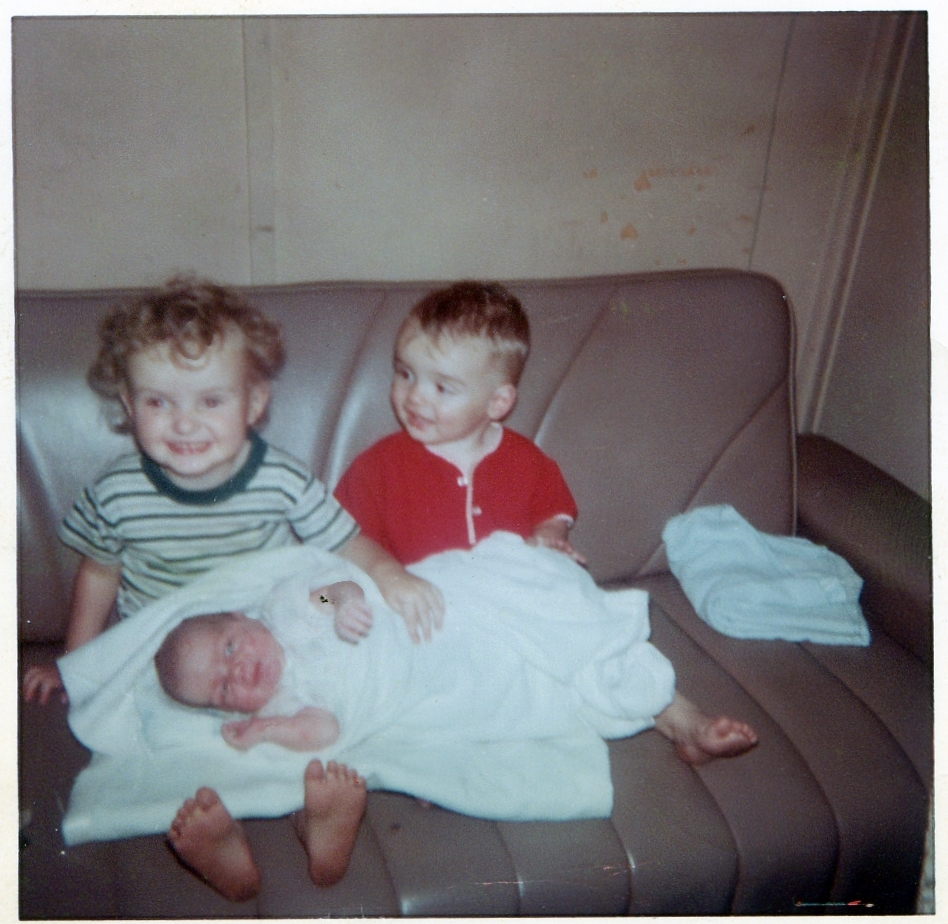
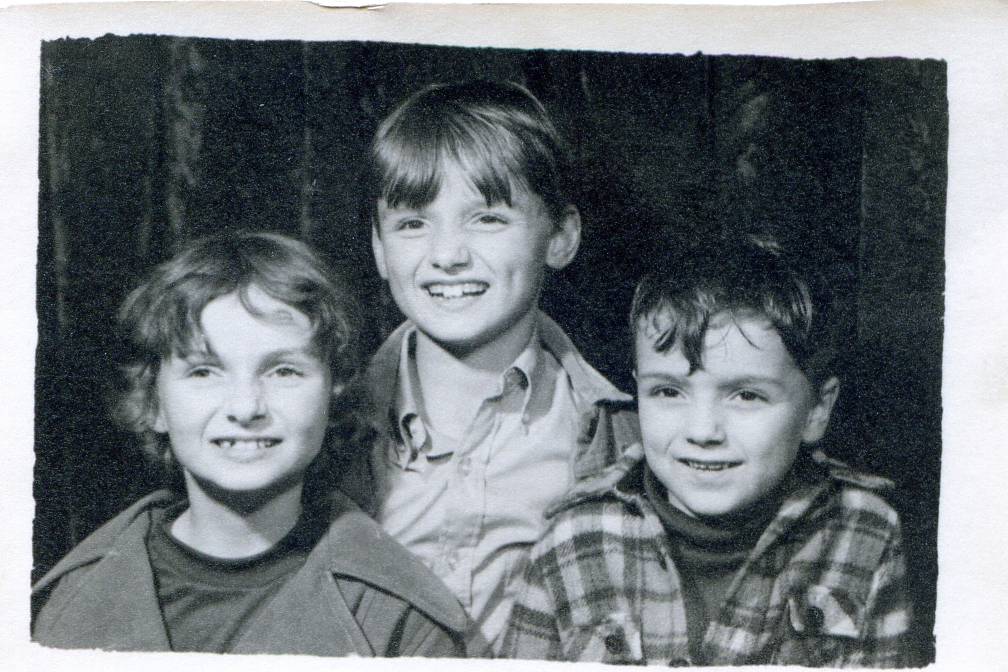
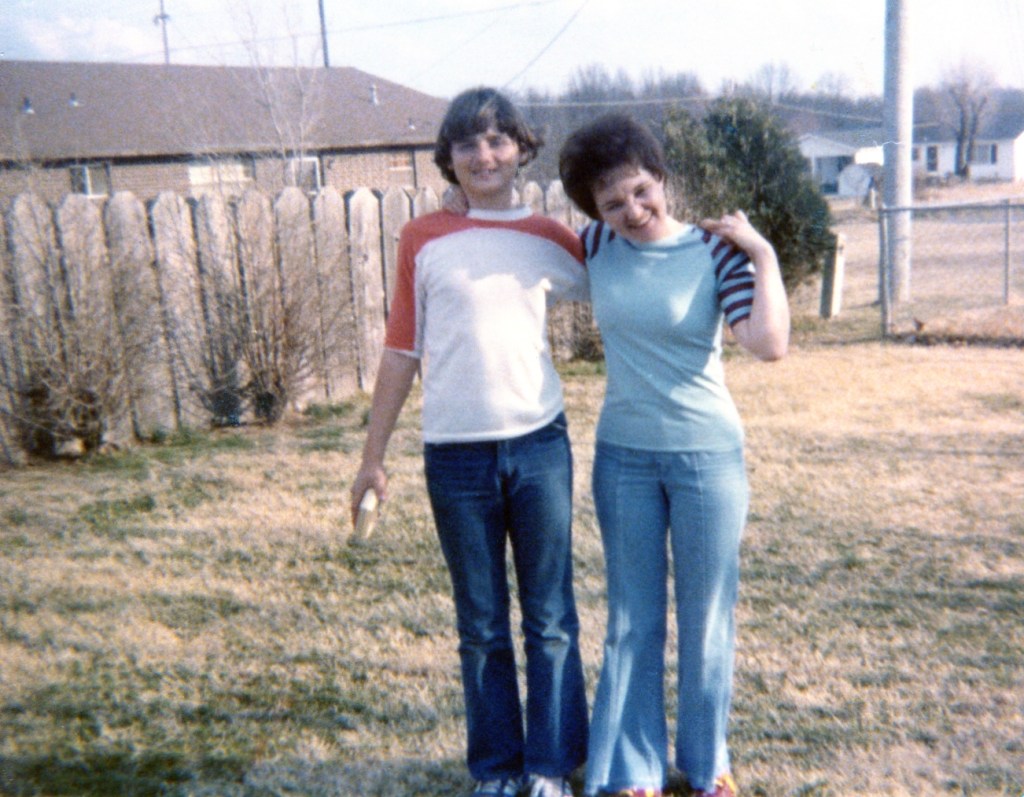
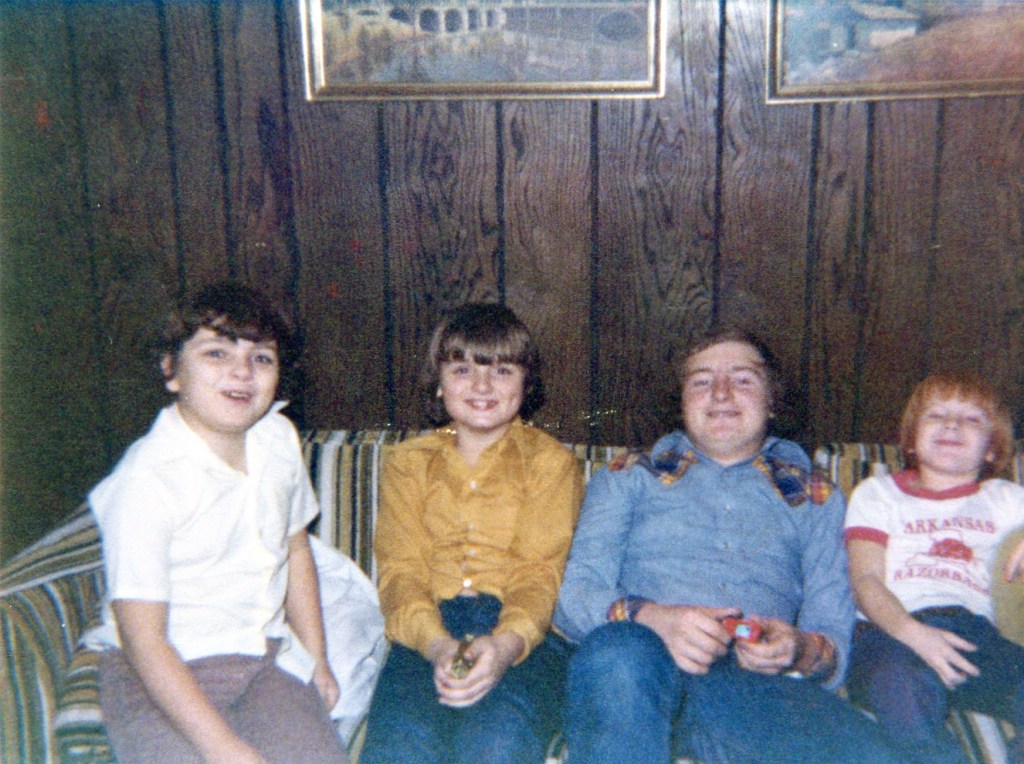
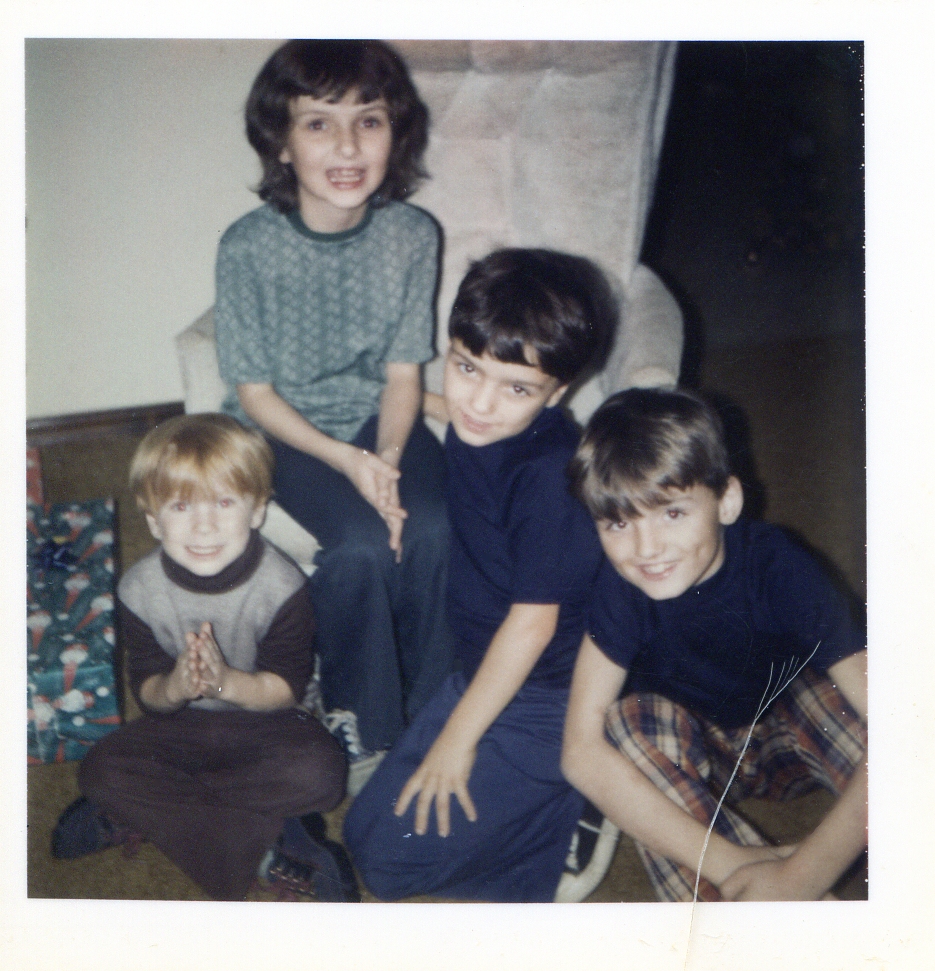
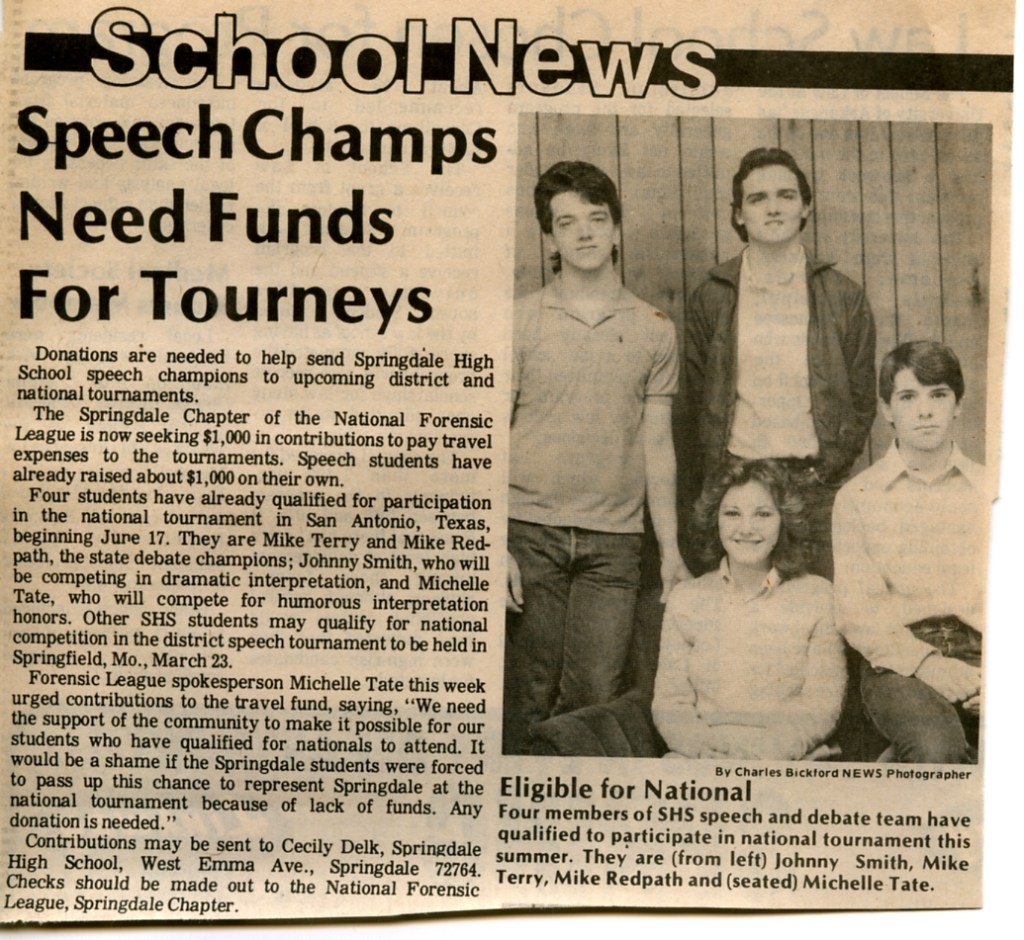
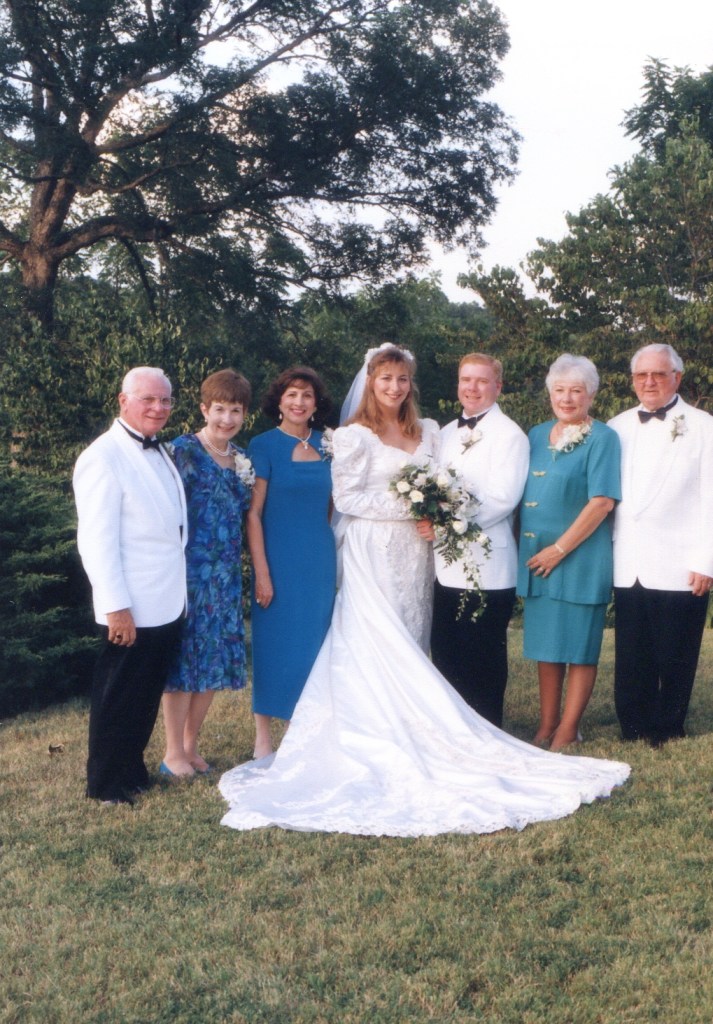
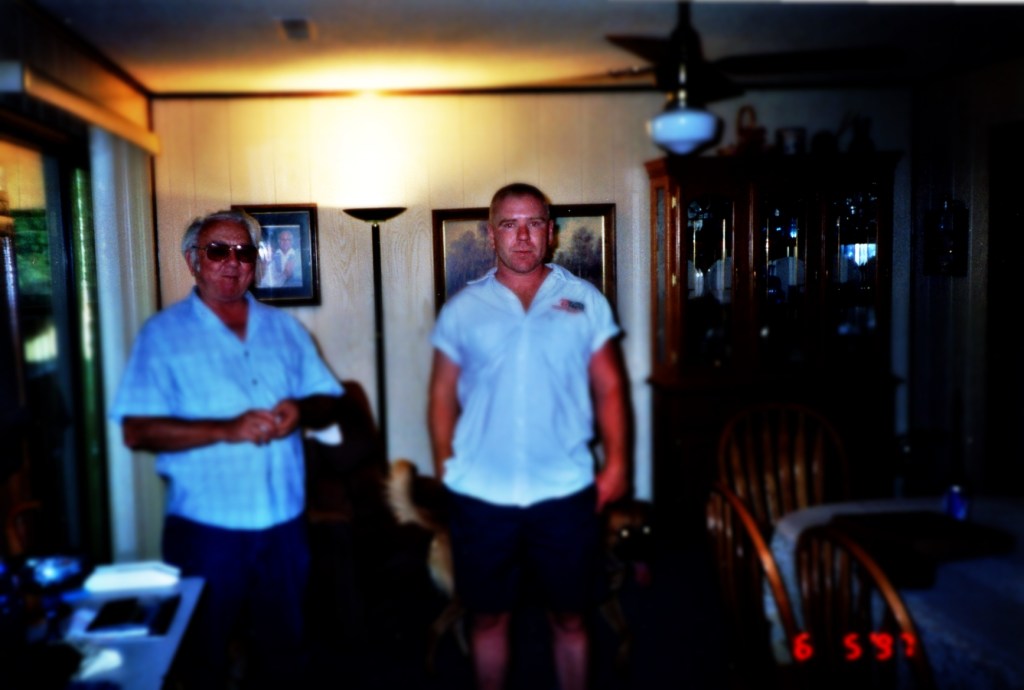
The first picture is my sister, my brother Mike, and me laying like a lump of coal. This picture was taken at Grandpa and Grandpa Cook’s house in Rich, when they lived near White Cemetery. The second was taken when we lived in Springdale for a short time.

*

My brother recently died as he neared 55. Our dad died before he turned 50.

The military was not Mike’s first, second, or third choice. But it’s the choice that got him out of Arkansas and into a career in law enforcement. Whatever else the military does, it spectacularly solves a multitude of problems when people join. It may present others, that’s true, but those are unseen and delayed when you decide to join. No matter how old we get, option fatigue is paralyzing.

Out of high school, my brother recently returned from a very brief stint at Arkansas State University. He convinced me that the military was the worst possible choice for me, even though I was being offered an incredibly cushy spot in the Army music program. As it always does, hindsight paints a panorama of choices and chances for me in the Army.

Mike then turned around unexpectedly and went directly into the Army and off to another life, leaving me with a wtf-face beyond description. He went to Germany while there were still two of them and then to Northern Illinois, where he remained.

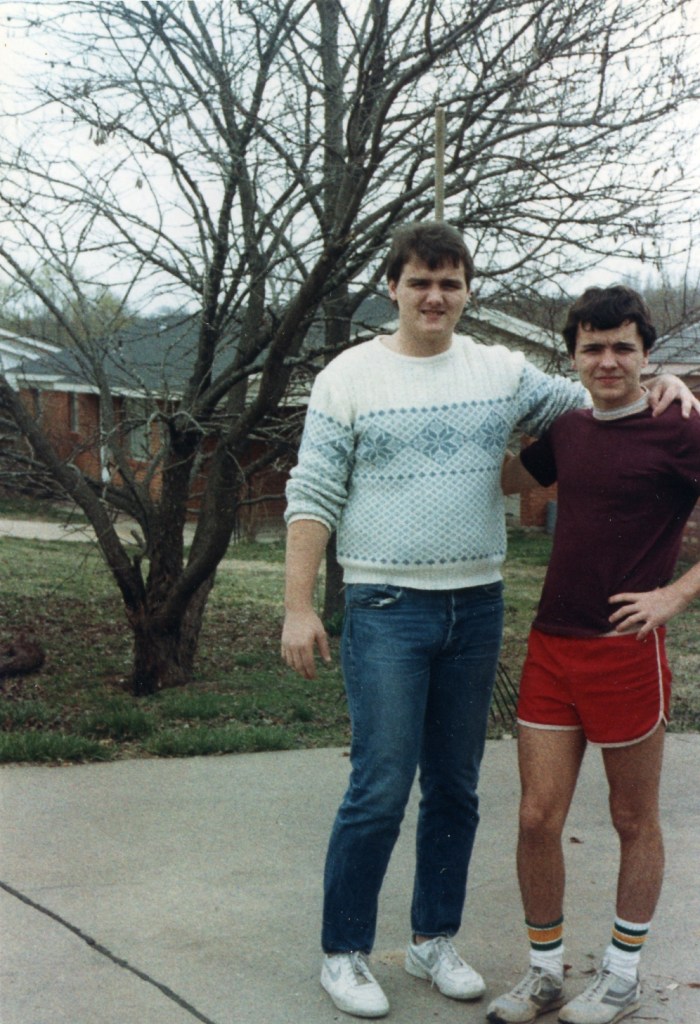
My brother with me, before he left Springdale to join the Army. We standing in the driveway at the house on Cottonwood. Many years later, I bought a house right down the street from that spot.

Over a decade later, I seriously considered the option of the military again. I had my physical and background check, and also signed up for delayed entry. He got me out of that idea, too.

Because of our upbringing, I often wonder what would have been the course of our lives if he stayed in Springdale and I had left for the Army as a musician. Would his tendency toward drinking and anger blossom so fiercely. Would mine, had I untethered from family?

In those early years, he publicly held the family honor, even as it continued to vex him. Me? I changed my name and kept my distance. Being poor helped me in this regard. Being ignorant didn’t hurt, either. Mike gave me a lot of grief for my dislike for most of the family’s ideas of politics and how to behave. In my defense and as I increasingly learned, racism often disguised itself as politics. In part because he was the big brother and in part because he thought he was indeed the authority, he fought and lectured me to stop sharing family secrets. I often called him Mike O’Reilly, even though he wanted to break my fingers for it. As time passed, it became evident to anyone paying attention thought although I was the weird kid with the weirder name, I was dead on regarding our biography. Mike favored the Terry family while I loved the Cooks. Both had an equal measure of mishap and heartbreak. The Terry family just had a bigger rug they used to sweep everything under.

As late as last year, I was still uncovering skeletons from our family. People make movies and write books about such strangeness. Had I followed Mike’s insistence to let it go, I would have never picked up genealogy or pursued DNA trails.

Who we once were does not determine who we will be; however, its aim is so undeniably true that those who manage to escape their fate are miracles at work. A lot of smart people know their arcs. Few see themselves in the shadow of their choices. I’m often as guilty as anyone. I’ve never doubted that I inherited the infection of whatever ails my family. I’ve felt its breath to varying degrees for my entire adult life.

Mike was smarter than me. It’s unquestionable. There must be some magical sliding scale and accounting that would prioritize other things over intelligence. I would have cashed in a bucket of compassion and a dose of deafness for a lower IQ. When you are as under-prepared for adult life as we were, it is folly to follow our trajectories and assume success.

Somewhere in those years, that shared biography and its litany of grievances overtook my brother. While I arced into a middle-aged life, he let his guard down to how human he was and how inescapable the dungeon of the lesser can be to us.

While I was still talking to him at length, I asked him at least fifty times to take his time and energy and sit and write his stories. He loved to read and had lived a life stuffed with unusual characters. He told several book that he was excited about the book I was going to write. He didn’t take me up on my enthusiasm. So many stories passed with him.

No matter what anyone else said or will say, one of the things I consider a gift is to often recognize the universality of a good story. Mike had many of them. As I’ve often echoed about my youth, though Mike and I often were at odds, I’d be the first to line up to read a book of stories from his life, whether they were darkly shadowed or humorous.

I’m ready to rush ahead to the magical time when our memories shift and shuffle and lose their harsh edges. Nostalgia is one of those things that’s hard to define yet bangs a gong in all of us.

Though my dad died over twenty-seven years ago, I’m still pondering his choices, his secrets, and his pathology. I still find new revelations.


I suspect it will be the same with my brother.

We fought bitterly a few times in my life. As hard as it was for him to understand, I usually fought for quiet.

Some will exit onto the revisionist road, believing that one’s life and echoes end with death and that those who remain can change the stories of a person’s life. Others will individually have their own stories to tell and questions to ask. It is our way as human beings.

As for me, all judgement laid to rest, all I see is a reservoir of memories and stories. Whether they are told or not is not a valid question. They’ll be told, whether in whispers or shouts.

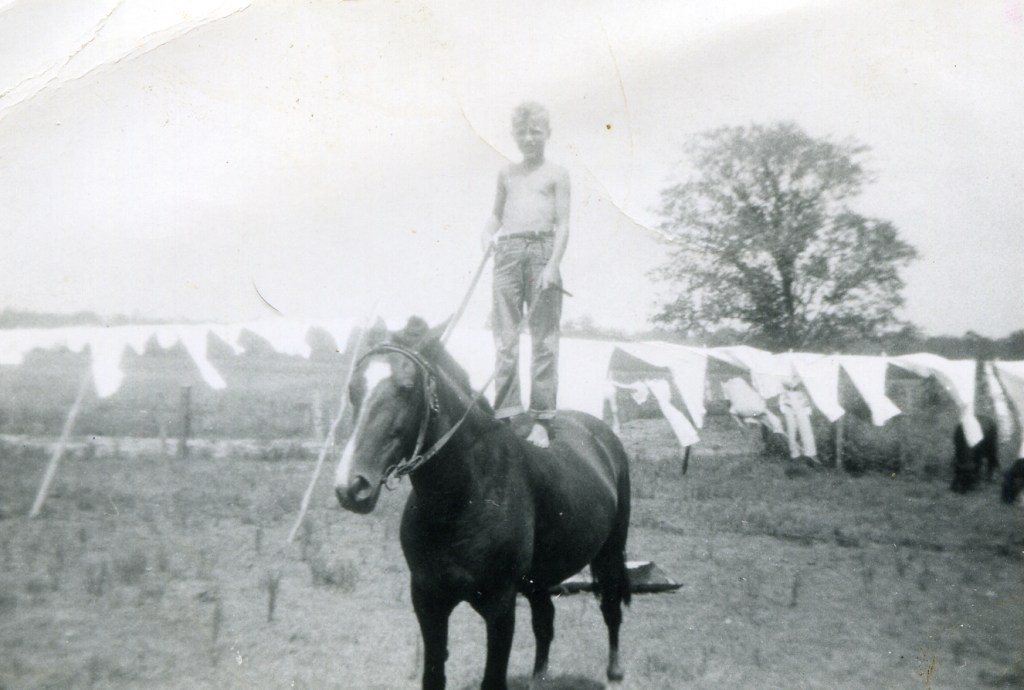
My dad, standing on a horse. Mike liked this picture.
My brother, with mom when she was Budweiser happy, in Aunt Ardith’s back yard.
Me, Mike, cousin Ricky, cousin Jimmy.
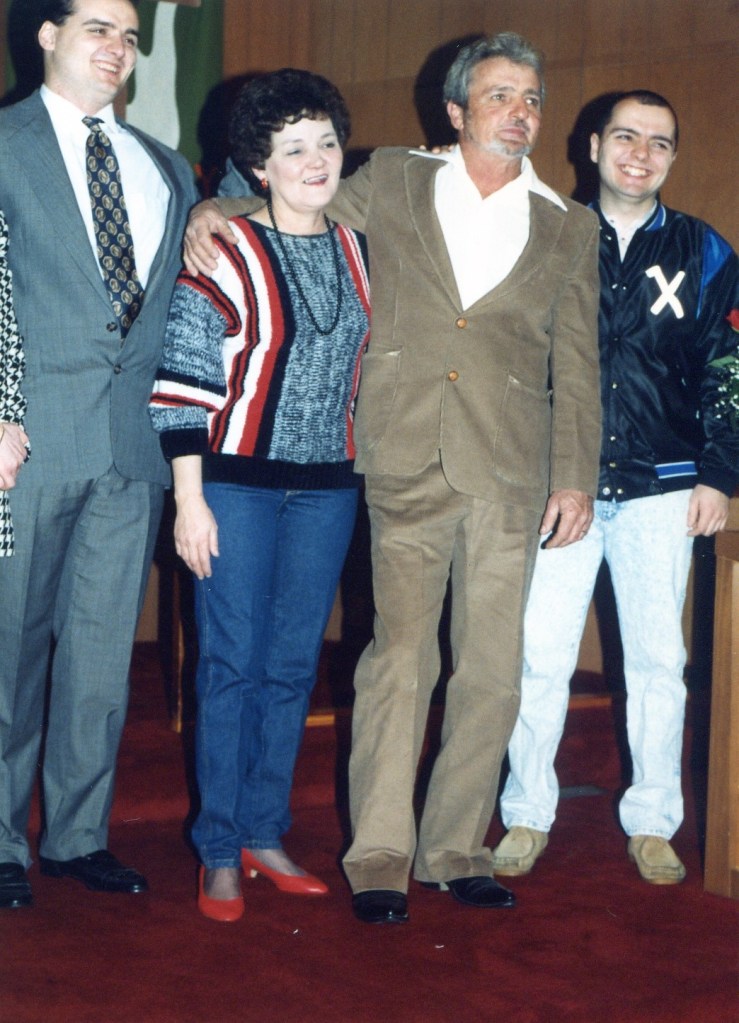
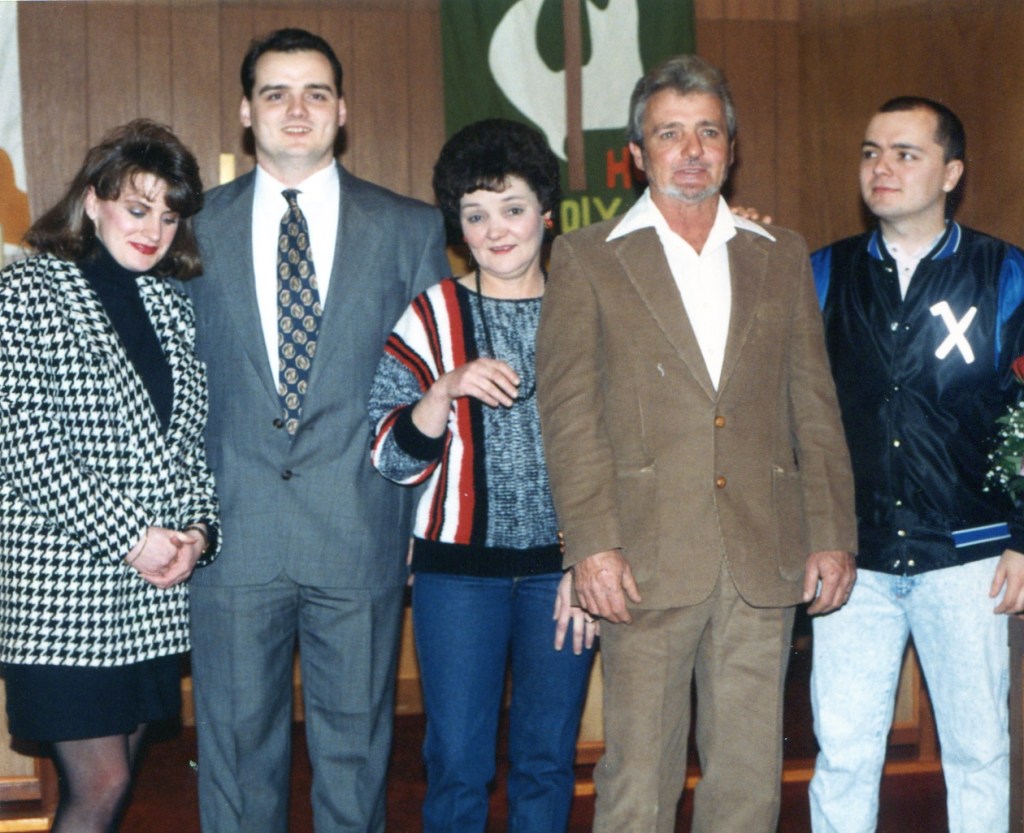
Mike, mom, dad, me. We were at Lutheran Church in Rich, near Brinkley – at mom and dad’s second wedding.
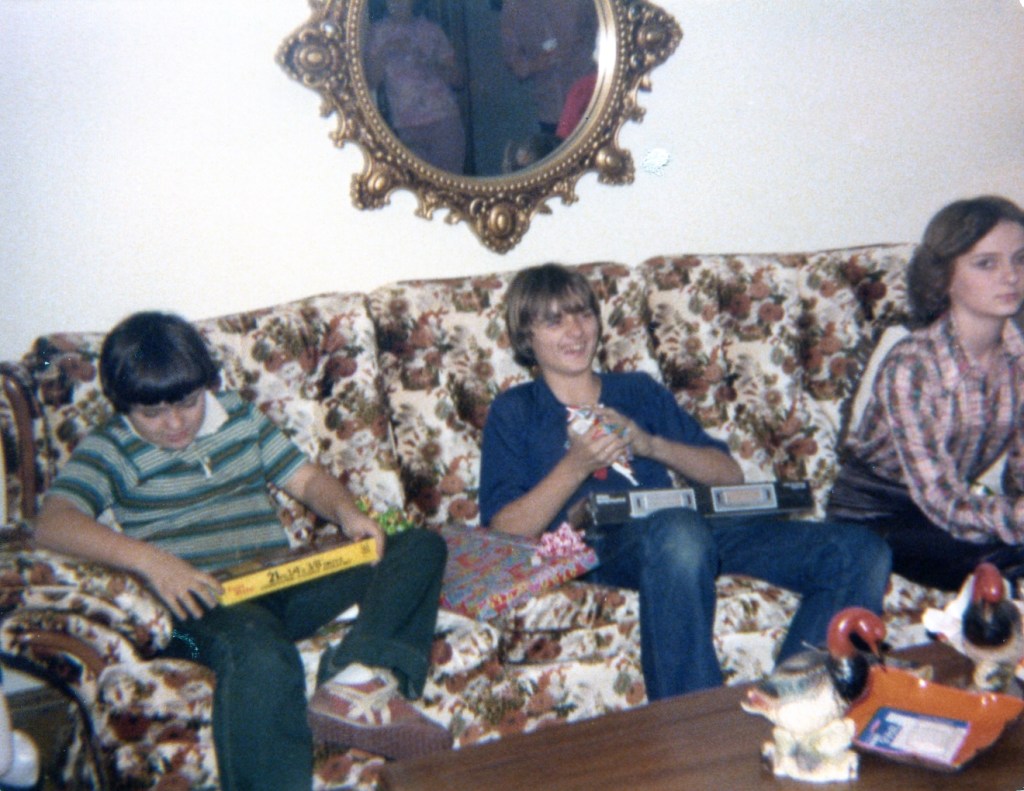
Me, with siblings, at Xmas at Aunt Ardith’s house.

They Could Have Called Me “The Streak”

Jimmy isn’t the one in the long dress. He’s the one wearing a white jacket, wondering what he’d got himself into.

One of my regrets is that I didn’t streak naked around Thorncrown Chapel in Eureka Springs during my cousin Jimmy’s first wedding. His first wedding was in August of 1995 to a woman named Lona Heckle. In 1995, I still had the body to allow me to run fast – and, if caught, not feel too badly about my picture being on the nightly news after my arrest for streaking. Camcorders were common but it was still possible to just be a blur on such cameras. Regular cameras were unwieldy and snapping flash pictures inside a giant glass rectangle tended to yield less-than-stellar photos.

Coincidentally, one of my other regrets is that I did not get to perform Jimmy’s other marriage shortly before his death. I overcame my inertia to become ordained due to the possibility of this marriage. I understand the particulars of why someone else was chosen but still remain a bit uneasy about it. Personally, I can’t understand why more families don’t have someone ordained so that the family member doing the ceremony will forever be part of the memory, too. After all, standing with the two people in love is the best seat in the house, so to speak.

Were Jimmy still alive, he’d join me in laughter if I told him, “Yes, I was going to perform your second marriage naked, Jimmy. No need to streak if I’m standing in front of everyone.”

He’s been dead for more than 7 1/2 years now, which itself seems alien to write.

I wrote much of this post a few days ago, before the other shoe fell and my brother died. I don’t recall why Mike wasn’t at Jimmy’s wedding. Fittingly enough, Jimmy and I didn’t make the trip up to the Chicago Metro area to attend my brother’s wedding. Our excuse wasn’t personal; we were both just young, poor, and unaware that we could reach out and find a way to get there.

My cousin was a bit crazy himself. He was prone to get whiskey courage and do some outrageous things. We inherited the tendency from our ancestors.

For whatever reason, Jimmy was very nervous about the wedding itself. All the family he’d ever known was attending. When I first started teasing Jimmy about potentially streaking during his wedding, he laughed and said, “You’ll never do it. You’ll say you will but you don’t have your dad’s crazy streak.” So I told him, “Exactly. NOT having it gives me the courage to do it precisely because no one will expect it.” As the days passed, I could tell I had got into his head.

For those unfamiliar with the Thorncrown Chapel, it’s made of glass and steel and sits in the middle of an expanse of trees and forest. I’ve witnessed people become overwhelmed by emotion while sitting inside. If you’ve ever had the pleasure of being inside during heavy snow or while the sun is beaming through at an oblique angle, you undoubtedly can imagine it again.

Now add the idea of me running around the place naked with dozens of horrified onlookers trapped on the inside watching me do it.

I made the short video cut of Jimmy standing at the altar. It captures his unease at being the center of attention and spectacle. I took it from a VHS tape I had digitized several years ago. It was one of my few chances to be able to see videos and images from lives overlapping mine. Much of the bulk of such photography was lost to me due to the odd lack of sharing many of the family members seemed to inherit.

And because it’s one of the few relics of me on video, here’s a short one of me the day of Jimmy’s wedding. We were milling around outside the motel waiting for the hurry-and-wait part of the afternoon to commence.

*

*

*

I wanted to post this picture of Jimmy and Lona a couple of years after they were married. I mean no disrespect but I always remember wrong how long they were married.

Cursejoy

Reaching the age when you are looking through old photos and realizing that you are the only one in the picture still alive.

It truly comes for us all.

Because I’ve maintained my ancestry account for so long, I’ve had at least 20 instances where I realized that I needed to update someone’s life by posting their death. For several, I’ve not only been the first to do so, but the only one. In time, others often see a death marked with a ‘hint’ on their trees and borrow my initiative. I try to gather the enthusiasm as soon as possible to post all the pictures I have of the person who has died. I find it increasingly hard to imagine hoarding pictures from posterity; while I might possess a picture, I’m merely its custodian.

I can imagine what Paul Edgecombe from “The Green Mile” felt when he was cursed with long life. Part of the arrangement was that he had no choice but to witness the passing of everyone who shared his life. While I’m in my early 50s, I can feel the pain of someone who reaches 80.

Getting older presents us with more opportunities to hold the disparate ideas of bittersweet and melancholy simultaneously.

Because I love pictures and genealogy, the two hobbies often coalesce and focus my attention to the passing of people – as well as the infrequent but inescapable realization that the deaths accumulate behind me.

Cursejoy.

Granddaddy Lun

A wise woman once told me anyone can be a father, but it takes someone special to be a daddy.

She spoke from experience having been raised from the age of three by a man who wasn’t her biological father but who loved her as if she were his own.

He was a man of the land; a farmer who sweated in the cotton fields of Monroe county and hunted in the area’s woods. He took his family to live for a time in California during the Depression where he worked as a carpenter and where one of his children was born before the family returned to its roots in the soil of the Arkansas Delta.

Before that, he had a wife and  children he loved. When the youngest of them was still a baby, his wife became ill, and the family needed help. A young woman needing work came to the house each day to care for the younger children, cook, clean, and tend chickens while the man worked the fields and cared for his wife. Tuberculosis was common in those days, and it robbed many families of their loved ones. With her passing, the man was left a widower with children. He and the family still needed the young woman’s help, and, to keep things “proper,” they wed so she and her small daughter could move into the house full time. What surely began as a marriage of necessity turned to a marriage where love lived and grew, and they added four more children to the family. The number of grandchildren grew, too, over the years.

For many of them, memories of him included how he rolled his own cigarettes—carefully pulling a thin cigarette paper from its packet and holding it between several fingers of one hand while tapping tobacco from a Prince Albert can with the other. He then rolled the paper, licked to seal it, and twisted the ends. If asked, he allowed whichever grandchild had climbed into his lap to watch the fascinating process lick the paper for him. It was a thrill beyond thrills, and only a granddaddy wouldn’t mind a child’s spit on his cigarette. He loved his grandchildren, and the honest summary of their high energy visits was a simple “I love to see them come, and I love to see them go,” as he smiled.

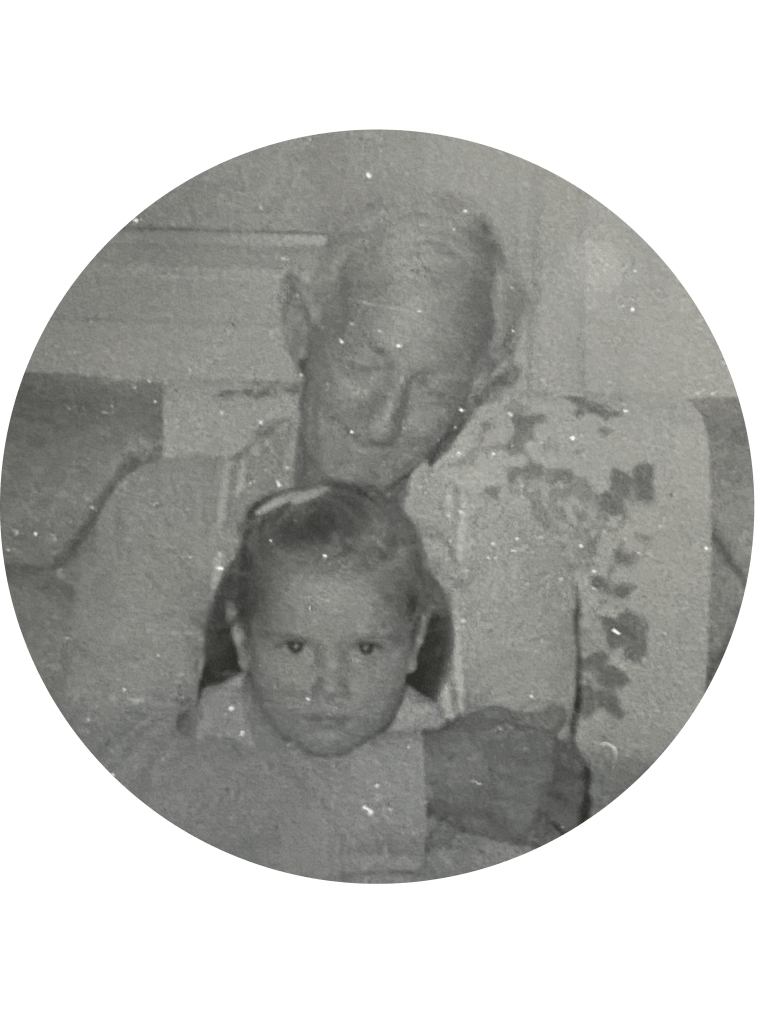
He was a quiet man, but his eyes and facial expressions spoke volumes. You can take my word for it, or you can look at his expression in this photo—the first photo taken by my sister on her first camera. Its value can’t be determined by a number for it is priceless to me as it is the only known photo to exist of this elderly man and young child, and he only lived a few years longer after it was taken.

Most folks called him Lawrence; his wife called him Lun. Turns out the wise woman mentioned at the beginning of this memory was right. Anyone can be a father or grandfather, but it took someone special to be the man I call Granddaddy.

A Girl Called Incident

I know most of you know that a lot of people reach out to me and share personal stories. Most of them who do so respond to my fling-it-to-the-wall method of personal sharing, I’ve yet to find a single person who doesn’t have a couple of jaw-dropping stories.

In the last year, I would say the strangest and most incredible story someone shared with me was the one shared by a woman about her sister, thought to have died during birth – but was actually stolen by a doctor here in Northwest Arkansas and given to a well-to-do family.

A while back, I wrote a post about not using a clothes iron. (I also don’t own anything that requires dry cleaning, either.) It was a little piece of fun writing. Shortly after, I received a note from someone who told me an interesting story. As with the baby-stealing doctor, I was fascinated but was held to secrecy regarding the people involved. She told me she couldn’t think about irons of any kind without thinking about her grandmother.

Here it is, with some redaction:

My grandmother was born dirt-poor. She didn’t really know what her birthday was because she was born between fields. Her great-aunt told her she was born in 1912. She remembered it was the year that Wilson won the presidency and that it was a leap year. The leap year fact stuck in her head because her uncles kept joking that they had been given an extra day to work. Everyone in her family worked the fields and farms, no matter how old they were. Until WWI, they barely survived. My grandmother Edna remembered her father going to serve along with his two brothers. Only one brother returned alive. His name was Henry, and he was an alcoholic and a violent man. Even though Edna was only 8 or 9, she knew she had to hide from Henry when he was drunk. Her mom Ethel married Henry to survive. Four children were too many to care for.

When she was 12, Edna was working as an adult woman. She spent her days cooking, cleaning, doing laundry, and working in the fields. Her other sister worked with her and neither went to school past the 4th grade. After a late-night of drinking, Henry came home and grabbed Edna. He later claimed he didn’t know it was Edna rather than Ethel. Edna fought and clawed until Henry collapsed on the floor. He broke several of her fingers during the fight. Her mom fixed her fingers on the back porch but offered no consolation or words of compassion for her daughter. Years later, she found out that her mom had been abused by someone for several years. The fact melted her heart and turned most of her anger to bittersweet understanding.

Weeks later, Edna hatched a plan to get rid of Henry. She stoked the stove in the living room with more firewood late in the evening instead of letting it burn down to ashes. She put one of the fire-irons into the red coals and closed the stove door as much as possible. After all the lanterns were extinguished in the two rooms used for sleeping, she lay awake, waiting. Before too long, she could hear Henry’s raucous snoring from the room next to hers and her siblings. She climbed from the sunken bed and walked across the freezing-cold floorboards of the cheaply-constructed shotgun house. She searched in the dark for the clothes she’d arranged under the dresser, tucked out of sight. All the doors creaked like the floor as she passed through.

As she entered the living room, she listened to the crack of the stove and the wind-up clock behind her.

Before losing her nerve, she used three rags to pull the red-hot fire-iron from the stove. Walking quickly, she went into the room where Henry and her mom Ethel slept. Henry’s snoring told her he was asleep. Before she could talk herself out of it, Edna pulled back the thick covers from Henry. She put the fire-iron, tip down, across his stomach and legs, as best as she could manage in the dark. She threw the covers back on top of her stepfather. In a few seconds, the snoring stopped, and then a loud scream erupted from Henry. She couldn’t see him grab the iron, but he screamed again, probably as he grabbed the brutally hot iron with a bare hand. A loud thud hit the wood floor. Her mom Ethel began to shout, asking what was wrong. Back in those days, the bedrooms didn’t have light bulbs, or if they did, they were a single hanging bulb awkwardly danging in the middle of the room in shotgun houses. You had to get up and relight the lantern. Her mom, still hollering, shuffled around and struggled to light one of the long matches next to the oil lantern on the table across from the bed. She managed to light the lantern and turn the wick up. As she turned to see what had happened, she saw her daughter Edna standing by the door with her hand over her mouth. Henry was gasping and clawing at his stomach and lower half. The iron had burned away his underclothes from just below his belly button to his upper right leg. Edna had misjudged the iron a little bit; otherwise, Henry would have been reminded of her each time he went to the bathroom. He looked as if he’d been burned by an absurd branding iron.

As Edna looked at Henry writhing in pain, she knew he’d never abuse anyone again. She also knew she couldn’t stay. She ran out of the house into the cold night. She didn’t go back. A second cousin offered to let her stay with her if she agreed to work with her at the store she and her husband owned a town over.

The sheriff visited Edna a few days after she moved. “Henry isn’t pressing charges. What did he do to you to make you do that to him?” The sheriff seemed as if he suspected. “What did he tell you?” Edna asked.

“He didn’t say much, other than he didn’t ever want to see you again.” The sheriff shook his head and left. “I expect you won’t be causing any more trouble, will you?” Edna shook her head “no.”

Edna’s new family immediately started referring to the incident as “the incident.” Before long, they jokingly referred to her by the nickname “Incident.” A few months later, Edna’s sister moved to live with her. Both sisters were adopted in the family and started attending school again. Though they didn’t go to court, as people often didn’t do in those days, they changed their names to honor their new family.

Both sisters became teachers and lived their lives without further felonious undertakings.

The woman who wrote me told me she discovered the story after doing a DNA test. Luckily for her, some of the surviving family shared all their stories with her, several of which she’s written for everyone to share.

*

As with the stolen baby story that happened here in Arkansas, the fascinating details aren’t mine to share. If it were my story, I would proudly tell it as a story of a woman who figured out that sometimes fire is a better solution than words or hope.

Screen Door To The World

7777777777777777777

*Guest post…

“Hurry up and close the screen door! You’re letting flies in!” If I heard that phrase yelled at one of us kids once, I heard it, by conservative count, at least 32,760 times in my life. If the phrase had to be said more than once, the lollygagger was likely to be threatened with being locked out for a while; a punishment my brother figured out could be short-circuited by popping the door right where the hook went through the eye sending the hook flying up and over to dangle uselessly.


Keeping the screen door closed was important. We lived behind a grocery store in a small town. Its dumpster was straight across the street from our driveway and the screen door. My mother hated having the back of that store as the view from her kitchen window. In fact, she hated everything about that store.


Store employees and management dumped all kinds of expired food, including meat, in that dumpster. In the winter, it wasn’t so bad. But in the hot summertime, it became unbearable. The stench from rotting meat, produce, and milk could almost gag the maggots that formed on it. It was a common sight to see my mother marching across the street and pouring a jug of bleach all over the bin’s contents. She had talked to management time and again simply asking that they not throw away raw food items until the night before or the morning of the sanitation truck’s arrival. Sometimes, they would do as she asked. More often, they didn’t. As a result, they lost all of our business, as my mother began driving across town to the Kroger store near the interstate. The amount spent by my mother on groceries each week was substantial as she fed our family of five (including a male teenager who could pack away a lot of food easily).


Apparently, my mother’s example taught me as a child that not being able to beat them didn’t mean you had to join them. To this day, I will boycott a business in a heartbeat based on principle alone.


Aside from the smell in the summer, having a grocery store as a neighbor wasn’t so bad for us kids in the neighborhood. Really, it couldn’t get much better if you could scrape together enough change to buy a fudgsicle or a tiny container of ice cream with its own wooden spoon attached. If that much money couldn’t be found or begged from an adult, sometimes we had enough for a pack of candy cigarettes or a package of wax paper wrapped Now and Later candy (as if any of it was ever left for later).


Sometimes when money was scarce but supplies were available, we got our parents’ permission to make lemonade and sell it in the parking lot to earn candy money. Yep, for a kid, the positives of the store outweighed the negatives by far.


My mother rejoiced the day the grocery store’s owner closed the store. It stayed vacant for a while but eventually was converted into a maintenance shop and parking area for the school district’s buses. Life became a lot more peaceful – especially on the weekends when the shop sat empty waiting for school again on Monday.


Several decades have passed since then. The shop remains though the school district is shrinking as the town’s population shrinks. The house, however, now sits empty, its latest occupant having deserted it for reasons unknown to me. The kitchen windows stare blankly – one window partially broken.


It’s not much to look at, that house, but on the rare occasion I do, I can still hear “Hurry up and close the screen door! You’re letting flies in!” And I smile.

The Whisper Of The Night Train

night-2469408_1920

It’s 1:19 in the morning; another sleepless night as Lonely drops in for an unwelcome visit. Lonely doesn’t care if you’re by yourself or with others. It simply shows up when it pleases. As I attempt to put Lonely and the other things bothering me out of mind, I take a deep breath and release it slowly. Then, like a small gift from above, a train whistle sounds in the distance. As it draws closer, it transports me to a place in the past — a place where I can feel the subtle rumble and shake of the train’s cars as they rock to the wheels on the rails.

My sister and I shared a room until I was 10, when she moved out. She was 19 and had never had a room to herself. Nor would she in the foreseeable future. She was getting married. For me, a lot of excitement surrounded her wedding-especially since I was to be the only attendant. She would be a beautiful bride, and I would get to wear a pretty dress and hold a bouquet of lovely flowers.

Excitement surrounded her move too because she would be moving into a house she could decorate and set up completely as she chose. This was going to be fun to watch! Then, it hit me – I was going to have my own room for the first time ever! Wow! Things became more exciting each day!

The wedding day passed in a blur, but the bride was indeed beautiful, and I did wear a pretty dress while standing next to this young woman who was part big sister, part mother to me.

Later that evening, I went to my bedroom excited at the thought of having it to myself. As life often shows us, things aren’t usually what we think they will be. The room felt empty and sad. I had rarely spent a night without my sister, and now I was facing endless days and nights without her. She was the one who held and rocked me when I had a bad dream, she participated in my sleep talking to soothe me back to sleep; she even allowed me to warm my cold feet on her legs when winter nights were icy.

Facing that first night without her was lonely and more than a little scary. As I lay in what suddenly felt like a huge, empty bed, my fear of what might lurk in the dark grew until I wanted to scream for my mother. Knowing she was asleep and would not appreciate a screaming kid disrupting her rest kept me silent.

Just as the fear became completely paralyzing, I heard it. It was faint in the distance, but it was there, and it was coming closer. The evening train was rolling through town. We lived close to the tracks, and, as it approached, the sound of the wheels hugging the rails and the sound of swaying rail cars grew louder until the train was right there – practically outside the window. I could feel the vibrations from the floor up, and it was comforting. For a few minutes, I was conscious of the fact that I wasn’t the only one awake in the world, and relief washed over me. I relaxed and focused on the train’s every sound and movement and drifted off to sleep as the train finished passing the house.

The nightly train became a trusted and reliable friend. I counted on it each night to lull me to sleep and, later, when fears and worries woke me in the early hours, I found that another train would come through and provide that distinctive rhythm that told me everything was on schedule and okay.

.

.

.

P.S. This is a guest post written by a reluctant writer, counted among my favorite people.


Two Gloves For Rosen

sdffdf

As I neared the last corner on the way home, I saw my Marshallese neighbor in the lateral sideyard playing ball with his son. They were using a tennis ball and running across the yard, laughing. Unlike some of the neighbors, they were careful. It was a great late morning for such games, with a temperature in the upper 70s, a light breeze washing over them, and a sun uncharacteristically cool.

Seeing them frolic made me realize that I found a home for another of my keepsakes.

I drove past the few remaining houses to mine and parked in the driveway. I backed my wife’s car out of the garage and then used the drop-down attic staircase to go up. I shifted the bins around until I found the one with my two baseball gloves and a special baseball. A few years ago, I reconditioned both gloves and sealed them. It surprised me that I had not found a good home for the gloves before today.

When I was younger, I learned to catch using whatever glove was available. For most lefties like me, especially poor ones, I either used my bare hands or learned to rapidly remove my glove and throw the ball. The positive result of this was that I could catch perfectly well with either hand and bat right-handed.

Until today, I’ve waited to find a new home for my gloves. I didn’t want to give them to someone who wouldn’t appreciate them. Having them unused in the attic bothered me a bit, though. I’m violently opposed to owning such things without using them. Gloves are meant to be used. As terrible as a sports fan that I am, the simplicity of playing catch, hotbox, or hitting balls in the summer sun is something that I loved doing when I was young. Like most boys, I participated in versions of baseball anywhere that we could manage, from dormant municipal baseball fields to cow patches where large apartments now tower above the land.

I walked down to the corner. Rosen, the younger Marshallese owner of the house, walked up to meet me. His young son stood on the lawn, wondering what I was up to. Another smaller boy sat on the chair under the small covered porch on the front of the house.

“Hey, do you remember me? I’m the one who gave you the weedeater and spoke Spanish to you?”

Rosen nodded yes, and then said, “I know you have a strange name, but I can’t remember what it is.”

I showed him my work badge and told him, “X.” Seeing it written out sometimes gives people the right context to understand what I’m saying.

“Rosen, I want you to have my gloves. One if for lefties, and the other is for those who use the wrong hand to catch. And the baseball is a special one I’ve kept for many years. I want you to keep them and enjoy them.” The look on Rosen’s face told me that I had once again surprised him. When I moved to the new house a few years ago, I walked down and gave him a new weedeater. He was shocked then and surprised now.

“Wow, thanks X. We’ll definitely go to a ball field and play. We’ll use the tennis ball right now.”

I laughed. “Okay, but if you really want to repay me, you’ll break out a couple of windows of that neighbor’s house.” I turned and pointed to a house across the street, a house that is well on its way to becoming a version of Boo Radley’s house.

The residents of that infamous house are using every page of the ‘Asshole Neighbor’s Playbook.’ If the human underarm could become a house, it would be that one.

Rosen laughed, too.

He might not know the significance of that ball or what it meant to me, but if he uses it even for a single shared afternoon with his son, the honor will have been paid in equal measure.

I walked away and heard one of the boys say, “Dad, who was that nice man?”

I smiled, wondering what ripple effects I had unknowingly set in motion by my gift.