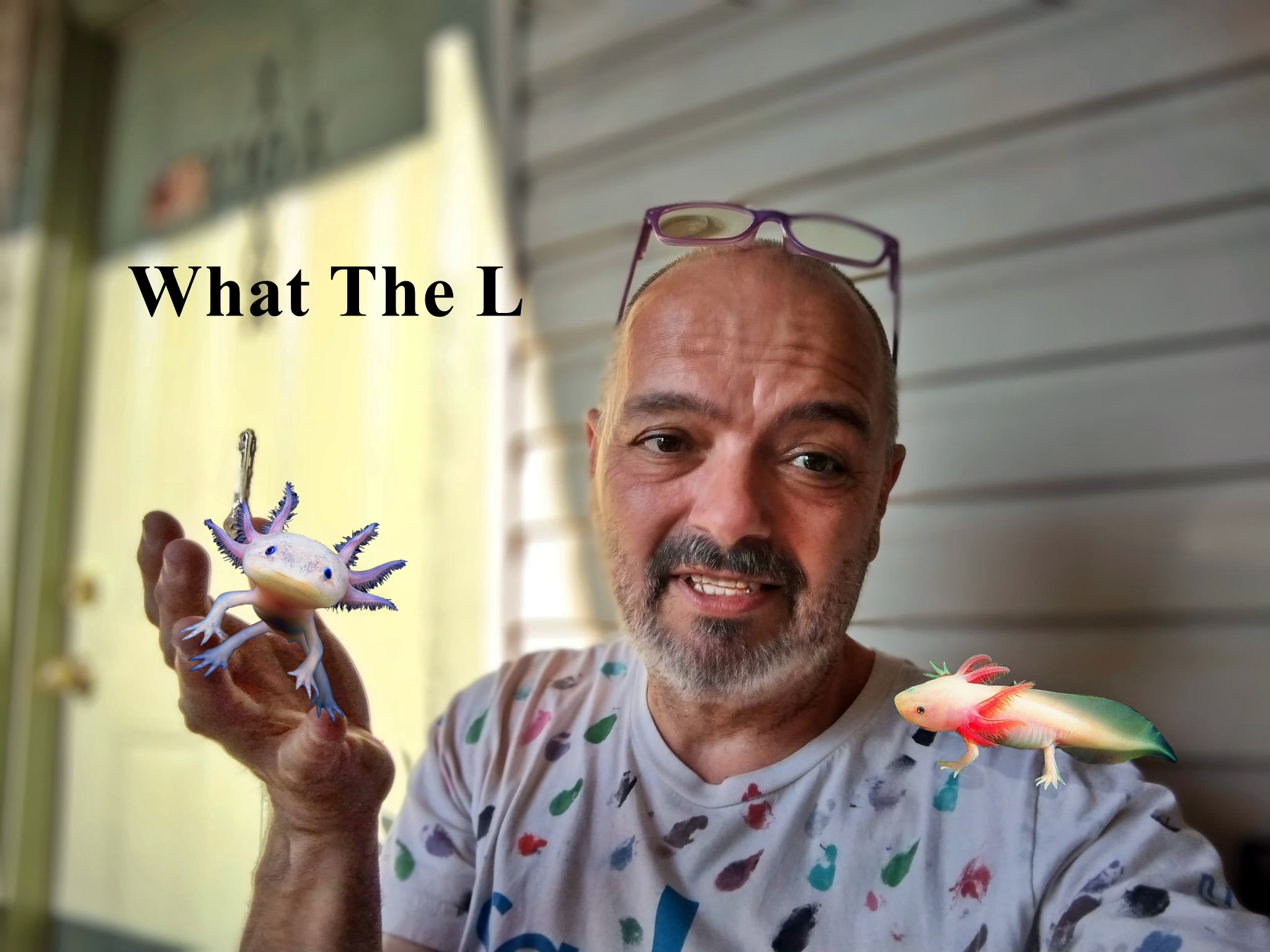
People aren’t familiar with axolotls. (Unless they do a lot of hallucinogens.) They’ve probably seen Pokémons based on axolotls or salamanders. It’s a beautiful creature native to a couple of lakes in Mexico. They have no eyelids, are deaf, and don’t undergo metamorphosis like their salamander counterparts. (Much like incels. PS The word “incel” is a portmanteau of “involuntarily celibate.”) Axolots can be induced to replace their gills with lungs and become land creatures. They also are intensely studied because they can regenerate literally any body part.
The word axolotl is derived from the Nahuatl language. I find this fascinating because it’s the perfect example of people arguing about how to say the word “axolotl.” Most people say “AK-suh-laa-tul.” But that’s not actually how you pronounce the word if you’re saying it like a native. It’s supposed to be more or less pronounced “ah-sho-lote.”
The Nahuatl language considers the “tl” as an odd single sound that’s not comfortable for English speakers. Much like any polysyllabic word for that matter – such as “compassion.”
As for me, I’m not concerned with pronunciation. It’s just another branch of the pointless navel-gazing about language that frustrates me. Language is not static, everyone has their own set of rules about spelling and pronunciation, and it’s idiotic to me to worry needlessly about it. I LOVE it when people mispronounce words, especially when it results in the purists shrieking and running from the room with their armpit hair on fire.
More often than not, the grammar police and purists are wrong anyway.
It’s no comfort to know this, but if people work to keep you silent, they inadvertently tell you that you have power. Silencing you is an attempt to avoid the consequences of mistreating you or confronting that you’re right about something. (It’s the same in relationships as it is at work.) People without valid points or influence are ignored. People who tell the truth or cause discomfort upset the status quo. Again, it is no consolation. But remember that silencing treatment is a de facto acknowledgment that you’re on the right track. Everything sounds crazy until it becomes the truth. We do not celebrate the people who make us uncomfortable. About our behavior as individuals and certainly not as a group.
While my thoughts aren’t about book banning, the same concept applies. People with the urge to limit content, ideas, and information are admitting that they are afraid of what’s inside. You don’t ban things or ideas that don’t threaten your opinion. It’s usually a nod to the fact that they fully know that much of their opinions and worldview aren’t sustainable under the lens of logic.
No one likes to be wrong.
No one likes having to confront their mistakes.
No one likes being judged for the associations we have: friends, religions, politics, sports, work.
Looking at where we are as people and our lack of focus as a society, the last thing we need is for the outliers to stop pushing our buttons. A therapist once told me that the more we stop hearing criticism, the more in danger we are of being cemented in the past and of playing it safe.
Silencing behavior is the cousin to secrecy. Almost all misbehavior and turmoil derive from secrecy and the lack of transparency. Whether it’s us as a whole or each of us as individuals.
PS I wish it were okay to say, “I think you’re wrong,” without starting a fight. Because we damn well think our friends, family, and coworkers are wrong a LOT. Why isn’t it okay to just admit it? And why can’t we accept this sort of observation for what it is: someone’s opinion. We take everything personally as if we’re surprised that people haven’t had the same lives as us, the same education, the same religion, or the same interpersonal relationships.
Someone noted that one reason they love theaters is that it’s about the only place left where phone usage is unwelcome. Everyone is expected to relax and enjoy the experience. Violating the usage expectation results in interference with other people being able to enjoy their experience. Irritation at those who ignore the expectation is universal. There are so many other circumstances in which the ubiquitous nature of phones interferes with the simple act of presence or attentive listening. You’re not checking your phone; it’s checking you. The nostalgia for days gone by results from people realizing that lack of constant access to the world meant that you were in the moment with the people and places you chose to be with. Yet, here we are. We’ve normalized interruption. A smart person pointed out that it’s one thing to want things and another to need them. Like all technology, its existence was supposed to make our lives easier, more efficient, and less stressful. Yet, it’s obvious that the opposite is the case for a lot of people. We are technology addicts. If you don’t believe it, try laying it down for four hours. You’ll react with the “…but what if…” argument. It will overwhelm you. I watch so many people let work slide into off-hours thanks to phones. “Let me take a quick look at…” becomes the preface poetry of the modern age. I love technology. And even that phones are so useful. But I can’t help but contemplate the fact that so many people seem to allow their phones to be their master. Love, X
The original picture is from Six Feet Under, one of my favorite shows. Just the memory of it sharpens internal knives inside me. The series finale still resonates as the de facto best series finale ever produced.
A few years ago, I modified the picture with one additional line. It’s a reminder that if you’re invested in ‘winning’ an argument, you’re also watching your precious time race past you – along with all the other things you could be doing. Most of us don’t win arguments. Not because we’re wrong or right, but rather due to the fact that most arguments are either a matter of opinion or stubborn bias against facts or other perspectives. If people won’t listen to facts or evolving discoveries, you’re playing by a different set of rules subject to the other person’s whimsy. And if neither of you can recognize the futility of individual perspective, you might be living on another planet.
The people who intelligently challenge you are the very people you probably need the most in your life. But also the ones that you shun. Who wants to live a life of introspection and self-accountability? It would be a marathon just making it to breakfast to have a life filled with such people.
“You sit in such judgment of the world. How do you expect to ever be a part of it?” Olivier (who was one of the smartest and most irritating characters on the show).
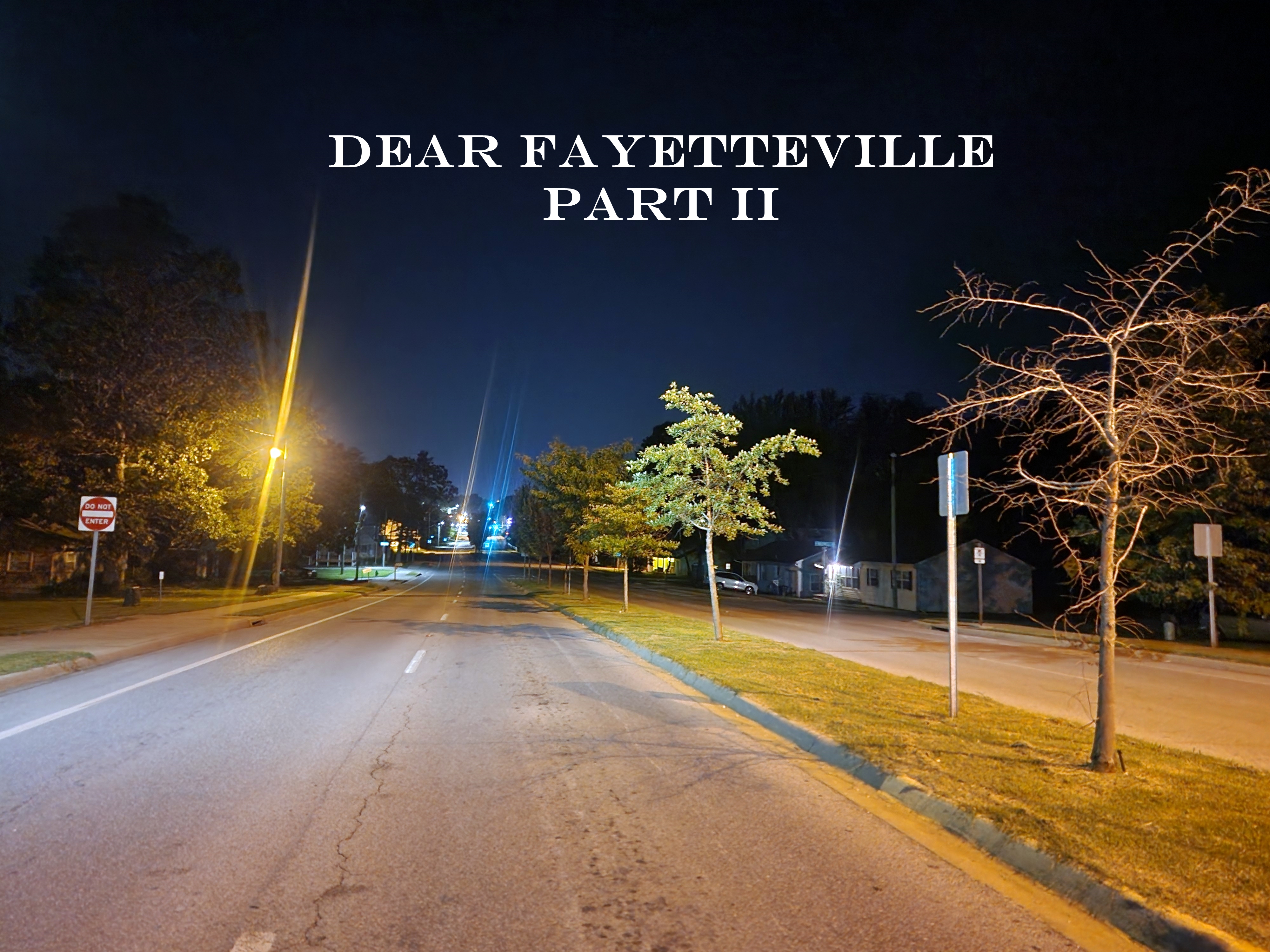
I love Fayetteville, so please take this unusual post as-is: both humor and opinion woven together like a weird rug you might find at the red flea market.
Most of you don’t experience Fayetteville like I do. It’s a markedly different place in the early morning hours before thousands of people wake up and flood the streets. The beautiful houses along Garland, the surprising pop-up new architecture that violates the normalcy of the surrounding houses. This beauty also serves to drive the cost of living higher, pushing out the people who’ve called it home. The university, downtown, and many other places resonate with simplicity and beauty. If Fayetteville had its own statue of Jesus, he’d likely be slapping himself on the forehead and peeking through fingers at the town below him, wincing at the traffic near Wedington and begging us to use our blinkers.
We will always grip the steering wheel here. The traffic is a consequence of geography and people’s desire to live here. We are not in traffic. We are traffic. We’ll always shake our heads at the scooters somehow finding a home in the branches of trees. There’ll be beer cans scattered along the sculpted buildings. But there will be food, drinks, and great times at games, the theater, and a hundred other places that make Fayetteville worthwhile. I don’t understand the mentality of people dreading the influx of students. The university is the literal backbone of everything we are. Even if it irritates the heck out of us at times.
Another university year begins. And another pointless tug of war about people being allegedly underage and wanting to drink or smoke. I can hit a baseball and within the range of that ball, there are a dozen people who will sell me anything I want. When I say anything, I mean literally anything. Drugs, alcohol, cigarettes, fake IDs, a flamethrower – and if you’re really desperate, some Texas Longhorn fan memorabilia. We’ll complain while attempting to find a parking spot anywhere on gameday or the ability to safely pull into the Chik-fil-A lot without a demolition derby incident.
There are three or four popular drinking places near where I live. I observe drinking under the influence and the other behavior that accompanies this with such frequency that it fades into the background. Many of them give me subtle hints regarding their worthiness to drive by doing unintentional donuts, driving on the sidewalk, or being on the wrong side of the road. And I’m only talking about the traffic police. My apologies to the Fayetteville Police. I’ve yet to have a questionable interaction with any of y’all. I’ll never forget the early morning when one of you pulled over while I was walking to ask me if I needed anything. We laughed and talked about the nonsense that the night inevitably brought along with it.
Nestled serenely in the epicenter of these drinking establishments is the cultural landmark Bottoms Up. Its military-grade bunker appearance is so astoundingly beautiful that its website contains no picture of the building. Each time I pass it, I pause long enough to put Visine in both eyes. Just in case.
You shouldn’t get a speeding ticket on some sections of Leverett no matter how fast you’re driving; excessive speed at some points on that street is an act of self-preservation. I didn’t mention MLK or any nearby streets because it’s an open secret that speeding is not only desirable but necessary. If you want to drive slowly, please head over to Wedington, where the traffic snarls resemble a hoarder’s attic. I also don’t want to exclude College Avenue, which seems to have more traffic lights than Grandma’s Christmas decorations.
Prohibiting sales of alcohol here on Sunday is an effective means to force people to visit Springdale on purpose when they otherwise wouldn’t. Once they visit and purchase their spirits, they can at least absolve their horrors by imbibing the very thing that caused the visit in the first place. (PS I love Springdale.)
Living in Fayetteville brings front and center the issue of age restrictions constantly and more so once the students are back. Before the inevitable comments ensue: yes, I realize that restrictions do not originate in Fayetteville. If you can vote, I still think it’s intrusive to tell these people they can’t do what they choose. If they want to drink four Bear Claws and accidentally drive a scooter into the ravine, just keep the gurneys on standby. I don’t know many older people who didn’t start as young people. Those same people creasing their brows at the indiscretions of the younger generation mostly pulled the same shenanigans themselves before civility and sanity taught them to pretend to be well-adjusted, law-abiding folk. You can’t have a university town without the secret war of youthful indiscretion. Looking at the Washington County detention roster convinces me that it’s not the students doing most of the crazy stuff.
My opinion may not be popular with the older crowd. It’s extremely easy to tell other people what to do when the restrictions don’t affect you. Hell, it’s half the reason we have so many social arguments. If you’re going to restrict it, apply the restrictions to everyone. And good luck trying to effectively spend tax dollars thwarting people’s tendencies toward vice. You’ll never see a Mafia family attempting to horn in on the lucrative knitting trade.
Our focus should not be on the consumption of such things. It should be on enrichment, education, and treatment. Anyone who thinks this is an intelligence issue hasn’t had to stick their hands in the thorns of alcoholism. Or convince someone with the munchies that they don’t NEED Taco Bell.
The underground network that informs and connects underage users comes alive again each fall. Where to go to get whatever you need. Which establishments wink and nod while they give it to you and accept your money. Which food trucks will leave you dashing madly for a secluded spot.
Of course, I’m oversimplifying. I have nuanced arguments about specific substances and laws. Doesn’t everybody? No one likes nuanced arguments. It’s why we don’t like bowties or words with needless syllables.
Let the yearly games begin.
PS I still find more beauty in the lesser-known spaces and places around town. These are difficult for visitors to find because our focus tends toward Kodak events and places. Fayetteville is a great place due to its disparate (or desperate?) mix of people and places. When the students arrive, the town is a markedly different place.
And a much more vivid place to call home because of it, in my opinion.
X
I posted this on the FB “What’s Wrong, Fayetteville” page. 99% overwhelming appreciation and the inevitable fringe of bitter people.
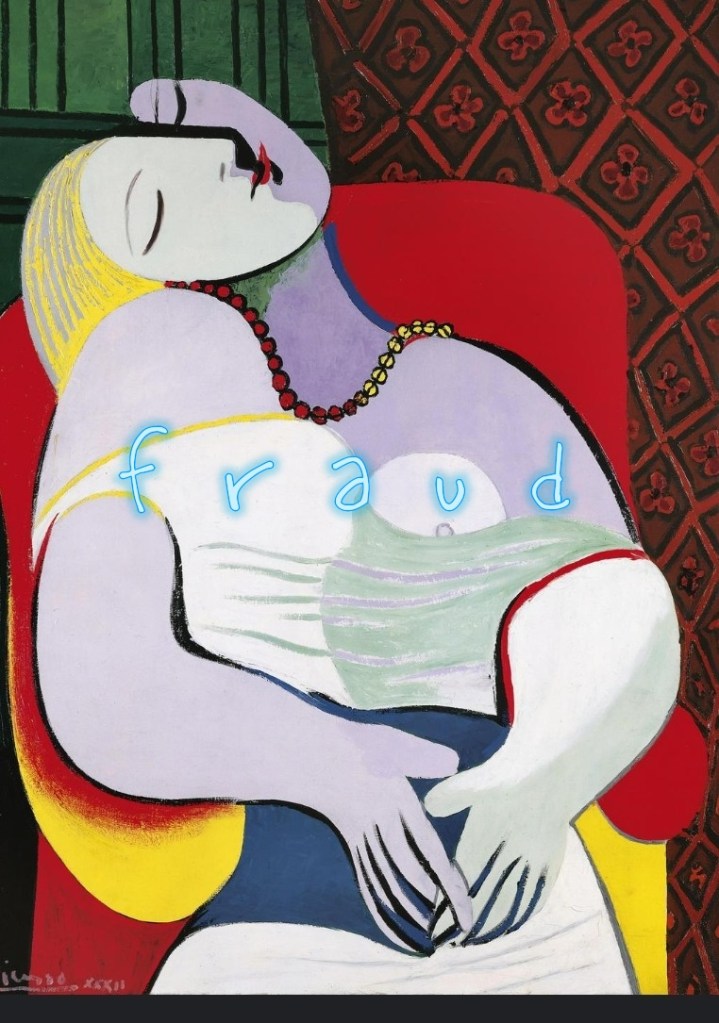
Picasso was a terrible human being. I can’t look at his paintings or consider any of his allegedly important works without thinking of all the women he destroyed. The works that made him famous and allegedly important were done by being insanely cruel to women. He became rich in the process. At least two of his lovers ended themselves. He kidnapped one, and locked many unwilling ones in his studio. As he got older they got younger and younger. At one point, he adopted a very young girl to use in his nude sketches. She was returned to the convent from where she came when he was done with her. He enjoyed prostitutes, probably because his first experience was with one. Even if you do superficial searches, you will be shocked at how much information is out there. It’s not a secret. Yet, students are shown his work, visitors see his paintings in museums, and most of them are completely unaware that they are looking at a tapestry of sexual deviancy and exploitation.
Years ago when I attended NWACC, a professor really loved a complicated thing I drew that I titled “Elvis Angel.” It was an intricate and preposterous mess but very interesting. Another student said, “It’s like Picasso with pens and pencils.” She didn’t understand when I said, “Thank you. But I don’t know if it’s monstrously sexual enough for that comparison.” The professor asked me about my comment. She was a very engaging and educated professor who enjoyed my nonsense. Even though I didn’t know a lot about Picasso at the time, I told her that he was a monster. It shocked her because despite her education, she had never heard anything like that. After our conversation, she spent time looking it up, just as she had done when I pointed out something related to employment law that she was unaware of.
Even the painting in this post seems innocuous. But if you know what it really depicts, it’s difficult to look at it in the same way. And if you know the woman’s story, the one used in the painting, you can feel nothing except disgusted and sorry that her path intersected with Picasso.
I love history and trivia. This is not one of those cases wherein people take things out of context against the backdrop of history. This is one of those cases where the behavior of the person involved would be universally reviled if it were known.
This is not a post about reality TV per se. Reality TV fascinates me; not as a watcher, but more for the process of misdirection, drama creation, and constant familiar themes to provoke an emotional or shocked reaction. When I do watch reality TV, I spend an inordinate amount of time looking up the people and places to find out what really happened and how the writers and producers repackaged it for entertainment.
Again, this post isn’t about reality TV per se. It’s about the fact that a great number of people are exactly like reality TV. They aren’t living authentically, they don’t say what’s on their mind, emotional connection feels foreign to them, and honesty tends to be in short supply. We tend to be reactionary by nature. And even with legitimate reasons to react with frustration, anger, or emotion, our tendency is to bite our natural response to whatever is happening around us. We watch one another, evaluating what’s going behind the facade. It’s why memes caution us to remember that each of us has things going on that others don’t know about.
Turn off the TV. Surprise yourself and other people. As a self-admitted hypocrite, I can write these words without feeling like a fraud. I hate the disparity between who I am and how I communicate and behave in a lot of situations. All of this artifice we build up around us is a cage. The strange thing is is that we are our own guards. The key is in our pocket.
Dashiki shirts have a lot of history and symbolism. I realized that my new scrub tops were very similar to the style and cut of these shirts. So I got a colorful one. Of course. It’s extremely comfortable. I’m wondering why we don’t wear this type of garment way more often.
Since it is a cultural item, I will studiously avoid driving inside any small municipality around here. I won’t mention any of them by name.
Listen… People keep begging me to share more of my great ideas. And to use a LOT more words doing so. They complain that I keep things too short. And I think this is a really good one!
For comedy clubs, after the MC comes out and tells stale jokes laden with false enthusiasm, they should bring two people from the audience to the stage. The first one should be a volunteer. He or she has the opportunity to tell any joke they want. I think we would find some good comedians accidentally this way. I’ve known several people who would be phenomenal as comedians. They look at me like a three-headed armadillo when I point it out to them. The second person would be chosen randomly. They would be asked to tell a joke or do an ad-lib.
Both of these scenarios would drive audience participation and keep things interesting. It would also give all their friends and family an opportunity to witness most of them experience most people’s most fundamental fear: public speaking. Oh, and a really good photo-op.
Thank you for participating in my great ideas series.
I apologize in advance for my failure to write at least 11,256 words.
If I had a way to tell every young person in the world one of the best ways to be ahead of most people, it would be to be able to stay calm when everything is going to hell around you. Not in a trauma-response way. When I was growing up, I didn’t realize that I was often reacting to the violence and craziness In such a way that it would imprint a foolish cycle onto my adult life. It’s difficult to remain calm and fearless because we are biologically wired to be adrenaline filled. Our endocrine system is our enemy in this modern world. Much of our anxiety stems from a lack of control, both for the things that swirl around us and our response to it. Letting it flow around us without internalizing it is a superpower. If you’re observant and prone to introspection and overthinking, you will have a bad time. Anyone living in this modern mess has ample fodder to wonder if we’ve all lost our minds. We are supposed to be spirits, yet it’s more likely we’re collectors, feathering our own nests at the expense of whatever passes for the greater whole.
My friend Marjay might tell us to “look for the helpers” when things go to hell. It’s good advice as far as it goes. It also belies the fact that we need to be helpers. When you’re on a plane and trained to use the oxygen masks that fall during an emergency, you’re also told to ensure that your own mask is on first. Otherwise, you’re useless. And so it goes with the mundane yet herculean task of navigating your own day. Be your own helper. It’s not a reassuring feeling to know that after decades of witnessing the casual avalanche of surprises in life, that I’ve failed to be my own helper. I’m not being glib; I’m being honest in the acknowledgment and nod toward my own deficiency. It was easier to look back to my childhood and shift the blame to the people masquerading as adults. It’s not their fault. They were broken. Using them as a template for either blame or guidance is stupidity. I might stretch the comparison to include how we collectively manage our society.
Every few years, I watch the 1993 movie “Fearless.” I watched it Sunday. It always triggers a wild parade of ideas and emotions in me. It used to do so because of my own plane encounter a couple of years prior to the movie. As my life progresses, it increasingly morphs into an analogy about how I’ve responded to crisis as it comes along. The main character survives a plane crash, during which he experiences a zen-like moment of clarity that detaches him from worry. The obverse side of his coin is that while it gives him an almost supernatural ability to detach and help other people, it damn near destroys him in the process. Enlightenment is personal; living is a task that requires immersion into the craziness.
“If you are what you do, when you don’t, you aren’t.” A convoluted way for Wayne Dyer to remind us that we are what we do and think. He also said, “How people treat you is their karma; how you react is yours.”
The “Try That In A Small Town” controversy is fascinating. It seems like people are using it to defend their identities with it, on both sides of the spectrum. That such a song can be true for both polar opposites should remind us of the danger of ideology and certainty. On a side note, I laughed my ass off looking at all the memes on both sides of the argument. People are clever, and many used it to satirically make their point. Satire and snark are two of my favorite nutrients to deal with the world. For me, the song also brought back my childhood and one of my harshest criticisms of it. A small town or parochial lifeview can be a comfort. That same circumstance can also hide a lot of violence and misbehavior. Families, like communities, often rubberstamp things that would be better served with a dose of sunlight and scrutiny. A lot of children walk around in a world where God doesn’t rescue them from senselessness – and family members turn a blind eye or don’t get involved.
How you react to what’s around you is your decision. You either float peacefully on the river, or it sweeps you downstream. It’s the same river regardless. As with the protagonist of “Fearless,” you might find yourself on the edge of the roof, looking a mile below you. The danger remains, whether you’re on the high roof’s edge or standing on the street below. You are your own biggest danger.