Category Archives: Personal

A Personal Story About Guns

This story is intensely personal, one involving guns, domestic abuse, and biography. It’s not what I started to write and it certainly isn’t perfect, but it’s honest and reflects much of who I am. Apologies for any errors and I tried to avoid the mention of real people; however, it is just as much my story to tell as theirs.

In 1970, I lived near Rich, Arkansas, near the nexus of Highways 39 and 49. It was a swampy place, surrounded by farms and mosquitoes. My family lived for a brief time slightly up the hill to the East, on the south side of the road. It’s easy to remember, because in March of that year, my dad killed a cousin of mine while drunk driving. Growing up, I thought my cousin Donald Wayne Morris was an uncle, as we called his wife Aunt Elizabeth. Like most family lore, it wasn’t accurate and caused confused conversations. After my dad was released from prison for, among other things, armed robbery, he came back to Monroe County, Arkansas to continue his wild ways. One of the ways he chose to do this was to have an affair with my “Aunt Elizabeth,” the widow of the cousin he had killed in a drunken driving episode. I was at home in the little white house near Rich the day my dad killed Donald Wayne. As I remember it, his wife was with us at the house, too.

But this story isn’t about Aunt Elizabeth, drunk driving, or armed robbery.

Despite having an extensive criminal record, my dad always had firearms around the house. Being a quintessential redneck, he believed that all guns should always be loaded. He would brag, “You’ll be careful if you know that all guns are always loaded.” Had Bill Engvall been around back then, he would have paid for a “Here’s your sign” tattoo to be emblazoned on my dad’s forehead. My dad also didn’t believe in keeping guns hidden or under lock and key, even if toddlers or small children were around. After extensive research, the word that best describes him in this regard is “moron.”

Growing up, there were a couple of notable deaths resulting from children getting their hands on guns and shooting themselves or each other. Some family members wanted to scream and get angry about such easy access to guns – but were silenced by the withering collective stare of the culture that considered any questions about gun access to be a treasonous breach of their rights. There were angry shouts about it sometimes, but they were rare and quickly subdued. In pockets of society all around this country, men will grow angry at any mention of responsible gun ownership. They are not likely to understand nuance and the greater collective good. The words evoke a threatening aura of loss, or make them feel like they are quite wrong about the idea that not all guns and gun owners are created equal. It is an ‘all or nothing,’ scenario, without regard to a safer middle ground.

I’m not certain how old I was, but somewhere before my fifth birthday. One early Saturday afternoon, my mom and dad were screaming at one another, planning to escalate to blows at any moment. It was a familiar and constant ritual – and they knew the steps as well as any dance. I went into their bedroom and the longest rifle I had ever seen lay across the bed. It was sleekly black, with a surprisingly long silver barrel. There were others guns in the room; there were a couple of shotguns and pistols under the bed, a few in the closet, and one leaning in the corner for quick access. It was the black one on the bed calling my name, though. Without hesitation, I went up to it, put my hand across the trigger guard, and squeezed the trigger. The gun leaped from the bed, thundering like an exploding gas tank in the bedroom. I felt my ears pop inward.

I’m sure I started crying – and not just because of the painful gunshot inside the room. I knew my enraged dad would be coming in to exact his revenge. I wasn’t disappointed. I suppose he forgot his mission to scream at my mom in the kitchen when the gun fired, because he backhanded me so hard I thought the back of my head was going to touch my shoulder blades. Although mom denied it, dad kicked me more than once as I curled against the dresser near the bedroom door. Mom would find it hard to believe I could recall an event from such an early age. I used to point out that it was more traumatic than a typical memory, as it involved firearms in closed spaces and being kicked like a coffee can along the sidewalk.

Later, I looked through the round hole in the bedroom wall to see that the line of fire went straight to the next house along the road. It turned out that the bullet had pierced through the siding on that house, too, although no one was hurt. I often wonder if anyone from the other house still tells this story.

At the time, I couldn’t understand how stupid my dad sounded, screaming at me that I could have shot someone – and that I should never touch guns. Part of it was that he was constantly handing them to me or doing ridiculously stupid things with them as he drank. Often, he pointed them in anger at other people, including his own family. He shot at several people when I was growing up. He fired guns from inside moving vehicles, shot propane tanks, poured ammunition into both open campfires and fireplaces, and did just about every idiotic and unreasonable thing possible with a gun.

But this story isn’t about how I could have killed someone when I was very young.

All through my youth, my dad had guns everywhere. Guns, knives, crossbows – of all kinds. He had a violent temper and a lengthy history of domestic violence and criminal behavior. Anyone who knows me also knows that while I came to terms with my dad before he died, the truth is that he had no business being allowed to touch guns or own them. Police in Northwest Arkansas and in Monroe County knew dad’s criminal history and love of hitting people in anger. They also knew he had an arsenal pretty much his entire adult life. Dad had more than one gun given to him by members of law enforcement. Is it hard to see that he felt somehow empowered to continue the same wayward behavior?

Part of the reason I’m telling this story is to shake my head that people seem surprised that just about anyone can get guns and commit horrible acts of violence. I acknowledge that it was a different time even a couple of decades ago. The truth, though? People haven’t changed. Right now, in places that might surprise you, there are people are thinking of doing crazy things. Many of them are surrounded by people that don’t think their friend or family member is going to be the one who loses it and goes on a rampage. The gun buffet is at their disposal, if they want it. It’s true that a person so motivated isn’t going to be limited by a lack of easy access to guns. Don’t try to weaken my story by implying otherwise. If the guns are military grade automatic weapons, though, we are treading into the less reasonable realm of gun ownership. As I might have mentioned, my dad had access to explosives, too, despite his criminal record.

On more than one occasion, I fantasized about taking one of the guns and killing my dad. He deserved it on several different nights. For those unfamiliar with anger and alcohol, the nightfall has always brought with it a greater likelihood of violence. For all of you who’ve never been put in the position of wishing you could kill your own father to protect yourself, I can only say “you’re lucky.” People around us and certainly some family members knew how likely it would be to get a call informing them that my dad had killed one or all of us, finally. There would have been tears and the usual, “We could have done something”nonsense. Yes, they could have done something – they could have knocked my dad silly and taken all of his guns. There were a couple of times I regretted not killing my dad because the lesson of not doing so was followed by him beating my mom so violently that it was difficult to get the sound of her head bouncing off the metal bed support frame from my mind. It would not have been the gun’s fault had I grabbed a pistol from under the table and shot my dad. It would have been his fault.

It is true that it’s not the gun’s fault. People commit crimes.

It’s also true that the gun crowd is a little too zealous; playing the role of society that surrounded me while I was growing up. We can all be reasonable without resorting to exaggeration. Our collective future society is not going to look like it does today. It’s inevitable, because the problems we are dealing with are complicated.

It might be an easy thing to say that my dad was an aberration from the normal; he was aberrant, that is true. He also was representative of many in our society, those who secretly know that having access to any gun they want is probably a bad thing for most of the rest of us. We blithely wander through our lives, hoping that anger or mental illness doesn’t propel someone to kill us or someone we love, all the while uneasily thinking of the millions of complex firearms sitting in closets, under beds, in attics, within reach.

As I walk the streets, I don’t worry about getting shot or protecting myself. It’s a fools errand. There is no guarantee of safety, no matter how many guns I carry or how many take up space in my home. From my experience, if everyone is carrying around sticks, the likelihood of someone getting clobbered is 100%.

I don’t own any guns but shooting at a firing range is entertaining. If you’ve never done it, you might be surprised how enjoyable it is. I don’t hunt, though, mainly because I would be a vegetarian if I weren’t so damned lazy. The idea of shooting animals for sport or food is strangely exotic to me. While I would do it to survive, it would be a lesser choice for me. (You’d find me eating stale prairie grass before you’d catch me skinning a hog as an appetizer.) For our own sake, we have to figure out a way to separate the exaggerated claims of gun ownership for hunting and basic personal protection from the one the fringe continues to impose on us all – the one which commands us to pretend that all guns and gun owners are the same.

Most gun owners are responsible, reasonable people. Contrary to what the NRA would try to tell us, most people don’t want automatic weapons or the ability to buy literally any firearm they want. They think gun locks and safes are reasonable. Most want responsible controls in place for everyone. It’s the way society works when it works well.

The shadow in the back of my mind, though, is the one created by people such as my father.

Why Think?

manure managers

A satirical nugget of truth I wrote for someone needing anecdotal evidence. If you spew it, you don’t notice it coming or going.

.

Shielding my eyes from the onslaught of the descending summer sun, I ran as fast as my middle-aged body would grudgingly allow, my arms pistoning in an obscure pantomime of speed. As I neared the open sliding door, I dove into the sleek helicopter, hands stretched in front of me. A button ripped off the collar of my shirt as I skidded across the soft rubbery floor. I sat up, grabbing the lanyard hook next to the open door, looking down and to my left as the helicopter rapidly lifted away from the parking lot. Lines and arrows on the pavement blurred quickly, and passersby shrank rapidly to the size of toy figurines below. Within seconds, I was several hundred feet above the ground and the whirling ferocity of the helices of the helicopter finally reached my ears, the adrenaline-fueled deafness relenting only slightly. I smelled the sea, calling me forward on the winds that now swished across my smiling face. I knew that a bonfire would soon be ferociously consuming a mountainous array of driftwood along a nameless beach, unknown faces surrounding the ember-laden air near it, as if giving homage to an ancient god. So it begins, so it begins.

(I wrote this in an attempt to accurately describe one of those crazy dreams that possessed me around 3 a.m. this morning – the kind that most love having but detest hearing about from others. I woke up feeling as if I had just dived inside the helicopter and as if there were such a beach waiting beneath the dusky sky. Reluctantly, I went about my day, waiting for the feeling of ‘next,’ the anticipation of a thing to come, to dissipate. Like an impending sneeze in the back of my nose, the tickle of the dream left me disjointed.)

.

“The rumors of his demise are greatly exaggerated but the likelihood of such isn’t.” – X (My apologies if this is too dark.)

.

“Trump is pro-gun, as he is always shooting off his mouth.” -X

.

“Be your own boss,” they advise me. I’d rather be the boss of my boss for fifteen seconds. Please, dear Aladdin, lend me your lamp that I may make it so.

.

My publicist messed up badly. It wasn’t until after the ceremony they told me it was a eulogy rather than a motivational speech. But I totally killed it, so to speak.

.

I knew my friends and I probably weren’t going to finish our first movie, mainly because we are lazy. So lazy, in fact, that every time we’d start a scene, the director would grab the megaphone and yell, “Nonaction!”

.


Typically Atypical


If you come into work early, no one ever notices.

If you leave early, everyone thinks you’re a slacker. – Reddit

Sincerely, (Someone who is at work before you even think of hitting ‘snooze.’)

.

Yesterday, I put my foot in my mouth on purpose, just to demonstrate that hypocrisy has its limits, only to find that the hypocrites own about 400 shoes.

.

Constantly overheard quote at work: “At ____________, we are family.” If that is the case, you won’t mind if we pop open a few cold ones and proceed to scream at each other about things we did to each other 10 years ago?

.

“Faith is knowing that the stairs are still there at 4 a.m. Experience is not running down them three at a time in the dark. Wisdom is not pointing at your spouse at the bottom of the stairs and laughing.” – X

.

“You can choose your own opinion, but not your own facts.” The contradiction of this cliché is what leads so many not only to walk the path of willful ignorance, but to prance along its way. Or, as a scholar might say, “The reason it smells like flowers to you is because you are mowing your neighbor’s petunias.”

.

That moment of sublime perverse celebration; seeing the blue sky above and knowing that although you might not be here in 10 years to see it, someone else will gaze up and notice.

.

Saturday Night Fight = Arkansas Theater

(Just asking, after a friend posted about yet another brawl where she lives.)

.

When you’re hungry, you hear weird things. Watching HGTV – and I was certain the voiceover person said they were buying a property on the island of Santa Marinara.

.

Here I am again, wishing I had been a pro football player; at least with a history of concussions, all of this nonsense might seem more reasonable – or I could forget between days.

(A brief commentary on a Monday workday…)

.

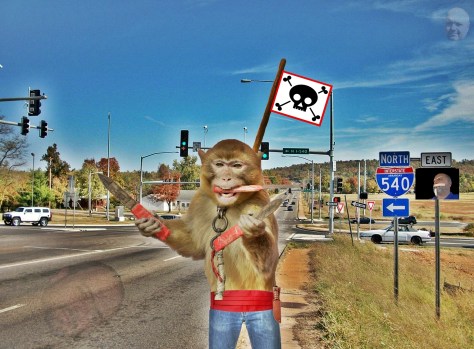
The most accurate and stupidest picture I’ve yet created. Unfortunately, not only is the circus mine, but I’m one of the monkeys. Millions of years of evolution has led us to these ill-devised systems that mulch us like discarded leaves.

x monkey 2

(No matter how weird your friends are, I’m fairly certain that none of them have made a picture as ridiculous as this one.)

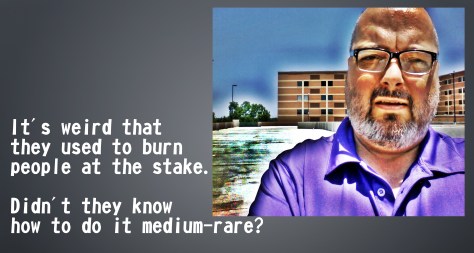
Thursday de Almost Friday

burn at the stake.jpg

.


Normal moved out of my house – and I kicked it in the butt as it tried to leave gracefully. Me and weird are now sitting comfortably on the couch.

.

Mary had a little lamb, but after a while, she also had a really dirty carpet.

.

They said a storm was brewing. I hope it’s not decaffeinated. (My apology to yet another cliché…)

.

I hope that if a SWAT team ever breaks into my house to arrest me that I am on the toilet. That way, it will be awkward for all of us – and not just me.

.

With apologies: That awkward moment when you look at a picture of a posing couple and momentarily think “Is that a before-and-after picture?”

.

The secret to musical harmony is to hear the other notes even when the trumpets fall silent. The secret to feeling connected in life is to picture the orchestra when all you see is an empty podium.

.

“I wrote a letter to all my fans. It was returned as undeliverable.”

.

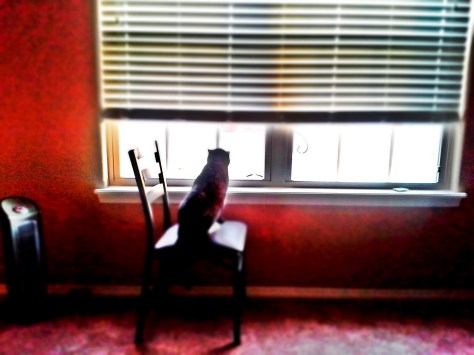
20160529_062704

We have a budding tradition at my house: as the likelihood of visitors increases, my wife begins the primarily-female ritual of “straightening up,” which now leads me to hang underwear on the front door hook outside. Invariably, everyone’s first reaction is now one of “Ha, ha – Look, there’s underwear on the door!” – and subsequently forget to measure the apparent dust found everywhere. I’m considering buying a colorful assortment of undies to better match the occasion. (In this picture, you can see our faithful cat, seated, awaiting n̶e̶w̶ ̶v̶i̶c̶t̶i̶m̶s̶ new visitors to the house.)

If enough people show interest, this might be something I could market to husbands/boyfriends, and other idiots.

.


A Possible Story to Frighten

jay hill

(This is a story I wrote for a friend of mine. Some of it is true, some of it is embellishment to amuse and delight him.)

I am telling you this story so that you can better understand Jay Hill. Like all interesting people, he has some history that he keeps well-guarded; not just from fear of being judged, but as a sort of superstitious protection. Sometimes, giving words to fears grants them life.

Years ago, Jay lived in a house that had been abandoned for 13 years. A new owner spent the minimum necessary to get it habitable again. Jay’s family rented it for much less than they would have paid anywhere else.

The lady who previously owned the house, Marjorie Wilson, died under suspicious circumstances. Even though the police investigated the adult children of Marjorie twice for suspected foul play, they could never bring charges. Within a year, both of Mrs. Wilson’s children disappeared after having last been seen inside the residence. You might be able to google the mysterious death, as a semi-famous investigator spent months trying to unravel the mystery. He wrote a story for the Arkansas-Democrat Gazette – and that story was later loosely used to make a movie. The house no longer exists, having been torn down two years after Jay moved out. It was once known as the Fuller House, sitting slightly off West Center Street.

Jay’s family had lived in the house for only about two weeks when he began to experience sleepless nights, imagining a figure at the foot of his bed. He would wake suddenly, thinking he could feel fingers slide across his feet. If he covered his head with a blanket, he could hear a female voice, softly asking him to go downstairs. Jay’s sister teased him mercilessly about it, accusing him of claiming there was a ghost in his room in order to get more attention. After a month in the house, Jay began to feel himself being pulled in the direction of the windowless wall on the East side of the house. He would wake up, hearing the irritated female figure demanding that he get up and leave with her. In two months, Jay began sneaking out of bed and sleeping inside one of the two closets in the bedroom, curled up with his feet bracing against the door. He could hear the ghostly figure scratching relentlessly. No one else in the house could see or hear any of it, which only worsened Jay’s already frazzled composure. He lost several pounds and his hair started falling out around his temples.

A school counselor pulled Jay aside and talked to him privately. Even though she didn’t believe that Jay was actually being visited by ghosts, she recommended that he wake himself up during these dreams and imagined visits. She was certain Jay was imagining it all, due to some family or personal issue that was robbing him of his ability to sleep deeply.

On April 15th, Jay awoke, feeling a face within inches of his. He was inside the closet with the door closed. He realized he could hear a low, guttural voice repeating, “We must go.” Since Jay half-believed he had been imagining it all, he reached up to pass his hand had through the empty air above him in the musty closet. And touched a face, one covered in what felt like small bristly hair.

Just as Jay started to scream in terror, the apparition grabbed his arm and took him threw the wall, into the back room used for storage. Stunned, Jay curled himself into a tight ball and rocked himself.

Before he knew how much time had passed, he woke up, feeling his sister shaking him and asking, “What are doing sleeping on the floor back here?” Jay told her the story. She of course laughed and teased him again.

Twice afterwards, Jay witnessed the female apparition walking past open doors. Once she looked his in direction and seemed to say “Some day.” Jay spent every night doing anything possible to prevent himself from falling asleep.

Before Jay could lose his sanity totally, his family had to move again, as a developer had bought the property for cash and wanted it so quickly that he paid the first and last month rent on an apartment on the other side of 6th Street.

For those of you who know Jay, he might have told you this childhood story and about the woman visitor in the Fuller House. I think he honestly sleeps with one eye open some nights, wondering if the ghost would follow through on her promise to visit him again. I wouldn’t be surprised if this isn’t half the reason he rents instead of buying a house.

Until this morning, I hadn’t thought about his old story for at least 10 years. He walked up to me, cup of coffee in hand, frazzled and nervous. He told me that he had awoke last night, after dreaming a female ghostly form had walked past a door in his apartment. Jay told me he lunged at it and instead of disappearing or recoiling that the ghost had grabbed him – and dragged him through a wall. Jay said he awoke to the feel of the claw-like fingers on his arm, the sensation of literally having just went through a solid wall still echoing in his body, his heart pounding like a symphony of hammers.

I could see it in his eyes. The fear. The dread. But I joked, trying to relieve the discomfort of what he was probably really thinking. That’s what people do when they are truly afraid.

The apparition isn’t waiting for him to be in a house. I think it’s started again.

I hope that Jay gets a good night’s sleep and walks into work tomorrow, tired but still there. Because I think I might be the one who loses my mind if Jay doesn’t call in and then doesn’t show up to work. I’m afraid that if I visit his apartment, I might find it to be perfectly empty, with no clue as to where Jay might be. Or worse, hear a small female voice asking me to come downstairs.


Jury Duty Aftermath


As I predicted, the jury pool for the trial of Samuel Robert Hill in Washington County, Arkansas ignored his mental illness defense and threw the book at him.

Whether he was really mentally ill isn’t something I can be certain of, as I didn’t get to hear the evidence that the jury heard during trial. On the other hand, I didn’t enter the jury process with a predisposed belief that mental illness isn’t a ‘real’ thing, either, or that even though the law says juries must take them into account, that mental illness should never be used to defend someone – and if it is, it should be ignored. Also, while I didn’t hear the evidence in the same way as the jury did, I did read it, including many things which were kept away from the jury during the trial. In some ways, I had a more complete picture and better information than they did. That’s how trials, work, though. The distinction in my case is that I heard some of the potential jurors say they didn’t believe in mental illness and that it can’t be used to mitigate a crime or its punishment. While I was dismissed for some unknown reason, citizens were left to serve on the jury who legally didn’t qualify, given their beliefs and biases about mental illness. Maybe the opposing psychiatrists had different levels of credibility or the defendant’s mother was a better witness than her sister, who testified for the defendant. Truth be told, though, none of it really mattered if enough mental illness-deniers got seated on the jury. Most of them wouldn’t admit they believe such things, as it sounds stupid to admit, just as bigots know they can’t claim that certain minorities are better at sports or that some are just angrier people – they believe it in their hearts but have been conditioned to conceal these bigoted or stereotypical ideas from everyone else.

I know that there are people who don’t believe in mental illness, people who think such sufferers can just ‘snap out it,’ or just get busy to distract themselves. It’s almost insurmountable to get past that kind of attitude in people. It’s not based on evidence or science, so argument and reason won’t get you around their mental block.

Likewise, many of those in the jury pool said that they were certain that if a defendant didn’t get on the stand, that this indicated either deceit or outright guilt. Despite the judge and the defense pointing out that this attitude was not acceptable if you were going to serve on a jury, several of those people also remained and undoubtedly served on the jury. Deciding to not testify is a fundamental right in criminal trials. It’s a foundation of our system. Especially if a defendant’s case rests on the idea that he or she is mentally ill, it is ludicrous to hold that against them. The law is clear: you can’t hold it against a defendant. As a citizen, of course you can. Many of the jurors ignored the law and should not have been on the jury deciding a person’s fate. Like most people, those who believe it know they can’t just admit such a belief in the face of scrutiny; they’ll justify or rationalize their bias and tell us that they can decide a case, not realizing that such a bias infects everything that filters through their eyes and ears.

(PS  Another bias that I heard people admit to: people charged with crimes are overwhelmingly guilty. Which may or may not be true – but again, jurors aren’t supposed to have this bias.)

I wrote the defense attorney in the trial a couple of times, as he wanted to know my opinion as an outsider. Much of what I wrote in my previous blog post I included in my email to him. The premise of my reply was that I knew before I ever left the building that day during jury selection that the jury pool wasn’t one I would ever want on a trial wherein me or my family was a defendant. There was too much bias. I told the attorney that I guessed every major aspect of the trial and its outcome, both in its decision and punishment. I was careful to not point fingers at a specific person, but I did my best to convey the overwhelming specifics that I observed, all of which combined left me with the idea that the jury pool wasn’t one that should have been hearing that case. In sort, I told the attorney that no matter what he had said or done once the trial started, the conclusion was predetermined. Had the prosecutor been the worst to have ever served, he would have won the case with that jury pool.

Some potential jurors knew more about the case than they admitted, too, and some had access to information after jury selection started. In the age of cellphones, it’s probably impossible to eliminate such temptations. I had some recommendations for different kinds of questions to help weed out these people. I could easily sit and watch a jury pool and come up with easy questions to make them uncomfortable- and more forthcoming and honest during jury selection.

The defense attorney told me that it was apparent that I was exactly the type of juror that both sides needed.

But we’ll never know. My opinion of jury selection and trials went down a notch and I’m left with the feeling, no matter what ‘really’ was the case, that the wrong jury was probably seated.


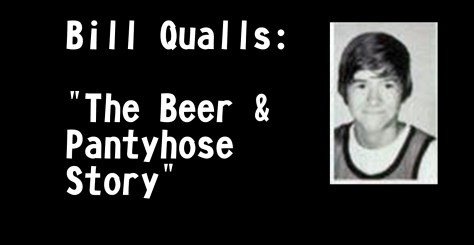
The Beer and Pantyhose Story

1686323

(The following story is one I was asked to write down yesterday. Please forgive any errors. It’s as true of a story as you’ll ever read and one that sometimes comes to mind when I’m driving near Noel, Missouri.)

The Beer & Pantyhose Story

Years ago, Bill Qualls needed someone to help him move some timber off his cousin’s property, near a bend in Elk River, over by Noel, Missouri. Since no one else was available, he called me and came by to pick me up. For three hours, he watched in amused irritation as I did literally everything wrong. I broke out both taillights of his pickup and then managed to crack the rear glass of the cab. I reminded him that my labor was free and kept on piling the timber across the truck.

After I dropped the same piece of wood on his hand twice, Bill decided that we were as done as we were ever going to be, and that he wanted to go get a beer. (Later, after the night’s excitement, it seemed like he was trying to get me killed – or at least get me prominently pictured on the back of some milk cartons.)

As we took several obscure turns in increasingly dark tree-lined roads, we hit a dirt road that seemed to be about four feet wide. Bill turned down the static-filled a.m. radio and said, “Now X, you gotta be careful in this place. These are deep woods folks. Don’t be doing or saying anything weird like you enjoy doing. Just keep your piehole closed and listen. And don’t ask them to play any Vanilla Ice on the jukebox, either.”

I looked at Bill as if he had just accused me of offering to kill his grandmother. “Of course, Bill, I’ll be on my best behavior. You won’t even know I’m there.” Bill cut me a look of suspicion, as if I weren’t capable of being normal for five minutes.

Bill took a sharp left and drove off into a holler, or so it seemed. There was a deep, narrow dirt road leading to a dimly-lit cabin front. I could make out a long building, probably about 75 feet long. Where the front porch should have been was a large sign with mostly burned-out bulbs, indicating “Beer Here.”

“That’s clever, Bill. Is the competition called ‘Beer There,’ or ‘Friends in Really Low Places’ or what?” I giggled.

Bill said, “That’s exactly what I don’t want to hear once we go in there. Just keep it down.”

“Calm down, you worry too much. It’s all good.” I smiled. And then added, “I hope they have Perrier water, though.”

As we pulled up, I could see dark figures sitting on old stumps, smoking and drinking. Their voices seemed to be speaking some exotic language.

Within one minute of entering the bar, we were already in danger of needing our organ donation cards.

Let me back up a little bit, though. And it was probably closer to 20 seconds, anyway.

As we went inside, I started coughing. The air was so thick with cigarette smoke that it felt like I was breathing cotton into my lungs. I followed Bill, still trying to get some clean air into my body. I leaned over, trying to get leverage to stop coughing.

“Hey boy, get your damned hand off my pool table!” I looked up to see the meanest, ugliest imitation of a man-bear hybrid I’d ever seen. At the same time, I realized that I had leaned over and put my hand directly on the cue ball, interrupting the pool game already in progress.

I don’t know what possessed me to say it, but I blurted out, “Why are you so fixated on these balls?” And I kept coughing.

I heard a whoosh go by my ear and I heard Bill gasp in surprise. Bear-Man hybrid had swung his pool stick by the narrow end, attempting to hit me in the temple with the wide end of it. He missed, either from the fog of smoke or due to the quantity of cheap beer he had already drank.

But he did successfully hit Boss, another large ugly man standing to my left, who turned out to be both his cousin and uncle. The cue stick hit him solidly on the forehead. Boss grunted and started to fall. As he did, he grabbed me and started pulling me down. I held on to the cue ball I already had my hand on and threw it crazily pass Bear-Man hybrid’s face. The ball sailed past him and hit another monster of a man seated with his back to the pool table. I could see Monster’s head turn and come to the wrong conclusion that Bear-Man Hybrid had just him in the back with the cue stick. As I fell past the edge of the table toward the floor, Monster was already out of his chair, kicking it backwards, ready to fight. I knew that half the bar was going to jump in and fight anyone already standing up. In my mind, I was already planning Bill’s funeral – assuming I survived the encounter myself.

I heard Bill shriek like someone had just pulled his underwear so hard that his grandkids could feel it. I could hear glass shatter and then grunting. As I hit the floor, Boss’ hand came loose from my arm. He was out cold. I crawled under the filthy pool table and jumped out the other side, standing about 10 feet from Bill, who was now engaged in fisticuffs with another bar patron. I had the impression that said bar patron was trying to use Bill’s head as a human cymbal.

I turned to run back through the fog toward what I presumed to be the front door. Just as I did, Bill’s voice rang out with an odd vibrato, probably from just recently being hit like a cymbal by a fist larger than my entire head.

“Where are you going?” Bill hollered at me as I moved away.
“I gotta go put on some pantyhose!” I screamed, in order to be heard over the boisterous crowd
.
“What? Pantyhose? What are you talking about?” Bill stood up, ignoring the fist flying past him. Curiosity had taken over.

“You told me if I ever got into a fight and was gonna choke someone, I had to do it with pantyhose.” I thought this explained it all nicely. Words had always come easily to me, whether they made any sense or not.

The entire fight came to a complete standstill, and a couple of fighters literally stopped their fists in mid-air, with looks of incredulity on their faces. (Although if I had said the word “incredulity” at that point, most of the bar would have resumed trying to kill us and each other, mistaking the word for an insult. There probably was a county-wide ban on four-syllable words, anyway.)

For two infinite seconds, the bar was deadly silent. We could all hear the hum of the decrepit air conditioner struggling to run and cool the room.

As quietly as the oldest lady in church, Bill’s voice squeaked out: “No, you choke the guy WITH the pantyhose, not WHILE you have pantyhose on. That’ll give the wrong impression.”

Everyone turned toward Bill, still not quite understanding the confusion. Bill shrugged his shoulders and said, “X is from Arkansas. He’s not much of a fighter.”

The laughter erupted immediately and grew into a horrible crescendo of drunken mockery. Some of the guys who had been prepared to bite off noses and gouge eyes were doubled over, holding their stomachs, laughing like 8 month-old babies.

By the time Bill and I got out of that bar, we had bought 63 beers for our new friends. Bear-Man Hybrid actually liked the nickname I had given him, even though he told me his Christian name was Alfonso – which in no way matched his appearance. His cousin/uncle Boss showed me his library card to prove his real name was Beard. He wasn’t sure why I thought it was so funny that he owned a library card. It turned out that Beard loved reading Agatha Christie novels. As for me, I lied and told them my name was “X” thanks to the witness protection program.

As we drove away, we were both making promises to lead an upstanding life, having just come as close to death as would be humanly possible.

I asked Bill many times to take me back to that bar to relive old memories. Each time I did, he would mumble something about not having enough insurance to cover it and change the subject.

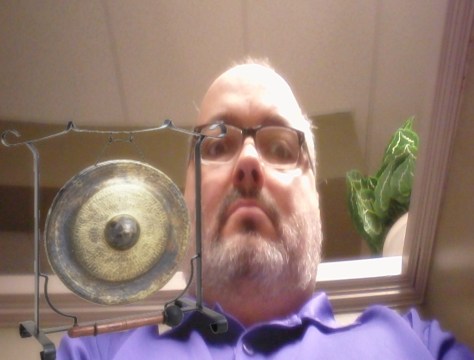
Gongzilla

This is a true story, and my wife was a witness and/or victim to it… Gongzilla. Inside the Fayetteville Auto Park Honda dealership, there is a gong to the right as one enters the main building. That thing beckoned and whispered to me like a syringe of heroin. In my defense, I initially didn’t do it because a nice lady with a very small baby came in and sat down with her back to the door. I was afraid she would throw the baby across the room in startled surprise if I gonged her without warning. Thrown babies, no matter the circumstance, usually don’t cause the desired comedic response, despite the oft-cited “baby with the bath water” cliché.

At the right time, I casually made my way to the door, acting nonchalantly and without indication I was going to grab the hammer. Two staff members were to my right and when they were both distracted, I quickly removed the soft hammer hanging on the right of the 4-foot gong, reared back like Hank Aaron, and swung that gong hammer as if I were Thor after losing my hammer for six weeks.

I hit that gong so hard that the gentleman to the right of the door almost swallowed his dentures. It was amazing! The gong resonated so loudly that it seemed as if the windows bulged like the walls did in “The Matrix.” Even I was shocked how loudly the gone echoed. Most of the staff applauded and laughter erupted. Several people seemed as if they wished they had worn adult diapers for accidents as they turned or half-jumped up from their comfortable chairs. No coffee or soda was thrown and luckily, no one bit off the end of their tongue. There were a few curse words that drifted lazily in the air, mostly drowned out by the godlike bomb drop of the gong’s metallic thunder. Afterwards, it occurred to me that it was also nice that no one suffering from PTSD or possessing a concealed carry permit over-reacted, either.

Forget a trip to Portland or hiking the trails of Asia. For me, nothing can compare to the zeal and happiness of that Zen moment that I almost caused cardiac arrest for those people unlucky to have been in the room the day I couldn’t overcome my urge to bang the gong. Call me Gongzilla if you wish. I didn’t even know that such a bong strike was on my bucket list. Thank you, life, for giving me the chance to express myself in a way that I didn’t even know I needed! Love, X


20160422_070014


.


Only slightly less popular than Jason’s Deli… Jason’s Urinal.

jasons urinal.jpg

As John Cage from Ally McBeal often said, “This pleases me.” I know you already think I am crazy, but this made me laugh more than you can imagine. It is a picture of the urinal at Jason’s Deli in Fayetteville yesterday morning.

.

Given the number of people dying at the summit of Mt. Everest, am I the only one who has come up with the idea of renaming it Mr. Foreverest?

.

Almost a Juror in a Murder Trial in Washington County

20160516_085908


I sat and wrote this mostly in one continuous effort, so please forgive the errors, boredom-inducing commentary, and staggeringly ineffective points. In my own defense, I was around lawyers today. I wanted to get much of this written down while it was still fresh, for comparison after I have time to think about it more. I’m going to leave out details, as some of it is accusatory and would probably get me into some trouble – being honest is rarely rewarded.

Of the hundreds of citizens called for jury duty in Washington County every year, I was one of the few both interested and anticipating the process. Not only does my employer still pay me as if I were working, but the process itself was something I was looking forward to seeing from the inside. I’m one of those rare unicorns who would have loved the experience. I knew that my desire to be called, in conjunction with the lack of legitimate financial or personal reason to not serve, was going to doom my enthusiasm – and not just because that seems to be the way everything associated with the government sometimes seems to work. Lord forbid that people who are both able to serve and interested in service get picked, much less serve on a jury. Somehow, it seems so much less fair to know that defendants and prosecutors are working with citizens who would rather be anywhere on the planet other than being forced into jury duty. I was expecting people to be disinterested, but I was put off by the level of frustration and lack of candor about the preconceptions and misconceptions about crime, criminals, and mental illness from many of the prospective jurors.

After getting the 3-month call of service, several weeks passed without any hint I might be selected. Finally, the call came and I showed up early today at the Washington County Courthouse. Part of the reason to arrive early was to people-watch and to observe the discomfort, nervousness, and behavior of those involved. As I always do, I brought a stack of index cards to take notes – or to take them until someone told me that I couldn’t do so. People laugh at me a lot when they see that I actually do have index or note cards in my back pocket. Even while waiting in the lobby area on the 4th floor of Judge Lindsay’s courtroom with the other 70 or so potential jurors, I wasn’t nervous and passed the time attentively listening and watching. Almost without exception, no one wanted to be there or be picked. Most joked that it was the befitting beginning for a Monday morning. I told several people that I was excited by the learning process – they looked at me with leprosy-filled eyes of suspicion or laughed because telling people you wanted jury duty is so rare that it sounds foreign when spoken aloud. It seemed as if a few people knew what kind of case it was going to be and that it would take a few days if it wasn’t settled. I don’t know how  they knew that or where the information came from. At that point, I didn’t hear them say it was a criminal case, but they did talk among themselves and one of them seemed to be familiar with previous hearings related to the case. One was a female voice seated around the corner to the right. As more people entered the lobby outside the courtroom, it got harder to pick out conversations, especially when the gentleman who works recycling was talking. I mostly stood in front of the glass case (the one with the 1980 Wash. County Bar members pictured) to the right of the elevators, facing the doors to the courtroom and the clerk’s office, basically dead center of all the people, seated and standing. The female deputy was mostly behind me, talking. Her voice made it hard to hear any of a conversation taking place to her right. It seemed like one of the women knew about the case, too, but I didn’t hear the specifics. They were all potential jurors, as they were identified by roll call once inside the courtroom.

When we all were called inside the courtroom, I deliberately sat in the middle, as far up front as possible in the front row, directly behind the defense table. Most of the other people did their best to get away from the action, so to speak, just as happened when we were all in school. The judge caused a murmur, as it turns out the case was for Samuel Robert Hill, a 27 year-old who was initially charged with capital murder and capital attempted murder, back on August 20th, 2014, in Elkins. It was the same case in which his mom shot Capt. Reed of the Sheriff’s office, claiming she thought Capt. Reed was her son Samuel as he approached her in the dark, intent on killing her as she escaped out a window. He’s also charged with aggravated assault due to allegations he beat his wife at another residence before driving over to where he shot his father. That charge will be tried separately and the defense has previously won the right to keep that from even being mentioned at the murder trial. Most people had no inkling they were there for a murder trial, although some definitely did. Since the initial charges, the charges were amended to take the death penalty off the table, as well as for the defense to claim an affirmative defense of mental defect at the time of the crime. With the capital punishment being off the table, I knew I could serve and listen to the law and the instructions related to it. When the judge explained that the capital portion had been removed, there were several verbal exchanges from the jury pool. It was my overactive imagination, of course, but I thought of the spectators inside the gladiatorial stadium.

I was able to sit 6’ from the defense table, close enough to read notes if I had wanted, and also with a clear view of the prosecution table. (I keep seeing the defendant’s unusual tattoo inside his left ear lobe.) While sitting there, I had no memory of the crime as it was described to us all. Several of the jurors talked about having memories, but almost no one spoke up, which is not the way the process is supposed to occur. When I got home and googled it, the fact that his mom shot the sheriff (deputy) (sorry, Eric Clapton…), jogged my memory. I remember people joking about it because it seemed like everyone in that house in Elkins was armed. Being so close, I had the chance to watch the defendant and his two attorneys very closely, see their body language, and watch them as they watch us, waiting to be called up to sit in the jury box.

The elderly lady sitting on the pew with me to my left was angry she was there at all. With the judge’s first question, she aggressively insisted that she believed that anyone charged by the police was 99.99% guilty. I think she meant it, too. The judge dismissed her. Behind me, among the courtroom pews full of potential jurors, I heard more than a few people make comments in agreement with the elderly lady who was dismissed for believing that defendants were basically all guilty. In reality, all of those people should have been sent home, too – but none were. The bailiff and the waiting police officers to my left next to the door undoubtedly heard the murmurs, too. There were several others dismissed as well, following her, for different reasons. Exactly as I predicted, I was picked to be seated among the first 12 numbers called. With the exception of one number, I noted the juror numbers as they were called up before and after me.

From there, it was voir dire, listening to the defense and prosecution ask us a series of questions about our fitness, opinions, and ability to be impartial based on the law and instructions. Since I was seated on the far left of the jury box, I had a perfect line of sight for the judge, defense, and prosecution. I watched all of them closely. The prosecutor talked a long time, much longer than the defense. For presentation and likeability, the defense lawyer John Baker was much more likeable and disarming. The two office workers seated on the other end of the table from the prosecutors were watching more much closely than the lawyers for the state – the dark-haired lady second from the end in particular seemed to have more interest in the proceedings and based on the documents she was holding, already had a good idea who they didn’t want, based our very basic questionnaire and/or appearance. While the judge and lawyers talked to us and asked us questions and explained points of law, I watched the body language of the prospective jurors. I was one of the few people who was in no way bored and felt comfortable being there – and felt okay turning to look down all the jurors who were seated to my right. I made eye contact with the defense lawyer and the prosecutor as much as possible. I could tell that the prosecutor was expecting some surprises in the judge’s instructions, ones that would benefit the defense over prosecution. Remember that the defense wasn’t denying that the defendant killed his step-father, just that he was out of his mind at the time, vaguely speaking.

The defense lawyer specifically asked us about the points of law associated with the absence of the defendant choosing to testify. Most jurors nodded their heads in agreement when he asked everyone if they felt that they defendant was guilty or hiding something if he didn’t testify. Most of the courtroom nodded their heads in agreement, whether they were seated and waiting or on the jury. While the prosecution would have tried to get me kicked out, here is what I would have told the defense attorney if he asked me: “No, since your defense is predicated on admitting that your client killed his step-dad, you are also maintaining that he was or is suffering from a mental defect. It would be idiotic to put someone of uncertain mental stability on the stand, even on his own defense, and doubly so if your intent is to get him help.” My answer would have been heard by every potential juror in the room, even if the prosecution would have thrown me out the window. It was truly a lost moment for the defense. What the lawyers didn’t see was what I saw from my viewpoint. Other than the court reporter and the judge, I had a great view of most of the courtroom. I wish they had they seen almost everyone nod their heads in agreement with the idea that a defendant who chooses to not testify is almost certainly guilty. It wasn’t a lukewarm agreement – it was confident and almost universal. This observation added to my premise that they defendant wasn’t going to get a fair review if most of the courtroom basically just agreed that if he didn’t get on the stand, he was lying or hiding something. This right to not testify, despite being described as a right and a point of law, one necessary to be on the jury, was obviously unimportant to most of the jury pool. But it was ignored. To be more specific, I think a reasonable person not involved in the case would have seen this and assumed that the jury pool was mostly comprised of people who could not be follow the law and not draw an inference of guilt or deceit solely because the defendant would not get on the stand. From this pool, though, the jury was chosen. Even if for that reason only, I knew that the jury pool was tainted. That was my opinion – and I was paying attention.

Ask yourself and your friends. I think most of them will say the same thing about a defendant not testifying- and there’s nothing wrong with believing it. Most people will say it is common sense and the way it should be. But as a point of law and for being chosen to sit on a jury, you shouldn’t serve if you truly believe that a defendant is lying because they invoke their right to not testify.

Since my group was the first seated, I knew most of us weren’t going to make it. If you’ve never witnessed voir dire and the juror questioning in smaller trials, it is important to remember that while each side has a certain number of strikes and challenges, the truth is that in the beginning, both sides almost never challenge the opposition if you don’t both call the same jurors out. It is only during the latter part of the juror voir dire system that the defense or prosecution starts trying to fight to keep certain people on or off the jury. A murder trial has larger implications and I knew that both sides were going to play it safer and then dig their heels in. Seeing the jury, I knew that, in general, older white males weren’t going to fare well during selection, for example. Older people in general seemed to have made up their mind.

After the initial presentation by both the defense and prosecution, both went up to Judge Lindsay’s bench and the clerk turned on the static generator for the intercom, presumably to mask the sound. There were a couple of problems with this, though. First, the courtroom is very small and even despite my old ears, I could still associate sounds with lip movements. Second, I also had a great view of the prosecution table. Third, it is easy to understand words in context and in this case, one commonality for all of it was that almost every comment or sentence started with the word “juror,” then “number” and then the juror number. Keep in mind that with the exception of one juror on the panel, I had noted on my note card the juror number for all of us. (That juror was a young red-headed female,  who was asked to leave when she said she couldn’t get past the grisly nature of the murder.) The judge almost immediately interrupted to tell the courtroom to be quiet so that the two teams and he could hear other. The net effect of his asking for silence resulted in me being able to hear and/or ‘see’ every juror number being called, including mine. I leaned to the older gentleman on my right, telling him that both he and I were being excused. “What did I do or say?” was his demeanor to my comment. He told me that they probably would have excused him anyway if they had discovered he was a pastor. He could see my note card with juror numbers on it, in two rows. No one had ever said I couldn’t note juror numbers – or anything else for that matter. He had his cellphone in his front shirt pocket so I asked him what time it was. I had heard 3 phones ring while seated in the pews, either softly or vibrating. The bailiff and court personnel didn’t seem to notice. A lot of jurors had cellphones, something that probably was a bad idea.

According to my count, only 4 remained. The judge called out 3 names, and the rest of us were excused. I’m not sure where I counted wrong, but it wasn’t too far off, given the circumstances. Even though I estimated 70 people had been called to the cattle call, I also realized that they were going to encounter some issues later in the day as they attempted to fill 12 seats and 2 alternates. I also predicted that juror selection was going to take much longer than anticipated. What troubled me is that I had already seen and heard a lot of evidence that jurors weren’t exactly being honest about their foreknowledge of the crime, their attitude about mental illness, their attitude about the defendant needing to testify, and the presumed guilt of someone being charged for such a crime. Nothing about it seemed fair or impartial. I was surprised that it wasn’t obvious to everyone else. It wasn’t just because I had been paying careful attention since I entered the building. It seemed like that sort of thing was commonplace and almost expected. Were roles were reversed, I would have asked these questions: “Did any of you overhear people before or after y’all were called in talking about the case? Or do you think you did?” “Do you know of anyone who might have used their cellphones inappropriately?” The latter I would ask after each round of jurors.

Were I ever charged with a crime, or a close family member, I would not want the kind of indifference or lack of transparency from most of the jury pool. It is not what we have in mind when we think of a fair jury. After thinking about for a day, it pisses me off a little.

As we went to see the court clerk to get a note of excusal, I told the youngest excused juror at the desk he would have never made it past a defense challenge, anyway. As the clerk asked for my information, I went through the process of repetition of my name a couple of times, as I well know how weird it is. The gentleman who I had told that he wasn’t going to be picked then said, “Oh, that’s what you meant about your name.” I told him that the two sides were working on incorrect assumptions about people and their biases – and that based on what I had just seen and heard, that the defendant’s affirmative defense of mental illness was going to be ignored and that he would be found guilty without being able to invoke mental illness as a defense.

PS: After the clerk gave me my notice of excusal, I lingered in the outer office by the unattended desk for a long moment. I pulled out my wallet to put the notice away and as I did, both the defense lawyer and the prosecutor came out the courtroom inner door and stood there talking, where I could hear them.  After the prosecutor asked, “Are you sure you don’t want so-and-so on the record?” I also used the bathroom on the 4th floor before I left, as the judge had given the remaining potential jurors a short break so that the two lawyer teams could confer. The bathroom had about 15 men in it, basically every male called to jury duty who hadn’t been excused.  Here’s what I heard: “God, how boring!” And, “I hope they don’t pick me.” Or, “He’s not crazy.” Another guy waiting in line answered him by replying, “He’s got to testify!” “Did you see that tattoo in his ear?” (I don’t know if it was a tattoo, just that jurors called it one. And I had seen it up close while seated behind the defense table.) Followed by commentary. As I was leaving, another guy pointed out that he couldn’t go through the entire week like that.  These people are among those I left behind me in the building, almost certainly some of whom were going to be chosen to sit in judgment. I’m sure there are some lessons in there somewhere, or criticisms of how things work. I heard other commentary, but I am omitting it on purpose. Looking back, I think that several people would like to forget that they talked that way, especially those chosen for jury duty. Their disinterest and disdain for the niceties of law and mental illness will be fogged by the spectacle of the trial and their own specific renditions of their memories. Collectively, though, I wouldn’t want such a group to be the one chosen for me or my family if we are ever charged with a serious crime, especially if we are guilty. I mean no disrespect toward them as individuals! But to deny a lack of enthusiasm or to deny that you already had intense preconceptions which could seriously impact the trial goes against what we shared in moments and commentary.

Edit: I’m adding a few details a day later, and I’m not too sure I should include it, because it seems damaging to bring it up, but it is bothering me. I don’t want to get called to explain or to try to remember faces with some of the commentary I heard. Some of the potential jurors definitely had previous knowledge of the case – but didn’t mention it during questioning by the judge or the attorneys. Some jurors didn’t believe that mental illness was ‘real,’ or shouldn’t affect being found guilty, no matter how crazy they might have been when they commit a crime. This goes in direct contradiction to what we were told to consider, especially by the defense lawyer. I’ve been wondering all day just how many people with those attitudes made it on the jury – I’m sure some must have. It is part of the reason I predicted yesterday that the defendant’s mental defect defense would be thrown out completely by the jury. From my experience, I’ve found that people are mostly not receptive to mental illness reasons for behaviors, including crime. I’m certain that this carried over and contaminated the jury pool, as people just weren’t being forthcoming. I don’t want to say ‘dishonest,’ because everyone believes they can overcome bias – even when it is invisible to them. Just as people know they can’t go around justifying bigotry, they also can’t go around saying socially unacceptable things about mental illness or the legal process.

The prosecutor made a point to describe in detail the necessity of using our common sense, but to follow the points of law over our our misconceptions and preconceptions. Overwhelmingly, I think this contributed to the direction of the jury. Because if you feel that those who don’t testify are guilty or that mental illness isn’t a real defense, you aren’t going to let facts confuse you out of continuing to believe them. The deck was therefore stacked before one word of testimony was uttered.

(Also, without being too specific, it would be wise to not let people use their cellphones, as you can be certain that despite being told not to do so, people are going to google the trial or crime as soon as they think they have privacy. FYI – for anyone over judicial proceedings such as this one. While I wouldn’t want the scrutiny, I’ll edit this comment to cover my specific situation. Most of the potential jurors had sat through a LOT of advisories, questions and warnings about what to do or not to do about the case. After my group was mostly excused, that left around 30-4o potential jurors, all of whom now had heard specifics of the case. They are then given a break. As you would imagine, all of them had cellphones. How many of them do you think used their break to look up the background of the case during that break? How many saw the parts in the news accounts that weren’t allowed to be brought up in trial, such as the allegations that the defendant had beaten his wife prior to killing his step-dad? If they did, don’t you think they would talk about it, given the chance? How many of those people ended up on the jury? Don’t you imagine that people using the stall in the bathroom succumbed to curiosity and looked it up, despite being warned not to do so?)

After leaving the 4th floor bathroom, I went directly out of the building and made 5 or 6 index cards full of notes, some long, some bullet points to jog my memory when I would write a recap. I stopped before I got home and did the same again because I had accumulated another long list of ideas and questions I wanted to try to incorporate. Most of them I’ve added either that day or a day later. I softened my language because I don’t want to be judgmental and I don’t to be second-guessed or questioned. My goal wasn’t drama or blame, but they are side effects.

So, even though I would have worked to listen to instructions and to be attentive to the law, I would like to say that the defense team made a horrendous error by eliminating me from the juror pool – or at least an error by not fighting for me to stay there. Unlike many of my other counterparts, I wanted to be there and had looked forward to the process of several days of a trial. And while I am unabashedly liberal, despite my constant humor and irreverence, I would have relished the chance to listen. Absent the threat of capital punishment, it would have been much easier to listen and help people decide.

The defendant is going to be found guilty and his affirmative defense of mental illness will not sway the type of juror that I saw to be remaining.

I’m not making this prediction based on points of law or familiarity with the case notes – quite the opposite. But I went in there early and dedicated my time to practice human observation. I wanted to watch people, to listen to them, and be part of the process. While I was excluded from the trial, I cannot understand how anyone will be surprised when the defendant is found criminally guilty. I would have been an ideal advocate for the idea of ‘preponderance of the evidence.’ Unlike a murder charge, using an affirmative defense of mental defect doesn’t require the same burden of evidence for the defense. In other words, it’s easier to achieve that point. I would have listened closely, but I also don’t have – or hide – a disdain for mental illness that many other people do.

Most of the witnesses for the prosecution were police. The defense already stipulates that the defendant killed his step-father. In this context, the truth is that the prosecution wants to color the scope of the proceedings by bludgeoning the juror with the brutality of murder. And it will succeed in this case. I’m certain that the most of the jurors will not be able to separate the criminal act from the separate issue of mental defect at the time of the crime. Most people wouldn’t, and that is exactly why the defense did itself a disservice by not fighting to keep me on the jury for trial. I could already see that the crime details were going to be presented harshly – as they should be, except with the net effect that people would rather not let someone off if such a crime had been committed.

Again, I know it sounds whiny to complain about not getting chosen for jury service – and not only because it sounds crazy. It’s because I can see the path already chosen by what happened today. Should I charge someone a lot of money for this type of insider observation?

Or I can just wait until the next time when I get called and my enthusiasm has turned to apathy or hostility toward the process? The only question I was asked directly was basically “If you hear rumbling, hear drops hitting the roof, and wake up to the ground being wet, what happened?” My answer “Precipitation.” That’s it. Despite my sense of humor and mouth, I didn’t say anything crazy – because I literally said nothing.

I didn’t say or do anything provocative, even when the prosecution talked about motive, intent, and mind reading. In short, I was a great candidate for jury service, just as were most of the people who were excused the same time I was. On the surface, I was perfect for both sides. Yet, I was excused for reasons and criteria not observed. In other words, invisible evidence or ‘feelings / instinct,’ the very things both sides said should in no way be allowed into our minds during the trail. 9 out of 12, or  75% of a representative cross-section of this county was excused for no reason whatsoever, for criteria which cannot be measured or observed.

Even though I was in a very small group of people who wanted to be called, several of those dismissed for no reason were irritated at their dismissal. They didn’t want to be there, but they didn’t really expect to be told “go home” without cause. The prosecution had said “Don’t take it personally” at the early stages. How else can it be taken? Each of us were eliminated for reasons we will never know, or for no reason at all. That’s not the kind of legal system people are going to rally behind. They feel like they were accused – although of what, they can never know. In my case, I heard many reasons from other jurors why they shouldn’t be a part of any jury process – but almost certainly were.

What was it I heard while standing outside the courtroom waiting to go in? “Great. What a waste of time. 12 people too stupid to get out of jury duty.” It’s a cliché, of course, but it took a different twist after experiencing the process.

It is strange for me to go into a process that is universally disliked or perceived to be negative by almost everyone – except I went in with an unnaturally positive outlook. I don’t mean to come across as negative about the day or experience, but it had a big dose of everything I had hoped it would not. I learned some things, many of which I would have rather remained ignorant about.

I’ve made my prediction and I would love to be wrong. But I see it coming. Their is no way the defense is going to get an impartial trial for a mental illness defense. Too many of the jurors weren’t forthcoming about what they knew about the case or their attitudes about mental illness and the defendant’s right to not take the stand. If he truly was ‘crazy’ at the time, it won’t matter because based on what I saw and heard, the jury pool mostly already had their own ideas. I wanted to call the defense team and tell them that they were fighting a losing battle. I told my wife more than once that the jury had no intention of following the evidence or the law from the outset of the jury selection, much less the trial.

And the process of jury selection failed to eliminate those who shouldn’t be seated to hear such a case. Or maybe I’m stupid – maybe all criminal trials are conducted that way – with a veneer or process and pomp but concealing deep conflicts.


Regards, X


Oxfam Report: Give Us A Break

Oxfam Poultry Practices Report

.
I am putting the link to the Oxfam report on practices in the poultry industry in the comment section, as well as a couple of others. It’s a comprehensive report across several states and companies. This isn’t a hatchet job from a single source– it is a serious reminder that many people are treated with inhumanity in some industries. I challenge anyone with an opinion to read the report in the link in the comments. For anyone who has worked a production poultry line, I am certain that you will be nodding your head in agreement while saying, “No Sh*%, Sherlock.” If you are in poultry management, it will piss you off because you either agree that it is inhumane or you will disagree because you will claim the issue doesn’t exist or, at least, isn’t as bad as some would have us believe. If you believe the latter, cash your check and ignore me.

For those working production lines, especially poultry, this report highlights the ongoing substandard practices found in many poultry plants. I’ve written about it many times.

I don’t want to hear blanket objections such as “But it doesn’t happen at my plant.” If it doesn’t, that is great news – and I mean that. In your case, the bad managers or companies are harming other companies in your field.

I’ve witnessed the type of inhumanity described in the Oxfam report. People were denied convenient access to the bathroom or were arbitrarily delayed. Production speed and cost vs. efficiency factors directly affected the staffing levels needed to give safe and necessary bathroom access. Did people suffer and sometimes urinate themselves? Yes. It may be going on right under your noses, even at your plant, where you think it doesn’t happen. In line production jobs, the odds are greater that people are made to feel bad for needing to go to the bathroom. “Hold it or else” can still be heard echoing the plant’s lines, in various languages.

The lower on the socioeconomic rung you or your job falls, the greater the chance that you are faced with the need to go to the bathroom but don’t have permission. If you’ve never worked in such a position, you are lucky. For politeness, I refer to ‘peeing,’ when in reality, who among us has not intestinal cramps so bad we couldn’t stand up, only to run for the bathroom before defecating ourselves? All of us – because we are human. That’s how people end up standing in production spots with urine or worse trailing down their leg. Of course they are ashamed and afraid to talk about it.

Being bilingual gave me a much better insight into how systemic and pervasive the problem was. Most of the poultry industry is minority-staffed and this reality distances the owners and managers from those doing the work, both in economic overlap and language.

I often give companies the benefit of the doubt, despite continuing to hear bathroom horror stories from many people. I still hear stories of people being denied bathroom breaks or being made to wait. The same factors from my past still affect human beings working in the poultry industry. Reports such as this one remind me that companies will all too often lose sight of the humanity of those doing the work.

Again – I am not saying ALL poultry plants operate this way, nor any specific one, local or distant. I am saying that it is still widespread. Further, I knew some great administrators and poultry managers who would say they never condone denying people access to bathrooms. Likewise, I knew that bathroom abuse was happening at their plants, on their watch. They would never believe it, even today. The people they trusted to run their plants felt like making people feel like they were not entitled to bathroom access was saving them money and that it was the right thing to do to perpetuate a system that humiliated or denied people the right to bathroom access; a necessary evil, if you would like to call it that. Regardless of whether the corporate offices or plant management know about unsafe and inhuman practices, the truth is that the entire company culture is their responsibility. These types of practices don’t become common unless cost is stressed at the expense of intangible considerations, including the human impact. If you can’t make a profit without doing things like those described in the report, find another business.

It costs money to operate production lines. Staffing to allow a human being to step off and go urinate, take their medications or do necessary bodily functions of course has an economic impact. We all know that if companies could engineer a way to mechanize all the production elements without people that they would do so. Until they do, however, it is an ethical and moral obligation for the company to honor people’s humanity and not only condone bathroom access, but to acknowledge and embrace it. Avoid the reputation of behaving like monsters and encourage training so that everyone from the production workers to the plant managers must structure their processes in such a way as to ensure that people aren’t standing in a line peeing themselves or being made to feel less-than-human because they need to step off their production spot to relieve themselves. One story of a grandmother peeing herself because she couldn’t get permission to leave her spot is one story too many.

It is such an obvious thing to say that I get angry writing it. If your mom worked at a poultry company and she said that her line supervisor laughed at her for asking (or begging) to go to the bathroom, I am sure that your first impulse might be to remind them via knuckle sandwich that your mom is a human being who needs to go to the bathroom when she asks. Would you be surprised to know that some production keep track of how many bathroom breaks you need – and would reprimand you for violating their arbitrary number? Is once a week too much? Once a day? If you’ve had nothing except jobs which honor your humanity, this will sound like a bad movie script to you.

Imagine all the times you went to the bathroom during the last work day you had. Imagine this: no matter how bad your need, imagine that you worked with hundreds of people and that you had to wait for someone to give your permission and replace you when you needed to go. Now imagine that instead of seeing someone walk up to you and allow you to go, that they called you ‘lazy’ and told you that you had to hold it an hour until the next line break. Or that you had to beg and provide intimate details of why you needed to go. Or decide whether to go without permission and risk losing your job. Now imagine that your mom, wife, or sister had to hear that kind of horrific inhumane response. That scenario is reality for a lot of people.

Kudos to those companies which don’t denigrate people like this. Shame to those which still do. I don’t doubt a single word of the Oxfam report.

When asked about the Oxfam report, many of the CEOs and marketing departments of some of the poultry companies were “outraged,” and “will be checking on the veracity of these reports.” Dear millionaires, can I save you some time? Call me. Of course this craziness is still going on. Not because some report says so. It’s because the people working on the line jobs at your companies say so, day in and day out. The reputation of line positions isn’t accidental. You’ve created it one bad incident at a time.

I put it out of my mind as I’ve moved on to jobs which aren’t monstrous in this regard. I still hear stories, though. And I read reports such as the one I mentioned. I hear it in English and Spanish.

Countless times people have asked me, “How do I find out if these things are true?” It’s strikingly simple, even for management. Find the lower-end employees, the ones working sanitation and production jobs, the ones with mops and knives, the ones speaking Spanish or other languages. Stand around them, listen, and ask questions. Listen again. Then ask them a question like this: “Is it common to be denied access to the bathroom?” All of them will tell you, “Of course.” That’s a problem. It’s a human problem aggravated by a profit motive.

Those doing the work experience the reality and consequences of cost control over humanity more directly than anyone else. If you can get them to talk, listen. And treat them with respect. They are doing jobs that we won’t, all so that we can eat the things we want to.

My food tastes like garbage when I think that people were treated this way in the United State while they were making my food. Raise the price of your product if you need to, if it allows people the right to behave and be treated like human beings worthy of respect for their biology, if not their humanity.

Lives on The Line Link


Lives On The Line Full Report

Humanity aside, if a company perpetuates an environment wherein treating people like this happens, what do you imagine is ‘really’ going on in the production and food safety side of the equation?” – X

PS: I started writing this yesterday, after seeing it on a “Southern Poverty Law Center” comment. Within 60 seconds of me posting this, someone who knows me well had tagged me on social media on another site to draw my attention to it. That’s how much this issue bothers me.