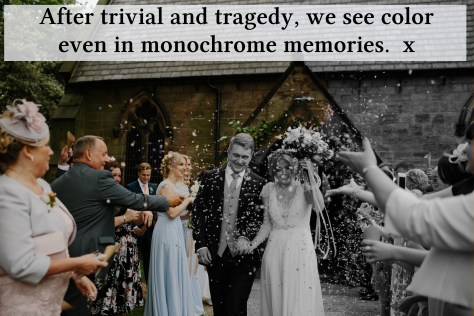
…of the greatest gifts of age is experiencing the width of life, no matter how it is packaged…

…of the greatest gifts of age is experiencing the width of life, no matter how it is packaged…

Each day contains a secret moment in time; in that moment, colors belie their nature, music kidnaps our senses, and laughter beats at our hearts like a long-lost friend. We never know when that moment might be or who will inhabit the moment as our day overtakes us. The happy people in life reside in a parade of those moments. We mortals are lucky to experience a handful.
Today, I hung the remainder of the crystals I surprised Dawn with so many weeks ago. Intent on my mundane tasks, I casually forgot that I had done so. The globe crystals went well with the obelisk I had already placed there, facing west.
I went outside to take out the trash and detoured around the house to startle my cat Güino, who was sleepily occupying the chair placed against the street side window. (It’s ‘Bird TV’ for him there, and he can lie there and accompany Dawn as she crazily types at her computer.) As he lazily turned his head to peer over the windowsill, I tapped the glass with a bang and yelled, “Boo!” The cat rewarded me with a total body lift from the chair. I laughed. The neighbor across the street looked over at me, her right hand shielding her face from the sun; undoubtedly, she was gauging what nonsense the gringo might be up to again.
Returning inside, my eyes switched from the glare of the nuclear sunlight outside to the dim confines of my living room. The cat had jumped up to either greet me or bite me, in order to register his contempt for my idiotic scareplay at the window.
I opened the door to the back bedroom and a million shards of polychromatic light greeted me. The crystals had chosen that moment to cascade in a dazzling colorscape. Even though I rarely succumb to such impulses, I wanted to capture the breadth of the surprise all over the ceiling, walls, and contents of the room. Instead of standing there to observe the fleeting barrage of hues, I left to capture the image.
By the time I returned to snap a picture of it, the words of Nate from Six Feet Under resounded in my head: “You can’t take a picture of this. It’s already gone.” And it was – not just the array of colors and shards of color thrown haphazardly about, but the moment of amazement.
I can re-imagine the spectacle of surprise and light, or feebly attempt to share it via failing words with Dawn, but it has departed. It has escaped, after having briefly pushed out the walls of my life for a moment. I have this picture of it, after 90% of it had vanished, a speeding car already in the distance. I can lie in wait tomorrow or another day, hoping to recapture the surprise but these moments are nimble thieves, stealing our precious seconds as we scamper from one possible moment of happiness to another, never tiring of the possibility contained in the moments.
Long personal story…. Please read knowing that all businesses, no matter their reputations, have countless great employees who don’t misbehave and/or don’t appreciate how their employers conduct business. It’s a conundrum we all face with businesses. Unless my issue is with a specific person, I in no way wish for people reading my words to think I’m painting all employees of any business with a broad brush of accusation.
A couple of years ago, I shared a story with you about Arvest mistreating my wife. An ATM failed to give her $400. She reported it immediately and Arvest fixed the error. Months later, without notice, they reached into her checking account without permission and without telling her and took the same $400 back out. There was no appeal. They had waited months, after all video evidence was gone, and without following up. Dawn politely worked to get the error fixed. Not only did she not get the error fixed, but a couple of the people working at the bank had an attitude which was dismissive, as if Dawn somehow had lied about what happened. Dawn’s feelings were hurt, to say the least. She’s polite and was certain that logic and patience would fix the problem. No one at the bank cared.
Dawn responded by deciding to leave Arvest, after many years of doing business with them. She took all of her accounts and later we got another mortgage to get away from their shenanigans.
Just because I can, I have also frequently picked on Arvest on social media. I’ve been polite, but I’ve satirically jabbed at them a few hundred times and made several memes to poke fun at the bank.
Yesterday, before coming home, we stopped at our community mailbox and checked the mail. I handed the mail to Dawn, who was seated in the passenger seat. I told her, “Look, you got a big check from Arvest,” and laughed. We joked that it was one of those fake mailers, especially since it didn’t have postage. Also, we had never given Arvest our new address, having wiped them off our feet before we ever decided to move.
I told Dawn to open the Arvest envelope. Lucky for us, she did, instead of discarding it. Inside was a check addressed to Dawn, in the amount of $400. In read, in part: “…during a review… we determined one of more disputes was denied in error. Due to this error, we are enclosing a check…” It was an unsigned form letter with no explanation as to how they got Dawn’s address, nor did it contain any sort of apology.
The look on Dawn’s face was priceless.
More than the $400 Dawn got in the mail, the admission that Arvest screwed up a couple of years ago when we said they did is worth much, much more than that. It should have never happened, because Dawn would have stayed with the bank for the rest of her life, if possible. Now we have the magical words in writing and those words all this time later prove that we weren’t lying or crazy: Arvest took $400 of Dawn’s money without cause and worsened the problem by strangling us with bureaucracy and apathy.
It’s easy to get a customer, but very difficult to get one back after you’ve mistreated them. You should never let a customer walk all over you, but you should also remember that customers are people. The $400 is nice, but nicer still would have been for one person at Arvest a couple of years ago willing to stand up and say, “Enough. We can’t do this to a customer. It is our error.”
PS: You should always address customer service issues or old business before taking any steps toward acquiring new business. The disgruntled folks are going to eat your lunch telling their stories.
Click link and button above to hear the latest ad I made for Joe, to compete with the Krav Maga system.

Joe, a large friend of mine, someone who looks like a human Bigfoot, despises those Israeli Krav Maga self-defense courses. Not content with merely turning off the radio when a commercial comes on for the local version, my friend rips the entire radio out of the dashboard and hurls it across the freeway. Naturally, this costs him a lot of money. His point is that if he can yank the stereo out of his vehicle while driving, he doesn’t need a goofy martial arts course to show him how to pull a human arm from its socket.
If you know anything in life, other than “You do not talk about Fight Club,” the second rule is that you do not tell your friends what you despise, or you will see and/or hear it for the rest of your life, and probably nine times at your funeral.
Given my friend’s hatred for Krav Maga commercials, I had no choice but to make 11 different versions of the same jokes for him.
You’re welcome Mr. Bigfoot. Stop ripping out your car stereos. Not everyone was born with arms that look like the back leg of a bull. PS: And if you try to whip my butt I will use those Krav Maga tactics I learned just from listening to the terrible ads on the radio.

As an infrequent transient in this small town of Batesville, I confess that at times I feel the old souls of this place lingering around me, dwelling in the interesting remnants and observing its residents. I sit here, alone, in this sunlit open-air courtyard, surrounded in my periphery by those who live here, each of them unable to join me in my admiration for this place and this day. They are chained to their mundane duties as I experience their home. I wonder if the old souls lurking here find the humor in a visitor frolicking amidst their endeavors.
It is a noon on Friday, in the early reaches of March. Spring has already declared its foothold and despite the chilly breeze, people move with the enthusiasm that only spring can provide us. While my previous spar with itching-inducing plants still irritates me, I can’t help but enjoy the day as it unfolds.
I drove haphazardly about Batesville, vaguely looking for places of interest such as the expansive cemetery and the railroad spurs along the river, which, no matter where I find them in any small town, evoke a pungent nostalgia for a time I never lived in. The technology behind such places hasn’t evolved and though I am one to love the reaches of our creativity, I too relish the idea that we are the same nervous souls as we’ve always been, tied to places by the roots of who preceded us.
I made another loop around the railroad tracks and spurs along the boundaries of downtown, then alongside the incredible view of the river serenely passing me by. I stopped to slowly walk along the bank, wondering how many thousands of people had stood in that exact place, feeling March breezes and enjoying one of the quintessential smells of the American South. I then drove around the cemetery, a perfect blend of meandering stones and old town atmosphere, and behind the new park center being constructed. Looping around Harrison Street, I drove until the businesses and houses grew sparse and then returned. I stopped at Goodwill, hoping to find a hideous shirt to make Dawn gasp in mock disgust at my style choices. Instead, I gave my only $20 to someone who was buying a stack of clothing. I didn’t have to be in the conversation to know that she wasn’t buying out of a desire to hoard her closet with clothing – she was buying to keep it from being empty. All I said to her was, “Here, this is for you and I hope that you continue to find the luck you deserve today.” I smiled and left without granting her opportunity to reply. The clerk hollered, “Thank you so much, sir,” as the bell on the door jarred into a high-pitched clang and I made my escape.
Because I was inattentive to my whereabouts, I missed the quaint place near downtown I had chosen to invade with my appetite. As I looped around, I spotted the holy grail of double-barrel fried foods: a double location of KFC and Long John’s Silvers. I learned to distrust my hometown Long John’s; while it might lure one inside with the wafting scent of fried batter and hush puppies, there are myriad reasons to resist its deceptive Siren calls. Anytime I near such a place, I can almost hear a coven of cardiologists applauding their approval, knowing that increased visits to these places guarantee ongoing Colorado skiing vacations for them. In my defense, though, I could eat a platter of cardboard if I have tartar sauce to drown it in.
As I neared the entrance to the double restaurant, I noted a piece of paper taped inelegantly to the glass. “We no longer accept $100 bills or $100 checks,” the note indicated. Sardonically, I asked myself how often such a scenario might arise.
I approached the cashier and he said, “Buffet, I assume?” I laughed and said, “I don’t think you guys can afford to fill me up, so I’ll go for the pirate menu today.” With relief I noted I wasn’t going to have to pay with my chipped debit card. As I was getting my drink, a demure man had approached the other cashier and began ordering. There was a huge language barrier. I could make out he was ordering for 4 people in his family. I went back to the table near the buffet (to better be able to stare at what I was missing) and sat down.
From nowhere, I heard the cashier tell the gentleman, “We don’t accept $100 bills.” I groaned. “You have got to be kidding me!” I told myself. I filed away a mental note to stop mocking the notices posted on doorways as I entered them.
There were several exchanges between customer and cashier. He found an emergency $20 bill folded in his wallet. He then began a lengthy process of finding pennies, nickels and whatever loose change he could. The cashier did the same with the penny jar. I could see that he was going to be way short, so I approached and motioned to the cashier. “I’ll pay for it. All of it, if you will send it to the card reader.” I swiped my card and all 3 of the people working there came up to tell me how gracious it was for me to do so.
“We’ve got to pay it forward or there’s no point to any of this,” I laughed. “Besides, he can come back later for more with what he saved today. This tartar sauce isn’t going to eat itself.”
While I wasn’t sure the gentleman was Latino, I asked him in Spanish if he spoke Spanish, and then told him to repay the favor to someone else who needed it. His smile almost shattered the edges of his face, as it became so wide and pronounced. I felt a little piece of my heart slide away, recognizing that he hadn’t experienced many such unsolicited offers of help. I went back to my seat to eat my 77 packets of delicious tartar sauce.
As the man I had helped passed by he held out his hand, the same bright smile across his face. I shook his hand and told him to go home and enjoy his day with family. You might think he benefited more than I with our chance encounter, but the opposite is true. The gift of language united us for a brief moment, strengthened by one of the most underrated of our human powers: to help. The people working there got to forget the rush of work demands for a moment and see that we could manage to see beyond the roles of customer, stranger, and employee.
So, I sit in this courtyard, the same sun still beating down on my balding head, probably temporarily blinding anyone sauntering by the open end of the courtyard. For this day, I am thankful. Batesville’s heartbeat can still be heard and felt. For a brief day, I had the opportunity to step away from normal life and be an exclusive member of what can only be described as peace.

A few anecdotes from my diary…
Earlier today, I went to Wal-Mart to buy an array of botanical poisons for the fence line. As they were out of agent orange, I bought a huge supply of the stuff that kills plants, bushes, and probably even the entire biosphere of North America. In addition, I saw that table salt was on sale for about fifty cents a container. Naturally, I bought twelve or so. As I was checking out, I asked if I could borrow a kleenex. The clerk looked up and before she could ask, I warned her that the chip reader was about to make me cry. I think I’d rather have a burglar steal my underwear than deal with chipped cards. As she was scanning the large volume of salt, I could tell she was curious. Instead of letting her wonder, I volunteered the reasons for so much salt. “Well, meth uses a lot ammonia and bleach. The salt can be used to reduce the dissolution temperature of the third stage of the process. Having made a few hundred batches, salt is a cheap way to keep the house from blowing up – again. I was the lucky the first time.” I pointed at my half-closed eye, as if it was the result of a past meth explosion at my house. The look on her face was as startled as any I’ve ever seen. I think she ultimately realized that I was a clown, having a good time. We shared several laughs after that. PS: When she asked me if I wanted cash back, I replied, “Yeah, wouldn’t that be great, to hear his smooth country voice again?” Surprisingly, she got that dumb joke immediately.
(Sidenote for the SWAT Team: I was kidding about the meth thing. While I adored “Breaking Bad,” chemistry requires math -which excludes my participation. Also, given my poor tooth maintenance program and total lack of juvenile dental care, I have to cherish my remaining teeth before they escape my mandibles.)
Once near Batesville, Dawn opted to eat at Aubrey’s Mexican Food and Pizza for the second time. And yes, they do both. It was much better this time – and I made a few friends. I think our waitress wanted to marry me. I only say that because she got down on one knee and proposed. Just kidding, but she was so excited to find someone who is bilingual and so weird. She was very familiar with NWA and lived a long time just North of there in Monett. We talked a long time and shared many laughs and jokes. She came to Batesville to care for a sick daughter and while she loves the area, would love to go back across the state. Although having no personal worries about the law, she was concerned about the change in mood lately. I told her enough reasons in Spanish to allay her fears. There’s nothing like pico de gallo, cheese dip, and taking a moment to both laugh and think to lift a person’s soul a little bit. As a bonus, we also got to work into the conversation my resemblance to a fat version of Pablo Escobar, as well as Dawn’s poorly-concealed admiration of Ricky Martin and Chayanne. While she denies it, I think she keeps muttering “Delicioso” when they appear on TV.
Dawn wanted a cup of coffee. That or some exotic hallucinogen – I couldn’t be sure. All I know is that she had that intense look of mysterious determination, evidenced by a trail of spittle around her lips. After investigating the infamous whereabouts of the Notorious missing Starbucks (we did find at least 3 doughnut shops in a cluster, though, as if there was a pastry mafia at work in Batesville), we stopped at a stop-and-rob near our intended hotel. After I was able to give the useful and hilarious “Your other right” advice to Dawn when she was vainly searching for a coffee accessory hidden directly to her right, we ambled around the convenience store like drunken sailors on leave after having been quarantined for a month but yet desperately wanting an obscure snack cake. After what seemed like 90 minutes of wandering in the wilderness of the aisles, I went up to the cashier’s station. A large, thick-bearded gentleman offered to help me. I pointed at the cups and said, “Two coffees and two ices.” Dawn for some reason only known to sages and blind gurus, mentioned the coffees again, as if the clerk had been rendered instantaneously blind by my comment. To be funny, I repeated what I had chosen, except in reverse. “Two coffees and two ices,” I bellowed in a strange voice, just to be amusing. To my shock, though, the word “ICES” when shouted sounded exactly like I had screamed “ISIS.” The clerk momentarily looked at me like he was a concealed carry permit holder anxious to exercise his right to blow my stupid head off. I wouldn’t have blamed him. Instead, a slow smile spread across his face. I pointed to Dawn and uttered, “She don’t get out much, sir.”
When we got to the car, I relented and decided to get gas. (Dawn and I engage in an elaborate dance about how frequently we need to put gas in the car. I like to pretend I’m just about to let it coast into the garage on fumes.) Since I had one eye partially closed from my battle with the fence line this week and my glasses weren’t helping, I kept vainly trying to get the gas pump to work. I had a new chipped debit card which evidently didn’t affect anything – but in my mind, it was that darned new-fangled technology that was the problem, rather than my inability to follow simple instructions. I leaned in an kept reading, “Prepray before pumping,”instead of “Prepay before pumping.” Darn, I thought to myself, they have no idea I’m about to start doing just that if I can’t get this pump to work. In the back of my mind, too, I thought I might scream a prayer if the large bearded clerk had changed his mind about my shenanigans and came out to either offer to assist me in the complicated task of pumping gas, or hurling me into the highway.
When we arrived at the hotel in Batesville, I attempted to circumvent my wife’s notorious OCD-whatif-omg tendency by insisting we take both laptops to the hotel room before proceeding with anything else. I didn’t want her to enumerate the potential 47 illicit things that could wrong if something happened to our personal computers. In her defense, she made an impassioned plea to include the package of lemon ice cookies regardless of whatever else we took up. After exiting for the return trip to the car, Dawn noticed she had only one key card in the fold-up holder. “I probably dropped it,” she joked. I replied, “Yes, you probably did, but if not, we’ll be okay with just one.” As we came back up to the room and exited the elevator, we both saw a room key card in the middle of the hallway. As we neared, we could see that Dawn had, in fact, dropped the other key card outside our door where anyone could have picked it up while we were absent for a few minutes. Naturally, we both laughed at the idiocy of it all, because for once we brought the most valuable things up to the room first, only to be vanquished by Dawn’s butterfingers with the keys.
Bonus: Despite several reasons and opportunity to do so, Dawn did NOT in fact push me out the door of the car around the serpentine curves to Batesville. Personally, I think she was afraid of the ‘No Littering’ signs along the highway.

After you’ve been married long enough, there’s no need to wait for your significant other to say, “I told you so.” It’s easier just to say, “You told me so” preemptively and steal their thunder. It’s one of the few pleasures for those in the AARP spectrum.
For those who aren’t married, it would help you to know that at least 7% of all married life is spent saying some version of “I told you so,” or “Duh!” -albeit in more cleverly-concealed word packets. You have to choose your battles, with most of them being silent and snickering skirmishes along the periphery of your partner’s attention span. I’ve heard fables of those with the ability to just directly smack-talk their spouses, but I presume these are distraction stories planted by some nefarious society for the abolition of living husbands.
After moving, I swore off fixing the neighbor’s messes, including the inevitable neighbors who let their lawns and fences start to look like Isla Nublar from Jurassic Park, after 100 years of abandonment. My wife Dawn told me ignore the encroaching wilderness or pay someone to do it. (Remove it, not ignore it, although one camp of thought firmly believes that ignoring a problem either solves it -or solves you from being around to need to be involved.) The afternoon we were expecting powerful weather, I convinced myself that the foliage hadn’t had time to mature enough to trick me into making contact with it. I not only trimmed it all, but carefully cut it and compacted it into compost recycling collection bags – and thereby ensuring that it touched every square inch of my body, just as an idiot bonus. Thinking back, I wish I had sneaked over to the neighbor’s house and shoved it through the side windows where, according to the hoarded collection of things shoved there, Bigfoot was probably already living.
At the Cottonwood house, I had some epic struggles with skin rashes caused by some unknown plant, ones which made me resemble the ‘before’ pictures in leprosy photos. Even wearing a bee suit under an astronaut’s gear, I still broke out. We paid thousands of dollars for tree and foliage removal, after which I continued the Sisyphean and quixotic task of removing everyone’s else mess. While wasting my time keeping other people’s messes at bay, I (mostly) silently practiced my barrage of creative cursing, inventing newer and cleverer ways to imply my neighbors were lazy cretins.
At this new house, we have zero trees and zero bushes, so our landscaping ideology could be best described as ‘Spartan.’ The upside to this is that we can’t be accused of allowing our choices to encroach on other people or their property. When I bought this house, I had to shame the home builder into clearing the property to back line as I had been promised, trees, bushes, and any remaining squirrels included. Almost immediately, however, I noted my neighbor’s were more interested in smoking foliage than in maintaining it. Lest the wacky weed fail to dull their senses of duty, they also drown the remainder of their responsibility in small, conveniently packaged cans of work inhibitors.
Wednesday morning, I awoke to skin that felt like it had been dipped in fiberglass itching powder and spread on my body. My right eye looked like I had stepped in the ring for Rocky Balboa for the Clubber Lane fight. And, of course, I had scratched in my sleep, spreading the fun into my unmentionable nether regions.
I tried to work, but finally went to the doctor and admitted that I had ignored the admonition of my wife and ventured into Isla Nublar again. If you’ve ever wondered what it would feel like to sleep on a fiberglass insulation mattress, come over and I’ll have you toss about in the neighbor’s fence line.
I realize that it would have been much, much cheaper to hire semi-professionals to cut the fence line back, even if they, too, contract my irritating case of itchy-nethers instead of me, rather than me miss work and pay for the privilege of a doctor basically telling me, “Don’t do that and you won’t have this problem again.” He should have handed me a “Here’s-Your-Sign” sign a la Bill Engvall in addition to the prescription for 5,000 steroid pills.
Next time, I’ll grumble dismissively at Dawn and heed her words of advice as she counsels me against doing something else stupid. I’ll listen, though. (She preaches ‘advise and no dissent’ instead of ‘advise and consent’ as Congress does.)
If you hear about a 911 call from the boundary between Vanleer and Green Acres, don’t worry, it’s me. I’m ordering plans now for building my own DIY flamethrower, the kind that can blast waves of fire 20 feet. I could use machinery to trim the neighbor’s neglect, or hire innocent bystanders to do it. I think, however, that a tower of flame, held in my maniacal laughing hands of destruction will send a better message and make for better optics, even if the fire department comes and puts me on the wagon. I’m going to blame it all on the massive dose of steroids the doctor gave me.
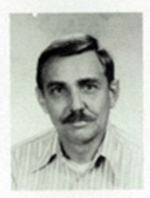
Recently I briefly wrote about an English teacher who trusted me with his original novel. His name was Harold McDuffie, an unassuming-looking man with what I would call a policeman’s mustache. While his teaching style was dry, I could see that he appreciated literature. His love for words didn’t translate well, not in terms of enthusiasm or charisma. I think in part this might be because high school students weren’t his ideal audience. These opinions are all mine, of course. For all I know, he might have anticipated each day to interact with young people. Works by Melville or Faulkner, however, tended to be at the bottom of the playlist for the average high school student.
One day, without much fanfare, Mr. McDuffie stopped me and asked me if I would be interested in reading a novel he had written. He warned me that it had some mature content and that I needed to be careful with that aspect of it. I think he knew that my home life had exposed me to things beyond the contents of his novel, but he was smart enough to know that it was a risk, one that I would not expose him to. I was flabbergasted and honored. Reading the words someone chooses to put on paper inevitably lets us get to know them better and connects the mechanics of translating ideas to words and content.
After I wrote a lengthy interpretation of a book, Mr. McDuffie had asked me why I had not shortened my homework. I told him that I thought writing was easy. All one has to do is to put pen to paper and not stop. (Later, Steve Martin stole my idea for the New Yorker and one of his books.) “What about the mistakes?” Mr. McDuffie asked. “There aren’t any if you refuse to see them that way.” It turns out this is a common life theme for many of us.
Later, he brought in a printer’s box full of several hundred linen sheets of paper. I had never held an original unpublished work before, and the effect was mesmerizing. The title of the book was “Taking Care,” and the main character’s name was Budd Clevenger. The plot involved a drunk-driving death and the cycle of vengeance that followed. Drunk driving was a topic woven all through my childhood: my father had killed a cousin of mine while drunk, I had been in a few accidents involving alcohol, and my parents had each been rewarded with multiple DWIs. They were also involved in the DWI “fixing” scandal that sent a notable lawyer to prison.
As many things as I’ve forgotten, I will always remember the excitement of taking the novel home, opening the box, and starting on page one with the inside cover sheet. I had to carefully pick out each sheet, read it, and lay it face down on the other side of the box. Despite the book’s length, I read it in one evening. One thing about the novel that caught me was that it was one which took place in Northwest Arkansas, traversing places I might have known.
Even as a work of fiction, Mr. McDuffie did as so many authors had done before him: he secreted away little slices of himself into his novel. While I had no way to know which pieces might be fiction and which might be the truth, it opened my eyes to him as a real person struggling with the same life issues that everyone else had. He was a descriptive and gifted writer.
Over the years, I have done deep web searches to see if McDuffie’s novel ever made it to the shelves or to a screenplay adaptation. His book deserved such a chance. While it was no work by Faulkner, it was worthy of being shared and read; because it wasn’t Faulkner, though, it would have appealed to a broader range of interested readers.
That I remember the title of the book and so much about it should indicate the level of attention I gave to the novel. While I read many books in Mr. McDuffie’s class, I read those with a casual indifference granted to schoolwork; as for his original, unpublished novel, I gave it the reverence it deserved. It would have been sinful to have not shown appreciation for the gift of sharing that my English teacher granted me.
Beyond the act of sharing the book, he shared a moment with me. It turns out to be one which lingers. Thanks, Mr. McDuffie.
(PS: I also have some stories about good and strange times I had in his wife’s classes, too)
As you read this, give me the benefit of the doubt, just as I strive to do as often as possible. I’ve got the respiratory crud and my usual sweet temperament leans toward riotous today. The errors are all mine, as always, especially since I’m both increasingly blind and lazy about proofreading.
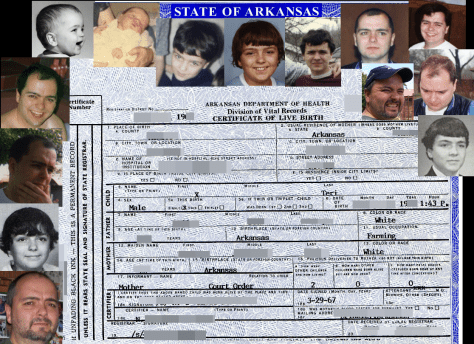
I’ve shared a volume of stories about my past, about my birth name, and about the process I used to change my name and I how I chose it. I hammered a large nail in the coffin of my previous life when I changed my name. I got a whole new set of documents to go with the rejection of my former life, including a new birth certificate, passport, driver’s license, and school records. (No, I wasn’t actually in Witness Protection, although I’ve told a lot of people that one.) I haven’t always handled well those who used my old name like a dagger; overall, however, I’m confident I gave most of them more benefit of the doubt than they deserved. Had I to do it all over again, I would’ve adopted the final season Walter White persona to deal with them. Much of the nastiness leveled against me made for great stories. I can’t have those stories without having been on the receiving end of the behavior – life provides stories most often when things don’t go well, as you know. Sharing those stories put the spotlight on those very people who hated being illuminated.
PS: (1) Due to the Malcolm X movie in 1992, I literally got a truckload of free merchandise with my new name on it: shoes, socks, shorts, gym bags and at least 50 t-shirts. (2) When the radio station 104.9 The X came online, I had a lot of fun, too, and another round of free stuff. (3) I landed on the no-fly list for a while, just as much for my crazy politics as my name. (4) For a couple of years, I lived in Apartment X, which confused EVERYONE who thought it was a joke. (The complex of 4-unit duplexes used letters in lieu of numbers on their units.) Changing my name resulted in several great stories, a more interesting life, and a better outlook for me. My name in and of itself announced to all to stop expecting someone normal to be the face associated with the name; many thought I was black or a member of the Nation of Islam. (If it made for good fun, I would encourage such erroneous conclusions). I’m sure that my name closed a few doors to me as well, to be honest, but those doors were not ones I was particularly interested in anyway.
At least I didn’t have a large leg/arm/neck/face tattoo to startle people. I guess I could have put a large “X” on my forehead like Charles Manson did. I embraced my weirdness and if I could repeat those steps, I’m afraid I would have embraced weirdness earlier and with much more aggressive creativity. Most of the truly happy people I know somehow learned to disconnect the fuse that connects their self-worth to the outside world and the judgment which accompanies it.
The common element that flows through it all is that my birth name was and is a symbol of abuse and ignorance. As young as I was when I opted to change my name, I waited too long. While I came to a place of acceptance about my dad, I never once enjoyed my birth name or the thought that I shared such a bond with a person who demonstrated such brutality. It’s not within my ability to convince you that it was the right thing for me to do; it was the only thing that got me past the lingering nonsense of my youth. Absent a childhood and story similar to mine, you can’t bridge that gap without losing something in translation.
If you can imagine having a name that you loathed, one that caused you to cringe or want to hide away in a dark corner each time you heard it, or one that causes actual pain, that’s the feeling elicited by the name my parents threw on me.
I’ve been X for way more than 1/2 of my life now. I rarely see my old name and hear it even less. And when I hear it, it’s because I am probably back in the cradle of the indifference and passive-aggressive hostility that spawned me. I alternate between irritation of those who ignorantly insist on using it and pity for the lack of understanding on their part. I try to give people the benefit of the doubt. The decades that have shot by should have eradicated any reasonable attempt to use my old name.
It is obvious that I’ve spent an inordinate amount of time explaining to people why I hated my name and that it is the equivalent of verbal ammunition when used against me. I can’t force people to be good, compassionate considerate people; only they can lead themselves to that course of action.
As for my family, time has marched past most of them, leaving me to fend off a few stragglers. As they age, their logic weakens and their actions belie the prejudice toward me that failed to conceal their contempt for me and my choices. I mostly chose the person I became, while they became victimized by their own pettiness. I suffer the infrequent flare-up of derision. Now, though, I am adept at using the tools in the family toolbox to hold a mirror to such ignorance. It is true that much of our shared time was wasted arguing about something that was not for them to decide. I tried to get them to see that but haughtiness and arrogance held them to their attitudes.
I also have a couple of people who lash out in my defense at those who still want to be asses about my name change. My wife is one of them. She knew me when I was young and still had my birth name. It angers her that people can be so petty. There are times when I almost fail to notice or worse, don’t have the energy to pick up the battle-ax and fight on a particular day.
Here’s a list of acceptable reasons to call me by my birth name. This list is one a friend objectively and half-jokingly wrote for me:
1) You don’t like me and using my old name is a means to backhandedly express it.
2) You haven’t seen me in forever and your brain used its old pathways. No harm!
3) You are writing my biography and your mind slipped for a second. No harm!
4) You don’t like my name and you think that using my old name somehow not only negates my life choices but also allows you to use it without coming off a little mean-spirited.
5) You just forgot accidentally, which can happen to anyone. No harm!
As always, though, the cardinal rule is this: if you are asked to stop doing it and don’t, it’s not a failure to communicate; rather, it is a failure to emancipate – to let everyone be who they are.
Regards, X
A personal story. It’s not an accusation – it’s just a few words that I’ve had in outline form for a long time. I’m tired of seeing the draft go through various digital incarnations, from Lotus to Word.doc to Word.docx. I’m pushing it out the door, taking away its leftover power. The errors are all mine, embraced and sent out into the world.
I’m writing this, neither to spoil the legacy of someone who others hold dear, nor to complain about sunsets long past, but to remind people that sometimes we know different versions of the same person. Words of praise are deeply worthwhile; sometimes, though, words conveying truth that all might not embrace are equally important. My little story will have no lasting impact on anyone who had a different experience. People can say they had a different experience but not that they disagree with me, because the words herein are true and these experiences are mine to share.
After high school, I wrote letters to all the teachers who I thought were deserving of a kind note or word. There were many. Many of you who know me have read some of my individual words of praise. I’ve written a lot of them to the dear people in my life before they’ve passed, so that they can be warmed by knowing that someone remembers them and cherishes that part of our lives that overlapped.
For me, Mrs. Creighton was not someone I admired. I tried to like her, to look past her scowl and directness. After a few interactions, though, I discovered that I wasn’t imagining things and that she simply did not like me – and for no reason I could discern. I was mostly a quiet student, usually scared and frightened by life, and didn’t give her a reason to lash out at me. Maybe if I had known her when her teaching career was younger or if she had simply voiced aloud why she detested me immediately, maybe then I would have had an opportunity to understand her.
Before taking her class, I had heard the rumors. I had also heard all the larger-than-life stories about her, of her military background, of her personal eccentricities. I went in prepared to pay attention and stay off her radar. (Please note that I am paraphrasing words in my story. They aren’t exact quotes but the content and feelings elicited are accurate.)
After one of the first assignments in her class, one in which I poured myself and creativity into over 5 extra pages of writing, she responded with this: “C student. Some are not destined to extend their reach. Quantity doesn’t replace talent.” She had only red-lined two words out of the entire body of my assignment. The girl on the right of me had a paper that looked like a chicken has scratched it for an hour. She had a large “B” across the top of her paper, however. When Mrs. Creighton had announced the assignment, I was one of the few in class who didn’t dread it. Writing was easy for me. Maybe not grammar or syntax, but the act of writing was effortless and I tended to write something each day. I was stunned by the C grade, especially given the extra writing I had done. But the words justifying the grade punched me directly where I lived. They seemed irresponsible, almost hateful, coming from a teacher.
I reluctantly waited after class and asked her what I could do to not be on her bad side. She laughed a staccato burst as she so often did and said, “Nothing. There’s nothing you can do. Now run along,” waving her arm dismissively toward the door.
As quiet as I was, I told her that it was unacceptable for her to give me a “C,” and not just because I was afraid to get a lesser grade. I told her that if I couldn’t stop her from disliking me even though I had never interacted with her that I could object to her grading my assignments with an unequal eye compared to my classmates.
“I don’t take kindly to threats, young man, and if you persist you’ll find yourself in the principal’s office explaining your behavior.” She stood up from her desk as she said it.
To which I replied, “If I’m going to the principal’s office for some personal reason on your part, I might as well have him take a look at my work. And if you think you scare me, I’ll tell you stories about my dad.”
“The grade will not be modified. Now please leave.” She once again pointed to the door. I left, shaking my head at the idea I was going to endure a semester of that sort of treatment.
I should point out that I wasn’t afraid of getting a bad grade to make a point. While my final GPA was about 3.6 (when 4 was the highest possible), for example, I deliberately flunked trigonometry in my senior year, after getting over 100% in a previous semester in Geometry. My problem is that Mrs. Creighton needlessly used her words to squash me. Had she given me a “C” without comment, I would have been perplexed, but would have never said a word to her. My personal life had beaten into me the idiocy of expecting fairness; she was simply another example.
I was a voracious reader, writer, and loved the power of words. She gave me one assignment that I simply didn’t understand. I told her that I honestly just wasn’t getting it and needed guidance. With the iciest of looks, she told me, “I can’t make you understand. Read the instructions again.”
Toward the end of my term with Mrs. Creighton, my dad had punched me in the face after coming home drunk and finding me practicing my French horn for band. It always angered him that I loved band. He hadn’t warned me or said a word to me. He simply sat the bottle of whatever whiskey he was drinking on the table and punched me while I was playing. I dropped the horn, which was school-owned, and I fell to the floor. Luckily, my dad had drunkenly misjudged and his fist had hit me on the outside of my right eye. By the next morning, the black eye was mostly confined to that side of my eye, although my ear was still ringing and my face was sore. I got a pair of broken sunglasses that had belonged to my brother and wore them to school. I put them on in each class to cover the dark smudge on the side of my eye. I had never covered such bruising or signs before, not really. Dad was usually very careful to conceal his brutality, a habit I learned later that most abusers share in common.
When Mrs. Creighton came in to the classroom, I had forgotten to take the glasses off. She shrieked at me in front of the entire class. “Take those foolish glasses off now! You are no Tom Cruise by the stretch of anyone’s imagination!”
After class, I approached her desk to apologize.
“Don’t apologize to me. You know the rules.” I pointed at my eye and said, “My dad sucker-punched me when he came home drunk, Mrs. Creighton.” She held up a hand to stop me. “Perhaps if you’d behave your father wouldn’t see the need to discipline you.”
It was that moment when I knew that her heart was stone to me.
.
I took being tardy seriously when I was in school. One day, I had walked back across campus to return a personal book a teacher had loaned me. Mrs. Creighton had semi-shouted from quite a distance down the hallway “Where do you think you are heading?” I heard her but didn’t turn, because I couldn’t imagine she was addressing me.
“Mister, I asked you where you are heading?” Something in her voice caught my attention.
I turned and politely said, “Back to the band hall.” I wasn’t being snarky, funny, or impolite. I was just answering her question. I kept walking.
“Stop!” Mrs. Creighton seemed miffed at this point. “Are you trying to be humorous? If so, you are failing.”
“Just answering your question. Another teacher loaned me a personal book of hers and I just returned it. I have no class now, so I’m not tardy, and am going to go practice in the band room.” I answered without any rancor, as I wasn’t in the mood to get into any trouble.
“Next time, don’t be in the halls after the bell rings.” It was a command.
“Thanks, the bell hasn’t sounded yet, though.” I said and turned to get away from her.
“Did you hear and understand what I said?” Mrs. Creighton had decided that I was being impertinent, if the icicles hanging in the air were any indication.
“I understand where you are coming from, yes.” She knew the deeper intent of what I had said.
I saluted her and walked off, putting her dislike of me out of my mind. I expected to be hit on the head by a thrown object or to hear a screaming demanding that I stop again.
.
PS: The book I’m talking about in the scene in the hallway, that novel was loaned to me by the teacher who had written it. It was an unpublished novel with mature content. He had trusted me enough to want to share it with me, to see how much work goes into writing a well-crafted book. And I had read his book, turning the unbound printer’s copy of his book one sheet at a time as I read them. His goal was to always remind me that grammar could be learned but creativity and inspiration were things that had to be nurtured. He encouraged me to stop worrying so much about the process and instead develop the habit and love of reading and writing. I read his book at home, getting a glimpse of his mind, and of another world of possibilities. The example of my other teacher who had authored a book and shared it with me to encourage whatever hope or ambition I might have- his example is a testament to what a teacher can and should strive for. I was the same student, the same person in each teacher’s class. In one, I was a waste of time and nuisance. In the other teacher’s classroom, I was a nascent mind needing some guidance. (Sidenote: the subject of the teacher’s novel involved the consequences of a man drinking and driving, which is a strange coincidence when aligned with my life.) I remember Mrs. Creighton being so mean in the hallway precisely because I felt a little magical, being trusted enough to have the printer’s copy of an author’s book in my hands.
But, through the years, I read kind words offered by ex-students of Mrs. Creighton and think of her. I wish I could recall her brusqueness with warmth; instead, I picture the look of scorn on her face when she interacted with me. Whatever caused her to dislike me before she knew me was obviously something outside of my control. Perhaps she saw someone she once knew in my eyes or thought I was someone I was not. After her passing, I discovered that her anger wasn’t a secret, just as much as her wry sense of humor. I felt a little vindicated that others shared on the receiving end of her sharp tongue. Whatever demon that possessed Mrs. Creighton to be so angry toward me luckily was one she didn’t apply to many students. It lifted a little of my burden to know that I hadn’t been crazy – that she had disliked me without cause and the burden of ‘why’ was entirely on her shoulders.
You might ask, “But what good does it do to share criticism of her now?” Firstly, because I am still here and it’s my story to tell. Each of us navigates through life and leaves a history in our wake. Not all of it is to be admired and the stories might not be ones we’d like to be recalled after we’re gone.
That might be the point of it all, though. We are the sum total of our moments. There are so many I’ve forgotten, even important ones. Whatever my motivation, this story is mine to share, just as it is for those who had a different experience.

