“I don’t look for exoneration, though I want it. There is no one in this world who can be both aware of my actions and the reasons for them except for me. Since I don’t pardon myself, I expect no less from others.” -X
I do look for understanding, and if that’s not possible, acceptance. All of us desire to know who we are and that who we are is of consequence to someone.
“Never attribute to malice that which can be adequately explained by stupidity.” I fail in this regard a lot, even as I continue to hope that others will assume no failure of character on my part.
“We judge ourselves by our intentions and everyone else by their actions.” -S. Covey
If you think above these for a few moments, the hypocrisy of how true it all is numbing. I’m working on it. Honestly, I always will be. I can’t imagine aiming for an authentic life without such reflection.
Most of us tentatively feel our way through our lives, wanting more of the invisible things that bind us, yet distracted by things around us. Awakening to our houses’ solid walls, we forget that whatever else we are, we are not focused on the sublime and unknowable lives of satisfaction that could be ours. It is possible that you’re different than me, and that you don’t get distracted by the volume of “other” that surrounds and confounds me.
“The bitterness of knowing the truth is that it is impossible to unknow.” The same idea has been expressed in many ways. I see “the truth hurts, but lies are worse” frequently on social media. Like all universal knowledge, it becomes fuzzy and self-referential the more you try to grasp it.
Knowledge changes us, even if we turn the recognition of it away from prying eyes or panic that it will change us. Whatever we are is already essentially invisible, leading us to hold close the changes we can’t share. In part, it explains why people suddenly seem to change; they trapped their truth until it couldn’t be contained. While the catalyst might have exploded in a single moment, the ability to reveal ourselves is frightening.
We learn something, we figure another thing out, or knowledge breaches our defenses. When we compare it to what we knew before, it’s inescapable that we’ve changed too. Whatever malleable ideas make us a person, a new insight either dents us or expands us.
For those of you who don’t know the agony of insight, it often results in paralysis. Whether you understand that something fundamental to you cannot be right or that you’ve spent time furthering people or a life that you didn’t seek, it is at once liberating and confining. If I were a betting man, I would predict that the postcovid world will shatter us as we wonder if our attention wasn’t in the wrong direction. I do hope it continues to break us of our obsession for things.
Some of my insights include the idea that if God exists, he cannot be an interventionist. Unseen dangers fly above and around us and narrowly miss us with ridiculous frequency regardless of who we are or our accomplishments. That youth and health are no more a guarantee of a long life than any other factor. That certainty of the world or myself is the surest sign I am about to reminded that I am ignorant of both. That love is the glue that both expands and contracts.
Of all my insights, I think the one that traps us most might be that we are indoctrinated into the false promise of security by the right choices. It’s possible to make only the right choices and still fail – or be unhappy. It’s a bitter truth. With the finite number of breaths I was given, how could I possibly know what would lead me to a satisfied life? Not one without agony, because such lives are absent.
I find myself inside the pinball machine, bouncing from one reaction to the next – even as the tally of my remaining steps allotted to me fades. Because we’re human, I suspect you also often look out into the world and deeply feel the disparity between who you are and your place in it.
I have no answers. As I’ve aged, I’ve been glad to see that so many people have admitted that they are struggling for meaning and unsure of themselves. Those who seemed to have surety and confidence often are better at distraction or demeanor. A few years ago, I told a graduate that “the secret to life is most of us are winging it.” His dad, though a brilliant man, told me, “He is not ready for that certainty.”
With love comes turmoil. With life, hardness.
As late as yesterday, someone told me to “choose your hard.”
The census worker stood by my custom address plate when I emerged from around the blind corner of the house, holding a long metal ladder over my head like an idiot. I didn’t know he was standing there; the ladder was over my head for purely ridiculous reasons. The truth is that it seems perfectly safe and reasonable to run around one’s house with a long metal ladder above one’s head, much in the same way that scampering inside the house with two pairs of open scissors seems safe. I’m 53, so stupidity hasn’t so far been fatal. Check back tomorrow, please.
The census worker must have noted a large shadow was overtaking him because he turned around quickly. I’m not sure what he was thinking – only that he was perplexed. Without bothering explaining why I say so, he was the embodiment of what a census taker should look like. I wish he had been wearing a green accountant’s visor. It could save us all a lot of guessing and speculation as the workers navigate through neighborhoods. (If you’re with the Census Bureau, you’re welcome.)
“I completed my census form online a long time ago,” I told him. “Sorry about listing myself as a Vulcan. It was hard enough searching for ‘human’ on the checkboxes.”
“Yes, I saw that in my system. I’m doing a follow-up on a few of your neighbors.”
“Well, you’ve come to the right place,” I told him. “I’m X, bilingual, and do genealogy and general nosiness.”
He smiled. “I’m having problems getting these two houses to respond. I’ve been here before, left notes, etc.” He pointed across the street.
“Yes, you’re not going to get a great response rate here for the reasons you’d expect.” I told him the number of people residing in each house and their general age, ethnicity, and why I thought they wouldn’t respond no matter how many times he knocked, called, emailed, or parachuted into their respective backyards. The census worker seemed surprised when I told him that the first house he pointed to had 6 cars usually parked everywhere. (It looks like a parking lot. The entire neighborhood is slowly becoming one – a fact I predicted when we moved here. A closed set of streets that allows parking on both sides is doomed to become a hazard.)
“You’re going to need to bring a minority census worker with you. You need to come back at 6 p.m. and approach the house when one occupant is already outside. And say, “We need your help” instead of whatever has been scripted for you.” The census worker nodded. We talked for a few minutes.
Before surprising the census worker, I noticed someone sitting suspiciously along the curb a couple of times. I imagined several imaginary scenarios for him: assassin, assessor, or inept thief. I’m still surprised that people distrust census workers. That says a lot about my sheltered life and privilege.
The total number of residents in those two houses is 15-17, depending on the time of the year. That’s a lot of federal money and representation missing. Multiply it by the likelihood that the same pattern is being repeated over much of Springdale, and you get the idea of how massive the problem is.
I’ve done more than my share to help people understand what the census is for and why citizenship is irrelevant for the purposes of counting. I can understand why some people might not be so trusting, given the White House’s occupant in the last few years. Since the census is being prematurely closed down this year, it is a certainty that we’re all being undercounted. Whatever else is going on, the current president isn’t helping matters.
Whether every person should be counted is an issue for us to decide and remedy via the constitution. Until we change the way we do it, we rely on accuracy to share dollars and representation. I get a little cranky about constitutional arguments, as the group of rich white men who wrote it managed to demean well over half the population when they did so.
I have a few white American friends who are also deliberately not participating in the census. Some do so out of privacy fears, some simply because they don’t understand how it impacts them, their community, or their children. The others fall into a category I call “boneheadedness.” That’s what democracy is for: to irritate one’s neighbors. As a liberal, I do my part.
Everyone failing to be counted is doing all of us a disservice. Unlike failing to vote, it is inaction that literally costs us.
With the technology we have today, it is difficult to understand why such a herculean bureaucracy is needed to do what consistently applied technology can. Before I pat myself on the back, I admit that such a system would rely on people much smarter than I am – and not as prone to shenanigans.
Meanwhile, countless residents refuse to answer their doors or reply to the mail the census bureau sends.
As for neighbors who didn’t answer directly, they can thank me for doing the heavy lifting for them. If I had the inclination, I would knock on their doors and leave a note to let them know that their secrecy in itself draws attention to a handful of possible explanations that tend to draw increased scrutiny rather than less. Unlike many, I understand their reluctance and remind myself that my reality is not theirs and to stop blinding myself to it.
I enjoyed talking to the census worker. He was impressively smart about a lot of topics. They really need the green visors, though. .
Notes: The 2020 census was conducted with fewer than 1/2 the total census workers we used in 2016. Many Americans don’t know that everyone alive inside the United States is supposed to be counted. This is the first census that allowed responses by mail, internet, phone, and in-person. For those who don’t do genealogy, census data is released 72 years after it was taken. (This information is incredibly valuable to us tracking ancestors.)
“I find it damning that I can both love someone as a person walking this earth with me and yet despise their ideals. Politics is subverted because we are.”
We blame our response on the system itself as if we did not actively create it or passively nod as we inherited it. Few of us find this to be what gives us comfort or represents the best in us. Most of us scowl and grow angrier at what we’ve allowed, although we might do so from opposite political spectrums. That we don’t have ten distinct political powers is the single biggest issue we face; such fragmentation requires coalition and cooperation. Two-party systems destroy our ability to stop rooting for ‘us’ at the exclusion of ‘them.’
It is our system, the one we’ve allowed to remain. Acknowledging our failure is an indictment of how incapable we are of managing our affairs—failing to realize it is a charge of compassionless disregard. The constitution recognizes itself as a fluid document, just as we should see ourselves as fallible and prone to selfishness and stupidity.
If we are each not culpable, no one is.
Wandering through this year, each of us fought against our better nature. Simply put, it is not about an election. It’s about us.
We’ve failed.
No political system that culminates in a crescendo of shouts and dissonant voices like this one is a success – no matter how it turns out. The victory you might imagine will be its opposite to those who lost.
We all know that elections are supposed to be a collective handshake about the direction we choose. Words like ‘us’ mean nothing when we disagree on what ‘us’ is or how we get to raise our hands and offer opinions. Marginalizing anyone will water dissent and anger.
We learned of our shared history in school and wondered how such a young country could tear itself or reveal that its dedication to ideals could be so completely torn. Observant citizens no longer wonder; instead, they pivot and watch those around them.
No matter who wins the election, we have fundamentally exposed the facade of our imperfect system. As flawed as it is, it is merely a reflection of us.
We’re fixable. So is the system that seems to dissatisfy all of us.
Though I’m a liberal, I’ll give up all my nuanced objections if we could establish a political system designed to help people. As ignorant as I am about so much, most of us agree that what we have is unworkable and increasingly worse.
If we don’t devise an intelligent way to find a system that serves us better, entropy and chaos will align to assign us as a footnote to an avoidable disaster.
2020 had its issues before involving a national election. How many of us can survive a repeat of this for the rest of our lives? We will lose the ability to engage in public policy and how to manage it.
Unlike many, I’m not foolishly offering solutions. If we can’t get there from here, we’re in trouble.
Breaking the entire system will result in something no one will enjoy.
Since we seem to be there already, I suggest we try something different.
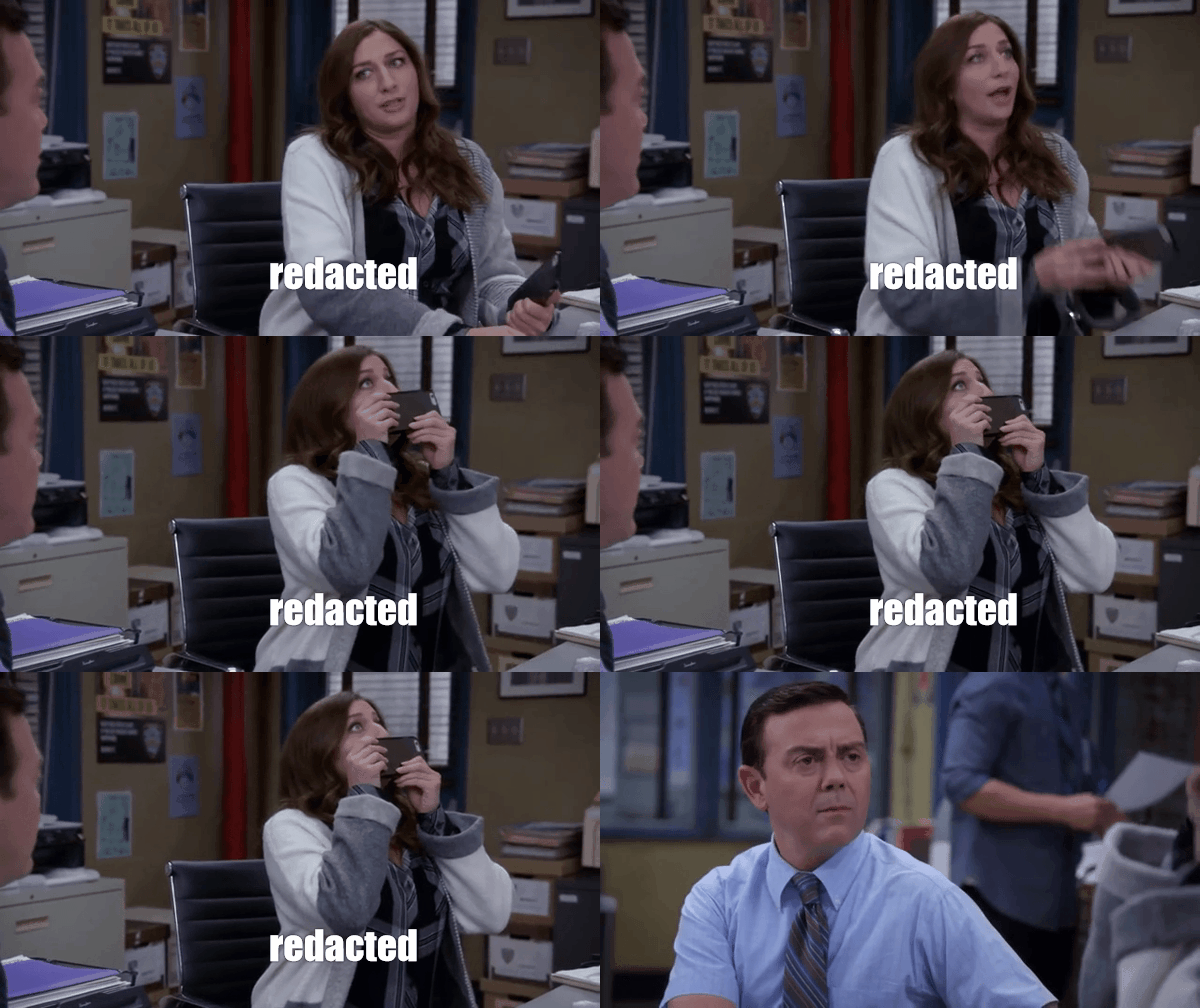
Although similar thoughts have passed through my porous brain over the years, I admit that the “Brooklyn 99” episode with Gina forced me to laugh out loud. I’ve said “blank” or “unintelligible mumble” in the past. Gina’s use of “redacted” was funnier, perhaps in part to the fact that not everyone would use the word in everyday conversation.
Have something you’d like to say but not say it? Want to curse but can’t? Have something potentially offensive? “Redacted” is your word.
In much the same way that saying “Karl” (from “Sling Blade”) denotes sharing a deep feeling for me, I find “redacted” increasingly serving in that capacity, too.
I made a gif to commemorate the word’s increased usage in my private vocabulary.
I see so much teeth-gnashing about truth and reality.
Even Grammarly, the proofreading AI I use, told me, “Your tone is angry.” If it had such a mechanism, I’d reply, “No, you’re wrong,” to prove this post. I did chose “ignore suggestion,” which does address one aspect of this post. It’s ironic that I pay for this service only to ignore such suggestions.
It doesn’t matter what the specific conspiracy theory or weird belief is. It is not the particular belief that is the problem. People don’t have a system to examine how they got there or how to get out of that particular belief. Politics, vaccines, covid, religion, astrology, or white people’s alleged supremacy are a few examples. We bludgeon our way through our lives, trying the same tactics and responses repeatedly, even as we paint ourselves into constricting circles.
Our biggest problem is that “we know.” Even when we don’t.
As wrong as I was when I was younger, it is still hard for me to accept that I must be wrong about things now too. Having always been wrong about something indicates that I’m currently suffering from an unidentified bit of idiocy.
To get the hypocrisy out of the way, I have my blind spots. I have a system to counteract it. I hold a very few people in esteem enough to let them gleefully bodycheck me if necessary if I’m trapped in a stupidity loop. If they point out that I’ve suddenly fallen victim to believing something stupid, I’ll take a long look. But I don’t include most people in this circle. For example, anyone trying to discuss politics but doesn’t vote, I don’t listen. (But I do believe that non-voters have the right to participate and opine.) If they are working an entry-level job, I disregard anything financial they say unless they are monk-like in their happiness. If someone hasn’t read a book in five years, let’s be honest – they should sit down and be quiet. The tricky part is convincing a good person that you’re interested in frank criticism. It’s a rare offering. Human beings aren’t programmed to make friends by being honest in that way. “Hey, you’re getting kind of chunky, X” would be a good example of something hard to share, no matter how close I am to that person.
One of my favorite go-to comments is that millions of people think the moon landing was fake – and many more millions are ‘undecided’ regarding its validity. I try to say it like a mantra, as it reminds me that no matter how well we explain ourselves, teach science, or rely on the common bond of truth, the lunatic fringe is not only more than just a fringe, but one that we can’t convince to evolve.
Among my list of popular ‘truths’ that are bogus is the Lunar Effect. It addresses the misconception that the moon (and especially a full moon) affects human behavior and especially strange human behavior. Pop culture, our grandmothers, and countless reinforcements have pushed it into people’s brains in such a way that it is just background noise and accepted. Due to the recent full moon, I saw at least two Lunar Effect posts on social media, with multiple comments and anecdotes. I didn’t interfere. The result would have been immediate contradiction and anger if I insisted. A letter from both Jesus and Albert Einstein would not have diverted their certainty.
It’s not true, of course. Like the ongoing and incorrect belief that an ulcer is primarily caused by stress rather than a bacteria, no amount of evidence, study, or direct appeal can convince people that they are completely wrong about the moon’s effects on behavior.
As you would guess, even bringing this up triggers many people’s defensive response. Their brains immediately react with a litany of learned responses. All are wrong. You’ll see a barrage of misstatements, each based on faulty methodology and study – but also cemented into their rigid structures identified as truth.
If you’re reading this and disagree, you’ll invest a great deal of your time and attention to devise a point to ‘prove’ my argument is invalid. Meanwhile, pieces of your life will pass you by, you’ll lose vital energy, and you’ll still be wrong. The only thing you’ve proven is that you’ll waste much of your time and energy trying to convince someone who probably isn’t in your inner circle anyway.
As with the moon landing deniers, no amount of science, data, or facts can dissuade a closed mind.
Don’t try it.
At any given time, about 1/3 of Americans are on the fringe side of any debate, question, or issue.
You can expose people to the truth, but no amount of words or strident argument will ever turn their attention and convince them. People must convince themselves.
Any effort you expend to convince an unwilling dissident will be a piece of your life that you’ve wasted. There is no magic combination of words that will ignite a light of recognition in people’s minds.
When my Facebook author page started getting readers, I had a smart older gentleman start reading all my posts and interacting. One day, I opened Facebook to discover that he’d angrily written at least a half dozen angry comments, each of them detailing the evil of using the word “xmas” instead of “Christmas.” My post was very optimistic. He focused solely on the word “xmas” to the exclusion of all else. Of course, I politely linked him to multiple sources indicating that he should acquaint himself with the historical and religious context of “xmas.” At that point, he flamed out like a cotton bale on the 4th of July.
Over the years, I’ve had multiple instances of grammar experts incorrectly repeating various ‘rules’ that are mostly just generally agreed-upon ways to communicate. Whether it’s the apostrophe, ain’t, you’re/your, couldn’t care less, or any of the other thousand bones of contention, many people want language to be as concise and static as math. It’s not. As a bona fide older person, I’m supposed to become more rigid as I age. I don’t. Quite the opposite. As late as yesterday, I found myself surprised that there is no agreement whether “detectible” or “detectable” is the correct choice.
Without getting into the weeds, I recently had someone challenge me on the validity of something I’d written. I’d mentioned I could prove it. The person in question angrily said I had fabricated the allegation. Naturally, I did my best to stay calm. I wrote an email and attached a copy of the email that proved what I said and an IP index. The reply was hate-filled. The person writing didn’t stop to think that he/she sounded like an angry lunatic. After thinking about it, I wrote back and said, “Ask _. They’ll confirm. That should convince you.” A couple of days later, another reply. This one was worse than the first. They were furious that someone else knew about the incident in question – and worse, that it made the angry person look stupid and hateful – something out of my control. My final reply was an apology for expecting them to respond critically and that I’d keep their correspondence for myself unless they tried to call me a liar again.
A few years ago, I finally hit the end with my mom. I couldn’t do it anymore. I’d been through the cycle of no contact with her several times. Discovering she had Stage 4 cancer forced me to try to navigate the waters with her until her death. I’m not sure I would do it if given an unlikely chance for a do-over. My emotional deficit made it impossible for me to engage logically.
In the last couple of years, I alternated wildly with my brother, despite knowing that I was inconsistent and probably stupid. One of my go-to people told me that I needed to avoid replying, as it would fan the flames and reward the person trying to victimize me. (This person wasn’t my brother.) It took me a bit to see how right it was. It didn’t stop the other person from being a tool to me, but it did leave me out of the equation. When I did get around to addressing it, I was able to be peaceful and calm about it. (Which, of course, made the person even angrier. No one likes being angry while dealing with someone who won’t’ stoop to your level.)
As a liberal, it took me years to understand that not all the immigration arguments were specious. All the shouting obscured much of the meat and bones of the counter-arguments. As a result, I realized one day that while there were a lot of angles and I still generally disagreed substantially with the conservative viewpoint, I saw the truth in some of the objections. More importantly, I noticed that not allowing any flexibility in my stance was causing me dissonance.
More importantly, living a good life is often 80% the act of not engaging. That part is almost a miraculous ability.
If you’ve read this post and wondered what the theme is, accept my apology. I’ve had a version of this sitting in my growing list of drafts long enough to have children.
I am of the continued mind that we should drop the pretense of vanity and concealment. We should just offer voluntarily the worst possible perspective, the worst possible picture, and the worst possible interpretation of our motives through life.
If you think about the title of this post, it should project the exact tone, imagery, and point that I’m trying to make. Sunsets are beautiful and most of us agree. The world that brings us back to the center is one of necessity and immediacy.
Each of us is engaged in a varying degree of war with other people’s opinions of us. Someone smarter than me pointed out that every person has a different idea of who we are in their head. Each of those images reveals at best 75% accuracy.
When we are reduced to our visceral essence, much of our ego of pretense abandons us. For all our lofty goals and vain ideology, we are all equally engaged in the grind of survival.
For me, what gets me through these days, is the idea that you’re sitting there with an unpleasant picture in your head and wondering how mere words took you there.






 P.S. Parenthetically Speaking