Category Archives: Social Rules

Years And Years (TV Show)

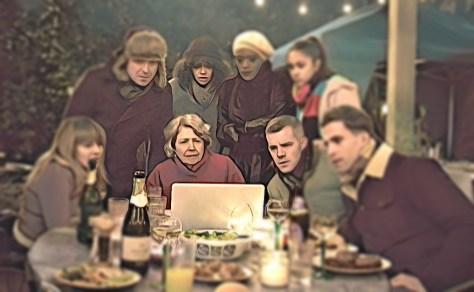
Painnt_Creation_2019-07-22_043528

For anyone interested, I recommend the HBO import show “Years and Years.” It’s dystopian from necessity, yet feels like a time traveler may have gone forward and returned to camouflage a possible timeline waiting for all of us.

Without flinching, the show throws you into a tailspin as Trump detonates a nuclear bomb near China as his second term expires. Technology, medicine, immigration, politics, money, and other issues swirl and coalesce as time frenziedly hurls forward, whether we’re ready or not.

Although it’s based in England, the storylines overlap with world events we’re already witnessing. The story focuses on a particular family as it spins in and out of control. The family could be any of us. Forces we’ve set in motion conspire against us.

Anne Reid, who plays the matriarch Muriel in the show (and who was phenomenal in “Last Tango in Halifax”), gets credit for the best line of the show: “It’s a terrible, terrible world, but I want to see every second of it.” She gets credit for the second-best lines in the show – and perhaps one of the best lines in a TV show, ever, when she points that each and every one of us is to blame for almost all the problems we see externally in the world. It’s impossible to watch it without wincing in recognition.

It’s easy to compare “Years and Years” to “Handmaid’s Tale.” This show, however, connects in a more recognizable way. You’ll feel some strange emotions as you watch the show unfold. Among them are dread, fascination, wonder, loss, a bit of terror, and hope. All of them fight for dominance, often simultaneously. Like the Hulu show, I find myself thinking about the implications of some of the ideas days afterward.

For anyone wishing to find something that is limited in length but infinite in the ideas it will provoke, I give this show a huge recommendation.

When time shifts forward in the show, the eerie melody that accompanies the shift might make your hair stand on end. You’ll be thinking, though.

And you might be thinking, “Is it REALLY us?”

Yes, it could be.

“Years and Years” is one of the best shows I’ve watched in quite a while.

The Grudge Conclusion

kelly-sikkema-_whs7FPfkwQ-unsplash


The Grudge Conclusion:

If you consume social media, you’ll get tired of simpletons saying that all grudges are synonymous. If someone doesn’t want to talk to you because you significantly abused or harmed them, it isn’t a grudge: it’s wisdom disguised as self-protection. If the simpletons persist in wrongly classifying your decision, they are clearly indicating to you that they hold a low opinion of you – or a disproportionate opinion of themselves.

Privilege, Improvement, Hypocrisy

brandon-wentland-VYLrXrI-Rwk-unsplash


Now that enough time has elapsed, I can post this. A former resident of Springdale had taken considerable pains to challenge a bit of civic improvement. He has a family member still living in Springdale. After investigating the details, I agreed that the city had awkwardly presented its plan. Most of the intended change, however, greatly benefited the city as a whole. Unfortunately for my friend, the improvements would slightly infringe on the previous way of life a bit.

This is just me talking without an appeal for my words to set in stone or to be taken as words of certainty. They are in their totality a walk through some of the thoughts which come to mind when I read or hear words other people have spoken.  I don’t have all the answers, but I do have many questions.

First, appeals to the past are strange to me because the people making them inevitably and arbitrarily choose a specific time amenable to their own arguments, rather than the broader scope of history.

At risk of being ostracized from polite company again, I cringe when I see someone say, “My family has owned that land since…” as a defense against change or incursion. I can only imagine what those who preceded them might think about such a narrow view of ownership. The European arrival, for example, dislocated and eradicated millions of indigenous people. Also, this world is predicated on the illusion of permanence, even though we are floating on gigantic and active tectonic plates, swirling in a complicated vastness which will one day extinguish itself.

Yes, I know that we didn’t personally participate in the distant past; we just benefit from it. I’m not immune to being tone deaf myself. It’s strange to see other people failing to realize they also are making errors of both logic and consistency.

One of the people criticizing the previous Springdale resident for jumping into the discussion harshly framed the argument: a rich, white outsider using the process to thwart what the majority saw as a benefit for the community. He used more profane words, but the message was striking.

Springdale is the 4th-largest city in Arkansas. For several reasons, there have been significant changes which have moved it away from its parochial past. The people who’ve stepped up to make the changes have overall done a spectacular job of managing resources, finances, and issues. Yes, I have problems with the way some of it has been done, but it is the price I pay for being a part of a living and thriving community. Change is constant. At my age, I’m not supposed to be enthusiastic about the march forward. It’s supposed to be my job to be reluctant. I disagree, though. We’re moving forward, and it’s as much on me as the rest of the community to take the long view.

It’s also odd to see people who fight change because it impacts them disproportionately. It’s difficult to accept change, despite enjoying the fruits and benefits of the community. By belonging to a city, you agree to a compromise of interests. If your property is affected or impacted, you can at least take solace in the fact that you will have a chance at fair compensation – a chance the indigenous people who lived here before were never afforded.

Those fighting against change for self-interest rarely see themselves in the way I’m describing – or realize that they are fighting the tide of time and impermanence.

New roads, street widening, public amenities, parks, rezoning, public condemnation proceedings, expansion- all of these are presented as improvements, for the common good. All of them happen because communities or their leaders have decided that things must change.

Yes, sometimes boneheaded decisions are made, precisely because human beings are involved. In those cases, it’s wise to use the processes in place to cause absolute hell. Absent those circumstances, though, it is an argument from privilege to rail against the public interest, generally speaking. Poor people don’t generally get to make such arguments.

P.S. I realize that there’s hypocrisy in my argument. That’s part of the point.


Education Comes With A Needless Cost

aaron-burden-6jYoil2GhVk-unsplash

It’s strange to hear people say, “Most people don’t need college for work.”

Most people don’t need pants, either, but you won’t see millions of people heading to work tomorrow sans pants. Even if it happens, you still wouldn’t want to see such a sight, based on my wild imagination of what that might look like.

Is economic motive our best barometer for achievement? If we pursue economic interests above those of humanity, it’s my opinion that we’ve surrendered much of what grants our collective future any hope. Capitalism as we know it hasn’t been around for most of our human history. Whatever happens shortly, it’s a certainty that the economic system we currently experience will not be the one which dominates in the future.

Most people don’t need high school for a portion of the jobs that exist; trade or occupational training could replace it, but at what cost to our humanity? Implementing such a system demonstrates that we have lesser motives coursing through our veins. Whether you agree with me or not, I see our enthusiasm for education for all as an indicator of the health of our society.

If only the wealthy can easily take advantage of higher education, we’re going to see a decline in our progressive nature. As the number of jobs declines, we’re going to need to shift our perceptions of work.

We already demand that everyone fund the current educational system, even those who choose to have no children. It’s no stretch to ask everyone to pay for local college for anyone who wishes to attend. I can’t convince those with hardened hearts that an educated populace is a better populace, just as I can’t reach those who believe that we shouldn’t pay for universal healthcare.

Yes, we know it’s not free. Everything is redistribution.

If we can maintain a military capable of eradicating most life on earth, I think we can manage a way to ensure everyone who desires it can get a higher level of education (or training). It’s a strange world to me that so many passively fund an irrational arsenal of destruction, yet balk at improving our intelligence and reasoning.

We are not protected from external threats if we become a threat to ourselves. Stupidity is its own reward. Just ask a Congressman.

Whether a person ultimately becomes a plumber, nurse, or teacher, higher education is an invaluable benchmark for our commitment to society. A plumber with an educated mind is a much more valuable resource to our society. A member of society interacts on many more levels than simple business and commerce.

An argument that strives to provide only the required education to perform a job is one premised on ideals that are unbecoming to us as human beings. The amplitude and depth of our minds is one of the most valuable assets we have.

There’s no reason that we cannot establish an affordable network of responsible public colleges and universities – and pay for everyone to attend. We’re smart people. Most of us know that it’s possible to get an excellent education for a much smaller cost than our current per capita average. Eliminating the elitist demand that people attend colleges based on reputation is the first step. Private colleges could, of course, continue to overcharge for the same education that a public college can provide. The objective is supposed to be education and training for all – at a reasonable price. It’s lunacy to fund a system which doesn’t demand that education itself be the goal, rather than the path or the building in which it was obtained.

Likewise, “college” isn’t a fixed concept. We can re-design curriculum, courses, and content in such a way to eliminate fluff or graduation requirements which often only serve the education machine rather than the degree sought. We can fund community colleges which allow students to live in their communities. We can design course schedules which will enable adults to both work and attend school. We can demand that students be allowed to demonstrate knowledge without attending traditional classes and thereby sidestep the necessity of wasting time and resources by forcing them to go through the motions of the bureaucracy. There are better ways. We didn’t plan our current system; it’s a patchwork of implementations that are devoid of a cohesive objective.

We’re sending too many adults into the world with crippling debt. There’s a better way and a more natural way. We all know that college or vocational training can be done at a much lower cost to students and to society.

Whether we absolve the debt of those who preceded our proposed changes to our higher education system, it’s vital that we amend our system to course correct now that we’ve recognized the size of the problem. We can adjust accordingly as we learn more.

Much of our problem is that many are distracted by the demand for a perfect solution that doesn’t exist and isn’t directly attainable. We must be willing to listen and adapt the system as we go – which is precisely the foundation of education.

Using the benchmarks of the past to determine our path to the future is short-sighted and unbecoming.

Most of us also recognize that educated minds are more necessary now than ever. The perils of ignorance have already brought us sorrow.

I know I’m ignorant of many things. I had some experiences in school that perplexed me. One of my most significant issues was that colleges forgot they are running a business and that as a student, I’m a customer. The goal is knowledge or certification of the same for a reasonable price. As you can imagine, administrators, advisers, and professors had their ears burned by the revolutionary idea of mine that my role was not subordinate to theirs.

We can re-imagine college to mold it to meets its objective: knowledge and ability. We can do so by significantly reducing the time it takes, as well as the cost. And we can do it so that adults don’t have debt as a result of something so vital for our well-being.

It’s the least we can: demonstrate the importance of education without it being an empty platitude.

There Are No Small Deaths

miguel-bruna-655204-unsplash.jpg

This post is in defense of those who have connections with other people we don’t understand. As I hope we’ve all experienced, it’s possible to meet a person and ‘get’ them, as if we are estranged best friends. Some of these bonds are stronger than those of family. It’s possible to feel closer to one’s fourth cousin than one’s grandmother. Bit players in our lives often morph into the main actors. By living in reverse, we don’t see their importance until they’ve stepped out and away from our lives.

Only the person experiencing the feelings of loss at a person’s passing knows to what depth those feelings reach. Tendrils of connection are often invisible, incomprehensible, and unknowable. It’s important that we abandon the false expectation that we understand the loss someone else is processing.

There are no small deaths.

Even with my best arsenal of words and passion, I sometimes struggle to describe the nuances of another person and their importance accurately. That’s the best-case scenario even when I’m communicating with someone who shares a great deal of humanity. It’s a fool’s errand with those who lack a common understanding.

When a person commits suicide, it’s human to question all your choices, as well as your attention to the person who has left us. Even without the shadow of self-harm, we tend to experience a depth of introspection when we lose someone.

Whether it’s fair or not, suicide strikes us an accusation. We have to give space to those who need more time to find first gear again. Implying that the loss isn’t a reason to grieve is an unacceptable reaction.

Because of the invisibility of many of these connections, one of the most traitorous acts you can do is to doubt or question whether the relationship was real when another person is suffering from the unexpected rupture and loss. “Did you know him or her very well?” or “Were you ‘friend’ friends?” both serve to undermine and accentuate the pain of the other human being you’re inadvertently demeaning.

“Only the spoon knows what is stirring in the pot” is one of my favorite clichés precisely because it reminds me that I’m not privy to all the information contained in a situation or between people. I’ve committed the error of assuming I know. Worse, I’ve judged people based on what I perceive as only imagined depth. Because I’m human and stupid at times, I fear that I’ll do it again.

A typical example of callousness is when someone says, “It was only a dog” in reaction to someone’s disabling sorrow at losing a pet. Such shallow and meaningless comments only serve to highlight the accuser’s fractured self. We should feel compassion for them, as they’ve been deprived of a pleasure in life that they’ll never understand. It was indeed ‘only’ a dog. The greater truth is that a human being had a deep love for that dog. You’re not demeaning the dog; instead, you’re demeaning another human being’s choices and authentic feelings. From the right perspective, such an attitude is monstrous.

Likewise, when people are involved, the callous person can’t know the person they doubt shared a bond with you. The connection isn’t measurable. We can’t see the swell of your heart or the yearning you wish upon the Earth to have this person inhabit your space again. Grief makes even the best of people uncomfortable. As you learn with age, it also unhinges people who have no foundation to come to terms with the helpless sorrow they see from other people.

Perhaps the person who passed once took a moment and literally reached out to let you know that you were seen, measured, and appreciated. Whether you were indeed at your rock bottom, their outstretched hand and openness pulled you out of the abyss. These moments create a bond that’s difficult to inventory – and treasured forever. Because these moments are often private and held close, those left behind are often the only witness to their measure.

As people die, it’s important to remember that grief is terrible, personal, and unknowable. Each time we’re the one experiencing the loss, if we are lucky, we suddenly remember the lesson of connection.

Time, with its caress and embrace, imperceptibly diminishes our pain, even as it prepares us for the next dark surprise.
.
.
*…written for someone struggling with friends who don’t understand the loss…
.

The Bathrobe Rule

Painnt_190612115150

The Bathrobe Rule:
Some things need only to be seen once.

.

.


Only after writing this to encompass a variety of situations did the overwhelming interpretation occur to me. A given movie: once. A particular place: once. A neighbor taking the garbage out in the assumed cover of darkness while wearing a deficient bathrobe: once


The Etiquette Practicality Exception

charles-540418-unsplash.jpg

I still see many posts about manners and etiquette. One of them that invariably makes the lists: “Always use a person’s last name until you know them well enough or they say it is okay to use another.”

Pure manure.

One big problem with etiquette is that it’s based on past customs and behavior. Additionally, across cultures, countries, and societies, etiquette demands vary wildly.

It’s hard for some people to imagine, but there are quite a few people whose entire legal name consists of one name. Also, it is no social faux pas to have trouble attempting to remember or pronounce many of the world’s names. We should stop beating up on one another when no malice was intended, even as we botch names in our daily lives. Some names are akin to a mouthful of consonants and live crickets.

The ongoing attempt to insist that there is a single method of etiquette and politeness is absurd and almost bigoted. If you live inside a regimented or closed society, perhaps it is possible to assume that there might be one infallible way to ensure you’re behaving according to a particular imaginary list of societal demands. Otherwise, it’s a rodeo out there in the world.

Using a person’s last name requires you to know whether they’re married, male or female, and a couple of other variables. (Unless you’re a barbarian and saunter around calling people strictly by their last names, such as “Johnson!” or “Gonzalez.”) Ms., Mrs. ma’am, and Mr. are not the simple labels they once were.

Whether the older generation agrees or not, we’re changing the way we use titles and pronouns – and in ways they never imagined. It’s presumptuous to assume we know the other person’s pronoun or marital status. As I rapidly approach dinosaur status myself, I find myself needing to learn new manners and ways to extract my foot from my mouth. I strive to stop thinking that I ‘know’ the rules that are emerging in life. I don’t, precisely because the rules are a moving target.

We’re all equal. Using a person’s first name does not reveal a lack of respect or an overdeveloped sense of familiarity with the other person. It does, however, demonstrate that we are capable of unilaterally agreeing that a person’s name is, in fact, the label with which they identify. If the person in question wishes to be called an alternate name, they should politely say so. It would also help if people stopped using names as vanity devices or as ammunition in conversations. It’s worth noting that it’s bad form to call someone by a different name or label after they’ve asked you to use another one in their regard.

If we are introduced to someone as ‘Mark Hemmington,’ the only other argument to be made is that we should address them by their full name. That’s a bit unwieldy. Why not insist on using their entire legal name, even if it an absurd array of three, four, or five names? I’m one of the smart ones. I have two names, both spelled phonetically, and only have a surname from necessity. My name is the same in public, on my birth certificate, and on my identification. I don’t use nicknames, titles, or further naming devices to confound those around me. Some people indeed use some rather base nicknames in my regard; that’s another issue.

I don’t mean disrespect if I fail to use an expected title. It’s more comfortable as a society to accept a default of no harm or ill will intended.

I don’t kneel to royalty and don’t consider a senator or president to be anything other than an elected employee we collectively chose to do a job as our representative. Judges are legal experts, not demi-gods of virtue. Police aren’t officers; they are public servants whose dangerous and complicated jobs give them the authority and responsibility to keep us safe. Anyone in those professions who angrily demand conformity or obedience in regards to their title needs to remember humility as a virtue.

I have learned to distrust anyone with a reverence for titles.

I don’t call my personal physician “Doctor.” Financial transactions don’t require an element of inequality. I’m thankful that doctors are well-trained and able to help me. I’m paying for that service – and it is their job. Until the day we call all occupations by their respective vocational title, I think it’s objectionable to anyone to demand the title before their name. Carpenter Joe. Plumber Jim. Teacher Jill. All trained professionals. We need doctors desperately, but we also need people to pick up our trash, fix our vehicles, and keep us from drowning in sink water.

As always, I don’t expect my arguments to be perfect. I don’t defend these ideas with a fiery passion. I do, however, know there’s a strong element of truth running through the points I’ve made in this post.

As a person with a peculiar name and an aversion to bending a knee to titles, I watch in keen observation as society struggles with our out-dated naming conventions.

The Confetti Corruption


tom-the-photographer-641820-unsplash.jpg

“…life can be a handful of confetti. Or dirt…”
 
I see a version of this frequently on the internet. Until I see you put dirt on your cake, you need a better comparison. Not everything is a matter of perspective and comparing lives or circumstances is folly. You can clean your glasses fifteen times, change your attitude, or renew – but it won’t change the reality of your obstacles and challenges. Through is often the only route, one bitter clod of dirt at a time.
-The Confetti Corruption