Error
This video doesn’t exist
I wrote a simple song and made a video for a friend; his struggle with the insurmountable unfairness of one of life’s grayer days prompted me to attempt to balance the scales a very tiny bit.

I wrote a simple song and made a video for a friend; his struggle with the insurmountable unfairness of one of life’s grayer days prompted me to attempt to balance the scales a very tiny bit.
Here are some words in a particular order. Perhaps you will find something in them to make you think – or to wonder what I have been smoking. It’s not perfect & neither am I, so somewhere in the middle, focus, with your mind’s eye.

As mentioned, I don’t play Pokémon Go. (If they add free pizza to the mix, I will be signing up immediately.) As with all fun crazes, I’m seeing frequent and cynical comments about the game, who plays it, and the apparent ‘waste’ of time it entails.
When I watch people play and engage, I see happiness and engaged interest. These are NEVER bad things, even when the activity doesn’t interest you. Pokémon Go pulls people into the real world, even if slightly imaginary – and from there, tends to result in smiles, shouts, and people excitedly hopping about.
We all know the quote, “The time you enjoy wasting is not wasted time.” But how is Pokémon Go any more of a waste than watching “Grey’s Anatomy,” or endless hours of sports programming? I could get specific, but you get the idea; any hobby will be susceptible to criticism.
We all have our likes and dislikes and it is hilariously odd for me to read or hear friends putting down the new trends, saying they are child’s games or a waste of anyone’s time.
I don’t play the game but I also don’t share the attitude of derision that many others seem to have. Like anything else, if you don’t enjoy it or think it is stupid, by all means, don’t participate. If you are going to mock this new game, at least be creative about it. Take a moment and think hard. Your couch will still be there when you are worn out from all the thinking. (See, that last comment was a small joke as a jab.)
Any activity which makes other people seem crazier while granting me a greater appearance of normalcy is 100% bona fide in my book.
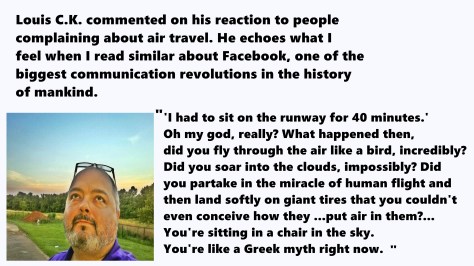
I was asked to write some ideas for an online article regarding social media and the election cycle’s impact on virtual friendships. I wrote a short snippet Sunday morning and posted it. Here’s a long diatribe, so skip it if you are microwaving something and killing a moment or are currently experiencing a craving for a quick internet cat fix. (Or actually have a life and don’t like reading people’s opinions about anything, ever.) Every error is mine and thank you in advance. And no, I don’t know how to get to the point. You keep saying you don’t want memes, so read these actual words as you fall asleep and hit your head on the coffee table. 🙂
.
If you feel like you are broadcasting or sharing with people you don’t know, don’t trust you, or shouldn’t be in the loop, you are doing Facebook wrong in the most basic way. Chances are, it is because no one has ever shown you how to use the tools in plain sight to talk directly to those you love, appreciate and trust – rather than everyone in the world. If you are an average user, you have a few hundred people you never engage with. They have access because you either allow it or set it up that way. You can post in such a way that they can never see it. The people who know the ‘deep’ you already know what peeves you, provides motivation, inspires you, or angers you. Just because you give voice to that doesn’t mean that you can’t control to whom you’re speaking. Every time I hear a version of the argument of ‘the dangers’ of Facebook, I imagine someone holding a shotgun, firing randomly into crowds of people. If you are holding the gun and pulling the trigger, you can aim it. You control who sees and hears what you share. If you can’t post and share to even a handful of people you deeply love and trust, you have a problem immensely bigger than Facebook.
.
Sidenote: After watching dozens of people over the years, I’ve come to some unusual observational conclusions. One of them is that it is very hard for people to limit to whom they post. They might not choose ‘public,’ but overwhelmingly, ‘friends’ is the default option. In effect, you might be posting to 700 people. That’s strange to me. To increase your engagement and sense of privacy, reduce your number of friends or add them to ‘restricted’ and unfollow them. You won’t see them and they won’t see your posts until you post it publicly. I’m not sure why people are reluctant to take a few moments and use the tools available to limit to whom they are speaking, but I have a lot of theories based on what I’ve witnessed. Sociologists tell us that an average of 150 is about manageable. Even in a such a small sample, you are going to find the largest variety of opinion and crazy.
.
Never giving voice to things you deem to be negative simply perpetuates the inherent flaw in social media we’ve all heard about: people overestimate the fun their friends are enjoying and conversely feel worse about their own lives. It’s because so many people superficially share the shiny things and just as in real life only whisper delicately about those things that might shed darker shadows on our lives. Everything we do, say and feel, the sum total of it all is who we are. The platforms of social media don’t share any of the responsibility for how we as participants play the game. We bring broken expectations to the game and then don’t see that we are literally using a rock instead of a tennis ball to play the game. It’s okay to be negative sometimes – but it is also imperative that you throttle the frequency, venom, and relative significance of it. While you are doing it, think about who you are sharing with and share only with those people.
.
I pity those who can’t be honest or authentic on social media. People tend to denigrate the lack of authenticity of the news or on the part of those they interact with, yet rarely stop to consider that they might be doing the same by being reluctant to share the meaningful things in their lives. Facebook is literally the only place where some people get their news. Whether you believe it or not, for people you don’t seen on a daily basis, it is often the only insight others have into your life. It can be and often is the only window many peer through to know about the world. We all feel misunderstood or judged, yet don’t provide the personal backdrop that allows others to see us in a way that might reflect our natures.
.
If you argue that ‘they don’t need to know,’ you are at least a part of the problem, as social media has easy tools to allow you to control who, what, when, where and how. You can share only with two people, ten, or the whole world. You can write and post to your close friends, or your family, or to only the people you work with and trust. Setting up lists shouldn’t be more work than making a nice pot of tea. If you have 800 friends, again, most of the blame falls on you. Social media is a powerful conversation tool cleverly hidden inside the mask of narcissism. If you engage with the people close to you and they reciprocate in kind, even the lowly Facebook powerfully adds meaning and access to your life. Facebook hides in plain sight, one of the best communication tools in the history of mankind. Yet, so many people look it and cast blame to the medium rather than the users.
.
To get to that point, though, you have to know how the car works and being willing to learn to drive it properly. I see constant complaints about Facebook and most of the source of the complaint is rooted in unfamiliarity with how it works. People are glad to take the keys from their parents but are at a loss when they need gas or have a flat. Worse still, they then complain when the drive isn’t scenic or enjoyable.
.
It’s the not the system that’s the problem. It’s you. Social media works well when used well. It works best when those involved take a moment and see that there are bigger factors than simply sharing or controlling access to your life. Absent a tendency toward personal sharing, social media is worthless to those using it. Without an embrace toward a little vulnerability, it is superficial and perpetuates all the things we tend to loathe in other people. If you feel that you can’t share without reprisal, social media isn’t for you. It is hard to quietly read people complain about what people share when I see that those complaining control access to their lives like they are in a prison camp – or gripe that they are misunderstood. Knowing people well only happens when we know their stories and have seen glimpses of the moments that define them. While it is true that it might be easier to post only superficial information under the mistaken belief it is ‘safer,’ the reality is that this retraction from sharing serves the master of the banal; while it might seem safer, it tends to foster an environment where people can’t make deeper understandings. We discuss the weather but don’t care about the responses.
.
“But I don’t want everyone to know my business.” Either post nothing or learn to use the multiple and myriad tools to achieve your goal of sharing and informing without being victimized or feeling exposed. “What’s the point?” What’s the point in any communication, especially if it isn’t engaging, personal, and relevant? “I don’t want people to get the wrong idea.” People already get the wrong idea and form conclusions about you that aren’t based in reality and aren’t fair – and they are going to continue to do so whether you use Facebook or not. “Someone close to me might see it.” Oh dear, someone in your life who should be respected and respectful is going to judge you for who you are? Hmmm… “I get tired of seeing the same old thing.” Just like TV, you’re going to see the same old thing if you watch the same old channel, interact with the same old friends, or don’t use the social media platform to creatively participate. “I get mad when I see what others post.” There are tools for that. And if you find yourself getting angry a lot while reading social media, you are doing it wrong in several ways – and might need to start understanding that social media is like a room of shouting, belligerent people – if you let it be. Take control. “It seems like dirty laundry.” Yes, it might be. If you don’t want to see it, change what you see. Treat social media done correctly as a window into the life of someone you love and respect. People who use it sometimes share too much with you, just as they do in real life. If you are hearing too much anger and nonsense, you are doing Facebook wrong. Or have really lousy friends.
.
It’s not ‘them,’ it is you. But it doesn’t need to be that way.
.
If you think social media is nothing except the same tired nonsense, repeated and regurgitated, you have the wrong friends, or are surrounded by people who aren’t engaging creatively. The creative part is what provides the true fun and excitement to every endeavor and not just social media. You derive what you put in.
.
In my case, I use it in the way I think it works best: I make most of my content and share it. I share moments, memories, and even opinions. You have a door available to get to know me better. You might not like who I am or what I believe, but you do indeed have an immense path to stroll around and investigate.
.
It’s not me, it’s you. But it doesn’t need to be that way.
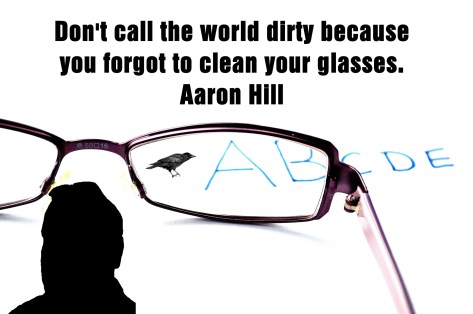
3 or 4 times a year I post about the unfounded and nonsensical claim that ‘society is worse than ever,’ or ‘people are worse than they used to be.’ People have been saying this for thousands of years. They are still wrong. If I stare at a red circle long enough, then look away, the reddish image will move around with my vision, discoloring everything. Cynicism, anger and distrust all filter us.
Look away from whatever convinces you that people or the world is corrupt or devoid of fantastic things. Silence still exists, as do courtesy, imagination, and intelligence.
It is vital to remember that if you are seeing red frequently, it is time for you to blink and look away. And look again, free of your insistence that your eyes are telling you the whole truth.
If you want to shout that the world has gone mad or that people are somehow worse than they once were, you are doing so in defiance of the evidence visible to everyone else who isn’t seeing out your front window.
PS: The picture is one I made from a year or two ago. Always relevant – as tempers flare and the cynics attempt to gain attention.
This story is intensely personal, one involving guns, domestic abuse, and biography. It’s not what I started to write and it certainly isn’t perfect, but it’s honest and reflects much of who I am. Apologies for any errors and I tried to avoid the mention of real people; however, it is just as much my story to tell as theirs.
In 1970, I lived near Rich, Arkansas, near the nexus of Highways 39 and 49. It was a swampy place, surrounded by farms and mosquitoes. My family lived for a brief time slightly up the hill to the East, on the south side of the road. It’s easy to remember, because in March of that year, my dad killed a cousin of mine while drunk driving. Growing up, I thought my cousin Donald Wayne Morris was an uncle, as we called his wife Aunt Elizabeth. Like most family lore, it wasn’t accurate and caused confused conversations. After my dad was released from prison for, among other things, armed robbery, he came back to Monroe County, Arkansas to continue his wild ways. One of the ways he chose to do this was to have an affair with my “Aunt Elizabeth,” the widow of the cousin he had killed in a drunken driving episode. I was at home in the little white house near Rich the day my dad killed Donald Wayne. As I remember it, his wife was with us at the house, too.
But this story isn’t about Aunt Elizabeth, drunk driving, or armed robbery.
Despite having an extensive criminal record, my dad always had firearms around the house. Being a quintessential redneck, he believed that all guns should always be loaded. He would brag, “You’ll be careful if you know that all guns are always loaded.” Had Bill Engvall been around back then, he would have paid for a “Here’s your sign” tattoo to be emblazoned on my dad’s forehead. My dad also didn’t believe in keeping guns hidden or under lock and key, even if toddlers or small children were around. After extensive research, the word that best describes him in this regard is “moron.”
Growing up, there were a couple of notable deaths resulting from children getting their hands on guns and shooting themselves or each other. Some family members wanted to scream and get angry about such easy access to guns – but were silenced by the withering collective stare of the culture that considered any questions about gun access to be a treasonous breach of their rights. There were angry shouts about it sometimes, but they were rare and quickly subdued. In pockets of society all around this country, men will grow angry at any mention of responsible gun ownership. They are not likely to understand nuance and the greater collective good. The words evoke a threatening aura of loss, or make them feel like they are quite wrong about the idea that not all guns and gun owners are created equal. It is an ‘all or nothing,’ scenario, without regard to a safer middle ground.
I’m not certain how old I was, but somewhere before my fifth birthday. One early Saturday afternoon, my mom and dad were screaming at one another, planning to escalate to blows at any moment. It was a familiar and constant ritual – and they knew the steps as well as any dance. I went into their bedroom and the longest rifle I had ever seen lay across the bed. It was sleekly black, with a surprisingly long silver barrel. There were others guns in the room; there were a couple of shotguns and pistols under the bed, a few in the closet, and one leaning in the corner for quick access. It was the black one on the bed calling my name, though. Without hesitation, I went up to it, put my hand across the trigger guard, and squeezed the trigger. The gun leaped from the bed, thundering like an exploding gas tank in the bedroom. I felt my ears pop inward.
I’m sure I started crying – and not just because of the painful gunshot inside the room. I knew my enraged dad would be coming in to exact his revenge. I wasn’t disappointed. I suppose he forgot his mission to scream at my mom in the kitchen when the gun fired, because he backhanded me so hard I thought the back of my head was going to touch my shoulder blades. Although mom denied it, dad kicked me more than once as I curled against the dresser near the bedroom door. Mom would find it hard to believe I could recall an event from such an early age. I used to point out that it was more traumatic than a typical memory, as it involved firearms in closed spaces and being kicked like a coffee can along the sidewalk.
Later, I looked through the round hole in the bedroom wall to see that the line of fire went straight to the next house along the road. It turned out that the bullet had pierced through the siding on that house, too, although no one was hurt. I often wonder if anyone from the other house still tells this story.
At the time, I couldn’t understand how stupid my dad sounded, screaming at me that I could have shot someone – and that I should never touch guns. Part of it was that he was constantly handing them to me or doing ridiculously stupid things with them as he drank. Often, he pointed them in anger at other people, including his own family. He shot at several people when I was growing up. He fired guns from inside moving vehicles, shot propane tanks, poured ammunition into both open campfires and fireplaces, and did just about every idiotic and unreasonable thing possible with a gun.
But this story isn’t about how I could have killed someone when I was very young.
All through my youth, my dad had guns everywhere. Guns, knives, crossbows – of all kinds. He had a violent temper and a lengthy history of domestic violence and criminal behavior. Anyone who knows me also knows that while I came to terms with my dad before he died, the truth is that he had no business being allowed to touch guns or own them. Police in Northwest Arkansas and in Monroe County knew dad’s criminal history and love of hitting people in anger. They also knew he had an arsenal pretty much his entire adult life. Dad had more than one gun given to him by members of law enforcement. Is it hard to see that he felt somehow empowered to continue the same wayward behavior?
Part of the reason I’m telling this story is to shake my head that people seem surprised that just about anyone can get guns and commit horrible acts of violence. I acknowledge that it was a different time even a couple of decades ago. The truth, though? People haven’t changed. Right now, in places that might surprise you, there are people are thinking of doing crazy things. Many of them are surrounded by people that don’t think their friend or family member is going to be the one who loses it and goes on a rampage. The gun buffet is at their disposal, if they want it. It’s true that a person so motivated isn’t going to be limited by a lack of easy access to guns. Don’t try to weaken my story by implying otherwise. If the guns are military grade automatic weapons, though, we are treading into the less reasonable realm of gun ownership. As I might have mentioned, my dad had access to explosives, too, despite his criminal record.
On more than one occasion, I fantasized about taking one of the guns and killing my dad. He deserved it on several different nights. For those unfamiliar with anger and alcohol, the nightfall has always brought with it a greater likelihood of violence. For all of you who’ve never been put in the position of wishing you could kill your own father to protect yourself, I can only say “you’re lucky.” People around us and certainly some family members knew how likely it would be to get a call informing them that my dad had killed one or all of us, finally. There would have been tears and the usual, “We could have done something”nonsense. Yes, they could have done something – they could have knocked my dad silly and taken all of his guns. There were a couple of times I regretted not killing my dad because the lesson of not doing so was followed by him beating my mom so violently that it was difficult to get the sound of her head bouncing off the metal bed support frame from my mind. It would not have been the gun’s fault had I grabbed a pistol from under the table and shot my dad. It would have been his fault.
It is true that it’s not the gun’s fault. People commit crimes.
It’s also true that the gun crowd is a little too zealous; playing the role of society that surrounded me while I was growing up. We can all be reasonable without resorting to exaggeration. Our collective future society is not going to look like it does today. It’s inevitable, because the problems we are dealing with are complicated.
It might be an easy thing to say that my dad was an aberration from the normal; he was aberrant, that is true. He also was representative of many in our society, those who secretly know that having access to any gun they want is probably a bad thing for most of the rest of us. We blithely wander through our lives, hoping that anger or mental illness doesn’t propel someone to kill us or someone we love, all the while uneasily thinking of the millions of complex firearms sitting in closets, under beds, in attics, within reach.
As I walk the streets, I don’t worry about getting shot or protecting myself. It’s a fools errand. There is no guarantee of safety, no matter how many guns I carry or how many take up space in my home. From my experience, if everyone is carrying around sticks, the likelihood of someone getting clobbered is 100%.
I don’t own any guns but shooting at a firing range is entertaining. If you’ve never done it, you might be surprised how enjoyable it is. I don’t hunt, though, mainly because I would be a vegetarian if I weren’t so damned lazy. The idea of shooting animals for sport or food is strangely exotic to me. While I would do it to survive, it would be a lesser choice for me. (You’d find me eating stale prairie grass before you’d catch me skinning a hog as an appetizer.) For our own sake, we have to figure out a way to separate the exaggerated claims of gun ownership for hunting and basic personal protection from the one the fringe continues to impose on us all – the one which commands us to pretend that all guns and gun owners are the same.
Most gun owners are responsible, reasonable people. Contrary to what the NRA would try to tell us, most people don’t want automatic weapons or the ability to buy literally any firearm they want. They think gun locks and safes are reasonable. Most want responsible controls in place for everyone. It’s the way society works when it works well.
The shadow in the back of my mind, though, is the one created by people such as my father.
Scientists tell us to use stairs to live longer. I’ll believe that when I see scientists living inside stairwells – they’ll damn near live forever in that scenario.
For the average Fitbit user: I’m glad you are tracking your alleged health. It’s important. I’m not sure what you are prolonging, though, unless it is a further comparison to unusually tech-savvy ferrets.
The only thing worse than hearing health advice from a doctor is getting it in person from someone who smokes.
The only thing worse than hearing health advice from a doctor is not hearing it because I’m dead.
I think I had a bad reaction to my ‘meds,’ because I could have sworn my math professor told me to do my homework using fractals instead of fractions. My work was all wrong, but it sure is pretty to look at.
I hate it when I’m reading vague warnings on medications. If it says “explosive diarrhea” instead of “projectile explosive diarrhea,” that kind of thing really matters when planning your social calendar.
“Were you born in a barn?” is the wrong thing to ask kids these days. The last time I asked, my nephew shouted back, “I must have been, because there were cows and asses in there.”
If I were a realtor, I would add “beautiful screen doors on all entrances” to all property descriptions just to confuse the snotty clients.
Likewise, if I were a realtor, I would add “Haunted” to every house listing so that once the house was sold, I would have some prank victims lined up.
I have a jar of nickels. I don’t collect them. I keep them for when some cliché-abusing speaker says “If I had a nickel for every…” Perhaps a slingshot is the wrong method of delivery, but you have to stick to what works.
It’s weird that people say “…all you could hear were crickets…” to describe an awkward social silence because if all I can hear are crickets, I’m already pulling my own hair out.
I jumped off the roof of a ten-story building. The roof was on the ground and awaiting a crane to lift it up there – still, though, I did jump off the roof of a ten-story building. Thank you, English language.
Have you seen the rumor about bees learning Morse code? Well, now you have. And it’s all the buzz around here.
Just once, I would like to attend an opera where the actors suddenly start doing improv.
Opera: squealy singing in another language, punctuated by one delicious intermission.
I’m just kidding, I love opera. Like a brother. Cain and Abel, I mean.
Instead of taxing fast food, I think we should instead require each fast food place to have mucus on at least 5 of their top-selling items. I think Arby’s has already jumped the gun on this one.
I got permission to make my own version of “Oil of Olay.” Mine is called “Oil of Olé,” and is made of 75% taco grease. Like with the original, wrinkles will be the least of your worries.
These jokes are sponsored by Hardee’s: where meat lovers gather to share communicable diseases.
I’m still slightly off guard about the idea that society has many people who don’t believe that mental illness is real – or that if it real, that it affects people so dramatically in their daily lives. The criminal case I was involved in a few weeks ago still echoes in my mind. Last night, I woke up with the remnants of dreams about it slipping away from me. I’m still astonished that people who think mental illness might not be ‘real’ were involved in a jury case that was predicated on the concept of mental illness. Whether it is a question of mental health assistance or counseling, disability assistance for those who need it, or being judged from the rational perspective of mental health issues, I am having a problem with those people around us who can’t even agree that it’s a real issue that affects all of us. I wish that anyone who needed it could get substance abuse help or mental health treatment without any conditions or limitations. What makes the denial such a problem is that most of those who don’t think it’s real know they sound ridiculous when they say it – so they whisper it or don’t admit it at all, even while they are voting, sitting on a jury, or making decisions that affect treatment for those who suffer. It’s likely that you are reading this and thinking that none of your friends or family believes that mental illness isn’t real. I promise you that you do and they do.
As I predicted, the jury pool for the trial of Samuel Robert Hill in Washington County, Arkansas ignored his mental illness defense and threw the book at him.
Whether he was really mentally ill isn’t something I can be certain of, as I didn’t get to hear the evidence that the jury heard during trial. On the other hand, I didn’t enter the jury process with a predisposed belief that mental illness isn’t a ‘real’ thing, either, or that even though the law says juries must take them into account, that mental illness should never be used to defend someone – and if it is, it should be ignored. Also, while I didn’t hear the evidence in the same way as the jury did, I did read it, including many things which were kept away from the jury during the trial. In some ways, I had a more complete picture and better information than they did. That’s how trials, work, though. The distinction in my case is that I heard some of the potential jurors say they didn’t believe in mental illness and that it can’t be used to mitigate a crime or its punishment. While I was dismissed for some unknown reason, citizens were left to serve on the jury who legally didn’t qualify, given their beliefs and biases about mental illness. Maybe the opposing psychiatrists had different levels of credibility or the defendant’s mother was a better witness than her sister, who testified for the defendant. Truth be told, though, none of it really mattered if enough mental illness-deniers got seated on the jury. Most of them wouldn’t admit they believe such things, as it sounds stupid to admit, just as bigots know they can’t claim that certain minorities are better at sports or that some are just angrier people – they believe it in their hearts but have been conditioned to conceal these bigoted or stereotypical ideas from everyone else.
I know that there are people who don’t believe in mental illness, people who think such sufferers can just ‘snap out it,’ or just get busy to distract themselves. It’s almost insurmountable to get past that kind of attitude in people. It’s not based on evidence or science, so argument and reason won’t get you around their mental block.
Likewise, many of those in the jury pool said that they were certain that if a defendant didn’t get on the stand, that this indicated either deceit or outright guilt. Despite the judge and the defense pointing out that this attitude was not acceptable if you were going to serve on a jury, several of those people also remained and undoubtedly served on the jury. Deciding to not testify is a fundamental right in criminal trials. It’s a foundation of our system. Especially if a defendant’s case rests on the idea that he or she is mentally ill, it is ludicrous to hold that against them. The law is clear: you can’t hold it against a defendant. As a citizen, of course you can. Many of the jurors ignored the law and should not have been on the jury deciding a person’s fate. Like most people, those who believe it know they can’t just admit such a belief in the face of scrutiny; they’ll justify or rationalize their bias and tell us that they can decide a case, not realizing that such a bias infects everything that filters through their eyes and ears.
(PS Another bias that I heard people admit to: people charged with crimes are overwhelmingly guilty. Which may or may not be true – but again, jurors aren’t supposed to have this bias.)
I wrote the defense attorney in the trial a couple of times, as he wanted to know my opinion as an outsider. Much of what I wrote in my previous blog post I included in my email to him. The premise of my reply was that I knew before I ever left the building that day during jury selection that the jury pool wasn’t one I would ever want on a trial wherein me or my family was a defendant. There was too much bias. I told the attorney that I guessed every major aspect of the trial and its outcome, both in its decision and punishment. I was careful to not point fingers at a specific person, but I did my best to convey the overwhelming specifics that I observed, all of which combined left me with the idea that the jury pool wasn’t one that should have been hearing that case. In sort, I told the attorney that no matter what he had said or done once the trial started, the conclusion was predetermined. Had the prosecutor been the worst to have ever served, he would have won the case with that jury pool.
Some potential jurors knew more about the case than they admitted, too, and some had access to information after jury selection started. In the age of cellphones, it’s probably impossible to eliminate such temptations. I had some recommendations for different kinds of questions to help weed out these people. I could easily sit and watch a jury pool and come up with easy questions to make them uncomfortable- and more forthcoming and honest during jury selection.
The defense attorney told me that it was apparent that I was exactly the type of juror that both sides needed.
But we’ll never know. My opinion of jury selection and trials went down a notch and I’m left with the feeling, no matter what ‘really’ was the case, that the wrong jury was probably seated.
Since moving from one side of Springdale to the other, I relish no longer traversing the jurisdiction of one small town in particular, which I will call TownBetween. While there are several fine officers there, it is strange to me that so many hilariously cringe-worthy stories continue to originate from there – yet, the fans of this police force vainly try to insist that there isn’t a problem, and that if you aren’t breaking the law, you have nothing to fear. Let me be the first to argue this point: where there is smoke, there is fire, and where there are short haircuts with batons and blank ticket books, there is trouble. Reputation once lost takes an insurmountable level of work to regain. When I drive through TownBetween, I constantly tap my brake, even if I’m driving so slowly that skateboarders are passing me. I look closely at the roadside, scanning intensely for either properly designated police vehicles, or million dollar Hummers and dark, deeply tinted ninja attack force vehicles paid for and maintained through what I can only to presume to be black magic. I worry that I won’t be able to show my papers quickly enough, as if I am trying to illegally cross a border during WWII. I won’t have to wipe my rear brake lights with a polishing cloth, in case the officers of TownBetween need a proposed reason to pull me over, nor will I need to use lab equipment to check my headlight brightness, tint thickness, or tread depth. Paranoia is a required trait for daily travel there and a CSI forensics degree will be helpful to you if you foolishly drive through there with any regularity. I don’t want to feel as if I’ll be in the basement of a hidden jail somewhere awaiting extradition to Poland.
One of the best aspects of moving across Springdale is that my exposure to TownBetween has lessened. I don’t want this to be an indictment of other departments, of course, but comparisons inevitably lead to less-than-stellar commentary. I love Springdale and I have never had a direct issue with a Fayetteville police office, even when I was really young and stupid. I’m old and stupid now, of course. I wrote this a couple of weeks after moving across town. Recent articles and comments lead me to realize that it’s still something a lot of people talk about. A car salesman yesterday told me he will never drive across TownBetween, and not just because he is Latino. He said driving there makes him feel like he is in a police lineup, waiting to be grabbed and asked a hundred personal questions, all of them implied accusations. His friends and family feel the same way.
Every department is comprised of individuals, each with his or her own idea of process and decorum. Above and beyond that, however, is an ideal which governs the entire police force. Reputation is a hard-earned coin and not all local law enforcement is administrated with an equal insistence on professionalism and courtesy. You can be the best officer on the roster in a department with a maligned reputation and your efforts will be difficult to trust. But even the “least officer” in a department characterized by a commitment to professionalism will be given the benefit of the doubt. That same “least officer,” reports to a command structure that will not condone or tolerate less than ideal behavior. As a citizen, this is how we learn to trust the police – one interaction at a time. An officer might make a poor decision or act hastily, but his or her peers and superiors will move to make it right. I don’t mind a little confusion or delay if I know I can trust it work out with consistency and fairness. Springdale’s officers represent the spectrum of their community. Mistakes will happen and great departments like Springdale won’t worsen a problem through concealment or deceit; if officers acted that way in the distant past, it might have squeaked by, but not any longer.
When I drive in Springdale, I do not flinch or instinctively hit the brake with so much force that my spare tire flies through the backseat. I expect that every officer I see is operating under a sense of priority and expediency. I also don’t imagine scenarios wherein there is doubt to automatically be interpreted in the most unfavorable light toward me. The police are here to keep us safe and to help us. It doesn’t occur to me that there might be quotas, or that the municipal court is going to do anything other than listen to any potential case to get to the bottom of the issues at hand. I won’t be getting emails from the police chief, ones which like they were written by a third-grader with both writer’s cramp and a lack of oxygen in the room.
When I discuss TownBetween with normal people, the predominant attitude is “Ugh, that place?” Many of these people aren’t miscreants such as me. They are doctors, lawyers, and teachers. They didn’t secretly get together and erroneously decide by cabal that they were going to detest driving in and through TownBetween. Most of the detractors are perplexed because only through sheer accidental geography were they there to begin with. Had a better route been available, they would have availed themselves to it. Guess what? Now many of them refuse to drive through TownBetween, no matter what the circumstances. It’s easier to avoid the bully than to fix the problem. That is what much of Northwest Arkansas does. Meanwhile, TownBetween insists the fog there is brought in by the outsiders and that only those breaking the law complain. (Yes, and you only need aspirin when you have a headache.)
I didn’t intend to water-down any compliment of the Springdale police as a result of my comedic derision of TownBetween. I was attempting to inelegantly say that I look forward to crossing the boundaries of TownBetween with must less frequency. If I want to live dangerously, I will instead stay home and rip the tags off my mattresses. I’ll stay in my borders of Springdale with more glee, waving at the officers I pass, knowing that they won’t assume the worst of us all. I’ve also noted a strange absence of military-style vehicles here. It has been very nice these last few months not needing to drive through TownBetween if I don’t want to.
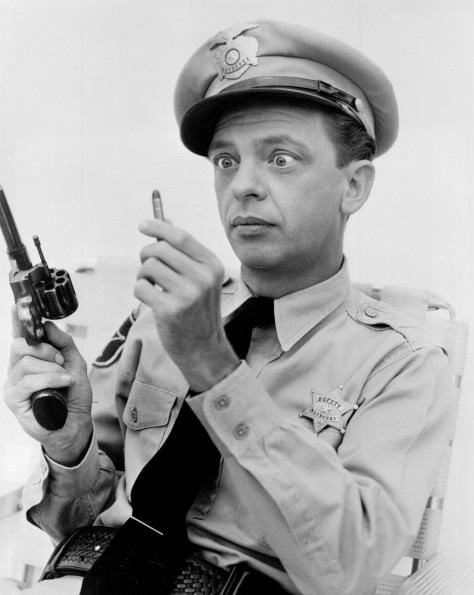
TownBetween can continue on its merry way, reinforcing many of the horrid stereotypes that motorists hurl toward the Barney Fife little towns scattered across Arkansas. I’ll be over here, hoping for the day when the little town grows up and gets a police force like the one Springdale has – or gets assimilated by one of the bigger and better police forces.
Meanwhile, I’d propose a bypass around TownBetween, since we can’t dig it up and move it to the 19th century where it would fit in better. I’d like to remind them all that just because you can write a ticket, doesn’t mean you should. I once got a hilariously bad email from the Chief in TownBetween. He was insisting he couldn’t force his officers to the right thing, even when he knew they hadn’t acted appropriately.
 P.S. Parenthetically Speaking