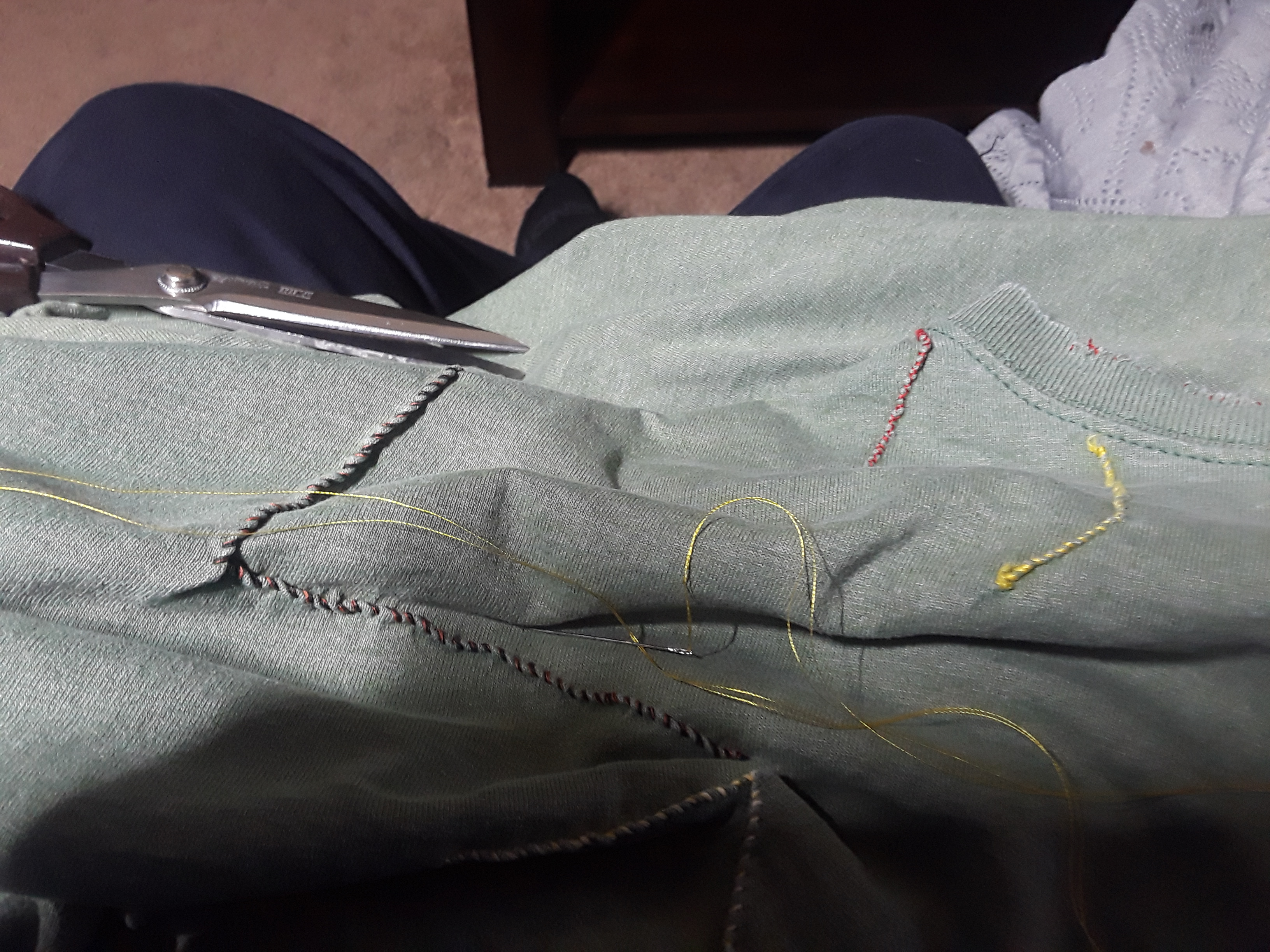
Today, I used a phrase that I used to say often: “Fingers crossed. Elbows oiled.” I wrote it without even remembering that I ever stopped, though the divide now exceeds 15 years.
It’s supposed to convey that you’re hoping for the best but prepared to do the hard work with elbows flying if needed.
I don’t know why I stopped saying it. I love the expression.
Watching people understand what it means in real-time is also a pleasure.
“Are you ready?” “Yes. Fingers Crossed. Elbows Oiled.”
This story zigzags like my life. I apologize for having no consistency.
I generally have a rip-shirt in the closet. The current one is somewhere between 15-20 years old. The vivid color of the shirt has faded, and the fabric is stretched past its intended shape. But I keep fixing the rips and frayed edges because that is what life is. I’ve done every activity you can imagine in that shirt. (Don’t overthink that.)
Because I have always sewed, I sometimes dabble with a variety of things that require it. My Grandma Cook taught me to do a stitch when I was very young. I loved sitting at her feet on the rough floor and sewing anything she handed to me. And often, my fingertips. Thimbles were available but made poor guides for novice sewers.
My Dad and brother loved mercilessly teasing me about my penchant for making non-bunching pillows many years ago; my favorite kind involved going to a fabric store or department and choosing something appropriate for the intended v̵i̵c̵t̵i̵m̵s̵ recipients. Sewing has always been meditative for me. I’m not GOOD at it, of course, but you know what I’m going to say: I don’t care. No one in their right mind would ever invite me to a quilting circle for my sewing skills unless they needed comic relief.
In my early 20s, I started doing what I call rip-shirts. Some of them took me 100 hours to make. Simply put, I choose a shirt, usually of a distinctive color, then spend hours sewing stitch patterns all over it. Part of the fun is using a wide variety of threads, especially of different colors. It’s supposed to be garish. It’s possible to do intricate monograms this way, too, which I’ve done. I gave away many of these for years. One of the key advantages of such a shirt is that it becomes almost impossible to distinguish if it should be discarded, as all subsequent rips, tears, and issues can be restitched and become part of the resulting pattern. One of my shirts had over 500 hand-stitched lines on it. For another, I sewed a difficult-to-see curse word cleverly hidden in the stitch lines. That one amused me greatly.
Later, I discovered Kintsugi’s idea, where breaks and defects in bowls and cups are repaired using lacquer and gold dust. Theoretically, such repaired bowls can be fixed repeatedly and still be both useful and beautiful.
Rip-shirts fulfill the same purpose for me. They are each unique.
As the fabric wears, it becomes softer and more comfortable. If you rip the shirt, you can just sew it back. Unless you tell someone, they’ll assume all the stitches were purposefully placed.
When I was 30, I made a shirt for someone I initially thought was mocking me. He pulled me aside to correct me and told me that the idea was perfection to him. Because he was a large black man, I chose a very large shirt. I monogrammed his nickname along one sleeve and put hundreds of stitch lines on it. It was the only time that I worked hard to get the stitches perfectly aligned. When I handed him the shirt, he teared up. “Wow. I bet this took twenty hours to make, X!” I shook my head. “No, it took fifty.” He couldn’t believe that I spent so much time making him the shirt. He died much too young a few years later. What breaks my heart when I think too long about it? I told him I could teach him to do basic stitching in less than 15 minutes. So it came to pass that I sat in an industrial office in a vast poultry plant patiently showing another grown man how to stitch. It occurred to me how strange the idea would have been to my Grandma.
I indeed caught a fair bit of mockery for wearing these shirts. Likewise, I also wore my clothes inside out for fun, too, or made exotic and ridiculous headbands, sewed on a long-sleeve to a t-shirt, and a wild variety of stupidity. I went inside what is now First Security on Emma. The plant manager for the company I worked for had a wife who worked there. I went to the next teller, and it was the plant manager’s wife. I’ll never forget the look on her face when she realized that my t-shirt had the sleeve of a long-sleeve button-down dress shirt sewed on it instead of a standard t-shirt sleeve. She laughed so hard that a bubble came out of her nose. The look of mortification on her face was etched in marble. And then she laughed more. The person in charge of the tellers walked over to see what the problem was. The plant manager’s wife was crying from laughter and trying to tell her what the joke was. Looking at the floor manager in the eye, I said, “I got robbed, and they did THIS to me!” – and I pointed at my sleeve. The plant manager’s wife and I both laughed for another full minute. The floor manager walked away, shaking her head.
I made several rip-shirts for younger kids, who were fascinated by the concoction of stories I created to go along with them. Kids take a bit longer to lose their sense of adventure or categorically reject something interesting.
Somewhere around 2000, I was at the store wearing a rip-shirt, and a gentleman asked me where I bought the shirt. I think I was at Hastings Records. “I didn’t buy it. I made it.” He seemed genuinely interested. That particular shirt had a lot of neon threads in it. I grabbed the hem of my shirt, pulled the shirt up and off, and handed it to him. “Here,” I told him as I stood there shirtless near the main entrance. He didn’t argue or hesitate. “Thanks, Man!” You would have thought I handed him my wallet. At least fifty times that year, I bragged that I was willing to give someone the shirt off my back.
As my eyesight naturally worsened, I began to sew less often. That was a mistake.
I wonder where some of the rip-shirts ended up or if they still exist. Each of them was made by my imperfect hand. Each one of them is a literal tapestry of the moments I spent making them. They are not for everyone.
I don’t remember when I tried Pop Chips for the first time. I don’t remember the 2500th, either. But I could fill all the pickups at a NASCAR race with the chips I’ve eaten since.
They are only 100 calories a bag. Under the “Anything that opens is just one serving” rule, these keep me from the insanity of opening a large bag of baked chips and discovering a large blob of regret at the bottom.
More importantly, though – the texture is perfection. Yes, the flavor is perfectly proportioned. It’s the texture that makes these chips sublime. When I eat them, though they aren’t heavy, they make me feel like I’ve eaten something substantial, much in the same way you’d lose your appetite if someone put a small frog in your mouth while you’re chewing. Except in a good way.
I eat mine with tuna, soup, lettuce, and would probably brush my teeth with them if I could figure out how to do it.
Sams Club sells a case of 30 for $12. I usually just run in, throw money at the manager, and scamper out with several cases. I’ve considered hijacking a semi-trailer full of them. So far, they keep varying the routes, so it’s hard to pick a suitable robbery location. Having a mask on all the time only exacerbates the whim to do this.
P.S. If you overeat this item, it does have the curious side effect of making you want to dress like a handmaiden. Adjust your expectations accordingly.
I waved hello to the girl standing at the end of the trailer. Though the trailer had probably seen its last tenant, the little girl would grow up to touch thousands of people. She didn’t understand that the voice in her head was incapable of silence. As happens in so many similar places, the cauldron’s circumstance made it difficult for her to talk above a whisper. She would leave the place. Such places and the people who inhabit them touch us deeply and rob us of our ability to flourish.
I waved again, though decades of intervening history lie like a chasm between us.
Because no good act goes unheard in a just world, my small voice and gesture caught her attention. Time became diaphanous.
She looked up inquisitively. I felt her as she saw me wave.
Impossibly, she began to shout. The silence was no longer her prison.
I stood at the edge of the rural road, looking north. Because I knew another road once met the edge of the one I stood on, I could see the subtle difference in the ground and the trees’ varying thickness ahead that the forgotten dirt road left behind. Up until 1965, the road led to the Chowderwick house, once home to a prosperous family. It had likely fallen in now and was probably a pile of boards and tin cups somewhere back in the dense trees. It was likely that no one would remember that a house once proudly stood back there in a generation. Such places litter the South.
From the confines of my mind, I saw an image of Lilly Chowderwick when she was 6. In 1964, the Esper community went into shock when they heard Lilly had been abducted and likely murdered. Sheriff Brimley found blood along the floorboards near the wood stove in the front room and along the porch that comprised the entire length of the front of the house. Dogs lost the scent at the edge of the porch. To him, such things indicated that whoever did the crime had planned on not being caught.
Sheriff Brimley conducted as thorough an investigation as was possible in the South in those days. He concluded that Lilly was likely dead and that someone would slip up and say something incriminating one day. Or, more likely, someone would stumble upon a hidden set of bones somewhere within the rural boundaries of Maylean County.
Lilly’s dad Jeffrey inherited a good fortune. It included a store along Main Street as well as some mining interests across two counties. He didn’t inherit the savvy or patience that Lilly’s grandfather used to build a small fortune. By the early 1960s, the Chowderwicks had retreated to the acreage along the road on which I stood. Jeffrey was rumored to beat his once beautiful wife, Lilian. Lilian often disappeared from public view for days on end. Esper, like all small towns, whispered and gossiped each time. After Lilly’s murder, Lilian fell into a trance and seldom spoke. It seemed like she was waiting for her turn.
Sheriff Brimley brought in Jeffrey for questioning. Jeffrey insisted he had nothing to do with Lilly’s disappearance. Although the Sheriff believed his story, he arranged a trunk interrogation a week later. Two of his deputies grabbed Jeffrey as he walked on the edge of the town drunk. They deposited him in the trunk of one of their cars and drove him a few miles to a barn. After convincing Jeffrey he would likely die in that barn that night, they decided he hadn’t abducted or killed his daughter. He was capable of it, though. He confessed to beating his wife repeatedly.
In 1965, Jeffrey died when he drank too much and walked out onto the main road on a cold Wednesday night. A truck loaded with lumber crushed him as he stumbled out onto the road. The driver said he never saw Jeffrey. The accident happened where the swamp and creek encroached on the farmland adjacent to it. The trees often leaned and overhung the road.
Within months, Lilian left without saying goodbye. Everyone assumed she moved out west where distant cousins once lived. No one knew for sure.
I had promised to tell no one the secrets of Esper or Lilian and Lilly Chowderwick. Fifty-five years later, I knew that DNA would out their family secret. I knew what no one else did: that little girl had not been abducted or killed. Lilian murdered her husband. She endured countless beatings after the burial of the empty coffin that should have held her daughter. When the time was right, she killed Jeffrey and put his body on the road. I helped.
Despite my promise, I can finally say that I know all this because I’m the one who drove little Lily out of town in May of 1964. If she had stayed, her father would have continued to abuse her or worse.
My confession must include that I am an accessory to several crimes.
I’m not sorry, and I don’t apologize.
In a few minutes, Lillian would drive down this road and meet me in the place she swore she’d never see again. And with her would be Lilly, now 61 years old, a grandmother in her own right, with a full life that remained a mystery to me. At that age, we decided that she should know that we killed her father.
Though the air was filled with dust, the tears on my face came from a place of nostalgia.
There are hidden roads everywhere if you know where to look.
Obviously, reasonable people get their culinary advice from me. I didn’t go wrong with the plant-based alien-skin bacon, did I?
These tortillas are available in tomato, spinach, regular, and dirty cardboard flavor. The last one isn’t true. Not that I care. With the right spices, a lot of things suddenly acquire a new flavor and texture. Dogs bark for a reason.
Although not related, I think any product high in fiber shouldn’t attempt to use the word “regular” in its description. You’ll be regular.
Each tortilla is only 50 calories and each contains 38% of the recommended daily fiber you need. Most of us don’t even eat half the fiber we’re supposed to. If you’re not sure whether you are getting enough, eat two of these and sit patiently on the couch. You’ll have your answer sooner or later. Otherwise, have a big bowl of brown beans and sauerkraut. While it may not work for you, eating a lot of fiber has helped me in ways I wasn’t expecting – not the least of which is people now approach me with considerably more caution.
Unlike many of the other healthy alternative tortillas, the texture for these is normal. Normal by normal standards – not normal by mine, which present another range of potential issues.
I’ve been taking fiber supplements for several months. I’ve also eaten at least 100 packs of these tortillas this year. They allow me to eat less, more quickly, and feel full.
Just don’t start eating them until you discover if you normally eat enough fiber.
Or, ignore me and find out creatively. Go ahead and apologize to your family first, though.
Since I’m shouting out an opinion, I love these. They taste great and have a normal texture.
No matter how comfortable you are, if you wake up needing to go to the bathroom, you should go immediately. (Get out of bed first, though!) Additionally, as you age, the likelihood that you will misjudge your capacity to navigate the delicate balance of comfort versus biology increases exponentially. Young people read this and think it’s stupid. Older people read this and say, “Genius!” The difference between those two perspectives is experience.
“If you want a guarantee, buy a toaster.” – Clint Eastwood
Before.
After.
The chasm between any two parts of your life seems predestined.
“We do not remember days. We remember moments.” – Cesare Pavese
Then again, all of the cross-sections of our lives appear that way after the fact, with clear divisions of some calamitous or joyous event to artificially demarcate them.
Whether due to death, career, pandemic, new love, or the discovery of a friend you didn’t know you were missing, our lives are a series of bookmarks. If we’re lucky, our books are a series of laughter and events and only briefly interspersed with the sorrow that must accompany us.
Honestly, I did not recognize my own mind until I was in my late 40s.
In my life, I’ve had trouble learning complicated things quickly. I’m not saying this as self-deprecation; it is an absolute truth that I can readily admit. Mastery comes if I can overcome the reluctance the wiring in my brain presents. I was a genius with geometry and a failure with trigonometry. I love language and love it the best when I can break the rules that ask me for adherence.
Many people profess that they feel they’ve wasted their lives. Superficially, I can relate. On a deeper level, I can’t understand it at all. Life is an experience. It is possible to waste it, but very difficult.
Our lives are a succession of attempts to distract ourselves from the underpinning of our lives; no matter how well-lived, we will wither. Living a raucous and uncaring life in response is no way to find ourselves or a meaning that matters. Most of us fight a battle between polarizing options. We want to break a beer mug while dancing with someone beautiful at 11:30 p.m. and also want a couch and someone to share it.
What might the ideal increment of a happy life be? A year? 50? I suspect that it varies in proportion to the depth one feels one’s life.
I’ve stepped over the imaginary border into the ‘after.’ I feel its tangible presence behind me. There is no guarantee and no clear path. I don’t need one, nor do I curse myself for waiting for faith to propel me with enthusiasm.
Because of my long life, I can avoid feeling panicked when I realize that I’ve stepped over another milestone.
Given that many milestones were invisible until they happened, I should laugh and resign myself to the fact life isn’t done with me yet, no matter what it may look like next year.
I see the light. It shines upon me, whether I deserve it or not.
Such a facile word, one rapid syllable. It is supposed to mean “expressing discomfort, surprise, or dismay.” Generally, it also is used to convey a gut-punch or calamity. A recent copyright dispute brought up the previous and singular connotation for the word.
As happens in life, the word transitioned for me without my recognizing it. It was an incremental change until the lever sprung, and it suddenly acquired a different meaning, much in the same way you peer into the eyes of someone you’ve known and see a depth that you’d skirted around unknowingly.
Oof: a sudden emotional reaction, usually characterized by intense pleasure or divination.
The word now carries a paralyzing and gossamer overtone for me.
I’ll ask you to whisper the word internally, in a quiet moment. Find a place, person, or time in your guarded heart of memories and say the word as you vividly remember it. If you pay homage sufficiently, you’ll be able to see “oof” in the same way.
The word is mine now.
It is shorthand for the unuttered but not unfelt contagion of bliss or glimpse of what lies beneath.
Q – “What do lemons wear in the rain?” A – “Yellow jackets.”
As I left work, the skies finally opened, and rain fell. The wind noticed and opted to blast the rain sideways. I lost interest in going to the store, even though the idea of watching meandering mobs of discerning consumers arbitrarily observe the new social norms interested me, much in the same way that it’s difficult to close one’s ears to titillating gossip.
Because I’m an adventurous guy, I stopped at the gas station, a place seldom associated with adventure – at least not the kind people pay to see. The universe continues to remind me that cars need gas to remain operational. I’m smart that way. It took 30 years, but wisdom finds us at our own incremental and obstinate pace. Remember that when you watch the younger generation do new versions of the same stupidity you and I once did. Note: yes, you did some foolish nonsense when you were younger: we all did.
I went inside and chose a gas additive, and approached the register as a couple of very young Latina girls danced around the edge of the register. Their mom tried and failed to herd them toward the door to leave. The young male customer in front of me was asking a series of specific questions about his food. The clerk had an exciting look of “wtf” and “no clue whatsoever” on his face. Knowing that my superpower of supreme bullshi%%ery would be useful, I leaned in and said, “First, go with the turkey if you aren’t sure. Take a packet of mayo, bbq sauce, tartar sauce, hot sauce, and mustard and try a nibble of each with a bite of the sandwich.” The picky customer looked at me directly, even as I told myself not to smile or frown. I just nodded. “Well, thanks! That’s a great idea.” The customer picked up his sandwich and went to the condiment container to obtain one of each.
The clerk leaned over and softly said, “Thanks. He does that often.” I laughed. “The joke’s on him. I don’t think it matters what I said. I think he just wanted a voice of confidence to recommend something.” The clerk laughed. “Noted!” as he tapped his right temple. “But you should recommend something crazy next time to test the theory,” I quickly added. We both laughed.
I paid for my additive after asking the clerk where they keep the flavored gas additives. I also bought a lottery ticket. “Keep the change,” I told the clerk. “Thanks, that is nice of you.” I turned and said, “You’re welcome. I didn’t know you could take tips here.” The clerk nodded.
As I pushed open the door, I returned to the register and put a $10 bill on the register. “You can keep this. Buy yourself something nice!” He looked at me, quizzically and smiling. “Really?” Thanks!” I nodded. “Let’s test to see if karma will give my lottery ticket a boost. If I win the lottery, I’ll give you $1000 if I win 100K and 100k of it if I win it all. No BS.” The clerk waved goodbye as I walked out. I think he would be stunned to know that I meant it when I said it.
In my attempt to avoid getting soaked at the store, I ended up standing under a massive overhang as I pumped the gas, and the wind howled and brought the rain almost horizontally under the roof. I got soaked in the process. While the gas pumped, I could see the young man with the sandwich. He sat in a booth by the long row of glass windows. In front of him was a variety of packets. For those of you who don’t know, I often eat food similarly, with ten different spices and sauces scattered around me.
But.
I gave someone permission to enjoy their lunch. There’s a high probability that they’ll love a condiment they’ve never tried before.
I surprised a total stranger with an unexpected gift.
And I got soaked. But the small moment of this afternoon was worthwhile, even though it will never be listed in the accounting of our lives.