This picture was taken 29 years ago, 10,592 days. Almost half a life ago, a fulcrum that seems impossible at this point. It was supposed to happen on Halloween that year, but logistics conspired to make that difficult.
Most of us like to imagine going back and being able to look forward, seeing the relentless incremental changes that we choose or are foisted on us. The acceleration of change that’s almost invisible while we’re experiecing it. Can you imagine reliving the moments as instantaneous bullets of laughter, agony, and experience? Most of us would choose it, even if it’s a roller coaster that leaves us lying on the pavement, asking ourselves why we got back on the ride, knowing how it would end.
Every cell of our bodies has changed, but the memories remain – if we’re lucky. I took a moment to fling open the door early this morning, remembering, and then bolted it shut afterward.
Years ago, I doggedly started down the path of biographical discovery. Some of my family hated the idea. Although I suspected I knew why, years of intermittent discovery and revelation allowed me to piece together facts. Not innuendo or conjecture, nor the vague yet prideful assertions of some of my family.
It is true that behind reluctance, there is always truth. As an adult, I understand it. Who wants their dirty laundry floating around? On the other hand, open discussion of it with one’s children can be a learning experience – not to mention that acknowledging mistakes can be liberating.
I probably should have taken more care with this post. Finding another piece of the puzzle yesterday fascinated me, as the dots connected effortlessly.
Using both DNA and slipshod yet determined obstinacy, I peeled back layers. Not to malign or accuse people, especially if they were already gone. They could have just told me, or answered my questions, giving me a complex and informed view of the people who came before me. They largely chose misdirection and sometimes passive-aggressive hostility.
“Your family has a lot of damn secrets, X,” is something I’ve often heard. But what family doesn’t? A word of advice to those who choose secrecy? Be careful. There’s an idiot out there determined to find out. Curiosity has driven many people to morph from interested to detective.
One of my earliest memories is of standing in the back seat of a black or dark sedan. We were driving on a sun-filled day, heading to the water. My dad was driving. In the passenger seat was someone who should not have been. Years ago, my mom insisted that I couldn’t have remembered it. Then, she insisted it never happened. “Which is it? It didn’t happen or I couldn’t have remembered it.” Stunned recognition on her part that logically, she wasn’t making sense.
Over the years, I figured out we were driving to Clarendon to go to the water. As for the woman in the passenger seat, I’ll call her Susan. I grew up calling her Aunt Susan, even though she wasn’t my aunt. Aunt Susan was married to my mom’s half-sister’s sons.
son
In March of 1970, my dad was involved in a drunk-driving accident that killed Aunt Susan’s husband. Dad escaped accountability through what can only be described as “good old boy” connections.
He’d already been to prison in Indiana in the 60s. He swore he’d never leave Monroe County again. He moved to Indiana out of necessity after being a little wild for Monroe County. (Which is saying a lot.) He had cousins there, none of whom I grew up to know. That story was another one that required doggedness on my part to get to the bottom of. Just a few months ago, I finally got a little bit of my dad’s prison records. A couple of years before that, I went through thousands of pages of online news articles until I found news articles related to his crimes. The only reason I did it was because another member of my dad’s family indirectly acknowledged to me that they existed. That’s all it took to set me in motion. If she wouldn’t give them to me, I’d find them.
After Aunt Susan became a widow because of my dad, they started seeing each other. It was during that period that I had the memory of driving down a sunny road with them both. It would have taken place between late March of 1970 and before October of the following year.
I don’t know how it came up, but I had questions. Aunt Marylou knew everything. Whether she would repeat it or not was the question. After I started doing ancestry, I had a list of nine thousand questions. She answered many of them, including ones about Grandpa and Mom’s potential half-sister, who came about because of one of my Grandpa’s indiscretions.
One of my questions was about my memory of the summer day in the car with dad and Aunt Susan. “Oh, that was after your mom filed for divorce from your dad.” I was shocked. They obviously had not been divorced, at least not yet. She then went on to hit the high points of a little bit of the less-savory family lore that I was chasing.
Mom was livid. “None of that is true. None of it. It didn’t happen.”
I added the search for proof to my list years ago.
Later, a lot of it made sense. Mom invariably couldn’t resist ranting about past grievances. I do remember Mom drunkenly ranting about Aunt Susan. For reasons I didn’t understand, she didn’t want me to go to my Grandpa’s funeral. Some of that had to do with Aunt Susan. I’ll never know why now.
My brother Mike remembered much more of it than I did. He even recalled the night that Aunt Susan’s husband died as a result of the DWI incident with dad. His memory gave me the time frame we lived in the house right off of AR-39, something which had eluded me for years. That’s the same house we lived in when I almost killed myself pulling the trigger on one of dad’s hunting rifles. He’d left it on the bed unattended. (I’ve written about that incident before.) As a convicted felon, he wasn’t supposed to own guns, which is, of course, why he had dozens of them. Those laws were ignored back then, and especially in rural Arkansas.
My brother Mike also confirmed that my memories about living briefly in Wheatley were true. Of the scant memories I had of it, I remember having a picture of Jiminy Cricket on the bedroom wall, and of being deathly sick on Christmas when I was extremely young. That memory places us in Wheatley in December 1969. I would have been 2 and 3/4 years old. I FEEL like I have a bag of memories locked away. I can feel them floating around in my head.
Somewhere in the above time frame, we lived in another house in Brinkley. Mom went to bingo with her friend. Upon our return, the house had caught fire, allegedly due to an oven. I have strange, detached memories of that place too.
Mom lived in multiple houses that caught fire. My brother and I once calculated that we could remember living in at least a couple of dozen places by the time we graduated.
Off and on, I’ve been meticulously searching records online, often one dense page at a time, even in unindexed records.
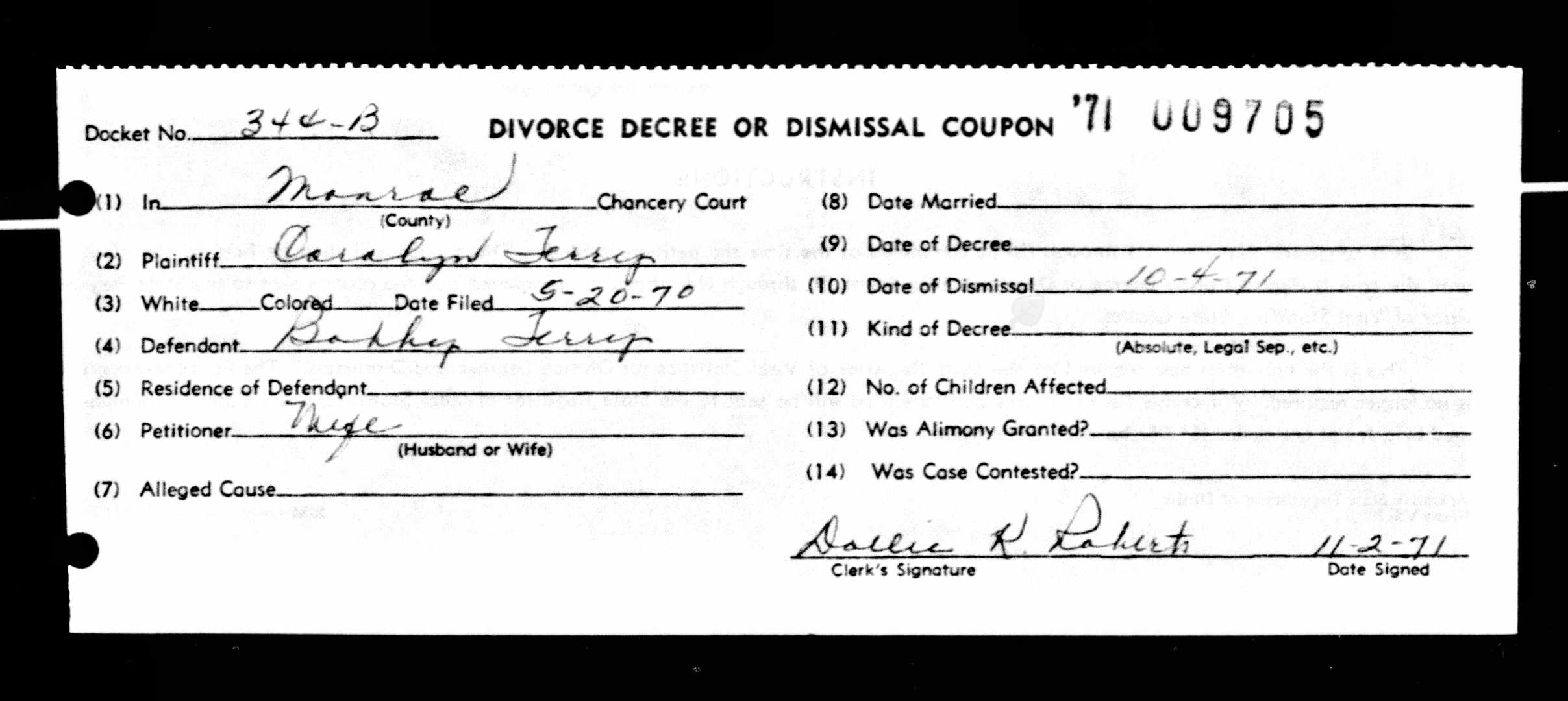
It wasn’t until Saturday morning that I found the proof. Just one more click, and there it was. Proof that Mom had found out about another one of dad’s affairs, this time with one of the last people she could have expected. She filed for divorce in May and then dismissed it in October of the following year. I note with irony that the “number of children affected” is left blank.
Whether I should or not, I have to connect the dots. I now know the specific time frame that I lived with my grandma and grandpa. When I fell out of bed made of two chairs and stopped breathing. When some of my earliest and best memories were made. It took me years to learn that it was normal for people who felt traumatized to lose swaths of their memory. People sometimes mistake my dogged intensity for research as good memory. That’s totally inaccurate. Even with the memories I’m sure of, I tread cautiously.
I remember shortly after mom and dad got back together. Even though it’s largely irrelevant, we lived somewhere along Main near Spruce Street. I remember coming inside to see dad on the couch with his gallon jug of water. I remember him being grouchy from a hard day’s work. Of being scared to death of him. I did not understand that partial memory until this morning. I had been forced back into the house after being with Grandma and Grandpa, during which Mom reluctantly described it as a separation. She never admitted to me or anyone in front of me that she had filed for divorce. I’ve lost all memory of the massive, violent fights they had before and after.
The other big wow of all this is that my secret sister was born in May of 1972. Subtracting nine months from that means that the document I discovered also indicates that dad had another affair shortly before mom dropped the divorce. So when I had to go home to a place on Main Street in Brinkley, dad was having another child, whether he knew it or not.
As for dad, Aunt Susan wasn’t the last affair he had with someone he shouldn’t have. When we got burned out of City View in Springdale, we went to live with the widow of one dad’s cousins. He had an affair with her, too.
Shortly after my secret sister’s birth, we packed up and moved to Northwest Arkansas. I didn’t find out about ‘why’ we moved until the day I met my secret sister, almost five decades later.
We moved back to Brinkley for about a year while I attended 3rd grade. I don’t know why dad felt like his secret was safe regarding his daughter we didn’t know about. Dad operated a gas station across from the Lutheran church in Rich, off Highway 49. He tried making a go of it again in 1993, up until his death. He remarried mom exactly 29 years after he married her the first time. I constantly think about the year we lived in Brinkley, and about the fact that I had another sister just out of reach. Or about how differently our lives would have been had mom proceeded with the divorce.
The more I learn, the more I know how many secrets the Terry side of the family kept. It seems impossible that mom didn’t know more of them, but as my sister agreed, when mom was angry, she couldn’t resist screaming about whatever she could. None of us remember her ever mentioning our secret sister.
As for this original divorce filing, mom never admitted it.
I love when forgotten memories get unlocked by music. Monday afternoon I was scrolling and Sammy Arriaga’s version of Freddy Fender’s “Before The Next Teardrop Falls” came on.
I remembered a specific summer afternoon over the years. But for some reason, this time an enormous amount of details came back. It felt like a door had been unlocked and let me remember things that were locked away. It was July of 1990, back when I was as naive about so many things and an expert at things most people didn’t experience.
I hadn’t thought about that summer afternoon in years. Even though it was my first year at Cargill, I was trying to do something for Uncle Buck who had helped me yet again. Many people don’t know that it was because of him that I was able to do things that I otherwise might not have. Several times in junior high, he stepped in and helped me when my parents drank all their money away. I have to include Aunt Ardith in my thanks.
I mowed Uncle Buck’s yard for him. Because Aunt Ardith went to play bingo, Uncle Buck invited me to join him as he poured himself a “snortee.” Jimmy would have been at his job at Mary Maestri’s, working in the separate building on the large property at the corner of what is now highway 112 and 412. Like almost everything else, it’s an entirely different world out there now.
For once, I accepted a small glass of whiskey with two cubes of ice. Uncle Buck laughed like he did, pointing out that people who preferred to drink their whiskey straight were either sophisticated or about to start a fight.
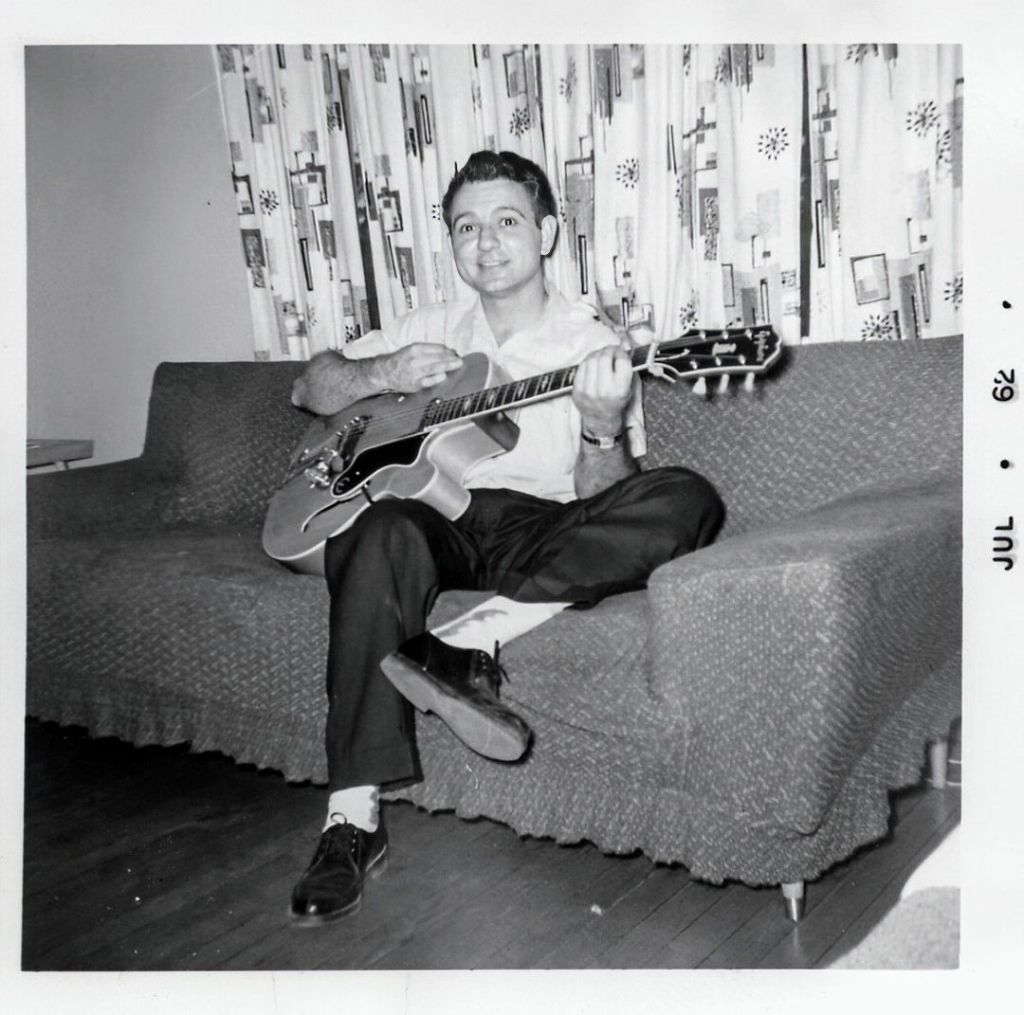
When I was younger, Uncle Buck tried to encourage me to learn to play bass guitar. He liked to tease me about being in band and choosing the French horn. But he was glad that I was into music. Once I graduated, I turned down both a music scholarship and an offer to be in the United States Army Orchestra. Uncle Buck wasn’t someone who repeated himself often, but there were a few times he told me to find a way to get back into music.
Uncle Buck got out one of his records. He chose Freddy Fender’s “Before The Next Teardrop Falls.” He showed me the album cover and laughed at Fender’s enormous head of hair. By that age, I had already adopted my short haircut.
Probably because no one else was at the house, Uncle Buck told me to listen to the song with fresh ears. He said that it was one of the best examples of a perfect country song. Just a stripped down love song that wasn’t cluttered by technique.
I don’t know what Uncle Buck was thinking about when the song played the first time. It’s strange to me to think that he was around 57 years old that afternoon, just a little younger than I am now. Whatever look he had on his face, it was 100% nostalgic.
When he played it the second time, he explained it to me as a musician. While I don’t remember specifically everything he said, he told me that it was the perfect tempo to sing or dance to. That it was standard time, mostly major chords, and that it was the perfect example of a verse-chorus song. Uncle Buck was impressed with the fact that Freddy Fender made a hit out of it both in country and pop. Uncle Buck was also impressed that the song included a steel guitar and an accordion.
As the song played a second time, I almost fell out of my chair when Uncle Buck softly followed the lyrics as Freddy Fender switched to Spanish. Uncle Buck loved teasing me about speaking Spanish, but this time, after the song ended, I asked him about it. He told me that because he learned all music by ear, it was just a question of repetition.
We listened to a couple of other songs before Uncle Buck put on Charlie Pride’s “Kiss An Angel Good Morning ”
I don’t remember exactly how he put it, but he pointed out that it was almost perfect too, because it was the type of song bad singers could do reasonably well.
I wish I could remember what song he played next. That part is lost to me. He got up to pour himself another drink. He stood in front of his well-equipped stereo system, thinking. As an electronics tech for Montgomery Ward, he had nice stereo equipment. Whatever song it was, by the time it ended, he had downed his drink.
If I had it to do all over again, I would find ways to sit with Uncle Buck and have him talk about music. When he was younger, he had the chance to play with some amazing musicians in Memphis. Even though he played in a couple of bands that did well, he chose a good job with benefits over the musician lifestyle when he moved to Springdale. Because I’m older now and can relate to the fact that he was about the age I am now, I understand the nostalgia he probably felt that afternoon.
This is personal. I’m not overthinking these words. I just want to get them out.
I’ve written about some of this before. My dad was in prison in Indiana. I heard so many different stories when I was younger. The Terry family was cemented into compulsory silence about this and many other things. (Such as the fact that I had another sister until a few years ago.) To find any truthful reference to ‘why’ my Dad was in prison, I had to do it the hard way: I searched THOUSANDS of pages of newspapers across Indiana. I’ll never forget that feeling of finding specific information. I had a cousin who probably knew most of it correctly. But she opted to adhere to the family code of silence. That’s why I had to do it the hard way. When she didn’t provide the information, I told her that I was patient and that I would find it.
I don’t disclose these things to shame members of my family. Apart from the fact that you can’t shame someone who is no longer alive, facts don’t bring shame. They bring revelation. I’ve proven time and time again that anyone who stays at it will uncover most truths. That’s how I used DNA and a decade to find my sister. It’s also how I kept at it to substantiate the details of some of my dad’s life.
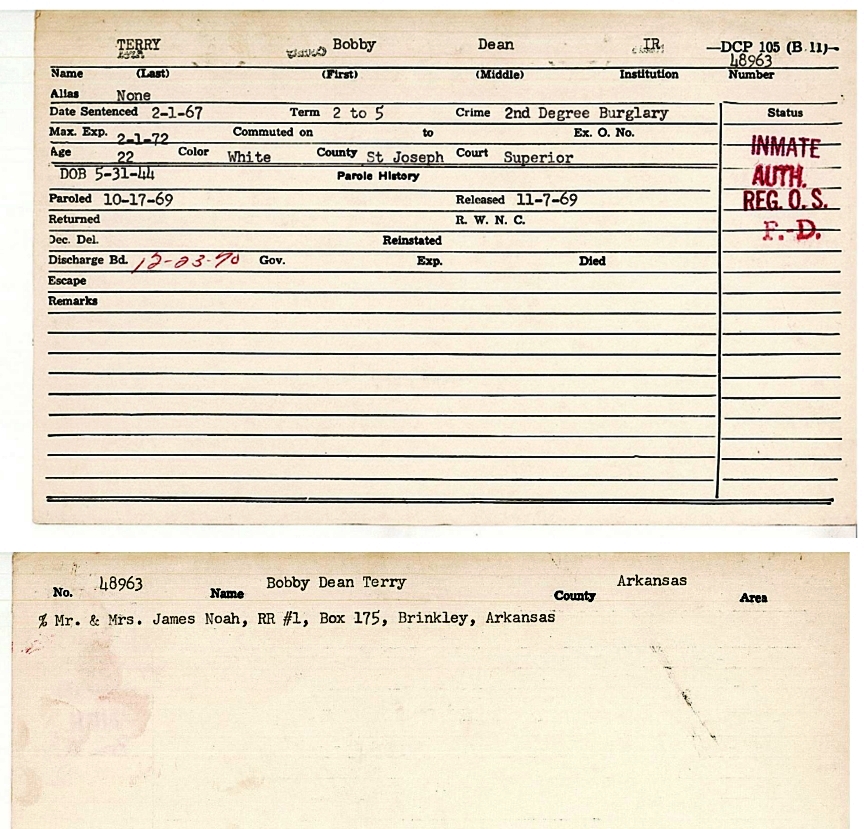
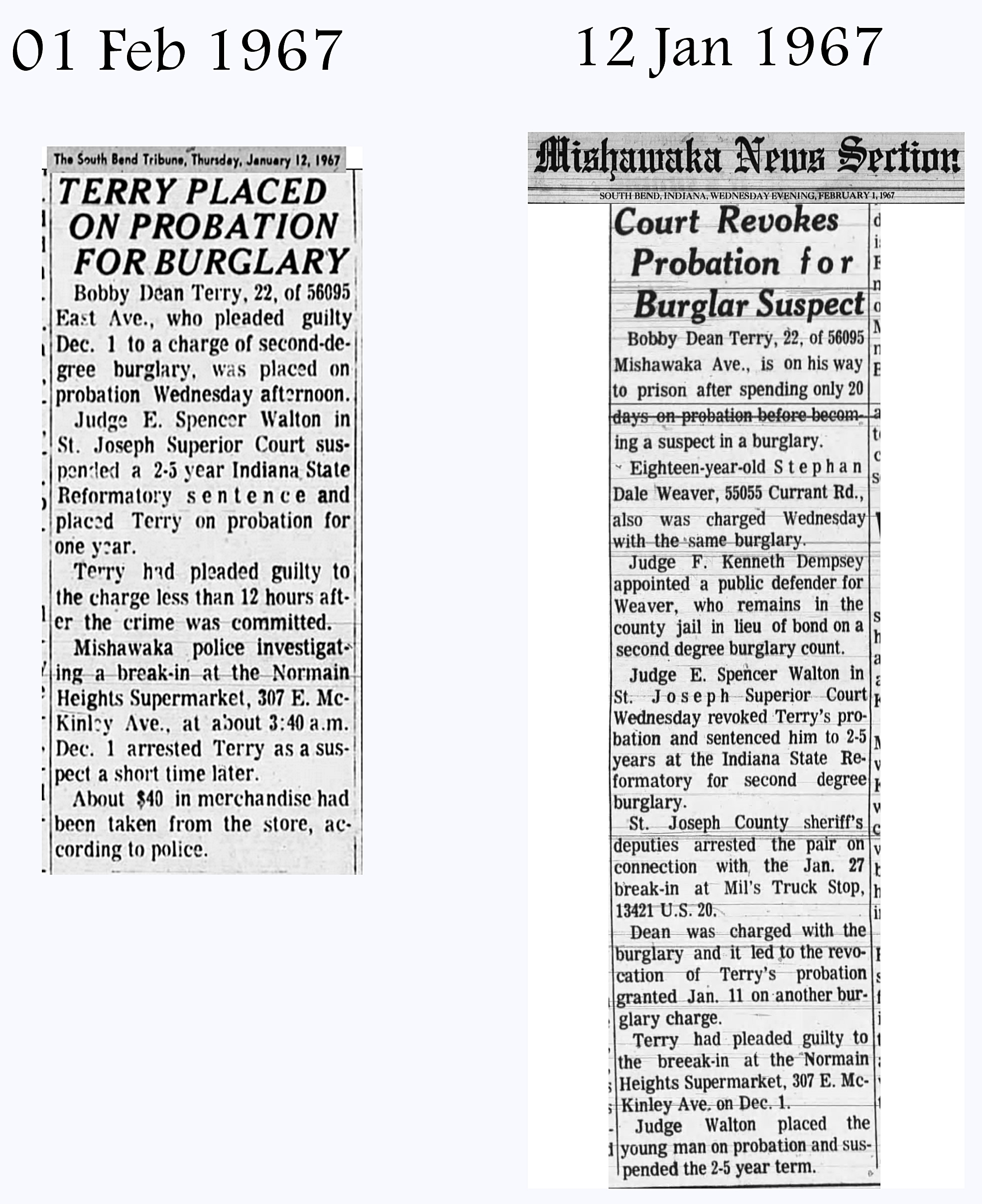
I received the Indiana Reformatory index card out of the blue today. The prison stopped maintaining most old mugshots. But in those few lines of information, there are massive implications.
I was born in March 1967. My dad was imprisoned on February 1st, 1967. He was in prison for two years, ten months, and six days. That’s a lot longer than anyone ever mentioned to me when I pressed them for information. Dad was living in Indiana before his arrest, which is the first documented proof that my parents were not living together. Dad joked that he had been in Alaska. He didn’t make the joke often because being in prison wasn’t something he talked about unless he was drunkenly telling people.
Less than four months after being released from the Indiana prison, my dad was involved in the death of a maternal cousin during a DWI incident. My Dad didn’t suffer any charges for this. Regardless of how people feel about me saying so, connections kept him out of trouble. Monroe County, Arkansas, was a different place then. The Terry family didn’t hesitate to use those connections to quash any concerns. Had my Dad been held accountable, it might have caused him to return to an Indiana prison. His parole wasn’t discharged until almost eight months after the DWI death.
When I’m thinking about my life or talking about it, I mention that I lived with my maternal grandparents while Dad was in prison. I wonder what life might have been like had he not returned. Whether his presence would have been substituted for another man of similar temperament. It’s all speculation. I wouldn’t have my other sister had Dad not returned, or if he had been put back into the system.
After the DWI death of my maternal cousin, Dad jumped into a highly questionable affair. It took me years to piece together that one of my earliest memories of standing up in the back seat was one in which I accompanied my Dad to Clarendon beach with his affair partner. Mom said that I couldn’t possibly remember it. Normally, I’d agree. Growing up that way tends to erase a lot of memory. But that memory stuck with me.
After that affair debacle, Dad engaged in another affair, one that led to the birth of my sister. I didn’t realize until I met her that her birth explained my family’s sudden departure from Dad’s beloved Monroe County to Northwest Arkansas. Away from my grandparents and some of my maternal family, who would have altered the trajectory that Dad’s behavior brought upon us.
I’m sharing this because I feel vindicated for finding more pieces as time passes. I’m not revealing anything that should not have been disclosed to all of us. The foolishness and false family honor of those who demanded secrecy still bother me. Then again, I’ve come to learn that this tendency governed their lives. Several of them were completely different people than their demeanor indicated.
“Cicadas are gross,” she said. That’s because she didn’t experience the magical connection of hearing them out in the wide fields of Monroe County during her formative years. The insects of that area are already formidable and should be considered true citizens, counting in the billions. Anyone who has driven on the county roads in the evening knows the folly of attempting to use windshield wipers to remove them. I don’t recall which year I happened to be with my Grandpa and Grandma to experience the cicadas. It was deafening at night because we slept with the windows open, surrounded by fields filled with them. Hearing the cicadas now evokes buried memories, all tied to wonder and childhood experiences.
I have the same reaction upon smelling creosote, especially when it heats up. It reminds me of things I can’t quite remember. Diesel and gas are inextricably tied to my dad’s attempts at operating a gas station on Highway 49. Or my Grandpa, who insisted that the smell warded off the torrent of mosquitoes. The trains humming in the distance. The area of my early childhood owed its existence to railroads. Brinkley was once called Lick Skillet, a name that should have been preserved. The topography conspires to have the train horns and rattling metal echo for miles. Those who’ve not lived in the flatlands don’t understand why people refer to it as haunting. Grandma’s house in Brinkley on Shumard Street was close to the railroad. My apartment is less than 50 yards from one, too.
Years ago, I drove in the late evening on Highway 70 from Little Rock to Brinkley. There were millions of small frogs. They coated the road and the low Geo Prism, so much so that the uneven road became slick and hazardous. My deceased wife, a native South Dakotan, was initially horrified but soon fell quiet in awe of the spectacle. She later told the story to her family. They were convinced she was exaggerating. Had we chosen the quicker route of the parallel interstate, we wouldn’t have had the moment.
Since I’m being nostalgic, yesterday I got out of one of my bottles of burned seasoning. It’s a delicious mix I make myself, but that’s another story for another day. Dabbing it on my tongue, I felt like I was tasting Grandma’s salt pork again. Salt pork is the antithesis of what I normally would prefer to eat. Because of my upbringing, I tended to avoid eating most meat. My dad’s proclivity toward forcing me to eat vile things almost at gunpoint soured me considerably. But if time travel were possible, it is what I would like to return to first. Opening the screen door of Grandma’s house and smell the aroma of her cooking bacon and salt pork. A wall of memory.
Since this post is titled, “All Over The Place,” something that I’ve mentioned before seems much more significant now. I never concealed that I wet the bed much too often when I was younger. When I started therapy, I did a workbook online. I didn’t know that most people barely write a page. I wrote at least fifty pages. I rarely wet the bed at Grandma’s. Of course, I now know that it wasn’t because laundry was much more of a chore for her. It was because I felt safe. Don’t get me wrong. Grandma could be stern. But she never once arbitrarily shouted at me or threatened to box my jaws off unless I wasn’t listening. While not actually boxing my jaws, I knew better than to tempt her. I did not, in fact, ever want for her to follow through on her promise to snatch me bald-headed, either.
Sometimes, Grandpa would tell me not to fear things in the dark or glinting eyes through the screens on the windows. He told me often that the only real danger was things walking on two legs. As mean as he was when he was younger, by the time he had me to call him Grandpa, he protected me. Quite often those who needed a reminder were the two people who came to pick me up at the end of the summer.
In a few short minutes, the train will speed by me on the other side of the road. I’ll be on the landing, cicadas buzzing. And if I were so inclined, I could walk over and touch my hand to the rails. They are connected, reaching the fields of Monroe County.
I undoubtedly awoke with all this on my mind because before going to sleep last night, I stood at my kitchen window, listening to the roar of the cicadas. I dreamed of fields and imaginary stories. Waking, I recalled none of them. Just the tendrils of fading geography and bygones.
I sat to write words of memory this afternoon. No matter how I tried, I kept returning to the places surrounding the person who departed Monroe County, Arkansas, yesterday. Though she lived in Memphis for a time, she came back to Holly Grove and lived a long life. She had the iron in her bones to outlive her husband, Poor Bob. She shared that almost indomitable spirit with my Grandma Nellie. I could write a volume about how much I misunderstood my aunt when I was younger. My childhood was both an enclave and a firestorm. When I was very young, she stood ready to voice her opinions loudly. Her gaze unnerved me. It wasn’t until I was older that I realized how fierce her sense of humor was. She needed it to do battle with my mom. My aunt was a hard worker and had iron in her hands that my mom didn’t.
Monroe County no longer exists, but it’s still on the map. Citizens still dot the places within with their presence. But it is a place largely holding its breath and studiously peering away from its dwindling ranks. From 2010 until 2022, it lost 19.3% of its population. In that same time frame, it lost 1/3 of its 35-49 age group. Brinkley, Roe, Clarendon, Fargo, Holly Grove, Indian Bay, Blackton, Smales, Pine Ridge, Dixon, and Keevil; all these places sit in careful silence, awaiting their turn to be memories and names of places once filled with people living their lives. They’ll survive as census notes. I’ve learned more about them as an adult than I ever did as a child living there or as an adult returning to visit.
I did not appreciate the beauty of those small places until much later. To me, Monroe County was where my grandparents lived. Truthfully, Monroe County could have been almost anywhere in the delta, on either side of the Great River. Most of the places share a similar heartbeat and footprint. The odd asphalt roads, the infinite number of dusty dirt roads, miles of telephone wire stretching lazily across the flat land, interrupted by crops, mosquitoes, swamps, and irrigation ditches. Community was everywhere, regardless of the distance between neighbors.
Although I better understand it now, the prejudices seemed disconnected. I didn’t know that the same small town that held my aunt in its embrace was also the crucible for a sister that I hadn’t known for almost five decades. Now, Monroe County has a citizenship rate of almost 100% and no household reported being secondarily English-speaking. Monroe is not a place to go to; rather, it is a place to leave or retire and await one’s fate. For those who love the places of Monroe County, they feel it in their bones and wish their bones to rest there.
I cannot observe a storm without recalling the austere beauty of watching the weather move in across the open spaces, the towers of lightning and clouds visible for miles. I cannot sit on a swing without remembering summer nights. Nostalgia mostly erases the agony and buzz of mosquitoes.
Now? The last of those in my family who followed the beacon of Monroe County have gone to visit other places, ones to which we cannot tread. Not yet, anyway.
Monroe County now has one less to claim as a citizen.
But if you tally her voice and character, it lost something precious in her that is hard to define. People might be easy to come by, but there are so few remaining who, upon hearing them speak, evoke in us the spine and vitality of the places that are becoming shadows.
I can’t return to my hometown of Brinkley or Monroe County, which holds a place in my head. The same winds blow, and the same crops withstand the blistering sun. There is some wisdom that only older age can provide. Among that knowledge is that you carry some places so deeply inside you that you can’t quite identify what’s missing until you take the place of your ancestors, remembering what once was.
You can return and stand next to a recently plowed field. Or up to your knees in growing cotton. The only thing that has changed is everything.
One less.
With some, we lose more than one with their passing.
A local doctor stole babies from birth mothers, telling them that their children had died. And one case in particular… It took decades for DNA to reveal the story. That happened here in Northwest Arkansas. One of my ideas for a Netflix documentary would be to contact the families of every mother, especially single mothers, who gave birth during a specific time period to perform DNA tests and compare them nationally.
Handsome, charismatic men who portray themselves as humble Christian husbands. Yet engage in a cycle of highly sexual affairs. (A story so common it is literally copy and paste.) Another one with a conservative political career who used his position at his work to take advantage of women. There’s a reason so many sexual harassment complaints arise in the workplace. It has built-in inequality that largely negates people speaking up and setting things right.
More than one doctor who openly had mistresses but yet were considered pillars of the community. Who had children with those mistresses.
People I knew who experienced a wild array of trauma. Everything you can imagine. Even though I had my own mostly unknown traumas, some of these people went through much, much worse than I did.
A dentist who preyed on women. Money can lighten any stain or accusation. Rarely do people choose victims whom they consider their equals.
Cops took advantage of people monetarily or sexually. Some used their positions to ruin their victims instead of admitting what they had done.
Coaches who bullied young kids. Or worse.
Teachers who are inappropriate with their students.
Church leaders behaving inappropriately.
A multitude of lawyer stories. Except they are armed and knowledgeable regarding the process of eluding accountability. Mostly. I’ve told the story many times, but one of them went to prison for fixing cases. My parents were among those who benefited from the arrangement.
Last year I had a bad feeling about someone who owned a plumbing company. I used my skills and uncovered a trail of female victims. One leading me across the country.
I had a similar feeling about a neighbor. He turned out to be a previously convicted sexual predator, along with a nice jacket full of criminal offenses.
All of these things have shadows around them.
Most people are good people.
But one thing you have to understand is that your experience with a particular person does not mean they didn’t have a dark side.
Especially upon their passing, if you lionize them, you have to be willing to listen to anyone who has a contrary opinion or experience with them.
It is in darkness and secrecy that people can be duplicitous and lead secret lives out of sight from observers. At least observers who will speak up.
The above examples are stories I know from here in Northwest Arkansas.
When I got involved in learning about the doctor who was stealing babies, I was expecting a reasonable explanation. Instead, I had to sit in the knowledge that someone was capable of ruining a mother’s life in that way. There was no doubt that he had done it to multiple women.
It’s human nature to avoid accountability, just as it’s also our nature to get mad when someone tries to tarnish a family member or someone we admire. Even a cursory look at Mother Theresa and her charity reveals many detestable secrets.
People have different faces for each aspect of their life.
I don’t have a nice bow with which to tie this post up.
There are certainly false accusers.
But there are also victims or people who know the truth about someone.
Each of these people has the right to tell their truth and story.
History and familiarity with people have repeatedly and demonstrably proven that truth is stranger than fiction.
I have several examples from my life in which the truth didn’t come to light for decades. In one, I found the gift of a beautiful and intelligent sister concealed from me. In another, I found proof of the final crime that sent my dad to prison in Indiana in the 60s.
NSFW due to a wild mix of subject matter and personal commentary…
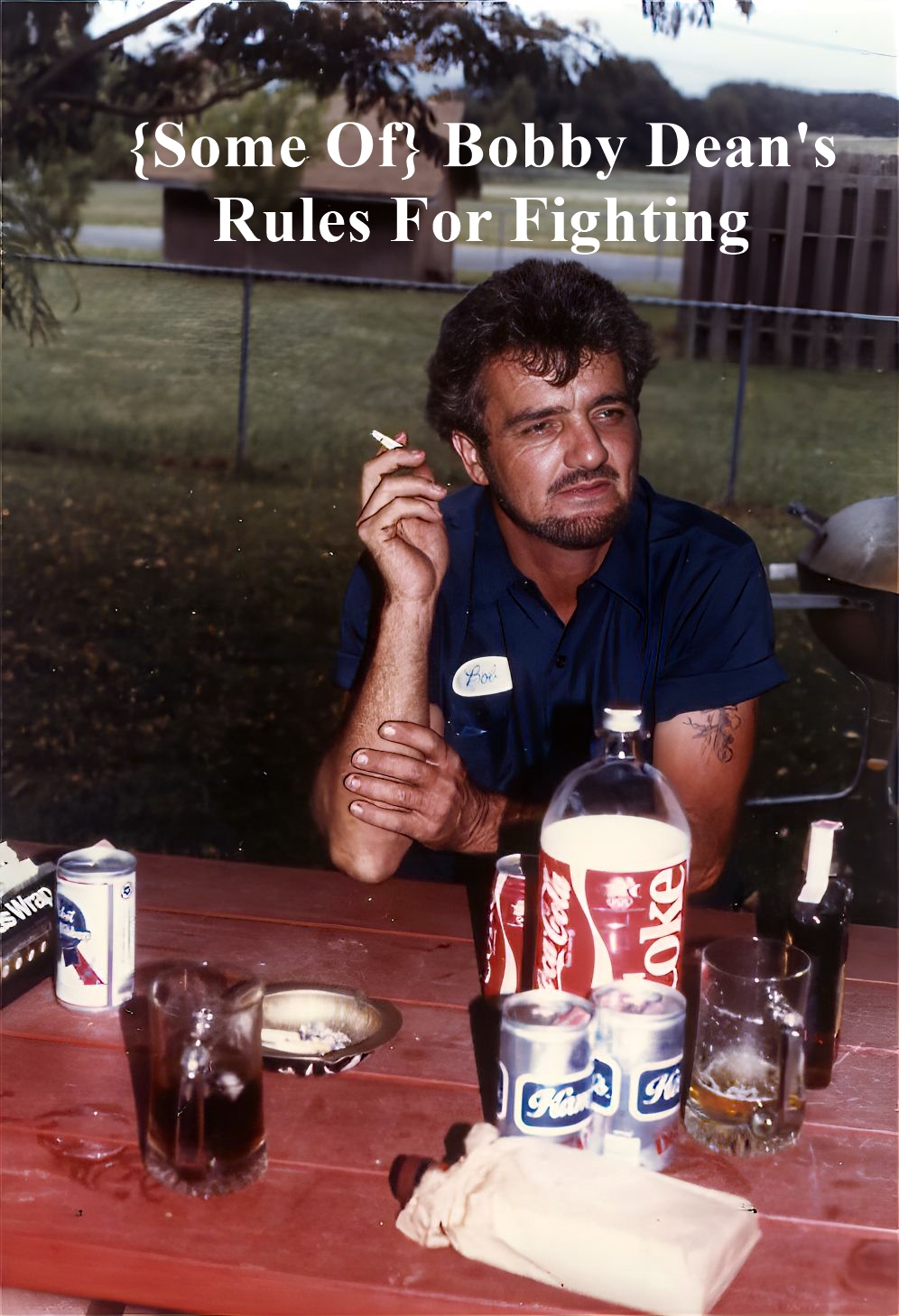
My brother Mike died without fulfilling my desire that he write a book. He absorbed the false honor narrative of some of my family members. He was a big man, my brother. I took these rules from conversations that Mike and I had on the phone when he was winding down. I’ve shared pieces of them before. My brother Mike had an interesting life. He was a great writer. We both recognized that between the two of us, we might be able to capture the horror, dark humor, and insights that we experienced. Of all the things that piss me off about the way he went out, it’s that he didn’t have enough clarity to see that he should pull up and find a way to live a few more years. Had he chosen to find a way, the resulting book we would have written would have been an irreverent mixture of Pat Conroy and Stephen King.
I’m paraphrasing my dad: “You’re going to get punched in the f mouth. There’s no doubt about it.”
My brother Mike saw a few fights that I didn’t. While I did witness my dad getting his ass whipped, Mike saw a few more of these than I did. Dad had whiskey courage. He read a few too many Westerns and got the wrong lesson out of most of the movies.
Take them for what you will. My dad was a walking contradiction. I despise a lot of what he did. But I understand it a hell of a lot better as I get older.
Rules:
If you’re going to drink in a bar, you’re going to need to be deaf or have a thick skull.
If your buddy is getting his ass whipped, you have to get your ass whipped too.
If someone threatens you… There are no rules, no warning. Do not think about it. Start hitting.
If someone says they’re going to whip your ass, don’t wait for them to prove it.
If they’re close enough to hit you, hit them first. Don’t stop hitting until they’re down.
The most dangerous man is never the loudest.
Don’t punch them more than you need to. But if they are intent on killing you, don’t walk away when they’re on the ground.
If they dress like a dandy, they will not want to get dirty. If they wear a tight shirt, it’s a sure sign that their muscles are for show. Except if they have dirty, scruffed-up boots. You don’t mess around with people who work hard for a living.
Nuts, throat, nose. If those don’t work, bite anything that gets near your mouth.
There’s no such thing as fighting dirty. If they are coming for you, everything in the room is fair game.
If you deserve to get punched, let them hit you in the face. If they attempt to give you more than what you’ve got coming, remind them that you’re a dirty bastard.
Once you’re done fighting, men have a drink. If you can’t have a drink with a man you just fought with, you’re not worth the hat that sits on your head.
… Dad tried to make a man out of me. Whatever that means. He had his demons. A great deal of his alleged teaching resulted in me choosing the opposite. I never could get my head around that kind of violence. But if you ask me if I understand it, the answer is yes. Especially so when the universe fails or when people fail to honor the fact that violence should never be out of proportion to what caused it. Dad scrambled my brains a few times, but one thing that came out of it was that I learned that many fights come out of nowhere. And a few people who should have scared me didn’t. That’s a part of the Bobby Dean legacy that fills me with contradiction.
I’m forgetting a few of his rules. Despite some of the negative things I have to say about him, he surprised my brother and me many times with how he phrased things. I sometimes forget that he was smart. I would snarkily mention that he often failed to incorporate his intelligence into his behavior. But I’m tired of getting hit by a bolt of hypocritical lightning.
I’ve confessed before that my brother and I actively thought about killing my dad more than once. I’m not proud of it. But if Dad had survived a few more years, he would have appreciated the dark humor of this truth a lot more. Mike realized when we got older that it probably would have been me who would have done it because I experienced and witnessed a lot more of the violence. When my brother Mike got older, Dad looked at him much differently. Mike would have hurled him through the kitchen window like firewood.
Knowing them both, I am 100% certain that one of them would have pulled out the whiskey bottle and poured the other a shot.
They were the kind of men I did not aspire to become. Whatever dark streak ran through them has luckily remained mostly dormant in me. I’d love to have the devilish prankster spirit. I wouldn’t tie someone to a hunting camp tree stump and light it, but I would enjoy making someone think it could happen. There is a fine line between lunacy and free-spiritedness.
I’m sharing this because it’s supposed to be a tip of the hat. It’s not an accusation. The history is there, written as fact in my mind. One of the crazy lessons of ambivalence is that you can witness a tornado but fall in love with how the lightning looks across the sky. Life can be appreciated similarly, even if you would rather flip the light switch off for some moments.
Prepare yourself for turbulent oversharing. Some wounds get exposed again, revealing dark, unmanageable emotions. These words are supposed to be about addiction, alcoholism, and generational anger. I apologize in advance to anyone who thinks I am saying too much or to inflict pain.
I don’t want “I am so sorry” or any words of encouragement. Instead, I would much prefer that you read these words. And if they ring true for someone in your life, find a way to act before it’s too far down the road to turn back.
People often forget that I became an unwilling expert in abnormal psychology because I lived in an intermittent crucible inhabited by some of the most versed, angry people. For most of my life, I told people I believed my DNA must be infected. Though others couldn’t recognize it, I did. Though I now call it the “Bobby Dean,” the sinister recognition that my family’s maternal and paternal sides gifted me with the lesser side of humanity plagues me.
Like anyone without children, I sometimes mourn the choice to have none. Since life taught me that intelligence has little to do with the odds of giving in to anger and addiction, I remind myself that it’s possible that I would have given in to the lunacy passed down through my family. At fifty-six, if I had treated my children like others, there would have been little choice other than to end myself. I’ve hurt other people callously. But I at least can swallow my ‘what-ifs’ and know that I didn’t hurt my children and continue the generational trauma that populates the world with damaged adults. Ones who carry invisible wounds, anger, self-doubt, and the handicap of attempting to be happy and prosperous, even though they were mentally beaten into submission.
Nothing new happened recently to rip the bandage off. However, I was forced to learn further details of how nasty the effects of this anger and addiction were to people in my family. Because of geography and shared secrecy, it turns out that the imagined and partially confirmed psychopathy passed to the next generation was much worse than I knew.
Alcoholism amplifies monstrous behavior. It might not create it, but it unleashes it. The whisper of the disinhibiting lover in a drunk’s head becomes a shout. The person you once knew gets trapped and silent inside the shell of the alcoholic. As it worsens, the person you once knew becomes a faint echo. The new version will say and do things that increasingly become impossible to live with. You are tethered to the person who once was. As a result, you attempt to deal rationally with the effects of addiction.
Meanwhile, the person possessed by it will do anything to guard their ability to keep drinking. They’ll gaslight you, lash out, and create clusters of people who assume that the version of the truth they are being told is valid. People with no ill feelings toward one another become manipulated pawns, initially acting out of honest concern. But what results is another level of toxic behavior, all hinged on the central person. It is drama and chaos. Because of the secrecy and generated toxicity, people’s relationships get ruined.
One of the most significant pieces of advice I can give people when they are attempting to coexist in an addict’s world is to talk. Talk to everyone. I guarantee that the addict curates everything you do and say to make you a monster because addiction requires secrecy. Intelligent addicts learn the behaviors of narcissists.
People sometimes ask me what makes me so well-versed in narcissism. (Not the generalized version of it prevalent in social media.) Anyone raised or living around addicts inadvertently learns the behaviors. The hallmarks of narcissism always bubble up with addicts and alcoholics. They must deny reality. They become delusional to the effects of their behavior. They enlist everyone and everything to perpetuate their ability to keep drinking.
Recently, I met someone who triggered my “Bobby Dean” response. I knew immediately upon meeting them that they were evil. I hate to use that word. Nothing outwardly about them gave a clue, not directly. The bells went off in my head. I was right about them, of course. And then you’re left with the impossible task of coexisting with them. Such people thrive on chaos and the emotional distress of people around them. Since most people are genuine, they get stuck in a loop of the foolish desire to mitigate the narcissist. It can’t be done.
In the same way, most of us think we can win over an alcoholic with love, words, and compassion. It’s not true. You’re not dealing with a real person until you can slap the bottle out of their hands. They are an angry parody, possessed by a demon demanding nourishment. Replace the word ‘alcohol’ with ‘heroin’ and you’ll realize that until you get rid of the heroin, you can’t move forward. The addict can’t attempt to be themselves and regain their humanity until they eliminate the invisible straightjacket of addiction. Addicts put you in the position of helpless anger. Anger with yourself and anger with them. We each know that a person trapped in addiction isn’t being themselves. But that knowledge does not give us any comfort. We find ourselves screaming. It’s reactionary abuse.
My goal isn’t to tarnish my brother in this post. He was older than me. I loved him and knew early on that he was among the most intelligent people I’d ever known. We survived our parents. He got the worst of it from Dad. Perversely, it turns out he got the worst from Mom, too. As he got older, I tried to give him the benefit of the doubt. Obviously, the anger he’d inherited from our family poisoned him. I thought it must be me, that I was somehow doing or saying things wrong. Toxic people don’t take the time to doubt whether they are wrong. I became the opposite of my brother in so many ways. And he hated being wrong. It was one of his defining behaviors. Because he was so smart, he was seldom wrong. But when he was wrong? He doubled and tripled down on it. From there, he justified saying and doing anything to keep it that way. The alcohol perverted him into someone who could behave and speak in ways that the younger version of himself could not have imagined.
He was particularly vile to me when I changed my name. At that point in his life, he still pretended to carry the torch of family honor. He’d grown up with the Terry side of the family. They were true experts in horrific secrecy. When I changed my name, I wrote them all letters. There was no way to avoid them knowing that I rejected everything my name held within the letters that formed it. They got their revenge when my dad died. Their secret hatred was so intense that they refused even to list me by my legal name in his obituary. That’s the best example of expressed passive-aggressive behavior that I can cite. When I think of self-righteous hypocrisy, I imagine their example. It does not mean I don’t have good memories of them, too! But the older I get, the more I concentrate on knowing they were well aware of what was happening in our violent private lives. They preferred to stay out of it, even though they knew what was happening. Family honor and secrecy held more value than protecting children who were getting damaged right under their noses. It invalidated every religious idea that they allegedly cherished. I can’t imagine doing that. It makes sense that they hid my sister from me for almost fifty years. That she wasn’t white must have been the biggest threat to their false family honor that they could imagine. I would hate myself if I’d become the secret racists that they were. I’d write more about this, but that part of the story isn’t mine to tell.
I made the mistake of attempting to lovingly help my brother a few years before he died. I was all in. It was the worst possible move. He retaliated by lashing at me and everyone around me. He scorched the Earth to keep his addiction. I was rightfully convinced that he might actually kill me. He spent a great deal of time detailing how he would do it. Had he wanted to, he easily could have. Life had geared him up with the tools to do just about anything. Some of the family pretended they couldn’t imagine he was doing and saying those things, even though they could see the emails, listen to the voicemails, and read the texts. Each of them had spent decades enforcing family silence. Why would it be any different with my brother? Had this not happened with my brother, I might not have decided to cut off ties with my Mom not long after. It was just too much. Two of the world’s best alcoholics take a massive toll on a person’s sanity. It struck me how similar they were, each insistent on maintaining their addiction at any cost.
My brother was lucky. Though he left a trail behind him, even professionally, he was forced to retire and avoid the consequences that would have befallen anyone outside law enforcement. I hope anyone he encountered at work didn’t suffer as much as I imagined. People in that stage of alcoholism behave in ways that they never would absent the addiction. It is no secret that law enforcement suffers more from addiction than the general population. (As they do domestic abuse.)
No one was safe. No one ever is around an end-of-run alcoholic.
My brother had the chance to retire and enjoy a full life. To make amends. To admit his transgressions, to replace spiteful words with love and hugs, and to reject the poison of our DNA. He chose otherwise. It’s a story I have witnessed repeated too many times. It is agony for all of us to prefer to tell the good stories and push back the bad ones. Who wouldn’t want to honor the good times? There were many. My brother could have written several of the best books ever written. I would likely have helped him. Anyone and anything can be forgiven if they are open to it. Alcoholism demands everything. It reduces people to their worst common denominator.
A couple of years ago, I scrapped a lot of my shared history and records of my brother. After his death, I thought I could move on and continue to work to remember the good things about him. Some of it was incredible, an irrefutable dissertation on how crazy his addiction made him. He created entire fantasy worlds, each independent of the other, all designed to alienate people and render them unable to interfere with his addiction. Addiction requires secrecy. And as it progresses, it forces the addict to silence those who challenge it. It is exactly like a demon facing exorcism. It will destroy the world in the pursuit of its existence, even if it kills the host.
I write this because the newest revelations force me to confront that he created a world of pain for people. Those people are left with the immense struggle to be good people. It can be done. The first step is to no longer worry about people knowing. Sunlight gives breath. You have to talk about it, acknowledge it, and work to silence the self-doubt that the toxicity of alcoholism demands.
I damn well know that we all have addicts or alcoholics in our lives right now. The cycle is endless. If you think it is manageable, you’re wrong. It will worsen. You’ll look back and understand that if you could return to when it started, you’d do almost anything to stop it.
If you have an addict or alcoholic in your life, whether you think it is true or not, you must start talking to people first. They need to know you are dealing with an addict. You must rob the alcoholic of their secrecy. It is the critical component that precedes every other consequence and behavior.
I can add anger to my reaction recently. Anger can motivate if channeled. If you’re dealing with an addict or alcoholic, I recommend anger as a defense. Let them experience the consequences of what they’ve created. If you do nothing, you’re going to be angry anyway. It might be more effective than compassion.
I’m telling you this as an unwilling expert.
A piece of my heart will always be broken. To discover that people now gone still creates shockwaves in the hearts and minds of those who are still here. It is a recurring wound, and one opened periodically by reminders by those who remind me of myself when I was young.
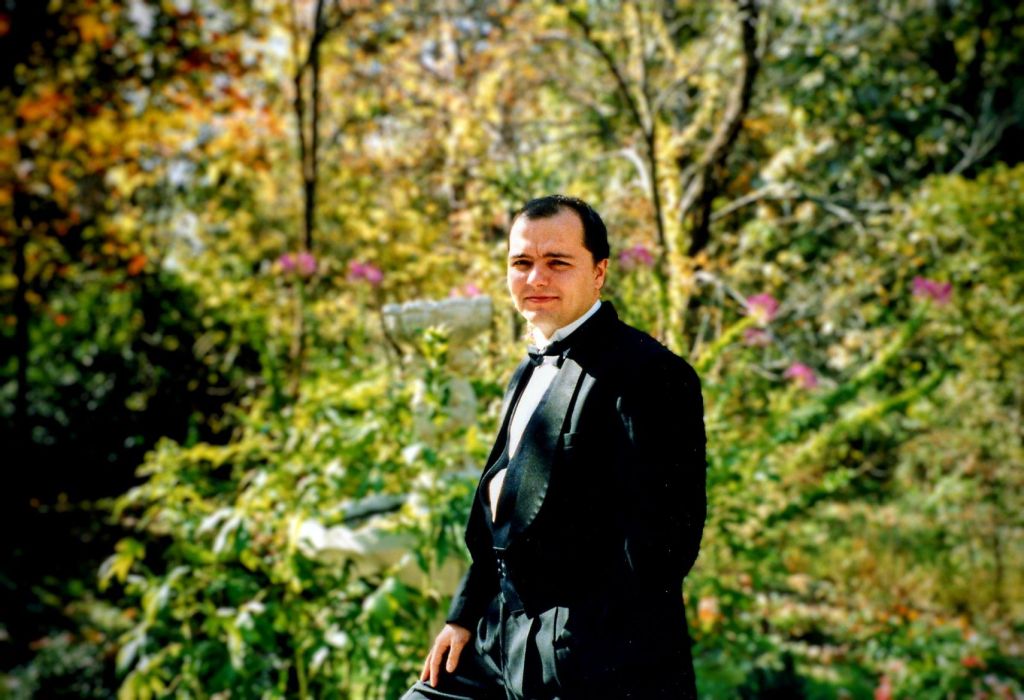
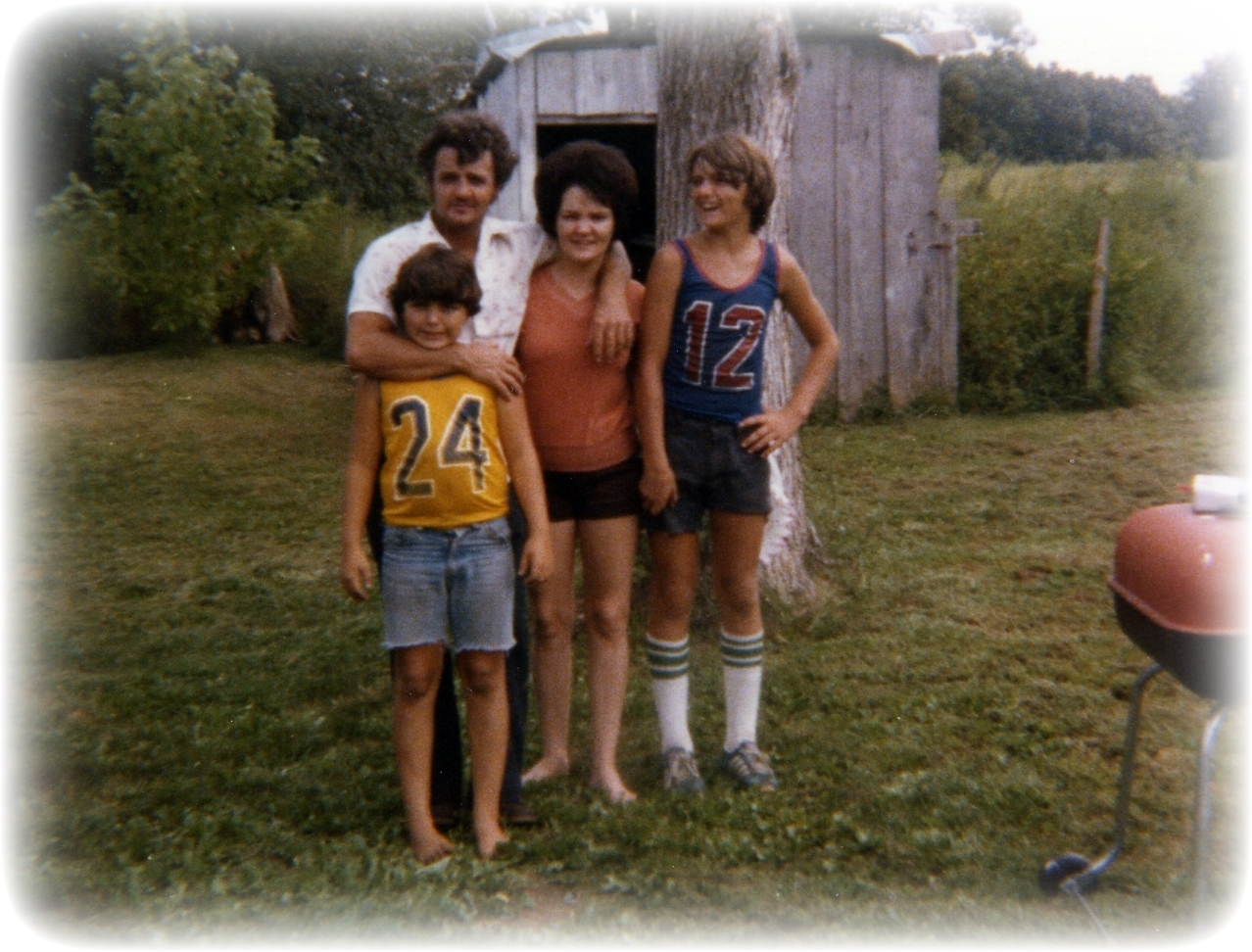
PS Pictures don’t lie. But they do conceal, just as most of us do as we live our daily lives. Just remember, I had many great moments as a kid. And as an adult with my brother. But behind it all…
Recently, I made a megamix of Rocky theme songs. Though I am not great at it, I made one remix that is impossible to remain immobile while it’s playing. The “Five Minute” rule works great when I’m not feeling it. Because it’s certainly true that motivation follows action rather than the converse. People wait for the urge, motivation, or willpower. It’s the opposite. As soon as the thought hits your noggin, you get up and do whatever it is you were about to put off. Or worse, say aloud, “I need to do so-and-so.” One of the best pieces of advice I was ever given was: “DON’T tell me what you’re going to do. Live it. Show me.”
Most of the time, if you practice doing, telling yourself you’ll spend just five minutes on a task cures your procrastination enough to keep going once you start. That’s true with so many things in life.
The Five Minute rule aligns seamlessly with my Law of Increments. If you do a little consistently throughout the day and days, before long, you will amass much effort – and probably consequences.
I know Rocky is old school. One of the reasons it did so well is because Sylvester Stallone (whose real name is Michael Sylvester Gardenzio Stallone) was a nobody with a story about overcoming odds. He was nominated for an Oscar for his screenplay.
Late in my 9th-grade year, I got pissed off at myself one early spring afternoon and decided to go running. I figured if the violence in the house hadn’t killed me, I could risk a heart attack. We lived on the downside of a hill in Tontitown near 4K farms. To say that I regretted starting that day is an understatement. I ran a mile. My shorts were ragged, and my shoes weren’t running shoes. Poor aptly describes my predicament. But I put it all aside and just ran. I did it every day, no matter the weather and how sore I was. After a while, I was shocked to discover that the exhilaration of barely being able to breathe was an absolute high. At the end of it, I knew I’d have a hill to run down. Over time, I found myself sprinting a half-mile before the incline. I added more and more distance until one day, it occurred to me that even distance wasn’t an issue. Years later, I wondered what it was that first day propelled me to stop yammering in my head about what I needed to do – and just do it.
My brother forced me to do pullups and lift weights in the horrid dirt floor cellar on the bottom level of the trailer we rented. He usually punctuated the necessity of compliance by punching me in the upper arm with enough force to numb it. Months later, I turned the tables on him when he told me I had to do at least a dozen pull-ups. I said, “After you, my lady, after which I will.” He struggled and finished. I jumped up on the bar and did thirty. “How many CAN you do?” The look on his face was hard to read. “I don’t know. I don’t count. Pullups aren’t a normal thing I do in the real world.” My brother Mike was ridiculously stronger than me. I didn’t like weights. But if I wasn’t practicing my French Horn or reading amongst the trees, it was safe to hide somewhere, anywhere, rather than inside, where the violence would erupt. I’d do anything to have my brother Mike around so I could duck, weave, and throw punches at HIM.
Later, I realized that when I didn’t have motivation, I would listen to a couple of the songs from Rocky and Rocky 3 in my head. “Eye of The Tiger” played ad nauseam everywhere back then. You couldn’t go to church without expecting to hear it being played in lieu of old hymns. That song always gave me the energy to beat my immobility inertia.
All these decades later, some of the music still motivates me. I loathe many of the songs on the soundtracks. Anything by that crack-voiced Frank Stallone, for example. The new remixes incorporate more of the wall of brass sound that the main theme personifies. It’s just raw power demanding that I stay focused.
Through the years, I discovered that almost all obstacles were a figment of my imagination. Could I do 1,000 pushups a day? No, but I could do 1,500. That’s a bit excessive, I know. I stopped doing quite so many a few days before my emergency surgery about sixteen months ago. Could I run a mile in under six minutes at age 55? Yes. Can I run as fast as my childhood best friend Mike? Hell, no. I still have mud in my nostrils from years ago when I tried to keep pace with him. (I decided he might be Superman.) Could I walk twenty a day if I want to? Yes.
I’ve failed at so many things. So please don’t read all this as a litany of humblebrags. I’m self-aware enough to understand that I wasted a lot of my time and energy. I am proud to be a Spanish bilingual and to be a liberal as an adult. Not just politically but across the spectrum relating to people.
The gist of it is that if we are focused enough to ask ourselves what our goals are, we probably can get there. If we want to. Regardless of most of the obstacles. Everyone has their obstacles. And yes, I do recognize my own privilege by writing all this. So many people have no opportunities or advantages. Mine were massive on both sides of the scale. I’m not so stupid as not to realize that despite the harsh hand I started out with, things are good.
I wish my life had a wall of horns blasting at key moments. It would drown out the complaining and haters, for one thing. It would help to get out of bed, too, not that I have that problem. I’m lucky enough to wake up rattling the rafters most days.
From “Eye Of The Tiger” to “Pancreas Of The Platypus” might be an ideal title for a book to describe my outlook on life.
PS That dust all over my vest is from rolling around on the floor with my cat. I can beat him wrestling any day.




 P.S. Parenthetically Speaking