Category Archives: Brinkley

Silence Is Seldom Rewarded

1xfamilyscan (123)


It turns out that the story I wrote regarding my dad and Oct. 23rd, 1993 might end up being ‘the’ thing.

A torrent of people wrote to me after reading the story in other places, wanting to know the rest of the story or asking questions about Bobby Dean – or the history of the place I once called home. I’ve done my best to answer them. My dad would get a laugh from the idea that so many people, almost all of them strangers to himself or his hometown, might want to read about his life. He would also struggle to understand that it would be his younger son who valued nothing of his contribution until it was too late who would ultimately be the culprit responsible for softening Bobby Dean’s character. I opted to shed myself of his name and yet the residue of his shadow eternally lurks just behind me.

Better writers, better singers, and better historians might recount a more compelling tale; from their absence or application of effort, however, they’ve yielded the floor to me. I don’t know what writer’s block is and I seldom let the undertone of misbehavior break my pencil. Our lives are all stories, even as we fail to see it or wish them to be unwritten.

For anyone who has looked past my imperfect and stubborn way of writing and reached out to me to let me know they found something of value in it, I thank you. I still believe that our lives and the internet would be more understanding if everyone could find a way to share stories, even those tempered by our lesser natures.

It’s maddening and rewarding to find an audience out in the sea of strangers on the internet, in the place allegedly most hostile to sharing one’s life or story.

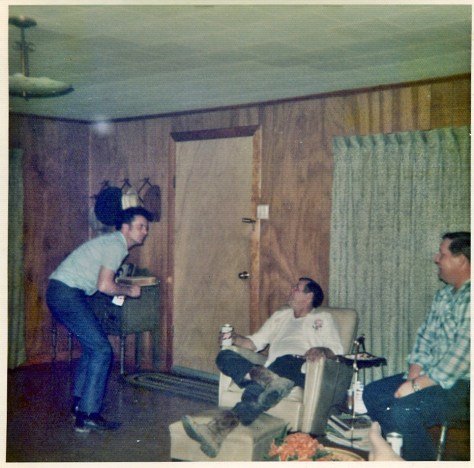
This picture is of my dad in a moment brimming with happiness. The house is now a hunting lodge off of Highway 49. I’m not sure what music might have been playing in the background, but Schlitz beer was powering the occasion. Dad, whose dance moves ran the gamut between A and all the way to B, danced with glee in front of his friends. It’s worth noting that Bobby Dean would have never danced in front of other men had alcohol not been involved. Delma Lee, the wife of one of dad’s friends, snapped the picture. She was one of the nicest people I’ve ever known. Her voice was as supple as a whispering angel, one with a drawl long to reach across the room and cause people to listen.

It’s still difficult for me to believe that dad wasn’t even 30 when this picture was taken. 25 years after his death, people who never shook his hand or cursed at his antics are thinking about his life. It’s a romanticized version, of course, but the majority of our memories are culled from the husks of things that many times should remain at rest or fuzzy with the passage of time.

X

A Living History Focused In a Moment

5555


In the early evening of Saturday, October 23rd, 1993, Bobby Dean stood by the tan surface of Highway 49, in a community sometimes called Rich. He watched as the last glimmers of the sun reflected from one of the windows of the fellowship hall of the Lutheran church across the state highway. The church itself had no front-facing windows, something that always drew his attention. Due to Bobby Dean’s connection to farming in the Delta of Arkansas, he knew that the official sunset was technically 15 minutes ago, slightly before 6:30. Like so many from that part of the state, he didn’t need a calendar or weatherman to predict the weather for him.

It was a warm day for eastern Arkansas. Not that Bobby Dean typically wore a jacket, but on this day, he had left his grease-stained jacket on the hook in the garage all day. The day had turned out to be perfect, rising to the upper 60s. The gas pumps were busy for most of the day, then activity tapered substantially as people headed home to eat before either venturing out again of staying home to watch the world series or Hee Haw. In the last ten minutes, only two cars had passed. Neither had stopped, probably on their way to Helena or Tunica. The casinos had recently put their footprint on the area and Highway 49 was quickly becoming a rapid corridor to find them. Locals argued relentlessly about whether they’d bring life back to their area or further drain it.

As the last car passed, Bobby Dean had been inside the station, closing the old register, the kind featuring mechanical rolling numbers. For no particular reason, he looked out one of the two wide front windows and saw the Reverend from Our Savior Church pull out on to the highway and point his vehicle toward Brinkley. As was his custom, Bobby Dean instinctively waved at toward the departing pastor, unsure whether the preacher could see his silhouette inside the station. Much to the surprise of many, the preacher and Bobby Dean had become well-acquainted. He performed Bobby Dean’s remarriage, as well as his funeral. One of Bobby Dean’s jokes was that remarriage technically could be considered to be a funeral, depending on one’s perspective.

As Bobby Dean looked to the north and south, the highway lay silent, its straight strip of asphalt pointing the way to wide expanses of farmland and house dotted along its perimeter. The tilled-under fields now waited, dormant and marching toward winter lifelessness. For those who admire such austere landscapes, it was meditative. Bobby Dean was certainly no one to ascribe to such silly words. To him, it was simply peaceful.

A younger Bobby Dean had lived in Northwest Arkansas and a short time in Indiana. He resided in Pendleton Correctional facility in Indiana as well, for his part in a robbery of a truck stop off of U.S. Highway 20. His heart always beat strongest in Monroe County. He was anchored to his wild youth, his family, the soil, and the freedom that such wide open spaces always presented to those willing to live inside them. Unfettered freedom and wide stages often led people like Bobby Dean to run wild.

He took an unfiltered Camel from his front shirt pocket and lit it. The smoke filled his lungs. As he exhaled, it formed a small cloud near him. The day’s light breeze had weakened. Bobby Dean always smelled like a blend of one or more of gasoline, oil, cigarettes, dirt, mints, and whiskey. Those who knew him could often read his potential behavior based on the prevalence of one scent over the other.

Looking back at the small church across the highway, he recalled that he had remarried there only 8 months prior. Strangely, it reaffirmed where he’d started: married to Carolyn and living in the small farming community. Carolyn would undoubtedly be at home just a bit up the road, near Cypress Road. The last time Bobby Dean ran this service station, the United States was celebrating its bicentennial and he and Carolyn had lived in a trailer almost touching the rear of the gas station. For a second, Bobby Dean wished they still lived behind the station. He could imagine the scent of freshly fried catfish in hot oil, the shouts of people congregating, and time before family began succumbing to inevitable biological frailty. His weariness enveloped him. His dream of coming back here to live and to work was realized but his bones were weary. Bobby Dean’s idea of a metaphor was the type found in Louis L’Amour westerns or demonstrated in the slitted, watchful eyes of Clint Eastwood.

Tonight, his demon fed by whiskey would not rear its head. Lately, Bobby Dean could not sustain its aftermath. His hard life was dealing out hard consequences. His namesake son, X, had surprised him last weekend with a visit. Bobby Dean had been driving his pickup along Highway 39, heading toward Monroe. His son had pulled alongside him in his roommate’s borrowed car, hogging the entire road. Carolyn was in the passenger seat, smiling like an idiot and shouting. “What’s up, #$%#$%#$%$@#$ ?” Bobby Dean had shouted back, laughing. He pulled over so everyone could exchange greetings and cleverly-worded obscenities as they laughed. Bobby Dean managed to salvage a few normal moments with his son during that visit until the urge to drink overwhelmed him. Like so many, he had no way of knowing that it would be his last chance to build a narrow bridge back toward his son.

He finished his cigarette, dropped it to the pavement, and smashed it out with his boot. Bobby Dean turned and walked over to the three gas pumps. He leaned against the outside pump, watching.

The October sun had disappeared entirely. The edge of the highway and all that surrounded it now lay in a blanket of time and silence. Waiting.

38 days later, Bobby Dean walked his last step.

His bones now rest in Upper Cemetery along the same highway, near one of the areas where Cypress Creek and its thick, muddy waters crest near the road. If you drive by at night, you can hear Bobby Dean’s shouts trailing behind you. You’ll fight the urge to floor it without knowing why. Instead, you’ll roll down the window and listen more closely. Tilled earth, smoke, and whiskey will greet you. It’s my hope that you’ll find only the wild, enthusiastic side of Bobby Dean as you pass; may his violent undercurrent forever be at rest.

If you drive the highway to visit the area where the station once stood, you’ll find the small church still patiently marking the days of its members. The station, though, is long gone. In April of 2009, someone removed the subterranean gas tanks. Not long after, the building was gone. Now, as you pass, you’ll note almost no remaining footprint for the gas station. The two telephone poles which once aligned with either end of the property still stand, along with a very narrow strip of pavement. The rest, however, has surrendered to the relentless fertile soil of the Monroe County landscape. The last couple of times that I passed where the station once stood, I resisted the urge to stop and stand in the field there. I couldn’t be sure that time itself wouldn’t grab me and whisk me back to a distant decade, trapping me in nostalgia.

I fear that the entire area might be slipping into non-existence, reverting to a time before railroads, lumber, and commerce; one inhabited by natives.

I fear that Bobby Dean might be dissipating, too. He’s been dead for over half of my life and I’ve survived this place longer than he did.

Each of us only survives in actuality as long as a living soul still remembers us.

Somehow, I received the curse of being the historian of the family. Despite my untrustworthy memory, the only honor I can bring to the history of those who preceded me is to hold my hand aloft and swear to tell the unflinching truth. Some facts slightly disjoin in my retelling, without a doubt.

The mood and temperament though? These are my promises kept.
.

Of Love’s Comprehension

hhh7788999

Nothing is entirely real, not even much of our memory. We revisit the places of our past and often find our footing slightly unfamiliar.

Emotion and bias tinge everything, a spreading patina of ink from a single drop. The more desperately we cling to our version of events, the less firm is our ability to live a life worthy enough to satisfy us. The emotional context which surrounds us shapes our ability to recall objectively what precedes us.

My parents were a volatile mix of temper and tantrum and no one could be an innocent bystander. To be a witness meant participation was mandatory and choosing sides wasn’t optional. There was no Switzerland in the households of my youth.

Yet, my parents chose to marry each other again, despite their long and violent history and while ignoring incredulous scrutiny from friends and family. Both had married other people during their marital hiatus and neither found adversaries willing to suffer and share their scarring.

I’m guilty of allowing my own history with them to cloud my ability to see that somewhere out of my reach, they shared a connection with one another. While it was forged in years of anger, it was real to them. Alcohol, jealousy, and unhappiness were the fuels of their mutual fire. Both of them were adept at stockpiling these lesser tendencies for the upcoming fires that would rage. None of us was equipped with the right tools to combat their wildfires. Each of us tried and failed.

Mom and dad married on Feb. 12th, 1964 and again on Feb. 12th, 1993. Dad died 9 months later, once again with mom in his life and while trying to make his dream work, in a rural little gas station on the edge of highway 49. The gas station is gone and a field has enveloped even its memory. If my father has a ghost, these greening acres along a nondescript highway are one of its homes. Most of these stretches of rural America certainly feel as if they are inhabited by lost souls.

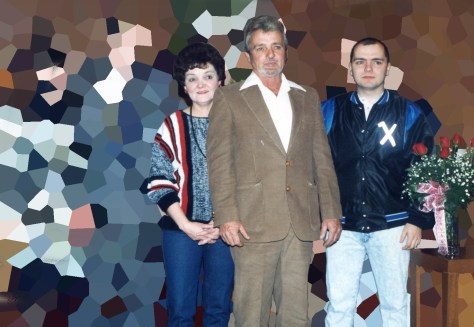
This picture is of us in 1993, at a small Lutheran church that still manages to survive today. Mom and Dad had just exchanged vows for the second time. Although Dad was visibly uncomfortable in the suit he was wearing, he was at home with mom once again in his corner. Twenty-five long years have intervened. The church sits defiantly and almost directly across the road from the gas station dad attempted to make successful during two tries in his lifetime. Small communities need churches to bond them, serving both spiritual and mundane connections. Many of us in this world converged upon that small church in different stages of our lives; most of us have at least a few memories that are rendered opaque and wistful by having done so.

None of the facts has changed, but I have. I’m a stranger in the lands of my memories and I take comfort in my distorted reflection.

Somehow, experience has wrapped me in its strange embrace and violently shaken me. Not only is the sum of my parts now more than whole, but things I knew and things in my field or ignorance have exchanged residency.

I’m not certain of anything anymore.

Yet, paradoxically, I think that it might bring me greater happiness to see a fuzzy world instead of one sharply focused by my own opinions and experience.

The gas station and church both left footprints somewhere inside me, just as my parents did. I struggle with the same forces now that tormented me when I was younger. I learned ways to mitigate the disaster of my upbringing. There was no easy road or prolonged escape from the lessons I learned involuntarily.

I can see immeasurable violence in those whispering the word ‘love’ openly in the world and compassion in the eyes of someone with snarled lip and ready fist. I saw both in Carolyn and in Bobby Dean, the people who played the roles of my parents.

Love’s mystery is that it flourishes at all, as we teeter on the edge of loss at every moment.

Love, X
.
.


Charlotte’s Hope

a mothers remembrance.jpg


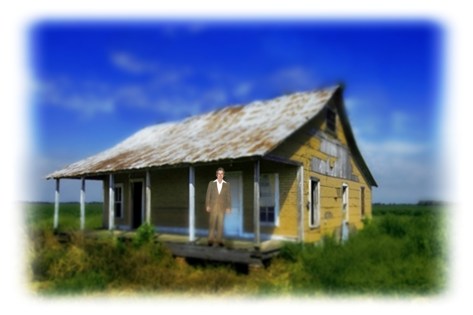
Charlotte once resided in a modest house on the corner of Lilly Street and Shumer Way, nestled inside one of the many decaying towns in the delta area of Arkansas. While she hadn’t stepped foot inside the family home in decades, it was still an infrequent and lingering beacon, a place that once defined her. Her mom had departed this world unexpectedly just as Charlotte hit her stride as an adult. Though her own life was full, a little air exited her soul with her mother’s passing. She not only had buried her mother but a sliver of her own life as well. It remained in her hometown, cloistered and protected from the world.

The promise of life blossomed before her, of course, but the loss of the person closest to her heart would always be one characterized by that uneasy and painful feeling one experiences after swallowing too big of a bite. In Charlotte’s case, the bubble of discomfort failed to fade completely. Each new experience, every shared story, and all moments of clarity occurred with an invisible and almost indiscernible hand on her shoulder. As time marched forward, the hand would feel lighter even as the bruise on her soul deepened. If a kind soul such as her mother could find herself so ingloriously subjected to the injustice of unearned disease, it could writhe toward anyone, despite nobility, intention, or merit. It was a hard lesson to accept but her mother taught it with unimaginable and sublime beauty.

She’d find herself in her hometown, often without remembering the interstate or the quaint highways that brought her there, the same byways once traveled by her mother. The engine of her car would be thunderously ticking, even as the beads of sweat rolled down her forehead. After untold minutes, she’d lower the driver window. Her eyes would devour the familiar details of the small covered rear porch and door, the one almost everyone used. The front door was almost ornamental; someone announcing himself there invariably identified as strangers. She knew without looking that there were 18 rows of white clapboard ascending the side of the house, culminating in exposed painted soffits. Some nights she would slowly emerge from a dream and could still feel the rough sensation of those painted boards as she leaned against the house of her youth. In the summer, one could feel the heat from several feet away.

The cacophony of the summer insects would reach her ears, the hum of mosquitoes would play its summertime melody, and she would cry. In her hometown, most memories anchored in the perennial summertime of her youth. Her mother was so close and the echo of her voice was a lingering presence in the humid air. Whispers, languid syllables of laughter and love, all these intertwined and coalesced in the way that only occurs in Southern towns infected by the paradoxical need to move away.

The peeling paint of the place she once called home still called her name. The four side windows once adorned with light and familiar faces now blankly stared outward without regard. The lawn now screamed for someone to show it the attention it once took for granted. No children would dance in its hidden garden again and it was likely that no family would claim it as an anchor before the structure yielded to the inevitable neglect and gravity. This town and all other places like it are the observable results of entropy; all slide toward darkness and disorder without a guiding force to sustain them. She felt sometimes that her mother was the same dynamic demonstration of physics and that her growing absence was slowly accumulating in her own body as a void with a widening precipice.

The apparition of her mom walked the streets next to the house, idly chiding an unseen canine companion as it wandered in exploration. That her mother might indeed be slightly beyond the unseen membrane between this place of the here and now and the unknown seemed plausible. It was a spell without resolution, though. Hours of fondly wishing it to be so proved the fruitlessness of the endeavor.
“Claire,” Charlotte would cautiously whisper, her mother’s name a secret she dared not say aloud, all these years later. The name, once fallen from her lips, would unleash something primal inside her.

The expectation of her mother’s return was the closest thing to an afterlife that Charlotte could anticipate. Perhaps tomorrow, perhaps in a decade, she would also yield to this world’s demands and sleep one last time, to awaken in the place wherein her mother now resided. It was promise enough for her, beyond even the lofty covenants given to her in church.

Mother and daughter would join one another in raucous laughter, undoubtedly in the unassuming kitchen of her youth. Love would be on the menu, forever, accompanied by the foods with which her mother had so gracefully adorned the family dinner table.

For now, though, Charlotte experienced the heat, the buzz of insects, and the observance of the disintegration of the cradle and crucible of her innermost heart. She could feel the fingers of time furtively clawing their way up her spine, just as they were doing to the integrity of the house she once called home. Both she and the house would inevitably succumb.

As a bead of sweat coalesced against her neck, those same fateful fingers chilled her and she smiled the most secret and indecipherable of smiles that puzzled everyone who knew her.

Not everyone holds onto life with desperation. For some, hope lies beyond, away, and in lingering embraces.

Meanwhile, some of us, like her, sit in the gathering dark in our versions of curious little hometowns and wait. All of this, each detail, is temporary on a sufficiently long enough timeline.

Memories abide and love resists the void.

There’s Always Time For Underwear

lucy-chian-34385-unsplash.jpg


Note: this anecdote is from my favorite cousin Lynette. She grew up in Brinkley, Arkansas, a quintessential small agricultural town in the South, one preoccupied with tornados.
.

A bad weather post a friend made earlier reminded me of a tornado experience from my youth.

We lived a block from a tornado siren. If you have never experienced one of these at that range, you should. A resident of my hometown likened it to the sound of the angel Gabriel blowing the final trumpet.

Anyway, one evening I was in the shower, and the alarm sounded. The sudden firing up of the siren alone was enough to cause cardiac arrest even for a teenager. Add to that the thought of being hit by a tornado nude, and the panic was real.

My mother runs into the bathroom throwing clothes at me. I catch the underwear and throw it to the floor.
She yells, “Put on your underwear!”
I scream, “There’s no time for underwear!”
She shouts back, “If the house is destroyed by a tornado, that is the only pair of underwear you will have!”

It’s Mom for the win!
Remember – There’s always time for underwear.

Another Nostalgic Surprise

20180329_155731.jpg


Recently, I wrote a story about finally discovering exactly what type of coffee cup I had used to drink my first cup of coffee with, back when people like my grandpa Willie believed that such things should simply just happen regardless of one’s age. I ordered a jadeite Fire-king cup from Etsy, more as a tribute than a keepsake.

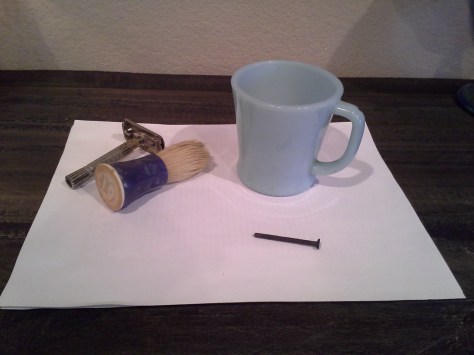
A cousin of mine read my post and reached out to me. It turns out that she had a blue Fire-King cup, a cup my grandpa used to hold his razor and shaving cream brush. He was a minimalist, too, but for totally different reasons than mine.

My grandpa died on a Saturday back in October 1977. The cup he used most days sat dormant, waiting for me to wind my way through decades of intervening years. My cousin graciously offered to send it to me. I received it today. With the piece of ‘art’ I already posted about, this was a day for both something old and something new.

As sentimental as it may sound to say it aloud, holding the cup has already peeled back the foggy curtains of my youth.

The half-broken nail in front of the ‘shaving kit’ is the infamous nail that I wrote about in another blog post. This is the shortened version: A Rusty Nail…

P.S. My post about the jadeite green coffee mug on my blog and public figure Facebook page opened many doors for other people, people whose memories were triggered by the same recollections of family and home.
.

An Imperfect Expression of Memory

2560x1600-air-force-dark-blue-solid-color-background (2)


It’s strange that jadeite glass and kitchenware was created to brighten people’s day in the early part of the 20th century. The idea that the glassware was made without any real focus toward consistency of color and defects makes it more interesting to me. If I were in charge of the world, every cup, plate, spoon, and fork would be distinct, both in style and color. Consistency for appearance is one of the biggest constrictive forces in our lives.

When I was young, my grandpa often drank from a jadeite coffee mug. There’s so much I don’t remember or remembered wrong. A few years ago, I thought I had it figured out but as if often the case, my certainty evaporated into 100% confusion. I find it hard to reconcile that I remember so many distinct moments so vividly, but yet somehow have lost 99% of the memories around them. My grandparents were magical to me, in part to their living at the edge of a cotton field, and in part to my youth, one punctuated by upheaval and anger. If I had to define an anchor point of my young childhood, it would be the simple house along highway 39, where I learned to love salt pork, mustard sandwiches, and coffee. I once tried to enumerate the number of places I had lived in my youth and it exceeds 20 and almost certainly reaches 30. I would consider the place in City View to be another defining place for me, one completely dissimilar in geography and content than the one in Monroe County, but one which shared the connection of people.

I had my first cup of coffee when I was very young. I remember my grandpa shushing my grandma Nellie. He was a big proponent of letting people try things, even if they shouted in surprise or pain as they did so. It’s part of the reason I learned to wince when I hit my fingers with a hammer, instead of screaming in pain. I sat at the table, trying not to burn my fingers on the hot glass of the coffee cup. Grandpa made me that cup of coffee in a green jadeite coffee cup. He put a dollop of evaporated milk in mine, mainly because he thought I’d like it better that way. Given that I once loved eating ashes and cinders, he should have assumed that I would prefer it black and bitter. (I still prefer coffee to be black – and I still can’t resist the taste of a burned match tip and the much-maligned flavor of a lot of burned foods.)

It’s very likely that grandma and grandpa got their jadeite with promotional items. It was included in sacks of flour, at giveaways at grocery stores and with ‘green stamp’ promotions. Grandma always had several glasses that were, in reality, empty snuff jars. Most were W.E. Garrett snuff jars. Like most people of her time, she also had an extensive collection of butter bowls and other assorted kitchen items which served other purposes in their previous lives. Grandma also saved anything interesting so that I could bury it in my ongoing excavation project next to highway 39. Both grandparents lived through the Great Depression and it molded much of their attitudes about things. Because of nostalgia, mason jars for drinking are in vogue. I’m waiting for snuff jars to get their turn in the sun again. Jadeite made a resurgence a few years ago thanks to Martha Stewart and a few ardent aficionados. It’s also weird to think that jadeite was widely used in diners and cafeterias, an almost valueless item back then.

I also know that my grandparent’s glassware was by Fire-King because grandpa would often set his coffee cup directly on the wood stove in the living room. I learned to read a few words ahead of my time, as life was slower in that part of Monroe County. Sitting on the floor, idly tracing words and letters was a great way to pass the simmering days, or poking myself with a sewing needle as grandma patiently showed me to sew without a thimble. I’ve never used one, despite discovering that I could stick one into my finger fairly deeply when distracted.

It turns out that cups made from original jadeite glass aren’t supposed to go in a microwave. (I also find it incredible to think that residential countertop microwaves first appeared in 1967, the year I was born.) One of the things I learned is that a couple of the companies making jadeite glass used glass that contained uranium. They did so up until WWII. Like all things, jadeite has a wider history than I would initially believe. To learn one thing without learning a spider web of interconnected details is impossible.

Even though I’m a minimalist, I ordered a green jadeite coffee mug from a collector on Etsy. The one I ordered is similar than the one I recall. As a nostalgia item, it serves its purpose despite not being quite right. If my grandpa could see that I had not only figured out what type of cup it was but also buy one online, he would shake his head in wonder at the crazy things that people do, especially for dishes. Like me, he would think anyone wanting matching plates and cups had lost his or her mind.

After years of wondering and searching for the green coffee cup I remembered so well, a friend of mine on social media unexpectedly posted a link to the exact brand I was looking for. I can’t completely explain why figuring out the origin of the green coffee cup was so satisfying for me, but it was. A few years ago, I asked my mom about the green coffee cup. She remembered a couple of them but since her memory wasn’t tied to anything personal, it didn’t have the same power of imagination and recollection attached to it. Grandma had some blue cups made by the same company, too.

Holding this touchstone from decades ago, I can imagine my grandpa, sitting in his chair, watching me as I sat on the wooden floor in front of the stove. He gave me the gift of coffee and the effervescent joy of running carelessly in the mud which inevitably curves its way around the fields.


Family History is Literally What I Choose To Make It

This post has no point, no moral or objective. It’s just a fact.

My paternal grandmother had just turned 14 when she was married. When she married, my grandfather was much older than her. Grandmother had just turned 14 and although she needed a signatory to marry, even the marriage license states she was older than was true.

Even in Arkansas, it seems, people were always concerned about a scandal. When I was very young, I knew my dad wasn’t in Alaska, even though he told me this more as a drunken joke than an explanation. He was in prison in Indiana, for what amounted to a minor crime compared to a few things he had done, one of which resulted in someone’s premature demise. The amusing thing is that my Grandmother Terry was petrified of gossip about her and her family.

I’ve written from time to time about it and other family stories. Like so much of the family lore, I learned of the existence of hidden secrets via hushed silences, sideways glances, and anger when direct questions were asked.

As I grew older, I knew that one day research and DNA would ‘out’ much of the stories some family members didn’t to be revealed. Most of those family members have died, leaving a tantalizing list of questions that might never be answered.

But I do know this: much of what made them nervous under scrutiny were legitimately embarrassing stories and behavior. Their refusal to be honest is a much bigger problem than anything they tried to conceal.

Lately, I’ve seen so many stories which skirt the edges of my grandmother’s story. Some of the same people who seem shocked by the revelations in the public realm are the very same who worked so tirelessly to conceal the truth in my family’s foggy past. They “cluck” at others, all the while knowing their own past is littered with much worse.

Isn’t that the way it always seems to be?

The danger some of my departed family seems to not understand is that by failing to divulge some of the family secrets, they have left their legacy in the hands of someone like me.

If I don’t get answers, I’ll make it up, based on what most likely happened. Given the trajectory of what I do know, that gives me license to go in any direction, no matter how dire, without possible complaint from those who constantly shouted, “Hush!” at me.

Family history, it seems, is literally what I choose to make it.

Springdale & Brinkley Hold Lessons

This post evolved from a simple comparison of my geographical past. It grew to encompass parts of me and as such, is very personal. If you will pardon my generalizations and laziness toward exact writing, you might find something interesting.

I didn’t come to Springdale until the early 70s. My dad dragged our recently reconstituted family up here for the promise of a steady job, away from the geography which took the blame for so much of my dad’s heartache. His time in prison in Indiana and his involvement in the death of one of my cousins (unrelated to prison) had broken him of some of his desperate need to remain in his hometown. My dad had a brother here, my Uncle Buck, as well as a few cousins. Our move was prior to the miracle of the interstate reaching its tentacles up to Northwest Arkansas, so all trips to NWA were long, winding escapades. It seemed like we drove for days to reach the mountains of Springdale. I didn’t understand what a ‘hillbilly’ was. All I knew were the fields of Monroe County and the places my grandma and grandpa called home. Being with my dad was the last thing on my wish list.

Years take on a different meaning when I stop to consider that soon enough I will be exactly halfway between 1970 and 2070. Springdale and I both have changed immeasurably since I was young. The area of the Delta from which I came has continued a generally languid, shuffled march toward annihilation while NWA has become a beacon for commerce and lifestyle. It was sheer luck that my dad’s terrible fortune planted my feet here. And while the Delta was once the powerhouse of agriculture but found no clear footing to advance, Springdale and surrounding areas used agriculture as a springboard from which to dive into a diversified future. So many of us here live in houses situated on plots once adorned with grapes, apples, strawberries and all manner of other foods.

It wasn’t until I was much older that I realized that the interstate running through Brinkley wasn’t always there, a fact which should have been immediately obvious. In Brinkley’s case, though, the interstate seems to have provided a convenient escape for the younger generation, as they ventured out and realized that the state had more to offer in other places. In Arkansas’ early history, roads were intensely local, often built to connect small town agricultural markets. For the affluent parts of the state, the interstate gave people and commerce alike the way to merge interests. While lifelong residents of Brinkley might wish to disagree, it is obvious that good roads shone a beacon toward better opportunities in other parts of the state. Brinkley could have been one of the jewels of this state, given its location. Even as I sometimes forget that I once loved the flatlands there, I will admit to its austere beauty.

I also forget that many parts of my early life are inexplicably entwined with those people who I deeply loved and those who were violent caricatures of real people. Geography mixes in my head and sometimes paints an unfair picture of those places, simply because the people walking across my stage were broken people. As we all do, I carry pieces of these broken people in my head, as such slivers are difficult to excise. I can hold the image of standing near a rice field near Brinkley, up to my ankles in mud, laughing; I can also imagine walking alongside a pungent Tontitown grape vine in August, my fingers cleverly stealing unwashed grapes and eating them like candies. I’m not sure which place or memory is more valid, but I do know that being surrounded by people with love in their hearts can make any geography welcoming, while immersion in the minds of lesser people will reduce the world’s brilliance regardless of where one’s feet might be. It’s how City View might have been a place of low resort for many, and a welcome mat for others.

Because of the reduced crucible I survived as a kid, on the one hand, there was so much about this town which remained unknown to me. My life was incredibly small. I could sense that it was an interesting place, though. My family moved over twenty times by the time I had reached adulthood. So many places around Springdale became familiar to me. In many ways, I feel as if this was advantageous to me, giving me a different perspective than someone who was lucky enough to remain fairly rooted in the same place growing up. In my family’s case, our ongoing moves concealed the array of abuse and violence camouflaged inside each respective new residence.

When I was in 2nd grade, I remember asking Mom what it was like attending school with black children in Monroe County. She looked at me like I had been hit with a shovel and said, “I didn’t. We were segregated.” (It was probably a lucky thing for them, though.) I wondered why Springdale was segregated, too, given that there were no black kids in class with me. How was I supposed to know that there were so few minorities living here? I was so naive. Even trying to understand that one of schoolyard buddies Danny was actually from Chile was beyond my comprehension. That’s how reduced my life was without education. Had I been born 100 years ago and remained in Monroe County, I could easily see myself in the role of unapologetic racist. My family would have raised me to believe that it was a certainty.

It’s funny now, my ignorance. In my early youth, I had never heard the word “segregated” except as a muttered curse. For most of the whites in the Delta, segregation was a word equated with government distrust. When I started learning history, it astonished me that there was such a short jump between our Civil War and WWII.

My dad took us back to Brinkley for my 3rd-grade year, to attempt to run a gas station in the no-man’s land on Highway 49 outside of Brinkley. While my home life was a slow-moving mess, school was fascinating. Just as I got acclimated to flat lands again, Dad’s failed business drove us back to Northwest Arkansas.

I remember my Uncle ___ saying that he was jealous of my dad, Bobby Dean because Springdale didn’t have ‘the plague’ of so many blacks. Other family members said the same and I only share this memory reluctantly. Perhaps it’s not wise or fair to generalize about my recollections of prejudice. On the other hand, they are my stories and as a sage once reminded us, perhaps people would behave more appropriately if they knew an observant writer was living amongst them. Truth be told, racism took a back seat when contrasted to the casual violence of my dad. I had a couple of god-fearing aunts and uncles who remind me that we should never be surprised by the sheer hatred some racists harbor in their hearts. One of the prevailing lessons they taught me was that religion could easily be twisted to justify and condone all manner of hate, all the while sitting behind a pearly-white smile and opened Bible. When I was young, I endured many a comment from them regarding my views on homosexuality, race, and language. When I grew up and realized that they were simply unadorned racists, their arguments dried up. The revisionists in life will insist they were great people and in many ways, they were the product of their times; in another way, though, they deliberately refused to change their minds, even as they paid pretense to the societal demands that they keep their boring and unimaginative racism mostly closeted.

Even though so much became second-hand to me, Springdale itself began to break away from its parochial roots; languages and color slowly entered and once inside sufficiently, kicked the door in and changed the fundamental nature of everything here. Even as I learned the town’s geography, it was already changing rapidly around me. In 1970, Springdale’s population was around 17,000. In 2015, it was on the high end of 77,000. (My hometown lost 1/2 of its population in the same time period, by comparison.) No road escaped the necessity of bulging outside of its small borders, and many signs became incomprehensible to the earlier residents. I was lucky enough to be present during many fits and tirades from Springdale residents insisting that hating the presence of another language wasn’t a sign of prejudice. They seem ignorant to almost everyone now, but the angry spew of their spittle was a sight to behold back in the day.

Springdale was akin to a debutante sent away to school in some exotic location; upon her return, she was unrecognizable as the same person. But almost everyone could look upon her and admire the changes. It’s almost impossible to turn back once someone or somewhere has caught a glimpse of the vastness of the world.

I’ve heard many people refer to Springdale as once being a Sundown Town. I don’t remember seeing such signage. On the other hand, I didn’t need to. My family provided all the exclusionary language anyone would ever need. Their distrust for minorities was amplified by our move to a white community. As strange as it is, I remember when my mom started working for Southwestern Bell (AT&T) in Fayetteville as an operator. She often came home, angrily ranting about blacks in her workplace. It was the same language she used in Monroe County except now she had a home base to retreat to, one which seemed to encourage her racism. Mom was an angry person most of her life, so the language was a symptom of her defect more than any commentary on her surroundings. Both my mom and dad fled back to Monroe County in the late 80s, after a long succession of disappointments.

Before I forget to mention it, my mom’s last job was as a custodian for Brinkley schools. The person who treated her the most kindly there was one of the black teachers there, proving that truth is stranger than fiction. Like so many racists, Mom’s racism tended to intensely situational. She couldn’t understand why I, as a white person, would ever stoop so low as to learn another language, much less love its differences. Her life was reduced by her prejudices.

The differences between the racism of Springdale and Brinkley were striking. It wasn’t until I was much older I surmised that Springdale didn’t need to be overtly racist. The whiteness of the faces walking the streets communicated a clear message as to the population. Springdale was a town waiting to be changed both monumentally and one person at a time, whether it saw the tidal wave approaching or not. It confused me how two places in the same state could be so markedly different, yet both have residents generally fixated on differences based on skin color. I’m generalizing of course, but I know that you understand the distinction I’m drawing. Most of Springdale’s residents weren’t prejudiced, of course, just unsure as to how to accommodate the changes to their towns. Racism tends to discolor a disproportionate number of people around it, giving it a larger circle than reality warrants. This circle of influence sometimes gives the wrong impression of tolerance toward prejudice and many of those practicing it become adept at hiding under its umbrella.

It’s strange to me that both Springdale and Brinkley had so much to build upon. Frankly, Brinkley had the advantage when I was young, and if a few visionaries had the temerity to act upon it, it would be flourishing now. Instead, Northwest Arkansas seized these opportunities.

Against the backdrop of economy and money, Springdale acquired deep populations of Latinos, Marshallese, and other minorities. Most of us who were paying attention and curious were amazed at the changes brought to us by different cultures. Since I’m naturally curious, I loved the overlap of cultures and couldn’t wait for it to become entrenched. Others, though, peered at it through narrowly-turned blinds, wondering if the small town they grew up in was gone forever. Thankfully, the answer was ‘yes.’ Change brought a greater viability to our town. The overlaps of other culture became so large that in many cases people felt conflicted about which culture was their primary one. That is the ‘melting’ we claim to honor as a country. The melting works much better when it is in both directions, with those who were here first welcoming the inevitable changes brought by new faces.

The same didn’t happen for Brinkley, despite it attempting a few rebrandings. The remaining base shifted out from under when it lost its Wal-Mart. People continued to flee, even if meant they’d be exposed to a greater variety of cultures elsewhere. For those who left, many have an idealized memory of what it once was. The truth, though, is that it was never really that place. People voted with their feet and the results are the only conclusion which needs no clarification. One day, hopefully, Brinkley will discern a path toward revitalization but all such paths are dead ends without new faces and new opportunities.

Springdale, albeit with a few hiccups still to come, is a place which can be a foundation for everyone to look back upon and feel a sense of community. It defies an easy definition, precisely because other groups came here to stay.