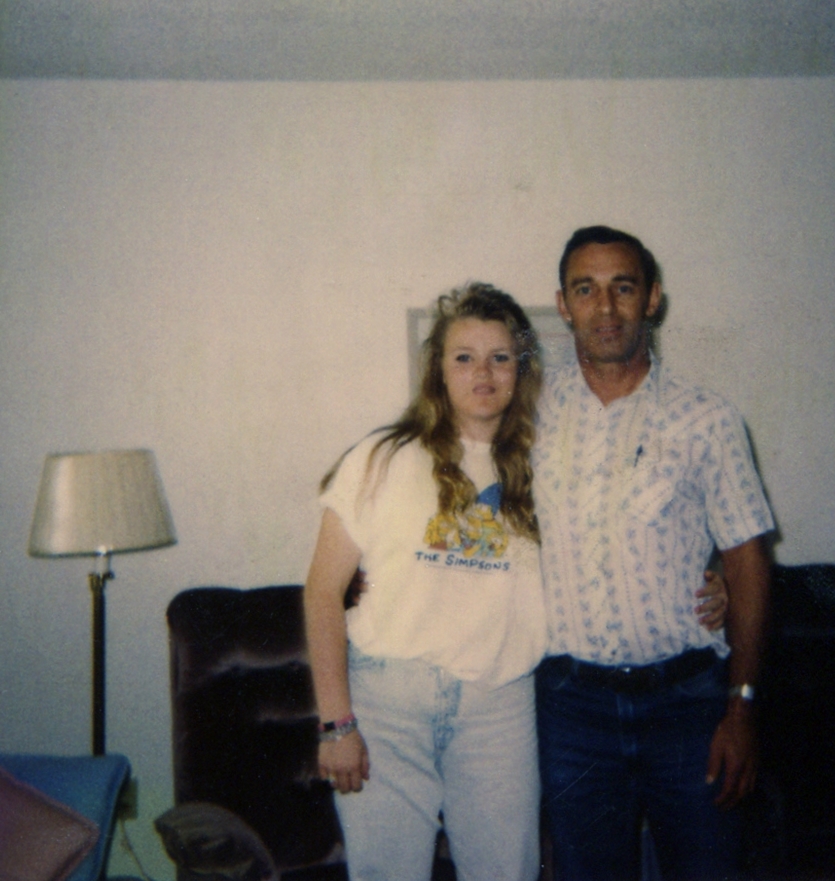
This picture was taken 29 years ago, 10,592 days. Almost half a life ago, a fulcrum that seems impossible at this point. It was supposed to happen on Halloween that year, but logistics conspired to make that difficult.
Most of us like to imagine going back and being able to look forward, seeing the relentless incremental changes that we choose or are foisted on us. The acceleration of change that’s almost invisible while we’re experiecing it. Can you imagine reliving the moments as instantaneous bullets of laughter, agony, and experience? Most of us would choose it, even if it’s a roller coaster that leaves us lying on the pavement, asking ourselves why we got back on the ride, knowing how it would end.
Every cell of our bodies has changed, but the memories remain – if we’re lucky. I took a moment to fling open the door early this morning, remembering, and then bolted it shut afterward.
This post is partially personal and also a metaphor. Or analogy. Although I know the difference, I don’t care about grammatical accuracy. If this post is all over the place, you can thank me later for taking you around the world with my shotgun storytelling.
In 2005, I visited my brother north of Chicago. He brought out a giant bag of tortilla chips, one suited for his appetite. Then, he brought out high-quality horseradish and made a two-ingredient dip. Although I’m laughing when I write this, my brother Mike might have held me down with one of his giant paws of a hand and inserted a horseradish-laden tortilla chip into my mouth had I persisted in refusing to try it. I grabbed a chip and loaded it. My brother’s eyes widened, and he laughed like a hyena because he knew I would eat the whole bite. Though it burned, it was delicious!
“See, you dumb bastard? I told you you would like it. This ain’t the horseradish Aunt Ardith kept hidden in a side shelf.”
Although my brother was one of those people who thought he was always right, I had to give him credit for insisting I at least try horseradish. The worst that could have happened is that I still would have hated it.
All these years later, I think about that. He did the same thing with guacamole after I refused to have some freshly made guacamole at what used to be my favorite Mexican restaurant in Springdale. Guacamole was the equivalent of turkish delight from C.S. Lewis’ Narnia tales.
I am now a world class aficionado of pico de gallo. For too many years, I assumed I wouldn’t like it because my mom made me automatically distrust onions. Onions were the second component of her one-two punch of seasoning, which consisted of onions and cigarette ash. It was a story of culinary violence in the South, never knowing if the potato salad or mashed potatoes would have fantasy-level chunks of onions.
The above anecdotes hint at much of our problem. Because I was naive and poor, I was rarely exposed to a wide swath of food, much less quality. My cousin Jimmy’s house was the crucible of exposure to many foods. Because of my dad, Bobby Dean, almost literally making me eat food at gunpoint, some of my first exposures to some things were less than ideal. That’s putting it mildly. Some of the food at my house was the equivalent of the discarded version of what you would find behind a dollar store grocery aisle. That explained my aversion to morel mushrooms.
And also horseradish.
I don’t remember how old I was when I first tried horseradish. I remember the time that soured me on it. It turned out to be old and nasty by any standard. So, it’s no wonder my first exposure was the equivalent of eating a goose-poop-filled donut. I was lucky to have Aunt Ardith and Uncle Buck. Without them, my life would have been much worse in several ways. Visiting my cousin Jimmy always guaranteed that I’d be well-fed and get to try a variety of things. I like to joke about the horseradish because it was one of the few times that Aunt Ardith convinced me to try something exotic (to me). She had the best intentions, unlike my dad. If he got a hint of an idea that I didn’t like something, you can be sure that I’d be eating a bucket of it. Aunt Ardith and Uncle Buck did their best to tell Dad to jump off a cliff when he behaved that way around them.
We have parallel aversions to many things resulting from our initial exposure. Look at most relationships, and you can see that it’s true. You had your heart broken. You repay your future self by carrying the mistake and believing that all relationships will turn sour. Or you think most people grew up without the love and caring everyone needs. You carry your words into the future, and all the potential people you meet indirectly pay for the wound. You either avoid deep relationships or insist the system is rigged and broken. The concept of relationships isn’t the problem; it’s us. You’re letting your version of horseradish tarnish your future with other people.
Life is horseradish and guacamole.
Be open to new things.
Be aware that you may have blinded yourself or made truth from experiences that should not be extrapolated into cynicism or isolation.
Although it is true that people rarely fundamentally change, it is possible both in outlook and preference.
Changing is, in part, acknowledging that the things, habits, and ideas that once defined you no longer do.
Only healthy people change their minds and their lives.
PS During this crazy election, I’ve had a few laughs because of my brother. He’s been gone for four years. In his later life, one of his proclivities was to be a blowhard, much in the ilk of Bill O’Reilly. My job was to be the liberal and sentimental brother that drove him crazy. And as I was fond of telling him, the person left standing gets the last word. Since I bought gallon by the ink, he didn’t have the temperament to keep up with me. If he were still alive, he’d be pissed off at me constantly. But I miss it. Not the anger of the last few years; that period owes its shadows to alcohol and unresolved trauma. I miss the undeniable intelligence of my brother, even when he used it to wither my well-intentioned arguments. I absorb a lot of the election craziness and play a dialog in my head, one in which my brother is the one repeating conspiracy theories and horrible rhetoric. My brother taught me that if you can’t argue the facts, you pound the table. If that fails, flip the table.
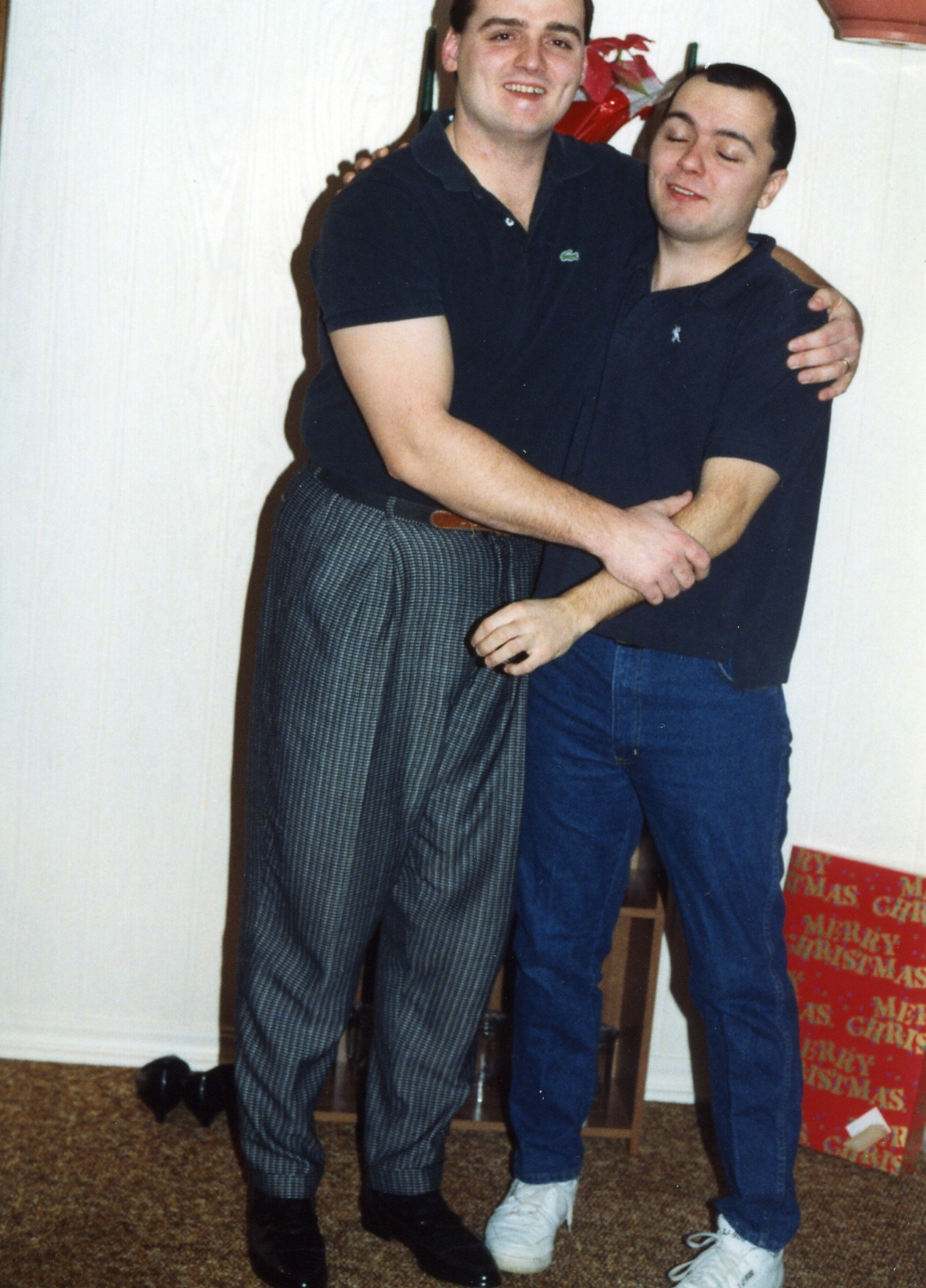
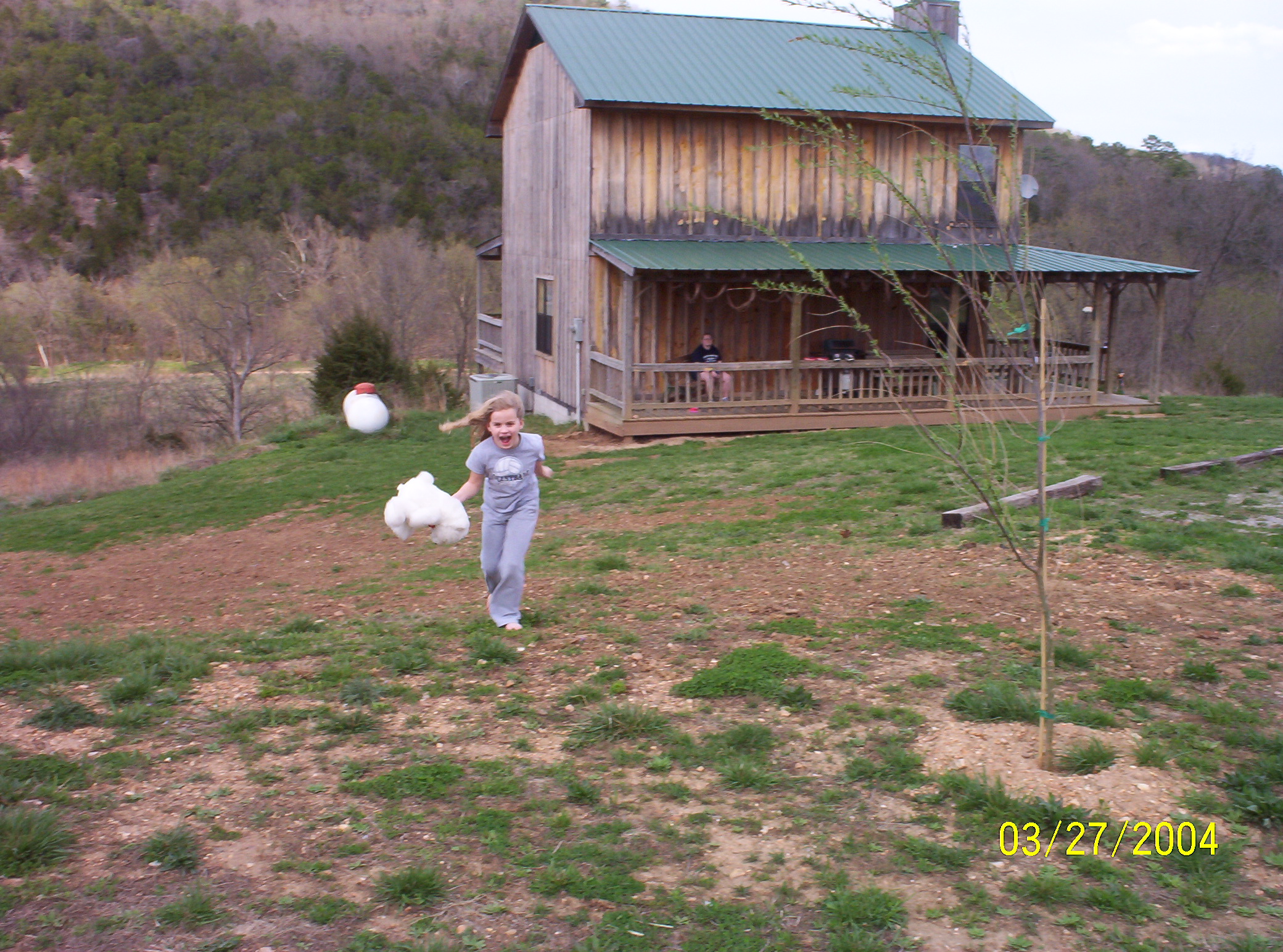
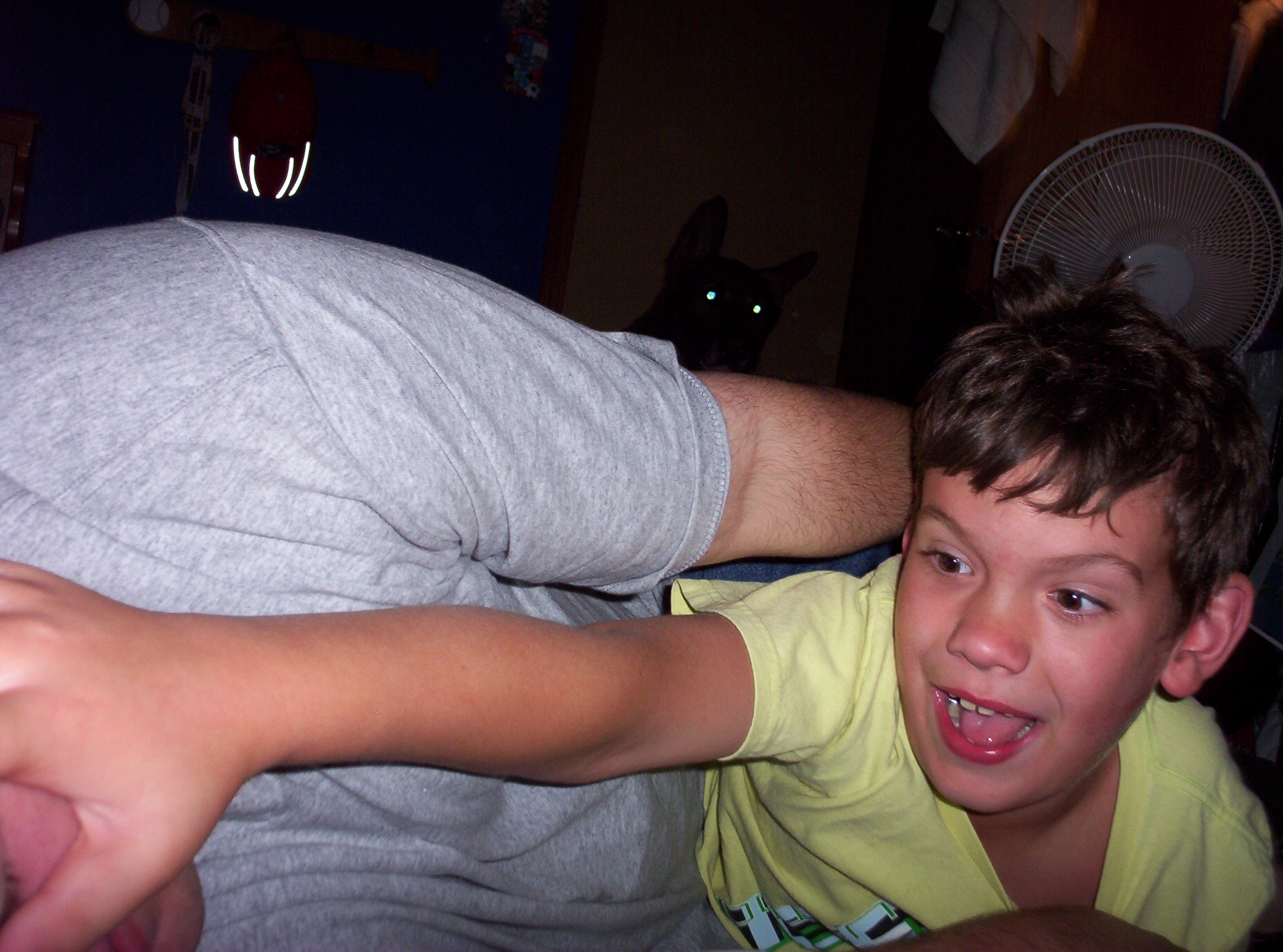
PSS I chose a different picture for this post instead of one of my brother. Both pictures are of joy and of family time. Even though there was a backdrop of unease during both visits, each of the pictures reveals both youth and connection. In one, my niece Brittany charges toward me as I stand by a pond outside a cabin on King’s River. I got deathly ill from food poisoning on that visit, and Mike’s police K-9 got violently snakebit while we were all swimming in the river. Behind Brittany, as she runs, my deceased wife watches happily. The other picture from another visit is of my nephew Quinlan kicking my ass as the three of us wrestle like savages. I’d forgotten that their dog was watching from the doorway. The third picture is of me and my brother. Mike had his wife bought me a plane to ticket to visit them in Illinois. I love the picture despite the goofy look on my face. It documents my brother’s vibrancy in the “before” part of his life. Mike bought me tickets for two such trips, and his doing so proved that he loved me and also missed me. It was before the branching of his life; the picture captures what could have been the case for the rest of his life had he made that choice. My niece is a mother now, and when I think about the fleeting speed of life, I get a glimpse of the idea that nothing stands alone in our lives and that each moment unfolds from the previous one. We don’t see its unfolding or interconnectedness until later.
It’s been 17 years, or 6,210 days, give or take one due to the uncertainty of the day emblazoned on the calendar.
Some years, it is sufficient to look at her family tree and at the countless pictures I indexed for those wishing to remember.
I’m more of a spontaneous remembrance person, allowing random moments to drag me into the past.
The bridge that might transport me back is a duality of both distance and proximity. Everyone who gets old enough feels the clock spinning like a roulette wheel, for its speed and also for the uncertainty regarding where its stop whimsically occurs.
Even if we’re unaware of our demarcations, we divide our lives in to eras. Most of our demarcations are passive. Childhood. Graduation. A child. And the rest launch from the magical yet persistently somber consequence of being alive in this world.
I had my turnstile moment this morning. Disrespect pushed me into a flare of brilliant anger. Because of the anniversary, I didn’t need to think about how I should probably respond. Anger is a call to action for remedy or an immobilizing force. I never need to intellectualize how she might have reacted. If something made her mad, it was a certainty that those around her would not need a soothsayer or psychic. The words would flow with a grimace to match.
I managed to merge and juxtapose her reaction with my natural inclination. The words came. Those who’ve ridden the ride and exited the fairgrounds know the stupidity of living inauthentically. Once your ticket is torn and handed it to you, the clock is already spinning.
And so through these words that will seem vague to many and perceptively painful for others, I tell you that it’s a dangerous game to be reminded.
I did not have a ticket rendered in two pieces in my hand today. It was given to me 57 years ago. 17 years ago, I had to come to terms with the fact that it probably should have been my ticket being requested.
I was supposed to use the alchemy of motivation and memory to live unapologetically. She handed me the baton and pointed me in the right direction.
When the weather chills in early September, even my oblivious bones haunt me a little.
That’s the way it’s supposed to be.
We are all busy and occupied instead of being purposeful and satisfied.
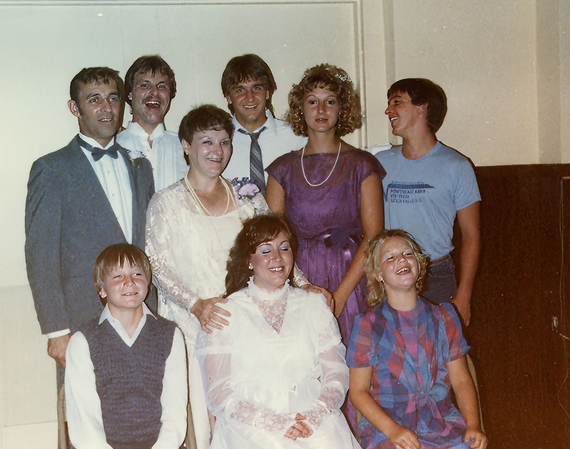
I have no claim to being the historian, the biographer, or the speaker for the dead for Marcia. I included the picture because it’s a rare one in which every person is smiling, all convened for a family wedding.
I arrived at the church early yesterday. I’d seen people outside and chatting as they always do before funerals. I took a few minutes to sit in the car, looking across the open area behind the church, my mind returning to the 90s and remembering another life. Not just the person’s life being heralded a few minutes later, but also mine swirled into a questionable collection of thoughts and memories.
Faces I hadn’t seen in well over a decade, some in fifteen years. I was once connected deeply to many of them. The children of the family? Some towered over me, their faces alien yet familiar. I hugged them all. I take my job as the Hug Ambassador seriously. I had to remind myself that I was in attendance for a funeral; the truth is that some of the warmth I used to experience with some of them came flooding back. Those who held a place in their hearts for me still told me plainly merely with their faces and enthusiasm upon seeing me. Seeing people after such a prolonged absence will gauge and plunder your feelings across a spectrum of emotions. All those lives, swirling inside and around a community we all share, were brought back together to send off someone who managed to make it to eighty-four years of age. She was the head of the family in what I call my Life 1.0. When I thought I was experienced and prepared for anything. Oof. Life reminded me that I was in store for a box containing both beautiful magic and dark shadows.
I remembered the first time I met Marcia. My deceased wife, Deanne, cautioned me, and she was right. Marcia mentioned the first time I met her that she wanted her large assembly of children to take care of her when she retired. We were sitting at Village Inn, having met her after our night shift. I had a lot better time than Deanne did. I acted like… myself: irreverent and fast-talking when her Mom veered into wild territory. Marcia had experienced a lot in her lifetime by the time I met her. It was written on her face and etched into her words even then. Deanne and her Mom argued often. It didn’t help things when it amused me when they did. Marcia didn’t quite understand at first how Deanne and I got together. So, I told her the truth: I was oblivious to Deanne’s attention, and Deanne took the reins and announced that I was coming over for dinner. Deanne was ten years younger than me and, at first sight, very outgoing.
The truth is that I had a lot more patience with her Mom than she did. I’ve found that to be the case universally. Most of us tend to grow too familiar with our family, and even the slightest oddness inspires us to imagine jumping into a well to escape them. It passes, of course. Especially when we realize that we probably irritate the blazes out of those around us equally. I know that Marcia hated that I took her baby girl away from her. But Marcia was also the one person we had with us when we married in Eureka Springs. As much as I unnerved Marcia sometimes, it’s hard to hold that in your heart when someone passes.
So, I hugged everyone in sight. I tried to avoid saying something stupid, including all the clichés accompanying death. I’ve continued to learn that everyone says something that rubs people the wrong way, no matter how innocent the intention is. I’ve said my share, and I’ve also listened as people said some incredible things to me while surrounded by death, grief, and discomfort. I watched most attendees respond reflexively to the litany of protocols of the Catholic church. Religious calisthenics, someone once called it. And I listened, my mind going back to the years my life overlapped with Marcia’s. As I sat in the pew next to one of Deanne’s brothers, I listened to the odd lilt of the priest’s voice and of the older male singer. The brother sitting next to me is much older now, of course. He was always irreverent. He and his sister Deanne used to annoy the piss out of each other. Older age suits him. Had Deanne still been alive and been sitting with us, I can only imagine the wild exchanges of inappropriate commentary we would have shared. Deanne and Joe would have traveled conversationally between insults and dark humor in a blink of an eye.
Marcia was cremated, a fact that surprised me. She was angry at me when Deanne died because she wanted her daughter buried. I pushed her irritation aside, maybe a little too confidently. Deanne and I had returned from a funeral in my hometown about a month earlier. We did what people do in those situations: we talked about what we wanted upon our demise two hundred years in the future.
I loved being invited yesterday. I made the picture for her obituary, one that was a composite of two pictures taken at one of her son’s weddings. That time frame was the quintessential “Marcia” most people hold in their minds. I realized I was a proxy for Marcia’s youngest daughter, the first to leave the family of six other siblings. That realization softened me more than I expected. It’s strange to think that if Deanne had not died so young, the arc of my life would have looped around to the same moment all these years later. All those experiences and years would have been replaced by the first arc of my life. Yet I still would have ended up in the same moment and place.
After the service, I went to Ancestry and closed out the chapter of her life by adding her date of death. Now, anyone looking for her will always find my family tree for her. It’s become a ritual for me. Closing out with that certain finality of a date and time. In a few days, I’ll add a hundred pictures to her tree to preserve them as long as the internet survives. 84 years is a long time to walk the earth. Yet it is also insufficient.
People, time, love, death, loss.
We march in time. If we are both lucky and unlucky, we will have enough life to see a parade of people precede us. It is both daunting and a gift.
It was a joy to see all the faces and to hug them. It also stabbed me a little because it was the life and family that I took for granted because the person connecting us was so young and left so early. Put aside were all the petty annoyances and dramas that characterize families. Just people, each trying to get through it and make sense of it in their own way. For me, it was literally another life ago.
Even when it’s truly someone’s time to go, it feels like a robbery. We’ll all convene and observe the rituals and expectations. But no one experiences a person the same way that another person does. Some experienced Marcia with both love and irritation, as a daughter, as a son, as an in-law, or as a friend. I don’t think I dishonored Marcia by saying she was brash, opinionated, and often argumentative. In her defense, most of her children inherited that predilection.
Maybe I overthink things, but I don’t think so. I think all of us have a long series of wild, contradictory, and disparate thoughts and ideas when someone dies. That’s probably an accurate way to go about it. Because people are complicated, and when we’re living a life that overlaps theirs, we don’t understand them.
I took time today to find more pictures of Marcia for her Ancestry entry. And I re-read Deanne’s calendar pages for her last year of life back in 2007. Even her short comments about arguing with her mom (and then mine) made me both laugh and remember her Mom truthfully, through both Deanne’s eyes and mine.
And to be remembered? That’s a feat all by itself.
This is a post in two parts. I didn’t know how to separate them…
She reached out to me in November, her heart dreading what I might tell her. Sheena and Deanne, my wife who died, were once inseparable comrades in friendship and a little mischief. The early 90s were their heyday. Both Sheena and Deanne were outgoing and beautiful young women.
They’d lost touch. I don’t remember that Deanne told me why other than she often told stories about her friends and the shenanigans and moments she lived before meeting me. As anyone knows, the first few months of getting to know someone is a sublime pleasure filled with stories and insights. We immerse ourselves into the unknown universe of someone else’s life as we get to know them. Deanne was almost ten years younger than me. Despite that, she had a lot of stories to tell and a large family to fill the spaces of her life. I already knew her brother Mark thanks to our jobs at Cargill.
Sheena said she’d seen Deanne once in April of 2001 when Sheena was giving birth to her daughter. Deanne worked at the hospital and surprised Sheena with an impromptu visit. Evidently, it was one filled with smiles and quick words. Sheena did not see her again. But she always wanted to and wondered where Deanne was in the world.
As so often happens when we get older, we think about the people who once touched us. Some of them drift away purposefully; others drift for other reasons. The truth is that some people have a room in our hearts even when we no longer see them. It’s one of life’s bittersweet lessons.
Sheena found an obituary for Deanne. I’d dutifully left a trail of her life and some of her stories on Ancestry and other places. People need to be remembered. Sheena told me that she cried reading it, knowing that her hopes of reconnecting were gone forever. I felt an immense pang of regret on her behalf. Deanne would have lovingly hugged Sheena had she had the chance. She loved a good grudge, but she loved connections more. One of Deanne’s foibles was how quickly she could get irritated. It was a blessing to her in some ways, too, though. As I grew to know her, her ire often made me laugh. She’d punch me in the arm and laugh, too, once the ridiculousness of the situation became apparent.
Sheena ultimately revealed that their friendship probably ruptured because she had told Deanne that we were not compatible. Deanne made up her mind about me very early on. I’m not sure I was consulted!
Sheena reached out to me on Ancestry, and I shared my entire picture collection with her, thousands of pictures – and every picture I owned of Deanne. She was able to sort through Deanne’s short life, as told in pictures. Later, I shared a few stories with her, ones some people have never read or heard.
More importantly, I gave Sheena peace. I let her know that she should feel happy that Deanne and I found each other and stayed together, even when it wasn’t easy. We all do and say things when we’re younger – and often continue the same when we’re older. And if she said the things she said to Deanne with an authentic heart, she should not be accountable for sharing her opinion or truth. That’s the risk of being genuine with other people.
The truth is that Deanne and I weren’t compatible at first glance. Or probably second glance. In that sense, Sheena was definitely not wrong. Deanne was an outgoing, buxom, active soul, almost ten years younger than me. I had no clue she was interested in me. Until she insisted I come over for a homemade meal. Believe me, I was not the one wearing the pants at the beginning of the relationship. Call me oblivious.
Sheena got to see Deanne’s life because I am committed to sharing every picture I own with anyone interested. I’m just the custodian. I love pictures, and I love knowing that people always come full circle with wanting to see every picture of someone they love or loved. Avoiding the soapbox, I will limit myself to saying that unappreciated or unseen pictures do no one any good.
I still feel a bit of remorse for both Deanne and Sheena. They could have reconnected. Had I been aware, I would have asked Deanne to look past any past words and find Sheena again. I did the same with Deanne’s dad. Deanne doubted she could forge a new beginning with him. Through the years, though, I encouraged her to try from a new foundation. And she did. I still count it as one of the best things I’ve ever accomplished. More so because she died so young.
I hope Sheena found a way to fill her life with new souls. She seems like the kind of person who deserves it. Her words to Deanne so many years ago would have been received differently had I known at the time. * *
After Deanne died, I didn’t have a big interval of time before I met Dawn, my ex-wife. Whether you can understand or not, I made the choice to plow through life and not let myself get overwhelmed with the loss. When we first got together, I had her meet Deanne’s brother and his wife. I wanted them to know that me getting on with life didn’t negate Deanne. Quite the contrary. I had to make a choice, one that wasn’t really a choice at all. Things could have ended very badly for me. If you’ve lived a life with loss, you can imagine what some of those endings might look like for me. There’s no shame in acknowledging them.
It’s not a choice a lot of people might make. I make no apologies, though. Dawn and I were together when we were very young. She’d had an intervening marriage, one that fizzled and ground down into apathy. We were happy to find each other again.
Deanne never was between Dawn and me. At least not for me. She wasn’t a ghost, but she was a catalyst and reminder for me, something that people misunderstand. When life snatches your optimism through mortality, there are a lot of impossible feelings. This amplifies when you consider how capricious life can be; anyone or anything can disappear at any moment. Deanne deserved more years to continue her journey. She was substantially different from the time when we first met. And that was a great thing to witness. I try to remember to be grateful for the years I had with her. The song always ends, leaving us with a melody we can replay in our heads through memories.
At the risk of repeating myself, one of my biggest mistakes in life has been to occasionally forget the lesson that Deanne’s death dealt me: life is for the living, obstacles will always punch, and love is never wasted, no matter how it ends.
It’s true I shared fewer stories about Deanne than I should have. I did make the mistake of not writing all the stories of adventure and mischief I had with Deanne. And also some about our hard times. We definitely had them. As Dawn and I disintegrated, she seemed to switch the narrative on me about how it was with Deanne. Whether that’s true or not is in the eye of the beholder. I made a choice – as did she. I’d make the same choice again because a choice to live and love is a positive choice; fearing another loss and avoiding taking the risk is a negative choice.
Someone reminded me this morning not to veer. Since she’s a disguised writer, I’m obligated to heed her warning.
Every love is forged with expansiveness and optimism. That we can’t navigate the treachery of daily living and one another’s messes isn’t a knock to love or vulnerability, though. The problem lies within us. Familiarity breeds contempt. We assign motive to actions or words, usually based on our faulty filters. It’s hilariously evident that most of us want the same things.
When love has drawn its last breath, it is easy to focus on the things that were wrong.
When a person draws their last breath, all the doors are shut forever.
Whether you are 31 or 71, the door is always about to shut. We just don’t see it coming. That helps us to forget how precarious our lives are. That same forgetfulness affords us the ability to live our daily lives but it also has the reciprocal defect of failing to focus on what lights us up.
For Sheena, for Deanne, and for anyone who no longer walks the Earth, we can do our best by choosing optimism over despair, deliberate risk over comfort, and for being ourselves, even as the world madly surprises us.
Deanne would tell us that all these years she’s been gone that she would hope we were squeezing the absolute hell out of whatever life has to offer – and shame on us if we aren’t.
She would have loved to be alive and make a lot of mistakes. We should be too. She’d be the first to call me out for being an idiot. And she’d mean it.
I remember before phones were ubiquitous, and cameras were a burden some of us willingly carried to capture moments.
“I love pictures but hate photography” is one of my quotes.
I used to take guerilla photos constantly, knowing at least one would be salvageable.
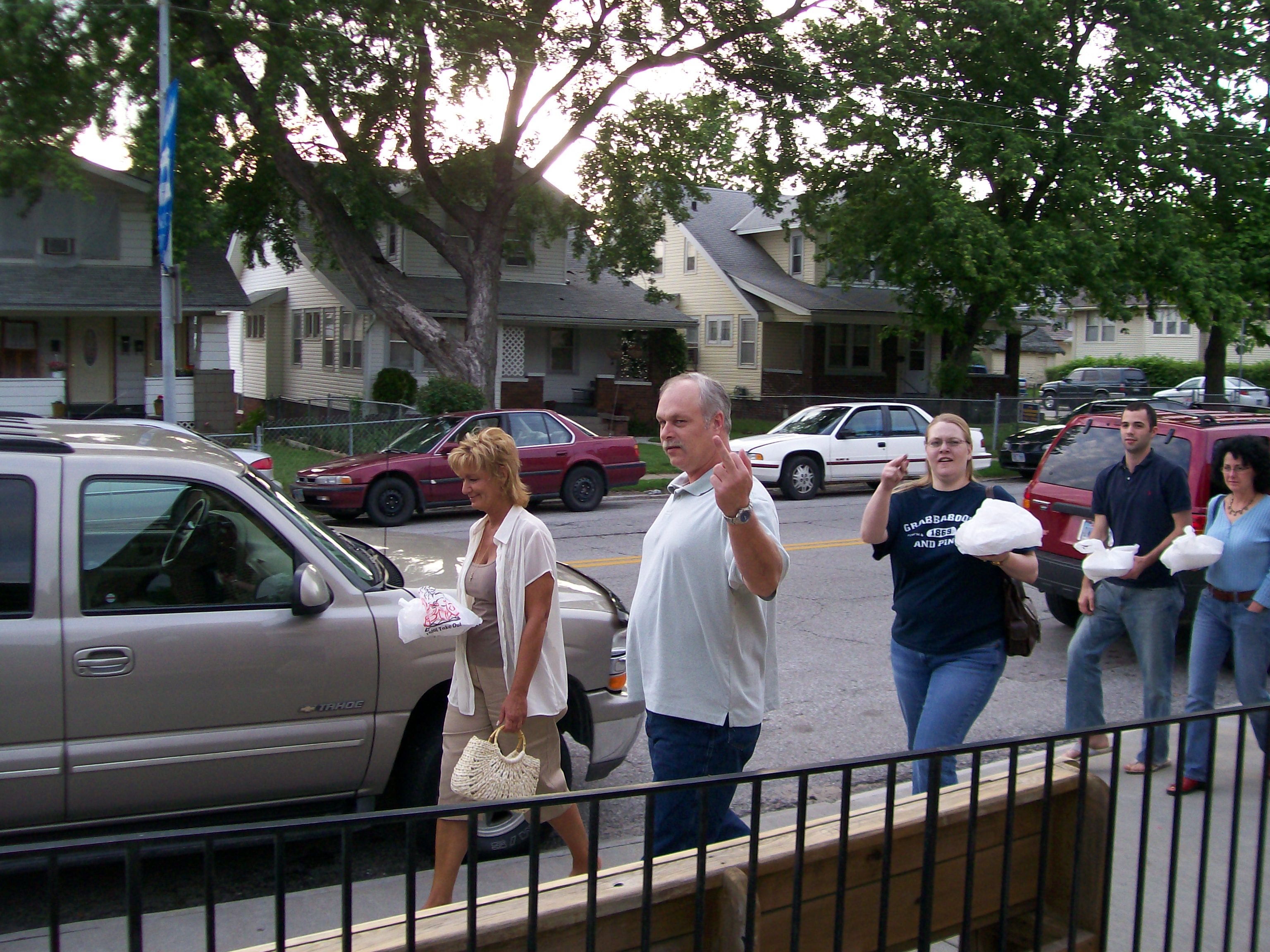
This first one is from May 2007, in Omaha, Nebraska. We shared a delicious Italian supper at an Italian restaurant. Though I didn’t realize it, I have a picture of the entrance! It was Lo Sole Mio Ristorante Italiano. I’d forgotten I took a quick snapshot, also grabbing a picture of my brother-in-law Joe in doing so.
Kim, in the lead, is looking down and smiling. My brother-in-law Steve is next to her. Behind him, my deceased wife, Deanne. She died four months later, unexpectedly, ten years my junior —her brother Steve, six years later. For all I know, everyone in this picture, even the innocent bystanders walking behind them, are dead. On a long enough timeline, this will be true for every single image you own.
I love this picture. Steve and Deanne gave me the one-finger salute independently and simultaneously. I laughed and laughed when I saw it. I apologized to the bystanders, telling them that some of us were from Arkansas.
Joe and Deanne had a bitter exchange of words afterward. I don’t remember why. I hope Joe doesn’t either because no matter what words they shared, they loved each other. I have a picture that captures the irritation.
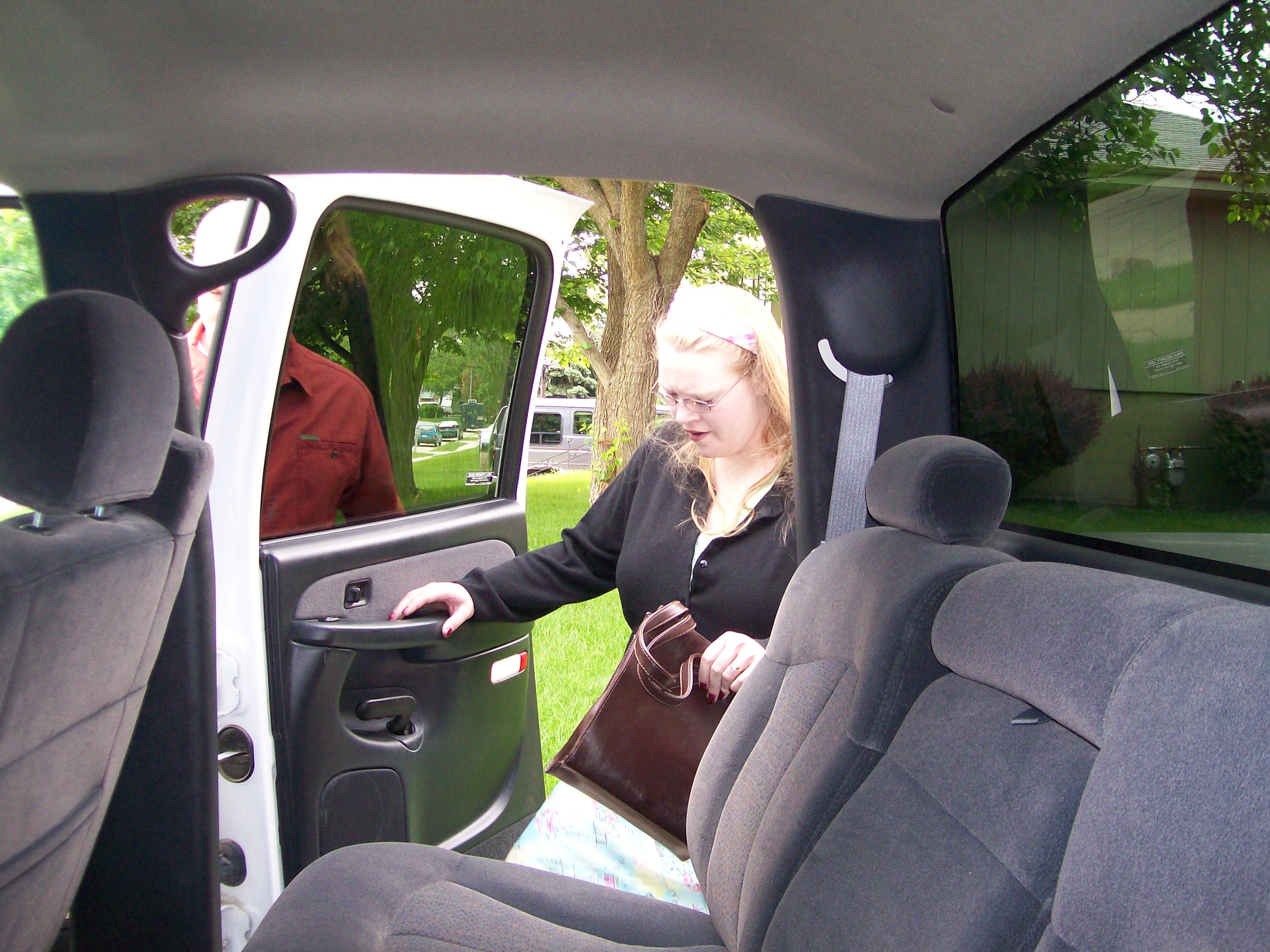
I have better pictures of Deanne from that day. But the one of her getting into Steve’s gargantuan truck captures her perfectly in an unguarded moment.
Now that I’m living in my own The After, I think about Deanne more. She was ten years younger than me. Loudly and aggressively vivacious.
Were she here, she would absolutely holler at me to stop wasting time on ‘what ifs’ and wishes. She’s been gone fourteen years.
She would quote “The Green Mile” and tell me, “Get busy living or get busy dying.”
Don’t stop taking pictures, even if people give you the finger.
One day, you might be sitting and reminiscing. And that picture might give you a breath of life.
When the sun begins to sit on the horizon, we are all memories.
A bit of truth to start, followed by a bit of goofy…
I’m not actively trying to lose weight. 160 lbs. was low enough to suit me and almost certainly not sustainable long-term. I felt that strange sensation that something had changed when I put on my pants and belt again after a day of shorts. Getting on the scale, there it was: 156. I’ve been walking a lot and probably eating less. The eating less part is mostly because I’m not hungry, have been occupied with other things, and when I do eat, I’ve been inclined to eat less quantity and simpler food choices. I ate great lunches at restaurants Sunday and Monday, so I’m not starving myself. (Not to mention I ate at Mr. Taco Loco today for lunch.)
.
.
Someone I love very much gave me a lovely gift over the weekend: a thank you card she forgot to mail 24 years ago, one in response to a wedding gift from me and my deceased wife, Deanne. I told my family member, “Not all tears are sad tears.” It touched me deeply, and I saw no reason to conceal or push away the tears. This is one of those instances where being a packrat led to a moment of remembrance and emotion – and a much-needed one, too.
.
.
Since life often jumps on you all at once, another moment that happened last weekend was that I felt forced to let someone down severely. I’m never proud of doing it. I won’t justify it or explain it. Of course, I have a list of valid reasons. Valid though it was, I know my response runs against the universe’s karma rules.
.
.
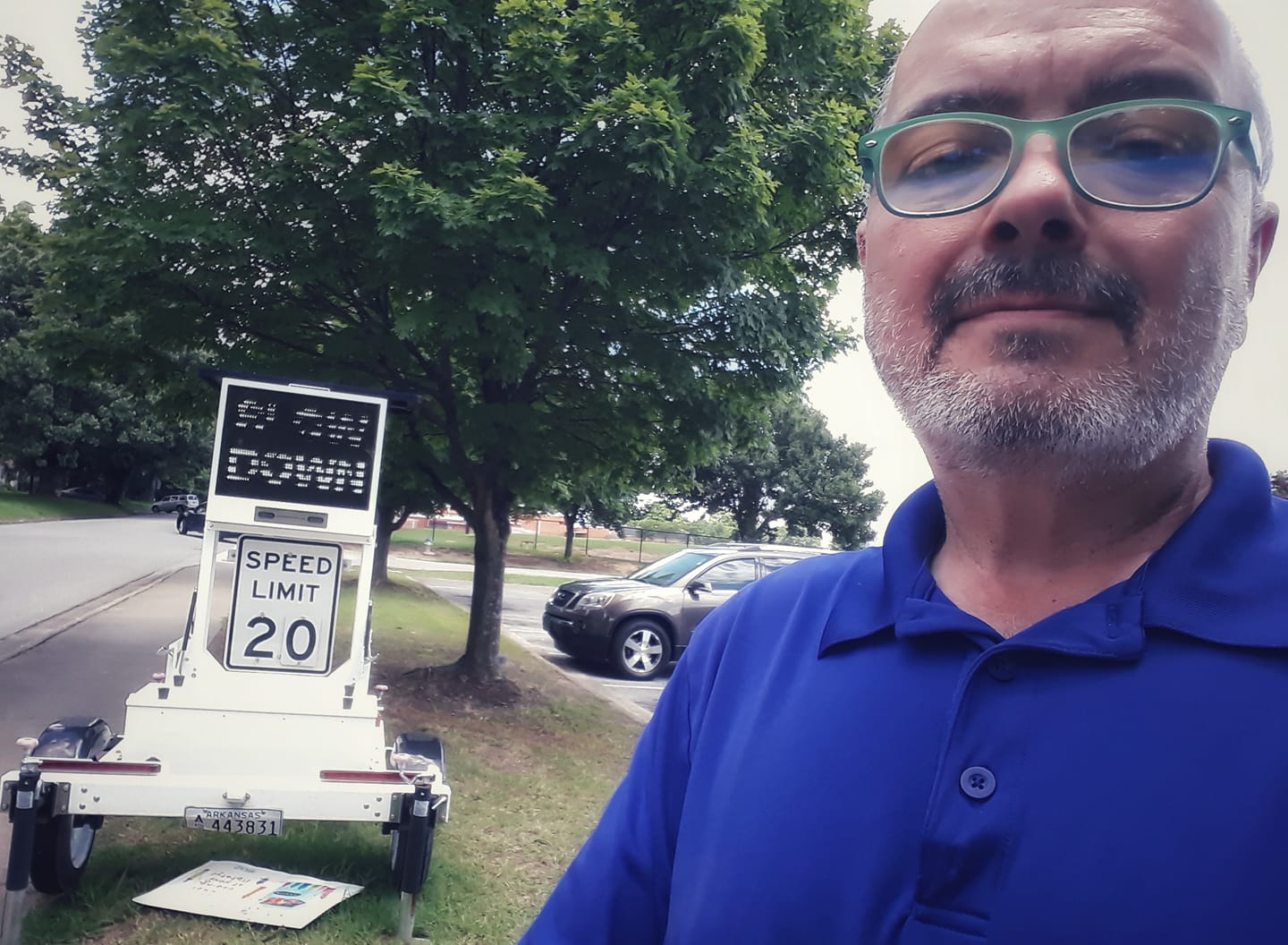
Even the speed trap advisory signs at the library are sending me a very clear message. I can’t run as fast as Michael Scott, obviously!. PS Standing next to the sign dressed like I am with a work badge, and holding a cell phone facing the road… a LOT more people suddenly slow down, as if anyone would ever trust me to be a part of anything with so much tomfoolery potential. Also: even the police who are randomly driving by suddenly realize they can’t very well speed past it like that, not with an idiot standing there with a phone. I propose that a bunch of us meet down here and have some fun with this. Anyone who can beat Michael Scott’s speed (12 -31 mph, depending on whether you count the car run or not) will win a free toaster, or a lunch date with me.
.
.
I’m getting contradictory signals about my index cards, the ones I use for all sorts of tomfoolery <○○> and practical note-taking. My cousin gave me two packs over the weekend and today someone gave me a pack, winked, and told me to engage in an endless series of index card creativity and/or pranks. I feel like this might be a test with no right or wrong answer. . Update: a coworker saw this post while I was still at work and gave me TWO more pads of usable note-craziness! In his defense, he is retiring soon, so he can cause as much mayhem as he would like.
When my wife died suddenly several years ago, I opted for an awkward visitation after her cremation. I know it was awkward; such things were not common, especially in the Venn diagram of the converging families affected by her death. Many of her family were Catholic; a few of those hid behind their Catholicism to attempt to blame their dislike of cremation. To be fair, I didn’t care. In my case, I was lucky. The death of a maternal uncle about a month before had crystallized any doubts what my wife wanted if she died. She loved the Catholic church through her grandmother’s eyes; she rejected in the world at large. Her displeasure with it took on its own life when she observed some of her family members use it as a disguise for the things that infected them.
Though it strays from the theme of this post, one of the first serious conversations I had with her involved her dad. Her youth was punctuated by heartache. Both parents were not appropriately tuned in to their kids. She was the youngest of a series of children born to a mix of fathers. Both misbehaved; the mom especially led a promiscuous lifestyle. I convinced my wife that she would almost certainly reach a point where she could sit in a room and laugh with her dad. That day came before her death. It wasn’t perfect, but it was miles from where they’d started.
Deanne with her dad Ralph…
Even though it made some people uncomfortable, for the visitation I had a table with letters, photos, and both mementos and moments for people to see. Like it or not, none of us are prepared for the unreasonable demands of sudden death, especially when young.
Someone familiar with my story and the players involved told me a story I keep forgetting. Her accounting of memories and happenings is much stronger than mine – though she would not agree with me saying so.
When she attended my wife’s visitation, the wife of my biggest critic turned to her and mentioned the cigarette burns on her husband’s back, ones earned during his abusive childhood.
I wasn’t a part of the conversation. Although I was told the story before, it slipped out of my mind as things do.
It was such an odd time to bring it up.
It was an odd and unrequested topic, too.
Given the recent uptick in unsolicited criticism, it echoes in my mind as a benchmark for so much.
I felt like I should share this story.
Because the story comes from someone unimpeachable, it seems important that the wife would later attempt a hard right turn into becoming a revisionist regarding any abuse.
The abused themselves do this with an astonishing frequency.
This post needs a preface. My last wife died suddenly over a decade ago. I was ten years older than she was. She came from a large family, one like so many others; dysfunctional and complicated. Deanne was the youngest of many siblings. Like so many of us, she made some terrible choices when she was younger. Her family mostly failed to adapt to the fact that she grew out of much of her youth. The church and religion were two separate entities in her mind. One, rooted in the practical and loving faith of her paternal grandmother in South Dakota, and the other, insistent on concealment and manipulation. Because of something that happened when she was young, Deanne’s appraisal of the church as a whole was marked by suspicion and lack of trust.
I posted this to Deanne’s ancestry records so that her truth would be preserved – and possibly outlive the revisionists who will read the words and be unable to resist lashing out against the truth I’ve shared. It’s uncomfortable hearing someone revise history or mischaracterize someone’s life. The purpose of my addition to Deanne’s posthumous biography isn’t to harm. The truth never harms unless those who hear it don’t wish to accept it.
…
Deanne Cordell was baptized in the Catholic church in Sioux Falls, South Dakota, on Nov. 28th, 1976, when she was two days old. Much of both sides of her family were Catholic. As she often joked, “I didn’t have a say in whether I was baptized, but I have a say about going to church.” Deanne loved her paternal grandparents, especially her grandmother Jessie Gosmire Cordell. She admired her faith and the way she lived it. Deanne often talked about how much she wished that people could have an open, honest, and compassionate faith like her grandmother. As for most other people, she had an intense impatience with their hypocrisy and lack of compassion toward those in need or those making mistakes. She’d look back at their life and see all the craziness and wonder how they didn’t recognize themselves in the lives of others, even as they criticized them. It caused friction with many people in her life.
I have no way of knowing what she was referring to or whether it was about her own life, but she knew a girl who had experienced some kind of abuse at the hands of clergy. She said that the girl had told her mother about it and had been punished repeatedly for lying about the church. It had a substantial impact on her views about the church. I tried to circumspectly discover the identity of the girl in question over the years. “It’s not a part of my life now, so it doesn’t matter,” she’d say. I knew it mattered, though.
By the time Deanne was an adult, she had grown to dislike the church intensely. She was unhappy with church politics, its policies, and also the way it concerned itself more with public relations than honesty. As an adult, she only attended church when mass was part of a Catholic wedding or funeral. Otherwise, she preferred to live a secular life. A great deal of her dissatisfaction with the church was the way so many had responded to her choices in life, some of them with great anger and disapproval. She found no holiness in their attitudes.
Oddly enough, had she remained in South Dakota or moved back as an adult, to be nearer her grandmother, I know she would have attended church with her. Her grandmother was her connection to faith, while her own mother was the wedge that distanced her from it. Her grandmother never held religion as a weapon and certainly didn’t sharpen it at people’s expense. Deanne admired that relentlessly.
Before she died, she talked about how ridiculous some of her family member’s ideas regarding religion were. One in particular was regarding cremation. She was fond of pointing out that those with the strongest views about cremation seldom managed to pay for their choice before departing, leaving other family members to bicker about the issue. When my Uncle Raymond died about a month before Deanne, it allowed us to talk about her own choices. She thought her mom’s antiquated ideas about cremation and Catholicism were ridiculous. She was adamant that she wanted to be cremated and not buried or memorialized in a Catholic church or cemetery. She was equally adamant that her middle name not be used. Given that I had legally changed my name, it was one of her wishes that she eventually change hers, too, and rid herself of the name. We joked a lot about choosing an entirely different name for herself, as I had done. Given enough time, I’m certain that she would have and I think she would have chosen “D” or “DeDe” as her first name. I had made and placed hand-painted “D” letters in a couple of places in the place we lived.
In my commentary, I’ve held back from the overt negativity Deanne had toward the church. She struggled to come to terms with her own beliefs, as most of do. She also struggled with her mom’s attitudes about religion, as they seemed to trigger her distaste for religion like nothing else. I’d laugh and talk her down from being angry about it. It’s part of the reason I still sometimes wonder whether Deanne was the girl she knew who had the story to tell about clergy.
Deanne has living family who would vainly attempt to revise my recounting of her attitudes. I was closer to Deanne than any other person in her life. No one knew her as an adult as I did. I married her when she was 20 years old. She died at 31. Many thought of her as the “kid” of the large group of siblings and half-siblings. They carried their prejudices about her youth into her adulthood and often discounted her opinions about life, whereas I only began to know her when her adulthood was starting. I had no preconceptions.
In the last year of her life, I attended a variety of different churches, trying to find one which might be worthwhile, despite my agnosticism. Deanne wasn’t interested in joining me. She was, however, interested in what I had to say about religion and the things I learned. Much to the surprise of many of her family members, she knew a great deal more than they realized. Many were simply too busy ignorantly trying to correct her instead of listening.
I write this in part because a few people have remarked that she was Catholic. She most certainly was not Catholic, despite the revisionist wishful thinking of some of those who knew her. Whether it is fair or note, Deanne would have much preferred a world without the church, or organized religion at all. One thing is certain: she believed that anyone involved in a sex scandal at church should not only be exposed and punished, but anyone protecting those who did so should be doubly punished.
I have no agenda to hide the truth or tarnish her image. Truth is its own reward, even as it leaves a bitter taste in some mouths.







 P.S. Parenthetically Speaking