This post isn’t a thread post. Please forgive me for just writing. Though I rarely do so, I compared this using the plagiarism tool. I was astonished at the variety of disparate sources that appeared.
One of the phrases I once employed often at work was, “Ma’am, are you a Christian?” I only used it when someone simply wouldn’t listen to reason – AND also lashed out in a way that made the person being spoken to feel lesser. Often, it made the person angrier, mostly if they recognized their brutality. This phrase was one of the quickest ways to penetrate someone’s attention. I’ve started saying it again. We endured a horrible election and still struggle against the worst modern pandemic. We have no business treating people as lesser. Those who found someone they call Savior should always take nine steps back before using their job as a reason to demean someone else. We are all going to fail at this – and that’s okay. But we have to shut up and realize we’re doing it if someone calls us out. If we can’t fail and still do that, none of us are worthy.
Meanwhile, the coronavirus has roared back to unavoidable significance. Working around it, I see the people’s faces as it impacts them without regard to how they’ve lived their lives. Good? Bad? The virus deflects and arbitrarily inflicts its harm. All of them had hopes, dreams, plans and found themselves confronted with a dagger that didn’t exist a year ago. I will not forgive the world if the virus that has surrounded me all this year kills me. I’ve got plans.
I’ve decided to start referring to many of my moments as “Lemon Moments.” I find myself able to help someone who didn’t request it or push someone back into their human form by triggering something sublime in them. Without peering too closely at my selfish reasons for doing random and not-so-random acts of kindness, I’ve found that these moments do more to reflect who I would like to be than much of the bulk of my life. So much of our lives is spent moving the bits of our lives from point A to B. In reality, they pass unnoticed. The Lemon Moments? They echo and create a pull to do more of them. The more I do them, the more I want to share them.
I love diet tonic water. I also love sugar-free sweet ‘n sour mix. Duh. I just figured out I love the lemony backwater taste of the two of them combined. Genius, right? If I were the type to frequent bars, I think I’d laugh if I walked up to the bartender and said, “Give me a diet tonic water and sugar-free sweet ‘n sour shot.” I imagine him or her responding, “I could just pee in your mouth, sir. Get out of here!”
This morning, I had a hell of a time reconciling myself to something. But my physical reaction to a realization told me that dissonance had infected me. I’m not sure my body would have sent a perceptible signal of this a few weeks ago. Painful though it was, I learned from it. I have written before how I don’t think I knew my own mind well until my late 40s. Today was another such surprise for me. Did I mention how uncomfortable the realization was? It is a sharp toe to the face to know that my certainty isn’t that of another person, no matter how furiously I rub the magic lamp and work to make it so. I don’t know ultimately what the takeaway lesson of it was, but I do know it shook me. As we do, I will be thinking about this for a long time to come. I hope grace finds me as I search for it.
I also created the hashtag #hunkcloset to force myself to accept that there will always be more interesting, attractive, and available people in the world. It’s best to just jump into the bitter truth of it and wallow in it for as long as necessary. And when you get up, do the dishes – because this sort of thinking is self-destructive. It’s impossible to guess what people will find worth cherishing. Some people hide their scars. Some love them on others. Others? No matter how you insist that you find something endearing or beautiful? They won’t believe you, and sometimes that is because they can’t see it.
When I started trying to eat healthily, I threw out all the expectations of counting calories. Instead, I opted for a letter grade. I had As, Bs, and Cs until October 17th. October 17th was “Ham Day,” as I’ll always remember it. My two favorite people in the world came through Springdale to visit. Every day since, I’ve earned an A – and not by fudging. I stopped even recording the grade manually. Instead, I decided to note only the rare days I might do worse than expected. Over 30 days later, it hasn’t happened. I can’t say I’ve managed that in 15 years.
Also, I’ve hit the level where I am starting to feel significantly lighter. It’s only about the equivalent of 3 gallons of milk (8lbs each, more or less), but when I’m laying down, I feel bones that I haven’t for a long time. The bones at the base of my sternum feel alien. I catch myself running my fingers there as if I expected there to be no bones underneath the weight. I did it about 15 times while driving home today from work. When I stand and look down toward my feet, I still can’t understand where my belly went. I still have a stomach, to be sure, but it is fleeing the scene of the crime with speed I dared hoped it would. I sit down and don’t feel cramped. I am appalled I didn’t heed my body as it warned me over the years. I can’t fix my past stupidity. I can only use it to remind me. Being able to move toward a normal body is a gift that I don’t see myself squander.
It’s amusing. My foot is substantially less painful, too, even on workdays when I walk a lot of miles. I can only hope that continues.
I picture myself at 185 and can’t imagine how I lost the love of being lighter. 185 is still heavy. I probably should weigh 160-165 to be in the normal range. That is 60 lbs lighter than when I started this. I’ve made it past the 1/3rd mark. Even if I stop at 185, I’m more than halfway there. While I don’t weigh myself that often, the number 200 has been on my horizon and on my mind. It’s an artificial milestone, but I already know it will give me a boost. Maybe it wasn’t healthy to lose 25 lbs in 6 weeks, but it certainly hasn’t hurt me any. It might be the only thing that has allowed me to work as I have.
Yo-yo weight also causes a bit of a problem with clothes. Because I wear black slacks as work pants, I’ve had to cyclically buy a range of sizes to match my runaway appetite. Over the last few days, I sorted through my needlessly non-minimalist array of pants. The pile to go away kept increasing. “You could put them away until you’re sure.” No. I’m sure. I am never going to be that weight again. It’s not a boastful claim. I’m not going back. I am as sure of this as anything I’ve ever known in my life. That part of me broke a few weeks ago. I give you permission to mock me mercilessly if I fail. Last weekend, I bought a pair of benchmark pants. The waist is a size that seems impossible to me a month ago. My permanent maximum size will still be 2-4″ inches smaller than that. Because my inseam is 29″ or 30″, it will be hard to find pants that ‘just fit’ at that size. But that is a first-world problem that I welcome – laughingly so. All the work shirts that are now too big were returned to my supervisor. “Oh, bragging, are you?” he teased me. “No. I’m not going back.” I smiled. He’s a believer this time around.
I don’t want congratulations for doing this. I remind you that I’m only benchmarking myself against where I should have been all along for any praise I might get.
Meanwhile, I am dedicated to paying forward as many Lemon Moments as I can squeeze into my life for the pounds that evaporate. It’s the only appropriate way to repay the spirit of lightness of being I’ve been given.
You’ll be seeing less of me. Also, more me in the reflection of the invisible part of me that I find more pride in.
It is astonishing how opening a dormant or neglected part of yourself makes you seethe and hunger for a buffet of it.
And if you see me rubbing the bottom of my sternum with a look of wonder on my face, mind your business. That s#$t is crazy!
Today, I used a phrase that I used to say often: “Fingers crossed. Elbows oiled.” I wrote it without even remembering that I ever stopped, though the divide now exceeds 15 years.
It’s supposed to convey that you’re hoping for the best but prepared to do the hard work with elbows flying if needed.
I don’t know why I stopped saying it. I love the expression.
Watching people understand what it means in real-time is also a pleasure.
“Are you ready?” “Yes. Fingers Crossed. Elbows Oiled.”
This story zigzags like my life. I apologize for having no consistency.
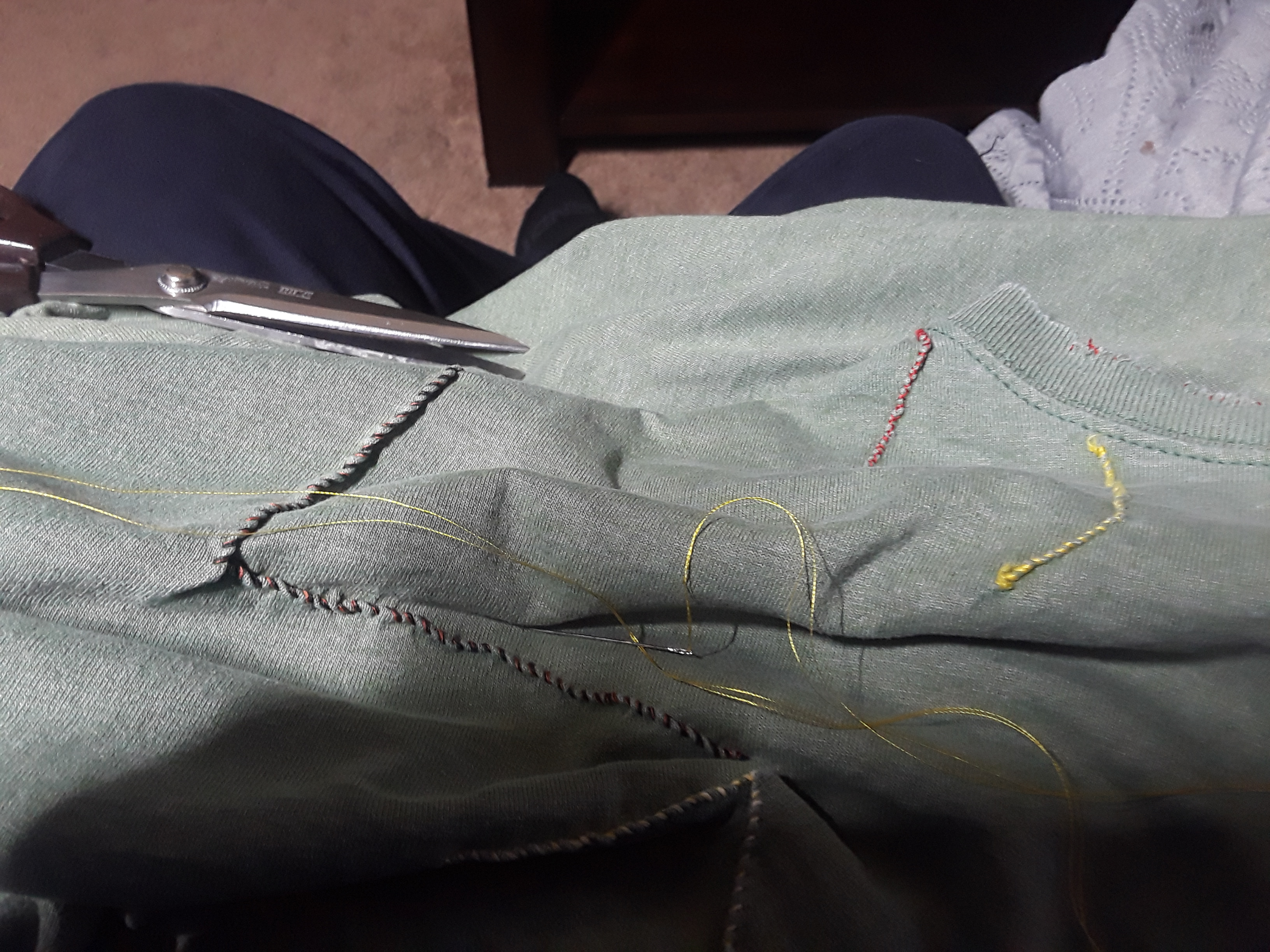
I generally have a rip-shirt in the closet. The current one is somewhere between 15-20 years old. The vivid color of the shirt has faded, and the fabric is stretched past its intended shape. But I keep fixing the rips and frayed edges because that is what life is. I’ve done every activity you can imagine in that shirt. (Don’t overthink that.)
Because I have always sewed, I sometimes dabble with a variety of things that require it. My Grandma Cook taught me to do a stitch when I was very young. I loved sitting at her feet on the rough floor and sewing anything she handed to me. And often, my fingertips. Thimbles were available but made poor guides for novice sewers.
My Dad and brother loved mercilessly teasing me about my penchant for making non-bunching pillows many years ago; my favorite kind involved going to a fabric store or department and choosing something appropriate for the intended v̵i̵c̵t̵i̵m̵s̵ recipients. Sewing has always been meditative for me. I’m not GOOD at it, of course, but you know what I’m going to say: I don’t care. No one in their right mind would ever invite me to a quilting circle for my sewing skills unless they needed comic relief.
In my early 20s, I started doing what I call rip-shirts. Some of them took me 100 hours to make. Simply put, I choose a shirt, usually of a distinctive color, then spend hours sewing stitch patterns all over it. Part of the fun is using a wide variety of threads, especially of different colors. It’s supposed to be garish. It’s possible to do intricate monograms this way, too, which I’ve done. I gave away many of these for years. One of the key advantages of such a shirt is that it becomes almost impossible to distinguish if it should be discarded, as all subsequent rips, tears, and issues can be restitched and become part of the resulting pattern. One of my shirts had over 500 hand-stitched lines on it. For another, I sewed a difficult-to-see curse word cleverly hidden in the stitch lines. That one amused me greatly.
Later, I discovered Kintsugi’s idea, where breaks and defects in bowls and cups are repaired using lacquer and gold dust. Theoretically, such repaired bowls can be fixed repeatedly and still be both useful and beautiful.
Rip-shirts fulfill the same purpose for me. They are each unique.
As the fabric wears, it becomes softer and more comfortable. If you rip the shirt, you can just sew it back. Unless you tell someone, they’ll assume all the stitches were purposefully placed.
When I was 30, I made a shirt for someone I initially thought was mocking me. He pulled me aside to correct me and told me that the idea was perfection to him. Because he was a large black man, I chose a very large shirt. I monogrammed his nickname along one sleeve and put hundreds of stitch lines on it. It was the only time that I worked hard to get the stitches perfectly aligned. When I handed him the shirt, he teared up. “Wow. I bet this took twenty hours to make, X!” I shook my head. “No, it took fifty.” He couldn’t believe that I spent so much time making him the shirt. He died much too young a few years later. What breaks my heart when I think too long about it? I told him I could teach him to do basic stitching in less than 15 minutes. So it came to pass that I sat in an industrial office in a vast poultry plant patiently showing another grown man how to stitch. It occurred to me how strange the idea would have been to my Grandma.
I indeed caught a fair bit of mockery for wearing these shirts. Likewise, I also wore my clothes inside out for fun, too, or made exotic and ridiculous headbands, sewed on a long-sleeve to a t-shirt, and a wild variety of stupidity. I went inside what is now First Security on Emma. The plant manager for the company I worked for had a wife who worked there. I went to the next teller, and it was the plant manager’s wife. I’ll never forget the look on her face when she realized that my t-shirt had the sleeve of a long-sleeve button-down dress shirt sewed on it instead of a standard t-shirt sleeve. She laughed so hard that a bubble came out of her nose. The look of mortification on her face was etched in marble. And then she laughed more. The person in charge of the tellers walked over to see what the problem was. The plant manager’s wife was crying from laughter and trying to tell her what the joke was. Looking at the floor manager in the eye, I said, “I got robbed, and they did THIS to me!” – and I pointed at my sleeve. The plant manager’s wife and I both laughed for another full minute. The floor manager walked away, shaking her head.
I made several rip-shirts for younger kids, who were fascinated by the concoction of stories I created to go along with them. Kids take a bit longer to lose their sense of adventure or categorically reject something interesting.
Somewhere around 2000, I was at the store wearing a rip-shirt, and a gentleman asked me where I bought the shirt. I think I was at Hastings Records. “I didn’t buy it. I made it.” He seemed genuinely interested. That particular shirt had a lot of neon threads in it. I grabbed the hem of my shirt, pulled the shirt up and off, and handed it to him. “Here,” I told him as I stood there shirtless near the main entrance. He didn’t argue or hesitate. “Thanks, Man!” You would have thought I handed him my wallet. At least fifty times that year, I bragged that I was willing to give someone the shirt off my back.
As my eyesight naturally worsened, I began to sew less often. That was a mistake.
I wonder where some of the rip-shirts ended up or if they still exist. Each of them was made by my imperfect hand. Each one of them is a literal tapestry of the moments I spent making them. They are not for everyone.
“If you want a guarantee, buy a toaster.” – Clint Eastwood
Before.
After.
The chasm between any two parts of your life seems predestined.
“We do not remember days. We remember moments.” – Cesare Pavese
Then again, all of the cross-sections of our lives appear that way after the fact, with clear divisions of some calamitous or joyous event to artificially demarcate them.
Whether due to death, career, pandemic, new love, or the discovery of a friend you didn’t know you were missing, our lives are a series of bookmarks. If we’re lucky, our books are a series of laughter and events and only briefly interspersed with the sorrow that must accompany us.
Honestly, I did not recognize my own mind until I was in my late 40s.
In my life, I’ve had trouble learning complicated things quickly. I’m not saying this as self-deprecation; it is an absolute truth that I can readily admit. Mastery comes if I can overcome the reluctance the wiring in my brain presents. I was a genius with geometry and a failure with trigonometry. I love language and love it the best when I can break the rules that ask me for adherence.
Many people profess that they feel they’ve wasted their lives. Superficially, I can relate. On a deeper level, I can’t understand it at all. Life is an experience. It is possible to waste it, but very difficult.
Our lives are a succession of attempts to distract ourselves from the underpinning of our lives; no matter how well-lived, we will wither. Living a raucous and uncaring life in response is no way to find ourselves or a meaning that matters. Most of us fight a battle between polarizing options. We want to break a beer mug while dancing with someone beautiful at 11:30 p.m. and also want a couch and someone to share it.
What might the ideal increment of a happy life be? A year? 50? I suspect that it varies in proportion to the depth one feels one’s life.
I’ve stepped over the imaginary border into the ‘after.’ I feel its tangible presence behind me. There is no guarantee and no clear path. I don’t need one, nor do I curse myself for waiting for faith to propel me with enthusiasm.
Because of my long life, I can avoid feeling panicked when I realize that I’ve stepped over another milestone.
Given that many milestones were invisible until they happened, I should laugh and resign myself to the fact life isn’t done with me yet, no matter what it may look like next year.
I see the light. It shines upon me, whether I deserve it or not.
Q – “What do lemons wear in the rain?” A – “Yellow jackets.”
As I left work, the skies finally opened, and rain fell. The wind noticed and opted to blast the rain sideways. I lost interest in going to the store, even though the idea of watching meandering mobs of discerning consumers arbitrarily observe the new social norms interested me, much in the same way that it’s difficult to close one’s ears to titillating gossip.
Because I’m an adventurous guy, I stopped at the gas station, a place seldom associated with adventure – at least not the kind people pay to see. The universe continues to remind me that cars need gas to remain operational. I’m smart that way. It took 30 years, but wisdom finds us at our own incremental and obstinate pace. Remember that when you watch the younger generation do new versions of the same stupidity you and I once did. Note: yes, you did some foolish nonsense when you were younger: we all did.
I went inside and chose a gas additive, and approached the register as a couple of very young Latina girls danced around the edge of the register. Their mom tried and failed to herd them toward the door to leave. The young male customer in front of me was asking a series of specific questions about his food. The clerk had an exciting look of “wtf” and “no clue whatsoever” on his face. Knowing that my superpower of supreme bullshi%%ery would be useful, I leaned in and said, “First, go with the turkey if you aren’t sure. Take a packet of mayo, bbq sauce, tartar sauce, hot sauce, and mustard and try a nibble of each with a bite of the sandwich.” The picky customer looked at me directly, even as I told myself not to smile or frown. I just nodded. “Well, thanks! That’s a great idea.” The customer picked up his sandwich and went to the condiment container to obtain one of each.
The clerk leaned over and softly said, “Thanks. He does that often.” I laughed. “The joke’s on him. I don’t think it matters what I said. I think he just wanted a voice of confidence to recommend something.” The clerk laughed. “Noted!” as he tapped his right temple. “But you should recommend something crazy next time to test the theory,” I quickly added. We both laughed.
I paid for my additive after asking the clerk where they keep the flavored gas additives. I also bought a lottery ticket. “Keep the change,” I told the clerk. “Thanks, that is nice of you.” I turned and said, “You’re welcome. I didn’t know you could take tips here.” The clerk nodded.
As I pushed open the door, I returned to the register and put a $10 bill on the register. “You can keep this. Buy yourself something nice!” He looked at me, quizzically and smiling. “Really?” Thanks!” I nodded. “Let’s test to see if karma will give my lottery ticket a boost. If I win the lottery, I’ll give you $1000 if I win 100K and 100k of it if I win it all. No BS.” The clerk waved goodbye as I walked out. I think he would be stunned to know that I meant it when I said it.
In my attempt to avoid getting soaked at the store, I ended up standing under a massive overhang as I pumped the gas, and the wind howled and brought the rain almost horizontally under the roof. I got soaked in the process. While the gas pumped, I could see the young man with the sandwich. He sat in a booth by the long row of glass windows. In front of him was a variety of packets. For those of you who don’t know, I often eat food similarly, with ten different spices and sauces scattered around me.
But.
I gave someone permission to enjoy their lunch. There’s a high probability that they’ll love a condiment they’ve never tried before.
I surprised a total stranger with an unexpected gift.
And I got soaked. But the small moment of this afternoon was worthwhile, even though it will never be listed in the accounting of our lives.
“I just want competency to be the standard for political office. All else is a distraction. I don’t need a leader. I need a decision-maker who takes pride in making the best available choice with the options given. Whether the person is a D or an R is a ridiculous modifier. We should have many political parties, with each staffed with the best, brightest, and most compassionate people. Governments not run by coalition fail us – and lead us to fail each other.” – X
Yesterday, I took advantage of the brilliant fall day and walked around the neighborhood. As I made my first pass around the closed-loop of one block, two young kids were shooting hoops in the middle of the street. I waved and watched them creatively and competitively trash talk one another. If their shooting skills were half as good as their verbal sparring, they’d be NBA stars. A few minutes later, as I made the corner again, I saw they were still there. I took off my headphones and told them I could make a shot from anywhere as I backed away to the opposite side of the street. Both kids looked at each other, wondering if they could trash talk me. “I used to play basketball professionally. My free throw average was almost perfect.” The kid with the ball bounced the ball toward me. Luckily, I caught it without falling over. I bounced the ball two or three times and then took the stance of someone about to do a small jump shot. “I can do this with my eyes closed, guys.” The smaller boy seemed intrigued. “Show us what you got then!” At the last second, I moved from a jump shot position to holding the ball granny style, with the ball between my legs and underhandedly threw the basketball up into the air. I missed the net – and the backboard by at least two feet. “Don’t believe everything you hear, okay?” I said and laughed. Both the boys laughed. “You suck big time!” I nodded. “Yes, I do.” The taller boy asked me what my name was. “Danny DeVito.” As I walked away, both of them took a few moments to trash talk me instead of each other.
.
.
The morning after I found out my brother died, I pulled over to the sidewalk near Turnbow Park and Shiloh Square on Emma. It was still very early. I sat sipping the horrible cup of coffee I’d bought and cursing my misfortune with the coffee lottery. Even at four in the morning, I noticed a young Latino man in the common area. He had a phone and seemed to be meandering aimlessly. As I made a call, he approached in a zigzag pattern. It didn’t concern me, as I’m generally oblivious to the possibility of danger. That area of Emma is brightly-lit and easily observable. As I put down my phone, the young man unexpectedly came up to the car and attempted to open the passenger door. I rolled down the passenger window. His English was choppy and hard to understand, so I asked him in Spanish what was wrong. As it turned out, he was waiting on a ride. When I offered to take him wherever he wanted to go, he hesitated and almost took me up on the offer. I can’t explain exactly how something was off about him; he might have been fatigued, or maybe he was distressed. As he walked away, I realized I should have pushed harder to make sure he was okay. It didn’t occur to me until later that things could have gone wrong for me.
Through the years, I’ve given many rides to people that most wouldn’t. A couple of times, I think the person was capable of doing harm. But I always ask myself what it would be like for me to be in their shoes. It’s likely that on a long enough timeline, I’m going to make the wrong choice. But I will still do it.
. .
Whoever you are and wherever you are, I hope you have a moment to consider that if you are in the majority, you have less to be concerned about than those who aren’t. If you’re white, straight, and Christian, you are shielded to a degree that many others aren’t. Politics isn’t just what we argue about on social media and do in the voting booth. Politics affects our ability to live freely. It’s easy to tell others to be more carefree about politics. For many, each election is a referendum on whether they’ll be enjoying the same rights as others. In this country, women, blacks, and others were literally and legally assigned a lesser role and value. No matter how perfectly we design our system of government, a faction will always be misusing it to target people who are vulnerable. All of you who are tired of politics should remember to shout for the person next to you at the table, just as if he or she is your brother and sister.
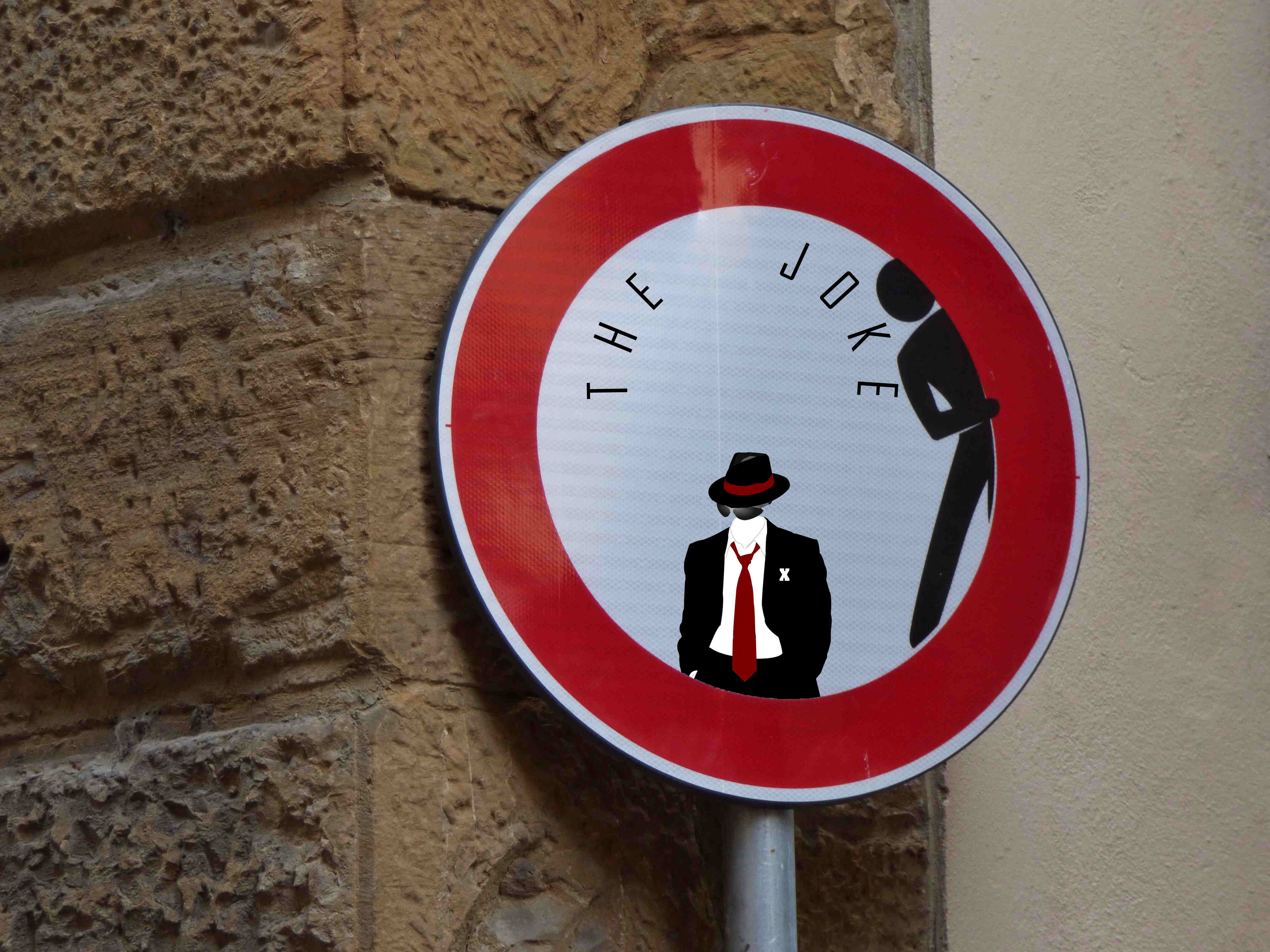
This is “the” joke I read in Spanish at a restaurant in Tulsa many years ago. Upon reading it, I realized that whatever controls language had clicked full-on for me in Spanish. The subtlety of the dumb joke caught me off guard and I’ve not forgotten that moment.
*
A Sergeant and his Lieutenant are on the edge of a wide prairie. Both are laying behind a slight rise on the perimeter of the prairie. The Lieutenant looks through his spyglass.
“Sarge, take this and look at the group of Indians riding toward us and tell me if you think they are friends or enemies!” The Lieutenant hands Sarge the telescope.
The Sargeant hits the Lieutenant on the shoulder. “Duh! I don’t need to use the telescope. They must be friends if they are riding so close together like that!”
The day grew long legs while I was busy frittering away the hours. I was so accustomed to hurling myself from the bed at an early hour that I wasn’t sure my enthusiasm for a long walk would meet me outside so late in the day. I was wrong, though. Even though it was Nov 19, it was warm enough for a brisk walk, even at 4 p.m. The sun was slowly dropping toward the horizon. Its orange glow made me squint as I hurried along the leaf-strewn trail. I felt as if I could walk for ten miles and that the receding sun was being converted directly into propellant for my feet. The recognition of my initial reluctance to take a walk reminded me that once started, few walks fail to yield positive moments.
As I passed the house I had christened “hoarder house,” its yard still seemed like an abandoned junkyard. I’ve written about the hoarder house once before. Its existence had surprised me, so close to the modern new homes and bright recently-built park. I counted no fewer than five boats, eleven vehicles, and at least forty appliances scattered through the unkempt yard. Even the grass seemed to have given up, trading its light brown hue for a dingy, decaying gray. The pile had grown so unmanageable that I couldn’t see much of the front of the house as I approached it from the city limits. Last summer, I could smell the contents of the yard as I strolled past. I used street view maps to look back in time and found myself staring at a mostly empty yard. That the yard became so cluttered so quickly was a surprise.
Reaching the sign that indicated “NO turnaround, private property” a few hundred feet past the hoarder house, I turned and began my trek back. The road dead-ended a little further along, and despite its proximity to the city limits, something primal in the back of my mind stopped me from walking to the end of the gravel road. As I approached the hoarder house on my return, I noticed smoke slowly escaping the dilapidated chimney at the end of the house closest to me. I didn’t see smoke when I had passed the house the first time. At this point, it was just a few minutes shy of sundown, which was going to occur a little after five that afternoon. The orange tint to the air had deepened, and the air’s chill was beginning to feel like the inside of a refrigerator door when first opened. While I prefer the early morning sun’s desolate greeting, some sunsets evoke a deep, peaceful feeling in me. The evening walk felt like a slice of stolen time, and I realized that I hadn’t once thought about how far I had walked.
I approached the cluttered driveway of the house. I saw what I thought was a cat jumping up and down in a bare spot in the grass near the front steps and probably hunting mice in the debris. After a few more seconds, I realized it might be a human arm rising from a prone position. My pulse quickened. As I passed the rusted barrels obstructing a clear view of the house, I could see an elderly lady. She had fallen off the steps, her legs tangled under her, and her messy silver hair scattered around her face like shorn feathers. Her right arm moved up and down while her left arm remained immobile. I ran toward the porch, dodging debris and trash as I neared the fallen woman. I felt a sharp pain in my right forearm as a sliver of metal pierced my skin and cut me deeply. The metal shard was protruding from the edge of a small boat. I knew I was bleeding. For the time being, I ignored it and ran the few steps remaining to the porch.
Kneeling, I put my hand on the woman’s exposed left arm. Her flesh was cold. Had I not seen her moving, I would have been sure that she was dead. I pushed the hair away from her face, expecting some unseen injury. “Ma’am! Are you okay?” I shook her more harshly than I had intended.
I looked up toward the closed door above both me and then the small porch steps. When I looked back, the woman was staring at me, both eyes open. I almost screamed. Her eyes were clouded and silvery. Her lips began to move, although no words escaped her mouth.
“Hold on. I’ll call an ambulance.” I looked directly into the woman’s unsettling silvery eyes as I said it, to comfort her.
Her right arm came up, and her fingers encircled my left wrist. “No,” she croaked, her voice barely discernible. “Please. Help. In the house.”
Lifting her and getting her in the house was momentarily overshadowed by the idea of going inside this house at all. I had thought many times about how terrible it must be inside there. The place seemed to be the embodiment of decay. On previous walks, I could smell the presence of the house and yard from the road. I hesitated and considered calling an ambulance anyway. As I looked at the woman’s face, though, I knew that I wouldn’t call. It seemed like this wasn’t her first serious fall. I wondered what might have happened to her had I not wandered by on an impromptu walk.
Without her telling me, I knew her left arm was almost useless to her. I crouched and put my right arm under hers and pulled. She feebly pushed with one of her legs, and she wobbled up. Oddly, she smelled of vanilla and cinnamon.
We took the three steps up the porch one at a time, without any hurry. I grabbed the broken door handle with my left arm even though I knew my right arm, which supported her, was probably leaving a bloody trail across the fallen woman’s back as the cut on my arm continued to pulse in pain.
I couldn’t get the door to open, even as I pushed hard.
“Hard. Push!” croaked the woman. I leaned in and pushed with more force than I intended. The door popped open, and before I could stop us, we both fell inside. I felt the crunch and fold of paper as I tumbled in.
I resisted the urge to scramble upright, hoping our unintentionally gymnastic entrance didn’t further injure the woman. I rolled her over to her back. Her hair looked like a silver mop blown by a malicious wind. I leaned over and pulled her up. As I looked around the room, I was surprised by how few furnishings were in the living room. The floors were covered with newspapers. I shuddered to imagine what was beneath the multiple layers. A couch sat on the far left, and at least six armchairs were on the right. None of them matched one another. I moved toward the chair furthest from the door as I carefully pulled the woman along with me. Cups, saucers, and papers surrounded the chair. I knew from experience that almost all hoarders tend to make a nest in the spot where they spend the most personal time.
I helped the woman turn and let her go a bit too soon. As she fell into the chair, I heard a ‘whoosh,’ followed by a high-pitched squeal which turned out to be a startled tortoise-shell cat fleeing in surprise. It ran through the doorway near the fireplace. I noted no fire in the fireplace but didn’t understand why that seemed to bother me. While I couldn’t see into the next room, I could hear things moving, though, and I wasn’t certain whether the sounds were from mice, cats, or some strange thing better left unbothered.
Not wanting to leave the woman until I knew she was safe, I reached under the lampshade and attempted to turn on the lamp next to her chair. My hand ran across a mass of cobwebs. I quickly snatched my hand back. The old woman cackled as she reached across and brushed her hand on the lamp. It turned on immediately.
“Son, you can call me Dolores.” Her voice sounded like a broken drawl, one accustomed to fatigue.
“Nice to meet you, Dolores, and sorry about the circumstances.” I moved to sit on one of the other five chairs, trying to pose myself as little as possible across its front cushion. As I sat, I could smell the dust and years of neglect rise out of the fabric.
For several minutes we sat in silence. My mind was asking several questions, none of which did I dare utter. I wasn’t sure how much of her condition was chronic and how much might have been exacerbated this afternoon in her latest fall. I remembered the cut on my arm. It was now just bloody and drying across my forearm, although it still throbbed. It didn’t occur to me that I should leave, so I sat, in silence, waiting for some sign of what to do.
“Fetch me that album off the shelf there. The one with the purple tassel,” Delores said. Her voice had substantially cleared up. I stood up and carefully placed one foot in front of the other as I crossed the room. As I pulled it from the edge of the shelf, I realized it was a photo album. A purple tassel dangled from within its pages.
I handed it to her and lowered it slowly so that the weight of it wouldn’t surprise her. She placed it on her lap. Instead of opening it, she asked me to pull a worn stool over from near the door. Though it was well-used, it was dark black and had a faint carving in the top; whether it was a wolf or a dog, I couldn’t tell. Someone had undoubtedly made it with their own hands. I picked it up and placed it near her, and sat on it. It was strange that I didn’t hesitate to sit close to her.
She opened the album. Inside the first page was a large photograph of a mostly smiling family. Across the top, it read, “Fising Family 1922.” She pointed at a young girl in the front, probably five years old. “That’s me, sonny. I was a happy girl.” I did the math. The little girl in the black and white photo was smiling as she gripped the left leg of the man standing next to her. Dolores was somewhere around 100 years old now.
As if reading my thoughts, she said, “Today is my birthday! Nov 19.” I was finding it hard to believe that she would be alone at that age. Dolores turned to the next page, reciting names. “My sister Georgie. My brother George. My mom, Georgie Mae Nador. My dad, George Wilson Fising. He was born in Romania but was adopted by someone coming to America. His real family was wealthy and sent him here.” She continued to turn the pages. I found myself looking intently at all the strangers in her album, imagining the one hundred years they documented.
She paused. “My son George. My only child who survived childbirth. He had seventeen kids. Can you believe it?” The next picture was of George, probably taken in the 1970s. Kids were sitting, standing, and crouching in every direction. “He had 47 grandchildren. What a wonderful life.”
“Where does he live now?” I whispered.
“He died in a fire on Christmas night many years ago. A good life, no regrets. He was the spitting image of my husband. My husband ran off the day George was born. He couldn’t take watching another child die. We lost nine kids before George was born and survived. I know how he felt, so I never begrudged him leaving like that. It was a relief, actually.” She sighed, undoubtedly picturing her husband in her thoughts.
We sat, slowly looking at every picture. Dolores occasionally commented. As she turned to the last picture, I could see that it was a snapshot of a very old man. He had a high hat in one hand and a cane in the other. He was smiling outrageously at the camera. Underneath the picture, someone had scribbled, “Yikes!”
“That’s my dad, George. That’s the day he died. He died on his 100th birthday, as spry as someone forty years younger. All his life, he joked that the Fising family in Romania was so wealthy because they all lived to be over 100 years old. He loved saying “Yikes” every time we turned around. We would often tell each other “Yikes” instead of “I love you.” It was a way of reminding us that life was just as many sparks and dismay as having a good time. But lord, we lived extraordinary lives.” Dolores wiped at her eyes with her right arm. It struck me that Dolores had, indeed, lived a proud life.
We sat and let the light diminish around us. As Dolores shared stories, I felt as if history itself were sitting in the room with us, cleverly hiding its presence. I pulled my cellphone out and was surprised to see that it was 7:30 and that we had been looking at pictures for over 2 hours. I didn’t want to pry, so I asked her if there was anything she needed. “No, I’m going to sit here a spell, sonny, and let the dark catch my thoughts.” The way she said it told me that she learned the phrase decades ago.
“Dolores,” I said, “Would it be okay with you if I come back tomorrow afternoon and look at another photo album with you?”
“Oh yes, that would be divine.” Dolores crookedly smiled. “Can you bring snack cakes,” she asked, her voice trailing.
I reached out and touched her hand as I stood, grabbing the stool to move it back where I had found it.
“Tomorrow it is, and yes, for the treats,” I said, trying to get outside before I started crying.
As soon as I opened the door, I realized it was dark. Pulling out my phone, I used its glow to slowly step around the obstacles in the yard and make my way back to the road. Once I reached it, I looked back and could see no lights on inside. Whether Delores used the time it took me to traverse the obstacles of her yard to cover the crevices or her windows or turned off all the lights, the idea of her seated in the living room alone bothered me.
The next afternoon, I finished work, and instead of parking at the park nearby to walk over, I drove and left my car a few hundred feet from Dolores’ hoarder house. I brought out a package of snack cakes and walked up to the house. After navigating the yard, I knocked loudly on the door several times. Finally, I heard a voice say, “Come on in.” I pushed the door hard to knock it loose, and it popped open.
“Sonny!” Delores said with energy. “I didn’t think you’d make it back.” Delores was wearing the same thin floral dress she had on the day before. She was seated in the same chair. Had I not know it was impossible, I would have believed she had remained in the same position since last night.
I handed her the bag of desserts, and as she clumsily looked inside, she laughed. “For some reason, I thought you’d bring me a fruitcake.” She looked up at me.
“I love fruitcakes, Dolores,” I said.
“I had a thought you might, sonny. I haven’t had one in what seems like a long spell.” I made a mental note to bring her a fruitcake. Or five. She placed the bag of cakes on the floor next to her.
Dolores asked me to bring her over another photo album, so I fumbled with the shelf’s contents until I pulled down an album with a green tassel. “My grandkids,” Dolores commented.
I pulled up the stool and sat. Delores once again began flipping the pages carefully, adding an anecdote or story about each one. Time stood still in that hoarded living room. Unlike yesterday, Delores seemed energetic and intensely created a whispered narrative of dozens of unfamiliar faces. I envied her life, though, the one cataloged in that album.
Her voice seemed to mimic a minor-key melody played on only black keys of an old piano. When she spoke of some of her family and the memories, I could discern a lilting pattern and uplift to her voice.
After she finished and closed the album, she told me some of the stories her father shared with her, many of them from Romania. Her love of fruitcake and minciunele were born from inside jokes she and her father had shared. “Never eat minciunele or fruitcake when you’re sad!” he would tell me.” For a moment, I could smell baking pastry dough pulled from a hot oven.
We both sat, staring into the past. As was the case yesterday, I was unaware of how much time had passed. I looked at my cellphone. Four hours had passed.
I stood and took the green tassel photo album from Dolores, and I placed it back on the shelf.
“Dolores, Thanksgiving is a couple of days away, the 23rd. I can’t come by tomorrow, but I’d love to come to see you on the holiday if you don’t mind. I’ll bring you a fruitcake and some fixings, if you’d like.” I couldn’t imagine her not being with family, but I was committed to avoid the sin of prying.
“Ooh, I’d love that, sonny.” She smiled.
An overwhelming urge to hug her possessed me, so I leaned in and wrapped my arms around her. She smelled like cinnamon again. “I forgot what it feels like to be hugged,” she said as I squeezed. I managed to get outside before my eyes filled with tears. Over one hundred years of life under her belt and dozens of family members in the world, and yet I was the one connecting with her. I stopped at the market on the way home and bought two small fruitcakes for my Thanksgiving visit. One for her and one for me. Or both for her, if she insisted.
Three days later, I again parked on the roadside a distance away. As I came up to the infamously cluttered driveway, I noted a newer Escalade was parked with its bumper up against the debris littering the front of the yard.
“Family is here after all,” I thought to myself. Though I was glad to know she had company, I felt a little put off by their presence.
I walked through the yard, and as I was about to knock on the door, it opened in front of me.
An older lady stood at the door, a mask hanging at her neck. Beneath it, I noted an ornate cross with a diamond inset.
“Yes. Can I help you?” She asked.
“I’m here to see Delores. We made arrangements to have fruitcake today.” I smiled.
“When might you have made those arrangements, sir?” She looked angry.
“Two days ago. Is she here? Is she okay?” I was getting an uneasy feeling.
“No, she’s not okay – and neither are you. I don’t know what game you’re playing. I’m Dolores’ granddaughter. She died a year ago on Nov 19.” Suddenly, I felt dizzy.
The next thing I was aware of, someone was shaking me and shouting.
“Hey, are you okay? What the hell? You passed out.” The lady who had answered the door was leaning over me. I felt the cold ground under me.
I rolled to prop myself up and sit upright on the ground. There were pieces of tools scattered all around me, all rusted. I had narrowly missed hitting a pile of pipes when I fell off the porch. It occurred to me that I had fallen almost in the very spot where Dolores had dropped a few days ago.
After a minute, I shakily stood up.
Delores’ granddaughter must have felt responsible for my fainting as she motioned for me to wobble my way up the stairs and inside. Without thinking, I grabbed the wolf stool by the door and sat on it.
The woman handed me a bottle of water. I opened it and drank almost all of it in one continuous gulp.
“I’m Georgie. Who are you?” Her voice was softer now, although I could tell she was a little concerned that I might be crazy.
“My name is X. I live a couple of miles away.” Realizing that my name probably didn’t help, I added, “And I met Dolores for the first time a couple of evenings ago. She told me a lot of stories.” I didn’t know what to say, in part because I had never fainted as an adult.
“I’m sorry. Dolores died Nov 19, 2016… X. There’s no way you saw her a couple of days ago.”
Before she could continue, I interrupted. “Delores Fising, born Nov 19, 1917, to Georgie Mae Nador and George Wilson Fising, born in Romania. Dolores was married and had nine miscarriages until her only child, George, was born. He had seventeen kids and forty-seven grandchildren, of which you are one.”
Georgie’s face slowly took on a shocked and confused look. “I don’t know how you know all of that, X, but it doesn’t change the fact that she’s been dead over a year. I’m here to hand the place over to someone who wants the property. Today was the only day I could drive here.” She waited for me to reply.
“Get the purple tassel photo album off the shelf, and I’ll tell you a few stories.” I was floating in a cloud of confused bewilderment.
As Georgie retrieved the album, she handed it to me and sat on one of the chairs nearby. I opened the book and pointed. “This is Dolores, a happy child. Her father, mother, and family. I turned the page and loosely shared the same anecdotes Delores told me. Before turning the last page, I looked at Georgie and said, “Yikes!” “and then turned the page. This pictured is your grandfather George on his 100th birthday, the day he passed away. He taught the entire family to say “Yikes!” as an endearment.”
Georgie’s face blanched as I finished, and she stood up and retrieved the green tassel photo album and handed it to me. I opened it and recited a dozen family stories.
“Your father George died in a fire on Christmas day. Dolores said those sad times will always be held in check because your family was afflicted with happiness. I think that’s how she put it.” I closed the second photo album and sat in silence. “Afflicted with happiness.”
“Wow. I don’t know what to say. You don’t sound crazy. But there’s no way your story is true, X.” She shook her head, trying to escape the feeling of underlying magic in that dirty living room.
“I’m going to need to think about this. Is that okay?” Before letting me answer, she stood up and found a short pencil and a scrap of paper. “This is where Dolores is buried. Go see her.” She handed me another scrap of paper and said, “Write down your phone number for me, and if I can bring myself to do it, I’ll call you.”
I noted my phone number. As I handed it to Georgie, she grabbed my hand and clasped it between hers. She was looking intently into my eyes. “They passed down stories about how superstitious the family in Romania was. Strange goings-on, probably just stories to spook us. It’s working. I’m spooked. Dolores had a knack of knowing things and always told everyone that life never ended, at least not the invisible part.”
The next morning, I called in sick at work. I had resisted using my ancestry skills to look for Dolores digitally. As I’m an early riser, by 6 a.m. I was driving, following the unknown roads east of town. Several missed and wrong turns later, I found myself going down an uncertain dirt path around 7 a.m. The sun was just peeking above the distant horizon. Next to me in the passenger’s seat sat Dolores’ fruitcake. I couldn’t drive any further as the dried grass and weeds made it impossible to see what might be found underneath. The wind had subsided, and the cold enveloped me as I exited my car, fruitcake in hand.
I crossed through the sparse trees and dead foliage, dodging stray limbs as I walked. Ahead, I saw the broken teeth of graying tombstones rising from dead grass. The cemetery wasn’t plotted like most rectangular gravesites. There was no uniformity between rows, nor interval space between the stones. Limbs and piles of blown leaves littered everything. Guessing, I’d say there were only thirty marked graves.
As I approached, I could see the name “Fising” engraved or marked in haphazard fonts along the stones. It seemed as if all the stones were marked with that surname. I walked along the first row, searching for signs of a recent grave. The newest one I found was already fifteen years old. Fearing I had missed the resting place of Dolores, I turned to look back, and that’s when her spot caught my eye.
Stepping hastily across the cemetery, I made a straight line to the most massive tree in the rear of the grave area. Someone had piled sandstones in a rough circle around a tombstone, extending seven or so feet from the headstone.
Her stone was a large native rock, carefully inscribed with the following: “Dolores. Lived 100 years and several lifetimes.”
Despite its primitive construction, it was a beautiful spot in an unspoiled area. I tentatively stepped on the sandstones to reach the tombstone. I opened the fruitcake and unwrapped it, placing it along one of the headstone’s smoother top sections.
As I stood up, the wind picked up, dragging rustling leaves from the fields and trees across the cemetery. The hair on the back of my neck stood up, and I turned to look behind me, instinctively. I felt foolish. The sun was just peeking over the distant trees, illuminating this magical place.
Just as suddenly, I felt as if someone were standing behind me, behind the headstone. I turned back and saw that no one had approached. The fruitcake, however, was gone. Only a couple of crumbs stuck to the stone.
“Yikes,” I whispered, knowing that I’d never see the explanation for what I’d just witnessed.
“Dear Dolores, yikes,” I whispered again as the swirl of leaves covered my feet in oak leaves. I waited for a reply I knew would never come.
Dolores’ granddaughter never called me. I like to think that she recognized that I was telling the truth about Dolores. In such a family, magic would undoubtedly survive.
From time to time, I’ll catch myself uttering the word “Yikes” to those around me, especially those times which evoke a feeling of connection with them. They look at me quizically, and I just smile. I’m cautious about using Delores’ magic too often.
I remember all of Dolores’ stories, each one of them. The faces in her family pictures talk to me sometimes, telling me the stories in soft voices. I think she infected me with her memory and of her life so that it might survive. Some nights, I wake up with the odd smell of Romanian forests in my nose.
Yikes, to each of you. .
I have not walked past the hoarder house since. While I am not superstitious, I’m uncertain what lesson was given to me three years ago. . . I wrote this story in November 2017. Though imperfections found in it are genuinely mine, this story came to me in one balloon, wrapped in a single moment, as I stared at the house that inspired it. It is strange how people who never existed can haunt my imagination. I put the story out of my mind and went to bed that night. To say that the fall night stretched into a swirl of years in my sleeping mind would be an understatement. I woke up the next morning as if I’d been unwillingly snatched from another person’s life.
Although it seems insignificant, I deleted a story today, one that was 40+ pages. Not because it was a lesser story, but because I am incapable of the subtlety needed to capture the bittersweet dread and optimistic anticipation of each of my days.
Each fall, I look back and remember when a plane crashed where I lived. It could have easily zeroed me out in a blink. The story I wrote involved Joe Frasca, the dead pilot, visiting me, much in the way Scrooge had visitors from the past and future.
In the story, Joe Frasca did not waste his time telling me to use my allotted time wisely.
Instead, he told me that the only authentic life is one that’s observed, felt, and experienced, regardless of location. We focus so much on the Kodak moments, the vistas snapped in impersonal pictures and the adrenaline-laced remnants of activity that we forget that every single moment of our lives is a solitary window observing everyone and everything around us.
That Joe was an expert stunt pilot and saw the world from one of the best viewpoints possible isn’t lost on me.
I forgot that the pilot was engaged at the time of his death. Someone sent me a link to a blog post his sister wrote. After reading it, I realized that the lessons he did actually leave me with aren’t mine to fictionalize. One day, if I am capable, I will revisit the story, in the same way that I still look to the sky, wondering about the other universe floating above us.









 P.S. Parenthetically Speaking