Several of my social media friends have been posting 1984 quotes.
“The Party told you to reject the evidence of your eyes and ears. It was their final, most essential command.”
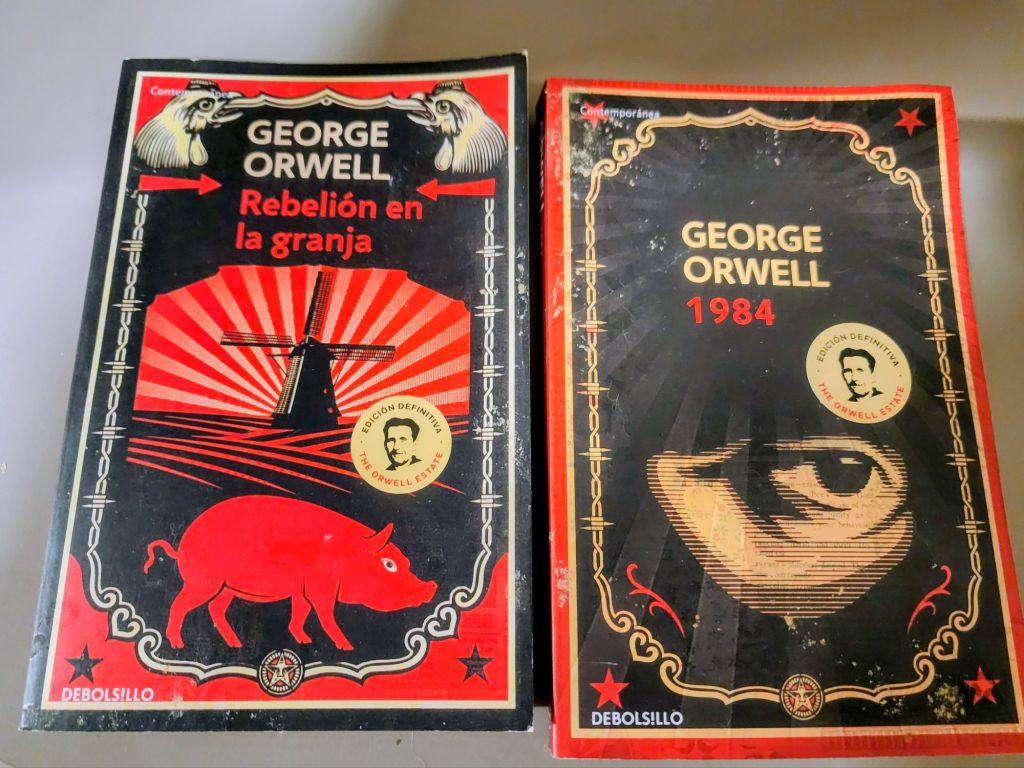
I have two of Orwell’s most famous books in Spanish. I’ve been reading “1984,” constantly finding parallels. I included “Animal Farm” in the picture because it is a companion warning to what’s going on around us.
Listening to the loons of this administration attempting to reframe what they’re doing takes me back to my childhood. Surrounded by violence and racism. Even though my dad was violent, the family members who justified their horrendous worldviews loom larger as villains. I think of them as I listen and watch. They were scared of losing control of a world that wasn’t just theirs to begin with. They could not admit that they might have been the bad guys.
“Anyone who posts words, policy, or statements by our current president for any purpose other than mockery or excoriation can no longer be taken seriously regarding any societal, political, or economic consideration.”
I can cite countless examples. The government shutdown can be ended without any Democrats voting in favor of it. By changing the filibuster rules, Trump and his Republican devotees can pass the budget bill immediately if they choose to do so. Given the increasing risk that Congress shall soon become an anachronism without teeth, it’s ridiculous to worry about tomorrow’s fire when our shoes are melting today.
People reposting Trump’s ill-informed and uneducated rants in support of something that’s factually untrue isn’t surprising. If racism, misogyny, fraud, and incitement toward insurrection aren’t deal breakers, it’s a deep well from which to draw an infinite spiral of malevolent ridiculousness.
If Trump wishes to be king, then let’s proceed with the coronation so that we can move on to a broken democracy. At least under that scenario, we will not be victim to an ongoing onslaught of “WTF”
moments, nor continue to hope for an end to the madness.
We can acclimate ourselves to the loss of the country we grew up in because we’ll have no other choice.
This isn’t politics. It’s madness and mayhem, driven by someone completely unfit to run a household, country, or company.
Dear citizens of Privilegeville: society most often works along the course of a huge pendulum. That which you take for granted today will be replaced, and most likely by something closer to its opposite. If you are pushing for an exclusionary society now, don’t be fooled by the status quo. Just as you couldn’t look back to 2008 and assume that the progressive surge would not fall into chaos. The further you push away from the middle, the greater the shock will be once the pendulum swings back. It is religious, political, generational, and societal. It’s such an obvious truth. But people embrace the status quo as if it’s anything other than temporary. We make plans for the future and we envision a society that will be there. It’s always a moving target. It is the very definition of entropy.
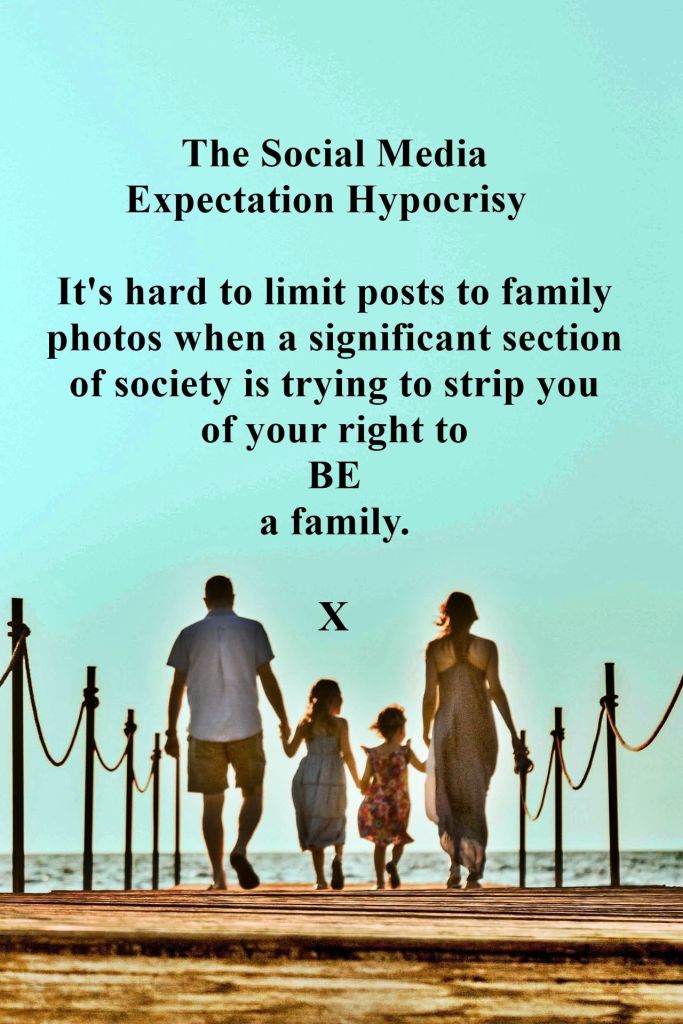
I wrote a powerful rebuttal to something recently. I haven’t posted it. In doing so, I came up with a quote that covers much of problem inherent in what I wrote about. The quote in the picture is a snippet of the words I conjured.
Our society will not function unless the prevailing notion that ‘live and let live’ governs us. Politics is a choice, much like religion, opinion, or what color underwear you choose. X .
Earlier today, someone shouted an old Spanish nickname of mine. It was an odd place to hear an old nickname. I remembered him immediately because he had the same smile, although it was hidden behind twenty additional years of hard-earned wrinkles. I will call him Sonrisa.
He told me he works with my old friend Carlos. After joking about the unlikelihood of Carlos working much and sharing a laugh, Sonrisa told me that Carlos was giving up on getting the citizenship that he had been promised for years. Both Carlos and Sonrisa are incredibly hard workers. Sonrisa told me a version of the same story I’ve been hearing repeatedly over the last few months: most of their cohort has given up on the United States being the promised land it once was.
They’ll probably return to El Salvador. It will be a loss for everyone. Not only are they hard workers, but they’re funny even in English.
They didn’t used to be prone to cynicism. Sonrisa remembered that I was one of the few gringos who actively stood out in the crowd in recognition of the contribution of Latinos.
He wasn’t surprised when I told him that there was not much hope in sight to feel respected as long as the current crowd of political idiots get their way.
I’m paraphrasing, but Sonrisa added, “You know he’s an idiot when he starts a fight with a friendly white country like Canada. I know if we go back to El Salvador we’ll experience similar authoritarian BS like we do here. But at least it won’t be based on prejudice.” He added, “I remember years ago when you said it was better for people to curse you directly to your face because then at least you knew who they were. We had a few great years here where the racists mostly kept to theirselves. We always knew it was there. But now? He gave them permission and gasoline to act openly.”
There’s no need to explain what people mean when they use the word ‘HE.”
I waved goodbye to Sonrisa and asked him to tell Carlos hello for me.
I silently hoped that 47 and the people who support him don’t get their way. But on the other hand, as always, a little part of me also hoped that they would continue to f*** around and find out.
Not only about the absence of a sufficient workforce to prop up our economy, but also the unavoidable consequences of believing that you can denigrate one group of people without harming the respect threshold for everyone else
Hate breeds hate, and distrust contaminates everyone.
There is no “them.” They are us and vice versa. You’ve simply avoided being targeted. Yet.
Authoritarians and those who believe they have the right of superiority are never content. Fear-mongering is an appetite that never lessens.
Francisco looked at me before he ran. Had he not, the immigration officials never would have looked twice. He came back to work later under another name. When he came to the United States, he worked hard. He rode a bicycle everywhere. I learned a lot of culture and language from Francisco.
After he ran, I went to the back docks were immigration officials were zip-tying people I knew in a refrigerated trailer. I had left my identification in my locker and diligently tried to be detained with the rest of my coworkers. I demanded in Spanish that the people I knew be moved out of the cold trailer. I refused to identify myself or provide identification. While I was not eloquent, I had to remind immigration that these were people being needlessly scared and put in discomfort for no reason.
I watched some of the agents half-heartedly perform their duties. They knew that the problem wasn’t the immigrants. It was the system and companies that relied on their labor. There were also agents who relished doing their jobs.
Later, I looked out at the back acres adjacent to Bethel Heights. At the work smocks hanging from the fence, left there by human beings fleeing.
It’s impossible to describe the people who didn’t experience it. Or to those who don’t speak the language and understand the need and drive to have a better life.
What a f mess.
I forget these experiences until I am required to remember. Every person rounded up or diminished by political grandstanding is still a person. And needed by the demands of our economy.
I did countless interviews and I-9 forms. The law required me to take a cursory look at identification prior to employment. If their identification was rectangular, it was good enough for me. Because anyone who wanted a job could have one. We constantly had unlimited positions available.
As immigrants become targeted, you can of course nod or applaud. But in so doing, you’re ignoring the bigger problem of economic necessity. Removing workers is a harsh solution that does not address the shadow economy or why we need so many additional workers.
Each time I see raids, I see Francisco. He was a hard-working man brought here by the fact that countless companies need workers. I think of that look of desperation on his face as he stood there zip-tied, knowing he faced a trip to Brownsville.
The raids were pointless. One man came to work with his suitcase. Instead of fleeing from immigration, he came to work ready for a free trip back to Mexico. He understood the economic reality that a job would be waiting for him when he came back across the border. And that it would likely always be this way.
Raids don’t address the problem.
They amplify it.
Companies who need labor anywhere they can get it will continue to do so.
Even if only 10% of undocumented immigrants disappear, it will have a devastating impact to our economy. Even if you’re unconcerned about the fact that these are people just like us, you probably won’t consider it to be an issue until prices rise and the reality of your choices results in discomfort for you.
We are not a nation of laws. We’re a nation of economics. Current events consistently prove this to be true.
Regardless of how we feel about the words, in a way, it’s a good thing.
We don’t have enough authenticity in the world.
I grew up inundated with prejudice, alcoholism, and violence, but also love and respect. The traumatic parts become the focus because they’re our biggest challenges. It’s hard to admire the sunset when your face is bruised by someone who is supposed to protect you. You can’t love reading if you’re hungry or afraid.
It’s the same now. Our society is safer and smarter, and our arc is generally that of betterment.
You wouldn’t think so – and that’s because the outliers draw our attention. Despite statistics that clearly show that we’re safer and smarter, that’s not the consensus you get when you ask a large group of people whether life is better now than it was. The effect of people thinking in large groups is that we increasingly find it easier to lose sight of doing the right thing.
Tribalism and echo chambers dominate us. It isn’t worse now than it once was. It’s just that we have tools to make information instantaneous.
It should be obvious who among us is motivated by the things that represent what our ideals demand of us. It’s not a question of intelligence, no more than your argument about loading the dishwasher is really about something else. Smart people do dumb things so it is no surprise that when we band together, we behave even more stupidly.
To justify, we vilify. We do this even as we recognize that we’re mostly doing and saying the same things. Names and geography changes – but we largely do not.
“Why can’t we all get along?” The answer is simple. Because we are not logical creatures.
We’re supposed to love our neighbor, but easily justify all manner of destruction. We’re supposed to honor and cherish those we’re with, but all of us see friends and family choose infidelity. Humanity is supposed to drive us forward and yet most of us participate in a capitalist system that takes advantage of the disadvantaged and favors the rich. We choose leaders who openly lie, cheat, and work for special interests and themselves. We claim to collectively despise entertainment that denigrates; yet, statistics demonstrate that we are consuming such content behind closed doors and locked phones. We know that our friends, family, and coworkers are drinking excessively, using mind-altering substances, or choosing the wrong things on a large scale.
Regarding politics, people are nuts. Studies show that we draw our conclusions and then find the evidence to support it. It’s what we do in our personal lives, so it’s no shock that it follows us in our ideologies. The religions we choose often propel us into certainty and dogma. The good ones preach universal love and respect, yet too many of their followers splinter the message and focus on controlling others.
If you’re a good person, you live without harming others. You choose what helps others. You’re going to fail often.
Saying the quiet part aloud helps us. For better or worse, at least you’re letting the rest of us know what percolates in your secret heart and life, the one you don’t want to be exposed. I grew up with a couple of people who were, in my opinion, monstrous. Not because they acted, but because they kept their secrets locked inside a box of righteousness and self-certainty.
Words, words, and more words, a flood of them.
Meanwhile, your life is your sermon.
As for alleged leaders, I want people who have mostly lived their lives with efficiency and honor. If they haven’t managed to control their own lives in agreement with the ideals they quote, it is dissonance and folly to expect them to lead us anywhere other than the wrong place.
Whatever your ideology is, if you’re focused on control or the certainty that you’re right, you will be blinded to other options.
I’m old enough to have become fascinated by people and their lack of self-understanding. I see it in myself so I can say it without sounding like a hypocrite.
A local doctor stole babies from birth mothers, telling them that their children had died. And one case in particular… It took decades for DNA to reveal the story. That happened here in Northwest Arkansas. One of my ideas for a Netflix documentary would be to contact the families of every mother, especially single mothers, who gave birth during a specific time period to perform DNA tests and compare them nationally.
Handsome, charismatic men who portray themselves as humble Christian husbands. Yet engage in a cycle of highly sexual affairs. (A story so common it is literally copy and paste.) Another one with a conservative political career who used his position at his work to take advantage of women. There’s a reason so many sexual harassment complaints arise in the workplace. It has built-in inequality that largely negates people speaking up and setting things right.
More than one doctor who openly had mistresses but yet were considered pillars of the community. Who had children with those mistresses.
People I knew who experienced a wild array of trauma. Everything you can imagine. Even though I had my own mostly unknown traumas, some of these people went through much, much worse than I did.
A dentist who preyed on women. Money can lighten any stain or accusation. Rarely do people choose victims whom they consider their equals.
Cops took advantage of people monetarily or sexually. Some used their positions to ruin their victims instead of admitting what they had done.
Coaches who bullied young kids. Or worse.
Teachers who are inappropriate with their students.
Church leaders behaving inappropriately.
A multitude of lawyer stories. Except they are armed and knowledgeable regarding the process of eluding accountability. Mostly. I’ve told the story many times, but one of them went to prison for fixing cases. My parents were among those who benefited from the arrangement.
Last year I had a bad feeling about someone who owned a plumbing company. I used my skills and uncovered a trail of female victims. One leading me across the country.
I had a similar feeling about a neighbor. He turned out to be a previously convicted sexual predator, along with a nice jacket full of criminal offenses.
All of these things have shadows around them.
Most people are good people.
But one thing you have to understand is that your experience with a particular person does not mean they didn’t have a dark side.
Especially upon their passing, if you lionize them, you have to be willing to listen to anyone who has a contrary opinion or experience with them.
It is in darkness and secrecy that people can be duplicitous and lead secret lives out of sight from observers. At least observers who will speak up.
The above examples are stories I know from here in Northwest Arkansas.
When I got involved in learning about the doctor who was stealing babies, I was expecting a reasonable explanation. Instead, I had to sit in the knowledge that someone was capable of ruining a mother’s life in that way. There was no doubt that he had done it to multiple women.
It’s human nature to avoid accountability, just as it’s also our nature to get mad when someone tries to tarnish a family member or someone we admire. Even a cursory look at Mother Theresa and her charity reveals many detestable secrets.
People have different faces for each aspect of their life.
I don’t have a nice bow with which to tie this post up.
There are certainly false accusers.
But there are also victims or people who know the truth about someone.
Each of these people has the right to tell their truth and story.
History and familiarity with people have repeatedly and demonstrably proven that truth is stranger than fiction.
I have several examples from my life in which the truth didn’t come to light for decades. In one, I found the gift of a beautiful and intelligent sister concealed from me. In another, I found proof of the final crime that sent my dad to prison in Indiana in the 60s.
I’ve written personal stories about my dad Bobby Dean. He was violent and loved alcohol. He went through at least a few years smoking marijuana, too. As did mom, who would be mortified to see me write this. For people with multiple DWIs and violence issues, it’s still odd to me that they were worried about something like that. As I’ve aged, a lot of the hardness I had toward dad dissipated, in part because of the human overlap I share with him. Including base emotions. He was responsible for a lot of carnage. Paradoxically, he infected me with a sense of humor that I like about myself. There were times he genuinely helped people. The same is true for mom. It’s a struggle to separate the dichotomy of that realization.
Especially because of my multiple and ongoing surprises with both DNA and genealogy, my belief that it’s stupid to fight the disclosure that history drags with it. It doesn’t change history; it merely mirrors it. Talking openly about someone or what they did or didn’t do doesn’t change history. Revelation should not be shunned because of the possible ramifications of needing to adjust your viewpoint or opinion. Truth is truth. You can turn away from it, but it remains, whether to illuminate or to tarnish.
No matter what personal mistakes a person makes, they might otherwise have monumental or mundane accomplishments. Dumb people sometimes say intelligent things. Someone might surprise us with their dedication toward a social or religious cause. Smart people? They are the worst about careening into the abyss in their personal lives.
Behind it is a human being. They have vices, anger, sexual issues, or be terrible spouses and parents. When we get to know someone, we go beyond the easy socialization and familiarity we have with people. There’s a lot hidden behind most people’s curtains.
Martin Luther King, Jr. changed the world in so many ways. Yet, as history peels back like an onion, we discover that he had numerous affairs. He was with another woman the night before, and the day he was assassinated. He smoked and didn’t like the image it portrayed, so he kept it a secret. Times were different back then, and though the FBI violently tried to tarnish his reputation and mitigate King’s accomplishment, news outlets didn’t take the bait. Because he was also a minister, it adds a level of incredulity to most people’s heads when they dive into everything hidden behind his public persona.
JFK followed the same trajectory. He was a political visionary but also had a torrid personal life.
Gandhi? He had some wildly racist views. History indicates that he had some strange views on sexuality and was undoubtedly bisexual. You can find reputable sources and look them up yourself. When you read these words, please remember that I’m a liberal. If people are consenting and wish to live their lives the way they choose, I am without criticism. Gandhi didn’t always express his life with consenting people.
Mother Theresa? It’s almost sacrilege for most people to hear reminders that she had so much baggage that I don’t even know where to start.
I wrote earlier in the week about Dr. Seuss, a writer who gave the world a love of words and fundamental poetry. He was not his public persona.
We all write our biographies each day with the choices we make, the words we say, even the things that we believe to be hidden.
I don’t have a premise, theory, or moral to this post either.
I foolishly decided to go to one of the home improvement stores after work. I opted to go to the one that isn’t a mission impossible to enter or exit the parking lot. Walking and looking for an item via the “it will magically appear in front of you if you wander long enough” method, I trailed behind a 50-something white male. His mask was in his hand, not that I cared. He had already told someone to “F-off” when they asked him to pull his mask up from his neck. Being the mature citizen that he is, he not only didn’t pull it up but yanked it off defiantly, probably to imaginary applause in his head.
For this story, I’ll call him Randy. He looked like a Randy more than any Randy in the history of the world. If your name is Randy, and you’re reading this, write me off as a jerk in your head.
Coming past the paint aisle, I noted that store employees had reduced the walkway space arbitrarily by placing pallets of things that no one possibly wanted to buy. Randy had one hand on his cart, pushing it. The other arm swung exaggeratedly as he walked; it swung almost cartoonishly. Coming from the other direction, I saw a woman walking with her presumed son. She held his left hand with her right. He was about eight. I am not sure what ethnicity or nationality she was.
Randy saw them approaching and precipitously moved to the wrong side of the walkway. The woman moved over without looking directly up. Randy swung his arm even wider. The mom pulled her son as close to her as she could and slowed. Randy ran into the son with a glancing blow. Instead of addressing her, he sneered, “Get the eff out the way, boy, that’s not how we do it here.” After he passed, I stopped and looked back. The mom pulled her son to her and gave him a quick hug. The hurt look on his face turned to a smile. The mom whispered something to him that I couldn’t understand.
Randy didn’t know it, but he was about to experience a bit of shenanigans, courtesy of me. I followed him to the area by the lights. He left his cart in the middle of the aisle (of course) and went down the shorter lengthwise aisle with the rakes. I grabbed his cart and took off, walking away with it, laughing as I did so. I left it two aisles over and put a bucket in it so that it looked like it belonged to an absent shopper. I returned to the area by the lights and watched. A minute later, Randy popped out of the rake aisle, looking for his cart. He turned in two complete circles. Cursing under his breath, he high-stepped his way through the entrance and grabbed another cart. His movements were angry and ridiculous.
At this point, I should have disengaged and left. That, however, wasn’t possible for me. I casually followed Randy back around the rear of the store. Randy left his cart by electrical and went down the aisle. He could still see the cart had he turned. He didn’t turn, though. Without thinking, I grabbed the cart, wheeled around, raced down six aisles, and left the second cart sitting out of sight. I kept myself from laughing as I walked back toward Randy.
Before I could see Randy, I heard someone shout, “Where is my @#$damned cart?!” He was furious this time. Because I had on my work badge, I turned the corner and politely asked, “Are you okay, sir?” Randy said, “No, @#$damnit, I’m not. I’ve had two carts taken from me in less than five minutes.” Because I was already neck-deep in this one, I offered to get him another cart. “Yeah, do that,” he said. I walked to the front of the store and retrieved another (his third) cart from the entrance, and took it back to him. People often mistake me for a store employee because of the way I dress. Now that I tuck my shirt in, it happens with greater frequency than ever.
Randy put a couple of items in the cart, and without saying “Thank you,” he turned and went the length of the store. I found my adhesive and walked through the outdoor area. It was there I encountered the woman and her son, both of whom were talking to the presumed husband and father of Randy’s victims.
In a flash of inspiration, I knew that my afternoon of tomfoolery wasn’t over. As all of you who know me are aware, I always carry flashcards and a permanent marker on me. They are perfect for notes, reminders, doodling, and all manner of communication.
I stood next to a stack of fans and wrote on one of the flashcards: “I saw what you did. Don’t be a jackass, especially to children. Good day!”
I decided that if I saw Randy in the store again, I would find a way to put the card in his cart. I knew it was a risk.
I walked the length of the store and saw that Randy was still inside. I laughed and tried to convince myself to leave and be satisfied with my efforts to that point. Instead, I walked toward Randy. He stood near the tool aisle, looking fixedly at a power tool. He was about ten feet away from his cart. Since he had placed several items in it, I doubt he was concerned about a THIRD stolen cart.
Before losing my nerve, I placed the flashcard I wrote on face-up in the top portion of his basket, pivoted like a ballerina, and marched away from him at a breakneck pace.
It’s true that I desperately wanted to see his face when he read the flashcard. I’m dumb, but not stupid. I didn’t turn until I was back in the outdoor area. The woman and her family were checking out at the outdoor register. As they left, I paid for my three or four items, laughing.
I sat in my car for ten minutes, hoping to get a glimpse of Randy. He didn’t exit the store while I waited.
While my tomfoolery didn’t improve the world any, I felt immensely better.







 P.S. Parenthetically Speaking