Category Archives: Uncategorized

Where The Crawdads Sing

“Writing a book demands so much specificity, in disagreement with the obvious truth that our most profound moments and memories call to us from inside the gauzy shrines of cheap childhood blankets, our tiny, unlearned hands clutching portals to the world disguised as books. We remember the creeping heat of a wood stove in the middle of a room, the silence before grandmother could shout at us for slamming the screendoor, or the interval between day and night when the fields slowly darkened as lightning bugs began to dance, granting us momentary amnesia from the remembered itch of an army of mosquitoes. And yet, we ran outside to greet them, no matter how hot the air or tired our bones. Another moment awaited, even if the moment drummed its fateful fingers to get to us. If you find a book that effortlessly draws you into another state of feeling, you should add it to your list of gratitude. If it does so while not shying away from the lesser of our human failings, it is okay to weep for the time when the book will be finished and its last page revealed.” – X

I see no need to mention the plot of the confines of the book I’ve mentioned.

These words speak, as did the words of the book.


Looking To The Left

20190928_121804.jpg

During my last visit to Crystal Bridges, all I could see in Carroll Cloar’s “Charlie Mae Practicing for the Baptizing” painting was Post Malone, inexplicably standing in a river.

I can’t unsee it, no matter how much I read about the painting.
.

.

Contrary Opinion Rationality Rule:
How you respond to contradictory and reciprocal opinion offered without malice is one of the best indicators of your temperament and ability to think rationally. Emotional or disproportionate responses to an opinion so offered are indicators of cognitive dissonance or in recognition of the frailty inherent in the arguments you choose to employ.

“That’s what he was telling me, anyway, right before I hit him with a pillowcase full of rocks.” – X

.

.

Social Media Exclusion Observation

If you say, “I can’t be on Facebook,” you have one of 4 problems: you despise seeing contrary opinion due to the precarious and unmeasured depth of your own, your view of the world is fundamentally unhappy, you aren’t pruning your social tree to weed out those motivated by values which demean, or you don’t strive to put out into the world that which you wish to reflect back.

Facebook gives you magnificent control to decide whose content you see. It gives you the ability to ignore, block, hide, or scroll past meaningless content. It can’t give you peace if you’re not generally peaceful in your heart. It can’t grant wisdom if you can’t use it for personal and heartfelt content that you value. It can’t make the people you chose to include in your social media circle speak and behave in a manner that you feel they should. You can’t either, for that matter. Stop trying to make people align with your internal idea of how they should mold their opinions. You have permission to release them to be friends in the real world without also needlessly struggling to reconcile them to your life on social media. Let’s face it – some people simply aren’t capable of silence or the solace the scrolling past without throwing a cup of mud into your face.

.

.


Just Enough Truth To This

sfdsdffds.PNG


It was a hot Saturday late afternoon. Though the clouds were piled high in the west, no one actually expected the sky to bless us with any rain. That part of the state hadn’t received any real rain in over ten days. Uncle Charles went through the screendoor and outside a few minutes ago. As he left, he shouted, “Get your behind moving,” already whistling. He taught me to whistle, too, and I knew I’d be mimicking him in a few minutes. He had also taught me how to whistle while inhaling, a valuable trait, albeit annoying to anyone who disliked whistling. “Assholes” was the endearing name Uncle Charles had for people who disagreed with him, especially if he was whistling or enjoying a bit of humor.

I was busily shoving as many homemade pickles in my mouth as I could, chewing like a man who just left a hunger strike. My Aunt Margie didn’t think much of her efforts at pickle-making. She couldn’t have been more wrong, though. On more than one occasion, I had devoured an entire jar without any assistance. Unlike most people, I accidentally discovered that I liked the pickles most people found to be less flavorful, especially if they were bitter.

I poured myself a huge glass of Coke from the 2-quart bottle as I struggled to get the pickles all consumed.

I went outside as quickly as possible to conserve as much of the cool air as possible. Grandma didn’t cotton to people dilly-dallying at the door in the summer. She was ecstatic for company to come to visit. She would, however, let anyone who took too long going in or out know that the air conditioning wasn’t free. In the South, it was common to hear shouts of “Get in or out!” or “Close the door!” fifty times a day. For those without air conditioning, the same shout was offered in response to the endless squadrons of mosquitoes circling every living creature.

Grandma didn’t have any foolishness such as chairs on her long front porch. Grandma didn’t understand why someone would sit outside in the heat if air conditioning was available. There was a porch swing on the opposite end of the porch, and it invitingly faced the field adjacent to her old house. You could sit on the edge of the porch, too, or on the creosote-soaked steps made from railroad ties. I sometimes forget how artfully so many men practiced the art of crouching and leaning.

Uncle Charles was leaning against the far end of the porch, near the porch swing. He was drinking a glass of water, a fact that seemed strange to me, given that Grandma kept a well-stocked supply of Coke in the house.

He and my Uncle Harry were arguing about the weather. It was a free hobby, so they tended to participate as if their livelihoods depended on it. Neither were farmers, so it seemed a bit odd to me that the matter managed to lasso so much of their attention.

Uncle Charles took my glass of Coke for a second as I clambered up onto the swing. He handed it back when I was situated. I nodded and said, “Thanks.” He winked at me and then clicked the side of his mouth to let me know it was okay. He lit a cigarette and handed it to me. Just as Uncle Harry was about to protest, Uncle Charles reached back over and took the cigarette from me. “You’re too old to smoke. And you don’t want to sound like your Aunt Helen.” He winked again.

As the yellow jackets flew by, we sweated. In the distance, loud cracks of thunder would occasionally echo, causing the wall of unseen insects to momentarily suspend their buzzing.

I finished my Coke after fifteen minutes. I remained on the swing, watching the wind blow against the bean plants. Both Uncle Charles and Harry sat on the edge of the porch with their backs turned to me. Uncle Charles had lit at least four more cigarettes. Their conversation had turned to baseball at some point, a subject I found to be as interesting as licking a hot stove.

Even though the wind had picked up speed, I hadn’t noticed that the sky had dimmed considerably. As Uncle Charles flicked his cigarette to knock loose the ashes on the tip, a massive lightning bolt struck the ground about fifty yards away, near the small board bridge along Clark Road. The clap of thunder that normally follows after a delay boomed immediately. We could all see where the lightning hit the field. All of us were seeing the afterglow of lightning in our eyes.

“Holy crap!” shouted Uncle Harry as he jumped down off the edge of the porch.

Behind us, someone threw open the front door and shouted, “Get your butts inside. Yes, Nannie, I’ll unplug the television!” The first part of Aunt Helen’s shout was for us. The second was for Grandma, who believed that unplugging everything prevented lightning from hitting. I always looked up at the tall television antennae wired to the side of the house when she mentioned it.

Uncle Harry quickly walked around the edge of the porch, up the railroad-tie steps, and inside the house. He worked outside a lot. Being around lightning didn’t inspire him to be closer to nature.

“Are you coming or what?” shouted Aunt Helen to Uncle Charles.

“Naw, we’ll come inside in a bit.” Uncle Charles jumped off the porch and onto the grass below. “Come on,” he said, turning to me. Even though I was short, fat, and barefoot, I ran and jumped off the porch and onto the ground. Such delights are long behind me. More than most things, the absence of such abandon ails my soul.

Uncle Charles removed his shoes and tossed them onto the planks of the porch. “It’s going to rain,” he said and laughed. He was wearing black socks. As a lover of all things barefoot, socks seemed ridiculous. Black socks made less sense to me than keeping a snake in the underwear drawer.

A few random pops sounded from the galvanized tin roof. They came more quickly. The air temperature dropped several degrees. Then came the deluge. The drops were so heavy that they pounded against us. Uncle Charles walked the few feet over to the edge of the bean field and stood in the perimeter of dirt there. The dirt quickly became soaked and muddy. I followed him. The mud between my toes was a sublime pleasure.

As Uncle Charles stood next to the bean field with me, we both quietly watched as the edge of the rainstorm enveloped us, the adjacent road, then race away. The rain pummeled the metal roof behind us and everything in its path.

Uncle Charles put his hand on my left shoulder and smiled.

I witnessed the possibility of a life filled with small joys in the wrinkles of his face.

We stood there, even as Aunt Helen shouted from the porch for us to get our fool heads inside before the Lord could come to take us.

The rain. Us.

I don’t know for certain that I’m not still standing there.


Richard Jewell – A Movie By Clint Eastwood

I know it’s weird to be excited to see a movie about someone who was utterly annihilated by the media and law enforcement.

I’m thankful that Clint Eastwood is making the Richard Jewell movie. Movies like this, of course, cause my blood pressure to jump, but they always remind me that people can go amazingly wrong, especially when the are righteously convinced of the inerrancy of their conclusions and motives. People are accused of all manner of things for which they might not be guilty. We’d like to think that some imaginary justice will prevail to help anyone wrongfully accused. Our system doesn’t function that way.

If you’ve forgotten the mess that the 1996 Summer Olympics bombing in Atlanta created, I recommend that you start with the Wikipedia page for Richard Jewell, the man whose life was ruined by law enforcement and the media. Follow it by reading about the wacko anti-abortionist/ anti-gay Eric Rudolph, who was actually the culprit for the Olympic bombings – and others.

It’s challenging to fault Clint Eastwood when he narrows his focus on a subject. Some of his films have been both sublime and amazing. The movie, “Richard Jewell,” is supposed to be in theaters sometime in mid-December. I’ll make sure to take a double-dose of my blood pressure medication when I go see it.

If the movie is 1/4 as good as the trailer, we’re all going to be fuming.


Richard Jewell – A Movie By Clint Eastwood

Regarding Bathrooms and Other Trickery

20190928_120047.jpg


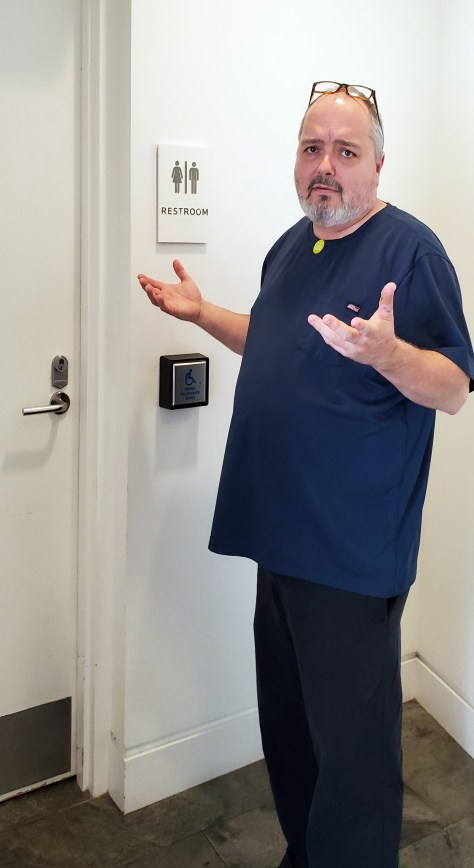
Because I have entered the wrong restroom many more times than I’d care to admit, I present this proof that I’m still an idiot.

My wife and I went to Crystal Bridges with people who’d never seen its mysteries. I worked hard to avoid tripping over the displays or falling on top of babies in strollers. I’m not a great driver and I’m equally prone to stupidity merely walking around. Whether it is symptomatic of Imposter Syndrome or merely an indication of my self-awareness of my own ability to do stupid things, nice venues like the museum sometimes trigger my survival instincts.

I’d rather not be on the nightly news for falling through a famous art display.

It’s going to happen, though. Seriously. I know it is. I’m going to be one of those dolts who walk into a fountain or back up over a railing into the Grand Canyon. Or hit the gas and hurl myself through a store window. It’s a question of when.

I waited a bit too long to use the restroom. The coffee, soda, water, and other beverages I’d downed sat in my gullet like a gallon of water.

I went around the corner and just as I was about to hit the magical “door open” square on the wall, I heard water inside. I froze. Was it one of those segregated restrooms with floor-to-ceiling stalls, or was it a devilish trick? The family restroom was on the opposite side of the vestibule inset, so I knew that I was going to run into some weirdness regardless of my choice. Because of my uncertainty, I stood, immobile, proving my idiocy to the stream of people passing by. My friend took a second to capture my indecision in the picture. My wife finally told me to go inside. I did. Luckily, there were no unprepared victims inside as I entered. Even so, I found myself to be in a huge hurry as if the door was about to burst inward with a swarm of chatting ladies.

My restroom visit was otherwise without surprise.

Yes, I know the emblem on the bathroom door is simple.

The problem? I’m simple, too.

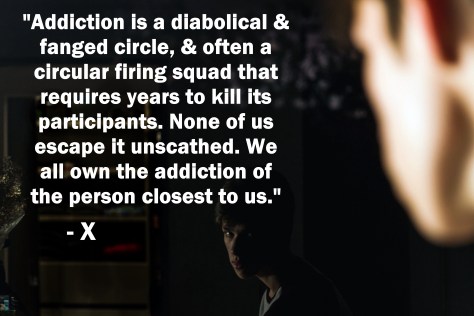
Alcoholic: Episode 1,378

thom-masat-fOKaK7EjydM-unsplash.jpg

Do not read this post if you are easily triggered or don’t want to inhale a topic not customarily laid out in plain view on social media.

Because I’m hoping that one of the people I know will one day get the courage to write a book of the insanity she’s lived with, I’m writing this public service announcement. She will discover that sharing what once was taboo will liberate her. She is not responsible for what happened to her. It’s a lesson I know better than most. You would think my exposure to alcoholics who refuse help would make me callous to the evil they spew into the world. To my surprise, I’m still surprised, though. Alcoholism only thrives in secrecy; everyone who has dealt with addiction knows this. Our most common reaction, though, tends to be protective until it is too late.

Our silence makes us traitors to ourselves on a long enough timeline.

Everyone deserves a chance, a helping hand, and a fresh start. Or two. Or three. Not twenty-three, though. And not at the literal expense of the friends and family around you.

If you’ve ever driven so erratically through a high school parking lot that students use their phones to record you, you’re probably an alcoholic. This is doubly true if you have no children in school, anywhere, especially on a random (and early) Wednesday morning. Triply true if you’re retired. It doesn’t help to throw all your alcoholic beverage containers out the window while you’re being filmed, either. If you top all that off by nearly killing several people, Betty Ford needs to see you. If a group of police comes to your door and you lie to them, even after they show the video that high school teenagers took of you, in your car, as you endangered the lives of several people, you definitely have a drinking problem – and not the kind popularized in the movie “Airplane!” By all means, though, keep lying and insisting that the world is against you. I hope that the students who were endangered upload the video of you careening through the parking area around them to YouTube.

If I sound a bit angry, it’s because I know someone whose career should have made it impossible for him to fight tooth and nail to keep drinking, even after it cost him his career, his health, and the sanity of those around him. His background was similar to mine. His childhood was filled with sociopathic, violent, and angry alcoholics. He continues to get into vehicles to drive, even though he is drunk. As far as anyone knows, he hasn’t killed or injured anyone yet. (Unlike both my parents, who killed and severely maimed people because their love of alcohol made them less than human. Their combined DWI tally is simply too high to be believable.)

As for the person in question, I fought hard to get him the help he needed years ago, even as my sanity slipped. His job protected him from consequences; in part, they are as responsible for his worsening addiction as he is. His career is filled with a markedly high concentration of addicts and alcoholics. Some of the bureaucracy that protected him from consequences suffer from the same addiction. It is ironic that these protectors failed to protect anyone and in fact worsened the addiction by being the ultimate enablers. Not surprisingly, I’ve found this type of concealing behavior to be universal.

I sit and wait for the final word. It will be an inelegant death, and hopefully, one not bordered by the tragedy of others continuing to suffer for his poisonous choices. Since nothing has convinced the addict that he must change, I now hope that those around him pull away and let him find the bottom that he has insisted upon. It’s impossible to swim to shore and save yourself with dead weight on your shoulders. Love both expands and constricts us into choices.

I have no sympathy in my heart for the addict and it is a painful admission. He used his career and his intelligence to assault and beat down anyone who called into question his misbehavior. Literally, anyone.

Recently, I again risked my sanity and tried to convince the alcoholic to get help. He has great insurance, a great retirement plan, and people who have supported him even through years of grievous indignation. He lashed out with some of the angriest, vilest, most personal hatred a human could possibly dish out.

98% of my sympathy lies with the people whose lives this addict has ruined. Their daily struggles, their failed optimism, and hopes, and their inability to live full lives. They are in a holding pattern, waiting for the worst, to testify and witness against a life that is imploding around them. They are victims without an expiration date.

I sit. I wait. I hope that those infected by those with addictions choose freedom over loyalty. Life is too short.

Now, whether you want to or not, you know a little more about me. There’s a good chance that you will recognize people you know in this story. It’s not a new story.
.

No, You Didn’t Get a Cold From Your Flu Shot

matthew-henry-U5rMrSI7Pn4-unsplash


My apologies in advance. Evidently, it’s impossible to get people to stop spreading incorrect information.

Reactions to flu shots are not contagious.

You do not get a communicable cold from the flu shot.

I can’t believe I still need to preach at people about this.

It’s an old and inaccurate wive’s tale that you have a cold because you got a flu shot. You have a cold because you were already exposed to another virus.

If you get a flu shot and exhibit fever, cough, runny nose, or body aches for any length of time, you need to treat the episode as if you have been contaminated with another virus. It didn’t come from the flu shot, and you certainly didn’t get a cold of any magnitude from getting the flu shot*.

It is possible to get a flu shot after being exposed to another virus, one which could be the common cold or any number of a variety of other viruses. You don’t “get” a cold from the flu shot. If you develop a fever, cough, and other more pronounced symptoms that persist, especially with intense symptoms and duration, it’s because you were already exposed to another virus – not because you got the flu shot. Flu vaccines do not contain live viruses. Rather, they contain dead viruses or gene pieces that trigger an immune response.

You don’t get a persistent fever, cough, runny nose, and watery eyes from the flu shot. Some people have mild reactions such as soreness and low-grade fever that dissipates quickly. You do not get a cold from getting a flu shot, just as you can’t get the flu from a flu shot. In blind studies, people who got either salt-water injections or the flu shot, the only differences in symptoms was increased soreness in the arm among people who got the flu shot. There were no differences in terms of other symptoms.

There are many myths about the flu shot.

I would apologize for being so preachy but it’s agonizing to see people fail to take basic precautions when they are infected with viruses unrelated to their flu shot.

It’s exactly how other people get your viruses.

You can ask your doctor, of course. That’s how science works. Knowledge defeats old wive’s tales, no matter whom you hear them from or how long they’ve been passed around.

Fried Chicken Amen

Painnt_Creation_2019-08-18_081335


*I was hesitant to post this. People tend to jump over subtlety and substance by unforgivingly bringing their own observations to things unsaid.

On a recent Wednesday, in a town which can be found in several states across the South, I entered a local eatery to pass a bit of the time away from the blistering reach of the summer sun. I gladly surrendered in the fight against it. I could tell that the little place was a hub for all manner of necessary human activity: gas, small groceries, food, and tobacco. The place was packed with smiling faces, each focused on satisfying their hunger.

I went inside, ordered a bit of deliciousness, and sat down at one of the dozen rectangular white tables scattered on one side of the convenience store. It wasn’t my intention to get another bite to eat. I’d already had lunch across the street. Overcoming the scent of the food filling in the air, however, was impossible for a man of my age and girth. Bacon and butter are my beloved enemies.

I casually watched through the glass as a young mom ignored her little daughter as she strained to reach over into the ice cream case. Her short arm stretched, and her fingers moved like scurrying spiders in their attempt to reach the unattainable buckets of ice cream. Her brother watched from the opposite end of the case, undoubtedly anticipating that she’d either reach the ice cream or fall into it. They were all behind the ice cream case on the employee’s side. The mom looked up and noticed my gaze. Without hesitation, she turned and struck the little girl forcefully on the back. It seemed like an instinctive reaction to her guilt at being observed. The girl shrieked in a small voice, and the mom grabbed her by the nape of the neck. The scream died. I could tell it was a long-rehearsed dance between them. The young mom then looked to her right, toward a stern older woman with a scream of a ponytail at the other register. It turns out that the young mom was an off-duty employee of the store, there to feed her four children. The old lady with the austere ponytail was undoubtedly the young mom’s boss. I later observed the family huddled around one of the tables, each devouring their pieces of chicken as their fingers became increasingly greasy. Watching little kids lick their fingers in deep appreciation is one of the minor joys in life. The little girl didn’t seem to recall being hit like an approaching tennis ball. I silently hoped that the hits weren’t frequent. I could easily see how much the daughter loved her mom. I hoped she could maintain that love as she grew.

Atop the ice cream case was a placard, one of those telling the world that the owners love their god and country, stand for the flag, and for anyone who felt otherwise, they should use the door as quickly as possible. I had a feeling that many visitors of different customs or appearance had seen the placard through the years and winced, many of them understanding that they weren’t welcomed there and were simply tolerated for the purpose of commerce. There’s no nuance in such signs, even if the owners believe there is. It’s the equivalent of a harsh, angry shout; this world needs more whispers and gentle examples of encouragement.

It wasn’t until I noticed the placard that I questioned much of the content of my experience there. My eyes wandered around the store, finding confederate flags in more than one place. Such flags are not a guarantee of other sinister inclinations; their presence, though, tends to accompany such attitudes. People can fly confederate flags and be good people. I’ve learned that the combination seldom proves the exception, leaving those without prejudice to be lumped in and suffer with those who use the symbols as shortcuts for unforgiving opinions. It’s unfortunate and unfair for all of us. Each of us in our own private lives tends to embrace ambiguity and understand that people are a spectrum of conflicting ideas.

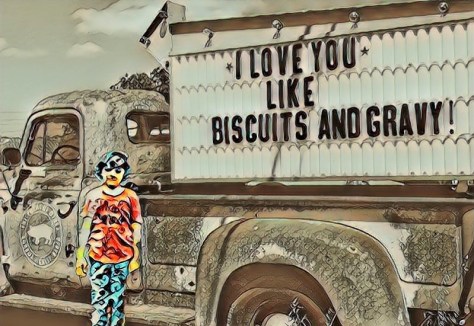
Inside the store, the air was thick with the scent of biscuits, gravy, and fried chicken. While I was inside, there was a constant, impatient line, slowly shuffling forward, and the tables were filled with people, each bubbling with a conversation. Unlike my adopted hometown, there were no faces of other color or snippets of foreign languages. There was no rainbow there and no spectrum of humanity. Once noticed, such absences are hard to unsee. There should have been other faces, though, because despite the small-town population, there were industries and occupations which were comprised of a majority of minorities. I was curious to know where those people enjoyed their lunch. I would describe the mood of everyone as happy and concentrated on their own bit of life.

Because of the recent tragedies, many of the conversations were about guns and violence. I could hear two distinct conversations ridiculing those who wanted things to change. The conversations merged into one, with the participant’s voices rising in volume. We all became involuntary listeners.

At the furthest table, a man in overalls and a plaid shirt leaned back and cocked his head toward the bulk of the tables and said, “Ain’t no one here going to disagree. Not in this town. We love our guns and those who don’t can leave.” Even though I was in a distant place, I laughed, the kind of raucous, loud laugh that makes my wife cringe sometimes. The speaker looked toward me with surprise, probably in an attempt to gauge my allegiance. Externally, I looked like them. Maybe my bright purple laptop case signaled a departure. Nothing else about me raised suspicion that I might differ strikingly from most of them.

The loud-voiced man’s false bravado revealed his temperament, one not accustomed to nuance or differing opinion. It’s a common affliction in places where the realm is small, and the courage to speak up is often swallowed to keep the peace. I doubt he was actually as harsh as the situation implied.

“You think they should take our guns away?” He challenged me. Several people turned their heads to look in my direction. I could see the owner standing next to the food counter, waiting to hear what foolishness would jump from my mouth.

All I could think to say was, “If you drink and can’t stop yourself from driving, you should lose the privilege of driving. But I don’t know who ‘they’ are.”

An older woman wearing a bright red shirt seated with two very young kids said, “That’s right!” as if she were in church and reciting a well-worn and enthusiastic “Amen.”

The original speaker abruptly leaned forward again in his chair as the conversations in the room went momentarily quiet. He wasn’t expecting a response to his oration, especially to encounter disagreement among his own tribe. Each table resumed speaking in subdued voices. I’m confident that several people were wondering how a traitor like me had entered their eating-place without being noticed. Truthfully, it gladdened me a little bit. I couldn’t get the smile of satisfaction off my face. The old lady who had invoked the informal amen smiled back at me and nodded.

Regardless of our individual opinions, each of us continued to eat our delicious food. Differences over guns seldom distract those with fried chicken on their plates.

A little later, I listened as the owner pulled up a chair and sat at a table nearby with one of his customers. He smiled and exuded friendliness. After a few seconds of listening to his conversation, I realized that the smile was a little forced. He had a lot to say about guns and the attitudes recently expressed in his eatery. I tuned him out. It’s unwise to strive to overhear words that you know will only serve to bait you toward a base response. We all vent, sometimes to the point of letting our mouths outrun our honest hearts. I’m afflicted with the tendency too. It would be unwise for me to paint him in a situation where one’s self-defense mechanism might override his ability to express himself honestly.

Not all the signs and symbols for these places are visible. That ideas and differences weren’t welcome somehow pervaded the room, though. The divisive placard on the ice cream case didn’t help much. Each of us loves our lives, our friends, and our families. Most of us appreciate our community. We don’t need code words or exclusion to feel like our lives are full. When I departed the store, I noted vehicles with confederate flags and harsh bumper stickers with rigid, us-vs.-them messages. Strangely, people don’t stop to think that at a certain level, we are all ‘them’ to other people.

The smell of fried chicken and gravy should be a sign of welcome for all those who appreciate a full stomach. Such a thing is a unifier, drawing us to places where each of us brings our differences and yet somehow joins in the spectacle of community.

If I could, I would ask the owners to remove their placard and relics of the confederacy. I’d ask them to instead let their smiles and kind words serve as both example and proof of their living creator flowing through them. The placard and things like it can only serve as whistles of perceived prejudices. Armed with love and fried chicken, it’s difficult to imagine a divided world. We preach our best sermons by example. I think that so many people feel cornered into a defensive position when the world stops seeing that everything is intertwined and complex. Except for love, few ideas worth fighting for can be encapsulated on a bumper sticker, placard, or t-shirt.

It is possible to love your religion and customs while also openly loving other people’s opportunity to do the same. Acknowledging their choices in no way denigrates your ability to live a good life in the way that you see fit. Only when we demand allegiance to our choices does our society suffer.

Let the chicken and gravy be sufficient to unite us.

We live in the United States of America, a place where all of us have an equal voice to be as proud or as ignorant as our own hearts require. There’s room for ignorance and intellect on all sides in this crowded room of togetherness. Let the best argument always prevail, though. Losing respect for the best ideas leads us all away from the truth and fried chicken.

All those in agreement say either “Amen,” or “Fried chicken and gravy.” They both come from the purest of hearts.
.