Celery Is The Cure For Happiness – An Autobiographical Anecdote


img721


The beet chip story from a few days ago forces my hand toward another story. It’s not one which ends with a grand moral observation, though, unless it’s a reminder for everyone to avoid being ‘food stupid,’ as I call it.

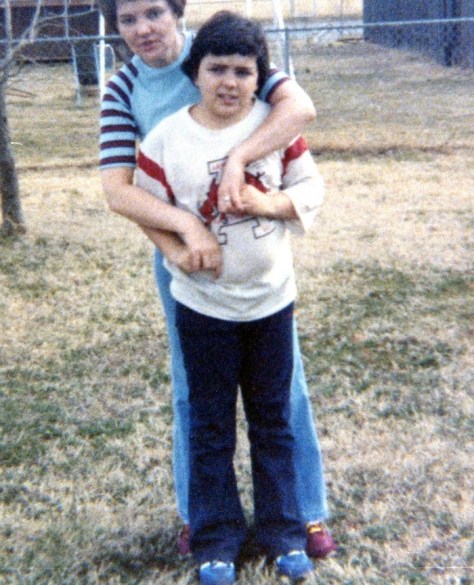
To assist you to better understand my youth, you can observe through the picture that while food scarcity was sometimes a problem for me, starvation was the least of my worries. It wasn’t until the end of my 9th grade year that I managed to break away from my intense infatuation with food. I probably should say ‘temporarily breakup’ given my adulthood. That’s my mom with her arms over my shoulders. She’d been drinking when my Aunt Ardith snapped this picture.

I wish I had been drinking heavily, especially if I had known I’d be writing about the herpes of the vegetable world: raw celery.

I mean no disrespect toward the current food waste programs. Teachers do difficult jobs and those involved in USDA-related food programs emphasize giving students control and also encourage eating what’s taken and taking only what one plans to eat. I went to elementary school 40 years ago, about the time that fire was discovered. What’s true now was definitely not true then.

Today, I listened to a story about food waste in schools. Most of the arguments were well reasoned and supported. They were so proud of the food waste reduction and that kids were now squirreling away leftover food instead of throwing it away at school. I knew immediately that at least one school kid was going to get his revenge on these well-intentioned people as they patted themselves on the back for reducing food waste. We not only don’t learn from history, but we also tend to amplify our egregiousness with even greater folly. I laughed as I imagined that imaginary and gleeful child puking all over the high heels of his well-intentioned teacher.

Thanks to my grandma, I was spoiled by food. Even though her type of cuisine leaned toward the basic, there was nothing as delicious in my mind as elbow macaroni soup, collard and mustard greens, green beans, corn in any form, tomatoes, okra, or potatoes. Unlike my parents, my grandparents were compassionate about food, even though they were children of the Great Depression. Both money and food were always held in high esteem. In my case, they didn’t care what I put on my plate as long as I ate it all. Wasting food was simply not something one could do. On the other hand, they didn’t threaten me for disliking food or force me to eat something for my own good. They weren’t “food stupid” as so many modern people are. They asked me to try everything before deciding whether I liked it or not. And I did, even things such as sardines and salt pork. I never rejected a food without trying it. My grandma knew that overall I was going to get much more than I needed, especially since I was known to eat more vegetables than any other 5 kids combined. I don’t know how harsh grandma was to other grandkids (because I was her favorite) but I do know that she would never have forced me to eat something I clearly indicated I didn’t like. In my defense, it would have never occurred to me to lie to her about it, either. I found out at a young age that I didn’t like beets, which puzzled my grandma.

At home, my parents were tyrants about food. I ate some of the worst, most ill-prepared foods known to man, many times under the guise of not being wasteful. This particular line of logic confused me, given that dollar for dollar, most of their money was spent on alcohol, cigarettes, or replacing broken furniture each time they decided to practice their ever-widening domestic violence reactions. Wherever we lived, most evenings threatened to turn into WWE nights, without referee or ropes. Never mind that because mom chain-smoked her entire life I had never eaten potatoes at home that didn’t look peppered already. Mom also put onions in everything. I mean that literally. I kept expecting to find several peeled onions in her bathwater. Because of dad, mom would often prepare the nastiest meats; large slabs of beef nonsense, barely cooked, smelling of old paper and blood. When she could, mom would buy large volumes of sliced ham, the kind that reminded of what a toilet smells like when seldom flushed. It’s one of the reasons to do this day that I dislike ham, and more so when it is sliced into slivers of hell like deli meat. Mom also made me eat potted meat and Vienna sausages, which as we learned from Karl in “Sling Blade”, is nothing more than brains and beef peckers.

I was content with noodles, soup, or vegetables. I was a simple kid and easily satisfied. Give me a soda, basic food, a book – and stop beating on me, and I could make a good day out it. As I’ve written about before, I also acquired an intense LIKE for over-cooked and burned food.

Even though it seems unlikely, it was because of my parents that I went years without eating much meat voluntarily. I wasn’t sure that meat could be prepared in an appetizing manner, so I’d eat salads, bread, and vegetables – or the tablecloth if it kept me from getting ill or having to force down food better suited to be thrown from a moving car at one’s enemies. Forays to other people’s houses showed me that the food at home versus out in the world were wildly different animals and that I was trapped in a culinary hell from which there would be no escape. It should be noted that no green leafy vegetables, much less lettuce, were kept at my house growing up. It was when I was older and had access to an unlimited amount of salad from a popular eatery in Tontitown and from a distant cousin we lived with that I found a love for lettuce.

Since I grew up in small-town Arkansas, I heard the phrase, “Boy, you don’t know what’s good” with such regularity that it lost all meaning. This phrase was considered to be the height of culinary comparative arguments. On one occasion, my Uncle Harold was chiding me for not wanting to eat any of whatever dead carcass flesh was being offered and proudly yelled, “Boy, you don’t what’s good!” Uncle Harold was one of the good guys, too. My grandma laughed and said, “Harold, why are you sitting there picking on the boy when you know darn well you wouldn’t eat a lot of things growing up?”

As for retaliation, for each gesture of love and kindness from my grandma, my dad would be capable of the most brutal reprisals for not wanting to eat whatever he wanted me to. I took beatings night and day. If I told him I didn’t want fried chicken or a slab of whatever animal carcass of the day he had, I would get hit by a fist, belt, spatula, or item he found nearby. He was like the Wile E. Coyote of food beatings. His creativity toward brutality was endless. To him, eating, especially meat eating was a characteristic of all real men. It incensed him that I had no desire whatsoever to eat what he dictated. Deer, frog legs, snake, gizzards, cow livers, boiled beef tongue, rabbit, and squirrel: all of these were required eating. I hated them all and don’t eat them willingly today. His cruelty expanded to other areas, too. Once, he forced me to try raw forest-gathered mushrooms at my Uncle Buck’s house. They tasted like a deer’s anus. When I started to throw up, he punched me. He then forced more of them into my mouth. Crying, I forced what I could down. He made me agree that I loved them. As soon as possible, I went outside and threw it all up on the next-door neighbor’s side of the house. This same scenario was re-enacted many times in my youth. (I often think I could have painted the house with vomit with sufficient time to do so.)

It is strange looking back, because despite having been in prison and falsely claiming he could eat anything, the truth is that my dad hated a lot of food, especially the healthy stuff. I’m not sure why food granted him such an expansive outlook on cruelty towards me. He never missed a chance, though, and I got it much, much worse than my siblings did. I often daydreamed of sautéing him a skillet full of wild mushrooms and steak – and then bashing him over the head with it.

In school, I learned that people would willingly barter with me, and happily, for my dessert or milk in exchange for whatever concoction of vegetables the school was inflicting on us that day. One of the most common was peas or one of the ten varieties of mixed vegetables that generally got boiled in huge cauldrons on the industrial stoves. Countless times, I would press my tray against that of a schoolmate and swap for something better. At home, I would eat green beans, corn, and tomatoes directly from the can – something I often do even now. While I looked like I traded for desserts, the opposite was usually true.

One day during elementary school, our teacher proudly explained that we would be graded on what we ate. “What fresh hell was this?” I asked myself. I figured there was some kind of error or that all the teachers had lost their minds. Unlike my fellow classmates, my world viewpoint didn’t preclude adults acting as if they had lost their minds at any given moment. At that school, we didn’t choose what we wanted. The school workers plopped, flung and threw whatever the next item was more or less into the segregated concavities of our food trays. There were things I simply couldn’t eat. Make no mistake, unlike most of my schoolmates; I overall REALLY enjoyed school lunches. They simply were miles above the consistency and content of what I could expect at home. Just like at home, I couldn’t always determine what the food was supposed to be. Unlike home, however, I could be reasonably certain it wasn’t poisonous, given the likelihood of dead children all over the concrete block cafeteria if things went terribly awry.

In those days, it was almost impossible to explain to your teachers that you were accustomed to being tortured by your dad if you said you didn’t like something. They didn’t know that if I wet the bed, I’d have stripes across my back and legs for a week if my dad had a hangover or was simply bored. I knew that with time, the school’s ill-advised plan to judge what I chose to eat or didn’t eat would cause a problem.

It was the same week that the food grading system started that I met my lifelong nemesis: Raw Celery. On a dozen previous occasions, I had attempted to eat this abomination without throwing up. I was scoreless against the impulse. It was puzzling, given my love of all things vegetable. If given a choice between licking the under-rim of a bus station bathroom toilet and eating celery, I would unflinchingly opt for the toilet, even if someone was sitting on it at the time. Lest you think I’m exaggerating, I will demonstrate this if ever given the choice between death and celery. If foreign terrorists ever capture me, all they’ll need to do is force me to eat celery in order to get a confession from me.

I don’t remember a lot about the lunch grading starting, honestly, other than dreading it. When I went up to put my tray on the conveyor, the teacher told me to eat my celery or get a reduced grade. As I was fearful of almost all teachers when controversy arose, I told her that I was fine with that. She got mad at me and reversed course. She insisted that I eat it – a reduced grade was no longer at stake. A paddle was in my future. I told her that I would get sick if I tried to eat the celery. She forced me to take a bite anyway and I spit it back out immediately. She let me go, through a clenched jaw. I knew the battle lines were drawn and that just like at home I had no artillery with which to fight back.

A few days later, celery once again made its disgusting appearance on the menu. They must have purchased a truckload of it from the local Satanic Distributor. I traded my celery and dessert for another boy’s mixed vegetables. He ate the celery with glee, as I did his vegetables. Soon enough, the Gestapo teacher doing lunch duty came over and told us we were forbidden to trade food. Therefore, I got another reduced grade, even though I had eaten more vegetables by trading for a serving of mixed vegetables compared to a slice of celery stalk.

How much later it was, I’m not sure, but the day came when celery was once again served. Except another horrific layer was added: they put peanut butter on the stalk. While I was okay with peanut butter, the only thing worse than a celery stalk with peanut butter on it would be if a large diseased bird pooped on it first. The teacher didn’t even wait for my reaction this time. She insisted I eat it, that everyone liked peanut butter and celery. Having forgotten the exact words, I’m sure she ranted off a list of reasons why I was being a little jerk for not wanting to eat the celery. Since I wasn’t getting out alive, she also insisted that I drink my carton of milk, something that I often didn’t touch. However, I held my nose and drank the milk quickly.

“Now eat the celery. You and I both know you are pretending you don’t like it.” The teacher glared at me. Having been shamed and beaten by experts way beyond her level of cruelty, I didn’t really care about getting a paddling. A paddling from someone at school was comparable to a pat on the back from Attila the Hun at home. The teacher, seeing my reluctance, came around next to me, picked up the celery stalk, and put it in my hand, then dragging my hand holding the celery toward my face. I unwillingly took a bite, immediately feeling the urge to vomit. “Keep going. You’ll see it won’t kill you.” The teacher stepped away at the end of the table. I took another bite – and that’s when the universe shifted.

The mix of peanut butter and raw celery triggered something in my mind. It might have been the last time my dad held my face into my plate and forced me to get a mouthful of whatever man-making garbage he wanted me to eat. Whatever it was, it was powerful. From my nose and mouth came a simultaneous torrent of milk and lunch remnants. It went across the table and onto the floor, splashing across to the table on the next aisle of seating. I flooded my plate with it, knocking over my milk carton. I heaved and expelled everything I had eaten for the last 10 meals, or so it seemed. Moreover, I then put my head down into the mess, feeling a massive wave of nausea and dizziness. Keeping my head up wasn’t an option.

This story would be much better if I remembered what sort of shocked reaction the teacher had on her face after seeing me projectile vomit. However, I don’t know. I was too sick.

Another teacher came and helped me to the restroom to clean up. I enjoyed several exceptional teachers. Like so many others growing up, I also had a few who somehow seemed to know that I was an easy victim. My secret shame from my tortured home life must have registered in some instinctive corner of their brains.

We didn’t do lunch grading for very long. I don’t remember why that it ended but I do know that my fantasy is that the teacher who was so intent on being totalitarian in regard to what I ate or didn’t eat was so sickened by my volcanic eruption of vomit that she insisted that the program be abandoned. While I don’t remember exactly which teacher was the mean one, I could figure it out, if I really wanted to. I won’t though because I might be tempted to go to her house with an array or reprehensible food and force her to eat them all, one by one until vomit ejects from her ear canals. I’ll start with beet chips and celery filled with tripe and livers.

She did me one favor, though: unlike so many other foods I grew to like or at least tolerate, raw celery to me is no better than raw sewage – and I’d drink a cup of the latter before I’d ever eat a stalk of celery.


If I every develop super-villain powers just spray me down with raw celery.
Good Thins (The Beet One): Proof of Diabolical Culinary Forces

Image result for Good thins beet

Product Review #13 Nabisco Good Thins Beet Crackers:

I originally posted this review more than a year ago. The trauma of my initial taste test had faded in my memory sufficiently for me to convince myself that a subsequent retry was in order. I’ve now added this mistaken idea of my list of most monumental errors in life.

I saw ads for this item and despite my natural aversion to beets, for some reason, this sounded divine to me. I enjoy weirdly-flavored crackers; it’s like a sadistic eccentricity of mine, like my love of licking 9V batteries, eating burned food, and the smell of tar and creosote. Truthfully, I thought I was going to fall in love with this incarnation of Nabisco’s The Good Thins line.

Many people don’t know that beets are actually goat livers which have been buried secretly by elves. They are second only to raw celery as ‘the food most likely to taste like death.’ Given my overall love of vegetables, it pains me to say that beets are the culinary equivalent of phlegm stuck in the back of one’s throat after a prolonged cold. How I thought Nabisco was capable of disguising the hideousness of beets remains a mystery to me.

I tried a sample of these crackers. After a couple of seconds, I regretted every bad thing I had done in my life – there was no doubt that this product was created with the singular aim of making me repent for my sins. As the product sample lady awaited my reaction with anticipation, I weighed my options: spit the vile concoction onto the floor or wait until projectile vomit pushed it from my mouth. Had a cliff been nearby, I would have thrown myself off of it, if only to rid myself forever of the aftertaste of these beet crackers. I managed to swallow the cracker and was certain that I had just eaten the edible equivalent of an exorcism. After eating this cracker, I fully expected a little Sigourney Weaver alien baby to burst forth from my abdomen.

When I got home, I researched this item on Nabisco’s website. It turns out that Nabisco digs up the goat livers (aka beets) and feeds them to miscreant cows. Once the cow naturally converts them into manure, that is then desiccated and sliced into micro-thin wedges and cooked by the evilest chef in North America. (Probably someone who ‘trained’ at the Culinary Institute of Applebee’s.) Then, they season the dried wedges with the tears of repentant teenagers.

Several reviews on Amazon suggest that this item is either a test product program whose aim is to gauge limits of self-imposed suffering or an attempt to punish vegetarians for their holier-than-thou ways.

Paradoxically, I give this product 5 out of 5 stars, if only to hoodwink you into stupidly attempting to eat this product, too. Please eat a box and let me know whether you need chemo afterward.

P.S. The other flavors of Good Thins are some of best chips/crackers that exist. Other flavors include spinach and herb, sea salt, potato, rice, white cheddar, sweet potato, chipotle tomato, among others. Nutritionally, the other flavors and textures are delicious.


I’m still perplexed that the same company which makes the other flavors is capable of the sadism required to continue manufacturing these beet chips.

A Photo Puzzle Gift and Evening of Espionage

1

My wife Dawn & I have decided that our nascent career in spookery and espionage has already faltered. Just attempting to quickly and efficiently exit the vehicle in an attempt to switch places was almost enough to do us in, never mind the furtive ‘chase’ across multiple lawns or the horrific sight of me as I ‘ran’ to escape being caught ringing a friend’s doorbell and fleeing.

While I scampered away to avoid detection, I imagined a neighbor calling the police and excitedly telling them, “There’s an old man wobbling through the middle of my yard. I think he might have done something he shouldn’t have, like have an extra serving at supper.”

By the way, we know our careers in sneakery are additionally suspect because it would have never occurred to us to attempt such a surprise under the cover of darkness.

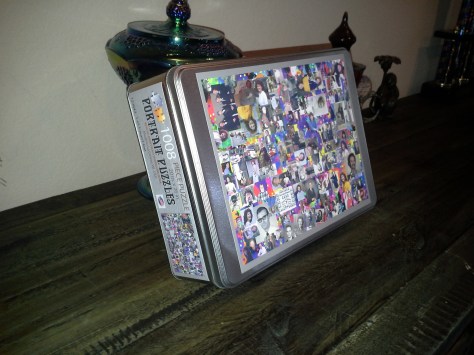
I had spent an inordinate amount of time devising the perfect 1008-piece customized puzzle iteration, using a couple of hundred distinct pictures, and it arrived unexpectedly today. The finished puzzle is 20″ x 26″. It seemed like a moral imperative for us to drive over and surprise our unsuspecting friends with it. I think we had more fun devising our plan than actually being able to say “mission accomplished.”

Portrait Puzzles does astonishingly great work if you find yourself in need of a really, really complicated and personalized puzzle. They’ll customize the tin the puzzle arrives in, too, if you think that it’s advisable that the people intending to assemble the puzzle might need to know what the finished picture might look like.The one I had made will probably cause either partial blindness or intense bouts of spontaneous vomiting. It’s pretty complicated, is my point. At my age, though, getting to the point is more of a goal than a requirement.

Despite my strong desire to remove one piece from the puzzle in the gift tin, I resisted. I think I might have killed someone doing this a few years. How was I supposed to know her chronic OCD would flare up if she spent 22 hours assembling a puzzle only to find that it was missing one critical piece?

The friends getting the puzzle are two of the nicest people one could ever hope to meet. I didn’t get to know them until fairly recently, in part due to their wise aversion to hanging out with people like me. I lived a little of their lives with them, though, all these years later, as they trusted me to digitize thousands of pictures of their lives. It was an honor and I hope they get a little bit of the magic of the lives back as they relive it, piece by piece. I hope they have enough sense to go lie down for a moment if they begin to hallucinate from the effort.

To the residents who live over by Pin Oak, I apologize if you were unlucky enough to peer out your window while I was up to my usual shenanigans in your neck of the woods. I think I lost a shoe in one of your yards. You can keep it, though, to remind yourself that not everyone should run through wet grass or attempt to commit acts of sneakery in broad daylight.

Love, X


test draft.png

A Springdale Morning’s Anecdotes

With the lengthening days, my inability to sleep soundly in the mornings once again dragged me from the bed and out into the morning. I chose to walk a byzantine and unplanned path through the bowels of Springdale’s downtown.

The brightest and most vivid storefront at 4 this morning was that of “Mr. Taco Laco.” I pitied those who would work there later today as the throngs of goofy Americans crowd in, each trying to eat their weight in appreciation of Cinco de Mayo, a dubious excuse to imbibe.

I stopped and admired the neon promise of salvation at the next corner. I was about to snap a photo of it but the inclination passed as I remembered that the worst logo in modern American history was just across the street. As I walked past it, I considered buying a large black sheet to hang over it, one to conceal its hideousness. The Chamber of Commerce is the furthest thing from a comedy club, though, so perhaps I’ll continue to just imagine doing so.

The store near the corner barbershop on Blair Street caught my attention. Despite the hour, its lights were blazing. The mannequins all seemed trapped in mid-step, waiting for me to pass and begin their secret dance. The store was strangely lit, like an aquarium.

As the theme song from “Stranger Things” started, an image of “The Langoliers” came to me. Though I was the sole owner of the morning, I knew that soon the streets would begin to hum with people as they began their days. I think the feeling was amplified by the empty and newly-renovated Tyson hatchery building. Its front was dark and I could see empty tables and chairs awaiting their occupants, each one preoccupied with whatever business they might be engaged in.

As I turned on to Grove Street, I surprised a man standing on the landing of his upper story converted apartment. He was smoking. The converted house he lived at was one I had lived in almost 30 years ago. Knowing the people who would need to live in such a place, I knew that his day was probably not going to be filled with pleasurable pursuits. When I lived on the lower floor of that place, the upstairs neighbor loved blaring “Opposites Attract” by Paula Abdul. He played it a dozen times in a row, day after day. He was one of the meanest and ugliest people I’d met and he certainly didn’t look like a person who would listen to Paula Abdul; his preference, based solely on his looks and personality, should have been a drum track against the backdrop of people screaming. (Not Top 40 material, I would imagine.)

When I passed the creekside behind the Montessori School, the one which began as First Baptist Church and then served as a drug rehab facility for years, the thickening mist on the creek rose to about shoulder height. As I passed the curve behind the fire station, I didn’t see the opossum until my foot was next to him. I did a stupid dance backward and the possum scrambled away. Unfortunately for him, he chose to run forward and was trapped against the black wire fence as it ran up to the underpass of the railroad trestle above it.  I stood for a moment under the train tracks, unable to see where my new friend had hidden.

About 100 feet further along, a skunk was hunkered down on the rise to my left. He didn’t pay me any attention as I whispered, “Here, kitty kitty” to amuse myself. I survived another day without being sprayed by a startled skunk. I’ll tell my wife later that it’s a certainty that I’m going to get sprayed at some point. Walking in the deep dark has its benefits and dangers.

Crossing Johnson Street, I remembered a rainy Friday afternoon long ago when I was driving too fast and failed to stop soon enough at a stop sign. I hit the driver door of a souped-up Honda. The driver had borrowed his roommate’s car without permission and I had rewarded his bravery by hitting him. The owner never filed a claim. The policeman who came to the scene was a little irritated at me. Not because of my excessive speed, but rather due to his dashed hopes. He had spotted what he thought were empty beer cans in the back floorboard. He had excitedly reached for one with an “Aha!” expression about to pass his lips. The cans were non-alcoholic beer cans. I couldn’t help but laugh. And laugh some more. He ticketed me and I didn’t complain because I deserved it. The officer should have received a commendation for not screaming at me as I smiled at his diminished glee of catching me in the act of driving while drinking non-alcoholic beer.

The aura of older homes in the dark streets always appeals to me. The defects are hidden, the owners tucked away in slumber. I pass the houses, seeing only the splendor of the intricate woodwork, covered porches, and elaborate trim inside the living rooms.

The Futility of Caring Less In A Couldn’t Care Less World

language


If someone says, “I should be so lucky!” it implies that they know they’ll never be that lucky. Everyone except those recently hit on the head with a Wile E. Coyote anvil easily recognize the words spoken and the intended meaning. The word for such a phrase is ‘idiom,’ which can be loosely defined as ‘words which have incorporated a meaning not easily evident in the words themselves.’ In other words, an idiom can take on any meaning we ascribe to it, regardless of how divorced it is from logic, lexicon, and lippitude. The more vibrant and involved a culture is, the more likely that the language used has evolved in an infinite trajectory, one more often determined by confused and seemingly incoherent words.

Those most invested in the idea of a stagnant and static language usually tend to be those who incorrectly think they’ve arrived at the imaginary train station marked as “Correct.” They tend to look at a painting and see that the proportion is slightly off rather than observe that a great work of art sees them as well, in part precisely due to its defect. While language’s mechanics might be best understood in the mind of a master, it is on the lips of the young and those dancing around the fringes of normal usage who see to it that it undergoes the transformation which grants our words magic.

Usage, collectively or popularly applied, constantly creates idioms that defy their own origins. Entire books have been written on the subject and a million doctoral candidates have expounded on the folly and futility of language. The well of this subject will never run dry, as most of its underpinnings sit on opinion rather than science. The rules can be any we choose. Regardless of our choices, none of us will ever learn ‘Standard English’ as a means toward poetry or as a dialect born in our infancy.

For me, it is sport to watch educated and well-intentioned people gnash their teeth at one another for esoteric perceptions of correctness. Almost all who do battle on the field of language do so at their own peril. At feud’s end, the language has already expatriated itself to foreign terrain, evolving even in the midst of disagreement. For those who’ve not noticed, I root for the team advocating a dose of anarchy.

Another peculiarity of our language is that we can juxtapose both negative and positive connotations of the same words and phrases, yet mean exactly the same thing. Our language is stuffed with examples, ones which remind us that language is not math and the roadmap toward language in no way follows a logical course. If I shout, “I can’t hardly wait!” you know that I’m full of enthusiasm. On the other hand, if I shout, “I can hardly wait!” I mean exactly the same thing. Both listener and speaker understand the context and content of the contradictory utterances. You can artfully quibble with this specific example but be warned that our language is an arsenal of similarly-defective pairings.

When you snarl your lip and smugly make your assertions, you are not presenting the scholarly front that you anticipate; you’re demonstrating an unwillingness to bend to reality. Language is not math and it certainly isn’t logic. Its consistency lies only in the recognition that it cannot be learned like a finite subject.

We use the word ‘awesome’ without stopping to consider that ‘awful’ also derived from the same root. Usage redefined the intention of the words. I could literally write a list a mile long, one filled with words which have drifted away from their linguistic docks, often to mean the opposite of its cousins.

Having written all the above, I move to one of my most cherished phrases: “I couldn’t care less.” An idiom which reveals the flawed understanding of its detractors more efficiently would be impossible to find. Many an argument has been waged by those using the word in the presence of those who’ve made up their mind about an idiom that means exactly what it is supposed to.

There is no real controversy here, not really. Before this phrase appeared in popular usage, even before its counterpart of “could care less,” people always said, “No one could care less than I.” If said aloud, this phrase sounds as if it had been born in the stilted and feverish imagination of a terrible English writer. It died precisely because of its ridiculousness.

Saying, “I couldn’t care less” in no way conveys confusion, except in the mind of the person who doesn’t understand language, idioms, or the dynamic and evolving presence of our language. If you persist in your insistence that “I couldn’t care less” isn’t correct, you are doing so in contradiction to all evidence to the contrary. You have become contrary yourself.

Language is whatever we decide it is to be.

The sacrosanct of today will soon lie dormant on our lips, replaced by what is to come.

Your objections?

I couldn’t care less.
Love, X

DNA and the Golden State Killer

In regards to the Golden State Killer being identified by using genealogy indexing, this is an area where I have experience. I’ve written so much about privacy over the years that I forget that people have an unusual and mistaken perception of their own privacy. DNA is the universal math of identification. Like our fingerprints, we leave it everywhere we go and transmit it through our intimate family web. To believe that we will one day not have a database of every living person’s DNA is to ignore the pull and push of history. The same arguments against DNA indexing are the same as those once used to push back against fingerprinting.
.
In those cases where I have tracked down missing fathers and absent family members, DNA would have immediately unlocked those doors.
.
I don’t ‘worry’ about my genetic profile being misused because I understand that it is already something out of my control, much like my identity and credit history. Before you accuse me of it, I will agree that I’m decently ignorant about some of the ramifications.
.
DNA unlocks the lies and misconceptions we have about our own family trees and the mechanics of our biology. Genealogy was already sufficiently fascinating for me prior to the DNA component; now, it is ethereal and scientific magic, opening doors and both answering and asking questions about what we think we know.
.
For years, I’ve predicted the scenario such as the Golden State Killer breakthrough.
.
For anyone related to me, you can relax. They already have our entire genetic code. Like with most puzzles, a relatively small sample size of the populace is enough to identify everyone. Even if you don’t ‘choose’ to share your DNA profile, statistically it is almost a meaningless decision on your part. It’s difficult to be able to piece together the math and science of this truth and even more frustrating to find a way to like it if you find yourself in disagreement.
.
The services I used don’t sell or transmit my genetic profile without my consent, which is more than I can say for other companies I’ve dealt with. Most people are unaware just how often they might consent to DNA indexing or sharing, especially when dealing with clinics, hospitals, or insurance companies.
.
When the Facebook hyperbole surfaced, I cringed at people’s over-reactions. Google, for instance, maintains massively larger databases about all of us, yet receives much less press for it. During the data breach at Equifax, most people simply didn’t understand what had happened. It certainly didn’t stop Congress from rewarding Equifax with an exclusive contract with the federal government.
.
Your DNA, like your fingerprints and credit history, is already ‘out there,’ beyond your control.
.
I have several concerns, of course, but know that my personal opinion won’t divert the trends already beyond my reach. Right now, I am grinning a satisfied grin, knowing that what I predicted for years finally happened.

The Great Tortilla Chip Famine of April 26th


My wife Dawn & I have a ritual of eating Mexican food on Thursday, when possible. Since we are eating considerably healthier than what used to be the case, there are times when it feels as if we are at risk of starvation by the time we reach the magical doors of the selected Mexican eatery. Today was such a day. Dawn has lost a lot of weight in the last weeks and I had to make another hole in my belt earlier this week. To say that we were anticipating our trip of culinary indulgence would be an insult to the word “exaggeration.” I was salivating so much on the way to the restaurant that I thought I might need to hang my head out the car window as I drove, much like a large and enthusiastic dog might. I had my extra bottle of Tajin seasoning next to me. (If you don’t know what Tajin is, please accept my words of pity and condolences for you.)

My stomach was not only growling but also filling out complaint cards of protest. A few things to note… We tip exceptionally well. I have tipped over 100% at some Mexican restaurants. If the staff plans just a little, they only need to visit our table once. (When it’s just us two, we never want a refill, for example.) Also, my favorite food in the world is pico de gallo, eaten in bulk and by using the food shovel of a chip to consume it. I constantly tell staff to feel free to charge me for an order of chips and salsa as most of the time the entrees aren’t interesting to me. I’ll order one for appearances but my heart belongs to pico de gallo and chips and salsa.

We’ll forgive any recipe disaster, including eyeballs in our rice or long dark hairs in our cheese sauce, as long as there are sufficient chips and salsa. I’ve been known to keep the wrong food if it’s brought to me or pay the bill even if I’ve been over-charged. Mexican food is that important to my mental well-being.

Today, we went to our ‘go-to’ eatery. In a bizarre twist, it wasn’t busy. It started out great but deteriorated from there. In a nod to those suffering First World Problems, we only had one less-than-full basket of chips. Given the volume of pico de gallo I requested, I hadn’t anticipated such a dramatic turn of events. The precise math necessary to calculate chip-to-pico enjoyment is difficult but it can be best summed up by the words “always over-estimate.”

We hit the bottom of our chip basket well ahead of schedule. Dawn and I exchanged horrified looks, as we had missed our opportunity to beg for a refill when the waitress walked away. As far as I know, she may well now be featured on a milk carton, so quick was her exit and noticeable her subsequent absence. Given the lack of chips, I had no choice except to eat from my actual entree. This is an unconscionable abomination. So disinterested am I in the entree selection that I’ve started almost ordering randomly.

For my selection today, my plate included a ‘chicken enchilada.’ Like the expectation of a loud scream or being startled by some unseen animal or person at the beginning of a horror movie, it did indeed contain that most vile concoction of shredded chicken, the kind that always smells like putrid chicken-in-a-can and looks like what a buzzard might regurgitate to its young. It is a rare thing to find shredded chicken anywhere that I can’t almost see the smell-waves emanating from it. Shredded chicken is too chickeny, in other words.

As we finished our available selection of edible portions on our plates, I noticed that it seemed as if our table must have an invisible solar eclipse above it. No one would look our direction. I stacked our plates on the outer edge of the table, an invitation to the perplexing “let me make room for you” offer that staff inevitably makes, even though the plates are never in fact in our way. No one succumbed to this universal call for retrieval. The plates and utensils remained there, stacked and immobile, adjacent to the forlorn and long-empty chip basket.

“We might as well go. We’re like people wearing Trump hats in here,” I told Dawn.

We both managed to avoid breaking out in tears. Our mouths watered with the mirage of further tortilla chips and salsa.

We drove home in silence, both of our faces locked in somber reflections of the meal that almost was.

Just kidding about that last part. We speculated about every possible scenario for the ‘why’ of The Great Tortilla Chip Famine of April 26th. My best guess is that on a sufficiently long enough timeline, you’ll not only be cheated out of enough chips and salsa, but also have to endure the presence of that vile ‘food’ known as shredded chicken.

P.S. I took my shredded chicken home in a folded napkin as an experiment. I threw it to a pack of wild dogs near the edge of Sonora. The dogs became so enraged at me for putting it anywhere near them that they almost tore my left arm before I could run and dive back into the relative safety of my wife’s Honda. As I drove away, I watched the dogs paw at the ground and bury the remains of that monstrosity known as shredded chicken.

A Rescued Audio Recording from 1994, Pastor James Huffman

This is a recording that pastor James Huffman made with his wife Jean, and his daugthers Jené and Jenise.

They recorded it in Bandy Brownlee’s studio in Virginia in 1994.

James rescued this recording from a copy of a copy of a copy before it was lost forever.

James E. Huffman is pastor of Christ’s Church in Fayetteville, Arkansas.

Christ’s Church Website

Christ’s Church Facebook Page

X