When I moved a little over 2 years ago, I left behind the special oven I bought to make a wild assortment of vegetables. When I devoted myself to losing the equivalent of 12 gallons of weight, I ate bushels of vegetables, each cooked differently with spices.
Yesterday, Erika opened up the beast in me when she deliberately overcooked tomato slices in the oven. I could have devoured 16 tomatoes cooked that way.
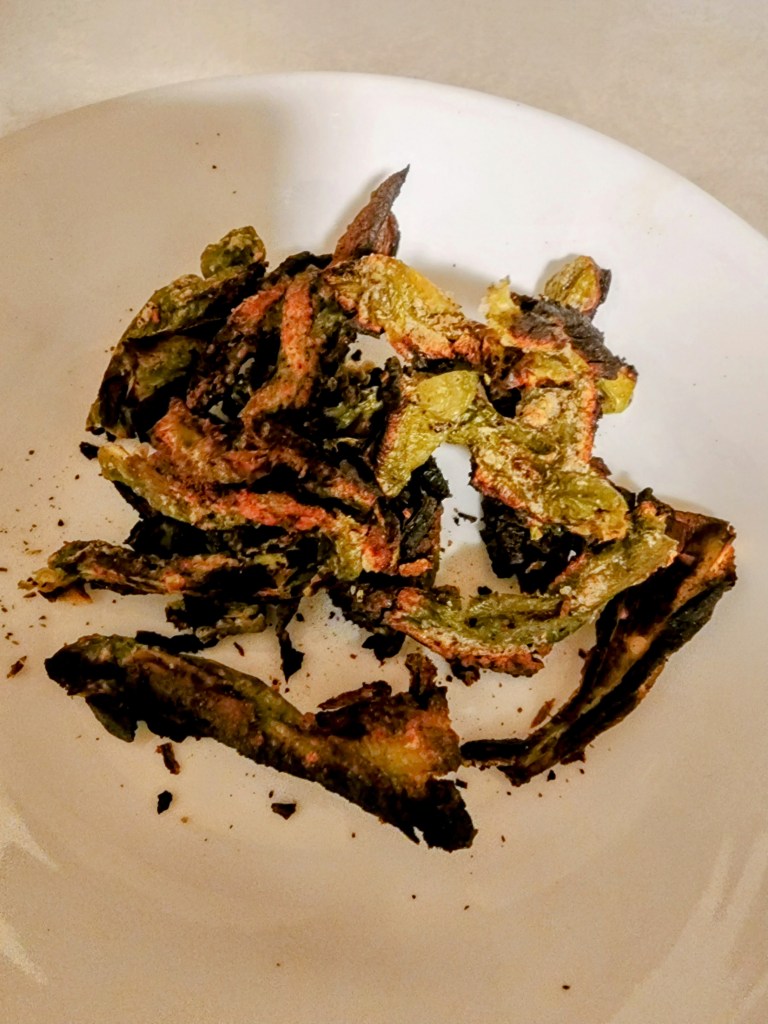
This morning, I cleaned and overbaked a container of Japanese shishoto peppers. I seasoned them with garlic and ranch.
While most people do not like charred flavor, for me it is sublime. And it reminds me of when I was very young and acquired a taste for burned things. One of my favorite jokes is that I loved charred food, while my Mom enjoyed burning our houses down.
If my neighbors below me are awake, it tickles me to wonder what they think I might be cooking before the sun rises. Given the track record of this neighborhood, at least my cooking efforts are culinary rather than chemical.
I have a batch of two differently flavored sliced apples in the oven now. And sugar cane stalk.
It’s no comfort to know this, but if people work to keep you silent, they inadvertently tell you that you have power. Silencing you is an attempt to avoid the consequences of mistreating you or confronting that you’re right about something. (It’s the same in relationships as it is at work.) People without valid points or influence are ignored. People who tell the truth or cause discomfort upset the status quo. Again, it is no consolation. But remember that silencing treatment is a de facto acknowledgment that you’re on the right track. Everything sounds crazy until it becomes the truth. We do not celebrate the people who make us uncomfortable. About our behavior as individuals and certainly not as a group.
While my thoughts aren’t about book banning, the same concept applies. People with the urge to limit content, ideas, and information are admitting that they are afraid of what’s inside. You don’t ban things or ideas that don’t threaten your opinion. It’s usually a nod to the fact that they fully know that much of their opinions and worldview aren’t sustainable under the lens of logic.
No one likes to be wrong.
No one likes having to confront their mistakes.
No one likes being judged for the associations we have: friends, religions, politics, sports, work.
Looking at where we are as people and our lack of focus as a society, the last thing we need is for the outliers to stop pushing our buttons. A therapist once told me that the more we stop hearing criticism, the more in danger we are of being cemented in the past and of playing it safe.
Silencing behavior is the cousin to secrecy. Almost all misbehavior and turmoil derive from secrecy and the lack of transparency. Whether it’s us as a whole or each of us as individuals.
PS I wish it were okay to say, “I think you’re wrong,” without starting a fight. Because we damn well think our friends, family, and coworkers are wrong a LOT. Why isn’t it okay to just admit it? And why can’t we accept this sort of observation for what it is: someone’s opinion. We take everything personally as if we’re surprised that people haven’t had the same lives as us, the same education, the same religion, or the same interpersonal relationships.
On an early Wednesday afternoon not long ago, a couple of miscreants disguised as wannabe drug dealers arrived at the apartment complex. They were vainly searching for one of the hooligans who previously lived below me. They banged on doors and even turned a couple of doorknobs. Their intentions were murderous. I miss the neighbors who once lived below me. Definitely Crystal Methodists and possessing an abnormal interest in homemade chemistry. Not to mention the drug dealer who lived next to me. It’s easier to write crime stories when you can make popcorn and watch it unfold in real-time. Whatever happened to the good old days when drug dealers demanded some sort of decorum? 🙂 One of the duo shouted and threatened me from the parking lot after banging a second time on my door. He promised he would return to give me an ass-kicking. I’m feeling lonely without him darkening my doorway as promised. I had a very creative surprise waiting for him. It might have even made the nightly news. The mugshot would have been glorious! Since the landlords asked me to do so, I uploaded security video of the gentlemen to the police. It was VERY tempting to add clown shoes and hats to the footage. Yes, I am sure that they are actually dangerous. (Not to books, critical thinking, polysyllabic words, or civilized behavior.) I try to remember that even people so devoid of decency have mothers. Mustachioed moms, I’m certain, the kind whose upper lips look like boiled caterpillars. If I sound carefree in my attitude, it’s due to my broken sense of danger. You can thank my Dad for a big part of that. But the reality is that danger blossoms anywhere – and at any time. The allegedly normal-looking folks tend to be as volatile as those whose appearance can best be described as “the before picture.” The ass-kicker didn’t return to my apartment complex. I’m working through the angst of missing his delightful presence. One of the surprises I had waiting was to add the music to “I Believe I Can Fly” to the footage that would have resulted. There are advantages to living on the second floor. His flight off my landing would be short, and without an in-flight meal.
PS I threw the paint can away, the best part of my pre-arranged surprise had either of the hooligans returned.
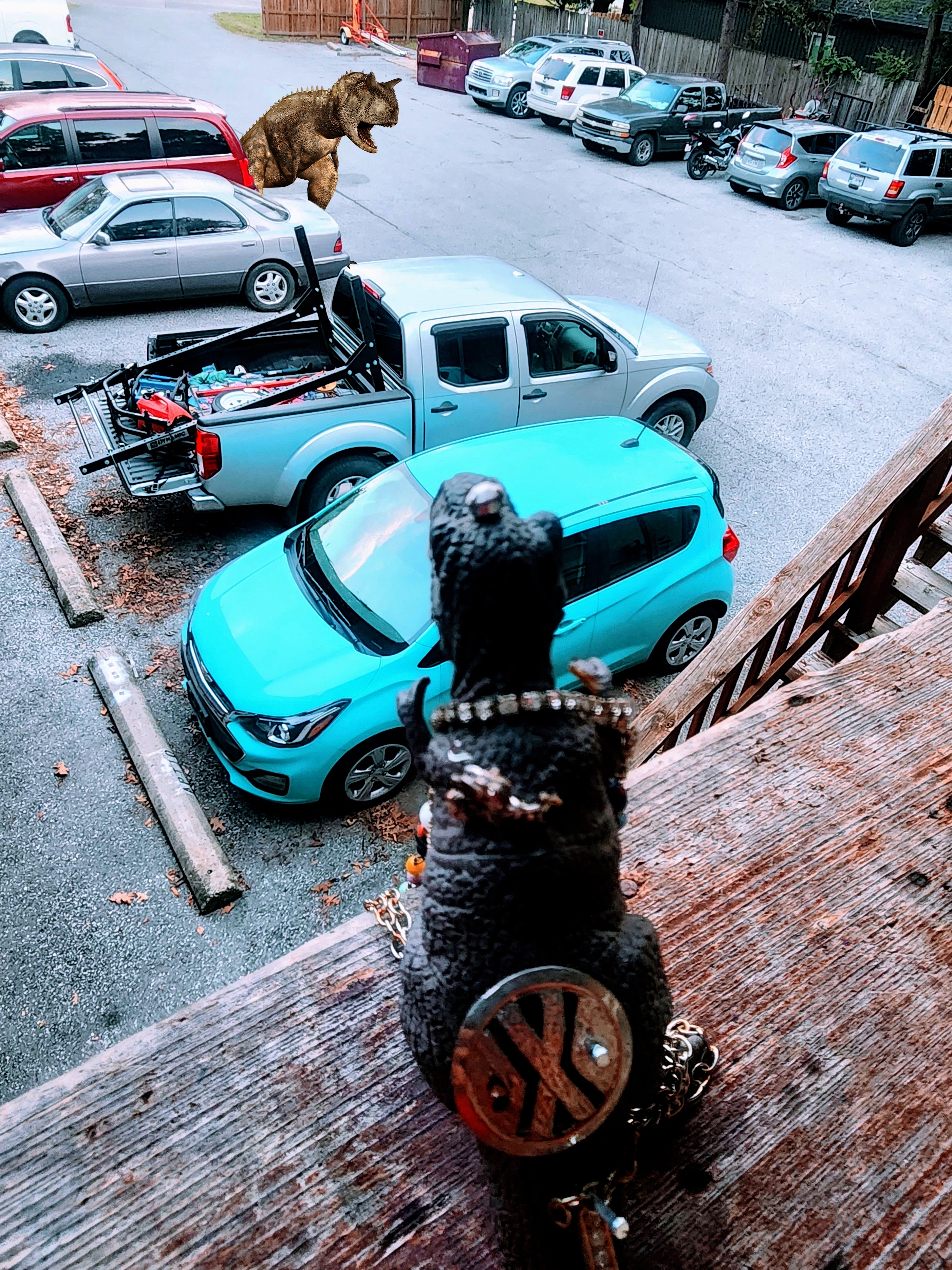
Photographic evidence of tomfoolery. My neighbors, congregated in a late-night, early-morning ongoing celebration… I hope to see or hear the effects of someone coming out and getting entangled in a 6-in wide band of clear tape as they step out onto the dark landing. If I get shot, I had a good life. Love, X .
Prepare yourself for turbulent oversharing. Some wounds get exposed again, revealing dark, unmanageable emotions. These words are supposed to be about addiction, alcoholism, and generational anger. I apologize in advance to anyone who thinks I am saying too much or to inflict pain.
I don’t want “I am so sorry” or any words of encouragement. Instead, I would much prefer that you read these words. And if they ring true for someone in your life, find a way to act before it’s too far down the road to turn back.
People often forget that I became an unwilling expert in abnormal psychology because I lived in an intermittent crucible inhabited by some of the most versed, angry people. For most of my life, I told people I believed my DNA must be infected. Though others couldn’t recognize it, I did. Though I now call it the “Bobby Dean,” the sinister recognition that my family’s maternal and paternal sides gifted me with the lesser side of humanity plagues me.
Like anyone without children, I sometimes mourn the choice to have none. Since life taught me that intelligence has little to do with the odds of giving in to anger and addiction, I remind myself that it’s possible that I would have given in to the lunacy passed down through my family. At fifty-six, if I had treated my children like others, there would have been little choice other than to end myself. I’ve hurt other people callously. But I at least can swallow my ‘what-ifs’ and know that I didn’t hurt my children and continue the generational trauma that populates the world with damaged adults. Ones who carry invisible wounds, anger, self-doubt, and the handicap of attempting to be happy and prosperous, even though they were mentally beaten into submission.
Nothing new happened recently to rip the bandage off. However, I was forced to learn further details of how nasty the effects of this anger and addiction were to people in my family. Because of geography and shared secrecy, it turns out that the imagined and partially confirmed psychopathy passed to the next generation was much worse than I knew.
Alcoholism amplifies monstrous behavior. It might not create it, but it unleashes it. The whisper of the disinhibiting lover in a drunk’s head becomes a shout. The person you once knew gets trapped and silent inside the shell of the alcoholic. As it worsens, the person you once knew becomes a faint echo. The new version will say and do things that increasingly become impossible to live with. You are tethered to the person who once was. As a result, you attempt to deal rationally with the effects of addiction.
Meanwhile, the person possessed by it will do anything to guard their ability to keep drinking. They’ll gaslight you, lash out, and create clusters of people who assume that the version of the truth they are being told is valid. People with no ill feelings toward one another become manipulated pawns, initially acting out of honest concern. But what results is another level of toxic behavior, all hinged on the central person. It is drama and chaos. Because of the secrecy and generated toxicity, people’s relationships get ruined.
One of the most significant pieces of advice I can give people when they are attempting to coexist in an addict’s world is to talk. Talk to everyone. I guarantee that the addict curates everything you do and say to make you a monster because addiction requires secrecy. Intelligent addicts learn the behaviors of narcissists.
People sometimes ask me what makes me so well-versed in narcissism. (Not the generalized version of it prevalent in social media.) Anyone raised or living around addicts inadvertently learns the behaviors. The hallmarks of narcissism always bubble up with addicts and alcoholics. They must deny reality. They become delusional to the effects of their behavior. They enlist everyone and everything to perpetuate their ability to keep drinking.
Recently, I met someone who triggered my “Bobby Dean” response. I knew immediately upon meeting them that they were evil. I hate to use that word. Nothing outwardly about them gave a clue, not directly. The bells went off in my head. I was right about them, of course. And then you’re left with the impossible task of coexisting with them. Such people thrive on chaos and the emotional distress of people around them. Since most people are genuine, they get stuck in a loop of the foolish desire to mitigate the narcissist. It can’t be done.
In the same way, most of us think we can win over an alcoholic with love, words, and compassion. It’s not true. You’re not dealing with a real person until you can slap the bottle out of their hands. They are an angry parody, possessed by a demon demanding nourishment. Replace the word ‘alcohol’ with ‘heroin’ and you’ll realize that until you get rid of the heroin, you can’t move forward. The addict can’t attempt to be themselves and regain their humanity until they eliminate the invisible straightjacket of addiction. Addicts put you in the position of helpless anger. Anger with yourself and anger with them. We each know that a person trapped in addiction isn’t being themselves. But that knowledge does not give us any comfort. We find ourselves screaming. It’s reactionary abuse.
My goal isn’t to tarnish my brother in this post. He was older than me. I loved him and knew early on that he was among the most intelligent people I’d ever known. We survived our parents. He got the worst of it from Dad. Perversely, it turns out he got the worst from Mom, too. As he got older, I tried to give him the benefit of the doubt. Obviously, the anger he’d inherited from our family poisoned him. I thought it must be me, that I was somehow doing or saying things wrong. Toxic people don’t take the time to doubt whether they are wrong. I became the opposite of my brother in so many ways. And he hated being wrong. It was one of his defining behaviors. Because he was so smart, he was seldom wrong. But when he was wrong? He doubled and tripled down on it. From there, he justified saying and doing anything to keep it that way. The alcohol perverted him into someone who could behave and speak in ways that the younger version of himself could not have imagined.
He was particularly vile to me when I changed my name. At that point in his life, he still pretended to carry the torch of family honor. He’d grown up with the Terry side of the family. They were true experts in horrific secrecy. When I changed my name, I wrote them all letters. There was no way to avoid them knowing that I rejected everything my name held within the letters that formed it. They got their revenge when my dad died. Their secret hatred was so intense that they refused even to list me by my legal name in his obituary. That’s the best example of expressed passive-aggressive behavior that I can cite. When I think of self-righteous hypocrisy, I imagine their example. It does not mean I don’t have good memories of them, too! But the older I get, the more I concentrate on knowing they were well aware of what was happening in our violent private lives. They preferred to stay out of it, even though they knew what was happening. Family honor and secrecy held more value than protecting children who were getting damaged right under their noses. It invalidated every religious idea that they allegedly cherished. I can’t imagine doing that. It makes sense that they hid my sister from me for almost fifty years. That she wasn’t white must have been the biggest threat to their false family honor that they could imagine. I would hate myself if I’d become the secret racists that they were. I’d write more about this, but that part of the story isn’t mine to tell.
I made the mistake of attempting to lovingly help my brother a few years before he died. I was all in. It was the worst possible move. He retaliated by lashing at me and everyone around me. He scorched the Earth to keep his addiction. I was rightfully convinced that he might actually kill me. He spent a great deal of time detailing how he would do it. Had he wanted to, he easily could have. Life had geared him up with the tools to do just about anything. Some of the family pretended they couldn’t imagine he was doing and saying those things, even though they could see the emails, listen to the voicemails, and read the texts. Each of them had spent decades enforcing family silence. Why would it be any different with my brother? Had this not happened with my brother, I might not have decided to cut off ties with my Mom not long after. It was just too much. Two of the world’s best alcoholics take a massive toll on a person’s sanity. It struck me how similar they were, each insistent on maintaining their addiction at any cost.
My brother was lucky. Though he left a trail behind him, even professionally, he was forced to retire and avoid the consequences that would have befallen anyone outside law enforcement. I hope anyone he encountered at work didn’t suffer as much as I imagined. People in that stage of alcoholism behave in ways that they never would absent the addiction. It is no secret that law enforcement suffers more from addiction than the general population. (As they do domestic abuse.)
No one was safe. No one ever is around an end-of-run alcoholic.
My brother had the chance to retire and enjoy a full life. To make amends. To admit his transgressions, to replace spiteful words with love and hugs, and to reject the poison of our DNA. He chose otherwise. It’s a story I have witnessed repeated too many times. It is agony for all of us to prefer to tell the good stories and push back the bad ones. Who wouldn’t want to honor the good times? There were many. My brother could have written several of the best books ever written. I would likely have helped him. Anyone and anything can be forgiven if they are open to it. Alcoholism demands everything. It reduces people to their worst common denominator.
A couple of years ago, I scrapped a lot of my shared history and records of my brother. After his death, I thought I could move on and continue to work to remember the good things about him. Some of it was incredible, an irrefutable dissertation on how crazy his addiction made him. He created entire fantasy worlds, each independent of the other, all designed to alienate people and render them unable to interfere with his addiction. Addiction requires secrecy. And as it progresses, it forces the addict to silence those who challenge it. It is exactly like a demon facing exorcism. It will destroy the world in the pursuit of its existence, even if it kills the host.
I write this because the newest revelations force me to confront that he created a world of pain for people. Those people are left with the immense struggle to be good people. It can be done. The first step is to no longer worry about people knowing. Sunlight gives breath. You have to talk about it, acknowledge it, and work to silence the self-doubt that the toxicity of alcoholism demands.
I damn well know that we all have addicts or alcoholics in our lives right now. The cycle is endless. If you think it is manageable, you’re wrong. It will worsen. You’ll look back and understand that if you could return to when it started, you’d do almost anything to stop it.
If you have an addict or alcoholic in your life, whether you think it is true or not, you must start talking to people first. They need to know you are dealing with an addict. You must rob the alcoholic of their secrecy. It is the critical component that precedes every other consequence and behavior.
I can add anger to my reaction recently. Anger can motivate if channeled. If you’re dealing with an addict or alcoholic, I recommend anger as a defense. Let them experience the consequences of what they’ve created. If you do nothing, you’re going to be angry anyway. It might be more effective than compassion.
I’m telling you this as an unwilling expert.
A piece of my heart will always be broken. To discover that people now gone still creates shockwaves in the hearts and minds of those who are still here. It is a recurring wound, and one opened periodically by reminders by those who remind me of myself when I was young.
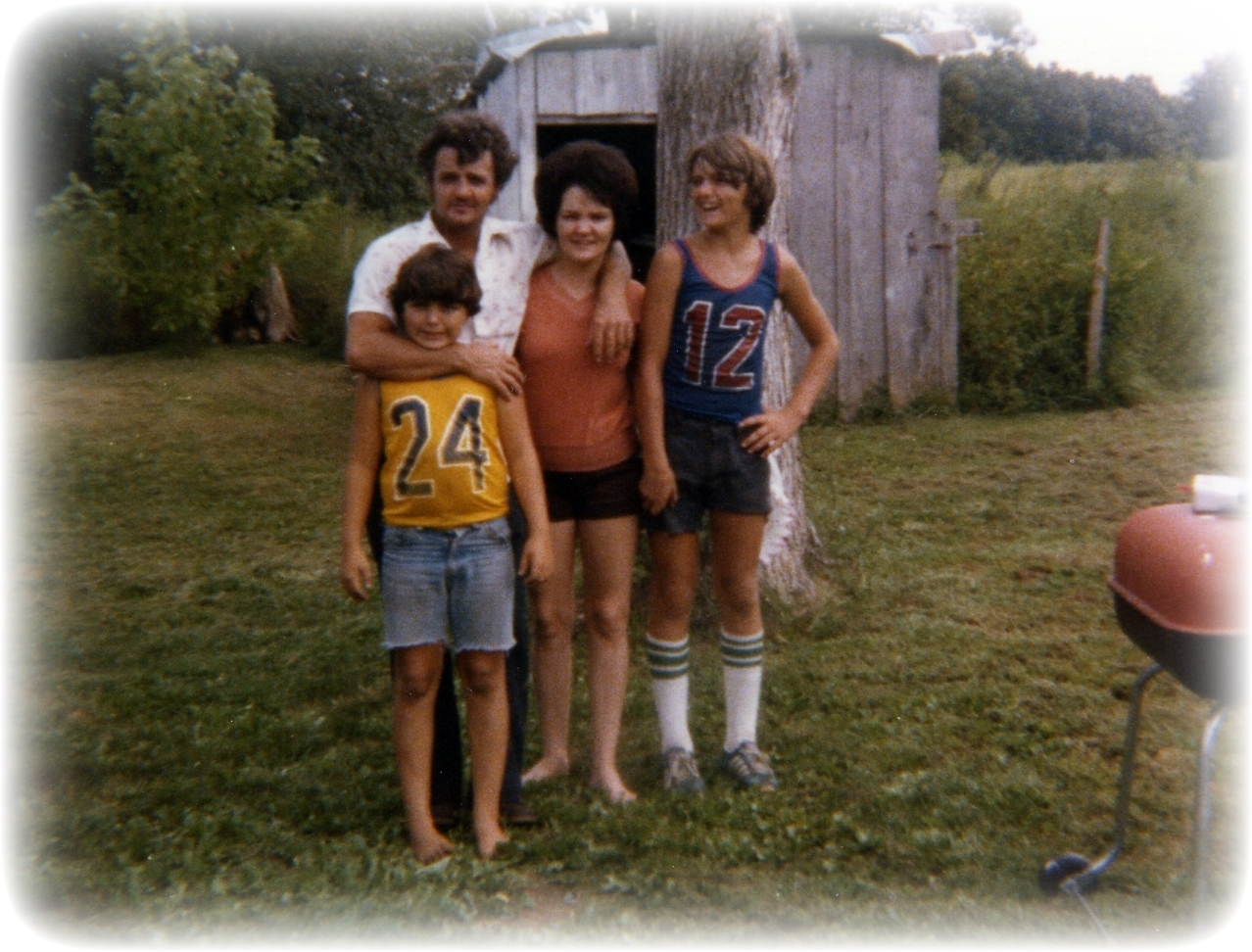
PS Pictures don’t lie. But they do conceal, just as most of us do as we live our daily lives. Just remember, I had many great moments as a kid. And as an adult with my brother. But behind it all…
I’m in the brook, a fancier word for creek. To say that the swiftly moving water feels pleasurable on my toes is a trivialization. I left things undone before I came here. (No matter where you find yourself, that statement will be true.)
I chose the tallest big flat rock I could find to place in the middle of the stream. The objective was to sit down and stretch my legs in the water. The rock weighed at least seventy lbs. But once I picked it up, I was committed. Even as I regretted my decision as my feet slipped on the mossy rocks.
I would worry about the potential for unseen reptiles rapidly approaching beneath the sheen of the water. But I see no need. The risk is small. And certainly less than the unfelt one that unleashed on a Monday afternoon after work almost two years ago. Within hours, a skilled surgeon cut me open, doing his version of an extemporaneous fact-finding mission. I assume it was a skilled surgeon. For all I know, it could have been a housekeeper impersonating a surgeon. I would hope he would have charged me less.
I woke up the next morning. Given that almost 7 million Americans are moving around with brain aneurysms, I won’t hold it against a snake or two if they do what comes naturally to them. Not to mention the lunacy of driving around here with rabid sports aficionados driving amok.
The number of days remaining to comfortably stand in the creek up to my knees is rapidly dwindling. Both because of Autumn’s approach and perhaps my own twilight.
I left the apartment behind this afternoon to go to the creek. Isn’t it amazing how inertia sometimes masquerades as relaxation or obligation? There will always be dust. Trash to take out. And other equally important tasks such as rearranging the utensil drawer.
Yesterday, I thought of myself as on the fringe. At least one hundred interesting things to do or see, yet there I was, esconsed in my tiny little box.
When you find yourself literally dreaming ‘time is short,’ maybe it’s a good time to give inertia a hard kick in the ass.
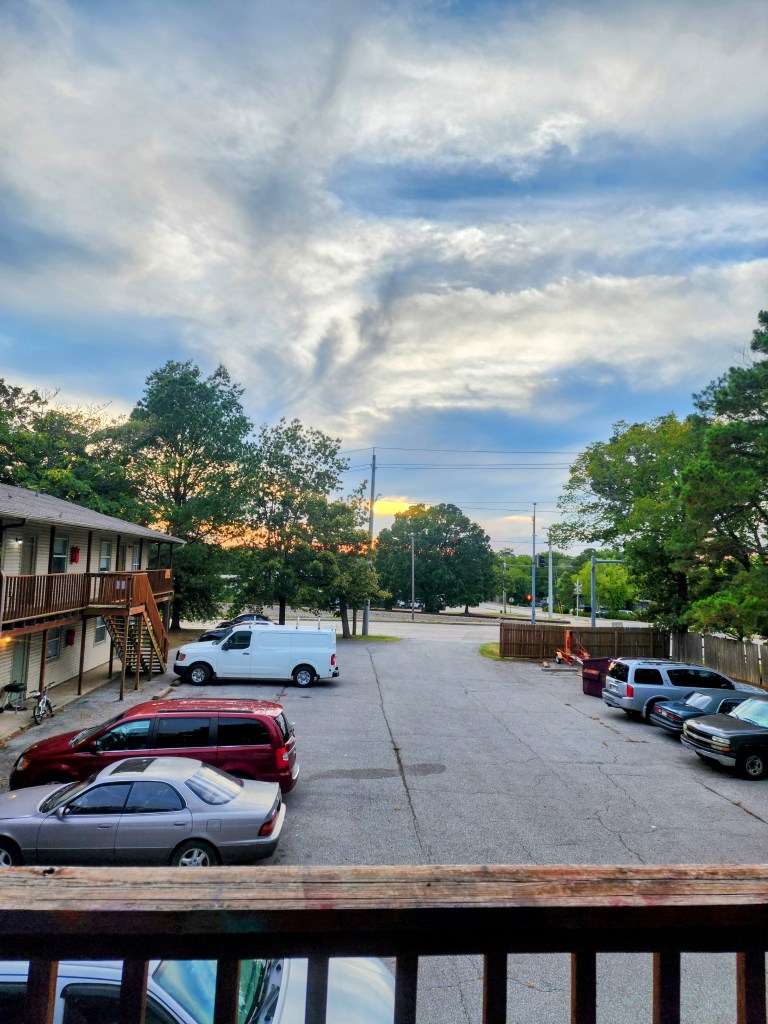
I stood on the landing, capturing the background insect sounds and the lightning above. A solitary skateboarder passed about 50 yards away, the friction of his wheels echoing through the empty streets. Much of the anticipated rain is north. I’m hoping that the creeks will fill. I’ve missed the peacefulness of the cool water. I heard the first scattered and intermittent drops of rain at 3:10 a.m. I hope the clouds open before I head to work. I could really use a September early morning baptism today. X
The September wind blew gently against Stan. He turned, cupping his hand in front of his cigarette as he lit it. The flame created shadows across his arm as it touched the cigarette’s tip. No one would be watching at 12:30 in the morning. The lone exception might see him, but whoever that potential person might be, it was likely their wakefulness stemmed from their own vices. “Nothing good happens after 9,” his grandfather told him at least a hundred times.
The nasty smoking habit allowed him to disappear from work more frequently than his coworkers. As well as to stand around watching without being noticed. Most of his coworkers needed a break more frequently than they enjoyed them. Some of them undoubtedly needed shock therapy. Their nerves were more frayed than a forgotten sailor’s rope. He knew that nicotine inflamed his nervous system. His IQ told him that much.
Stan stood at least ten yards from the back of the shopping center. The canopy of the trees still held its crest of leaves. Anyone exiting the rear door would need to stand for several seconds to even attempt to see a solitary figure standing under the trees against the property’s edge. Stan wore black pants and a grey T-shirt. The clothes blended in with the unmaintained wood fence behind the trees. At this hour, no vehicles park behind the shopping center.
Waiting didn’t bother him. Like most creative people, he could sit for hours, apparently bored. Nothing was further from the truth. Unimaginative people fail to observe the million interdependent moving parts of the people and world around them. Stan’s curse was that he learned human behavior by being raised by his grandfather Quinn. He’d spent a career as a detective and a follow-up career as a private investigator that carried him until the day he died.
At 12:45, the door opened. An average-size male stepped outside. He winced against the ridiculously bright security light bathing the door. It was Sebastian, the person Stan anticipated.
Sebastian froze as Stan spoke.
“Hey, don’t make any sudden moves. It’ll take you longer to swipe your access badge and open the door than it will for me to make you regret it. You can run if you want. I need the exercise.” Stan’s voice carried well in the quiet of the night.
Stan flicked his third cigarette away but didn’t move closer.
“Who are you? Surely you know who operates this business?” Sebastian attempted to make his voice sound confident. He failed.
“Yeah, I know. Big whoop. He’s not here. You’re by yourself.” Stan laughed. Laughing in such situations caused amateurs to become scared and legitimate players to understand when they didn’t have the upper hand.
“We’ll figure out who you are. No one messes around with us.” Sebastian sounded more assertive this time as he spoke.
“Maybe. But you must explain to your boss why you broke the rules and went out alone. And out the back unprotected, no less. I could take your badge and burn down the place.”
There was silence for ten seconds as Sebastian thought about his predicament. “Can I smoke at least?”
“Of course. Just get your cigarettes from your right pocket and avoid going to your left side where you keep your gun, and maybe we’ll both be okay.”
“Damn! Who ARE you?” Sebastian said in surprise. As he spoke, he moved to slowly extricate his pack of cigarettes. Sebastian pulled the lighter from inside the pack and lit one. Though Stan just finished smoking, he craved another one. That was the problem with smoking; the habit needed constant affirmation and practice. Even when recently begun, the habit had a way of taking control.
Sebastian pulled hard on the cigarette as he smoked, one giant gulp after another. “You’re not going to shoot me, that’s for certain, or you’d done it already. What’s your game?”
Stan laughed. “Believe it or not, I want a job, Sebastian. Just a job and nothing more. And I need you to help me get it.”
Sebastian snorted. “A job? You’re joking, right? You hold me up in the middle of the night and then want a job?”
“Yeah. I could rob you, but then you’d have to attempt to hunt me down. Your line of work doesn’t exactly advertise.” Stan grinned, although he knew Sebastian couldn’t see his face.
“You think I’m going to trust you after this?” Sebastian’s confidence grew with each question.
“Yeah, I do. Think of this as my interview. I got the drop on you because you got lazy. You all are convinced that no one knows what you’re doing in the back of the two storefronts you use to camouflage your real business.”
“You’re crazy. I don’t hire people. If you’ve been watching, you know who does.”
Stan laughed and stepped out from underneath the overhanging tree limbs. He continued to walk calmly toward Sebastian. Sebastian threw his cigarette on the ground and ground it out with his right foot.
“Well, now I recognize you. I’ve seen you around.”
Stan continued to grin. “Anonymity isn’t what I’m here for. I’m showing you my face to let you know that you could come for me easily. To give you an edge.”
“You’re definitely crazy. I don’t see a gun. That doesn’t mean you don’t have one. Or an accomplice watching from several vantage points.”
Stan nodded in agreement. He stopped less than ten feet from Sebastian.
“I’m intrigued by your craziness. If I agree to introduce you to my boss, what makes you think he won’t just close your mouth and be done with you.”
“That’s where you come in, Sebastian. Tell him you recruited me without divulging any of the business secrets. I’ll earn my keep.”
Sebastian laughed at the absurdity of being in a holdup-turned-job-application. He finally replied, “Tell you what. Either you’ll end up in a creek somewhere, or we’ll let you know. How’s that?”
“Agreed. You know I work at the rented office space on the opposite side of your storefronts. I’ll be outside smoking a few times a day. If I hear gunshots, I’ll take it as a “no” for my job application.” Stan laughed again.
Sebastian laughed. “You’re cold-blooded or stupid. We could use either one. But it’s not my decision. I’ll let you know.”
“Thanks, Sebastian.” Stan nodded.
“What’s your name? Creepy-AF-Guy won’t work well as a name if I bring you up.” Sebastian relaxed his arms, indicating that he’d decided no one would get shot tonight.
“Stan. Just Stan.”
“Okay, Stan. Please eff off for tonight, would you? I limit myself to one potentially fatal encounter per night.”
They both smiled.
Stan didn’t wait for further interaction. He turned and walked the length of the building. His instincts told me he didn’t need to fear a gunshot in the back. He had struck just the right nerve of surprise and curiosity. Work tomorrow might be another story. He walked to his Honda parked a few rows from where he worked. He drove a couple of miles before pulling into a McDonalds near the main highway. No one followed him.
Stan leaned over, opened the glove compartment, and pushed twice on the upper inside edge. A click sounded as the hidden section opened. He pulled out a modified cell phone and its battery. Clicking the battery into place, he powered the phone on and dialed the number.
“Section four. ID, please.” The voice carried all the enthusiasm of someone reading baseball statistics.
“Six, one, six, four, six. Pink cotton candy ice cream.” He laughed. He was told he could pick any passphrase he wanted.
“Confirmed. Nice password, by the way. Report, please.” Even less enthusiasm. Secret covert government organizations hired nothing but the most boring people to staff the operations that maintained them.
“Contact acquired. Expect secondary contact within twelve hours.”
There was a pause. “First contact already? It’s only been five days.”
“You’re paying me an exorbitant salary that could easily allow me to retire in ninety years. I saw no need to overthink the situation.” Stan smiled, knowing unseen functionaries would later review each word spoken during his call-in report.
“Report in by 1 p.m. Otherwise, the assumption of failure will occur.”
Stan thought those few words were an interesting way to express that he might be dead within those twelve hours.
“See you for supper, then. Out.” He didn’t wait for a response. He removed the battery from the cell phone and returned to its hidden compartment. Lucky for him, the McDonalds was open twenty-hours a day. He went through the drive-thru and ordered a basket of fries with thirty packets of ketchup. He amused himself by attempting to elicit the greatest number of condiments each time he ordered food.
Tomorrow would be a long day. He almost regretted the idea that he would soon leave his cover job, one way or another. If he got shot, at least his burnt-out coworkers would have something to brighten their day. Nothing invigorates office work like tragedy or drama.

 P.S. Parenthetically Speaking