I now understand what Steven Wright meant when he said, “I’m addicted to placebos.”
.
.
True / Dumb Words:”Nothing is on fire, fire is on things.”
.
.
“It can’t be so simple.””What if it is?” – Six Feet Under
.
.
As I turned from the frontage road near the interstate and careened through the roundabout, I saw two small dogs scampering across the road on the expansive asphalt. I then realized it was two very small foxes, scampering. The lead fox had a varmint of some kind clutched between its jaws. As they hit the middle of the parking lot, the lead fox slammed the varmint to the ground. Since there was zero traffic, I stopped and watched as the two foxes danced around their breakfast. I’m not sure why there are so many foxes this year. Their sporadic appearance always brightens my morning. -March 31st
.
.
I’ve had a run of bad luck my whole life. Even my Mom evicted me after nine months.
.
.
I need some new podcasts to not listen to.
.
.
It’s not working! The therapist recommended I go somewhere relaxing and meditative; perhaps go watch the tide for awhile. I’m feeling nothing here. \●/
.
.
My therapist told me to do something memorable to start the day. I guess my “Cymbal Crash In The Morning” idea needs a bit of work. Almost no one reacted joyously. But Jim did throw his coffee cup 34 feet.
.
.
Life can be majestic; I woke up, my face covered in slobber. My beard was so soaked that I started to look around for the German Shepherd that must have been in the room last night, licking my face.
.
.
These last 34 minutes were the best 15-minute break I’ve ever had!*
The anonymous internet sent me this message today:
“When you start advancing, moving toward goals, shit is going to get broken. Things will go wrong because your new behavior will disrupt the status quo and the routine you’ve previously lived. All of that is who you used to be and reality hasn’t caught up to the fact that you’re not going to be that same person. As you change, especially when the results kick in, the disruption will increase. Most of us judge that disruption to mean that we chose the wrong goals or we’ve chosen incorrectly. And then we often go backward. In the aftermath of anything positive, the result always looks like it was inevitable. But while we’re living it, it seems like the disruption (if not chaos) is a sign we’re doing it wrong or doing the wrong thing. All progress, personal or otherwise, makes a mess.”
I foolishly decided to go to one of the home improvement stores after work. I opted to go to the one that isn’t a mission impossible to enter or exit the parking lot. Walking and looking for an item via the “it will magically appear in front of you if you wander long enough” method, I trailed behind a 50-something white male. His mask was in his hand, not that I cared. He had already told someone to “F-off” when they asked him to pull his mask up from his neck. Being the mature citizen that he is, he not only didn’t pull it up but yanked it off defiantly, probably to imaginary applause in his head.
For this story, I’ll call him Randy. He looked like a Randy more than any Randy in the history of the world. If your name is Randy, and you’re reading this, write me off as a jerk in your head.
Coming past the paint aisle, I noted that store employees had reduced the walkway space arbitrarily by placing pallets of things that no one possibly wanted to buy. Randy had one hand on his cart, pushing it. The other arm swung exaggeratedly as he walked; it swung almost cartoonishly. Coming from the other direction, I saw a woman walking with her presumed son. She held his left hand with her right. He was about eight. I am not sure what ethnicity or nationality she was.
Randy saw them approaching and precipitously moved to the wrong side of the walkway. The woman moved over without looking directly up. Randy swung his arm even wider. The mom pulled her son as close to her as she could and slowed. Randy ran into the son with a glancing blow. Instead of addressing her, he sneered, “Get the eff out the way, boy, that’s not how we do it here.” After he passed, I stopped and looked back. The mom pulled her son to her and gave him a quick hug. The hurt look on his face turned to a smile. The mom whispered something to him that I couldn’t understand.
Randy didn’t know it, but he was about to experience a bit of shenanigans, courtesy of me. I followed him to the area by the lights. He left his cart in the middle of the aisle (of course) and went down the shorter lengthwise aisle with the rakes. I grabbed his cart and took off, walking away with it, laughing as I did so. I left it two aisles over and put a bucket in it so that it looked like it belonged to an absent shopper. I returned to the area by the lights and watched. A minute later, Randy popped out of the rake aisle, looking for his cart. He turned in two complete circles. Cursing under his breath, he high-stepped his way through the entrance and grabbed another cart. His movements were angry and ridiculous.
At this point, I should have disengaged and left. That, however, wasn’t possible for me. I casually followed Randy back around the rear of the store. Randy left his cart by electrical and went down the aisle. He could still see the cart had he turned. He didn’t turn, though. Without thinking, I grabbed the cart, wheeled around, raced down six aisles, and left the second cart sitting out of sight. I kept myself from laughing as I walked back toward Randy.
Before I could see Randy, I heard someone shout, “Where is my @#$damned cart?!” He was furious this time. Because I had on my work badge, I turned the corner and politely asked, “Are you okay, sir?” Randy said, “No, @#$damnit, I’m not. I’ve had two carts taken from me in less than five minutes.” Because I was already neck-deep in this one, I offered to get him another cart. “Yeah, do that,” he said. I walked to the front of the store and retrieved another (his third) cart from the entrance, and took it back to him. People often mistake me for a store employee because of the way I dress. Now that I tuck my shirt in, it happens with greater frequency than ever.
Randy put a couple of items in the cart, and without saying “Thank you,” he turned and went the length of the store. I found my adhesive and walked through the outdoor area. It was there I encountered the woman and her son, both of whom were talking to the presumed husband and father of Randy’s victims.
In a flash of inspiration, I knew that my afternoon of tomfoolery wasn’t over. As all of you who know me are aware, I always carry flashcards and a permanent marker on me. They are perfect for notes, reminders, doodling, and all manner of communication.
I stood next to a stack of fans and wrote on one of the flashcards: “I saw what you did. Don’t be a jackass, especially to children. Good day!”
I decided that if I saw Randy in the store again, I would find a way to put the card in his cart. I knew it was a risk.
I walked the length of the store and saw that Randy was still inside. I laughed and tried to convince myself to leave and be satisfied with my efforts to that point. Instead, I walked toward Randy. He stood near the tool aisle, looking fixedly at a power tool. He was about ten feet away from his cart. Since he had placed several items in it, I doubt he was concerned about a THIRD stolen cart.
Before losing my nerve, I placed the flashcard I wrote on face-up in the top portion of his basket, pivoted like a ballerina, and marched away from him at a breakneck pace.
It’s true that I desperately wanted to see his face when he read the flashcard. I’m dumb, but not stupid. I didn’t turn until I was back in the outdoor area. The woman and her family were checking out at the outdoor register. As they left, I paid for my three or four items, laughing.
I sat in my car for ten minutes, hoping to get a glimpse of Randy. He didn’t exit the store while I waited.
While my tomfoolery didn’t improve the world any, I felt immensely better.
Jeff sat near the large bank of windows at the front of the diner. In front of him, he held a cup of coffee between his hands. His eyes followed the passersby as they hurried by him. Few looked inside the diner as they marched past. The glass dissuaded most people from peering too closely if they did glance in his direction.
Jeff tipped well, so the small group of potential waitresses didn’t object to him lingering there until he drank five or six cups of coffee. Only one asked him why he enjoyed people watching there. Jeff smiled. “Watching people gives me an endless number of stories to tell. Each one who passes is his or her own universe, one which I get to populate in whatever way comes to me as my muse.” The waitress in question, Shirley, nodded, probably a little surprised by his unexpected answer. She’d seen a lot in twenty-two years of working at the diner.
This afternoon, Jeff had a couple of interesting stories. One older man who had walked past briefly opened his overcoat, revealing a silver pistol shoved into his waistband. A beautiful middle-aged woman had stopped nearby and surprised Jeff by lighting a cigarette. She dropped several things from her small purse. As she bent to retrieve them, her dress rose up, revealing lovely legs. When she stood back up, she looked directly at Jeff and winked. He winked back and nodded. She laughed and walked out of his view.
As Jeff sipped from his cup, a small blue Honda pulled up. The driver, a small man wearing an expensive suit, exited his car, leaving the driver’s door open. In his right hand, he held a small brick. Before Jeff could notice more details, the man swung the brick on the glass on the window about six feet from where Jeff sat. The glass cracked, making an odd popping sound. The man stepped back three or four paces and hurled the brick at the window. As the brick hit the window, it imploded, sending glass cascading inside.
The five or six customers inside turned their heads toward the window in surprise. The glass didn’t go far. Neither did the brick. It fell across the table in the next booth and then skidded to the floor.
Jeff stared at the man who threw the brick. Behind him, he heard Shirley say, “Damn it, Jim, not again!” The tone of her voice conveyed the accusation that he’d done it before. Shirley walked over to where the brick lay on the floor. She picked it up and threw it back out the window. It went further than Jeff anticipated. The man who threw the brick, presumably Jim, picked up the brick, cocked a finger at Shirley, and laughed. He turned, got into his Honda, and drove away.
Shirley turned to the register, where Jinny stood, a bemused look on her face. “Jinny, call Joe, and tell him Jim broke another window!” Shirley turned to Jeff and said, “Refill, hon?” Jeff nodded, unsure of what he had witnessed.
When Shirley came back over to refill his cup, Jeff exclaimed, “Are you going to tell me what that is all about?”
Shirley said, “Well, you’re always looking for stories. Jim is the brother of Joe who owns this diner. Jim breaks a window every year on March 22nd. So Joe takes the day off every year.” She smiled, knowing that although she answered his question, she hadn’t really.
“Okay…” Jeff stammered. “But why? And if he does it every year, why doesn’t someone stop him? Or warn us? Or close? Or whatever?” Jeff realized he sounded a bit foolish as he asked.
“Joe won’t say. He doesn’t call the police, and he won’t file insurance. It’s a big secret.” Shirley laughed. “Not the answer you expected, was it? Now it’s going to drive you crazy like it does the rest of us.”
“Well, I know where I’m going to be next year on March 22nd, Shirley. Right outside, waiting to ask him.” Jeff smiled, knowing that he would.
“Gotta have something to live for, Jeff. I guess I better clean up some of this glass before Joe gets here.” Shirley walked away, presumably to get a broom.
Jeff finished his cup of coffee and watched people look at the broken window as they walked. Curiosity filled everyone’s eyes as they looked. One younger man looked at Jeff as if to say, “What happened?” Jeff shrugged, pretending he didn’t know.
As Jeff stood up to leave, Joe came through the kitchen and around the long counter. To Jeff’s surprise, he was smiling as he looked at the damage.
Jeff laughed as he left. “Truth is stranger than fiction,” he told himself.
One of my favorite people asked me half-jokingly if “heretoforward” was a word. When she used it, I understood it in context.
My short answer to the question? Yes, because it conveyed meaning.
Is it proper? Who cares?
I added it to my dictionaries to ensure I use it in the future without being reminded of some arbitrary rule.
“Heretofore” is a ‘real’ word. It supposedly means ‘before now,’ or ‘previously.’
If that stupid word is a ‘real’ word, then so too is ‘heretoforward.’ English is stuffed with ridiculous words, thousands of them, most of them orphans.
It reminds me of the word ‘overmorrow,’ which means ‘the day after tomorrow.’ It’s a good word, one that shouldn’t have fallen out of favor. If we’re going to use logic, let’s take a hard look at some of the rules we take for granted, especially those which make it hard for regular people to immediately understand how our language can be used. I didn’t put the word ‘properly’ in that last sentence because ‘proper’ is a unicorn.
Regarding language, I am not a perfectionist and certainly not a purist. I like language that breaks things and evolves rapidly. If you search the ‘language’ or ‘grammar’ tags of my blog, I’ll probably irritate you with my consistent message: language exists in its present form because we politely agree that it does. It really is that simple.
You can accuse me of laziness all you want. Heretoforward, it won’t bother me. I’ll be over here doing whatever I want with the language. I won’t stray too far because I’m not writing “A Clockwork Orange.” The point is to convey meaning. If I can do that while causing the purists’ hair to stand on end, even better.
Since I’m helping someone new learn a bit of Spanish, I find myself reminding her that English is a bastard language and trying to impose its arbitrary rules on other languages is a recipe for disgust.
P.S. Commenting to tell me how stupid I am wastes your time, not mine. Ha!
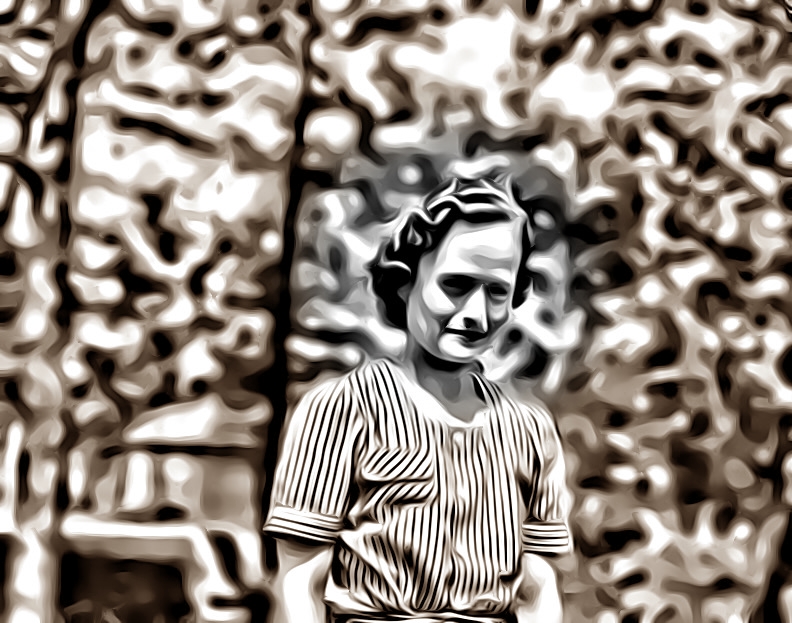
My Grandmother Bea surprised me by picking up the framed photograph from the oak table near the door. “It’s time I shared the story with you, John, if you want to hear it?” she asked, knowing my impatience to know was a decade in the making. “Have some tea with me while I tell you.” I wondered about that photograph at least a dozen times over the years. I called it the “Grandmother Mona Lisa” picture.
As I poured a ridiculous amount of honey into my teacup, Bea added the hot tea, using her prized teapot that resembled a rooster with its head craned.
“I was nineteen when this picture was taken. We lived in a little shotgun house no bigger than this living room. It was all heated by a single stove. We barely scraped by. My Uncle John, who you were probably named after, came by Saturday afternoon to give us a tableful of food. We were glad to have it. John worked at one of the mills, and he also loved cards. Though it killed my Dad to know it, John was good at gambling and often returned from his weekend trips to the Mississippi with cash. He always took time to share the wealth with us and a bit for the church up near Cypress. That church burned in 1961. On that Saturday, he came home with a camera. He won it playing cards. The photographer who foolishly played cards with him gave him to him instead of payment. He also showed John how to use it. It’s no small thing to know that your Uncle Thomas got his first guitar from Uncle John. And that guitar took him to Nashville. He also brought home three cars that way.”
Grandmother Bea was smiling in a way that I’d never seen before. She was joyously reaching back into the bygones, reliving the memories. She held up a finger and said, “Let’s celebrate a little.” She reached to the side of her sitting chair and pulled out a small bottle of whiskey. “You didn’t think I wasn’t able to have a little fun, did you?” She laughed. She poured a bit into her cup of tea and offered me some. I accepted it, shaking my head. Dad taught me that it was discourteous to decline a drink in someone else’s house.
“When Uncle John came to see us that day, he brought along a young man named Henry. Henry came back from the river to get a job at one of the mills. It wasn’t unusual for Uncle John to bring back recruits that he thought would be good workers. He was seldom wrong. I was sitting in the kitchen near the back window so I could catch a breeze. When Henry walked through and nodded his head as an introduction, he said, “Miss, pleased to meet you.” When his eyes met mine, I felt like I had been hit by a bolt of lightning. Henry’s brown eyes and dark hair consumed me. Uncle John walked in behind Henry. He must have seen the look on my face because he laughed. He said, “I remember being young!” Henry and Uncle John went to the backyard to sit in the shade with my Dad. After a few minutes, Mom asked me to take them tea. Even though my hands were shaking, I did. As I poured Henry a glass, his eyes met mine, and I almost dropped the glass. Dad asked me if I was alright. “Yes, sir.” Uncle John laughed and gave Dad one of those mischievous looks.
Grandmother Bea laughed, thinking about it. She gulped her tea and set the cup on the small table in front of us.
“Later, when we had sandwiches for an early supper, Henry and I walked along the dirt road that led to Cypress. I was a bit bashful and was tongue-tied. Henry seemed comfortable just walking and stealing an occasional glance at me. I was nineteen and had never done more than steal a quick peck on the lips. But I wanted to hug him like nobody’s business. When we got back to the house, Uncle John wanted to take our picture together, Henry and me. He kept teasing us. Mom told him it wouldn’t be proper, which seemed ridiculous even then. It was just a picture. So Uncle John had me sit by the front door in the fancy chair. Henry kneeled next to me, slightly out of frame. And right before Uncle Henry snapped the picture, Henry unexpectedly reached for my left hand and held it, his fingers encircling my wrist. You can’t see the blush on my face in the black and white photo, but I was flushed. Uncle John brought me the picture before Christmas, after. He told me it was the most beautiful picture he would ever take and that he would never forget how Henry and I looked at each other after the picture. It was then that I confessed to Uncle John what no one had known at the time: before Henry left with Uncle John that evening, Henry came back to me out on the porch, kneeled on one knee, and told me that he was coming back in two weeks to ask my Dad if he might be able to see me until he could earn enough to get married.”
Grandmother Bea took a sharp breath. I knew she was on the verge of being overwhelmed. I reached for her hand and held her delicate fingers as she continued. I knew whatever was coming was terrible and painted with tears.
“I wanted to tell Mom what Henry had said, but I didn’t want to break the spell. Sunday at church, all I could think about was imagining Henry and I standing at the front of the pews as we accepted our vows. It was young and foolish of me, I know. Monday, Henry started his new job at the mill. I knew he’d learn fast with Uncle John helping him. Wednesday afternoon, about 5:30, I heard a car pull up into the yard. I knew it was Uncle John. It was rare for him to visit during the week. He worked hard, and the hours sometimes wore him down. I looked out the front window and saw Dad walking up to meet Uncle John. After a minute of talking, Dad hugged Uncle John. That was a rare thing, even then. They walked around the house to sit under the big shade tree. Mom took them something to drink. When she came back inside, I couldn’t help but ask questions. “What happened, Mom? Did Uncle John get fired?” Mom looked at me strangely. “No. Nothing like that. The boy that he brought with him Saturday? Henry? He got killed this morning at the mill. A log came out of the sander and hit him in the head, killing him instantly.” I don’t remember much after that, only that I ran out of the house and along the dirt road, probably for a mile. Later, Uncle John’s car came up behind me as I shuffled along, my face covered in tears. He got out and hugged me, that I do remember. He held me as I cried. Eventually, he took me home. Mom didn’t ask me any questions. Uncle John likely told her not to.”
As I sat next to Grandmother Bea, I looked at the picture, taken at the happiest moment of her life, or at least the most bittersweet. Henry would have been my Grandfather except for circumstance.
Grandmother Bea spoke as her eyes pooled with tears. “When Uncle John gave me the picture at Christmas, it almost destroyed me. When I told him that Henry had proposed, he smiled and hugged me. “Y’all would have been spectacular, Bea! Don’t let that freeze up your life. Let time take your hand and lead you away from the pain. It just takes time.” He handed me the picture and told me I would have a great life. He was right. I have. But when my first child was born, I thought of Henry. When Uncle John died, it was Henry’s dark eyes that filled my mind. I don’t need a picture of him to know we would have been happy. You can’t see him in this picture, but his face was filled with a smile so large that I can’t bear to think about it. Now you know my story. I’m telling you the story because I know you will have a lot of heartache in your life. We all do. But if you find love, take it by the hand and smile in kindness and love. If you can do that, life will be a breeze.”
For a full minute, Grandmother Bea and I sat, both of us looking at the picture. Without speaking, both of us stood up as I hugged her, hoping that the power of Uncle John’s touch had passed to me. She pulled away from me, her hands on both of my arms. “Now, let’s have another little bit of whiskey and talk about you.” She smiled. . . . P.S. I didn’t share the photo because I want each of you to imagine Grandmother Bea as she was, much in the same way that each of us can imagine young Henry’s dark eyes and deep smile. One day, as each of us transitions from flesh to memory, it would serve us well to think of them both, precariously making plans, yet filled with life.
Because I’ve been experimenting with prisms, solar lights, and other things, I found these infinity firework bulbs. Simply put, they are beautiful. If you like vivid colors that catch the eye, these LED lights might be worth a look. This one fits a standard bulb socket.
If you search for ‘firework bulbs’ on Amazon, you’ll get a good idea of the variety available. You can also find a huge variety of unobtrusive lamp bases, or make one yourself using a kit.
This afternoon, I waited and sat in the shade of a leafless tree, and read the handwritten copy of Ecclesiastes that Mary Emma transcribed for me some seven years ago. The sky above me was clear, blue, and reminded me that serene as it is, it masks a volatile and unpredictable world. It’s still my favorite book, in part because not even scholars can agree whether it is highly optimistic or pessimistic, coherent or incoherent. It is not a religious text. Each time I read it, I realize that I’ve become a different person and interpret its optimism and pessimism in equal doses.
And I read Mary Emma’s passage from John I that she added: …”the light shines on in darkness, a darkness that did not overcome it.”
I sat in the filtered sun and read. And pondered.
It’s amazing the big circle that life places us in.
All those years ago, when I asked her to write it for me, I could not have imagined the place and time I’d find myself in today. I hope her world has blossomed into a spectacle for her, too. .
He turned to look back at the table. He didn’t remember resolving to leave the note there; he supposed instinct had taken over. The note remained on the table, face up, its small blue script unreadable from several feet away. The tone was etched in his heart. The specific words written there could have been redacted to contain a single word: pitiless.
He resignedly shrugged, turned, pulled up his mask, and exited the restaurant. He’d been callously reminded that life seldom follows one’s expectations and that the cliché regarding risk sometimes had real fangs with which to pierce us. Even when guided by our best and most noble intentions, life sometimes holds no discernible reward. “Intentions don’t change consequences,” he whispered to himself. It had become a mantra for him, as his resolve and confidence dissolved into confusion and hurt.
As he departed, a weight lifted from his body, one he hadn’t realized he still carried. Words hold no power without our minds to empower them. Some words are talismans and should be kept carefully. Or released, along with the power they may hold. The letter was the latter. It might as well have been blood-stained.
He looked up into the light rain as it fell past the awning overhanging the facade of the eatery. The skies were grey, but he didn’t notice. His pace quickened as he crossed the brilliant white crosswalk.
He hadn’t learned any lessons, other than that of his own naiveté. There would be no moral of the story, no exhumed realizations, no voiceover takeaway in his head. Just a series of lurches as things unraveled and as entropy exerted its morbid control over things. Even when a person realizes he’s on the wrong path, he can’t always turn and walk the path back to safety. The road is often invisible, unpassable, or closed. And sometimes lined by savages with rocks aimed at your head, seeking revenge for a crime you’ve already paid for. Sometimes, we throw rocks at ourselves.
“Me,” the note was signed.
Indeed.
It was a fitting last word of communication between them.
For all the reasons.
Somewhere, perhaps in a day, week, or month, he knew he’d look up and find himself again. The autopsy of moments would conclude. From time to time he might wonder what it all had meant. As time’s fog rolled in, the question would lose focus and recede into history.
Time is the kindest revisionist, giving us space to maneuver our heads around our stumbles, fumbles, and falls.
We learn our lessons in reverse. And sometimes, there is no new lesson, other than accepting that life is going to throw inside curveballs with surprising frequency, no matter who you are or the choices you’ve made.
He laughed as he neared his car. It wasn’t exactly true, that part of learning no lesson. He pulled out the notes shoved in his jacket pocket. There they were: “Don’t be a dumbass,” and “Choose your hard.” He hadn’t worked out the formula for which might take predominance in his life but he knew that both would mold his choices as he moved forward.
It occurred to him that he should tattoo the ‘dumbass’ one on his arm as a constant reminder – and then he wondered if the temptation to do just that was an affirmation that it wouldn’t stop him from continuing to be one.
He would do nothing, and that would be perfect.
Time would have to wash over him and hopefully remove the detritus of dumbassery from his shoulders.
And if not, life always moves forward, carrying us into unseen corridors.
Periodically, I take the time to write about writing.
The safest writing rule is: “Don’t.”
Everyone who writes struggles to avoid deliberately hurting people when they write. Most writers incorporate bits and bites, if not from whole cloth, from their lives. Good people don’t intentionally stab at others if it can be avoided. Good people also take a breath and consider that they might be filtering the words in a way that’s unintended.
I write stories that combine disparate elements of life. There have been times when I’ve written a story that is one hundred percent fiction and still had people criticize me for ‘stealing their stories.’ In others, I hide the truth in plain sight, as is the case with the stolen baby story, or the one about the vengeful abused girl who grew up to exact her revenge. People share a lot of secrets with me. I am grateful and don’t set out to repay that sharing by hurting them.
It is possible that people will personalize some of the writing. This happens even when their story wasn’t in my head when I wrote it.
That’s part of the reason I remind people to stop raising their hands if they think I’m talking about them.
Chances are, I am not.
Either way, raising your hand or objecting instantly removes the doubt as to whether my writing applies to you. Or more succinctly, that you think it does. (It becomes self-identification.)
While everything that happens to me is fair game for me to write about, anyone who reads what I write should easily see that I am judicious in my restraint and especially so for current shenanigans and goings-on. Time always morphs our initial reactions. We need time to process events; though the immediate ‘take’ we have gives us insight, so too does the passage of time.
I could be fearless and accountable to no one and spew out a wildly true and interesting blog. But it would also result in needless anger, harm, and hurt feelings. That similarity to shouting in anger does have its payoffs – but the consequences to the payoffs are invariably bad and reveals our lesser selves. I fail sometimes to take enough time to consider. Don’t we all? I try not to. But it is critical to understand that we all own our own stories.
So, if you read my blog, you’re going to have to trust that what I post is well-considered, even if ridiculous.
I would write a list of recent “I thought he was talking about” stories, but there are too many.
To be absolutely clear: it is possible that I’m being an asshole and that it isn’t your imagination. If that is communicated to me, I will probably rectify the confusion or applicability. Contrary to what many people think, being an obtuse asshole does not pay off in the long run. Or conversely, I could tell the story in its unvarnished form.
Hey, I’m not perfect. Just give me some leeway here, okay?