Category Archives: Opinion

Congress: One House

papaioannou-kostas-tysecUm5HJA-unsplash


The Senate of the U.S. Congress is an antiquated and inequitable system that we should abolish. When I learned how Congress worked, I was surprised. It’s a self-evident charade. The Senate and the Electoral College both deserve abolition. The man who served longer in Congress than any other agrees with me.

“One man, one vote” and all arising corollaries support the argument that 100 senators, 2 per state, bears no direct relation to our prevailing general concept of democracy. Its existence arose out of a need to give a nod toward states rights during the formation of our country. Senators were chosen by state leaders with the intent of protecting the state and its interests – not the citizens. It no way arose out of a need to serve us equally. The necessities present during our country’s founding are no longer current; our adherence to such a system no longer helps us. The Great Compromise has compromised this generation’s ability to determine our own trajectory.

As for the Founder’s intent, I’m not particularly interested. The same Founders had some strange ideas about humanity. I owe them no allegiance simply because they preceded me. Each generation deserves the same ability to determine its course. That the Founders declared war to achieve their determination holds no more weight than our current right to choose our governance.

More simply put: the Senate represents geography, no people. There’s no way around it. It’s an alien concept to a modern person. To have legislation passed by the House and then refused a vote by the Senate is unacceptable. The United States is no longer a confederation of states: it is a robust and unbreakable body. In a sense, the Senate is an untouchable example of gerrymandering because states with fewer people, economy, and interests have an undue voice. Though it may paint me as a radical, I’d much prefer that the federal government have a majority voice in every instance over that of my state. Either we are a republic or we aren’t. We can’t be both fervent nationalists and states-rights advocates simultaneously.

“The existence of the Senate helps keep majorities from other areas having a larger say in our government,” some might say. No kidding? The Senate as it exists today already deprives me of representation, in part because I live life as a progressive trapped in a Southern state. I’m not sure how majorities in other parts of the country hampering my right to representation are worse than having closer parties do so. My state does not deserve a greater share of the decision-making process simply because that’s the way it’s always been done.

I’m not making my argument based on the current composition of the House. I believe the same even when the other party controls the body. Because my progressive voice is already lost in a Southern state, I don’t unduly fear the probability of party disparity. This is doubly true if we ever manage to eliminate gerrymandering of districts at the state level. I predict that we won’t, at least not for a generation, barring political revolution. If you’re going to attempt to weaken my argument, you’re going to need to choose another argument other than current political makeup of the House.

The Senate is a sanctimonious relic which needs to be dismembered. Any institution formed with any intent to protect slavery is suspect at best and ongoing fraud at worst. That a state with 40 million people has the same number of senators as one with less than a million is a travesty of just representation. I loathe the idea that we are so anchored to the past, one which is problematic at best. Due to rules in the Senate, filibusters give groups without a majority the ability to prevent votes on issues, withhold the right of appointments, and overall lessen people’s collective voice.

Rare is the Senator who feels humbled and privileged to serve as an elected employee of the people. Most tend to demonstrate a disengaged superiority and fail to understand that they are simply employees we’ve chosen to represent us.

The majority of Americans now live in 9 states and therefore have only 18 out of 100 Senate seats. Senators representing 5% of the total population can prevent any significant changes to the government due to arcane rules in place. Most people simply don’t understand how the Senate itself contributes to many of the problems which plague our government. As the population grows, so too does the issue with the Senate, precisely because the largest concentrations of people tend to lose a disproportionate share of their representation. California has more population than the combined smallest 20 states, yet has the same number of Senators.

Having a congress of one body, divided by population, would be a much better method of representation. All duties and powers currently exercised by the Senate can and should be distributed among our Representatives. Elections would be simpler, our legal process would be more flexible, and the idea that a Senator is of elevated status would disappear. Most people claim they want a simpler government. Eliminating one house of Congress goes a long way toward that goal. All the arguments I’ve in resistance to my opinion can be lumped under the heading, “We’ve always done it that way,” or “It would require effort.”

Factoring in the discord between the two houses of Congress, and it’s difficult to argue that one serves as a check on the other. Given the power of the executive branch, it’s essential that all the duties currently falling to the Senate should be based on genuine representative democracy, with the population being the primary determinate of deliberations, rather than artificially created power in the hands of Senators who do not proportionately reflect the will of the people. I’m not approaching this issue as a liberal or conservative; my main focus is proportional voice and power.

I would also lengthen the terms of Representatives from 2 to 4 years, with a term limit of 1 term. All representatives would be up for election every 4 years. All members would receive a salary equalling three times the current minimum wage, with no benefit after their terms of service are finished, other than their wages contributed to our social safety net, like any other citizen. I would also reduce the number of representatives in the proposed Singular House to 250. Yes, I realize that this lessens the hold some states have on power. Under a representative democracy, that’s the way it should be.

Smarter people have written about this subject. The more I’ve witnessed and learned, the stronger my belief that our bicameral system is a farce. I think states would do well to implement a one-house system as well. It’s time.

While I realize that such a move is practically impossible, I wonder whether we’ll address the disparity before political chaos envelopes us as a nation.

P.S. If you think that individual states could rescind their agreement to be a part of the federal government, I suggest you return to your bunker.

Privilege, Improvement, Hypocrisy

brandon-wentland-VYLrXrI-Rwk-unsplash


Now that enough time has elapsed, I can post this. A former resident of Springdale had taken considerable pains to challenge a bit of civic improvement. He has a family member still living in Springdale. After investigating the details, I agreed that the city had awkwardly presented its plan. Most of the intended change, however, greatly benefited the city as a whole. Unfortunately for my friend, the improvements would slightly infringe on the previous way of life a bit.

This is just me talking without an appeal for my words to set in stone or to be taken as words of certainty. They are in their totality a walk through some of the thoughts which come to mind when I read or hear words other people have spoken.  I don’t have all the answers, but I do have many questions.

First, appeals to the past are strange to me because the people making them inevitably and arbitrarily choose a specific time amenable to their own arguments, rather than the broader scope of history.

At risk of being ostracized from polite company again, I cringe when I see someone say, “My family has owned that land since…” as a defense against change or incursion. I can only imagine what those who preceded them might think about such a narrow view of ownership. The European arrival, for example, dislocated and eradicated millions of indigenous people. Also, this world is predicated on the illusion of permanence, even though we are floating on gigantic and active tectonic plates, swirling in a complicated vastness which will one day extinguish itself.

Yes, I know that we didn’t personally participate in the distant past; we just benefit from it. I’m not immune to being tone deaf myself. It’s strange to see other people failing to realize they also are making errors of both logic and consistency.

One of the people criticizing the previous Springdale resident for jumping into the discussion harshly framed the argument: a rich, white outsider using the process to thwart what the majority saw as a benefit for the community. He used more profane words, but the message was striking.

Springdale is the 4th-largest city in Arkansas. For several reasons, there have been significant changes which have moved it away from its parochial past. The people who’ve stepped up to make the changes have overall done a spectacular job of managing resources, finances, and issues. Yes, I have problems with the way some of it has been done, but it is the price I pay for being a part of a living and thriving community. Change is constant. At my age, I’m not supposed to be enthusiastic about the march forward. It’s supposed to be my job to be reluctant. I disagree, though. We’re moving forward, and it’s as much on me as the rest of the community to take the long view.

It’s also odd to see people who fight change because it impacts them disproportionately. It’s difficult to accept change, despite enjoying the fruits and benefits of the community. By belonging to a city, you agree to a compromise of interests. If your property is affected or impacted, you can at least take solace in the fact that you will have a chance at fair compensation – a chance the indigenous people who lived here before were never afforded.

Those fighting against change for self-interest rarely see themselves in the way I’m describing – or realize that they are fighting the tide of time and impermanence.

New roads, street widening, public amenities, parks, rezoning, public condemnation proceedings, expansion- all of these are presented as improvements, for the common good. All of them happen because communities or their leaders have decided that things must change.

Yes, sometimes boneheaded decisions are made, precisely because human beings are involved. In those cases, it’s wise to use the processes in place to cause absolute hell. Absent those circumstances, though, it is an argument from privilege to rail against the public interest, generally speaking. Poor people don’t generally get to make such arguments.

P.S. I realize that there’s hypocrisy in my argument. That’s part of the point.


This Is The World’s Best Post

tina-dawson-b_X4aBtHndE-unsplash.jpg


“The World’s Best” anything is nonsensical.

If you look closely, you’ll see that the woman in the picture is eating raw meat. On the table, she has a cut tomato, black licorice, and maynnaise. On the further counter, there’s a fruitcake and plate of sushi. Chances are, one of those things gives you the urge to hurl your lunch.

It seems like a good cliché for a headline or when used as an easy marketing hook. When I see it, though, I wince. In the past, I was blasted by a critic who screamed at me for using the cliché, as well the one comparing anything to crack. I pointed out that criticizing me was acknowledging that my opinion held value. (Because who goes out of their way to attack a meaningless opinion?)

Tastes vary wildly. One man’s poison is another man’s passion. Perversely, some people love eating or ingesting actual poison – and I’m not referring to people who enjoy eating at Hardee’s.

Whether it’s raisins, black licorice, mayonnaise, fruitcake, whiskey, celery, beets, meats cooked rare, meats cooked well-done, eggs over easy, or dried crickets, there is no universal standard for food.

When I was growing up, a lot of Southerners would foolishly say, “You don’t know what’s good!” They’d smack their lips in condemnation at my refusal to eat some of the things they identified as ‘food.’ Some of these same people loved eating raw hamburger meat, spoonfuls of Crisco or lard, and half-cooked chicken gizzards, usually as they cooked over their stoves with a cigarette dangling from their lips. They also invariably had a tub of warm mayonnaise always open and sitting on the counter.

“The World’s Best” is a meaningless title, much in the same way all awards based on subjective taste are without foundation.

I like bitter, smoky coffee. My wife hates it. I like burned, dry food of all kinds, unlike literally everyone else. Hash browns? Burned. (But I do love standard hash browns too.) Some people hate shaved parmesan because it smells like foot odor. A ripe tomato is like a mouthful of phlegm for some and a delicacy for others. Milk, which is literally nutrition for only baby cows, gives many people the urge to vomit.

The two words, “I like,” are the critical component. If you like it, it’s good.

X’s Food Opinion Edict states: “All food is opinion.”

We can overlap on taste, of course, but it’s a rarity to find any two people whose opinion regarding taste is congruent.

Stop pretending that a universal standard for taste exists.

Like Buddy the Elf, he thought he’d found the world’s best cup of coffee, simply because the sign outside said so.

On the other hand, this is the world’s best post, right?

There Are No Small Deaths

miguel-bruna-655204-unsplash.jpg

This post is in defense of those who have connections with other people we don’t understand. As I hope we’ve all experienced, it’s possible to meet a person and ‘get’ them, as if we are estranged best friends. Some of these bonds are stronger than those of family. It’s possible to feel closer to one’s fourth cousin than one’s grandmother. Bit players in our lives often morph into the main actors. By living in reverse, we don’t see their importance until they’ve stepped out and away from our lives.

Only the person experiencing the feelings of loss at a person’s passing knows to what depth those feelings reach. Tendrils of connection are often invisible, incomprehensible, and unknowable. It’s important that we abandon the false expectation that we understand the loss someone else is processing.

There are no small deaths.

Even with my best arsenal of words and passion, I sometimes struggle to describe the nuances of another person and their importance accurately. That’s the best-case scenario even when I’m communicating with someone who shares a great deal of humanity. It’s a fool’s errand with those who lack a common understanding.

When a person commits suicide, it’s human to question all your choices, as well as your attention to the person who has left us. Even without the shadow of self-harm, we tend to experience a depth of introspection when we lose someone.

Whether it’s fair or not, suicide strikes us an accusation. We have to give space to those who need more time to find first gear again. Implying that the loss isn’t a reason to grieve is an unacceptable reaction.

Because of the invisibility of many of these connections, one of the most traitorous acts you can do is to doubt or question whether the relationship was real when another person is suffering from the unexpected rupture and loss. “Did you know him or her very well?” or “Were you ‘friend’ friends?” both serve to undermine and accentuate the pain of the other human being you’re inadvertently demeaning.

“Only the spoon knows what is stirring in the pot” is one of my favorite clichés precisely because it reminds me that I’m not privy to all the information contained in a situation or between people. I’ve committed the error of assuming I know. Worse, I’ve judged people based on what I perceive as only imagined depth. Because I’m human and stupid at times, I fear that I’ll do it again.

A typical example of callousness is when someone says, “It was only a dog” in reaction to someone’s disabling sorrow at losing a pet. Such shallow and meaningless comments only serve to highlight the accuser’s fractured self. We should feel compassion for them, as they’ve been deprived of a pleasure in life that they’ll never understand. It was indeed ‘only’ a dog. The greater truth is that a human being had a deep love for that dog. You’re not demeaning the dog; instead, you’re demeaning another human being’s choices and authentic feelings. From the right perspective, such an attitude is monstrous.

Likewise, when people are involved, the callous person can’t know the person they doubt shared a bond with you. The connection isn’t measurable. We can’t see the swell of your heart or the yearning you wish upon the Earth to have this person inhabit your space again. Grief makes even the best of people uncomfortable. As you learn with age, it also unhinges people who have no foundation to come to terms with the helpless sorrow they see from other people.

Perhaps the person who passed once took a moment and literally reached out to let you know that you were seen, measured, and appreciated. Whether you were indeed at your rock bottom, their outstretched hand and openness pulled you out of the abyss. These moments create a bond that’s difficult to inventory – and treasured forever. Because these moments are often private and held close, those left behind are often the only witness to their measure.

As people die, it’s important to remember that grief is terrible, personal, and unknowable. Each time we’re the one experiencing the loss, if we are lucky, we suddenly remember the lesson of connection.

Time, with its caress and embrace, imperceptibly diminishes our pain, even as it prepares us for the next dark surprise.
.
.
*…written for someone struggling with friends who don’t understand the loss…
.

X’s Humor Relativity Perspective

11122005november (11)222

This post is going to hit you over the head. It’s personal and genuine. Weirdly enough, it’s about humor. If you read it to the end, the turn it takes will probably bother you, much like a Twilight Zone episode using electric shocks as language.

More than ever, I find myself in awe with people who appoint themselves as gatekeepers for humor and appropriateness. Personally, I can’t get my foot out of my mouth long enough to start gatekeeping other people’s humor.

Eventually, everyone’s sense of humor will land them in hot water with friends, in-laws, pastors, politicians, the Girl Scouts, and strangers. You can’t control another person’s reaction. My sense of humor is darker than average. It’s a claim I make from truth rather than an idle part of my story. If someone is not addressing me or a person specifically, I interpret it differently than I do other humor.

Two weeks ago, I wrote a new rule named “Hanlon’s Disposable Razor.” It preaches that we all stop assuming we know the intent of humor, especially if from someone who generally isn’t guilty of malicious behavior – and no actual harm results from it. The term ‘actual harm’ is subject to context, as is every single human experience, so don’t start quibbling over semantics or issues unaddressed by this post.

Since then, my social media filled with examples of people failing to realize that they can’t read the minds or hearts of others. “Well, that’s not funny!” seems to be taken as a blanket justification for anger in response to something that someone finds a bit uncomfortable. Adam Sandler’s last ten movies weren’t funny, either, but plenty of people disagree. “You can’t joke about some things,” is another typical gatekeeping statement. It’s rare that the person making such a statement has a smile on his or her face when they say it. Or matching socks, now that I think about it.

I’m not advocating that we run willy-nilly over people’s feelings under the guise of humor. Quite the opposite. Likewise, 7-8 billion people surround you, all with differing takes on life. It’s impossible to avoid all possible topics of contention. Elevating all humor to the level of spiteful is a fool’s errand. As you know, nincompoops are always employed.

Mother’s Day, April Fools’ Day pranks, Avengers spoilers (as if the movie wasn’t terrible enough), euthanasia, illness, falling and breaking one’s arm: all of these can be funny in the right context. They are not amusing to the people currently embroiled in any pain associated with the topics, however. Humor is universally told from the point of view of an imaginary third person. We don’t laugh or joke with the intent of hurting anyone. Not if we’re reasonable, I mean. If we accidentally say or do something without realizing that it’s causing specific pain, it’s not a reason to lash out in righteous anger. Mistakes are going to happen. Compounding the innocent error with anger serves no one.

On two occasions since I posted my new rule, people attacked me for not showing the required gravitas to an issue or for the sin of laughing at a horrible post even as I cringed that someone had posted it. I did what any reasonable person would do: I printed a picture of that person’s face, laminated it, and taped it to a urinal at the bus station. (That last comment was humorous. FYI.)

Now, I’m going to get personal and provide an example that will erase any doubt that all of us sometimes pull back from humor that we find to be misplaced. The difference is that I avoid objections to ‘third person’ humor, generalized humor, or humor that references shared experiences. I have to be personal because it’s not only the only way I know how to write but because it strikes directly to the point I’m making.

The humor we allow ourselves and in others is a direct measure of our depth and appreciation for our error-prone lives.

It is not the content per se that brings problems; instead, it is the motivation of the person creating the humor. Most people don’t require much study. We’re stupid more than we are malignant.

There’s a popular meme of a white cat near a woman lying dead on the floor. It’s comprised of three panels, each with the cat approaching the deceased woman, meowing for attention at her side, and finally, sitting on her hip. “Your cat’s reaction to finding you dead on the floor,” or something similar usually serves as title or footnote to the pictures.

There’s a problem with the meme if you look at it from the vantage point of unintended humor. What many people don’t know is that cats tend to stay near the body of their deceased owner, exactly as pictured in the meme. Many people have their own stories relating to this tendency.

As thick-skinned as I am, if you don’t know this about me, I was in the exact situation pictured. My wife died late one Sunday night, the night before Labor Day, years ago. She lay in another room for hours before I woke up for work. Our white cat, Quito, stayed with her for most of the night. I found him with her the next morning when I went into the kitchen.

Now, imagine the pain that came from that situation.

It’s such a specific scenario that it seems unlikely that it would ever be the subject of one particular meme.

However, it is.

It’s not a general observation or bit of humor: it describes precisely one of the most significant traumas I’ve experienced in my entire life.

The meme or ones similar to it come up on my social media and the internet with a higher frequency than you’d imagine. It’s not ever going to be likely that anyone posts such content with the intent of trying to barb me.

I could, of course, lash out at people, as if they are responsible for my biography. I could casually mention my past, which would needlessly traumatize the person sharing the meme as a joke.

Alternatively, I could get a sharp jab and then move along.

In general, take the short jab and then move along. Not always, of course, because sometimes people do misbehave and troll their fellow human beings with ill intent.

But not most of the time. Move along.

If I can overlook a cat meme accidentally mocking this substantial trauma in my life, you can overlook jokes about pregnancy on April Fools’ Day, funny anecdotes about cancer, or insensitive humor scattered throughout your social media.

It is not an invalidation of your perspective or feelings for others to joke at the heart or fringes of subjects which overlap with your life’s discomforts, losses, or challenges unless it’s done with malice aforethought or callousness. I hope you don’t have many people in your life that would subject you to such behavior.

I’d rather live in a world in which I sometimes cringe at humor than to reside in one devoid of the richness of human creativity and whimsy.

I ask that you strive to assume that my humor isn’t personalized or weaponized to offend, which is a favor I’ll reciprocate. If there’s doubt, we owe it to one another to further give the benefit of goodwill unless the preponderance of evidence tells us that someone is speaking or acting out of spite.

When someone lashes out at me for a badly-timed or placed joke, I’ll repay their impatience and impoliteness with a reminder that I probably have the upper hand in this argument.

Do unto others – and I certainly do. I welcome all humor, from tripping down the stairs to jokes that would cause many to burst out in tears.

P.S. If you heard 1/50th the nonsense that goes through my head or that I say in private, your head would explode indignantly. The truth is, though, that we both know that you undoubtedly have at least a portion of my dark bent in your own head. That overlap is what gives us hope.

Also, I’m in the picture on this post three different times.

.

A Polite Lesson: Losing in 2020

image


Donald Trump is likely to be elected again in 2020.

I’m not going to vote for him. Because I live in Arkansas, my vote is irrelevant.

I voted against him twice in 2016: once in the Republican primary and again in the general election. I’m not a Democrat, but I am a liberal. I did more than most liberals to try to stop Trump, as many Democrats took a detour to argue over Bernie and Hillary. I’ll be surprised if they avoid the same mistake this time. The best is indeed the enemy of the good and some voters can’t stop fixating on irrelevant differences.

“Any functioning adult” was already my candidate against Trump.

Most people don’t like Trump but many will vote for him again despite his critical flaws. They believe he’ll advance an economy or agenda that’s favorable to them. Liberals watch in awe as Evangelicals defend and embrace Trump. It’s obvious that most people know that Trump is no man of faith and probably doesn’t care about most of the issues. As a politician, however, he has outmaneuvered almost everyone at every step. Trump’s polling numbers aren’t great, to be sure, but the economy is in his corner. He’s like the crappy job we endure because it pays the bills. We talk about leaving, but everyone knows we’re full of it. The Evangelicals will eventually face the consequences of endorsing a candidate and person like Trump – but it won’t be anytime soon. Movements which start at the extreme implode. (Take note, Democrats.)

A great number of Americans can’t watch the news, can’t talk to their friends and neighbors, and cringe at the idea that Trump has any position of authority. Worse, a trend that I’ve called the Polite Politics Pandemic has infected the minds of most of his detractors. People avoid any mention of politics or life issues on their social media, their conversations, and in general. They mistakenly believe that doing so makes their lives more manageable.

They’re wrong.

Just as it has done in other democracies, silence creates a false impression among your circle that you are either afraid of your opinion and the consequences of expressing it, don’t care, or secretly endorse the things that cause your silence. Over time, we find ourselves watching the boulder tumble faster and faster downhill.

Silence, even politeness with a goal of civility, works in favor of Trump.

Whatever your opinion, it is equally obvious that most Americans will overlook Trump’s onerous flaws and endorse him again. Like the last election, many of those voters will be Democrats.

Trump changed the nature of the Republican party and politics in general. Such a person comes along once a generation. Those who are politely silent are counting on their fellow Americans to push him out. The 2016 election taught us that it’s a fool’s wish to expect others to do the expected thing. If you don’t stand up and stand out now, you’re part of the problem. If you can’t find it in yourself to opine now, during a once-in-a-generation aberration, you never will.

Liberals should note that many of their friends and neighbors who once proudly shouted their enthusiasm for Trump have grown silent. Trump’s continued onslaught of profane and outlandish antics has cooled their support. The moderate in most of us eventually finds us again. Expecting most of them to violate their interests and not vote for him again, however, is lunacy. They’ll turn out in the next election whether you do or not.

I’m guilty of confusing a vote for Trump as an endorsement for some of his cruel policies. I can’t separate his policies and his endorsement. Many voters can, though, and we’re going to need a better way to frame it.

Incumbency and a strong economy invariably favor the candidate for re-election. Arguing about whether he’s qualified or a good person misses the point; it’s irrelevant. Politics has lost its facade. Qualifications will now invariably yield to tribalism and charisma.

Trump does not hold the blame for exploiting the election system or for our system of governance which assumed that rationality and normalcy would be prevailing standards. Some have shouted and barked so often that it’s impossible to alarm the bystanders sufficiently to believe that there is a real problem. I’m not asking anyone to snarl and fight; rather, I’m asking that you start by reminding everyone, even those who only passively see your influence, that the Trump America isn’t one you like.

We can do it without screaming. Screaming won’t work, anyway. If a few people get angry at you for simply enumerating your objections to a Trump America, it’s likely that those people don’t align with you or your life, anyway. Good people don’t banish other good people from their lives for honest expression; they banish them in fear of having to confront their own insecurities.

So many put their hope in the Mueller Repor. The biggest problem was its lack of transparency and immediacy. Simply put, such things must be developed quickly and openly. Whether it’s supposed to work that way sidesteps the fact that our democracy no longer finds value in the laborious process of law. Democrats lost the fight and bystanders mostly think it’s because there wasn’t enough meat on the bone. The average voter dislikes corruption, but most expect politics and politicians to be a little dirty. We’re not going to find a smoking gun in the last election unless someone releases footage of Trump killing someone with his bare hands. Anything less is a distraction.

Policy is not going to sway the middle in the 2020 election. Immigration is not an issue that will work for Democrats. Forget decorum, forget the small annoyances of a particular candidate, and stop shouting. Unless a charismatic third-party candidate enters the race late, the only Democrat who could possibly beat Trump will be the one who is standing in the middle with just enough charisma and intellect to know better than to offend voters who are mostly otherwise detached from politics. Stop focusing on how it ought to be and instead focus on the system that we’re left with.

Trump won’t win by much. Thanks to the electoral college and the tribal nature of national races, he won’t have to. If your family and friends don’t know that you dislike Trump and won’t vote for him, let them know. Don’t try to aggressively change their minds. If your life isn’t a shining example, you’re not going to change anyone’s minds. People will only stop to think about you or your opinion if something about your opinion and life speaks to them in a way that Trump’s charisma cannot.

On a personal note, I learned a hard lesson from FiveThirtyEight in 2016. As the interference of the last election became apparent, I learned more lessons from Facebook and the power of social media, watching in wonder as we discovered that they had been used effectively to sway opinion. I worked hard to embrace the lessons. My vote is almost irrelevant compared to the reach of anonymous and effective opinion. I’ve used it, especially in the last year.

Even if we miraculously get a new president in the next election, we now know that chaos and entropy are the wolves which will always be at the door. Trump or his surrogate is inevitably planning his next move.

Stay silent if you will.

Barring a major disruption, Trump will be elected again in 2020.

Silence will cost you more than your reputation.


A Conversation With Crazy

333333333333.jpg

I recently became acquainted with a gentleman who is one of those unexpected hybrids of pleasant, upbeat, and batshot crazy. He’s older and has wide exposure to the world. Superficially, he’s likable. You’d never know that his cheese slid off his cracker.

There’s one problem: he is certain that all forms of cancer are nothing more than a state of mind. “If you think it, you’ll be it.” I waited until he had uttered a version of the sentiment twice before directly inquiring. I know a couple of anti-vaxxers, flat-earthers, and chiropractic enthusiasts, so I’m used to weirdos.

I asked him, of course, if anyone very close to him had died of cancer – or if he had been to a hospice care facility. “No,” was the obvious answer. Since we get along well, I also told him that a great swath of humanity would think he’s crazy and that many would accuse him of being heartless. He’s otherwise very smart and I find myself aligning with his general outlook, at least the one that’s perceptible through regular conversation.

I’d go so far to say that regardless of one’s pleasantness when talking to him about these things, he takes logical insistence as proof that the person contradicting him is a negative person. He’ll even double-down on his thesis and claim that almost all disease is subject to the same self-causation.

Initially, I had great hopes I’d become better-acquainted with him.

As a bona fide nutjob myself, I can tolerate a huge quantity of asininity. I’m an expert at fool impersonation. It’s a herculean task to overcome the idea that someone harbors beliefs that can’t be approached with logic, conversation, or science.

Or, more importantly, the knowledge that it’s sometimes wise to keep one’s foolish ideas to oneself. Yes, I realize that I’m a hypocrite like everyone else.

“The moon is made of cheese.” Why not?

My fundamental problem is that there is a chasm of difference between walking around with a chicken wrapped around one’s neck and denying basic science.

My new acquaintance is the Michael G. Scott of my life: entertaining but absent most self-awareness.

He reminds me of a co-worker from back at my days at a meat processor; that man was convinced that eating one’s own nasal nuggets and taking a sip of your own urine was great for you. We called him the English equivalent of “Snot-eater.” (Thankfully, we didn’t do potluck dinners back then.) I thought he was fairly nuts until I discovered an entire trove of people who believed that the Sun orbits the Earth. People think the Flat-Earthers are dumb; I wish they could have entertained themselves with the lunacy of those who angrily contradicted sense and science so violently.

My new acquaintance is good training for me.

I know that people believe a lot of nonsense.

I guess I forgot.

This will help prepare me for the next election.

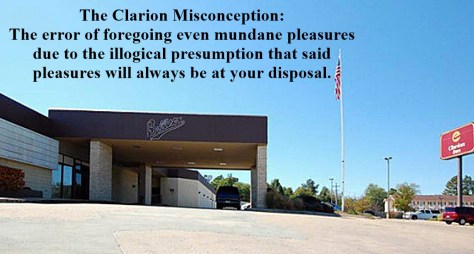
The Clarion Misconception

the clarion misconception

For anyone who never had the pleasure of the holiday buffets at the now-defunct Clarion Inn in Fayetteville, you’ll have to pick another such activity or place to visualize. It’s possible I’m too nostalgic. Something about the holiday buffets evoked a feeling of kinship and holiday in me that few things ever did. I was always surprised by the mix of people who would show up and join in.

The buffet was fabulous, whether you were a light eater, a healthy eater, or someone who could best be described as a “human disposal.”

I didn’t get to return “one last time,” mostly because of factors out of my control.

Over time, I wrote a few rules to keep in mind as I hear/see people forego simple things in life, as if they themselves will not be scattered dust on a day much sooner than most of us expect.

The Clarion Misconception
The error of foregoing even mundane pleasures due to the illogical
presumption that said pleasures will always be at your disposal.

The Clarion Misconception Addendum:
Giving primary consideration to other’s preferences due to perceived proximity to death or variable out of your control.

The Clarion Certainty: Future moments are all promissory notes without guarantee.

The Clarion Kinship Observation: Familial or societal expectations should be evaluated against all variables, with your own voice given equal vote.

The Clarion Selfishness Observation: Compromise in all things will get you far; giving yourself permission to not do so will sometimes make your life happier.