
The Whippersnapper Observation
As we age, the probability of forgetting how stupidly we behaved as young people increases in direct proportion to how angrily we judge the same mistakes made by the following generation.

The Whippersnapper Observation
As we age, the probability of forgetting how stupidly we behaved as young people increases in direct proportion to how angrily we judge the same mistakes made by the following generation.

I know it’s fashionable to say, “I’m leaving Facebook,” especially for the seemingly never-ending data scandals.
But for those who don’t know, Facebook (and most other media companies) can and will follow you across your life, even if you’ve never had a social media account of any kind. I’ve written so much about the unicorn of privacy that I find it impossible to believe that someone thinks they have privacy if they are using electronic devices of any kind.
If you close your social media accounts, it will have almost no effect on the quantity and quality of information collected about you. Your behavior and history are unflinching indicators of everything about your life. Even non-electronic information is being used, so unless you opt for a life in a shadowy cave, there’s no escape from being included in the heap of other consumers.
Yes, you might be leaving Facebook, but it’s not leaving you. And neither are any of the other companies watching you. (FB and Google directly control about 70% of the entire digital ad market.) Whoever you use for your internet is allowed to sell your history.
You might as well set fire to your own underpants.
We’ll film it and upload your fire dance to social media for you, though.
Amazon will show you an ad for burn cream or new underwear to let you know they’re interested in your well-being and business.

Perspective Disproportion Corollary
Cynicism paradoxically travels with greater enthusiasm – and with more luggage.
If you think you can express your opinion without someone yelling (or all-capping) a version of “You’re an idiot!”, you’re an idiot.
The Idiot Confirmation Bias
If you can’t honestly say, “I’m not afraid to look stupid,” then you need to be reminded that no matter who you are, where you are, what you’ve accomplished or not, there’s a lot of people who already think you look stupid – and nothing you do or say will sway their opinion.
Dubious Social Media Safety : while your friend list should be set to invisible, it’s good for your reputation if all your real friends are actually visible.
I went through the process to be vetted to run political ads and content on Facebook’s platform. (Which, as you may or may not know, isn’t limited to the site itself.
Because of the fallout from the 2016 debacle otherwise known as the election, Facebook instituted some exacting rules to ensure that people and organizations are whom they claim to be – and live where they claim to. The rules don’t affect what you post on your private pages; rather, they affect what you post on pages you control and advertising platforms you access. Facebook reaches a couple of billion people. In some respects, it is the biggest communication platform in our shared human history.
Regardless of what content is on Facebook’s platform, it is our responsibility, not theirs, to use our brains in the way they were designed. We don’t adopt attitudes or prejudices at gunpoint; we are the guilty party in almost every case in which advertising is claimed to have been misused. It’s too glib to blame Russia or Facebook for undue influence. We own our collective stupidity.
The 2016 election proved that voting sometimes has less power when compared the reach of a determined voice, even if the voice is shouting disinformation. You can get your opinion and voice heard more effectively than by voting or arguing in a closed system. Even though we know that shouting doesn’t work to change minds, only cement them, we still do it, instead of using appeals to humor, persuasion, and targeted communication.
The most persuasive voice is another human presence, one of open mind and ear. The only sermon or speech which spreads your message is one of example. As we learned from the last election, the next best thing is a communication platform which allows anyone to reach a staggering number of people. The effect is amplified when people are engaging with passion at the expense of their intelligence.
You’ve read my words and creations in other places, many times without realizing that they were mine. You shouldn’t assume that they were the ideas, words, or images you would expect from me, either. None of us is the imagined version in the minds of others.
In an open society, that’s perhaps the best way. The best idea should be given consideration, even if it is disruptive to the beliefs and certainties we all cling to. Buried in the illusion of tribal affiliations of today, we automatically flinch and recoil away from the opportunity to hear new information. Our motto should always be: “I change my mind with new information.” This tendency is necessary for learning and growing. The greater our tendency to fight against flexibility, the more likely we’ll experience a breakage. 7 billion people in the world demand that we stop seeing ourselves as the torchbearer for truth.
I rarely share anything from another source on social media. It’s almost exclusively mine, even if it only my opinion, full of error and disinterest. Much of the problem with social media is that it is too tempting and too easy to use others to give voice to our presence. Much of the time, the voice we choose is whispering – or shouting – information which is slanted, incorrect, or completely false.
This is part of the reason why it is amusing to think that I now can anonymously sway your opinion across the entire platform of social media. The last election demonstrated the power and reach of interactive content. Why hack the vote when we can convince large groups of people that up is down or that everyone falls into neat categories of political and religious ideology? Obviously, most of us don’t recognize that we are being swayed or led astray – that’s precisely why it is such a powerful tool. All of us feel immune to it. Reality proves otherwise.
All of us, every day, see information on social media that we know isn’t true. We think, “What an idiot!” We rarely stop to consider that the idiot in our scenario is often us in the other idiot’s mind.
P.S. Facebook has trusted me to access your eyes, ears, and minds. Good luck to you all. It’s my turn to be the idiot. You’ll find me all over the internet, thanks to the largest communication project ever created. You’re welcome.
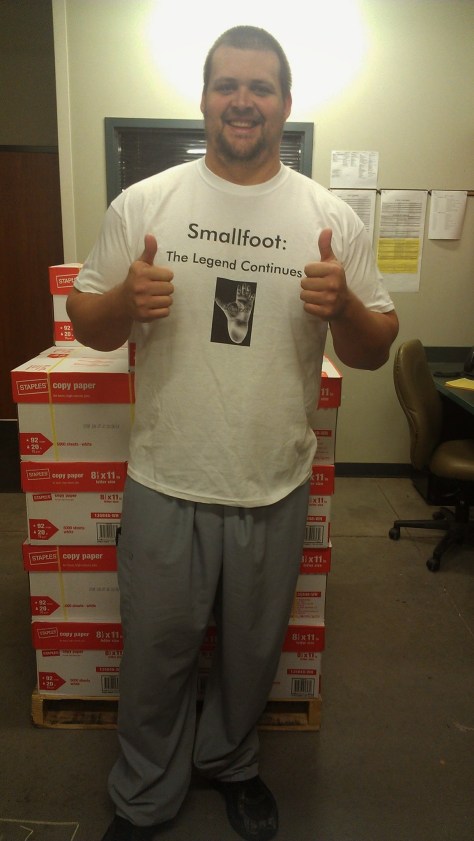
It’s interesting that there’s a movie named “Smallfoot” in theaters.
It looks like that I missed a chance to capitalize on the name “Smallfoot” and the marketing revenue that would have accompanied it.
For years, I’ve told stories about the ‘real’ Bigfoot: Smallfoot. The main story I’ve told: that Bigfoot is real, except that he’s exceptionally tiny and evades detection through his diminutive status. Everyone’s running around in the dark, desperately seeking a large creature when, in fact, Bigfoot is a tiny animal hiding in plain sight.
About 5 years ago, I created a Facebook page for the “Smallfoot” community. I filled it with the legends and sightings of a really small Bigfoot.
I even created a website (which I never took live) and made t-shirts. I had a REALLY large size t-shirt made for my co-worker Joe Buss. I made fake publicity stills and even wrote studios such as A&E to generate either buzz or confusion in their minds. For a while, I had a lot of fun with it.
I let it go and never went live with the website. Joe still has his t-shirt, though.
There’s no point to this post other than to say that I misjudged how much I could have taken advantage of my really dumb idea. Whether the studio saw my original nonsense or came up with it independently, I was first. Some of my friends and social media friends probably recall my flirtation with notoriety.
It turns out that my dumb take on the old legend wasn’t dumb at all.
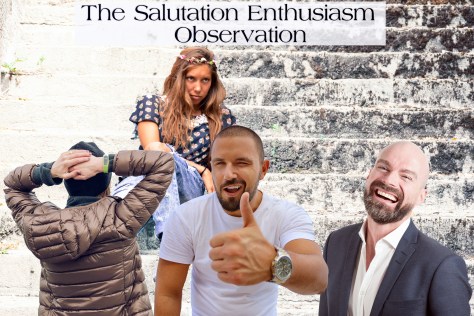
If you note a differing level of enthusiasm from someone as they initially encounter other people, it generally follows that it is an accurate reflection of their unstated yet observable opinion and/or social ranking of each.
*The greater your urge to nitpick the nuances of this concept, the more likely it is that the truth of it scrapes too close to something you’ve long suspected to be true. Observable variances in enthusiasm are opinions in motion. Naysaying notwithstanding, this generalization rarely bends to scrutiny.
 P.S. Parenthetically Speaking