This post is personal. Read at your own discretion.
.
I’m not quite sure what precipitated some of my revelations this week. Gears clicked and connections snapped together in so many different places. I felt like Rainman as a few things which had previously been a block for me fell away. Not only was I able to help several other people, but I also used my luck to take another stab at some of my own history.
.
I found a few things which I’ll process and write about later. Some of them are dark and some are simply crazy. A few of my ancestry leads broke open, too. A couple of people are going to have to rethink who they think they are who they think they come from. I’ll take this opportunity to remind everyone that while we are not our DNA, it is the tenuous and undeniable connection that belies our ancestry and heritage. I’ve made some discoveries which I’ve never shared with anyone; once told they are no longer ideas to be held, but burdens which cannot be forgotten. All of us have our internal history, the one which we know to be true – but often isn’t.
.
Regarding one of my most personal finds this week, I only found them because I had helped someone find a bit of information. I wrote, “Start your inquiry in the simplest way possible.” Easy words to write but hard to live by. Starting simple is exactly like attempting to tell a story without drawing an entirely new and complex roadmap in the middle of the story as we tell it. We are so impatient for the people in our lives to get to the point and yet some of us are enraptured by the presence of a story well-told, filled with wrinkles, and the destination unclear.
.
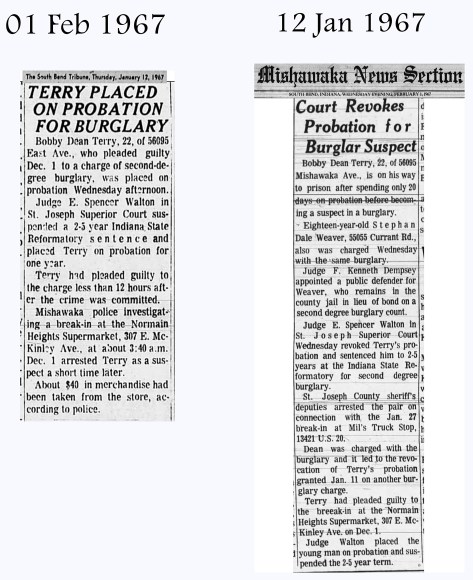
And so, in a matter of minutes, I found news articles in Indiana regarding some of my dad’s run-ins with the law. There was more than one, I discovered. I’ve been told that my dad left Arkansas because he had family in Indiana, which is true. The myth is that he had exhausted the good-ole-boy network in Monroe County, Arkansas and needed a clean break. Like in most rural Southern places, it was possible to run amok without real consequence in Monroe County, all the way to mayhem and sometimes murder. I do know that my Grandmother Terry exerted a great deal of pull in a continual attempt to keep my dad from being held accountable for the hell-raising that he always found himself in. My dad’s father James died in early 1964, and shortly before my oldest sibling was born.
.
The story of all this is a massive tapestry shared by countless people. Some know more of it than others, especially the older generation, the one succumbing to death with greater urgency. Others, the younger generation, are unaware of much of the tapestry, as ideas like family honor, secrecy and shame shielded them from being aware in the first place. I’ve unevenly kept my post through the last few years, honing in on some truths. Some I’ve cemented rightfully into the record because I was able to find sources other than those affected by dubious family loyalty.
.
That same misplaced loyalty to protect my dad served as an umbrella for him through much of his life. It enveloped him and encouraged many of my paternal relatives to shamefully look away as he engaged in a long series of brutally violent and alcohol-fueled crimes against his wife and children. (And society.)
.
Alcoholism is one of the few diseases that infects others with an inability to see and hear clearly. Alcohol coupled with anger or violence demands a collective and permanent bout of amnesia. Once initiated, this voluntary amnesia makes everyone an accomplice.
I’m relieved that I’ve learned to place this idea in a tidy descriptive box like that because it makes it more palatable and relatable. People get really angry when they are reminded that they allowed children to be abused.
.
My dad’s family silently stood by, almost always pretending to not see it, nor the symptoms of pathology that it engendered in myself, my brother and my sister. It is a miracle that we survived. It’s a greater miracle that I did not see fit to murder him while I had the chance, or that another family member didn’t light his bed on fire in the dark of night. Throughout my early life, I constantly heard, “We don’t talk about that.” Or, “Shame on you! He’s your dad.” The latter would be hurled at me through tightly-bound lips, spitting the obvious anger all over me, even as the person saying the words could see the dark purple and yellow bruises from my ankles to my neck. I can’t fathom how many children went to church with the hard wooden pews pressing against the trail of agony on their legs and back, wondering when the mercy would flow toward them.
.
“Only the spoon knows what is stirring in the pot,” is an old saying to remind us that situations are complicated and look different from the outside. It’s easy for normal people to jump to their dad’s defense, (or mine) on the pretense of biology. It’s easy for some to expect me not only to forgive, which I have done – yet for some, they also insanely demand that I not use my voice to share my experiences. It is possible to share simply because the story of our lives is interesting to us. As we tell it, we learn things anew.
.
“Bobby Dean was a good man,” some would say. No, he was not.
.
By any objective measure and any accounting, he was not good. In his defense, he had his shining moments, as everyone does – and I remember those with fondness. To any family member asking me to focus only on those shining moments, I remind them that not all monsters have fangs. Some of them are in the PTA and engage in all manner of horrors.
.
Years ago, Dad helped organize a fish fry to help someone with medical bills. It was truly a good effort with real consequence. A family member used it angrily against me as an example to support their ignorant thesis that my dad was a good man beneath it all. I acknowledged that it was indeed a good act, but that terrible people live lives of mostly normal constancy. I then shocked and angered the family member by saying, “Is that man good if he broke a rake across my back so violently that I peed blood for a week, or beat my mom so hard with a pistol that he broke her nose? Killed someone? Went to prison for multiple crimes?” As I talked, the man’s face became crimson. “And anyone who let him do it is as guilty as he is.” He stomped away.
.
As my ability to comb the past has grown, I’ve assembled a larger picture of my dad. The more I learn about his life, the more sympathy I see for his trajectory. His arc was cruelly bent at an early age and he chose not to deviate from its perpetual fall. The responsibility is his and his alone, though, just as my impatience in my own personal life has led me to some dark moments. I, however, didn’t have children; my ownership of the defective biology that flowed through my dad now dies with me. I’m being literal. Whatever dad had lurked in his DNA.
.
As I do with everyone, I say that almost everything we do when young can be forgiven. Most of us are simply stupid when younger. After a certain point, it becomes an issue of either willfulness or pathology. Beating your wife and kids to the point of risking murder is a great example of this, if using half your income to buy alcohol and cigarettes isn’t. Everything must be weighed against youthful ignorance and the long totality of a person’s life. Accumulated choices and consequences allow us to characterize someone in a way that singular mistakes cannot.
.
I’d also been reluctantly told that my dad was only guilty of being in the getaway car at a truck stop robbery on Highway 20 in Indiana. Based on the evidence I’ve been able to uncover, he wasn’t just “there.” What I wasn’t told, however, was that he had also committed other crimes, including burglary, while he was in Indiana. He was younger than I had been told, which had hampered my ability to accurately research. I had to indirectly ask questions, usually when people had been drinking. My head was filled with a million untruths, half-truths, misdirection.
.
My dad was sentenced to prison in Indiana the month before I was born. I was the last child, the baby, and the second-born son, and through a series of accidents and misunderstandings, was branded with his name upon my birth in Brinkley, Arkansas. Some of my dad’s misfortune benefitted me, as during one long portion, I lived with my Grandma and Grandpa Cook. I’ve long suspected that Dad’s incarceration in another state might have saved my life, and most probably the life of my mother.
.
As you all know, I later rejected my birth name entirely and yet credit my grandparents with the part of me that I find myself prideful of. Names don’t contain the essence of a person. My Grandpa would have never wrapped his head around my choice of name in “X,” but he would have leaned in and hugged me with his arm around me on the porch swing and laughed at my foolishness. He would have known why without being told. His eyes had seen a lot of human misery and recognized the stale indifference that often overpowered my dad. When I was young, Grandpa often said, “Don’t be afraid of things on four legs. It’s the ones on two that will get you.” In the rural area we lived, critters and creatures constantly came to visit, often stealthily and seen through the darkened screen of an open window on a blistering night. Years later, I felt as if Grandpa were talking about my dad. He rarely had words with my mom and dad, but several of the instances were warnings to stop mistreating their kids, and me in particular.
.
So it came to pass that this week, on a whim, I found the first article from Indiana in less than 2 minutes, after years of haphazard and dedicated digging. Dad started small and then went big with his nascent crime career in Indiana. I indexed the articles so that future interested parties might find the articles more easily.
.
It’s worth noting that regardless of my dad’s official criminal record, he killed a cousin of mine while drinking and driving, (Which I recently found a mention of in a newspaper. Another tidbit that I literally just discovered is that my dead cousin’s father was related to the county sheriff.)
.
My dad was quite the adept arsonist and managed to be involved in almost all the petty and felonious no-nos on the books, whether it involved guns, marijuana, VIN displacement, DWI, domestic violence, or assault. When the Springdale City Attorney went to prison for DWI-fixing, you can be sure that my parent’s names figured prominently in that accounting.
.
Because the truth reaches places I hadn’t expected, I now know that a few other rumors I had heard in screaming and bloody episodes in the deep of night as bones gave way to furniture are probably true. Words I didn’t have context for now have meaning and their incoherence has slithered away, leaving behind a freshly-washed sidewalk for me to examine.
.
I say none of this with shame; his life was his own.
.
I have more than paid the price for his presence in my life. For anyone who has read my mind by reading my words over the years, you know that I’ve worked hard to extract the useful parts of my dad’s life, too. I’ve not turned my back on the whole person. A story I wrote earlier this year was read by thousands of people. It was a story of my dad as a whole, imperfect person, written through his eyes. I understand much of dad’s pathology now. I owed him a demonstration that I could see him as a human being.
.
I’m not bitter, but I will confess that the sharpest lemonade is akin to water to my taste in part due to my dad.
.
There have been times in which people have incredulously asked me about some of my stories. “That can’t be true!” someone will say.
.
It’s true I sometimes get the details wrong, but I assure you that I try to get it right. I’m the only one out here on the limb of my family tree doing the time and attempting to share my part of the story. Not all stories are of youthful summer mornings on the porch with my Grandpa Willie.
.
Where I err in detail, I strike a chord in truth.
.
All these decades later, I’m amused that I get the final say. I read, I ponder, and I consider. The scarring I have is my friend, one which whispers in my ear as I put words on paper.
.
Recently, I’ve been able to talk openly with someone who is familiar with the tornado of my youth. He’s shared some stories, many of them I couldn’t remember. In the past, he might have been the one to silence my family’s critics, as his family loyalty was ingrained into him in a way that it never was with me. His advancing age and experiences in the world finally gave him permission to detach and tell the overlapping stories of our youth. I thought that it would have been my cousin Jimmy, but cancer silenced him a few years ago. During a conversation last week, I could only imagine the storytelling if Jimmy were alive to join in. Here we are though, with our myths, certainties and acquired perspective, wondering how many unpleasant ripples our own choices might have made in life.
.
.
Before parting, I’d like to mention that there’s another sinister chapter in my dad’s life, one which I don’t feel is my story to tell. It is a mirrored hall of horrors. I’ve circled its fringes with curiosity for a time; I doubt that I’ll ever claim ownership to the story. That I believe the chapter of his life is true reflects on the chasm that my dad punched and beat into me. I sometimes creep up to the bloody edge of it and recoil. It is the darkest of possible secrets. I guard it closely, knowing that those who would disagree with the assessment of dad would cringe and run if I were to shout it to them in reply their foundationless defense of a man long dead. I know that others walking in this world have their stories. Their silence is astounding to me. It is theirs to guard, though.
.
.