
Clichés often hide truth.
What kind of.maniac is capable of this level of agency?
The idea is n’t mine, but it is one I’ve been repeating often in the last few weeks.

Clichés often hide truth.
What kind of.maniac is capable of this level of agency?
The idea is n’t mine, but it is one I’ve been repeating often in the last few weeks.

Donald Trump is likely to be elected again in 2020.
I’m not going to vote for him. Because I live in Arkansas, my vote is irrelevant.
I voted against him twice in 2016: once in the Republican primary and again in the general election. I’m not a Democrat, but I am a liberal. I did more than most liberals to try to stop Trump, as many Democrats took a detour to argue over Bernie and Hillary. I’ll be surprised if they avoid the same mistake this time. The best is indeed the enemy of the good and some voters can’t stop fixating on irrelevant differences.
“Any functioning adult” was already my candidate against Trump.
Most people don’t like Trump but many will vote for him again despite his critical flaws. They believe he’ll advance an economy or agenda that’s favorable to them. Liberals watch in awe as Evangelicals defend and embrace Trump. It’s obvious that most people know that Trump is no man of faith and probably doesn’t care about most of the issues. As a politician, however, he has outmaneuvered almost everyone at every step. Trump’s polling numbers aren’t great, to be sure, but the economy is in his corner. He’s like the crappy job we endure because it pays the bills. We talk about leaving, but everyone knows we’re full of it. The Evangelicals will eventually face the consequences of endorsing a candidate and person like Trump – but it won’t be anytime soon. Movements which start at the extreme implode. (Take note, Democrats.)
A great number of Americans can’t watch the news, can’t talk to their friends and neighbors, and cringe at the idea that Trump has any position of authority. Worse, a trend that I’ve called the Polite Politics Pandemic has infected the minds of most of his detractors. People avoid any mention of politics or life issues on their social media, their conversations, and in general. They mistakenly believe that doing so makes their lives more manageable.
They’re wrong.
Just as it has done in other democracies, silence creates a false impression among your circle that you are either afraid of your opinion and the consequences of expressing it, don’t care, or secretly endorse the things that cause your silence. Over time, we find ourselves watching the boulder tumble faster and faster downhill.
Silence, even politeness with a goal of civility, works in favor of Trump.
Whatever your opinion, it is equally obvious that most Americans will overlook Trump’s onerous flaws and endorse him again. Like the last election, many of those voters will be Democrats.
Trump changed the nature of the Republican party and politics in general. Such a person comes along once a generation. Those who are politely silent are counting on their fellow Americans to push him out. The 2016 election taught us that it’s a fool’s wish to expect others to do the expected thing. If you don’t stand up and stand out now, you’re part of the problem. If you can’t find it in yourself to opine now, during a once-in-a-generation aberration, you never will.
Liberals should note that many of their friends and neighbors who once proudly shouted their enthusiasm for Trump have grown silent. Trump’s continued onslaught of profane and outlandish antics has cooled their support. The moderate in most of us eventually finds us again. Expecting most of them to violate their interests and not vote for him again, however, is lunacy. They’ll turn out in the next election whether you do or not.
I’m guilty of confusing a vote for Trump as an endorsement for some of his cruel policies. I can’t separate his policies and his endorsement. Many voters can, though, and we’re going to need a better way to frame it.
Incumbency and a strong economy invariably favor the candidate for re-election. Arguing about whether he’s qualified or a good person misses the point; it’s irrelevant. Politics has lost its facade. Qualifications will now invariably yield to tribalism and charisma.
Trump does not hold the blame for exploiting the election system or for our system of governance which assumed that rationality and normalcy would be prevailing standards. Some have shouted and barked so often that it’s impossible to alarm the bystanders sufficiently to believe that there is a real problem. I’m not asking anyone to snarl and fight; rather, I’m asking that you start by reminding everyone, even those who only passively see your influence, that the Trump America isn’t one you like.
We can do it without screaming. Screaming won’t work, anyway. If a few people get angry at you for simply enumerating your objections to a Trump America, it’s likely that those people don’t align with you or your life, anyway. Good people don’t banish other good people from their lives for honest expression; they banish them in fear of having to confront their own insecurities.
So many put their hope in the Mueller Repor. The biggest problem was its lack of transparency and immediacy. Simply put, such things must be developed quickly and openly. Whether it’s supposed to work that way sidesteps the fact that our democracy no longer finds value in the laborious process of law. Democrats lost the fight and bystanders mostly think it’s because there wasn’t enough meat on the bone. The average voter dislikes corruption, but most expect politics and politicians to be a little dirty. We’re not going to find a smoking gun in the last election unless someone releases footage of Trump killing someone with his bare hands. Anything less is a distraction.
Policy is not going to sway the middle in the 2020 election. Immigration is not an issue that will work for Democrats. Forget decorum, forget the small annoyances of a particular candidate, and stop shouting. Unless a charismatic third-party candidate enters the race late, the only Democrat who could possibly beat Trump will be the one who is standing in the middle with just enough charisma and intellect to know better than to offend voters who are mostly otherwise detached from politics. Stop focusing on how it ought to be and instead focus on the system that we’re left with.
Trump won’t win by much. Thanks to the electoral college and the tribal nature of national races, he won’t have to. If your family and friends don’t know that you dislike Trump and won’t vote for him, let them know. Don’t try to aggressively change their minds. If your life isn’t a shining example, you’re not going to change anyone’s minds. People will only stop to think about you or your opinion if something about your opinion and life speaks to them in a way that Trump’s charisma cannot.
On a personal note, I learned a hard lesson from FiveThirtyEight in 2016. As the interference of the last election became apparent, I learned more lessons from Facebook and the power of social media, watching in wonder as we discovered that they had been used effectively to sway opinion. I worked hard to embrace the lessons. My vote is almost irrelevant compared to the reach of anonymous and effective opinion. I’ve used it, especially in the last year.
Even if we miraculously get a new president in the next election, we now know that chaos and entropy are the wolves which will always be at the door. Trump or his surrogate is inevitably planning his next move.
Stay silent if you will.
Barring a major disruption, Trump will be elected again in 2020.
Silence will cost you more than your reputation.

Since the cake option wasn’t on the table, Dawn listened to me and opted to get Julia multiple culinary items of interest. I wanted to choose 15 distinct items but Dawn insisted that diabetes was an impediment to my whimsy. I almost forgot to mention we surprised Julia with a nice Chromebook laptop that I stole from Best Buy last Saturday at 12:35 p.m. I’m just kidding; I wrote that last part to determine with what attention you’re reading my post. Chromebooks are awesome devices. If Julia hates it, Darla’s cat Apollo will continue on its quest to tear it to pieces. It’s a win-win for our consumer economy. No sooner than I had started showing Julia how to use the new laptop than the cat somersaulted on top of the pristine keyboard in Julia’s lap.
Note: it is VERY important that no one notices that Julia joined us upstairs at Darla’s in her duster-gown. At any rate, you have to give her the benefit of the doubt. Anyone who can listen to me explain technology without falling into a deep, trance-like sleep is a saint.
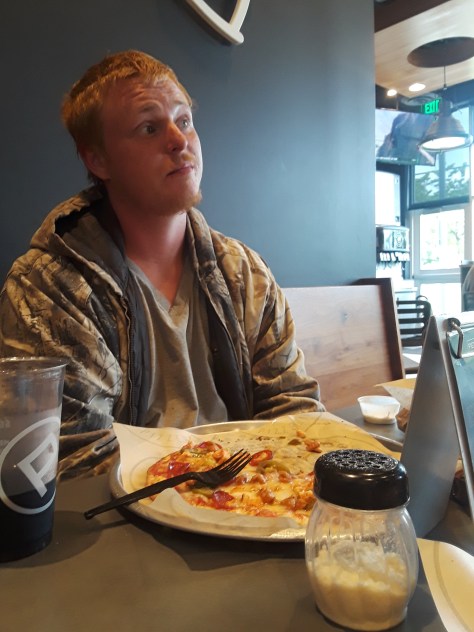
After we departed the in-law’s house, Ty decided that we should eat at Pieology, otherwise known as “The Subway of pizza.” Usually, it falls to us to bemusedly stare at Ty and his antics. As this photo clearly proves, Ty is giving his mom Dawn the ‘wtf’ face. (As Phil Dunphy says, “What the fracas.”) I’m not sure what exactly Dawn was saying at this point, as I had just reached that decision point of whether to shove the entire slice of pizza in my cavernous mouth as if it were accidental. Since I’m a multitasker, it was at that moment that I continued to snap a couple of dozen pictures in the hopes that at least one would earn me a Pulitzer prize. I had to choose between wastefulness and gluttony.

I also pranked my stepson when I went to pick up his to-go box. Carrying around a permanent marker and note cards at all times has its advantages when inspiration strikes. I blurred it out because no one needs to see proof that my sense of humor is tasteless. (Observation: your imagination is probably leading you to worse conclusions than what I actually wrote).
Afterward, with horror on my face, I realized that I had inadvertently described the picture of my stepson Ty as “cute.” I’m not sure if he’s getting funnier or those repeated blows I took to the head as a youngster are finally catching up to me.
Because we enjoyed ourselves during the day, Dawn informed me that my penance was to accompany her to a Walmart market for groceries. I wisely chose to drive through MLK and the traffic snarls resulting from the behemoth graduation ceremonies nearby.
Walmart market was the perfect blow to the nether regions after a great day. Balance was restored.
.
One of the hacks I often see is a fitted sheet over a table to replace a tablecloth.
Note: a ‘hack’ is an ill-advised method to self-delude oneself into believing that you’ve saved yourself time. We’re all going to live to be 117, stuffed inside houses brimming with goofy and astounding assortments of knick-knacks and paddywhacks. First, though, we’ll need to watch 76 shows dedicated to the pursuit of efficient households, followed by 256 hours of Etsy and internet browsing.
Can I point out that a tablecloth itself is a waste? As are placemats – and the herpes of household annoyances, the drink coaster. If we build things to be used ‘as is’ and make them interesting to begin with, we wouldn’t need additional nonsense. I know what you’re thinking; not having them would dramatically reduce our available choices for holiday gifts. Aunt Bernice needs more redundant layers of protection in order to live a normal, mundane existence.
“I wish I had some more tablecloths and coasters” is not something a rational person ever needs to say, along the same lines as, “These wooden slippers are perfect,” or, if you live in Arkansas, “I think I’ll vote for a Democrat.”
I’m still considering inventing the tableclothcovercloth, which of course is a clothcover for the tablecloth, in order to prevent the first tablecloth from being soiled. Look for it soon at Target and Hoarder’s Paradise.
Instead of putting a fitted sheet over a table, use it to capture and bag the ‘lifestyle hacker’ who wants to put it on a perfectly good table. Drive to the nearest peak and toss him/her from the precipice.
Yell, “Use the tablecloth as a parachute!” as they plummet.
It’s important to be helpful.

I recently became acquainted with a gentleman who is one of those unexpected hybrids of pleasant, upbeat, and batshot crazy. He’s older and has wide exposure to the world. Superficially, he’s likable. You’d never know that his cheese slid off his cracker.
There’s one problem: he is certain that all forms of cancer are nothing more than a state of mind. “If you think it, you’ll be it.” I waited until he had uttered a version of the sentiment twice before directly inquiring. I know a couple of anti-vaxxers, flat-earthers, and chiropractic enthusiasts, so I’m used to weirdos.
I asked him, of course, if anyone very close to him had died of cancer – or if he had been to a hospice care facility. “No,” was the obvious answer. Since we get along well, I also told him that a great swath of humanity would think he’s crazy and that many would accuse him of being heartless. He’s otherwise very smart and I find myself aligning with his general outlook, at least the one that’s perceptible through regular conversation.
I’d go so far to say that regardless of one’s pleasantness when talking to him about these things, he takes logical insistence as proof that the person contradicting him is a negative person. He’ll even double-down on his thesis and claim that almost all disease is subject to the same self-causation.
Initially, I had great hopes I’d become better-acquainted with him.
As a bona fide nutjob myself, I can tolerate a huge quantity of asininity. I’m an expert at fool impersonation. It’s a herculean task to overcome the idea that someone harbors beliefs that can’t be approached with logic, conversation, or science.
Or, more importantly, the knowledge that it’s sometimes wise to keep one’s foolish ideas to oneself. Yes, I realize that I’m a hypocrite like everyone else.
“The moon is made of cheese.” Why not?
My fundamental problem is that there is a chasm of difference between walking around with a chicken wrapped around one’s neck and denying basic science.
My new acquaintance is the Michael G. Scott of my life: entertaining but absent most self-awareness.
He reminds me of a co-worker from back at my days at a meat processor; that man was convinced that eating one’s own nasal nuggets and taking a sip of your own urine was great for you. We called him the English equivalent of “Snot-eater.” (Thankfully, we didn’t do potluck dinners back then.) I thought he was fairly nuts until I discovered an entire trove of people who believed that the Sun orbits the Earth. People think the Flat-Earthers are dumb; I wish they could have entertained themselves with the lunacy of those who angrily contradicted sense and science so violently.
My new acquaintance is good training for me.
I know that people believe a lot of nonsense.
I guess I forgot.
This will help prepare me for the next election.

One of the worst restaurant experiences I’ve ever had happened this week. It wasn’t because my stepson was with us, either, because he coined one of my new favorite phrases/restaurant names: “Gringo Needs a Taco,” in comedic response to our increasingly despondent faces as we realized that we were in the middle of a culinary catastrophe.
We have some amazing restaurants in Northwest Arkansas, especially Tex-Mex ones.
Our closest go-to Tex-Mex place, Acapulco, is still closed due to a kitchen fire in January. They claim they’ll re-open in July, although I don’t believe it. Most of the great staff they had have found positions at other restaurants. One of our favorite people surprised us at Las Palmas in Springdale. The other similar eatery on this side of town has never managed much success. (Which basically applies to any restaurant on the east side of Springdale.) I’m convinced that Americans mistakenly believe that the other Tex-Mex place is taqueria-style. It doesn’t help that it’s in a shopping center that seems like the shooting stage for season one of the Walking Dead. By the way, Playa Azul has a buffet some days. It’s great, especially since it’s impossible to find a Tex-Mex buffet anywhere.
The shining grace was an effort by one of our favorite waitresses – one not assigned to our table or area of the restaurant. We tried to reward her with a tip before we left. She noticed that my 4-lb. order of pico de gallo had been left negligently on the serving shelf. Evidently, I’m the only one who orders massive quantities of this delicious menu item. She came back later to hesitantly ask, “Has someone taken your order?” I think her first clue was that we had read the entire first book of the Harry Potter series since we entered. Our assigned waitress seemed like someone had swapped her favorite beverage with a chilled cup of straight white vinegar.
She might have been Amish, as her shunning ability was expert level.
It seems like we were unwitting participants in a customer dissatisfaction experiment. We felt terrible about the experience. The manager was simply speechless at how badly things had gone and struggled to explain it. He was relieved when I told him, “No harm, no foul,” even as I complimented the waitress who wasn’t assigned to our table. We left and were rewarded with a torrential downpour. Our spirits were so hammered that we all drove to Burger King. As you probably know, its new motto is, “Where Dreams Go To Die.”
Saturday, Dawn and I went to another Tex-Mex restaurant. We walked out after 15 minutes. On the way over, we discussed the consequences of not following our instincts. The person seating walk-ins could not have been more reluctant, with the exception of the admiration and attention she was giving her personal cellphone. The matriarch of the family by the door was throwing eye darts as she uneasily shifted back and forth, waiting, while attempting to corral two young boys. We had the misfortune of being seated in the far back corner. The matriarch and her family received great attention. I could tell that woman simply wouldn’t tolerate shenanigans or inattention. It’s difficult for me to be pushy, though. The manager was so engrossed in something unrelated to work that I couldn’t even let him know that we were leaving.
I’ve been known to get up, go outside, and then go back inside sometimes as if I hadn’t just walked out. Usually, this either makes people confused or laugh. We left. I’m glad we did because our final choice was a delight.
We ended up at another restaurant and were delighted. The food and service were impeccable. We joked with all the staff. I drew pictures on my index cards as we chatted with everyone, even as watched a table of gringos make their faces numb with way too much alcohol. (The one bad moment was when one of the gringos was a little violent with a precious curly-headed little girl. He doesn’t know how close he came to being force-fed a plate.) It was strange to have such a great eating experience after two terrible ones.
As I always do, I ensured that karma was paid forward by tipping the waitress 100%. She was delighted. So was I. Belly full, and smiles for all.
One consequence of a bad dining experience is that I always find a way to pay it forward to the next great person we encounter.
P.S. I didn’t even order pico de gallo at this restaurant, as I didn’t want to tempt fate.
Gringo needed a taco.
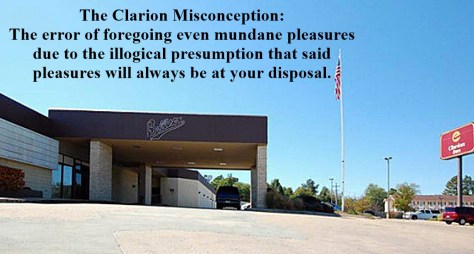
For anyone who never had the pleasure of the holiday buffets at the now-defunct Clarion Inn in Fayetteville, you’ll have to pick another such activity or place to visualize. It’s possible I’m too nostalgic. Something about the holiday buffets evoked a feeling of kinship and holiday in me that few things ever did. I was always surprised by the mix of people who would show up and join in.
The buffet was fabulous, whether you were a light eater, a healthy eater, or someone who could best be described as a “human disposal.”
I didn’t get to return “one last time,” mostly because of factors out of my control.
Over time, I wrote a few rules to keep in mind as I hear/see people forego simple things in life, as if they themselves will not be scattered dust on a day much sooner than most of us expect.
The Clarion Misconception
The error of foregoing even mundane pleasures due to the illogical
presumption that said pleasures will always be at your disposal.
The Clarion Misconception Addendum:
Giving primary consideration to other’s preferences due to perceived proximity to death or variable out of your control.
The Clarion Certainty: Future moments are all promissory notes without guarantee.
The Clarion Kinship Observation: Familial or societal expectations should be evaluated against all variables, with your own voice given equal vote.
The Clarion Selfishness Observation: Compromise in all things will get you far; giving yourself permission to not do so will sometimes make your life happier.

“Any word used in a televised presidential debate is now publicly acceptable.”
Addendum: “Any word uttered in public by a sitting president is no longer objectionable.”
This week, I discovered that my old quip had been stolen without appropriation. Flattering, but a tad unfair.

Worse than an assassin is the self-appointed gatekeeper of humor.
Humor, one of the most authentic human emotions, often treads in the mud.
My sense of humor lurches into the darkness and dwells there. I’ve uneasily enjoyed much of the social fire through the years, watching as people without any real intention of cruelty are publicly drawn and quartered for something they’ve said, or for an action that violated someone’s norms for humor. “Well, that isn’t funny!” Often, they are right. It wasn’t funny. But it wasn’t intended as an attack. It was just stupid or poorly stated. Most such humor harms another person’s sensibilities and those things they find to be sacred. As someone smart once said, “You can tell who is really in charge by what you can’t make fun of.”
Hanlon’s razor is a saying that reads: “Never attribute to malice that which is adequately explained by stupidity.”
Here’s my take: Hanlon’s Disposable Razor: “If no actual harm was done, never insist that you know the mind of someone who said or did something in jest. Accept an apology, but watch for a relapse.”
Given freely, humor should always be first interpreted as an imperfect and fluid expression of a shared human emotion, rather than a malicious attack on one’s viewpoint. In the larger scheme of human interaction, humor seldom produces observable harm. Weirdly, it often produces anger in the mind of the beholder, an anger that is often disproportionately harsh in comparison to the expression of a badly-worded or executed attempt at humor.
Even though we know the above to be true, we often jab humorously at funerals, cancer, parents, patriotism, sex, and just about every other possible thing common to people. All of them will wound people in the wrong place and at the wrong time.
Age has taught me: sooner or later, we all face the guillotine of error.
Some people seem to stand guard adjacent to the guillotine and wait for perceived breaches of humor and intent.
Because people so often bring their own arguments to these thoughts, it’s important that you understand that my comments bend more toward passive humor, such as when one person sees a billboard written in humor and becomes angry or the refrain is, “I don’t find that humorous.” I’m not pointing my finger at interpersonal humor.
Distrust anyone who is righteous and quick to anger in the face of humor.
Absent evidence, it’s unwise to assume that the accused had ill intent.
The volume of the objection doesn’t always coincide with the magnitude of the offense.
Like all human interaction, mistakes are going to happen.
Given that mind-reading is still out of our reach, it’s wise to take a look at the context and the totality of whomever and whatever you’re about to rail against.
And remember that no matter who you are, you’ve said and done some vile nonsense to other people.
P.S. Once, when I was telling a version of this, someone said that I should call it the “…But Did You Die?” rule. Perspective.
“Cabbage is the pizza of old age.” – X
.
.
A basic cable tv network is considering using my workplace for a docuseries.
To my surprise, one of the movers-and-shakers asked me, “You’re good at this sort of thing, X. What should we call it?”
Without hesitation, I replied, “Donuts & Dumbasses.”
.
.
“No rest for the wicked,” they said.
“This new mattress begs to differ.”
.
.
I just found out that Dawn started dating me accidentally. She thought my online dating profile had said, “…likes long one-way walks on the beach.”
.
.
Do you ever get the feeling you’re going to r-e-a-l-l-y need a good criminal defense attorney but can’t quite explain why? Me neither.
.
.
He refused to make a pot of coffee due to religious grounds.
.
.
I’m suing the “World’s Largest Baby Shower.” The baby was no more than 10 lbs.
.
.
My new sport “Skeetboarding” is amazing. Mixing the thrills of skateboarding with the explosive speed of skeet shooting, it is great fun for everyone. Except for the scorekeepers, whose mortality rate is at 100%.
.
.
If someone can market a “rice cake” without getting murdered by an angry snacker-mob, I can sell almost anything too.
.
.
As the meeting wound down, my manager held up his hand to get our attention.
“In the interest of learning new things, it’s customary for someone to give us a new word – or one we haven’t truly understood,” he said.
Because I’m helpful, I shouted “Ethics!” with a booming voice.
.
.
Were I able to distill & bottle the essence of returning to an unreasonable job after a vacation, I would market it to young people to serve as a distasteful motivation to find a way to fill your days with a meaningful blend of both commerce and freedom.
.
.
Diet salad dressing should be called salad undressing because the more you eat it, the more likely you’ll undress.
.
.
The party was a mess. Due to the fact that I mumble, I accidentally ordered a f(r)og machine, which made the dance floor unimaginably slippery.
.
.
*In Mississippi, it is legal to kill someone if they are playing bagpipes.
.
.
You know you’re too focused on eating when someone says, “Well, it’s food for thought,” and your first thought is whether you can eat supper twice or not.
.
.
“Love the one that’s your width.” – X’s new take on an old cliche and song lyric.
.
.
When Dawn walked with me Saturday, we stood motionless as a Bobcat approached. Then we noticed its tophat and realized it was a harmless yet proper Robertcat.
.
.
Seeking a recommendation or opinion.
Which is weirder, scented or flavored toilet paper?
.
.
Now that I’ve reached an altitude of 5,000 feet above sea level, I now realize that the motivational speaker’s catchphrase was “Attitude is everything.”
.
.

