What’s The Buzz?

anthony-intraversato-349655-unsplash.jpg

This morning, I walked a route I’d never taken before. The block behind me can’t be accessed directly, so I walked the circuitous path out of my neighborhood and around. Despite previously driving down the dead-end road behind me and seeing it on Streetview, I never noticed a spur sidestreet jutting from it, truncated as it points South. Unknown places are a treat, especially in the early morning before life startles everyone from their cocoons.

As I rounded the bushes on the entrance, I saw a man walking toward me. I could smell marijuana in the air as if someone with low self-esteem and a bad haircut had used it as a perfume by mistake. Keep in mind that it was still mostly dark and I was walking in a strange place. I felt like Donald Trump might if he were accidentally transported to a library.

By the time I was within a few feet of the approaching walker, he took a drag from what looked like a vape pen and exhaled. Marijuana wafted through the air. The man said, “Hey,” and kept walking.

Tempted to shout, “Police” and run for my life as a prank, I instead kept walking, the distance between us growing.

For the remainder of my walk, I pondered the question, “Who smokes marijuana at 5:00 in the morning, especially when no convenience store lurks nearby?”

Maybe the man in question is getting his exercise and buzz simultaneously, having just completed a ‘GTD’ seminar.

P.S. The photo isn’t the man in question. It’s what I picture in my mind when I think of how it should have looked.
.
.

Who Says A Doctor Visit Can’t Be Fun?

656355435k.JPG


This story is true. All of us involved laughed at least 25 times during my visit. I’m beginning to question their sanity.

I was seated in a nondescript patient room, amusing myself with wordplay and possible shenanigans. I vainly tried to make the interactive patient information display do something unexpected, such as indicating “Stop Touching Me.” I remembered to add something to my to-do list: bring a few crazy magazine titles on my next visit and exchange them with the normal magazines on the wall racks. I pulled this prank a few times when I was younger and it never failed to bring the expected confusion and hilarity. The interactive computer confirmed that I needed to lose more weight and recommended a haircut, preferably one starting with my back hair. Computers these days are increasingly impertinent, a trend which I enjoy.

My doctor asked me to come back in after 3 months, allegedly to determine if the blood pressure medication worked well enough to suit him. Being a doctor, though, meant that any condition not generally characterized as “still not dead” was an acceptable one to him. In my opinion, though, my visit was probably due to his suspicion that I had resumed eating for two people. No, I’m not currently pregnant, despite the rumors being broadcast by the waistline of my pants. I simply tend to eat for more than one person – not to be confused with a cannibal, who would tend to eat more than one person.

Because I arrived early, I could hear the goings-on of the doctor’s office as staff bantered, medical reps bartered their wares, and patients attempted to conceal the horror presented by the specter of a medical office. For most patients, a medical office is indeed a Pandora’s box, one filled with a hypochondriac’s WebMD web search. From outside, I heard the medical assistant say my name. “X” sounds like a curse when spoken in a normal tone of voice. Once people get to know me, they also tend to add an inexplicable “hissss” sound after my name, something that renders me slightly suspicious. I had already entertained her by claiming that the Med Rep in the inner sanctum of the back offices had given me free medical marijuana samples while in the lobby and that imbibing this sample resulted in the very low blood pressure reading she had elicited from me.

Assuming that the doctor would be on the cusp of opening the door, I placed my purple cellphone screen side down on the exam sink counter. I then quickly stepped behind the door, jamming myself in the corner as tightly as possible.

I felt the door open more than halfway. I held my breath.

I knew that on the other side of the door that Dr. Brown was scanning the length of the room, probably noticing my purple cellphone while doing so, and wondering where I went.

“Did the patient escape?” the doctor asked the two medical staffers seated nearby at the administration counter.

As he asked this, I quietly stepped out and away from behind the door, directly behind him, in plain sight of the two staffers, both of whom were looking at the doctor as he turned to face them and inquire as to my whereabouts.

Because decorum demanded it, I made a terrible, crazy face. Both staffers burst out laughing. The doctor sensed something behind him and half-turned, freezing as he saw me in his peripheral vision.

He shook his head and also burst into laughter.

Once we all stopped laughing, he told me, “No one has ever hidden behind the door from me like that, X. Well played. Well played.”

P.S. I don’t know what the billing code for playing “Hide-And-Seek” at the doctor’s office might be.


It’s A Place Which We Never Leave

666666


On the way back home from Texas, I turned off the discolored and uneven blacktop highway and drove through a small farming town in Arkansas. It was almost 7 p.m. on a windless Sunday evening. My windshield was a graveyard of hundreds of insects. The richness of the delta has its gifts.

I had lost all sense of urgency and time. Because I knew I wouldn’t drive all the way home that evening, I chose the blue highways to take me across part of my journey. These highways were once the only way to traverse the country and each one of them pierced rural communities, loosely connecting them to the outside world. As interstates rose to meet the demands of speed and commerce, the blue highways remained, like half-forgotten pictures tucked away in the top drawer of a dresser in one’s extra bedroom.

Downtown was a disintegrating and deceitful testament to the past. The solitary water tower still stood, rusting, and even the town’s name, once proudly emblazoned there, was long erased. The youthful graffiti always found on such a tower was illegible. The few young people who might live nearby attended school in another town, their own hometown mascot supplanted with another. Each of them quietly reminded themselves that they’d leave as soon as graduation came.

The jolt of crossing a desolate set of railroad tracks caused me to reach over and turn off the radio. A town’s railroad crossing conveys a clear message: a smooth transition indicates a thriving economy and nicer vehicles, while an uneven and poorly maintained one usually means that people live lives filled with less. People with money and separated from their agricultural roots clamor for better roads, ones devoid of historical reminders of commerce and transport.

History accompanied me as I made my way slowly across the brick-paved street. Without any evidence, I knew that several years ago, some well-meaning resident with a little money had vainly attempted to rejuvenate the corpse of this place, one founded on the backs of farmers. With his passing, the enthusiasm for saving the heritage of the place no longer loomed large on the psyche of the town. His tombstone, larger than those surrounding his resting place, is easily found in the cemetery not too far from the train tracks. In a generation, most of the cemeteries would be overgrown and many of these buildings would fall in on themselves, a gradual shattering and splintering of history. If I were to look, somewhere in the juncture of the small side streets would be a shuttered museum; its existence once contained within but with time, opened to spread out and include the entire town. My own hometown shares a similar and degenerative trajectory; the fiercely loyal will stay until nothing remains. They are the geographical observations points for entropy. Death need not make haste in these places.

Somewhere within the 4 blocks traversing west to east, I noticed a particular vacant storefront, displaying a single white rocking chair perched haphazardly up front, undoubtedly home to the bones of a once-thriving furniture store. The setting sun illuminated the faces of a hundred stacked cardboard boxes near the front windows. As carefully as the boxes were stacked, I couldn’t shake the feeling that they had been packed in haste and then abandoned, much like the store and probably like the town in general. I was certain that human hands hadn’t touched the boxes in years and that no one had relaxed in the rocking chair since its placement there. People were choosing to leave with as small a burden as possible.

Something about this store spoke to me. I pulled unevenly toward the broken curb and hesitated as I shut off the engine. The brick pavers had ended with the last block, probably as fund-raising dried up and people chose to leave instead. Every few feet a clump of grass was triumphantly sprouting from the untarred cracks in the road. I sat there, hands on the wheel, watching. Nothing moved around me. Maybe nothing had moved in the last hour, day, or week. A block ahead, the only traffic light in town blinked a dull red, casting a strange pall on an approaching evening. The light wasn’t blinking to any certain tempo and its arrhythmia went unheeded.

Looking at the sun reflected in the terrible facade of that building, I felt a creeping sadness wash over me. It seemed like I could feel the glances of the thousands of inhabitants who had passed here, reluctant to leave their hometown, but certain that they must. Brake lights always yield to a foot on the gas as nostalgia loses inevitably to hope. The fondness we so often feel for the places in our rearview mirrors softens our doubts about leaving yet rarely detains us.

The sun gave me its warmth as I sat in my car. Though the air was still and uncomfortable, I couldn’t break the silence by starting my car. The heat seemed to stir the ghosts of this place. I could hear their whispered names: Robert, Henry, Thomas, Samuel, Maggie and Jane Elvira. It was both melodious and cacophonous, like a choir warming up to an unspecified crescendo that would never quite arrive.

I could picture a shotgun house not too far from here, its ancient inhabitant eating cold cereal or buttermilk-soaked bread from a chipped white bowl. The metal fan nearby would be loudly alternating air through the cramped room. Around the person would be dozens of pictures, spanning generations, each of them revealing the face of someone long departed or of one who visits with less frequency. Next to the stubborn resident was a small wooden table. It was adorned with dozens of pill bottles, knick-knacks, and an older telephone, one wired to the world. In the rare event of a call, I could hear the fizzled and tired ring and recite almost every word that would ensue in the phone call, one measured by regret, loss, and small details.

I imagined the smell of cornbread, mustard greens, and fish quickly fried under the shade of any available tree. This place, once dominated by the sounds of screen doors casually slammed, pitchers of iced tea, and enthusiastic summer baseball games, was losing its voice. It seemed that even the echoes of lives once lived were fading now, departing with their particular smells and customs.

Before leaving town, I turned on the radio again. I pressed the ‘next station’ button and to my surprise, Merle Travis was singing “No Vacancy.” I smiled, pressed the gas pedal with enthusiasm, and took one last glance in the driver side mirror.

As I passed over the railroad tracks, I didn’t even notice the jolt.

I would wake up in another town tomorrow morning and this haunted place would fade to become an uncertain memory. All who had departed this place would unknowingly share this in common with me.

I, too, am from such a town. It is with me, always, in my quiet moments.



Above It All And Within


66666.jpg


Barbara closed her book with resolve, knowing that Pat Conroy’s love of the land which defined him would welcome her once again as soon as she opened the pages. She leaned over to kiss her husband David, even as he paused to remove himself from the world of John Irving. “I’ll be back in a minute, my Lowenstein,” she whispered. He nodded and peered at her over the rim of his ridiculous reading glasses.

She cast aside the bedspread and climbed from the bed. Though the room was a historical catalog of the shared lives of her, her husband, and daughter Elizabeth, Barbara no longer needed to cast a glance at the myriad collection of photos to remember each individual memory. Most of her days filled with recollections of the life they shared before Elizabeth departed. Nineteen eighty-five might as well have been another life. In many ways, it was.

She walked barefoot from the room and turned left, heading toward the darkened room which comprised the epicenter of her life and once belonged to her daughter. She counted the eight paces to the window and pulled it open. The warm breeze enveloped her as she exited to the roof. Tonight, she could smell the honeysuckle floating on the air. A night like tonight was the last one Elizabeth had enjoyed, slightly more than one-third of a century ago.

Barbara knew that on so many previous nights, her daughter Elizabeth had emerged from the same window to smoke. Unlike her daughter, though, Barbara limited herself to a solitary cigarette. She hadn’t smoked a puff in her life until her daughter had died. Since that night, she hadn’t missed a single night without smoking. Rituals demand adherents.

In the event of rain, Barbara would smoke under the overhang of the utility shed, just like Elizabeth. As the drops fell, they reminded her of the minutes her daughter failed to enjoy. Thousands of droplets, accumulating at her feet. At times, she imagined that she could feel each one as it fell.

David knew better than to question his wife. Contemplation requires tranquility, if not silence. Although he would never admit it, he loved his wife more for her dedication to the ritual of remembrance than almost any other thing. He couldn’t bring himself to join her on the roof, even as his absence sometimes drove a wedge between them. 33 years had failed to convince him otherwise.

Barbara measured her inhalations as she watched her quiet neighbors. If anyone now saw the glowing tip of her lit cigarette high on the roof, he or she no longer questioned it. Barbara’s loss was intensely private. When she finished the cigarette, she flicked it out into the yard. David didn’t mind. Collecting the butts was part of his ritual, one he did without comment. In his heart, he knew that one day he would give anything to have the chance to pick up after the people who were no longer with him.

Barbara paused on the other side of the roof, one leg draped over the windowsill. Elizabeth was somewhere out there, in a place of unknowing. Barbara sighed and headed back to her Lowenstein, even as her heart called into the blanket of night.
.
.

Voting Is Like Boots For Cows

97H.jpg


Warning: this madness may trigger you, either on the grounds of satire or foolishness. Were it my choice, partisanship would go the way of the Blue Squirrel, full of pellets and eaten with roasted potatoes. Part of the joy living in a d̵i̵c̵t̵a̵t̵o̵r̵s̵h̵i̵p̵  free country is that each of gets to voice our own ridiculous opinions. Unless you work in the NFL, home of the buy-one-get-one-free concussion special.

I voted on election day because the rodeo grounds in Springdale is the best voting station in Northwest Arkansas – and not just because they have free coffee and tanning beds available. The voting stations are no longer drive-through, though, as I discovered the hard way. Note: vehicle insurance covers these types of mishaps. My apologies to Janet, John, and Frida, who thankfully escaped injury as I drove through. It is fitting that the same odor which sometimes graces the hallowed acres of the rodeo grounds also captures the essence of the political process. It is an olfactory reminder that we shouldn’t take our own vote for granted, much in the same way that those already in office tend to take us for granted.

It serves as an early voting location, too, for the county. I tend to early-vote twice and then just once on election day unless my social media friends have been especially tedious and annoying about voting – in that case, I vote 3 or 4 times. The throngs of ineligible voters the Democrats bus to my voting location usually give me adequate cover to not get caught. (Note: part of that was a joke, obviously, much like the current presidency.) As a fairly nondescript middle-aged white guy who is often favorably compared to Danny Devito, I tend to blend in well with people, until I open my big mouth. They assume I’m a Republican mostly because I sound ridiculous and doubly so if you can understand what I’m saying. Once I get my hand inside their wallets, though, they know I tend to vote as a progressive. Any chance I get to vote to raise taxes, I do so gleefully and if I can raise yours too, I consider it a bonus.

I opted to vote in the Republican primary again, mainly to disrupt the process. Not that the GOP needs my help. Putting Trump in office has given everyone the idea that they should run for office, even if they are currently leaking brain fluid. I gladly did the same in 2016 so that I could vote against Trump in the GOP Presidential primary. In November, I had the honor of voting against him again. Because I live in Arkansas, though, the hordes overwhelmed me, as they were armed with the antiquated “Electoral College,” which is just about as bad as weighted voting on “The Voice.” I wish that the Native Americans would get together and deport all these white Europeans who are ruining the country. Somewhere, there’s a “Fox and Friends” viewer who is reading these words who is getting really pissed off. “That’s racism!” he or she will undoubtedly repeat two or three times before dragging out his or her old typewriter to write the editor an angry letter. That last part is supposed to be funny, too, because we all know that no self-respecting Fox & Friends viewer is going to read anything past the first paragraph unless it says “Applebee’s” across the top of the menu.

I voted against Steve Womack in the 3rd District race and I’ll vote against him again in November, probably twice just to be safe. There’s a rumor that he might have to drop out of the race in order to have the stick up his rear end removed. Those who revere his rigid posture often overlook the fact that it’s due to that same stick. (Also, he looks like Mike Pense’s 2nd cousin after a hard weekend of drinking.) I voted against Asa, even though Jan Morgan is nuttier than a closet full of fruitcakes. She wouldn’t win the primary, of course, so I’ll vote against Asa again this fall. She might be the next VP candidate, though, if Tom Cotton ever figures out that literally, anyone can become president. Additionally, it irritates me that Asa’s actual first name is “William.” For the supreme court, I voted for David Sterling, because more dark money was spent in his favor than the other candidates. In the Age of Trump, that’s the kind of idiotic logic that I find myself agreeing with. A massive influx of dark money and influence is very important to me, unless you ask me, in which case I’ll say the opposite and do so while waving my arms nonsensically. I’m not too fond of the supreme court, anyway, since black olives and onions are generally terrible on pizza.

Because I’m adept at reading upside down, I scanned down the clipboards the poll workers left in plain sight on the registration table. First, the text I was reading upside down was inverted- not me. I think the poll workers would not have been amused had I been upside down, either like a slumbering vampire or a gymnast walking on my hands. The R columns vastly outnumbered the D columns; simply put, the Republicans turned out in much greater numbers to vote today. I understand that there are variables which affect this observation, not the least of which is that a progressive voter is more likely to early-vote and traditional voters also tend to be retired and can, therefore, follow the tradition of voting on the day of the election. I like to think that by voting in the GOP primaries that marketers foolishly assume that I am anywhere in a Venn Diagram with their targeted constituency. Obviously, if I were to suffer a major head trauma it is possible that I would suddenly start seeing both logic and appeal in the platform of the GOP but until then, please continue to send me ridiculous flyers to warn me of the dangers of foreigners and the need to personally own no fewer than 17 guns, each of which I’ve given cute names.

I enjoy the moment immediately after I give the poll worker my I.D. Given that the average poll worker is older, he or she invariably reads my name at least ten times. Most of them usually give up and assume that my license, like every other person in this state, lists my last name first and vice versa. When requested to do so, I try to find the strangest way to recite my name, address, and date of birth. Today was no exception. My wife hates the way I recite my date of birth even though logically it’s the only way to be precise while simultaneously getting on everyone’s nerves. That last part is very important to me. One of my favorite quips is to quickly ask, “Date of conception, you asked?” and then pretend to start counting backward with the months of the year.

I sometimes ask if they have ballots with pictures of the candidates on them. One day, the answer will be “Yes.” It seems only fair if they can ask me to repeat the information that is plainly visible on the I.D. they are holding, I have the reciprocal right to amuse myself with a barrage of my own questions to yield the confused and nervous looks they often give me.

All of y’all pushing to get everyone out to vote should sometimes stop and remember that people like me listen and go vote, much to the detriment of the political process.

I was a little disappointed to find out that it was a rumor that Springdale was voting on whether to get rid of that horrible criss-cross pattern it chose as it’s mascot. Logo. I mean to say, “Logo.” The poll workers did tell me, however, that I was welcome to get some colored permanent markers and change all the logos in the city myself. Heads up, Chamber of Commerce and local constabulary.

Once done voting, I boarded the bus with the throngs of ineligible voters. As we drove away from the rodeo grounds, we saluted our framed picture of Robert Mueller.


Writer’s Block – An Imaginary Foe Leads to Wealth

Once the ad agency of Hodges And Hedge discovered that I never experience writer’s block, even when a heck of a lot of people would rather I did, they gave me a plum freelance assignment. Their usual staff writers were unable to get past the tame subject matter.

Even though I knew nothing about inclement weather safety and tornadoes other than the tried-and-true system of “Avoid It At All Costs,” I got to work.

Last Wednesday, I researched and wrote several pages of draft material. It was filled with data and advice, punctuated by wit. Without a second thought, I submitted it.

Thursday morning, I opened my email to find that the content editor was very unhappy with my work. “It’s not your normal style, X. We appreciate the draft, but we need something we can use, something which captures the essence of tornadic response but stated in a fanciful  way.”

Twenty minutes later, I submitted my abridged version.

The State of Vermont’s Department of Tourism bought the piece from Hodges and Hedge for $7,500.

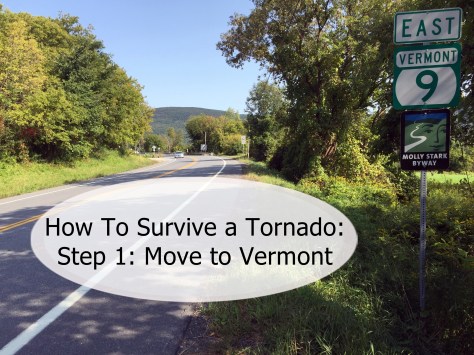
Here it is:


5555


I’m told that it is going to be used all over the midwest.

Is this story true or not? Ask Sarah Sanders.


Customer Service For Werewolves

When being normal fails, I bring the weird. WalMart’s attempts to make me into a cashier have been inspiring.

Given that I was enjoying a bout of sleeplessness, I went to Walmart before work very early this morning. I ended up with more items than I had planned because I’m a guy. When I reached the front of the cavernous store no lights were on for the cashier stations. As I walked towards a smaller lady in the very front she looked up, saw me approaching and rapidly started walking in the other direction. Not to be outdone I went the opposite direction to trick her into thinking I forgot an item somewhere in the store. I then hot-footed it back to the front coming from the other side. Now, she was directly in front of me with no way to evade.

But surprise me she did. She started to walk away. So I pulled out one of the tricks of my youth and shouted a small howl. Not only did she stop in her tracks but several other people dropped what they were doing and turned to see what freak was howling at 4 in the morning.

I couldn’t help but laugh, which probably amplified how crazy I looked and sounded.

“I’m sorry your corporate overlords put us in this situation, but there are no checkers,” I told her.

She turned and bellowed to someone, “You’re gonna have to do his checking for him.” To me, she said, “#11 is open. She’ll do your checking for you.”

“If I do YOUR job and check myself out, this cat food is clearly buy one get two free. Also, if the moonlight hits me directly I am uncertain as to whether I can control the werewolf conversion.” Yes, I amused myself.

As the other lady came to check me out I asked her if she believed in werewolves. She laughed and laughed.

In the background, I could hear someone on the radio asking for another pair of hands up front. Whether for work, weirdos, or werewolves, I can’t be sure.

Today, I was the victor.

I hope the run-and-hide lady knows I was joking.

A Few Words on Voting…

A couple of basic ‘voting’ posts I wrote a few years ago, especially regarding the feeble, illogical, and nonsensical “… if you don’t vote, you don’t have the right to voice your opinion” arguments seen every election cycle.

Not Voting Doesn’t Negate Your Right of Participation or Expression

Voting Disenfranchisement Is Wrong

P.S. I of course vote. But those who don’t, voluntarily or involuntarily, don’t forfeit their right to participation or opinion.

Charlotte’s Hope

a mothers remembrance.jpg


Charlotte once resided in a modest house on the corner of Lilly Street and Shumer Way, nestled inside one of the many decaying towns in the delta area of Arkansas. While she hadn’t stepped foot inside the family home in decades, it was still an infrequent and lingering beacon, a place that once defined her. Her mom had departed this world unexpectedly just as Charlotte hit her stride as an adult. Though her own life was full, a little air exited her soul with her mother’s passing. She not only had buried her mother but a sliver of her own life as well. It remained in her hometown, cloistered and protected from the world.

The promise of life blossomed before her, of course, but the loss of the person closest to her heart would always be one characterized by that uneasy and painful feeling one experiences after swallowing too big of a bite. In Charlotte’s case, the bubble of discomfort failed to fade completely. Each new experience, every shared story, and all moments of clarity occurred with an invisible and almost indiscernible hand on her shoulder. As time marched forward, the hand would feel lighter even as the bruise on her soul deepened. If a kind soul such as her mother could find herself so ingloriously subjected to the injustice of unearned disease, it could writhe toward anyone, despite nobility, intention, or merit. It was a hard lesson to accept but her mother taught it with unimaginable and sublime beauty.

She’d find herself in her hometown, often without remembering the interstate or the quaint highways that brought her there, the same byways once traveled by her mother. The engine of her car would be thunderously ticking, even as the beads of sweat rolled down her forehead. After untold minutes, she’d lower the driver window. Her eyes would devour the familiar details of the small covered rear porch and door, the one almost everyone used. The front door was almost ornamental; someone announcing himself there invariably identified as strangers. She knew without looking that there were 18 rows of white clapboard ascending the side of the house, culminating in exposed painted soffits. Some nights she would slowly emerge from a dream and could still feel the rough sensation of those painted boards as she leaned against the house of her youth. In the summer, one could feel the heat from several feet away.

The cacophony of the summer insects would reach her ears, the hum of mosquitoes would play its summertime melody, and she would cry. In her hometown, most memories anchored in the perennial summertime of her youth. Her mother was so close and the echo of her voice was a lingering presence in the humid air. Whispers, languid syllables of laughter and love, all these intertwined and coalesced in the way that only occurs in Southern towns infected by the paradoxical need to move away.

The peeling paint of the place she once called home still called her name. The four side windows once adorned with light and familiar faces now blankly stared outward without regard. The lawn now screamed for someone to show it the attention it once took for granted. No children would dance in its hidden garden again and it was likely that no family would claim it as an anchor before the structure yielded to the inevitable neglect and gravity. This town and all other places like it are the observable results of entropy; all slide toward darkness and disorder without a guiding force to sustain them. She felt sometimes that her mother was the same dynamic demonstration of physics and that her growing absence was slowly accumulating in her own body as a void with a widening precipice.

The apparition of her mom walked the streets next to the house, idly chiding an unseen canine companion as it wandered in exploration. That her mother might indeed be slightly beyond the unseen membrane between this place of the here and now and the unknown seemed plausible. It was a spell without resolution, though. Hours of fondly wishing it to be so proved the fruitlessness of the endeavor.
“Claire,” Charlotte would cautiously whisper, her mother’s name a secret she dared not say aloud, all these years later. The name, once fallen from her lips, would unleash something primal inside her.

The expectation of her mother’s return was the closest thing to an afterlife that Charlotte could anticipate. Perhaps tomorrow, perhaps in a decade, she would also yield to this world’s demands and sleep one last time, to awaken in the place wherein her mother now resided. It was promise enough for her, beyond even the lofty covenants given to her in church.

Mother and daughter would join one another in raucous laughter, undoubtedly in the unassuming kitchen of her youth. Love would be on the menu, forever, accompanied by the foods with which her mother had so gracefully adorned the family dinner table.

For now, though, Charlotte experienced the heat, the buzz of insects, and the observance of the disintegration of the cradle and crucible of her innermost heart. She could feel the fingers of time furtively clawing their way up her spine, just as they were doing to the integrity of the house she once called home. Both she and the house would inevitably succumb.

As a bead of sweat coalesced against her neck, those same fateful fingers chilled her and she smiled the most secret and indecipherable of smiles that puzzled everyone who knew her.

Not everyone holds onto life with desperation. For some, hope lies beyond, away, and in lingering embraces.

Meanwhile, some of us, like her, sit in the gathering dark in our versions of curious little hometowns and wait. All of this, each detail, is temporary on a sufficiently long enough timeline.

Memories abide and love resists the void.

S-Hook, Lime and Sinker

Just off  I-40 in Clarksville, Arkansas, there’s a Tex-Mex restaurant adjacent to the interstate. We’ve eaten there a couple of times. It’s inexpensive and we usually find ourselves pleasantly surprised by the speed, quality, and cost of the meal. Typically, we compensate by over-tipping by a wide margin. This is in no way related to the fact that the workers invariably point a machine gun at us as we pay. I’m just kidding about that last line. I just wanted to ensure that you’re reading closely. The pico de gallo, which all Tex-Mex eateries should be judged by, is delicious.

As we went to the front counter to pay, I heard the older gentleman who seemed to wear several hats of responsibility at the restaurant ask in Spanish, “How’d THIS get here?” I turned to see him holding the ‘S’ hook, inquiring toward our waitress and another waitress from the other half of the restaurant. As we exited the table, I had placed the hot hook on the edge of the large salsa dispenser at the edge of our table so that it wouldn’t be missed.

Toward the end of our meal, my wife had picked it up out of the bowels of the chip basket, not realizing how hot it had become in the warmer. We weren’t disgusted by the discovery of the thick metal hook, just intensely curious. I imagined that it had fallen from something at some point, but couldn’t place what the mysterious piece of machinery or structure might be. Such an ‘S’ hook typically is used to support two chains. Unless you’re at Applebee’s, one wouldn’t expect such random pieces of metal to be in one’s food.

So strange was the look on the older Latino man’s face that I felt compelled to walk the few steps back to our table and explain. In Spanish, I told them it was indeed inside the basket of chips as we ate, that we weren’t upset by its presence, and to have a great day.

“I’ve been looking for this darned hook since yesterday!” the older gentleman told me. “How did it get in the chips?” He wondered aloud.

“Suicidio,” I joked in Spanish and he took a moment to stare at me as if I had just sprouted a large tree from my forehead.

The other two waitresses looked at me quizzically, still confused by the large metal hook and the fact that I was suddenly speaking coherent Spanish to them. I think that the waitress for my table suspected that I spoke a few words in Spanish but it dawned on her that I had probably understood all their shouted conversations during my visit. (Yes, I heard their conversation about North Carolina. I wouldn’t move there, either.)

Mistakes happen and my wife and I weren’t bothered by the metal hook being in the basket of chips. At another restaurant, one staffed by less personable employees, it might have escalated into a full-fledged verbal duel-to-the-cash-register situation.

As it is, though, I find myself still wondering how the hook fell from whatever it was attached to and into the chips. I’ll bet that the older Latino man is wondering, too.