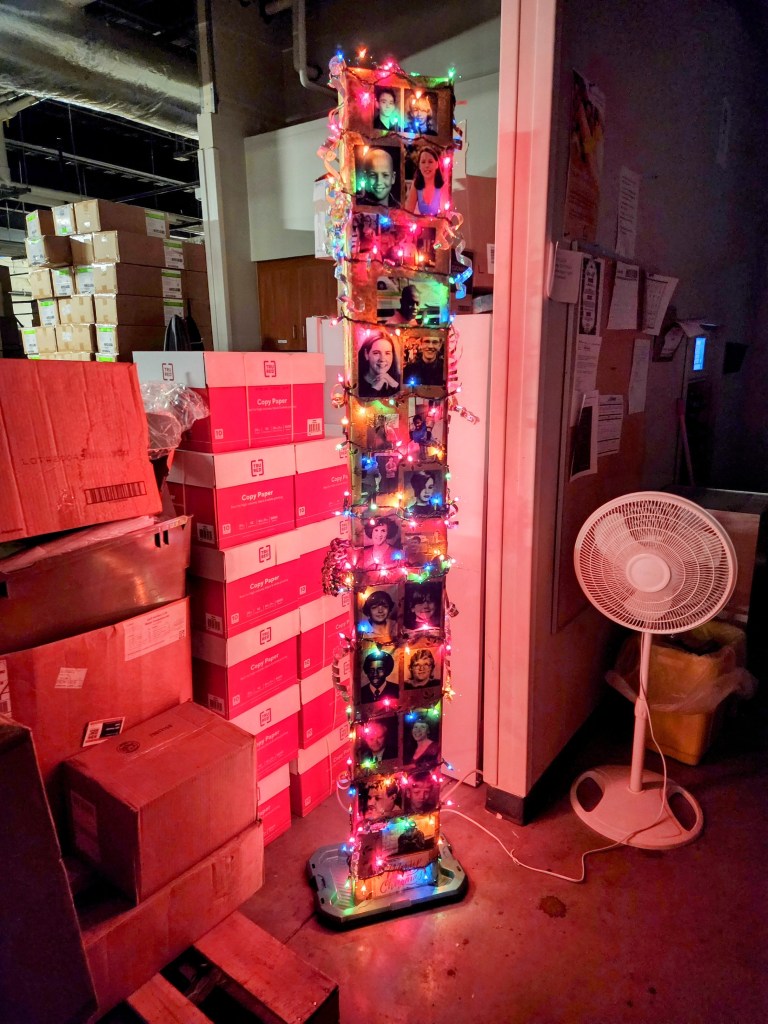
You’ve been gone many years. 2013 was two iterations of my life ago.
You left a legacy of which you weren’t aware.
You have beautiful grandchildren from a daughter you never knew of.
She found out today that you’re her father. That’s staggering news for anyone who wanted the simple truth and simplicity of an answer.
I’m sorry life took you so early. You’d be older and tired of the habits that deflected you from focusing on what makes you happy.
I can imagine you walking up to your daughter for the first time, seeing her children, your grandchildren. Especially if your smart and handsome son Noah were with you, each of you seeing a silhouette of yourselves in her face.
I’ve done the best I can to give your daughter some closure.
Your daughter will be able to separate what you call mistakes from the fact that you were in the world. She’s here because you were.
I’m humbled by the fact that science and DNA can unlock doors in a way that people couldn’t.
Knowing the past doesn’t change it. Judging it doesn’t color or discolor any of our previous chapters.
I didn’t find out my own dad had fathered a child until 26 years after his death. That I had another sister was a secret for 46 years. There’s no doubt that some of my family knew about her. They chose to rob us of the opportunity to know each other. I understand it even though I disagree. Age gives me the ability to dislike it but also to nod my head to some degree. Most of us are doing the best we can, and such decisions are complicated.
Jimmy, I know that your daughter would have brought you joy. She’s married and loved. She’s smart, kind, and the perfect complement to Noah, who is the embodiment of what you’d want your son to be.
Be proud wherever you are.
I sit in amazement at how life still surprises me, Jimmy.
I would give anything to have you here, even for an afternoon, to watch your eyes dance with joy meeting the daughter you never knew you had. To listen to your stupid, outrageous laugh.
For now, though, I’m still happy with this turn of events.
Maybe we will talk about it one day.
For now, know that you have a daughter who finally got a lot of answers. I’ve shared your pictures and stories with her. Her children can look at the family tree I’ve made and see through generations.
I used a picture of your daughter Brianna when she was 13. It was the month you died. It brings me to tears knowing you had such a sweet young daughter who was hidden.
I woke up around 3 a.m. and could hear the neighbors outside on the landing, their night still in progress.
I retrieved my trusty sheet, put it over my head, and knocked.
“Trick or Treat,” I said. No treats were forthcoming.
My brother Mike would have been 57 today. I don’t know what to say about that. He could have lived another twenty years had his choices been different. If he were alive, I’d prank call him and say, “Good morning, you dumb bast**d!” and then hang up. He’d probably call back and leave a message, “Sew any non-bunching pillows lately?”
The picture is one from Dogpatch: me on the left, Mike, my sister Marsha crouched on the bottom, and my cousin Jimmy on the right. We got to see a lot of things thanks to Jimmy. I restored the faces in the photo. Jimmy’s gone too, but I’ll take a few moments to think about him and my brother today. And I’ll think about my other sister, the one I didn’t know I had for another 40+ years after this picture was taken.
The nostalgia will undoubtedly make me more at peace as the world swirls around me today; my thousands of steps and interactions will remind me of the frozen nature of memory and time.
Each second carries me further away from that moment so many years ago at Dogpatch.
Though I’m not dogmatically religious, I’d like to write an incongruous post that merges the Black Eyed Peas with the Christian Bible.
The aforementioned group has a current hit called “Don’t You Worry.” It’s vibrant, energetic and a call put away your worries and concerns. It’s one of those throwaway songs, full of pop momentum and repetitious lyrics. It’s also delightful in a way that belies its formulaic lyrics. I’m certain they weren’t inspired by a call to remember that control and worry are the provinces of people unfocused on what’s essential to happiness, especially from a spiritual viewpoint.
I have a lot of issues with religious texts. Sometimes though, truth is where you find it.
Whether it is Matthew 6+, or a verse from my favorite book of Ecclesiastes, among several others, one of the essential truths of most religions is that we are forces living inside bodies. And we’re not supposed to be mental prisoners to the outcome of our worries.
Not to ignore them or blindfold yourself; rather, to rejoice at this moment and to dance with joy. It’s something that older people forget to do as if such a thing is only an option for the young.
The Black Eyed Peas song evokes a reaction in me. Something about it strikes a call to action to remember that for everything, there is a time and place. Maybe it’s because I love the book of Ecclesiastes.
And if your head is cluttered with worry and concern, no matter how justified, you might be distracting yourself from the opportunity to remember to live. To give up control and surrender. To dance, sing, and feel the physical world. But not to such a point that you forget that everything that makes your heart sing can’t be quantified.
I saw it on TikTok after seeing it on Reddit a while back. Of course, I doubted that it was true. Today, I loaded my Audacity sound software and chopped the song “Hey Jude” by The Beatles.
You’ve probably heard of them – they were a band from England who had a few songs back in the day.
Somewhere around the 2:55 – 3:00 minute mark in the song, the allegation was that you could hear Paul McCartney hit a wrong note on the piano and utter “Effing Hell,” using the actual f-bomb. John Lennon said, “Let’s keep it in the song,” so they did, albeit dropped to a lower register.
After snipping the song in Audacity, I could hear it clearly but wanted to be certain, so I overtracked it and isolated it.
You know what? It’s true.
I’d post it here, but I’m sure FB wouldn’t like me using language that many of us hear and use daily.
Paul McCartney wrote the song originally as “Hey Jules,” for John Lennon’s son. John Lennon went so far at one point to call Julian’s birth a drunken mistake.
Ouch. Proof even that icons say and behave stupidly.
So many people adore the song “Hey Jude” without knowing it was inspired by a five-year-old boy whom Paul McCartney loved and feared for as John Lennon abandoned him to start a new life with Yoko Ono.
Ardormorph: the process in which you love yourself and another to find a way to change with the goal of being happy.
If you want to be happy, you have to decide to be.
And then, the hard work.
Most people have a vague idea of what happiness or satisfaction even means. If you want love, you must learn what healthy love looks like.
If you want happiness, your personal life must reflect what you want out of it. It requires self-honesty and focus.
You must learn new habits, skills, and ways of communication.
If this is the last relationship you want to be in, you’re either all in or not. There is no middle ground.
That means forgiveness for being treated poorly and accountability for what you’ve done.
You can’t change what is behind you, nor can your partner.
Learning from it. Not repeating it.
Be tender. Be kind.
Discuss every aspect of what the future will look like. Please don’t shy away from it.
Don’t make your partner pay for mistakes others made in your past. This person is none of those.
It all starts with your commitment to stop trying to do things as you’ve done before. The behaviors weren’t effective, or you’d still be in a previous relationship. It seems obvious to say that.
Most of us keep repeating cycles and behaviors. We can’t do that and find happiness.
It requires change. Understanding. Listening.
Remember, you learn first and apply it afterward.
It starts with change.
In yourself and in the ways you’ve navigated being in love.
Preface: this isn’t about everyday interactions that happen over apps. This is about the personal, one-to-one, and private messages people send with intentions they’d rather keep concealed. There is a vast difference. Often, only the person with hidden intentions or desires knows for sure. People in relationships must be on guard to protect themselves.
It’s also about people who are in love, married or committed. Casual dating is a separate set of expectations and rules. Once you’re committed and monogamous, the expectations morph. The label by which you refer to your relationship isn’t what determines these changes.
I don’t know how to address connections through work or other scenarios adequately. We all know hundreds of stories wherein someone begins to morph a previously business-only exchange into something intimate. That’s what access and proximity do. As Hannibal Lecter quipped, “We covet what we see.” People in relationships need to be aware and prepare for those scenarios too. The most straightforward point to stop it in its tracks is the first time your instincts are triggered. It gets more challenging after that point.
There are a lot of lonely people out there. They have unlimited time and a lot of motivation to make connections. Someone is always going to see something in your partner, whether it is sexual attraction, creativity, or a sense of humor. Some of them will act on it and initiate conversations.
And since I’ve learned these lessons through hypocrisy, my partners will have access to my phone. I don’t have hidden apps, passcodes they don’t know, or anything similar. So if you write me and tell me that you want to eat me alive, my partner could see it.
I’ve been surprised by some great marriages or relationships being imploded because of all this. It only happens when there is a lack of transparency.
If someone reaches out by texting, DMing, or communicating with your partner, that’s normal. It’s no different than someone telling your partner, “Geez, you’re good-looking!” on the street. They might not know your partner is in love or their story. At least that possibly inappropriate or exuberant statement made in public is made in the sunlight openly.
People will cast their nets, take their swing, yolo, and all that. The biological urge toward intimacy and sex is already overwhelming. Apps and cell phones have made such access impossibly easy. What matters is how your partner responds the first time someone does. It reflects everything you need to know about love, respect, and understanding how relationships work in their heads and hearts.
If you’re lucky, neither of you has experienced the agony of being on the wrong side of this. If you have, it leaves scars – and those scars make you suspicious of almost all interactions your partner has. They pay for your previous trauma even when they are behaving appropriately and without concealment.
If they’ve engaged once, much less multiple times, the person trying to insinuate themselves sees an invitation. It’s code. You have to answer the door before someone can get inside.
Access is impossible to control.
Clarity, once it happens, is impossibly simple and elegant. “No thanks.”
A lot of people fail at this point. Whether they are looking for someone else, need validation, or enjoy someone being complimentary, they engage the other person and provide access. It’s not harmless. Just because someone knocks at your door does not mean you need to answer it, much less open it.
It’s a great analogy. “Hello. No, I’m not interested, especially since I’m with someone. But thank you!” That’s perfectly nice and acknowledges the other person – but sets the boundaries.
Imagine if your partner received such unwelcome advances and responded, “Hey, I’ve said no thanks. Does your partner know you’re writing the opposite sex on these apps? Have them call me, and maybe we can be friends.” You know darn well how that would go.
Of course, the texting person’s significant other doesn’t know!
It’s easy to get angry at the other person reaching out to your partner, whether they are in a relationship or not. It is cheating if they are casting nets, even without physical contact. They can deny it all they want. That’s part of the game. They are building a foundation toward intimacy or physical connection. Intimacy, even through the internet, is dangerous to your actual relationship. They’re somewhere in a relationship spending their energy, focus, and time attempting to connect elsewhere. All those comments, jokes, wishes, aspirations, sexual innuendo, and observations? Those could be spent with your actual partner because they are your person and would love to share those interactions with you.
If your partner engages in it, you have to assume they are well aware of the motivations of those doing it. If they are not, take the time to explain it to them – and that it’s hurtful and counterproductive in a committed relationship. It’s hard to imagine in this modern age that someone isn’t aware of the possible hidden agendas of the opposite sex. To be clear, this is NOT always the case. But it so often is. And at the beginning, there is no smoking gun, no direct way to show your partner that you’re right about it. Again, the test is whether that person texting has shared their interactions with their partner: it’s doubtful. And if you’re partner hasn’t shared them with you, that should be a warning sign.
The looming problem is that your partner now has a connection to someone. If you don’t know about it, you can be confident that your partner knows it would hurt you to know or read those messages. It’s how many affairs start—words, innuendo, hidden motivations. People get to know each other, and unwanted behavior blossoms. Fantasies, traded jokes, things that your partner isn’t aware of.
The other person is siphoning your partner’s time and possibly affection. People can be entertaining and engaged through these communications. Your partner might be attracted to having someone light, witty, and perhaps sexual. That’s what “too friendly” means. That mental picture they are creating of the other person isn’t wholly accurate. Generally. Our largest sexual organ is our brain.
Another person talking to someone else’s partner may have only platonic intentions. But the frequency, timing, and content of those messages will reveal such purposes if they are entirely and transparently shared with one’s partner. If your partner reads them and sees something you don’t – or don’t want to believe – you should default to your partner’s interpretation. That’s hard to grasp because you’re too close to see it. But if your partner is concerned enough to admit it, fire lurks in that smoke.
Many men approach their texting targets by slowly revealing things about their lives. They hide subtle or clever innuendos in their texts and wait to see if the person getting them responds in kind, amplifies, or shuts it off. They only need to find a crack, a small willingness, or something missing in that person’s life or heart to escalate.
If either of you is discussing problems in your current relationship, this is a massive red flag and a signal to cut off communications immediately. Once it reaches that stage, one or both of the people engaging in such communication has more than platonic feelings.
The same is true for sexual jokes and innuendo. Once the person gets your partner to allow, much less participate in or encourage, sexual banter, the danger dramatically increases. We’re sexual beings. Banter like that is fun and dangerous. Anyone who underestimates how our biology affects us that way is susceptible to engaging in inappropriate behavior.
Everyone starts by being friendly or being friends.
It all starts with access.
It’s the interaction that opens the door.
For toxic people, they know this and don’t hit the door with a battering ram on the first approach. They knock softly and follow the signs and signals.
It’s not mean to tell someone texting you that you are in a relationship and don’t welcome anything untoward. It is the only healthy response if you’re committed to your partner. One, because your partner is communicating openly to the world that they are in love and committed. Two, it establishes expectations and boundaries with the person reaching out. Three, it’s vital that your partner shut off any further communication once they feel that the line has been crossed.
Above all, share this with your partner, okay? Even the benign messages. But especially the ones that went wonky. If you do that, you will actively demonstrate respect, honesty, and love to your partner. If you don’t, if something suspicious ever occurs, it will be difficult for them to trust you when you talk about what happened.
It’s no crime that someone thinks your partner – or you – is attractive. That’s normal. Communicating it is a delicate situation that easily crosses boundaries.
You don’t accidentally text someone repeatedly. Concealing the time and content of that kind of communication takes effort.
It’s the concealment that triggers the worry.
If your partner sees that you’ve left the door open, it’s hurtful.
It would be best if you were transparent and immediate when someone reaches out to either of you.
Sunlight, above all, for both people’s sake.
Love is supposed to be easy and it’s supposed to be kind. Love is easy but daily living distracts us from the essential nature of a one-on-one relationship. Love is easy as an emotion and much more difficult as a commitment and an action.
I think all of us expect transparency. We just don’t know how to get there. I believe this is especially true for younger people. You achieve it by doing it first. If there’s no reciprocity, that’s something you will have to learn to accept, change, or learn from. In my experience, I have learned that it’s impossible for things to get sideways for either of you in a relationship is transparency is the foundation.
Never catch yourself behaving in a way that would hurt you if your partner did it.
I’m on antivirals for covid. My symptoms abated drastically. I went running this morning, something I haven’t done in a while. Maybe not the smartest thing to do, but being smart isn’t on the radar like it should be.
I’ve tested negative twice now, which puts into question when I actually “started” having it.
I offered to get anyone who might have been exposed a covid test for their own peace of mind. My employer doesn’t offer them. It’d be nice if they did, but we have great insurance.
On the other hand, as I’ve mentioned, many people just don’t test, even after a known exposure. We’re exposed a lot by those who have no symptoms and have no idea they are covid-positive. Since we don’t wear masks or practice social distancing, every single day is a crapshoot.
Every single person who shares your space or air could be infectious.
Saying you’re being safe while being social is, well, impossible.
Until now, if I were in close contact with a known positive case, I would test three or four days afterward. I realized that a lot of people were simply going about their routines without testing their symptoms and not getting boosters, and we’ve abandoned the behaviors that at least slowed the infection rate.
Some don’t even test when they have symptoms. “Why bother?” they ask. It’s their choice to test for their own benefit or for those around them.
We can’t do much about people who think they might have it and don’t test – and then go about their regular lives.
Compulsory testing doesn’t happen anywhere in my world.
Up until now, I tested more frequently than anyone else I personally know. That’s true. I wanted to know if I might be infecting other people, even if I didn’t have symptoms.
I’ve had five shots.
I was not going to be one of those people who were worried about getting covid unless I was certain I was not also giving it to others.
I’m glad I did that. It was the responsible thing to do.
And so, since masks aren’t required, shots aren’t generally mandated, nor is social distancing, testing has lost much of its practicality.
If anyone could have it, how do you protect yourself from that?
I’ll continue to get future boosters and vaccines, but the ritual of testing is over for me.
I’ve been alone in the wilderness in that regard, at least in my bubble.
I’ll be safe and keep the safety of others in mind, of course.
But my previous behavior doesn’t make much sense if most of us aren’t doing it.
I can be simple: “While the biological cause of covid is a virus, it only spreads because our social nature is embedded in us. There’s no cure for that, and if there were, it would be our end.” – X
I’ve taken each covid shot and booster as soon as it’s available. The science is clear: getting them reduces the likelihood of a more pronounced case if you get infected. We fought the same reluctance with the flu shot prior to covid’s arrival. Our contrary nature bedevils us, but it also keeps things interesting. I look at some people’s aversion to science or vaccinations differently than I once did. It’s not a question of intelligence; of that, I am completely sure.
It’s still true that a large number of people who are infected are asymptomatic. During the colder months, many people will think they have a cold or allergies. It’s often covid. Many people with symptoms ignore them – and that’s okay. Really. Whether they have misconceptions about the efficacy of covid shots, engage in conspiratorial theories about covid’s effects and origins, or simply see that it’s going to be around for a long time, it’s not irrational to feel that way. A lot of people just go on about life, and they either get better or don’t. We all rely on one another to keep each other safe, but our actions are always realized as individuals.
Studies that randomly test people reaffirm that at any given time, a lot of people test positive for covid whether they have symptoms or not. Each of these people comes into contact with hundreds of people daily, their spider web or potential exposures growing exponentially.
For most employers, masks have disappeared. In public? The same.
And that’s okay.
We are only as strong or as safe as our weakest link. That link? It’s all of us, unable to live our lives with love and seeing that we are so interconnected that any improvements or cures require all of us to actively work for it. We can’t even stop wars, so it’s no surprise that a medical emergency could have derailed us. Hell, we can’t even get a lot of people to use turn signals. On the other hand, the surprise of seeing where they decide to go at the last second is often a beautiful Pandora’s box.
Statistically speaking, you will be around many people who expose you to covid. There’s not much you can do. Knowing many people who undertook considerable change to limit their exposure – and got it anyway – I don’t want to sound like a pessimist. With covid, it’s obvious you can do everything right and still fail and get it. Watching people go about their day substantially proves we’re not doing everything right. Yes, that includes me, but I recognize my own grasp of known science compared to the practicality of attempting to limit a disease that lies at the crux of being social.
I had covid not too long ago, and then I got my fifth covid shot. Yesterday, I woke up to sniffles. I felt like a million dollars, which I characterize as feeling like I’m a human battery. I checked my temperature and found I had a fever. The sniffles worsened, so I tested after work.
Yes, covid positive again.
Maybe I shouldn’t have tested. Many don’t. It’s no worse than not testing regularly or having a nationalized system to randomly monitor unknown infections. I know how that sounds, written that way. But it’s a lesson I have learned pragmatically and in observance of a couple of years of real human behavior. I would not want to knowingly infect someone else. That recognition should be contrasted with people’s decisions not to get shots, or to test, or to attribute their symptoms (or lack of, for that matter) to allergies, a cold, or just feeling tired. Not everyone is lucky enough to work somewhere where they don’t lose a piece of their paycheck if they test positive. As for me, I’d much rather be at work, around people, and contributing. It’s certain that as covid continues, our policies will change as the cold compresses into smaller spaces sharing the same air. Practicality will bend policy, just as it did when covid jumped up and caught us unprepared. Lord, the things we did!
The psychology of people is what fascinates me. They worry about covid yet actively work and walk in public without masks, social distancing, etc. They grocery shop and attend events wherein large groups of people participate. Even if you are actively engaging in behavior that limits your exposure, it is a certainty that you are being exposed repeatedly. At work. At the convenience store. At the theater, sporting events, and concerts. If you’re not testing regularly, you may have had it and been an exposure yourself. Any behavior that puts you into contact with people is a potential exposure, not just the ones you know of due to a covid test. If you’re not testing regularly (which isn’t really practical on a national level), you’re only able to feel like you haven’t infected anyone simply because you are unaware.
In my case, I tested much more frequently than anyone else I know. Not because I was afraid of covid, but because I wanted to feel confident that I was not the source – and that it seemed like the right thing to do absent a system that encouraged all of us to do so. I did the best I could to cure my ignorance as to whether I might be spreading it. Because I sure as hell wasn’t limiting my social behavior as covid allegedly winded down. I hate sounding haughty or self-satisfied, but I do keep it in mind when I hear people express concern about getting it who didn’t take the time or money to test as regularly as I did during the bulk of the pandemic. Fear of getting it, a sincere fear, to me, means you’ll reciprocally do what is necessary to avoid being the one giving it. I wasn’t kidding when I say I don’t know anyone personally who tested more often than I did.
And that’s okay, too.
We’re social creatures. We hug, we eat, we touch. And we breathe the same air.
As for me, everyone who knows me well knows I am a world-class hugger. I can’t imagine a world wherein that wasn’t the case.
You can’t avoid covid. You are welcome to try.
I won’t complain as long as those who do remember that every single point of human contact is an exposure. There’s no practical way around it. If you are breathing their air, you are sharing all their invisible bacteria and viruses. It’s always been this way and obviously always will be.
We were lucky covid wasn’t the catastrophe it could have been.
As for me, I’m optimistic.
People’s behavior in the face of covid fascinates me endlessly.
I had the advantage of being in the medical hotseat when it blossomed. I watched as people verbally warred over its causes, its reality, and its treatment. Covid ended many lives prematurely.
At the center of it all is the fact that we are social creatures.
There is no cure for that. At least, I hope not.
Please don’t “at” me with anything other than an agreement that you understand that being around people is an agreement that anyone can have covid – or that you can, too, and not even know it. Short of locking yourself in a self-contained safe room in a contamination suit, you’re being exposed routinely. Even from those who’ve been fully boosted, from those who haven’t, and from those who look and sound perfectly healthy. You can worry about it all you’d like. But if you’re not in the aforementioned safe room by yourself, you are agreeing that being social is the risk you’re willing to take every day.
I don’t like the sexual analogies some use to compare covid. Sexuality is voluntary and expressed with one individual (Well, in most cases. Let’s not get crazy here!). You’re accepting the risk for yourself and responsible for your behavior. Covid is a disease that transmits omnidirectionally without other participants realizing it. That’s the social truth of these diseases. We rely on each other, just like we do when we drive the crazy streets with the assumption that the other driver is paying attention, not under the influence, and not ready to meet their maker.
All of us owe a huge debt to medical research and medical care itself. It’s easy to forget the pyramid of discoveries that have prolonged our lives. I don’t have to wonder ‘what if’ about the vaccines. I’ll never know. And I’m happy to be able to say that.
PS Remember that I’m not dead yet. I still have it penciled in for 2034. You’ll know it’s my time because I’ll probably be on the news: “local man dressed as a superhero can’t fly after all.”