All posts by X Teri

Walgreens: I’m a Suspect

freestocks-org-nss2eRzQwgw-unsplash


Sometimes, there are advantages of having a stupid name like X.

TLDR: Walgreens gave me someone else’s prescription and then told the other account holder that I’d somehow obtained their private information and gave it to Walgreens in order to get their prescription right before they came to pick it up.

Here’s an example of something that’s not ‘the world is on fire,’ but weirdly informative. I have a few Walgreens stories that I’ve not posted.

This time, it was her prescription that caused me the grief.

Dawn had another prescription ready, costing $4. After work, I drove by and waited in a long line of vehicles. When it was my turn, I pulled up, and the clerk asked me for a name. I said, “Last name T-E-R-I, first name, Dawn.” The clerk didn’t ask me for a DOB or an address. She was looking at her POS screen with all the information on it and said, “Found it.” She didn’t identify the prescription like is customarily done. Despite it being an ironclad requirement, they sometimes don’t. Sometimes they recognize us, sometimes they’re busy, and sometimes, they simply forget. It’s easy to spot a new employee because of their tendency to interrogate you like a German prisoner. Today, the clerk said, “$3.89 is the total.” Close enough. I pushed my debit card through and she processed it.

Because the store was busy, I put the prescription in the passenger seat and drove the short drive home.  I made us a great lunch. Afterward, Dawn ripped open the Walgreens bag and said, “What’s this?” They had given me someone else’s prescription. The names were similar in the sense that if you were drunk, they might sound the same if you’d never heard the English language before. Because I had this happen before, I dropped everything and went back up to the store, in case the woman in question somehow went to fill her prescription before I went back. I went inside and asked for the store manager instead of going to the pharmacy. I’ve learned to only explain myself once in these situations. I’ve also learned that not all techs appreciate an error being brought up, no matter how nicely it’s done. The woman who I thought was the manager told me that the woman whose prescription I had been erroneously given had, in fact, come to the store right after I left.  She told me that the clerk who gave me another person’s prescription thought she had verified the information with me. I wondered what the real conversation between the store staff and the other customer was really like.

We went to the back and I watched the purported store manager say something to the clerk who’d made the error. She turned to look at me. It felt like eye darts were coming out of her face to hit me in the forehead. I was polite because mistakes happen. I didn’t even care about a refund.  I knew that, for once, I had done nothing wrong. In a twist, the clerk made a dramatic and overt attempt to confirm my address and information this time. The irony didn’t escape me.

Arriving back home, Dawn agreed with me that I should call the other person whose prescription I had initially picked up. I googled her name and left a voicemail on what I thought was her answering machine. A little bit later, the woman’s husband called. It was a very interesting conversation. I told the husband a bit of backstory and what had happened at Walgreens. What he told me surprised me.

Walgreens had told them that immediately before they had come to pick up the wife’s prescription, that a man had driven up to the window and given them all of his wife’s information, including her full name, address, and date of birth. The couple left thinking that their information had been intercepted, hacked, or stolen. Walgreens staff further said that there would be an investigation and that the cameras would be reviewed!

It’s essential to keep in mind that when I had entered the store to bring back the wrong prescription, the person who I spoke with, the one who said she was the manager, had already talked to the couple whose medicine I had picked up.

Why Walgreens told the couple such a story is subject to interpretation. Likely, they didn’t want to initially admit that they had violated all their own rules. They could have said anything but chose to go that far out on a limb.

The husband and I spoke for several minutes. He and his wife had been very concerned about their information being taken. I allayed all his concerns in that regard. We compared notes and stories. He wasn’t happy about the possibility of people getting the wrong medications and couldn’t understand why Walgreens had told him the story about someone driving up to the window and giving all his wife’s information, especially since it was utterly untrue. For my part, it was a little disconcerting hearing someone tell me that Walgreens staff had slandered me instead of merely addressing the issue directly.

I’m happy I called the other prescription holder. I think he was, too. He knew Walgreens wasn’t making sense but didn’t know how to figure it out. Until I called.

After that call, I called the store to speak to the manager. Surprisingly, a man identified himself as the manager, saying he’d been in a meeting. I went over the story with him and told him that I had been understanding and kind about the entire incident. I emphatically told him that I had spelled my wife’s name but that the clerk did not ask for any more data points or do the diligence required of her. I let him know that I had allayed the other account holder’s privacy fears. I did tell him that I was a little bent out of shape about his staff telling other customers that I had driven up and given another person’s identifying information and implying that I had fraudulently bypassed Walgreen’s protocols. Even though I didn’t need to say it, I let him know that some customers would cry “Slander” and cause a literal uproar about it.

He was apologetic and said he’d look into it. I reminded him that in addition to looking into it, he might advise staff to limit their commentary to things they knew to be true. No, lightning did not strike me, in case you’re wondering.

 

Momentary Humanity

danielle-macinnes-ZyiT0dUPKy0-unsplash.jpg


As I drove home, I did my best to expunge the workday from my thoughts. So much of my day had been packed with banal, lifeless exchanges. I listened in fascination as Janet Mock talked about her early life in an interview on NPR. On a whim, I quickly turned into the drive of a convenience store.

I entered the convenience store to fulfill one of modern man’s biggest follies: buy lottery tickets. Ahead of me, a young black man was struggling with a pre-loaded card and a card swipe in an attempt to buy gas. I conducted my business with the pleasant cashier and stepped to the left. Another couple of customers finished their purchases and I stepped over to the other side as I pulled out my wallet to stuff the new ticket into its confines.

“I’m so sorry to waste your time. Thank you,” the young man told the clerk. She smiled and said, “No problem. Have a good day.” The look on his face was one I well recognized. He probably didn’t have enough gas to get much of anywhere.

I watched as he peered through the window at his tall friend outside. He was standing between the pumps and a tan Oldsmobile, waiting for the pump to authorize the gas. The man inside the store stopped as I held up my hand and said, “Wait.” Expecting something even more upsetting, his eyes looked up at mine. I handed him the cash from my wallet and said, “Didn’t you say you need some gas?”  He looked at the money, then back at me. “Thanks, sir. Jeez. I don’t know what to say.” Because I’m a master of wit and conversation, I told him, “Have a great afternoon.” He turned back toward the cashier, a smile spreading across his face.

I went outside, got inside my car, and turned on the ignition as a blast of cold air hit my face and the sound of Terry Gross delving back into the life of Janet Mock.

Although I usually don’t stick around to witness the aftermath of my moments, I looked down at my phone until the man inside the store had exited. I then watched him using my mirrors. He excitedly held his hands up and shouted something to his friend at the pumps. While I couldn’t quite discern the words, his glee was apparent.

I drove away, leaving the man’s story behind me.

In return, my heart was lighter, my day forgotten.


We All Have Our Jar of Snake Oil

feet_clownshoes_reflectyourworld-396788.jpg!d

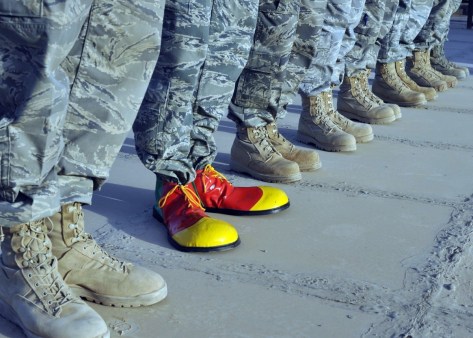
The Quackery Commentary Inhibition: an individual’s reluctance to honestly share his or her derisive opinion about another person’s ridiculous beliefs, usually under the mistaken assumption that our own views are beyond reproach. Each of us wears clown shoes in some sense.
.
It’s a treacherous path when you wish to express your opinion about some topics. People’s interests, beliefs, and attitudes overlap to a degree based on tribe, religion, or geography. Each of us has our crazy tangents, however, ones which often trigger a disproportionate defense mechanism when someone brushes against them, either accidentally or in mockery.
.
If you’re going to put your foot in your mouth, it’s easier if you’re not wearing clown shoes when the opportunity arises.
.
The fact that we convince ourselves we need to tread lightly is in itself a powerful demonstration of how unattached we are from reason and logic. It’s a certainty that many of our friends and family silently mock some of the things we follow or believe. Anyone claiming that their beliefs perfectly match those of all their family and friends is in a cult, not a society; even then, I doubt it’s possible.
.
“Truth is not flavored by opinion.”
.
That may be true – but opinion often throws a left jab into truth’s teeth.
.
With the goal of not slaughtering any sacred cows, I’ll ignore the overall question of religion, which is the most glaring example of personal beliefs that shape people’s otherwise logical framework of living. Anyone paying attention can see that the disagreements caused by religious differences are a constant source of irritation, anger, and amusement among people. Any framework demanding certainty is already saddled with an inherent disregard for the next guy’s version of the same.
.
I have my own blind spots, many of which aren’t logical or defensible. I’ve learned to recognize their fragility when I feel irritation when given contradictory information. No one likes to eat a hamburger carved from their own sacred cow. If you are going to do so, though, you might as well break out the mustard and pickles and figure out an easier way to swallow it.
.
In the last few years, I’ve been astounded to learn that I was wrong about a few things, ones which seemed set in stone before. Among them were cornerstones of liberalism. Facts did not support them. My insistence sufficiently silenced the contradictions until a new truth materialized. Given that some truths have given way to others, it is only logical to conclude that I have other blind spots which impede me.
.
Horoscopes, ________________ , homeopathy, psychic phenomenon, Bigfoot, ghosts, ESP, witchcraft, MLM schemes of all sorts (yes, even the one you’re thinking of), and other subjects are prone to evoke a snort of derision from me. Each of them presents an opportunity to examine their veracity, as well as a reciprocal reminder to consider what lunacy I might believe in.
.
*I’m not making an equivalency argument here regarding the mentioned subjects. One of the defects of listing such topics is that people will immediately and erroneously make that incorrect assumption.
.
People reading this are already jumping to a mental defense of one or more of the subjects mentioned above, their intellect turned to the purpose of hurling denials back at me. Their time would be better suited by simply ignoring whatever I have to say. Echo chambers at least offer a safe haven, even as they stunt growth. It’s impossible to reason someone out of a belief they didn’t reason themselves into. Most adherence to such belief systems is self-fortifying and tends to radicalize when a perceived contradiction is introduced. A while ago, I wrote about an acquaintance who believes that all cancer is mental. It’s not just ignorance – it’s dangerous and demeaning to those who suffer as a result of disease. Challenging the acquaintance on his stupidity will only cement his mistaken ideas.
.
A symptom of whether I place any credence in a particular belief is how I respond to humor or satire involving the subject. The faster I laugh, the more likely it is that I find the entire issue to be ridiculous or subjectively impossible to be sure of. I’ve also become a fervent believer in the fact that those who noticeably lack a sense of humor about a particular subject are indicating cognitive dissonance in its regard. If they otherwise have a definite sense of humor and yet belligerently respond to any commentary or critique of their particular belief, it’s a certainty that it is a belief that can’t withstand scrutiny. This observation applies to me, too; if I find myself mentally lashing out, it’s a sign that I’ve hit the crossroads between belief and sustainability.
.
Irritation becomes the carpet under which unsupported beliefs are swept.
.
The problem arises when we share our disbelief with people around us, especially people full of humor and intellect. Throwing a dart at their dubious reverence invariably causes a medical condition known as “pissing them off.” More dangerous than the Carpet Viper is the angry intellectual. Even more fatal than the fierce intellectual is the knuckle-dragger. There are few people enlightened enough to look the other way without anger if their beliefs are challenged.
.
When we don’t or can’t share our disagreement, it infects other areas of our lives and makes us less authentic. We become avatars and shadows on a stage, playing roles which deny what motivates us. Over time, we lose the real connection we have to one another, even if the link reveals profound differences in belief. If I can’t make a face every time you throw salt over your shoulder or claim to have seen a ghost, neither of us is getting a real connection from one another.
.
It’s a fool’s errand to apologize in advance if I’ve stepped on toes. In honesty, there’s no way that you don’t listen to me or read some of my posts and think, “That guy is missing a few bolts.” It’s hypocrisy to wish to shout me down and simultaneously refuse to agree that you do the same thing, even if you don’t want to get caught in the act.
.
All of us, each day, roll our eyes at the idiocy our cohorts believe. To simulate this experience, watch a couple of hours of Daystar television.
.
Everyone should take a moment and find the Wikipedia pages for Donald Gary Young, Daniel David Palmer, or the Barnum/Forer Effect, among others. Regardless of the modern incarnation of whatever it is you might find worthwhile about a particular subject, many of the things I mentioned find their genesis in doubtful science. Whether they’ve evolved is subject to opinion. The people involved were not the type of people I would find myself agreeing with, nor their beliefs compelling.
.
I could be wrong.
.
Can you?
.
More importantly, can you tell me you think some of my subjective beliefs are wrong?
.
I won’t get too bent out of shape about it if you do – but don’t expect me to go to a chiropractor for the bend if you do.
.

A Few Words About Springdale

sdfsd


Anyone who knows me or has read my comments about Springdale will tell you that I’ve been overwhelmingly positive about the changes in the city. The most significant exception, albeit half-jokingly, is my opinion of the marketing and design of the city’s logo, which is as inspiring as a crossword puzzle in German. Any improvements which reduce the number of cowboy hats being worn at government meetings can only be classified as miraculous and welcome. (In all seriousness, I like cowboy hats, but a couple of previous political players who donned them soured my regard for them in the public forum.)

Economics drove many of the changes. There’s been a lot of resistance from many, especially from the older citizens and less progressive people living in the city. Trails, polylingualism, and diversity are things which weren’t embraced in Springdale’s past.  Springdale’s roots are parochial and restrictive. By no means am I falsely claiming that these tendencies were homogenous or shared by everyone; they were, however, powerful influencers which resisted change. This tendency is as much Southern as it is a reflection of Springdale.

By almost all metrics, Springdale is a better city than it was in the past.

Springdale’s growth is directly intertwined with its embrace of modern amenities and dedication toward economic pragmatism.

Behind the scenes, though, we have a few forces which tend to exert a strange warping of the general direction of change. Whether it’s a corporation with an unusually loud voice in the Chamber of Commerce or a church with a disproportionate voice in politics and government, Springdale is not governed as transparently as one might expect. It is the quasi-government that carries a portion of the power in Springdale.

Because of the weird confluence of cultures, Springdale is undergoing an uneven metamorphosis. By any measure, its population is well over one-third Latino. Even though it’s only the fourth largest city in Arkansas, its school enrollment is the largest. About 4 in 10 residents speak a non-English language, and about 8 in 10 are citizens. (The citizenship rate is lower in Springdale than surrounding large cities and Washington County.) 1 in 4 residents was born outside the United States. (Compared to 1 in 9 in Benton County.) As the economy strengthens, the stability of the area allows residents to stay and put down roots. Most of them will not leave, statistically speaking. Despite these facts, the poverty rate is about 18%. Springdale’s homeownership rate is much lower than the national rate of about 64% – and also lower than our neighbors above us.

Having said that, Springdale is suffering from a problem that has blossomed in other places. As demographics shift, those left in the unbalanced position often deviate from their dedicated focus and adopt a less progressive attitude, both in their approach to economics and policy. Pragmatic governance gives rise to politics and issues.

I distrust all politicians who choose ideology over pragmatism, even those who agree with me on issues.

That Springdale is going to undergo a drastic shift in diversity and population is undeniable. Whether those tasked with peering into the future will honor this inevitability is the central question. Springdale will be a majority of non-whites, probably much more quickly than people realize. Springdale will be a crucible of language, culture, and diversity. Anything which fails to recognize this fact is a disservice to the future of the city. Like all cities growing in population, it is not a safe bet to assume that the community will not deviate in matters of religion or non-religion, language, and politics. It is a fool’s errand to engage in behavior which ignores the wave of changes that are coming.

The great thing about city government is that those involved in it traditionally can dedicate themselves to infrastructure and financial planning. There’s usually no room for demagoguery. When those tasked with local governance deviate into political ideology, things often go awry.

The most recent symptom of this loss of pragmatism is the effort of some to pass a non-binding resolution declaring that Springdale is a pro-life city. Even though the decision is entirely devoid of legal meaning, those in favor of the proclamation would rather be able to literally circumvent established law were they able to do so. It is disingenuous of them to claim it will not affect reproductive options. Obviously, this can’t be the case. If the resolution is meaningless, why pass it? Some of the City Council and within the government want to make abortion illegal. Simply say so, without the color of the city government’s authority behind it.

If it is any comfort, I personally cannot imagine that the right to abortion will stand as the law of the land for very much longer. My personal solution for this is to require every male to have a vasectomy by maturation. (They can be reversed.) It’s about time we put the burden of planning on the male half of the population, anyway. Am I kidding or not about the last half of this paragraph?

My argument isn’t in regard to Planned Parenthood, which indeed is a polarizing organization. My point is that the city should tread cautiously in its approach to using city time to make political comments that overreach the governing function of a local city government. We have entirely too much of that nonsense at the state and federal level. As for the latest development and the non-binding resolution, many of you might recall that I predicted that this sort of thing would occur as the composition of the city government changed.

Can they do so? Of course! We can all agree that politicians seem to be unable to stop using their status as elected public servants to wag their fingers and pontificate. It’s one of the things we dislike the most. We choose them to represent us as employees, and they repay us by lecturing us. I’ll admit we collectively behave stupidly, which partially explains the tendency.

Doing so, however, draws contentious scrutiny to the City of Springdale. The arguments in favor of economics simply get abbreviated and silenced by the weight of the stigma of the underlying fight. Businesses and people coming to the area have too many other legitimate choices regarding infrastructure, employment, and residence, especially when considering our neighbors to the north. It’s easier to sidestep the issue by going north. Employers behave in this pragmatic manner all the time. It’s safer to avoid a job applicant with potentially unwelcome baggage. This tendency in part explains why Harrison, which should be a large, thriving city, stills remains behind the curve.

If the City of Springdale cannot prohibit reproductive services inside city limits, those with profound objections to their availability should devote themselves to providing better alternatives. Many people do – and that is an honorable course of action if you honestly disagree with the status quo. I’m not mocking those with regard for human life. It’s an easy trap to fall into.

If the City of Springdale wishes to draw attention to itself by using non-binding resolutions, I would recommend that they choose ones which do not contain the fuse for a public relations fight. We have better people than this. I know that those in favor of this particular non-binding resolution want to send a message. And they probably will. But the converse to the message is generally disfavorable. It’s enough of a risk to dissuade most cautious people from making it.

On another note, it is unwise to appeal to the majority on issues, whatever those issues may be.

I think I’ve made a case to remind anyone who has forgotten that the majority is going to be someone else fairly soon. Giving predominant voice to the majority simply because you can, also provides the opposition with the right to do the same to you when the time comes.

We can do better.

We are better.

We don’t need a resolution to tell us.

…

P.S. The tenor and tone of any possible replies are indicators of the depth of your regard for civil discourse. Be nice, be concise, and as in life, don’t reduce the room by your presence. Civil servants are supposed to face criticism openly.

.


A Eulogy For December Moments

1111111111111


I’m holding my breath and waiting for his swan song. Though the stanzas of our lives are numerous, some of us race with abandon toward the long silence. He’s among those. Even if we cover our ears to drown out the notes, the subdued and reduced scales will still flow and ebb all around us, whether injurious or nostalgic.

There will be no melodic crescendo nor applause-laden curtain call, of that I’m sure. His symphony will abruptly cease, and the echoes of his efforts will radiate quickly into oblivion. I can feel the tempo and its accelerando, racing impatiently toward the inevitable.

A life will have ended. Each of us who knew him will have our own arrangement, filled with annotations, corrections, and commentary.

As is often the case, many will have reached conclusions and coda without understanding that his life filled with the burden of secrecy. Lives, like harmonies, often gain depth through filter and perspective.

Our facades conceal our secrets; they also conceal us.

We can only make decisions with the information we have. I tried. I failed. But it’s not my failure to own.

I don’t hold myself to accountability, either, in part because his addiction demanded secrecy, anger, and retribution for those peeking inside the fortress of denial.

It’s difficult to stand near the fire without wincing in pain – even in December moments. We draw close to the light for warmth. As we walk away, the warmed fabric which protects us burns.

Life will go on. We’ll claim to have learned our lessons from his exaggerated example. We’ll reflect, hope, and dedicate ourselves to avoiding the same mistakes.

We’ll make them, however. Our humanity requires an ignorant allegiance to forgetfulness. Collectively, we have only a few vices, ones which we ceaselessly abuse to our own detriment.

We’ll recall his presence. Perhaps, in time, even as it fills us with fondness. His melody will be a problematic reminiscence.

Those who lose their arguments with their lesser selves tend to bequeath a series of discordant and minor shards of broken glass for us to decipher.

Walk among them at your own peril.

To he, to him, to me, to we, to us, to you.

Love, X

Government Dress Codes Are Not Democratic

44057213_2107053119558308_8289574751463014400_o


Another post from another social media site. This one drew commentary, mainly from people who said they’d never thought about the issue in this way before.


Before I begin, I’m assuming you understand that I’m discussing normal, everyday people and the prevailing mode of dress. It’s important that I remove arguments toward the exception from the conversation before I elaborate.

Forgive my tone and insistence.

Though I might be wrong and you might not agree, the older I become, the more I find this issue to be a problem for me.

If you are in a public governmental space and anyone demands that you dress formally, you can be certain that the forces behind it aren’t interested in democratic representation and equality; title and formality do nothing except to distance us from those who work for us. Beggar, plumber, and lawyer alike are equal where the government is concerned.

All requirements of dress are artificial ways to insist that there are hierarchical distinctions between those served and those serving: servant and master, or at minimum, superior and inferior. In the governance of a democracy, no such distinction should exist.

All government officials work for us, even judges and senators. They are our employees, appointed or chosen based on qualification of résumé rather than worth. In a democracy, we are all equal, even to those who would claim elevated status. While it tends to be a more conservative point, almost all government officials are our employees or representatives; hired, chosen, or assigned to perform a job.

Observing so much of the process and methodology of our government, I’m always surprised that citizens grant illusory privilege to those we choose to govern or judge our disagreements. That we extend this privilege in such a manner that allows them to feel able to sanction us for our clothing is arrogance on their part and idiocy on ours. Whether it’s a judge who irately demands that you put on a tie or never wear open-toed shoes or a senator who won’t allow you to speak to your representatives because you’re wearing mechanic’s coveralls, it’s wrong and wrong-minded.

We owe our respect and allegiance to our collective agreement of justice and equity, not to the fallible men and women who often forget that they serve for us rather than over us. The title or robe do not bring reverence, and if you demand it, you are not worthy of either the robe or the title. I can think of no practical reason to demand that fellow citizens follow a dress code in the presence of the operation of any facet of governance or judicial determination.

Whether I wear a tie, slacks, or dress shoes in no way determines my attitude regarding the service rendered. If the place holds no intrinsic honor and the title is assignable based on qualification, to whom then do we bow to when we acquiesce to the unreasonable and undemocratic demand that we conform our appearance to an arbitrary standard they choose.

Fashion and attire are subjective; they are not factors any reputable government servant should weigh, much less censure. It’s not your job to demand conformity in attire or ours to fear your displeasure.

Simply put, sir or madam, I’ve given up the pretense. If you insist that my attire doesn’t do justice to the place you were appointed or chosen to work, it is you who needs to be removed or sanctioned. We are human beings in the presence of government officials, seeking that you do your job as assigned. Our reverence is toward the law and our democracy, not those who imperfectly bend it to human caprice or avarice.

If you choose to elevate yourself through requirements of attire, please be aware that we as voters can and should pass laws to require you to wear common clothing of our choosing.

Those who fear the mob or accountability to the masses know that dress codes are almost always motivated by a misguided demand to be honored, whether deserved or not.

In the presence of the execution of any government duty, no one should take into consideration the garments on the citizen’s back. This is especially true where our individual interests can be harmed or infringed.

.

I Deserve An Award

yns-plt-6dJ4fApKPk8-unsplash

Social media has its moments.

I laughed until I almost cried when I noticed an acquaintance had posted one of those mind-numbing memes mocking parents who forget their children are in the back seat of their vehicles.

One afternoon long ago, my acquaintance got in her van and drove away. Her child was in a carrier on the hood of the van. (Yes, in front of her.)

I’d like a moment of silence to commemorate my ability to control my urge to post a seriously snarky comment on her meme.

Universal Voting & Registration For Everyone

47320564_2132861066977513_5926534481652482048_o

I posted this back in November 2018 on another social media site. It generated a lot of white noise and argument.


“Just to be clear, I think that no one’s right to vote should be abridged – ever. The potential for abuse is otherwise inevitable.”

As radical as it seems to some, the simplest solution to all voting registration issues is to eliminate them all and implement universal registration without limitation, across all jurisdictions. Yes, even if you’ve been convicted of a felony; and yes, even if you are currently in prison. Barring any exemptions is one of the fairest means to ensure that political whim doesn’t interfere with people’s access to government. If you are over 18 and currently not dead, you should be able to vote if you wish to do so.

I’d like to be clear that my proposal in no way is intended to affect the number of people who actually vote; critics of universal voting often cite studies to substantiate claims that universal registration fails to result in more voters exercising their right. The crux of my argument goes to the attempted restriction of anyone’s right to vote, not whether they choose to exercise it. Having said that, there are several workable ideas to dramatically increase voter participation. Each person still decides whether to exercise his or her right to vote.

As a backdrop to my changes, I would, of course, implement federalized identification standards. Each citizen would be enrolled at a specified point: birth, school, driving, naturalization, etc. Identification systems would also include biometric data embeddable into the system itself. I’m not proposing a perfect out-of-the-box system. We’ll have to engage our collective resources and intelligence to ensure we address privacy concerns and logistics issues.

It’s difficult to imagine an advanced democracy and government which fails to maintain a complete list of its citizenry, for various purposes. While it’s my opinion, it’s one which seems necessary and efficient.

Note: if you are going to make a “we can’t trust the government” argument, or one involving the impossibility of maintaining a complex system, I’m not trying to reach you. A perfect system is impossible; even a well-organized one must be maintained by the government. We must always do the best we can with what we have, with the people willing to help achieve it.

For every argument made against my simple system, I can counter your argument with logic and technological safeguards. Instead of worrying about voter registration deadlines or varying laws across states, let’s wipe all voter registration requirements from the books and design a system which truly represents our collective right to vote.

Of course, there will be wrinkles which need to be addressed, just as there are inequities in our current patchwork system. Our tax system is flawed, and yet we rely on it to pay our bills. Each state and jurisdiction handles birth certificates differently, as they do with vehicles, property taxes, and all other methods of governance. We’re smart enough to figure out a better way to ensure everyone gets to vote. Technology and a dedication to providing guaranteed access to democracy is the right thing to do.

I’d like to start from scratch with a system which does not allow any state or federal government to tell a citizen he or she can’t vote. Universal registration and universal identification systems are an inevitability. It’s our system and our right to ensure that political whim doesn’t interfere with our access to the polls.

If you’re in favor of disenfranchising someone from their right to vote, all I can ask is that you investigate for yourself how such measures evolved. Secondly, I’d ask you to examine your personal motivation if you agree with measures which strip adults of their right to vote.

All the difficulties potentially mentioned with universal voter registration already have counterparts in our current patchwork mess of a system.

We spend so much of our time complaining and arguing about voter registration that we often fail to see that the problem itself exists because of the way we look at it. The discussion should always start with the question, “Why isn’t everyone always registered?”
*