Category Archives: Biographical

Carolyn’s Mashed potatoes

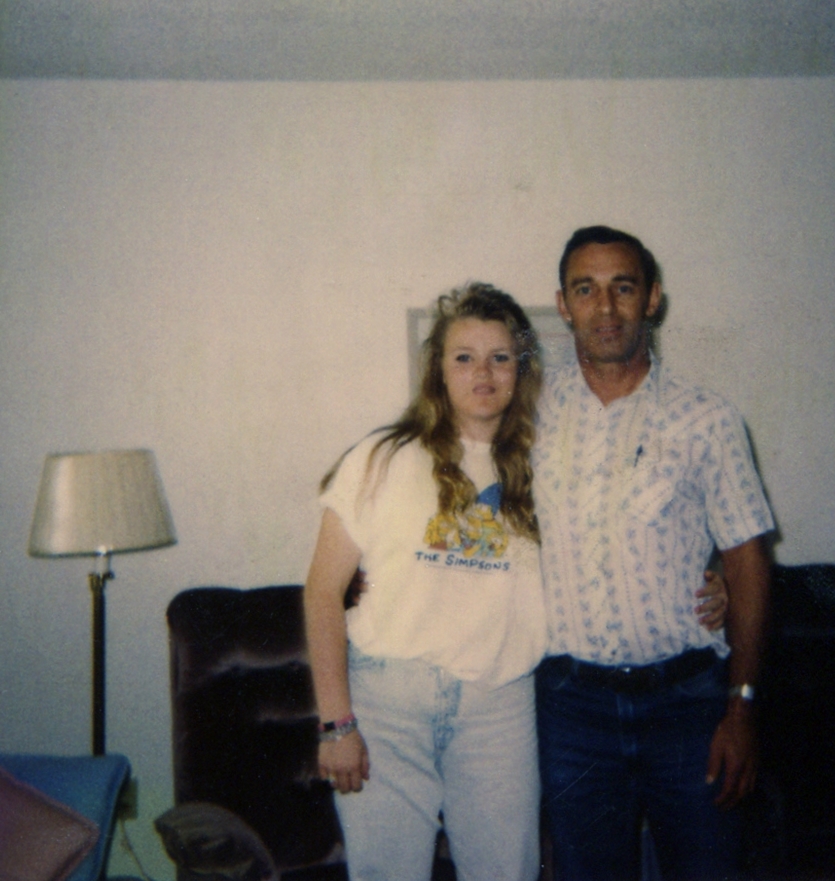
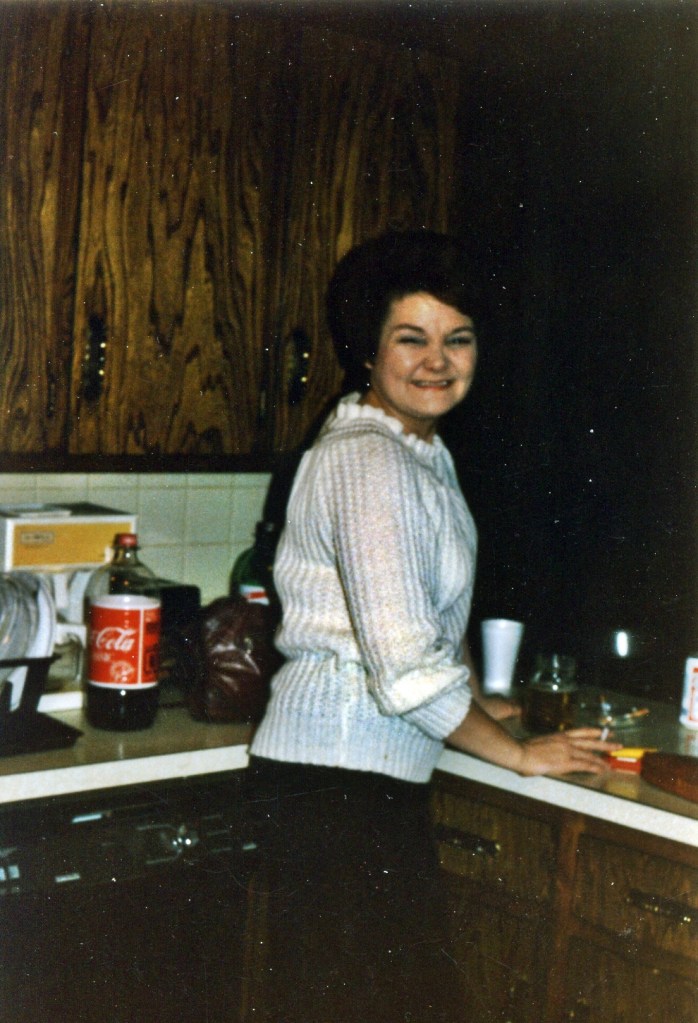
This is my mom standing in Aunt Ardith’s (and Uncle Buck’s) kitchen. Note: I think it was physically impossible for her to be in a kitchen unless she was smoking.


As we learned in “Like Water For Chocolate,” the emotions experienced while preparing food can significantly affect the culinary experience. (If you haven’t read this book or seen the movie, I will wait while you do so. You can read it in English if you need to.) The book on which the movie was based is separated into twelve sections, much like the months of the year. Each era is associated with particular foods that define the protagonist’s life.

It was important for her to unexpectedly inflict a bit of terror (or at least a sense of dread or apprehension) in someone in her vicinity while cooking. In part, it would explain the tendency for someone to wail, cry, or whimper while we ate supper. You might presume we were whimpering from the flavor otherwise. In mom’s defense, she didn’t need to concern herself with food. We were trained to eat anything without an audible complaint. In my case, I loved macaroni and any vegetable, even if coming directly from a can. Because I trusted my Grandma, I’d eat anything she offered. While there were times I didn’t like something she made, I never questioned whether it SHOULD be eaten. With my mom, this definitely wasn’t the case. There were exceptions. Because of my youth’s craziness, people often overlook the exceptions that were not characterized by the lesser human emotions I experienced growing up.

While it may not come across as funny, dad often did have a humorous way of driving mom bonkers about food. “What’s cooking,” he might shout. Or, “What in f$$$ is that smell?” Mom sometimes would scream back at him – and sometimes be funny in her response. It’s hard to explain how shouting and annoyance are funny, but it was. “Whatever the g####mned f### I want to make is what you’re eating,” she might scream. It probably sounded like WWII from outside. While they were often angry about it when their ability to tease back and forth emerged, it was obscenely sublime.

More than once growing up, we’d wake to the horrid smell of a burned cast iron skillet. A couple of times, mom did it. But it was usually dad who left the skillet on the stove. He’d arrive home drunk and cook a chunk of meat or fried bologna on the stove. There were a dozen times he’d try to cook frozen meat – and eat it anyway. It wasn’t unusual to pass through the kitchen and see an array of meat, grease, and a mess left there. Because mom usually got up insanely early, we knew dad left her a mess because mom would be in the kitchen cursing and banging every metal surface possible with pans, metal spoons, or by slamming the stove repeatedly. I’d generally not recommend this behavior if you have someone with both anger issues and a hangover in the house. By the way, a scorched cast iron skillet leaves a stench in the house for DAYS.

Much of the drama could have been sidestepped if someone had just asked us what we wanted. They could have fed me incredibly cheaply and often without the need for any actual cooking – and no ritual sacrifice of animals. In my world, kids were not asked what they wanted. Such a thought was heretical nonsense to people such as my parents. They didn’t need to tell us about starving kids in other countries; we knew that they wouldn’t be bothered with such an explanation when a good backhand said a thousand words. Note for those who don’t know: a backhand can be rendered at twice the speed as a forward-motion slap. Mom certainly could have handed me a can of tomatoes, corn, or green beans and sent me outside to eat in peace. Sitting at the table brought unseen battles to the front. By the 4th grade, I could expertly tip an opened can and eat the contents without utensils. Or without cutting myself.

We were lucky mom didn’t poison us, even if her target was my dad. Like most women in her class, she had no choice but to work full-time and perform all the other menial but necessary tasks of living for the household. Obviously, a lot of mom’s cooking stress was anger and resentment at being married to a lout. Mom didn’t have ‘signature dishes.’ I don’t remember her being romantic about cooking or the subtle art of gastronomy. To her, cooking was limited to the practical necessity of getting it done. It was a bizarre sight to witness her in the same kitchen with other people cooking. It might as well have been alien races sharing cooking space.

On another note, mom could have easily taught us to make one or two meals each. We would have willingly learned and helped had we been shown the attention—anything to avoid potential stress and drama of a ‘family’ meal. I know I couldn’t have been trusted to prepare any meal with meat. My recipe would have consisted only of tossing the meat carcass directly out the door and into the jaws of our succession of German Shepherd dogs named Duke.

Looking back, I’m still surprised that so many supper meals blur together into one indistinguishable mass in my memory. Few at-home suppers were devoid of distrust, dread, or unease. More importantly, I have no memories of meals wherein we gathered to eat where we shared our day, laughter, or happy moments. This was not part of our DNA. I like to think it must have happened accidentally. If it did, my treasonous brain has erased most of these memories. Exceptions tended to happen if dad arrived home drinking without his surliness or if extraordinary circumstances were at play. Watching sitcom families verbally teasing and laughing during dinner were Twilight Zone episodes for me.

On a typical day, mom had to read the tea leaves and decide when or if dad might come home. She was obligated to prepare some horrid slab of meat, partially cooked on the stove in a frying pan if he did. Dad was one of those absurd men who proudly pretended that the meat he consumed could indeed be eaten half-alive. “How in the hell can anyone eat that smell?” was a thought I often had. Along with the immutable truth that you don’t want to see sausage being made, the other is that no one should witness my dad eating meat. He was proof that our ancestors once jumped on wild walruses and ripped their ears off with their bare hands.

As you would guess, I generally wanted no part in the meat process. Given a choice between the meat prepared and eating live crickets culled from the underside of the trailer, you could find me with a mouthful of insect legs protruding from my mouth. Note: crickets thrive under trailers if you happen to be in the market for a truckload of crickets. If a vegetable were offered, I fought to eat an excessive portion of that and be happy. Truth be told, many of my supper experiences revolved around trying to be small and avoid my dad’s gaze. Though I’ve mentioned it before, his barbaric streak often led him to force me to eat things that should never pass the lips of a human being. If he noted I didn’t want meat, I often found myself chewing the fat off a bloody half-cooked ‘steak’ or the dark meat near the bone of an unidentifiable piece of chicken. (I shudder.) Or worse, the skin of a piece of chicken. I ate chicken skin quite often when I was very young and without dad around. It didn’t occur to me to think of how horrible it was. Later, though, I ate a mile of poorly-cooked or unappetizing skin that ruined me for the rest of my life.

It happened so often that I still have no desire to eat such meat. People underestimate how true this experience was. I was the youngest child; as such, dad felt offended by the lack of overt masculinity. He spent much of his life committed to ensuring that I consumed an array of inedible pieces of animals. His alcoholism is probably the single biggest factor that helped me escape his scrutiny. Unless mom was at his throat, dad’s drinking made him magnanimous at times, and his insistence on forcing me to eat things I didn’t like vanished. Some of the Terry family cooked very well and with love, so I didn’t understand how dad could be so barbaric in his approach, and other members of his family could prepare a wide selection of both meat and vegetables. My Uncle Buck cooked a few things extremely well. He also enjoyed cooking and preparing dishes. Especially gumbo and fish.

While I noted I disliked an increasing number of poorly and inexpertly cooked animal carcasses, it did at least drive home the idea that who and how something is cooked can often be 75% of whether you’ll like something you are about to eat. I felt like a medieval court taster who was anxiously waiting to feel his throat constricting against whatever poison had been inserted into the king’s food.

Despite all the instability in our house, mom spent a sizeable chunk of her money from her SW Bell operator’s paycheck going to the meat shops. It seemed strange to me that her dedication to doing this was so pronounced. Dad often could not discern the difference between a decent cut of meat and something found in the dumpster and fried in a pan for 30 seconds. Dad’s nutrition plan included chunks of meat, cigarettes, whiskey, Dentyne gum, and Brach’s peppermint candy. If I accompanied mom to the meat shop, I stood in amazement that there were more than 2 cuts of meat or 3 types of sandwich meat. It seemed odd that anyone needed something except bologna, salt pork, or bacon for a boy who loved mustard sandwiches. Mom was an impatient customer at such shops. It’s hard to believe that smoking was permitted inside them. And smoke she did, tapping her feet as she moved from one foot to the other, expecting her choice to be hurled toward her in less than 3 seconds. It seems strange that the building that currently holds the Las Margaritas Mexican restaurant in Springdale once was mom’s ‘go-to’ meat shop. I doubted my memory so strongly that I once searched for proof in the old phone books at the library and then matched the addresses against old maps.

Between errands, it seemed like mom was always buying cigarettes and alcohol. Much of my Springdale geography command resulted from the infinite trips to liquor stores and places to buy cigarettes. I could walk from Uncle Buck’s house to the liquor store that once stood at the intersection of Gutensohn and Highway 68/412, but wasn’t sure about the route to one of the grocery stores.

My access to the larger world and food expanded only because of my cousin Jimmy and infrequent visits to other people’s houses. Everything seemed exotic to me. Things like bbq sauce, olives, flavored pickles, and lemon pepper ignited my imagination. At home, we didn’t have these things. If such a store existed, my mom would have gladly shopped at “Bare Minimum Essentials.”

This impacted my brother Mike much more than me. He enjoyed eating meat. He also was a bigger boy, more athletic when we were younger, and had an expansive appetite. This annoyed the hell out of my dad. Unlike me, Mike loved grabbing a handful of dad’s prized sliced deli ham and stuffing it into his mouth as a snack. It was a perilous day to hear my dad holler, “Who ate all the g$$$amned ham!?” In turn, it annoyed Mike that I loved mustard sandwiches and was happy to eat basic food. If I annoyed him, he sometimes would take a piece of ham, roll it menacingly into a ball, and stuff it into my mouth, laughing at my cries of torture. I detested ham so much that I might as well be Jewish. Don’t get me wrong; I’d eat it sometimes but never with any enthusiasm and certainly not as a first choice. Having been in my brother’s ham hock of a hand, I liked it even less.

When the grocery store opened across from Johnson Road, my cousin Jimmy went to get Ron Calcagni’s autograph. Mom later went to the store and scoffed at the incredible selections, after listening to my Aunt Ardith list its array of food. I was mesmerized by the dozen types of bread and the endless row of assorted pasta. I wanted to live inside that store and stuff myself with gallons of marinara and spaghetti. Other kids could be seen getting politely or angrily admonished by their moms as they begged for treats from the candy aisle, special cereals, or ice cream. So dedicated was my mom’s brutality regarding asking, this simply didn’t happen with me. I didn’t touch – and never asked. It was a sin akin to peeing on someone’s head while riding the bus. There were a couple of memorable times I forgot myself and vocalized my desire to have something. Because I was a little strange. one of those times was when I saw Mexicorn, the kernel corn in a can with peppers. I didn’t want sweets or chips. I wanted that exotic can of corn. Not only did mom swat me with the wrath of Khan, but she waited to ensure that dad could put his 5-knuckles-worth into the equation. By the way, I had my first can of Mexicorn at my cousin Jimmy’s. Aunt Ardith bought several cans. She watched in amazement and then horror as I ate all of them, at once. When she put butter in them and stirred it, I felt as if Heaven had descended upon me and wrapped its arms around me. While I don’t know for sure that Aunt Ardith treated me to endless Mexicorn because of how my mom behaved, it seems likely. She smiled at me like Christmas while I ate. “You’re going to be sick,” she kept repeating, her voice growing more amazed as I emptied the cans one by one.
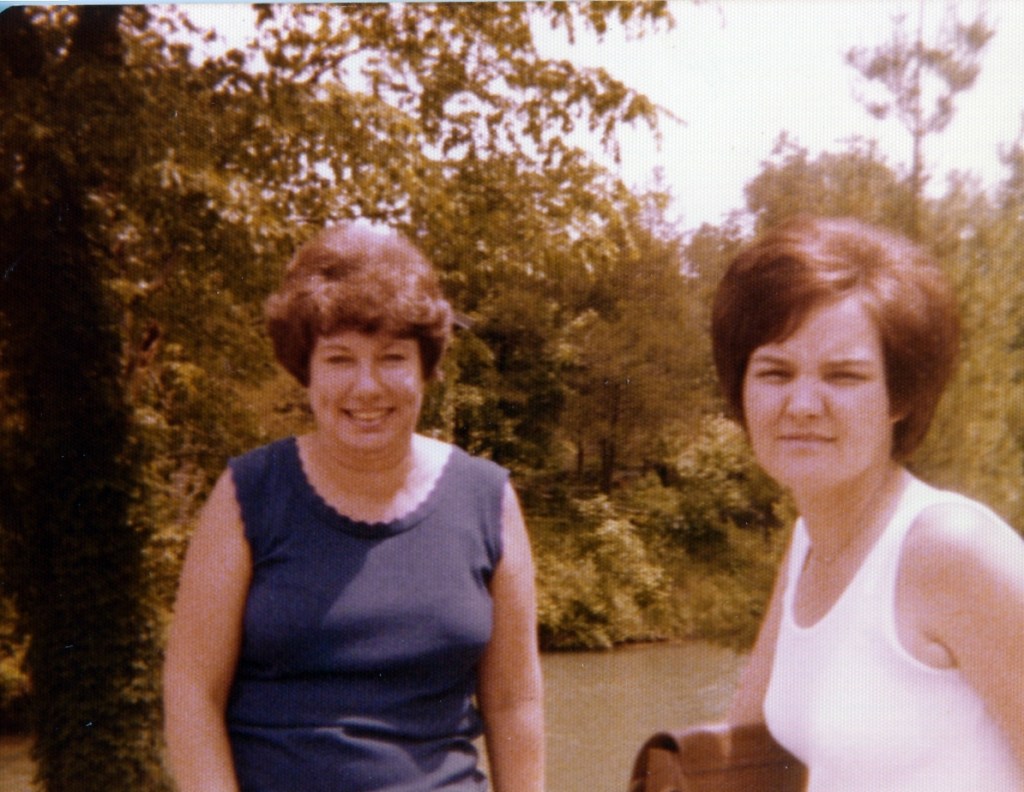
My Aunt Ardith on the left, mom on the right.


It was sometime in the summer of 1st or 2nd grade that I discovered that canned corn and green beans were delicious. Heating them was a needless step for me. Being able to skip steps to eat was a revelation for me. Soon enough, I learned how to make macaroni and spaghetti. Though I’d seen it made one thousand times, I was stupidly surprised by the fact that cooking it only required boiling water and waiting long enough for it to soften. A monster was born, one that still resides within me. While I could eat noodles plain, if tomatoes or tomato sauce were available, I would dump it into the water and noodles. We didn’t use strainers; we had to risk burns over the sink using the pot’s lid to drain spaghetti. I think the lack of good strainers is one characteristic that most poor kids share in common. Skipping all those steps was a benefit. Regardless of the size of the package of pasta, I cooked it all. And then ate it. Wasting it wasn’t a consideration.

All of which brings me to the Golden Macaroni Era at City View trailer park. Infrequently, mom would recover from the cyclical violence with dad. She’d violently clean the trailer and then later that evening make a pot of macaroni soup. Instead of simply making macaroni and adding tomatoes or sauce, she would cut up potatoes, onions, and a few other things and boil it into submission. Mom and I would sit at the table and eat. She would watch me eat a gallon of it in one sitting. Though it was simple, it was delicious beyond measure. While she made this after City View a couple of times, I’ll never forget the period at City View when she often did it. Usually, only she and I would eat this soup. She must’ve realized from Grandma that this was one of my favorite things in the world. Over one summer, my Grandma made a version of this for me at least every other day. Weirdly, I didn’t mind that mom had magically used at least 2 large onions in the soup. I count these nights eating macaroni soup as one of the few ways and times that mom tried to have a selfless connection with me, even if only through food. One of the other memorable times was her return from alcohol rehab in Fort Smith after I graduated high school. She made a mammoth pot of macaroni soup, and we ate the entire pot. I can’t see this moment as accidental. Mom returned from rehab, a completely different person.

When our trailer burned at City View and we moved to Tontitown’s fringe, this tradition died. My “cousin” Leta, who owned the house in Tontitown, where we moved, worked at the Venesian Inn. Because she could bring home endless food, it was from there I discovered my love of Italian dressing. Even as dad and family and friends had endless drunken cookouts, I found that salads with huge cut-up tomatoes and a bottle of Viva Italian salad dressing were available. I consumed truck loads of rolls and salad.
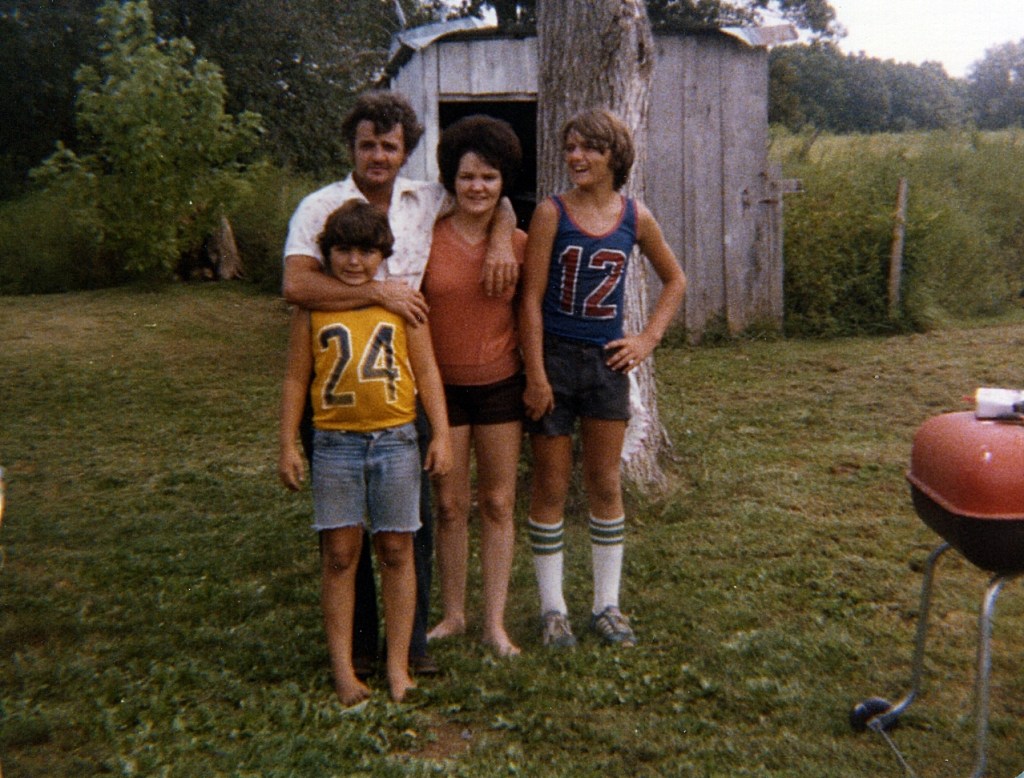
Me, dad, mom, and my brother Mike, aka “The Infamous Picture” at Leta’s house in Tontitown. I use this picture as the perfect embodiment of how perception thwarts reality.


In closing, I’ll finish with mom’s secret Mashed Potatoes recipe. This recipe has been sought after for years, so share it only with trusted friends and family.

You’ll need whatever kind of potatoes are on sale, a bit of milk (canned if you have it), a bit of pepper and salt, and access to non-menthol cigarettes. You’ll need to smoke constantly while boiling, mashing, and mixing the potatoes. Also, don’t knock the ashes from the cigarette as you cook. Allow them to fall freely into the potatoes. If you’re adventurous, coarsely cut a large onion into preposterously large pieces and throw them in the mashed potatoes. If the potatoes are lumpy, don’t notice. Hungry people don’t notice, much less comment, that the potatoes are lumpy. If you get a particularly large chunk of onion, spit it into your hand and keep eating. If anyone notices something that looks like ashes in the potatoes, tell them it’s pepper. Fun fact: it is almost impossible to taste cigarette ashes in mashed potatoes, no matter how much is present if you add pepper and onions to them. It’s for that reason that I mentioned that you shouldn’t smoke menthols – which are easily detectable.

Note: I was pleasantly surprised to learn that no one else puts onions in mashed potatoes. In 2017, I wrote about “Newport Potatoes.” Many people thought I made it up, even after citing the episode of “Master Of None.”
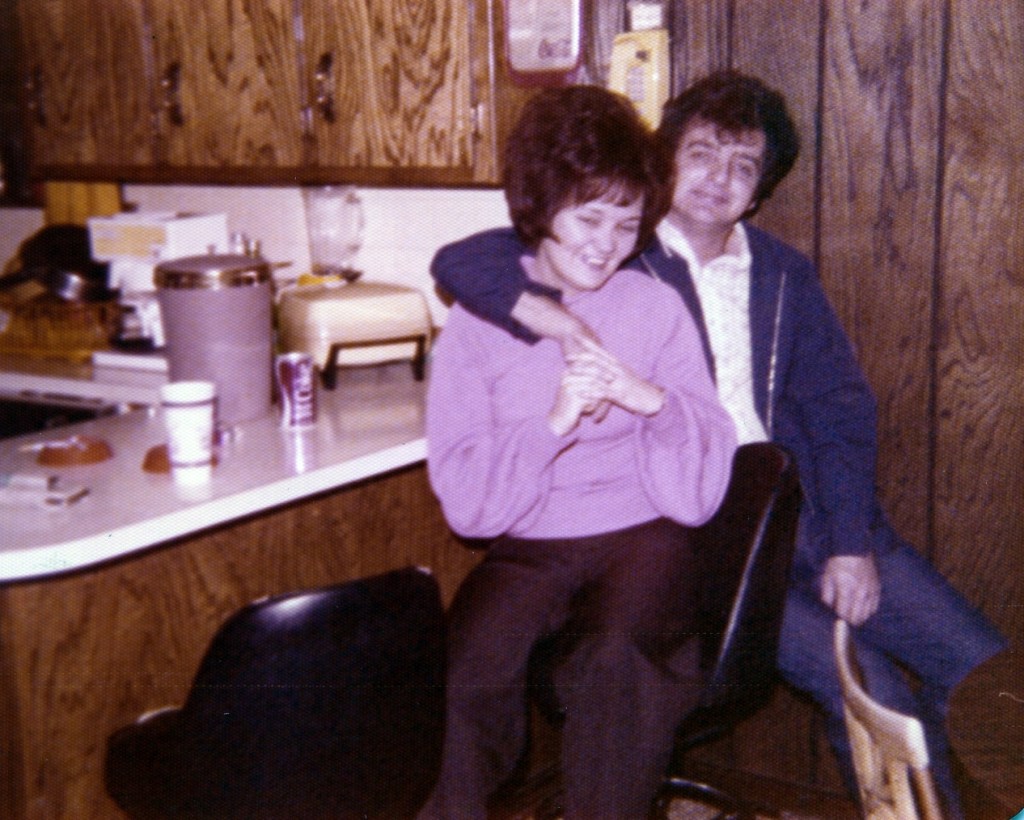
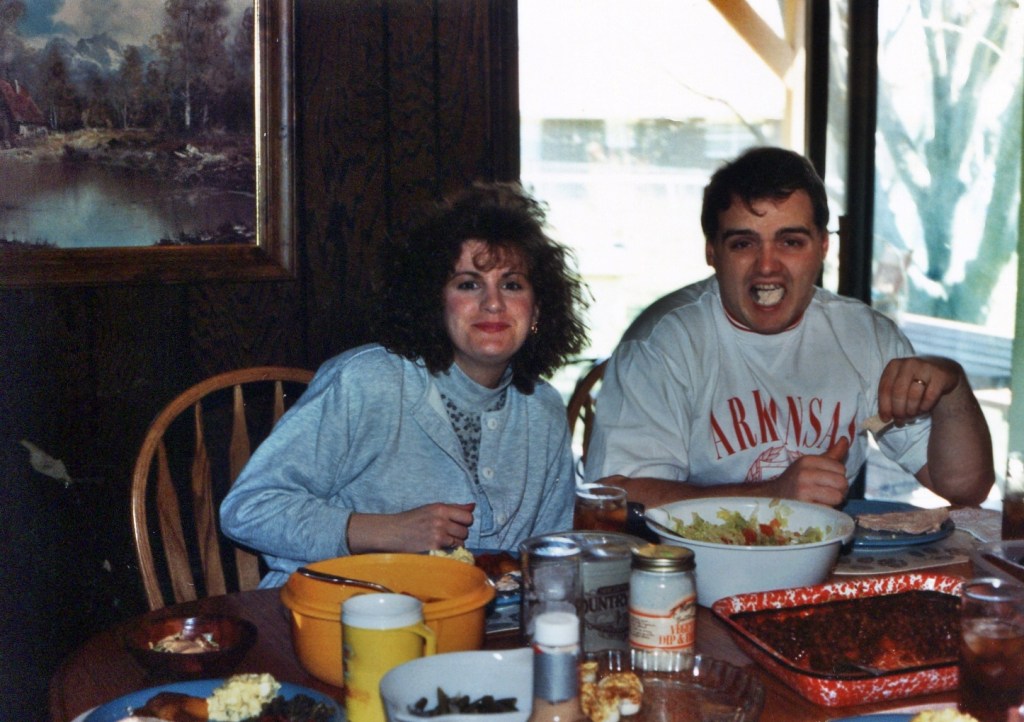
My mom and dad sitting at the bar at Uncle Buck’s house. We have no pictures of each other or us at our own house – and not just because we didn’t own a camera.
My brother Mike enjoying mashed potatoes at Aunt Ardith’s table on Ann Street in Springdale.
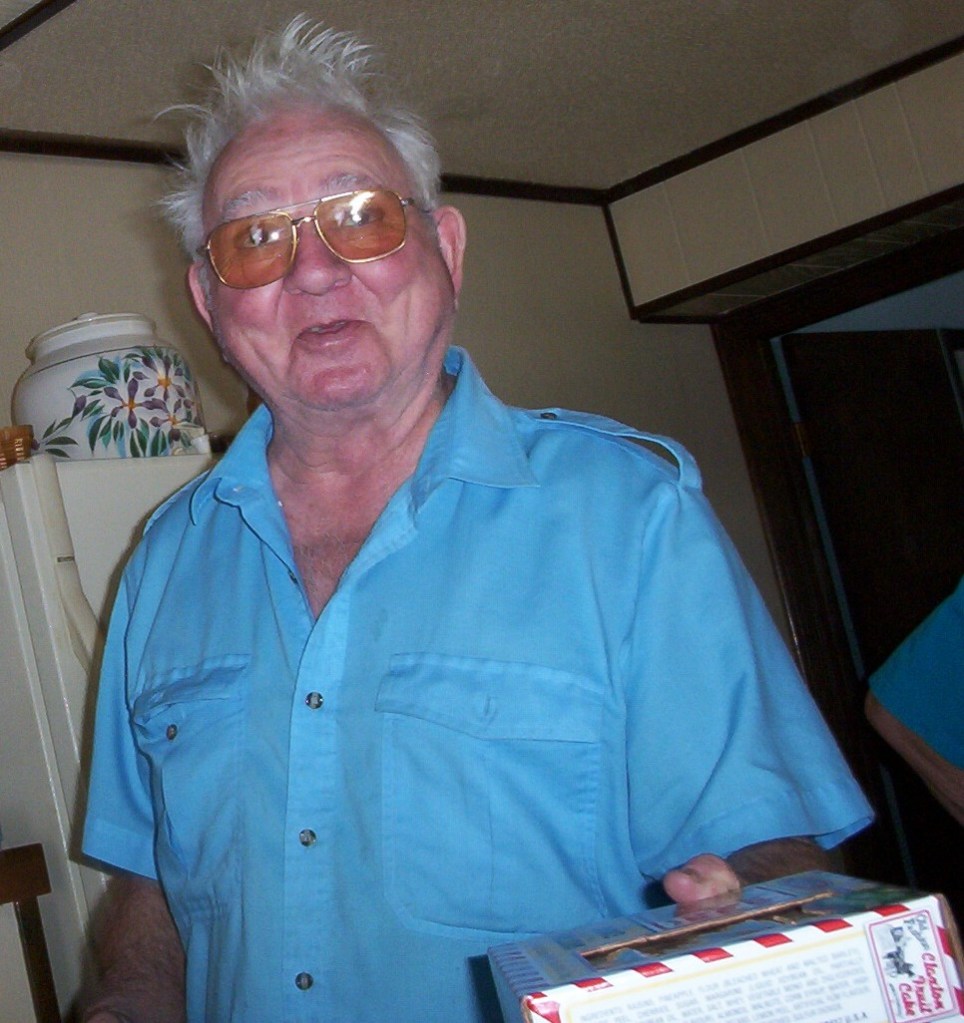
One of my favorite pictures of Uncle Buck. He was cooking up a storm and stopped long enough to present me with a fruitcake.

They Could Have Called Me “The Streak”

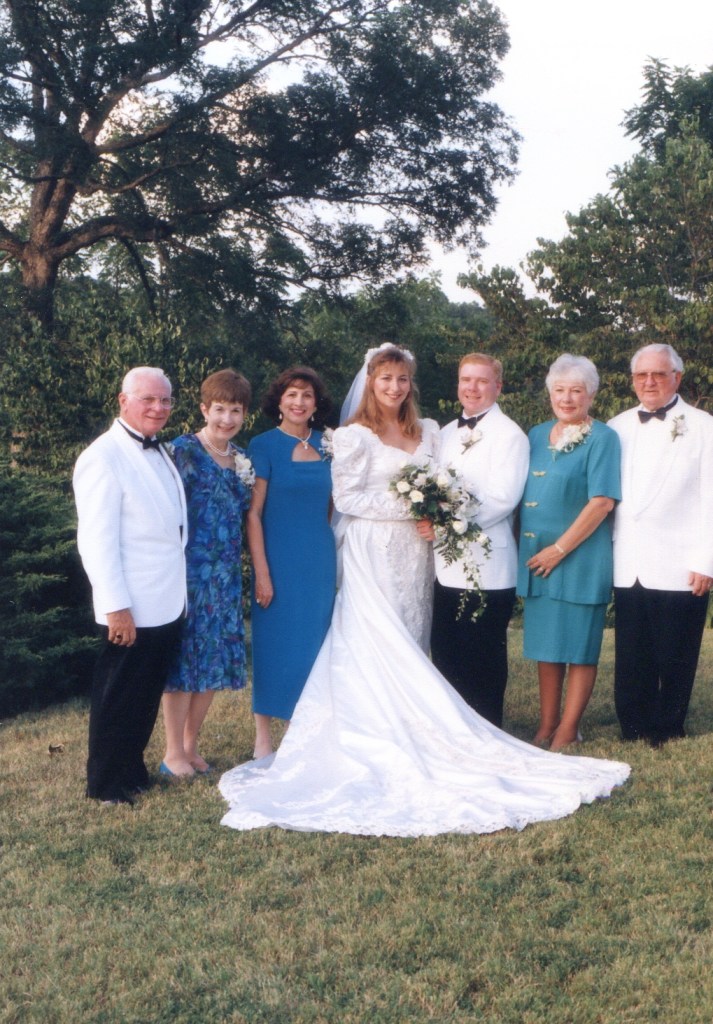
Jimmy isn’t the one in the long dress. He’s the one wearing a white jacket, wondering what he’d got himself into.

One of my regrets is that I didn’t streak naked around Thorncrown Chapel in Eureka Springs during my cousin Jimmy’s first wedding. His first wedding was in August of 1995 to a woman named Lona Heckle. In 1995, I still had the body to allow me to run fast – and, if caught, not feel too badly about my picture being on the nightly news after my arrest for streaking. Camcorders were common but it was still possible to just be a blur on such cameras. Regular cameras were unwieldy and snapping flash pictures inside a giant glass rectangle tended to yield less-than-stellar photos.

Coincidentally, one of my other regrets is that I did not get to perform Jimmy’s other marriage shortly before his death. I overcame my inertia to become ordained due to the possibility of this marriage. I understand the particulars of why someone else was chosen but still remain a bit uneasy about it. Personally, I can’t understand why more families don’t have someone ordained so that the family member doing the ceremony will forever be part of the memory, too. After all, standing with the two people in love is the best seat in the house, so to speak.

Were Jimmy still alive, he’d join me in laughter if I told him, “Yes, I was going to perform your second marriage naked, Jimmy. No need to streak if I’m standing in front of everyone.”

He’s been dead for more than 7 1/2 years now, which itself seems alien to write.

I wrote much of this post a few days ago, before the other shoe fell and my brother died. I don’t recall why Mike wasn’t at Jimmy’s wedding. Fittingly enough, Jimmy and I didn’t make the trip up to the Chicago Metro area to attend my brother’s wedding. Our excuse wasn’t personal; we were both just young, poor, and unaware that we could reach out and find a way to get there.

My cousin was a bit crazy himself. He was prone to get whiskey courage and do some outrageous things. We inherited the tendency from our ancestors.

For whatever reason, Jimmy was very nervous about the wedding itself. All the family he’d ever known was attending. When I first started teasing Jimmy about potentially streaking during his wedding, he laughed and said, “You’ll never do it. You’ll say you will but you don’t have your dad’s crazy streak.” So I told him, “Exactly. NOT having it gives me the courage to do it precisely because no one will expect it.” As the days passed, I could tell I had got into his head.

For those unfamiliar with the Thorncrown Chapel, it’s made of glass and steel and sits in the middle of an expanse of trees and forest. I’ve witnessed people become overwhelmed by emotion while sitting inside. If you’ve ever had the pleasure of being inside during heavy snow or while the sun is beaming through at an oblique angle, you undoubtedly can imagine it again.

Now add the idea of me running around the place naked with dozens of horrified onlookers trapped on the inside watching me do it.

I made the short video cut of Jimmy standing at the altar. It captures his unease at being the center of attention and spectacle. I took it from a VHS tape I had digitized several years ago. It was one of my few chances to be able to see videos and images from lives overlapping mine. Much of the bulk of such photography was lost to me due to the odd lack of sharing many of the family members seemed to inherit.

And because it’s one of the few relics of me on video, here’s a short one of me the day of Jimmy’s wedding. We were milling around outside the motel waiting for the hurry-and-wait part of the afternoon to commence.

*

*

*

I wanted to post this picture of Jimmy and Lona a couple of years after they were married. I mean no disrespect but I always remember wrong how long they were married.

The Mooch

james-hammond-da7ceBXjIt0-unsplash

What is the polite way to tell someone that people refer to them as “The Mooch” behind their backs? Answer: “There isn’t one.” Even if you’re right, trying to tell someone this can only result in anger. Even expert mooches don’t seem themselves in this light, much in the same way that prejudice blinds the holder from its influence. Such behavior becomes background noise for them .

I’d been at the fringes of this experience before, usually informally and always with one or two other people. Mooches tend to evolve into the habit. They learn the subtle ways to misdirect people or to convince them they’re being unfair.

I was in South Dakota with my wife, Deanne, long deceased. She had a huge Catholic family. Being with them in a group was at times like attending a party with gregarious and funny people who were always one joke ahead of you.

Several of us gathered at a bar/eatery in a mall in South Dakota. One of Deanne’s uncles made a comment about money and tipping. Another one piped in and laughed. He said, “Man, that makes me really miss -James-.”  (I changed his name to protect his anonymity.)

An Aunt immediately said, “What a mooch!” As she pronounced the last word ‘mooch,’ 4 or 5 other people at the table said the word ‘mooch’ in unison with her. It was a hilarious and jarring moment. I looked around the table and most of them noted the incredulity on my face.

They sang it in the same way that the characters on “Letterkenny” say “To Be Fair…” each time the phrase is uttered.

-James- wasn’t a blood relation to them. He’d been around the family often, though.

An uncle said, “I guess X here didn’t know we all call -James- “The Mooch” anytime we mention him?” I shook my head no. “Well, let me tell you some stories…”

For the next 15 minutes, all of them told an increasingly incredible series of “Mooch” stories. Forgotten wallets, lost $20 bills, requests to pay them back later, extra pizzas added to orders without asking and never repaid, one-night stays that turned into weeks, requests for double meat tacos, siphoned gas ‘because what mine is yours,’ among others.

The oldest uncle said, “X, watch out. He’ll trick you with his niceness and you will be trapped in an ever-larger cycle of loans that aren’t repaid and a helping hand that will get bitten. He’s done it to us all. We have all been marks at one point or another. Weirdly, he can be a fun guy, but it’s always about the angle with him.”

Over the years, I compiled quite a list of equally ridiculous mooching behavior from -James-. The uncle wasn’t wrong.

The Mooch in question grew older to become a conservative who bitterly complains about rich people, poor people living off the government, or anyone who was getting something he wouldn’t. A long series of jobs, a long series of financial missteps, repossessed vehicles, and unexpected involuntary moves from one place to another punctuate The Mooch’s life.

There’s no moral to this story and not much of a narrative. Perfectionism is tiresome to me. I was thinking about -James- today and hoping his bitter attitude had evolved.

I’ve not heard the word ‘mooch’ in the last 20 years without thinking about -James- and the eagerness with which people who knew him shared stories about it.

I cringe a bit, knowing that in a way I can’t see, I’m probably a little bit “-James-, ” too.

If -James- were to read this, he’d be very angry.

I’m certain that he’d be violently upset to discover that an entire clan of people equate him with the living embodiment of “The Mooch.” It’s not the most enviable way to be remembered.


Burns of Denial

markus-winkler-7EwWeNyzSwQ-unsplash

When my wife died suddenly several years ago, I opted for an awkward visitation after her cremation. I know it was awkward; such things were not common, especially in the Venn diagram of the converging families affected by her death. Many of her family were Catholic; a few of those hid behind their Catholicism to attempt to blame their dislike of cremation. To be fair, I didn’t care. In my case, I was lucky. The death of a maternal uncle about a month before had crystallized any doubts what my wife wanted if she died. She loved the Catholic church through her grandmother’s eyes; she rejected in the world at large. Her displeasure with it took on its own life when she observed some of her family members use it as a disguise for the things that infected them.

Though it strays from the theme of this post, one of the first serious conversations I had with her involved her dad. Her youth was punctuated by heartache. Both parents were not appropriately tuned in to their kids. She was the youngest of a series of children born to a mix of fathers. Both misbehaved; the mom especially led a promiscuous lifestyle. I convinced my wife that she would almost certainly reach a point where she could sit in a room and laugh with her dad. That day came before her death. It wasn’t perfect, but it was miles from where they’d started.

img691
Deanne with her dad Ralph…

Even though it made some people uncomfortable, for the visitation I had a table with letters, photos, and both mementos and moments for people to see. Like it or not, none of us are prepared for the unreasonable demands of sudden death, especially when young.

Someone familiar with my story and the players involved told me a story I keep forgetting. Her accounting of memories and happenings is much stronger than mine – though she would not agree with me saying so.

When she attended my wife’s visitation, the wife of my biggest critic turned to her and mentioned the cigarette burns on her husband’s back, ones earned during his abusive childhood.

I wasn’t a part of the conversation. Although I was told the story before, it slipped out of my mind as things do.

It was such an odd time to bring it up.

It was an odd and unrequested topic, too.

Given the recent uptick in unsolicited criticism, it echoes in my mind as a benchmark for so much.

I felt like I should share this story.

Because the story comes from someone unimpeachable, it seems important that the wife would later attempt a hard right turn into becoming a revisionist regarding any abuse.

The abused themselves do this with an astonishing frequency.

A Forgotten Monday

a forgotten Monday

Moments before, I’d been crouched against the dry, brittle earth as I pried it loose in a 16″ square, throwing the depth of removed dirt into a large bucket. I’ve been engaged in a methodical war with the ground along the back fence since I started my infinite project. Stone by stone, my bites of the earth growing larger as the squares I use become heavier and thicker.

The virus has involuntarily trained me to tolerate being hot and uncomfortable. At work, it is for safety; at home, it is for the war I declared on the ugliness left by my neighbors. Today, I stayed in my work clothes. Often they get so filthy that I must wash them unaccompanied in the washer when I’m done.

Though it was late in the day, I went outside and began the slow process of gouging rectangular templates in the ground. The work for Monday at my job was relentless. As contradictory as it may sound, working on the infernal yard project has probably saved me from a bit of insanity. My job does not reflect who I am and leaves me bone-weary some days but unsatisfied that I’ve accomplished anything real. I suspect it is a malady shared by many of my contemporaries, and one amplified by the virus intruding upon us.

Though working in the dirt tires me even further, it also rejuvenates me. There are no conflicts, no agendas, and no uncertainties.

After finishing my first large stone, drops began to hit me in the head and neck, dissipating instantaneously. I left my hat in the house, where I’d left it last time to dry and harden back to normal shape. A breeze lifted from the void and billowed my work shirt around me.

I walked over to the remainder of the old chain link and barbed wire fence and leaned against it. I stood there, my face upturned into the advancing rain and wind. As the droplets increased, dozens of dragonflies began their dance of pirouetting into the air to catch gnats, flies, and other insects as the rain brought them from the dense grass of the neighbor’s lawn behind me.

Because my clothes and shoes were already dirty, I stood for several minutes as the rain advanced and peppered me. The temperature dropped, and goosebumps rose along my arms and back. The dragonflies scattered from the other yard and began to circle around me and through the links in the fence.

I couldn’t help but smile.

The Monday accumulated behind me disappeared completely as I lost myself in the simple pleasure of the dragonflies and rain.


The Broken Record Is Renewed

For those who wanted a simple timeline, instead of my endless commentary. Names have been changed to protect whoever wants such protection.

One part of my motive for this blog was to share my stories and cement my stories so that revisionists couldn’t later do what they do when attempting to silence someone doesn’t work.

This isn’t going to be perfect. I’m leaving out huge gaps of nuttiness and drama.

People who read this blog won’t know who is being discussed unless they have a Ouija board or an exceptional dossier on the thousands of people in my life.

Earlier this week, my family member (who I will call Mark) created more identities and emails to attempt to interact with my blog. I already have a large list of blocked IP addresses, aliases, and emails he’s used previously. Though I can screenshot them, only people in denial would claim I’m making it up. I’ve shown it to a couple of people, ones who are familiar with the long pattern of anger and addiction that I’ve dealt with.

Mark was always a blowhard. When he was younger, his wit and intelligence were formidable. As his personality hardened, he became a victim to his own assuredness and secrets. We had a lot of great moments. To talk about the ones that diminish him does not negate that great moments occur. Mark hated my outspoken nature, especially when it walked over family honor. (Or dishonor.) Throughout most of his adult life, he was angry. Addiction did not help him in this regard. Whether anyone wants to hear it or not, his legacy will be one of anger and discord. There will be those who point the finger at me. Those who know me know that my life isn’t punctuated by this sort of addiction or constant refueling of anger and drama. It’s pointless.

When Mark resurfaces and starts in on me, he usually has a commensurate reaction in his personal life. When people get out their flamethrowers, they tend to scorch everyone. Previously, I let his wife know. (I’ll call her Jolene.)

I wrote Jolene a simple email to let her know Mark was at it again.

She responded angrily and with a swatch of allegations regarding my motive, character, and credibility.

I replied back, saying I wasn’t going to reply in anger, given that it wouldn’t help anyone, much less either of us.

She replied again, doubling down on her accusations. The email was boiled in anger. I could post the email chain here with names edited. It’s obvious when reading them who is suffering. And although Jolene wouldn’t want to hear it from me now,  I still feel a profound sense of loss and empathy for her and those who grew up in Mark’s sphere.

It has nothing to do with morality, superiority, or any of those accusatory defenses. It’s simply a matter of life not well-lived.

I replied a final time, using a short 3-sentence reply, one absent rancor, or accusation.

I went a long time without interacting with my Mark. In 2013, while I was helping to care for a cousin who was dying of cancer, Mark launched an all-out campaign to threaten me. It was effective. He worked in a job that gave him great ability to follow through on his threats and had a long history of alcoholism and anger issues. Instead of pressing charges, I tried to get someone to get him some help. I nearly lost my sanity for a bit.

As he does, Mark flipped it on me and told everyone that I was trying to get him fired. I still have the emails with his bosses that easily prove I’m telling the truth. Having perfected his skills over the decades, he told his bosses that I was bipolar and his family that I was out to ruin his life and get him fired. It took me forever to make him stop contacting me. My cousin died while I was dealing with Mark. Afterward, I had to endure the interference of family members who tried to paint it as a disagreement, despite that Mark had threatened to kill me – and that I believed it. People who knew me and who had heard his voicemails and calls knew it. While I might have been guilty of being an asshole, a charge I must confess to, Mark was guilty of an actual crime, one which I contributed to me trying to get him help instead of arrested.

In the intervening years, I dreaded the other shoe dropping. I knew that it would.

Not terribly long ago, Mark was forced to retire from his job due to alcoholism. I didn’t know that for quite some time. I didn’t know that he had been forced to get treated before, either. How could I know?

He began to call me intermittently and I answered. I was cautious. During one of my trips to Hot Springs, Mark called me. I’ll never forget telling him that he broke something in me in 2013 and afterward and that I might not ever regain it.

Mark began calling me more frequently. I tiptoed around his issues, wanting just to reconnect.

Many of us foolishly try to keep a relationship alive, even while swallowing huge parts of ourselves in exchange for doing so.

I sent Mark books, encouraged him to write his stories down, and made him personal gifts to encourage him. I tried to put in an effort.

Later, his wife Jolene wrote to me using an alias on social media, asking me to please call her. It’s important to note that I did not reach out to her; she asked me to talk.

Much to my surprise, we had an instant rapport, after so many years of not communicating. She shared with me that Mark was suffering badly from alcoholism. We talked many times and at length. I can’t stress enough that it was rewarding. We found out that Mark had told us differing stories to keep us from comparing notes. He had constructed a huge web of deceit and was continuing to victimize those around him.

At some point, Mark called me and told me he was another state to confront an ex-brother-in-law who slept with his wife Jolene. He was going to come back through Arkansas afterward. When I called Jolene, she said, “What are you talking about? He’s outside the house right now.” And she sent me a picture, which I still have.

Suddenly, all the things that Mark shared with me were called into doubt. He had told me a 1,000 stories, many about how evil Jolene had supposedly been to him. Most of them weren’t true. Jolene and I shared a lot of stories and compared notes. Mark had lied about his injury while drinking, as well about so many others. I won’t recount the list here. Suffice it to say there was a staggering amount.

My heart broke for Jolene and her children. All those years of assuming she hated me washed away. Mark was the spider in the middle of the web.

I tried to continue to talk to Mark. We talked many times, usually reminiscing. I tried to avoid mentioning the disparities or anything that would crash his fantasy world. It became harder and harder to do it – as well as to be nice to Mark. The longer I interacted with Jolene and her children, the more I tried to make him get help. I also worked hard to convince Jolene to get as much help as she could and to leave Mark if he wouldn’t do everything possible to get better. We talked many times about these issues.

I can prove it all, not that anyone reasonable would doubt what I’m saying. For those that do doubt, I can prove it. I’d hope that no one would make me. It’s needlessly traumatic.

During one episode, I recorded Mark at Jolene’s request. I emailed her the audio of the conversation. It laid bare to her how deeply Mark’s pathology extended. I’ll never forget that conversation we had. There was no escaping how deeply Mark’s addiction had advanced or how far he’d go to protect his choices.

At one point, Jolene sent me a picture of Mark passed out inside the garage, between the car door and the car. He wouldn’t stop drinking and driving. He was hiding alcohol everywhere.

I spoke with Jolene and one of her children.

I didn’t do it to refuel my drama cart. I did it because I was concerned. That concern grew to be anger at Mark for refusing to get help – as often as it took and for as long as it took. I discovered that he’d been misbehaving for a long time. I already knew it to be true due to a combination of observation, instinct, and passing comments from friends and family. Families traffic in gossip, truth, and innuendo.

It’s true that toward the end, I grew to be disgusted with Mark. I had to avoid him for long periods because I couldn’t peacefully maintain the facade of deceit or pretend I approved of his life. It would have been different had he not been so evil to his own family.

At some point in all this, he was caught driving drunk and endangering a lot of people. It was mishandled and because of his profession, he was not required to be accountable like a normal person. And so, he continued to drink and drive. I won’t share those stories which were shared with me.

He threatened his family and did and said things that were truly malicious.

Jolene told me to let it out and tell him how I really felt. I finally did.

Naturally, Mark waited until the day of the funeral for another family member. I’ve never participated in a conversation so ugly, even those involving my Mom. The level of pathological lying and misdirection was beyond what I’d dealt with before.

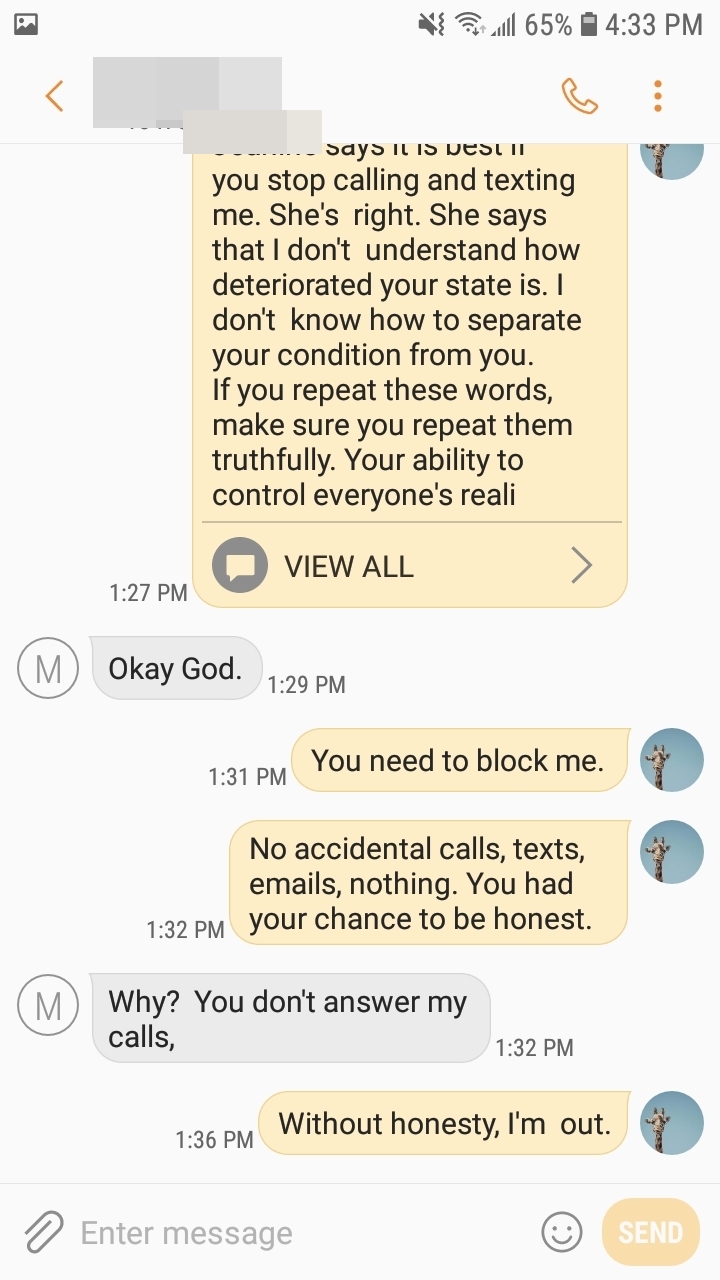
For me, the worst I behaved during all of it was during the phone call on the day of the funeral and later texts I traded with Mark In October 2019. I hit him in the jugular to try to get him to admit his issues and to get him to talk with me and Jolene simultaneously so that I could ask questions with her listening and gauge his response.


Screenshot_20191028-163325_Messages jeanine and numbers removed

Screenshot_20191028-163332_Messages without names and numbers


There are other screenshots in which I’m chasing Mark to be honest, to talk to me with someone else, etc. Truth be told, I wanted nothing except to have Mark and Jolene on the phone with me at the same time.


Ultimately, Jolene stayed with Mark, even though the children wanted her to leave. Jolene tired of talking to me and said she thought it would be easier if she didn’t keep me informed anymore. I agreed. I couldn’t be nice to Mark anymore and I realized that Jolene reached her endpoint.

I talked to her another time, as well as to one of her children, who told me that it was still terrible at home.

I knew the risks of talking to someone so close to Mark and that the likelihood of it being spoiled given enough time would be a certainty.

I traded texts back and forth with someone earlier this year – and it was worse than I had left it. It killed me to know that Mark not only had angrily refused help but had tightened his grip on those around him.

Each time I asked Mark to stop calling me, texting me, etc., he took great pains to go out of his way to ridicule me and do it even more. I have screenshots of pages of his calls. If I blocked his number, he’d leave nasty voicemails. For a time, I had to leave my voicemail full just to keep him out of it.

A few years ago, I had changed my email and phone number to avoid talking to him and my Mom. An allegedly well-intentioned family member gave him my new phone number.

No matter what Mark’s mental condition, he was together enough to employ complicated and ongoing efforts to create identities, use IP addresses, and continue to bother me when he knew it wasn’t welcome. His addiction and anger worked together to continue to convince him that I had no right to keep him at arm’s length.

I missed being able to talk casually with Jolene. We all shared a common battle and it shaped all of us and all of our lives.

But even that is gone now, probably forever, another casualty in the addiction war. Mark won. He’s poisoned us.

I have a mass of notes and records from all the craziness. I don’t like to peer into it for too long or look up details to understand. There’s nothing to understand. It’s just another wasted life being brought to a withering end.

Because Jolene called me a victim and insisted that I love washing in it, I’d agree I’m a victim in the sense that Mark perfected part of his skill at angry manipulation on me. I was stupid for returning to the scene of the crime. I failed Mark – and I failed Jolene and her children.

I knew there was a good chance that I’d end up on the wrong end of anyone conected to Mark. He’s gaslighted so well and so consistently his entire adult life that it is a rare person who escapes unburned.

As for that, there are more footprints on the internet that Jolene may realize. Not from me; rather, from those who were close and shared bits and pieces in their own way. They too shared parts of their stories, whether Jolene realized it or not. I didn’t go out of my way looking for them. They were offered voluntarily and at their own pace. They prove that the carnage was real and much worse than what is willingly admitted to. A lot of people eventually tell their stories. They validated what we all knew and whispered about. It’s no shame that someone had an addiction or couldn’t get their loved one to make amends.

We all failed. I wasn’t equipped to deal with it. I learned my own way and mostly avoided the craziness that Mark did. I didn’t escape it entirely, though.

As to whether I wrote too much about it, I only wrote about it when it dramatically crossed paths with my life. That’s my right. I can’t help it that some of those involved wouldn’t escape it. I understand that they have to paint a different picture, choose another villain, and ask someone else to pay their price on their behalf.

If you think I’m the problem, you need to take a long hard look across the internet. The truth is out there.


Slightly Embellished Story

allen-taylor-0cmJRW5rOJ8-unsplash


Someone close to one of the people who has vexed me most in later life wrote and lashed out at me with the phrase “Slightly Embellished Story,” stating that I write stories because I have a need to be a victim and relish the attention. I’ve written about this before and the ongoing likelihood that if you share your opinion and stories, even if they are completely yours to tell, people are going to use whatever tactics they can to knock you into silence. Or, worse, to question yourself.

I took some time to think about what I’d been told. While I didn’t let it pierce deeply, I did examine the implications. Only callous people disregard completely what they’ve been criticized for. We all go blind to our own foibles. I will admit that my brain glazes over when people scream or lash out in anger. I spent enough of my life around that sort of craziness. It’s almost totally absent from my day-to-day life. Those who don’t enjoy such lives simply can’t grasp how abnormal such anger is to most people living their lives.

In my case, I have grown so accustomed to this sort of manipulation that it works in reverse on me. I take a moment and consider what is really going on and what demons caused the person to write those words. In short, I’m appalled but fascinated. This sort of drama propels me to write MORE, not less.

Though the story is not mine to tell, I feel empathy for the person who wrote. They have lived a life diminished by things good people should not need to deal with, especially long term. They’ll never believe that I hoped for a long time that they’d find peace even if they had to build an entirely new life to do it. Gaslighting changes you fundamentally. Protecting secrets becomes an obligation. Ask any mental health professional about the consequences of being around addiction and pathology. We internalize what we cannot avoid.

Even as I write those words, I know I’m going to stumble and say and do stupid things. And I will also waste my remaining years making the same mistakes in the face of people who are not whole. I’ve been less than whole a few times in my own life.

One of the comments struck me as odd: “…you find a new audience to hear the same song/dance…” Which is weird as well as untrue. This blog, the one you’re reading. It’s been here since 2014. The previous blog on Blogger was there for several years before that. I imported some of the ancient ones here; some I edited and reposted later but many are in their original form. I don’t understand the criticism about my voice or stories “being new.” A decade of telling them doesn’t strike me as new.

This blog isn’t hidden. Anyone can read it. I used to allow open commenting. A couple of people with anger issues ruined that part for me.

I don’t post for secrecy. That’s a stupid argument to make. I post so that anyone interested can read what I have to say. It’s a one-way conversation. Unlike social media, no one has to even scroll past it.

Before that, I shared stories without embarrassment my entire adult life anywhere such outlets existed. Things happened to me that I didn’t choose. But I learned to embrace the hard things and talk about them.

If you’ve read much of my blog, you’ll read that I had a lot of family members who didn’t want to hear that we had some evil behavior in our family, didn’t want to hear that I had the right to change my name, and certainly didn’t want to be reminded of our right to choose our own paths.

All families are difficult. Being in one stuffed with alcoholics and abusers made learning to be independent of them difficult. We don’t start out understanding that people are scared of honesty or that someone might discover their dark secrets. They have to realize on their own that people know, anyway. It’s why if I get arrested or miraculously get a DWI, I will be the person saying so immediately on social media. Telling the secrets before they are outed robs them of their power. Most of it, anyway.

I never said I got it all right. In fact, I’ve said the opposite. One of my first blog posts was to point out that we are often wrong. Following that, I wrote a list of warnings about the dangers of writing anything down.

But I’ve been here, plugging away for more than a decade, telling the same stories that are mine to tell.

In 2014, I wrote another post about “Revisionists.” Even then, in 2014, I went through a period in which the haters almost silenced me. Several wrote and insisted that I was making so much of my story up. Years later, after DNA and research proved that countless stories of mine were true, they stopped trying to revise my life story.

As for the rest, I am a victim of some things. I’m certainly not a victim any longer, not for the most part. I don’t live a life full of drama, addiction, and secrets. My life isn’t perfect – but I have successfully reached a point now for several years when my sanity isn’t called into question. I continue to work to avoid people who can’t escape their lives.

Having said all that, that’s how this works: I write, you read. Or not.

If I’ve said something that you know is untrue, with the exception of those I asked to leave me alone, I’ll entertain any assertion that demonstrates how wrong I am. I don’t like to be wrong but I certainly hate to pretend to be right if I am not.

Otherwise, each of our lives is a Slightly Embellished Story.

Though the phrase was offered in anger, it did remind me to be wary of people. They are dangerous when wounded.


King of Kung Fools Rule

maria-krisanova-oxVxFGoweWM-unsplash

The King of Kung Fools Rule: once you ask that someone leave you alone and not communicate with you, total silence is the only option. If you engage, you will be bogged down in a perpetual fight wherein you’ll be held into a perpetual account for exercising your right to be free of someone.

If you’re reading this, you should think of Carly Simon: “I bet you think this song is about you.” It’s not. It’s about me and about the lesson I have to learn over and over.

We watch in society as people with protective orders still deal with the people tormenting them. It’s incredible it requires that. Pathology drives people to ignore the wishes of other adults.

It’s hard. Believe me, I know. I’m a fool on my best day.

Despite what people at a distance from me might think, I’m a bigger fan of snark, wit, and pithiness than you’d imagine.

I don’t care what you have to say or what motivates you. If I’ve asked you to stop communicating with me, you can be sure that you’ve done or said something (or many things) that brought me to the decision. Even if I decided on the spur of the moment, it is still my right to do so.

Even though I’ve been on both sides of this issue when I was younger, I’ve learned repeatedly that when someone says, “Leave me alone,” you should leave them alone. No matter how you’re connected, whether you’re related, past friends, or any other relationship, real or imagined, when someone says “No,” it means “no.” Regardless of your past connection, an adult has the right to say “Enough is enough,” if not, “I’ll let you know when I’m ready.” Forcing a conversation when it is unwelcome is aggressive and indicates that you don’t understand that each person has the right to choose who, what, when, how, and where regarding their lives. Who they permit to interact with them is entirely their choice and not subject to veto.

Manipulators and abusers insist they have a right because of __________. (Fill in the blank with the most common nonsense abusers mention.) This insistence indicates either immaturity, anger, or pathological tendencies on their part. Do not engage further. No matter what explanation you provide, it won’t be good enough. They will move the goalposts, gaslight you, or avail themselves to the tactics that all manipulators attempt. The worst will misbehave by saying or doing things to provoke a reaction. These actions will escalate to horrific levels if you acknowledge them. Being kind to them won’t work. Being mean to them won’t work. Their insistence to have access to you is a warning sign that they need help.

Have I mentioned how terribly I have failed to follow my own realizations listed above? I am an expert in falling into the holes I’ve dug for myself.

If you do engage, they’ll eventually succeed in making you respond with anger. They’ll then triumphantly screech in mock horror (and glee) that you got angry. Your anger at their stupidity is normal. It’s a superpower to be able to ignore abuse like that.

My Mother was a Kung Fool like no other.

At each stage of my life that I exerted control, she’d enlist any available family member to guilt me into reconnecting. My love for her sometimes interfered. It was a long, exhausting cycle. Not too long before she died, I finally broke the bond. I’d had enough. I mean, really enough, not the ‘enough’ of ‘maybe I’ll change my mind later’ enough. I only talked to her again because my Aunt Barbara called me and told me she had stage 4 cancer. Even then, I felt like I violated every protective mechanism I had in place. This was especially true because I had another family that convinced me he was going to kill me. In my family, that sort of thing is discounted at your own peril.

Addressing the other common refrain: you’ll be called crazy, a liar, or heartless. (Or some other word you can find it an Abusers Thesaurus.) IF the other person is correct and I am demanding to be left alone because I’m mentally ill, irrational, or simply hateful, it still doesn’t change the fact that I’ve demanded to be left alone. IF you insist on continuing the attempt anyway, you become the problem. If I’m spouting off nonsense, let me continue to do so and the truth will find me. Even Obama made famous a saying to let fools do their own talking.

If you can’t let me, you’re afraid of my message and that becomes obvious to people watching.

If you’re the abuser or troll, once the word “Stop” or its equivalent reaches you, stop. If you can’t get help, because you have control and anger issues that need to be addressed.

So, again, I don’t want to hear from you.


Let There Be Light – An Epitaph For Truth-Telling

christian-lue-EZOxj183uCM-unsplash


When I posted this story, I didn’t expect the invisible mob to approach me. It’s easy to skip over my stories if you don’t want to see them. Anyone not wanting to read what I have to say can easily avoid it. For most people, I’m a forgotten planet on the edge of the universe. If you’ve found me and continue to find me just to gnash your teeth, you should take more effort to stop looking for me.

It was amusing to see people assume they knew who I was talking about. That underscores my insistence that people only see what they want to see. Their own preconceptions mislead them into assumptions. Their defensive responses based on these errors tell me a lot about how they are wired and what goes on in their heads versus the persona they present to us.

This story is not about my siblings. It’s not about my paternal uncle. If it were, I would say so, especially now that I was attacked for people’s wrong assumptions about it. To be clear, I’ve been guilty of the same type of jumping to conclusions. It’s driven me to cause a couple of people needless harm. I tried to make up for it. While they might have forgiven my stupidity, they probably remember that I was a jerk needlessly to them.

I’ve waited a while to share it.

We all have people in our lives who have dark secrets. Many people would choose a miserable life over truth and honesty. They fear that the concealed darkness they protect will somehow consume them. The opposite is true: secrets, especially family secrets, only gain their power by our complicity. Children grow up to recognize the disconnect between what they’ve experienced and the story that follows them in life. Most maintain the charade of silence because it is safer. Silence seldom draws much ire or criticism. If we all consciously chose to avoid making ourselves prisoners to our secrets, we’d be happier. As with anything personal, there will always be people who ‘know,’ ones you interact with who are running their own truthline in their heads as they talk to you.

Although I can’t be sure who led him to my history online, it doesn’t change anything. He’d obviously found my thousand stories about love, life, laughter, loss, and lies. As with my family tree online, my stories are not hidden, private, or anonymous. I share them so that anyone can read them. I can’t force belief. I can’t force consumption.

I don’t claim to be a singular authority but I do lash back at anyone who challenges me with the asinine assertion that I have no right to tell my own story. I’m not forcing anyone to consume it. I get grumpy when people who’ve remained silent for decades suddenly get a voice or a conscience; or worse, when they go down the road of revisionism to challenge what happened or to create their own stories with the goal of mitigating the ones I’ve always shared. Several episodes of my life have been worsened because people have lashed out with their own revisions after mine have been out in the wild for most of my adult life. It doesn’t mean they stories are always wrong, but it does mean that their blooming interest should be cautiously examined.

I could tell the conversation had an intended point, even if we weren’t getting there directly.

He couldn’t see that attempting to challenge me would only cement my authority and right to tell my story. His anger and frustration not only told me that my words had pierced his heart, but that he recognized some truth in them. (People don’t generally argue with clowns or people with no credibility. They should stop and think about that before they start challenging or shouting at me.)

People tend to only stand rigid in anger when something has blurred their internal belief system.

It’s pointless to argue with someone wearing clown shoes – so any defensive reaction is in recognition of an arrow cast with keen accuracy.

So, I told him. “You are supposed to let the fools talk. Arguing with them only makes you foolish. If what I say is obviously false, why are you angrily wanting to silence me? It’s all out there, on the internet. Well, not all, but a great deal of it. And those parts which aren’t out there can be inferred. I think I captured the savagery of some of my youth truthfully. And some of the beauty. My story hasn’t changed in 30 years. I think that fact alone gives me a voice of authority and finality.” I wanted him to know that my story wasn’t accusatory; rather, it was history personalized and irrefutable. I wasn’t telling it to draw blood. It was my story – and mine to tell. He had his story to tell if he wants to. He won’t though, because words won’t conceal his complicity. People don’t want to take the time to examine their lives or write about it. I understand it, whether it is laziness or fear of the consequences. We cannot tell our own stories without stepping onto the fringes of other lives. It cannot be done.

“What good does it do? You’re not helping anyone. It’s over,” he said.

“It’s not entirely over. I’m not dead yet – and neither is all of your family. DNA has a lot to say, to reveal many of the lies we’ve been told. I can find things as an adult that our ancestors screamed to silence. Children will grow up and do their own research and find the things we’ve concealed. It took 25 years to find out that my family robbed me of being with a sister I would have undoubtedly appreciated more than my other sister.” I waited.

“DNA isn’t the full story, X. And people kept secrets for a reason.” It seemed like that comment wasn’t full of holes to him.

“Well, why did your parents fight you tooth and nail for no one to do a DNA test? Precisely because they knew you’d find skeletons, bastard children, and stories that would lead to huge lies. I often wonder if people knew if my own Dad had illegitimate children and that I had a black half-sister. It seems likely. They robbed me of all those years with her – and gave my Dad a chance to hide from the consequences of what he’d done. Even now, no one wants to talk about the fact that my Grandfather Terry was ridiculously old to be marrying Grandmother Terry as young as she was. My Grandpa Cook had his own skeletons, but he loved me when he was older. I didn’t know all those stories. The love he had for me was real. Knowing the truth does not change who they were. It might change who we are, though.”

He started to object and I cut him off and continued.

“It helps me. Most of the guilty are dead. I’m not claiming moral superiority. I am better than my ancestors, though. Literally, every moment of your life is over in the sense you use the word, right? Yet, when you think about yourself, you think about the sum of your words and experiences. All history. You can choose another path and never look back. That’s not what we do, though. Telling only the beautiful moments is easy. We are the sum total of what we’ve said or done. We have to earn a reset when we’ve realized we were wrong and offered to make amends.” I knew he hadn’t thought of that.

“What about your motive? It’s obvious that you are writing about it just to hurt people.” He seemed to think that was a rebuttal.

I noted he didn’t challenge the truth of my writing – just its existence.

“My motive? What was the motive when ancestors covered up that my dad killed someone or went to prison? Or beat me with a rake? Or when another family member told me it was my fault that my dad hit me so hard I was coughing blood? History doesn’t hold a motive. And I noticed you failed to mention that there were good times amid all the blood-stained teeth. I don’t just write about the terror. It’s odd that you focus only on the things that you’d rather that people not talk about, that you’re heavy-handedly trying to censor me. I had some great moments when I was young. I’ve never said otherwise and grow tired of people saying I do.”

He was clearly dumbstruck. “Listen, I can’t defend why anyone did or said things. I wasn’t there. But our dads were both more or less good people. They had problems, to be sure.”

I cut him off.

“Most people don’t beat their wife and kids. Or fail to protect kids when they are being beaten. They also don’t use the n-word or hold a buffet of prejudices. Or kill people because they chose to drink and drive. Those aren’t problems. They are psychosis. Family preached that they were superior to black people and that anyone sharing their religion wasn’t welcome in Heaven. My Dad tried to kill me and never faced the consequences of the law or even of family stepping in and demanding he act like a human being. Their silence encouraged him to continue for decades.”

I paused, as he stammered.

“Well, my dad loves God. He’ll be in Heaven.” I could tell he was certain of the fact.

“I know you love your dad. You were almost always good a good person and had a way of sharing laughter everywhere you went. It is possible to be a good person and have a parent or parents who were not good people. It’s okay to say you loved bad people because that is how love works. It’s no sin. It is a sin, though, to insist they were good people because you won’t see the truth of their badness. We have to eclipe the shadow of the people who should have known better.” I waited.

I continued.

“Some of my family looked away while my dad beat me dozens of times. They told me to go back to my dad after he literally tried to kill me. They let my dad lock me in a shed in the middle of summer, and make me eat rotted meat to teach me a lesson. They let dad beat mom and told her it was her fault and god’s will. They told people they were better than dark people. They used their jobs to hurt people who weren’t white. They said gay people were the Devil’s children. And as always, I have to reiterate that I had family members who did stand up sometimes and they were shouted down, too. Some tried. People forget that I acknowledge those people, too.”

“Your dad is a better person than me, I’ll give you that much. He’ll die one day and people will piously say he was a good man. And when he’s gone, I’m still be here, writing, if writing the truth can be twisted to be an accusation instead of a recitation. I stood in silence when people called my grandpa a degenerate drunk, all those years ago. Your dad could be generous and lovely as a person. I’ve said so. I know that the negative drowns out the positive. But that is the point. You can’t escape the totality of what you’ve said and done. People might not have snapped my bones with their own hands but their beliefs pushed them to allow others to do so. Had they ever realized they were wrong and told me as much, it would have been redemptive. People like them rarely do, though.”

I continued. “Your dad insisted that if a thing were true he could say it with a clear conscience. Those words alone give me a license to share my story where it overlaps with my family. And I will. Because I can. Because it’s my story. One day, this conversation will be out there, too. My goal isn’t to find the mud. It’s to tell a story. I can’t change what happened. I can either silence it or share it.”

“You’re an asshole!” he said.

“It’s hereditary. That’s my point. I haven’t beaten anyone to death yet, raped a young girl, or allowed anyone to do it and get by with it, so I guess I’m ahead of our ancestors, aren’t I? As an adult, I have not once allowed another adult to beat a child in my presence. I don’t recall ever saying that I wish the white race were back in charge, that gay people should be put down, or that my religion was the only one.” I laughed.

The phone went silent.

I won’t though.

Befourth

455555555555555555555

In a strange place, as dusk approached, I was alone, as if the world stood still. I heard echoes and booms. The frequency and intensity slowly intensified, much like a novice drummer tentatively using his sticks across the surface of a drum set. Peering through the window, I realized I had a front-row seat to a fireworks display at a church slightly more than a hundred yards from me. Because I was higher than the display, I had the best view in the house. It was a moment crafted just for me, though the dozens of spectators packed on the lawn and the parking lot behind the church would disagree. Before light succumbed to dusk and encroaching darkness, I could see the dozens of mismatched lawn chairs assembled in random order across the pavement.  I could see the dots of both adults and children restlessly moving around. Though they anticipated the commencement of the ceremony, I’m sure many of them realized how quickly it would come and go, much in the same manner as the days we take for granted overtake us. One of our modern curses is to be thinking about getting out easily after whatever event we’re attending is over; it is the opposite of living in the moment. “Parking prevails,” a wise man once said.

I pulled a desk chair in front of the large window and sat down to observe.

Because I continue to believe that 90% of our lives lie in the spaces between the grand moments, I couldn’t help but think that somehow I knew I would always remember this moment.

Though I’ve forgotten the majority of my incredible trip to D.C. with the band in high school, I’ll never forget the backdrop of the national fireworks display in the distance. Though we were confined inside due to rain, the moment was majestic and shared. We’d burned under the July sun earlier in the day. All of us were on an upper floor of the hotel. Perhaps the fireworks display I observed at Lake Atalanta 30 + years ago was more exciting because I was dangerously close to the firework system itself. I was within feet of it and found myself mesmerized by the colors and brilliant reflection of the charges on the shimmering surface of the lake as they exploded. As each charge fired, I could feel the heat and the tickle of the powder discharged from the nozzles.

This year, I had the best view, the best outlook and the most colorful advantage. In the background, the approaching dark skies blossomed with intermittent bolts of lightning above the horizon. Mother Nature competed against man and I was a sole witness.

It was an unplanned moment. Unplannable, really.

The subsequent booms and explosions of color ejected streams of dense smoke that floated slowly across to the west. The dark clouds behind and above seemed frozen in place, even as the lightning bolted from within. The smoke billows seemed artificially 3-D as they moved across the sky in front of me.

Across that same long horizon, I watched the dueling lights of the radio tower blink intermittently and the illumination of the coal electricity plant light up a small portion above the vista. Dotted all along the expanse were other fireworks displays, some large, some small, all equally observed by craning necks and fascinated watchers.

I could sense the anticipation of those at the church after so many confined moments and small rooms, behind masks, away from shared experiences.

This unscripted moment will not be rivaled.

Afterward, I watched the human dots and the lawn chairs as they dispersed back to their vehicles. I didn’t need to hear their private conversations to know the content. I now wonder why they didn’t remain there, congregated, and joined. Even in silence. The homes they’ve become too accustomed to in the last few months undoubtedly will echo falsely upon their return. How long will their memories of this exotic Fourth of July remain in their minds? Like the fireworks, things are moving explosively and with no preordained velocity, as if life must be packed into a single instantaneous moment that escapes our grasp. Amidst the temporary sizzle, all of us would probably agree that life is simultaneously on hold and flying past us with hurried feet.

Because you were not here to see, I’ll carve a tiny slice of my witnessed memory to share with you in the most imperfect way possible.

Now that everyone has departed, I remain at the window observing Mother Nature illuminate the dark clouds and the enveloping night with immense bolts of electricity. I feel that those attending the display should have remained to see this too. This eternal power abides restlessly and insistently, ignoring our movements with disregard. It needs no Fourth as an excuse; its power conjures a glimpse of a timeline so mammoth that it drowns out our concerns.

While I filmed both fireworks and lightning in their respective moments, I won’t share them with you. I’d like your imagination to fill in the gaps of what I witnessed, much in the same way I hope you fill in your life with as much curiosity and interest as these times permit.

The picture I used is not real, no more than the already-forgotten pictures you might have taken during the holiday. For me, the surprise and delight of experiencing fireworks spontaneously would overshadow the reality of data I could see. I stole that moment from a night otherwise absent such delight.