Category Archives: Business

No Cashier For You

ali-yahya-435967-unsplash.jpg

“1) Will a cashier always be available at the local Neighborhood Markets?” The answer is “No,” if Walmart has its way.

By the way, this hasn’t been answered by any of the dozens of emails, tweets, or direct messages I’ve exchanged in the last few weeks. Luckily, the corporation is staffed by human beings, ones who exist in the real world – and who share our misgivings about achieving cost reduction by eliminating jobs (and people) at the expense of customer convenience. Despite my complaint regarding being coerced into using self-checkout, even for large volume grocery shopping, the bigger shadow will come from passive scanning technologies which are designed to eliminate almost all interaction between shoppers and employees.

To all those with physical limitations or who dislike being required to be their own cashiers for one of the largest corporations in the world, please accept my apologies. Walmart will imply that their “Store Pickup” system will address these concerns. They won’t, at least not in the immediate future. From listening to people I know who’ve tried the order ahead and “Store Pickup” system, they love the idea of it but have universal frustrations with the implementation. Most of the hiccups are from, you guessed it, human error and insufficient staffing to provide a worry-free grocery experience. Warm ice cream? Shorter expiration dates on your dairy? Less appealing merchandise compared to what you might choose? Scheduling and logistic issues? Yes, yes, yes, and yes.

If you have a disability or limitation, I can only recommend that you insist that all retailers accommodate you. If you resent being less valued as a customer, I can only advise that you seek a retailer which honors your request.

Most of us will gladly embrace self-checkout for some situations. We’ll even use the ‘scan as you go’ apps in most cases. Equally true, though, is that we’re not going to accept a multi-billion dollar corporation’s insistence that we do a job better performed by an employee of its organization, a job for which we are already being charged. There are times when we want a cashier, especially when we’ve accumulated a few dozen items in our shopping carts.

As for the customer service reporting system, Walmart’s is broken. As it turns out, it is deliberately designed to function that way. In the last few weeks, I’ve exchanged hundreds of emails, direct messages and fruitless tweets and posts. None of them came from an identifiable person. With each promise of contact, I’d be sent back to the starting point of the broken carousel. I could almost hear the crackle of laughter behind some of the redirects. Walmart insulates itself from marketing glitches by pushing everything back out to the local branches, as if the store manager is the one wanting to reduce his or her staff. In a moment of candor, I had a store manager tell me directly that he/she blamed all of it on corporate’s sole focus on cost, even though the metrics of customer satisfaction skew away from cost as being the sole factor.

Officially, no one at Walmart had the courtesy or professionalism to answer any of my questions, even when I reduced it to the one question which starts this post. Their failure to answer me is a testament to their proven ability to ignore most pushback and to their own belief that they are too large to fail. I can’t blame them, not really. Arrogance of that magnitude is almost inescapable when scaled to their size.

One thing I found out for certain is that Walmart is slowly transitioning to self-kiosks while simultaneously avoiding any blanket statements about their future. A bigger part of their vision involves using scanning technology or customer-driven input, which either passively tracks what we pick up at every point in the store or requires our input to scan or tally the selected merchandise. We are the proverbial frog in the slowly heating pot of water and we won’t realize that we can’t turn back until we’re too boiled to hop out. Walmart is counting on our complacency to reach a point of no return.

Between initiatives like Project Kepler and Code Eight, Walmart is investing heavily in technology which reduces labor by removing Walmart employees from the process as much as possible. For cost reductions, it’s smart. For human relations, it is less than ideal.

If you don’t want to use a self-checkout kiosk, the best option is to politely say “No.” If you’re told something you don’t like, try to remember that employees are either badly trained, which is management’s fault, or they are only parroting the words and procedures given to them, which is also management’s fault. They are still people first and employees second. This is ironic when you stop to consider that these very people are the ones Walmart is eliminating to save you money. Truth be told, most managers don’t have any real ability to control these types of issues.

It is a certainty that many retailers will follow suit and use technology to push our shopping habits in a new direction. As I’ve said all along, such technology holds a place in our future but it shouldn’t be forced upon us for all situations.

I started all this weeks ago by saying that Walmart and its smaller food markets in particular is a business model I very much want to embrace. I love technology and welcome both self-checkout kiosks and “as you go” systems. I resent the idea, though, that I am becoming an involuntary employee of the organization I’m rewarding with my business. For those who are older or with physical issues, I am especially concerned.

Locally, most of us will have choices through smaller grocery stores and chains. They’ll face the same price pressures, though, at some point.

I realize that this isn’t the most well-written post but perfect is the enemy of the good. If a billion dollar company can wing it, I see no reason to hold myself to a higher standard.

P.S. If you write me, I’ll be sure to forward that to my compliance and correspondence officer. Or Tier 3. Or Reader Spark. Or that guy Jonathan sitting in the basement waiting to help you. Please give me at least 24 business days to ignore your message.

Walmart Neighborhood Market and the 7-Circles-of-Catch 22

robert-collins-333411-unsplash.jpg

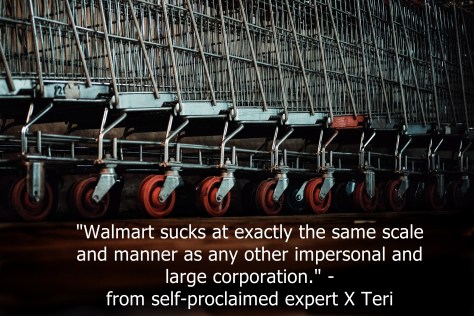
I originally planned on posting a picture of a vacuum hose; it, like Walmart’s customer service system, has a great deal of suck. Good people, terrible system. As a Walmart employee told me, a great portion of their job is to insulate management. It’s true in many places and it should be no surprise that large impersonal corporations would be the same. Everything about their complaint or issue system is designed to weed out the crazies. It also, unfortunately, weeds out the authentic questions and concerns. (I realize that in many cases I qualify in both columns.)

I forgot to mention something that a lot of people don’t know: I used to teach quality and customer service classes, in 2 languages, at another large, impersonal private corporation. Traditional methodology doesn’t work; people silently vote with their feet.

Corporate complaint systems are similar to Yossarian’s Catch-22 of circular logic and disinformation. Because I love Catch-22, perhaps it is why I occasionally enjoy a foray into the wonkiness of broken corporate structure, even when I fully realize that it’s like a symphony of interconnected voices, except in this case, everyone is screaming in medieval Italian.

“Men Are From Mars, Walmart is From Uranus” might also be a good meme theme to address the dismal communication channels.

People at the local level told me contradictory things, most of which can’t be verified, with each pointing fingers up the organizational chart. A couple were careful to imply I was lying, which was an additional bonus. I expect a call from Robert Mueller any day now.

A 5-minute call with someone in the corporate structure would have been the extent of the issue. A couple of emails with someone other than a drone would have also been perfectly adequate. A bucket of water thrown on me would have been unhelpful, but amusing.

Then, something curious happened.

I found out that Walmart had already read my post on social media and on my blog. They have staff who monitor these things for mentions. Much of it is automated, as with Google alerts. They don’t directly acknowledge this, even though it is an open secret that many companies do this. All of the large ones do.

Things like ” #Walmart ” help them find mentions much more easily.

It’s fun to think that someone from Walmart is reading these words in their head, probably with an increasingly strange look of realization dawning on his or her face. I hope that person’s name is Amy, Jake, or Alonso, for reasons I can’t disclose.

I remember when my Aunt Ardith, who worked for SW Bell/ AT&T at the time, did the monitoring for a short period back when newspapers were the most likely mining resource for mentions of a company or person. Later, after the death of a family member, I found out the hard way that banks often monitor public records, obituary notices, and other similar material and often take pre-emptive action, even if this behavior isn’t strictly proper. Not everyone can have a good degree: those people who don’t go to careers in Marketing. (Ha!)

So, I now know that several Walmart employees have read about my both my issue and the lack of followup from anyone willing to communicate about it.

Meanwhile, I exchanged a slew of emails. The promised ‘person’ who would be my salvation again turned out to be a generic and nameless email and contact phone number. I had been Rick-rolled.

Even though at this point the company acknowledged there were ADA-level implications, no one reached out or returned their calls as promised. I can only assume that this means that every person they know is 100% healthy and loves doing the jobs that were previously included in the price of the goods or services they buy. The circular emails and messages, however, continued, probably in hopes that I would put a large dirty shoe in my piehole and go away.

I found myself reading the entire tax code for fun, hoping to distract myself from Walmart’s inability to reply to a simple question.

Because people in the hierarchy have seen my posts, I assume they know that customers are watching what they do and how they address labor shortages and automation in their stores. A lot of us have a few basic questions we need to be answered before we make a decision to turn from apathetic toward resentful.

They’ll read this post, too, and know that I know that they know. I’m watching them as they watch me. (Think Rockwell, except without the creepy shower scene.)

As a reminder, this issue started because someone I know was mistreated by a local Neighborhood Market. Out of character, I went to find a manager and talk about it to try to get answers for all of us – and hopefully, help the company and its customers. Next time, I’m going to do what I know works: roll my hair in used cat litter and go to the store asking where they keep the duct tape.

Stupid me.

Jeesh, I certainly hope that #Harps is monitoring all this stupidity, too.

For the record, though, I’ve simplified the questions for Walmart executives:
1) Will a cashier always be available at the local Neighborhood Markets? 2) If not, would it be a burden for Walmart to clearly identify the hours and/or stores which will have no cashiers present? 3) Absent a cashier, does a person with an issue or disability need to disclose his or her private medical condition in order to get an employee to perform the job of cashier? 4) If you remove cashiers, do we get an additional discount? P.S. I’d rather pay a little more and keep more people employed and all of us happier. Otherwise, I’m going to forget to scan about 22 bags of cat litter as you force me to do the cashier job for your employees. You’ll get the cat litter back, though, one bad hair day at a time.

So, Amy, Jake, and Alonso, this post is finished. You can relax.

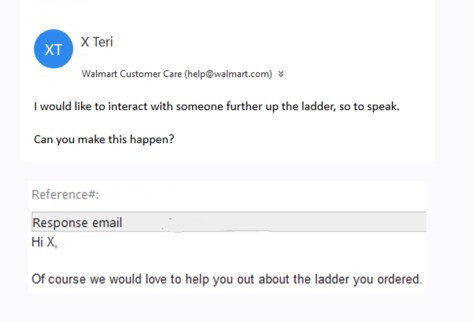
My ‘Ladder’ Problem at Walmart…

up the ladder bot or person 0324

A few people questioned the validity of the email screenshot I posted over the weekend. While I appreciate the idea that I love the ludicrous more than the next guy, it is 100% true that an actual human being from Walmart (Neighborhood Market) replied to my emails by inquiring about my ladder problem.

For anyone concerned, my ladder is in the garage, safe and sound.

I’m up to 84 interactions with Walmart help, customer care, and corporate.

It seems like it would just be cheaper (and smarter) for them to put me in contact with someone in Compliance, wouldn’t it? I’m not in charge of a multi-national corporation though, so it’s possible they know something I don’t. #walmart

P.S. Walmart really is the Cable TV of groceries, too. 2000 channels and nothing to watch. 2,000,000 associates and no one to listen.

YesOrNo.com

which-way-29941281444641fqVC

Note: this is an older post. Seeing Netflix and a few other sites adopt an idea I’ve had forever makes me smile – as I recommended exactly this course of action several years ago in this blog post.

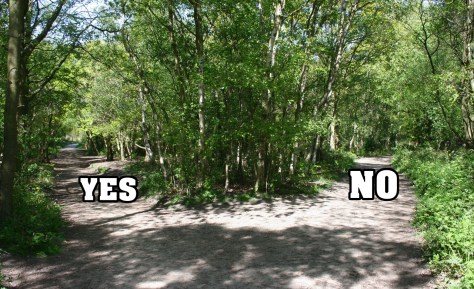
I’m going to start a website called “YesOrNo.” It will cover websites, restaurants, vehicles, tourists spots, movies, music and anything under the sun. It will be a testament to minimalism and focus in a world of too many options. If you are neutral to the website, movie, or restaurant, you don’t vote. No fence-sitting is allowed.

.
Instead of being weighed down by too many details, there are only going to be 2 options: “yes” or “no.” No comments. No categories to obfuscate the response. No Yelp-like lawsuits alleging vote-fixing or reviews. Studies have shown that too many options reduces our happiness and satisfaction.

.
Users will need to learn to be discerning with their votes. There will be neutral option. Either you vote or you don’t – but you’re going to need to decide between “yes” or “no.”

.
There will be technical issues to address governing how to identify participants and/or lessen abuse of voting. That’s true of any website or business idea. Clever, motivated people combined with technology should eliminate all the major hurdles.

.
With a social element, users can choose to add “trusted voters” to their logins so that they can refine their trusted opinions over time. This will allow you to ask the website to recommend a new place or experience to you, based on input from you and others who are similarly minded. In my scenario, however, the data will be limited to tallying without superfluous detail.

.

Unlike Angie’s List, users won’t be expected to pay – as such services exclude much of the population. It does tend to cause an uptick in the “crazies” noticing your website, but again, technology can overcome most of the stupidity that will ensue.

.

It’s so strange to see Tinder doing well. I’ve joked about yesorno.com for a long time, especially after an old-school website called “checkthegrid” died. On my old blog I had this idea designed, with screenshots and graphs. Like most people, though, my enthusiasm usually sputters at the implementation of an idea.

.


At it’s heart, the website would be simple categories, with “green” indicating “yes,” and “red” equating to “no.”


Adventure In Marketing

qweqwee

Adventure In Marketing

As many of you know, I often do work for other websites, usually satirical, and often hare-brained. Most of it I do without credit, which works out favorably for all concerned.

Recently, I had the chance to apply for an unpaid ‘think tank’ for an unnamed major U.S. pizza chain. When I first interviewed, I was certain I wouldn’t be chosen – as one of the hurdles was an IQ test. Since anyone who knows me knows that I find these things to be ridiculous and without merit, I finished mine in less than 4 minutes, using a system I call ‘random.’

When I slid it back across the oak table to the person conducting the IQ tests, she said, “Sir, you have 25 minutes to complete it all.” Without missing a beat, I replied that I already knew my IQ score.

“Really? What’s your score?” she sneered.

“Low oxygen level,” I replied, without daring to crack a smile.

I went home and almost forgot about the application process. Three weeks later, a welcome packet arrived in the mail, along with a website login and a credentialing packet. I had been accepted despite my interview antics.

By sheer coincidence, I had recently tried to treat myself by ordering home delivery pizza. I had eaten healthy for a week and thought that a celebration was needed to keep my motivation.

It was a disaster. The cardboard box tasted better than the pizza. I was hoping to throw up, just to get the taste of that pizza out of my mouth.

The next day, I logged in to the marketing website to start an assignment. Lo and behold, the subject was the very same company which had reminded me how low the bar could be set for edibles.

I weighed the pros and cons of each option: submit great work and possibly be rewarded OR write the best food review possible.

This is the result: the new logo and motto for Pizza Hurt. Look for it at a location hopefully very far from where you are.

And Now, A Word About Complaints

Among those frustrations we share in common as humans, perhaps none is as deeply pernicious as the specter of inaction in the face of a pattern of misbehavior. Each time the feeble question of “what could we have done” cuts deeper. It is difficult enough for an intelligent person to come forward at his or her own risk when silence is the easiest choice among glib options. In part, this is the major justification for pausing to listen attentively when someone steps forward with a complaint – even if no one else does. Silence, as we know, is just as likely to signify fear and distrust of the process as it is the absence of truth in the allegations. In the face of being ignored when speaking the truth, I am more surprised the table is not only pounded on with greater ferocity and frequency but also that the table is not overturned. Ignored complaints fester and make all of us lesser people.

While my post is personal and not born of any specific or recent event, I think it applies to current events as well. (P.S. Don’t ascribe motives or scenarios.)

Someone I am close to reluctantly got dragged into a lawsuit decades ago, one in which allegations against a prominent public figure were labeled as ridiculous. Those who came forward suffered a barrage of insults and distrust. As a result, the wrong side won and we will never know how much damage was done to other people.

Imagine the spectacle of that first person daring to come forward, knowing that her word was going to be questioned. Every scandal starts with an unsubstantiated allegation. Every truth starts as a heresy.

Springdale & Brinkley Hold Lessons

This post evolved from a simple comparison of my geographical past. It grew to encompass parts of me and as such, is very personal. If you will pardon my generalizations and laziness toward exact writing, you might find something interesting.

I didn’t come to Springdale until the early 70s. My dad dragged our recently reconstituted family up here for the promise of a steady job, away from the geography which took the blame for so much of my dad’s heartache. His time in prison in Indiana and his involvement in the death of one of my cousins (unrelated to prison) had broken him of some of his desperate need to remain in his hometown. My dad had a brother here, my Uncle Buck, as well as a few cousins. Our move was prior to the miracle of the interstate reaching its tentacles up to Northwest Arkansas, so all trips to NWA were long, winding escapades. It seemed like we drove for days to reach the mountains of Springdale. I didn’t understand what a ‘hillbilly’ was. All I knew were the fields of Monroe County and the places my grandma and grandpa called home. Being with my dad was the last thing on my wish list.

Years take on a different meaning when I stop to consider that soon enough I will be exactly halfway between 1970 and 2070. Springdale and I both have changed immeasurably since I was young. The area of the Delta from which I came has continued a generally languid, shuffled march toward annihilation while NWA has become a beacon for commerce and lifestyle. It was sheer luck that my dad’s terrible fortune planted my feet here. And while the Delta was once the powerhouse of agriculture but found no clear footing to advance, Springdale and surrounding areas used agriculture as a springboard from which to dive into a diversified future. So many of us here live in houses situated on plots once adorned with grapes, apples, strawberries and all manner of other foods.

It wasn’t until I was much older that I realized that the interstate running through Brinkley wasn’t always there, a fact which should have been immediately obvious. In Brinkley’s case, though, the interstate seems to have provided a convenient escape for the younger generation, as they ventured out and realized that the state had more to offer in other places. In Arkansas’ early history, roads were intensely local, often built to connect small town agricultural markets. For the affluent parts of the state, the interstate gave people and commerce alike the way to merge interests. While lifelong residents of Brinkley might wish to disagree, it is obvious that good roads shone a beacon toward better opportunities in other parts of the state. Brinkley could have been one of the jewels of this state, given its location. Even as I sometimes forget that I once loved the flatlands there, I will admit to its austere beauty.

I also forget that many parts of my early life are inexplicably entwined with those people who I deeply loved and those who were violent caricatures of real people. Geography mixes in my head and sometimes paints an unfair picture of those places, simply because the people walking across my stage were broken people. As we all do, I carry pieces of these broken people in my head, as such slivers are difficult to excise. I can hold the image of standing near a rice field near Brinkley, up to my ankles in mud, laughing; I can also imagine walking alongside a pungent Tontitown grape vine in August, my fingers cleverly stealing unwashed grapes and eating them like candies. I’m not sure which place or memory is more valid, but I do know that being surrounded by people with love in their hearts can make any geography welcoming, while immersion in the minds of lesser people will reduce the world’s brilliance regardless of where one’s feet might be. It’s how City View might have been a place of low resort for many, and a welcome mat for others.

Because of the reduced crucible I survived as a kid, on the one hand, there was so much about this town which remained unknown to me. My life was incredibly small. I could sense that it was an interesting place, though. My family moved over twenty times by the time I had reached adulthood. So many places around Springdale became familiar to me. In many ways, I feel as if this was advantageous to me, giving me a different perspective than someone who was lucky enough to remain fairly rooted in the same place growing up. In my family’s case, our ongoing moves concealed the array of abuse and violence camouflaged inside each respective new residence.

When I was in 2nd grade, I remember asking Mom what it was like attending school with black children in Monroe County. She looked at me like I had been hit with a shovel and said, “I didn’t. We were segregated.” (It was probably a lucky thing for them, though.) I wondered why Springdale was segregated, too, given that there were no black kids in class with me. How was I supposed to know that there were so few minorities living here? I was so naive. Even trying to understand that one of schoolyard buddies Danny was actually from Chile was beyond my comprehension. That’s how reduced my life was without education. Had I been born 100 years ago and remained in Monroe County, I could easily see myself in the role of unapologetic racist. My family would have raised me to believe that it was a certainty.

It’s funny now, my ignorance. In my early youth, I had never heard the word “segregated” except as a muttered curse. For most of the whites in the Delta, segregation was a word equated with government distrust. When I started learning history, it astonished me that there was such a short jump between our Civil War and WWII.

My dad took us back to Brinkley for my 3rd-grade year, to attempt to run a gas station in the no-man’s land on Highway 49 outside of Brinkley. While my home life was a slow-moving mess, school was fascinating. Just as I got acclimated to flat lands again, Dad’s failed business drove us back to Northwest Arkansas.

I remember my Uncle ___ saying that he was jealous of my dad, Bobby Dean because Springdale didn’t have ‘the plague’ of so many blacks. Other family members said the same and I only share this memory reluctantly. Perhaps it’s not wise or fair to generalize about my recollections of prejudice. On the other hand, they are my stories and as a sage once reminded us, perhaps people would behave more appropriately if they knew an observant writer was living amongst them. Truth be told, racism took a back seat when contrasted to the casual violence of my dad. I had a couple of god-fearing aunts and uncles who remind me that we should never be surprised by the sheer hatred some racists harbor in their hearts. One of the prevailing lessons they taught me was that religion could easily be twisted to justify and condone all manner of hate, all the while sitting behind a pearly-white smile and opened Bible. When I was young, I endured many a comment from them regarding my views on homosexuality, race, and language. When I grew up and realized that they were simply unadorned racists, their arguments dried up. The revisionists in life will insist they were great people and in many ways, they were the product of their times; in another way, though, they deliberately refused to change their minds, even as they paid pretense to the societal demands that they keep their boring and unimaginative racism mostly closeted.

Even though so much became second-hand to me, Springdale itself began to break away from its parochial roots; languages and color slowly entered and once inside sufficiently, kicked the door in and changed the fundamental nature of everything here. Even as I learned the town’s geography, it was already changing rapidly around me. In 1970, Springdale’s population was around 17,000. In 2015, it was on the high end of 77,000. (My hometown lost 1/2 of its population in the same time period, by comparison.) No road escaped the necessity of bulging outside of its small borders, and many signs became incomprehensible to the earlier residents. I was lucky enough to be present during many fits and tirades from Springdale residents insisting that hating the presence of another language wasn’t a sign of prejudice. They seem ignorant to almost everyone now, but the angry spew of their spittle was a sight to behold back in the day.

Springdale was akin to a debutante sent away to school in some exotic location; upon her return, she was unrecognizable as the same person. But almost everyone could look upon her and admire the changes. It’s almost impossible to turn back once someone or somewhere has caught a glimpse of the vastness of the world.

I’ve heard many people refer to Springdale as once being a Sundown Town. I don’t remember seeing such signage. On the other hand, I didn’t need to. My family provided all the exclusionary language anyone would ever need. Their distrust for minorities was amplified by our move to a white community. As strange as it is, I remember when my mom started working for Southwestern Bell (AT&T) in Fayetteville as an operator. She often came home, angrily ranting about blacks in her workplace. It was the same language she used in Monroe County except now she had a home base to retreat to, one which seemed to encourage her racism. Mom was an angry person most of her life, so the language was a symptom of her defect more than any commentary on her surroundings. Both my mom and dad fled back to Monroe County in the late 80s, after a long succession of disappointments.

Before I forget to mention it, my mom’s last job was as a custodian for Brinkley schools. The person who treated her the most kindly there was one of the black teachers there, proving that truth is stranger than fiction. Like so many racists, Mom’s racism tended to intensely situational. She couldn’t understand why I, as a white person, would ever stoop so low as to learn another language, much less love its differences. Her life was reduced by her prejudices.

The differences between the racism of Springdale and Brinkley were striking. It wasn’t until I was much older I surmised that Springdale didn’t need to be overtly racist. The whiteness of the faces walking the streets communicated a clear message as to the population. Springdale was a town waiting to be changed both monumentally and one person at a time, whether it saw the tidal wave approaching or not. It confused me how two places in the same state could be so markedly different, yet both have residents generally fixated on differences based on skin color. I’m generalizing of course, but I know that you understand the distinction I’m drawing. Most of Springdale’s residents weren’t prejudiced, of course, just unsure as to how to accommodate the changes to their towns. Racism tends to discolor a disproportionate number of people around it, giving it a larger circle than reality warrants. This circle of influence sometimes gives the wrong impression of tolerance toward prejudice and many of those practicing it become adept at hiding under its umbrella.

It’s strange to me that both Springdale and Brinkley had so much to build upon. Frankly, Brinkley had the advantage when I was young, and if a few visionaries had the temerity to act upon it, it would be flourishing now. Instead, Northwest Arkansas seized these opportunities.

Against the backdrop of economy and money, Springdale acquired deep populations of Latinos, Marshallese, and other minorities. Most of us who were paying attention and curious were amazed at the changes brought to us by different cultures. Since I’m naturally curious, I loved the overlap of cultures and couldn’t wait for it to become entrenched. Others, though, peered at it through narrowly-turned blinds, wondering if the small town they grew up in was gone forever. Thankfully, the answer was ‘yes.’ Change brought a greater viability to our town. The overlaps of other culture became so large that in many cases people felt conflicted about which culture was their primary one. That is the ‘melting’ we claim to honor as a country. The melting works much better when it is in both directions, with those who were here first welcoming the inevitable changes brought by new faces.

The same didn’t happen for Brinkley, despite it attempting a few rebrandings. The remaining base shifted out from under when it lost its Wal-Mart. People continued to flee, even if meant they’d be exposed to a greater variety of cultures elsewhere. For those who left, many have an idealized memory of what it once was. The truth, though, is that it was never really that place. People voted with their feet and the results are the only conclusion which needs no clarification. One day, hopefully, Brinkley will discern a path toward revitalization but all such paths are dead ends without new faces and new opportunities.

Springdale, albeit with a few hiccups still to come, is a place which can be a foundation for everyone to look back upon and feel a sense of community. It defies an easy definition, precisely because other groups came here to stay.



Vindicated…

Long personal story…. Please read knowing that all businesses, no matter their reputations, have countless great employees who don’t misbehave and/or don’t appreciate how their employers conduct business. It’s a conundrum we all face with businesses. Unless my issue is with a specific person, I in no way wish for people reading my words to think I’m painting all employees of any business with a broad brush of accusation.

A couple of years ago, I shared a story with you about Arvest mistreating my wife. An ATM failed to give her $400. She reported it immediately and Arvest fixed the error. Months later, without notice, they reached into her checking account without permission and without telling her and took the same $400 back out. There was no appeal. They had waited months, after all video evidence was gone, and without following up. Dawn politely worked to get the error fixed. Not only did she not get the error fixed, but a couple of the people working at the bank had an attitude which was dismissive, as if Dawn somehow had lied about what happened. Dawn’s feelings were hurt, to say the least. She’s polite and was certain that logic and patience would fix the problem. No one at the bank cared.

Dawn responded by deciding to leave Arvest, after many years of doing business with them. She took all of her accounts and later we got another mortgage to get away from their shenanigans.

Just because I can, I have also frequently picked on Arvest on social media. I’ve been polite, but I’ve satirically jabbed at them a few hundred times and made several memes to poke fun at the bank.

Yesterday, before coming home, we stopped at our community mailbox and checked the mail. I handed the mail to Dawn, who was seated in the passenger seat. I told her, “Look, you got a big check from Arvest,” and laughed. We joked that it was one of those fake mailers, especially since it didn’t have postage. Also, we had never given Arvest our new address, having wiped them off our feet before we ever decided to move.

I told Dawn to open the Arvest envelope. Lucky for us, she did, instead of discarding it. Inside was a check addressed to Dawn, in the amount of $400. In read, in part: “…during a review… we determined one of more disputes was denied in error. Due to this error, we are enclosing a check…” It was an unsigned form letter with no explanation as to how they got Dawn’s address, nor did it contain any sort of apology.

The look on Dawn’s face was priceless.

More than the $400 Dawn got in the mail, the admission that Arvest screwed up a couple of years ago when we said they did is worth much, much more than that. It should have never happened, because Dawn would have stayed with the bank for the rest of her life, if possible. Now we have the magical words in writing and those words all this time later prove that we weren’t lying or crazy: Arvest took $400 of Dawn’s money without cause and worsened the problem by strangling us with bureaucracy and apathy.

It’s easy to get a customer, but very difficult to get one back after you’ve mistreated them. You should never let a customer walk all over you, but you should also remember that customers are people. The $400 is nice, but nicer still would have been for one person at Arvest a couple of years ago willing to stand up and say, “Enough. We can’t do this to a customer. It is our error.”

PS: You should always address customer service issues or old business before taking any steps toward acquiring new business. The disgruntled folks are going to eat your lunch telling their stories.

Your Right To Discuss Pay

I wrote this specific post about 8 months ago. It made some people nervous, as employers tend to have the balance of power and when people are told something over and over, it becomes difficult to openly learn about the issue and discuss it. It’s empowering for both employer and employee to know the law and learn how to keep a business healthy.

I’m not talking about my employer  and also not talking about anyone I know personally. This is a PSA-style something-most-people-don’t-understand post. Yes, this is a Right-To-Work state, which doesn’t affect the content of what I am posting. Anyone can be fired legally or illegally, for reasons both legal and illegal, which is also not the focus of this post. And one more: it is almost never worth it to irritate your employer, even if you are ‘right.’

How much do you earn at your job? Interestingly, I’m finding that many people aren’t aware that their employers generally *can’t prohibit them from talking about their benefits, including wages.

I know that many of you are saying “But my employer has a policy that says I can’t.” It’s likely not legal, and hasn’t been for a long time. You can investigate it, if you want.

There are exceptions, of course, and you should be aware of how you fall in the category. In general, if you work a traditional job for a private employer, aren’t a contract employee, aren’t a supervisor, and don’t work for the government, you can talk about how much you’re paid until your jaw gets sore.

That’s the majority of us.

You can go to the National Labor Relations Board website at: NLRB Website 

(The NLRB is an independent federal agency that is often overlooked, especially in states where unions don’t tend to have much influence.)

If you’ve been warned, fired, or told you can’t discuss your wages with others, call the NLRB and use their website to get educated. Most of us have the right to discuss our wages if we choose to do so. Much of the problem arises when employers or their managers fail to understand the law, even with good intentions.

If you are a good employee, you will of course not waste your employer’s time talking instead of working. Modern companies know better than to pay less for any reason other than value and merit. At least I think they do. You choose to work for the wage your employer offers. Likewise, what your employer chooses to pay you is for you to decide to disclose to another person. Just as your employer is free to determine prevailing wage, you are free to talk about it. Your employer is paying you a combination of what you are worth, what it can afford, and according to its own policies. Assuming other variables aren’t present, employees generally are being compensated in a similar manner within the same company, based on common criteria. It doesn’t have to be that way, of course. Your employer has the right to determine your wage and you have the right to decline that wage or not. Discussion of wages is a different topic and unrelated to that employer’s right to determine pay under the law.

While all of the above is true, I don’t recommend you run around with a banner with a picture of yourself shouting how much you make while giving the finger. It’s not smart. Many of our problems with our employers stem from the inability to honestly bring questions to them and see that they are addressed – and that no one punishes the messenger for voicing concerns or questions.

Hillary Clinton got some attention for getting the law wrong. Here’s a link to the Politifact article detailing what happened: Clinton Gets Pay Discussion Law Wrong

Studies have shown that discussion of pay helps a company for long-term stability. It helps avoid allegations of unfairness, eliminates accusations of unequal pay or glass ceilings, and demonstrates openness from employers toward employees. It builds trust among employees and with the employer.

A good employer knows that all of the above is true and works actively to build trust with employees. A cornerstone of this kind of trust is centered on both compliance and embracing employee involvement, even when the traditional view is one of prohibition. One myth employers tend to believe is that employees who know what their counterparts earn are less flexible and efficient. Great employers don’t even worry themselves with these considerations: they don’t discriminate unlawfully and do their best to have consistent policies. That’s why you don’t have innumerable news stories each week about employees filing complaints. Most employers are too busy running their businesses without worrying about needless arguments about pay.

I generally don’t talk about where I work on social media and I don’t complain about what I earn – because for requiring only a HS education, I have good pay and benefits as an employee. I choose to work for the wage I’m given and it’s a fair wage for my job and hours. I’m not concerned that my employer is going to see this and be upset with me. (And not just because an ‘employer’ is only a collective of people.) I don’t run the halls challenging people with how much I earn or flaunting my knowledge or chanting ‘nana nana boo-boo.’ I would like everyone I work with to make at least as much as me if they are doing the same job, even those with less seniority. I’m weird like that. Qualifications and merit rule.

If your employer has a policy against pay discussion, be human about it. Ask someone you trust at your company if they are sure it is legal. Give them a chance to investigate. All of the people doing jobs have a massive number of laws and rules to juggle. Some of the most obvious ones are most often overlooked. Don’t jump to the conclusion that your employer is inhibiting pay discussion out of a nefarious motive – it might be simple ignorance. If your employer gets angry at you for even asking about the law, chances are that you are working for an employer who isn’t interested in complying with the law, which is another discussion entirely.

You’ll be surprised how often many employers tell their workers they can’t discuss wages – even though it is illegal for most of them to do so.

In my years working, I’ve encountered many people who simply don’t understand the law.