Someone noted that one reason they love theaters is that it’s about the only place left where phone usage is unwelcome. Everyone is expected to relax and enjoy the experience. Violating the usage expectation results in interference with other people being able to enjoy their experience. Irritation at those who ignore the expectation is universal. There are so many other circumstances in which the ubiquitous nature of phones interferes with the simple act of presence or attentive listening. You’re not checking your phone; it’s checking you. The nostalgia for days gone by results from people realizing that lack of constant access to the world meant that you were in the moment with the people and places you chose to be with. Yet, here we are. We’ve normalized interruption. A smart person pointed out that it’s one thing to want things and another to need them. Like all technology, its existence was supposed to make our lives easier, more efficient, and less stressful. Yet, it’s obvious that the opposite is the case for a lot of people. We are technology addicts. If you don’t believe it, try laying it down for four hours. You’ll react with the “…but what if…” argument. It will overwhelm you. I watch so many people let work slide into off-hours thanks to phones. “Let me take a quick look at…” becomes the preface poetry of the modern age. I love technology. And even that phones are so useful. But I can’t help but contemplate the fact that so many people seem to allow their phones to be their master. Love, X
The original picture is from Six Feet Under, one of my favorite shows. Just the memory of it sharpens internal knives inside me. The series finale still resonates as the de facto best series finale ever produced.
A few years ago, I modified the picture with one additional line. It’s a reminder that if you’re invested in ‘winning’ an argument, you’re also watching your precious time race past you – along with all the other things you could be doing. Most of us don’t win arguments. Not because we’re wrong or right, but rather due to the fact that most arguments are either a matter of opinion or stubborn bias against facts or other perspectives. If people won’t listen to facts or evolving discoveries, you’re playing by a different set of rules subject to the other person’s whimsy. And if neither of you can recognize the futility of individual perspective, you might be living on another planet.
The people who intelligently challenge you are the very people you probably need the most in your life. But also the ones that you shun. Who wants to live a life of introspection and self-accountability? It would be a marathon just making it to breakfast to have a life filled with such people.
“You sit in such judgment of the world. How do you expect to ever be a part of it?” Olivier (who was one of the smartest and most irritating characters on the show).
This is not a post about reality TV per se. Reality TV fascinates me; not as a watcher, but more for the process of misdirection, drama creation, and constant familiar themes to provoke an emotional or shocked reaction. When I do watch reality TV, I spend an inordinate amount of time looking up the people and places to find out what really happened and how the writers and producers repackaged it for entertainment.
Again, this post isn’t about reality TV per se. It’s about the fact that a great number of people are exactly like reality TV. They aren’t living authentically, they don’t say what’s on their mind, emotional connection feels foreign to them, and honesty tends to be in short supply. We tend to be reactionary by nature. And even with legitimate reasons to react with frustration, anger, or emotion, our tendency is to bite our natural response to whatever is happening around us. We watch one another, evaluating what’s going behind the facade. It’s why memes caution us to remember that each of us has things going on that others don’t know about.
Turn off the TV. Surprise yourself and other people. As a self-admitted hypocrite, I can write these words without feeling like a fraud. I hate the disparity between who I am and how I communicate and behave in a lot of situations. All of this artifice we build up around us is a cage. The strange thing is is that we are our own guards. The key is in our pocket.
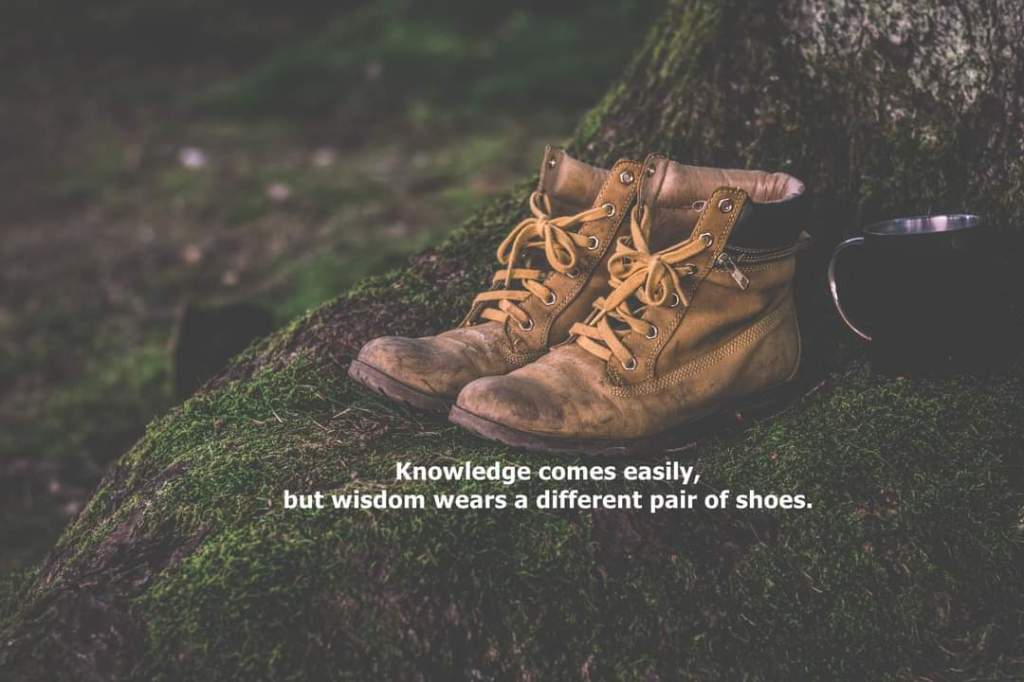
“Knowledge comes easily, but wisdom wears a different pair of shoes.”
We all know that change and new behavior is the only way to move forward. But we are reluctant to put on work boots. Inaction is easier. To reflect, evaluate, prune, and move in another direction. Every important change starts with a new attitude. Followed by action. And if it doesn’t? You move first, and motivation will follow. Almost everyone gets stuck in the familiar; no matter how unhelpful our status quo is, it’s familiar and comfortable despite its consequences. Most of us observe with wonder at how complex our brains are, how filled our world is with surprise, and how powerless we feel when we want to connect with the invisible and intangible power of just being alive. “You’re your own worst enemy” was intended as an insult. I took it as an insight. Knowing you’re an idiot can debilitate or motivate. Everyone says they will do the things that matter, express the words that want to spill, and be a better person. Tomorrow. Later. When the time is right. Your boots are stuck under the bed somewhere, lonely from disuse. Love, X .
This isn’t my story to tell. But I’ll trespass because it blankets the lines of odd convergences of the things we all experience. Regard it as fiction and find whatever value that words can convey.
She seemed to melt against the wall, her head down, with a cell phone pressed against her ear. “Margaret died this morning,” she said, her voice flatter then the plains of Iowa. It was the flatness that conveyed an overwhelming emotion behind her words. Numbness, like a whisper, sometimes telegraphs greater information.
He stopped and was about to ask her what she needed. A woman walked up to her and put her hand on her shoulder as she ended the phone call.
“She’s in a better place,” the late arrival told her. Though he looked indirectly at her, he watched her face wrinkle with conflicting emotions. He could read her mind.
They spoke a few sentences back and forth. The woman returned her verbal volleys with diminished enthusiasm and volume.
As the late arrival walked away, he asked her what she needed. “To be about 200 miles from here. None of these people knew my Aunt.”
Because it’s what he does, he hugged her. He wasn’t going to add vacuous words.
When he stepped back and away from her, she told him that she didn’t think she could stand listening to people talk about her aunt.
“Then don’t. The person you loved is gone. Your debt is paid.” He didn’t quite say it in so few words because he was surprisingly caught off guard by nervousness. His entire morning was a bout of unidentifiable anxiety. His arms still quivered with the exertion expended to quell what had saved insurmountable at the time.
“I hate it when people say someone’s in a better place.” The irritation in her voice was evident.
“They mean well. None of us know what to say. I put my foot in my mouth a lot. We’re not thinking about where they are. We’re thinking about going on without them. That’s what grief is.”
She looked at him directly. “That’s a really good way to put it.”
“I learned the hard way. When people are grieving, they say and do almost anything.”
She nodded. He walked away, hoping that time would warp for her. Time is one of the few things that helps. But sometimes, it remained fresh forever.
He wondered how the universe sometimes finds a way to overlap lessons that superficially have nothing in common.
The premise of the STFU method is sound: not every thought needs to be expressed and many feelings are transitory and not necessarily real. Keeping the lid on is an effective strategy most of the time. At some point though, you’re going to have to open the lid or haul it away. A wiser person once said, “It stays buried only if it’s dead.”
If I had a way to tell every young person in the world one of the best ways to be ahead of most people, it would be to be able to stay calm when everything is going to hell around you. Not in a trauma-response way. When I was growing up, I didn’t realize that I was often reacting to the violence and craziness In such a way that it would imprint a foolish cycle onto my adult life. It’s difficult to remain calm and fearless because we are biologically wired to be adrenaline filled. Our endocrine system is our enemy in this modern world. Much of our anxiety stems from a lack of control, both for the things that swirl around us and our response to it. Letting it flow around us without internalizing it is a superpower. If you’re observant and prone to introspection and overthinking, you will have a bad time. Anyone living in this modern mess has ample fodder to wonder if we’ve all lost our minds. We are supposed to be spirits, yet it’s more likely we’re collectors, feathering our own nests at the expense of whatever passes for the greater whole.
My friend Marjay might tell us to “look for the helpers” when things go to hell. It’s good advice as far as it goes. It also belies the fact that we need to be helpers. When you’re on a plane and trained to use the oxygen masks that fall during an emergency, you’re also told to ensure that your own mask is on first. Otherwise, you’re useless. And so it goes with the mundane yet herculean task of navigating your own day. Be your own helper. It’s not a reassuring feeling to know that after decades of witnessing the casual avalanche of surprises in life, that I’ve failed to be my own helper. I’m not being glib; I’m being honest in the acknowledgment and nod toward my own deficiency. It was easier to look back to my childhood and shift the blame to the people masquerading as adults. It’s not their fault. They were broken. Using them as a template for either blame or guidance is stupidity. I might stretch the comparison to include how we collectively manage our society.
Every few years, I watch the 1993 movie “Fearless.” I watched it Sunday. It always triggers a wild parade of ideas and emotions in me. It used to do so because of my own plane encounter a couple of years prior to the movie. As my life progresses, it increasingly morphs into an analogy about how I’ve responded to crisis as it comes along. The main character survives a plane crash, during which he experiences a zen-like moment of clarity that detaches him from worry. The obverse side of his coin is that while it gives him an almost supernatural ability to detach and help other people, it damn near destroys him in the process. Enlightenment is personal; living is a task that requires immersion into the craziness.
“If you are what you do, when you don’t, you aren’t.” A convoluted way for Wayne Dyer to remind us that we are what we do and think. He also said, “How people treat you is their karma; how you react is yours.”
The “Try That In A Small Town” controversy is fascinating. It seems like people are using it to defend their identities with it, on both sides of the spectrum. That such a song can be true for both polar opposites should remind us of the danger of ideology and certainty. On a side note, I laughed my ass off looking at all the memes on both sides of the argument. People are clever, and many used it to satirically make their point. Satire and snark are two of my favorite nutrients to deal with the world. For me, the song also brought back my childhood and one of my harshest criticisms of it. A small town or parochial lifeview can be a comfort. That same circumstance can also hide a lot of violence and misbehavior. Families, like communities, often rubberstamp things that would be better served with a dose of sunlight and scrutiny. A lot of children walk around in a world where God doesn’t rescue them from senselessness – and family members turn a blind eye or don’t get involved.
How you react to what’s around you is your decision. You either float peacefully on the river, or it sweeps you downstream. It’s the same river regardless. As with the protagonist of “Fearless,” you might find yourself on the edge of the roof, looking a mile below you. The danger remains, whether you’re on the high roof’s edge or standing on the street below. You are your own biggest danger.
Complaining is easy, much like opening a two-lb bag of Doritos and finding yourself licking the empty bottom corners of the bag.
I’ve had my apartment for two years today. I miss the two known drug dealers who once graced us with their presence. They don’t even send me Xmas cards anymore. If you have 14% of your apartments occupied by those, leaving your box of Barbie dolls unattended in the car is difficult. People who sell drugs aren’t dangerous by themselves; they do, however, often attract people you’d see on the Washington County detention roster. (You know the ones. They often look like they’ve spent the entire night in a carnival porta-potty.) I miss my huge mismatched art project that once dominated the fences outside. I took it down a year ago. Earlier this week, I pulled the commemorative purple tile I’d made to remember it. I’ve occupied myself otherwise by leaving strategically placed items in a LOT of different places over the last year. Somewhere, my large tile with a secret message on the back still towers above the ground, high up in a tree that I probably should not have climbed.
One such secret prank I did still amuses me, though I’m not proud of it. A particularly angry person at some point walked out of their residence to discover a gift certificate to Shakes, in hopes that it might lessen their angry, aggressive attitude. I left a note encouraging them to be silent if they couldn’t ever say anything nice. But I also wrote that there is hope for everyone if they’ll just slow down long enough to see that there are blessings and people around them worthy of appreciation. I doubt my attempt helped them. I would call it catharsis, but fancy words like that violate standards in the South.
The last two years seem tenuously stretched to accommodate five times as many days as they contained. That’s a good thing. Time flies, but it also distorts, like bargain-bin yoga pants.
Back to complaining. Complaining serves us in small doses. It allows us to vent and release pressure. It works until we find ourselves beyond the wall of negativity. If you can’t change it, change your attitude. Or altitude. (Go lie down for an hour.) Continuing to spew negativity past that point infects the people around you. Do what normal people do: drink excessively or dive into capitalism by collecting penguin trinkets to fill your walls. It’s easier to cure alcoholism than negativity. You can hide the alcohol, but there’s always going to be a reason to bitch and moan. Or moanbitch, if you need another invented word. As you read this, I’m sure you have such a person in mind. If it’s me, I will take the news better if you write it on a $100 bill and hand it to me.
It seems like I started with a unifying point. But I’ve been listening to political speeches and can’t seem to conclude anything. I noted that it gave me the urge to tell many other people what to do and how to live their lives while simultaneously becoming wealthy at taxpayer expense.
People have noticed how dark my skin has become. There’s no secret. The fascinating part is how much people talk about it. No matter what you do, people talk. When I lost 100 lbs, people convinced themselves that I was doing something crazy to achieve it; whether it was stimulants or starving myself, there ‘had’ to be something other than dedicating myself to my goal through radically changing my diet. While I started doing push-ups months into my weight loss, I lost 70-80 lbs without adding any exercise. I joked that I couldn’t write a book to capitalize on my weight loss. A book that said, “Eat differently,” wasn’t going to sell a million copies. People still fight the idea that most of us can lose weight only by eating fewer calories than we consume. After all, there m-u-s-t be some secret that I’d tapped into. It couldn’t be that straightforward. I still walk around and listen to people talk about wanting to lose weight. Even though they have me to convince them that they can do it without up-ending their lives, most don’t want to hear that it’s the foods you choose that keep your weight up, regardless of how much exercise you attempt. People are largely unaware of how many calories they eat versus how much they burn. If you upend the equation on a long enough timeline, you will lose weight if you’re not suffering from a medical condition that impedes it. I’m still in my target range for my weight. Which should be all I need to demonstrate that I’m doing something right. It is all summed up by the word “consistency.”
Genetics plays a huge role in weight loss, body mass, skin color, and a variety of other things. The trick is to find a way to capitalize on whatever you’re working with.
When I went to Pennsylvania in early June, I was often outside in the pool. I started getting darker. When I was young and spent summers with my grandma and grandpa, I was like a wild native, spending a lot of time outside in the intense summer sun. I got darker, running barefoot and wild.
When I returned from the trip early last month, I started taking Vitamin D and beta carotene. I was also eating a lot of dark, leafy vegetables. Even the protein-rich casserole I eat most nights contains a huge amount of tomatoes, spinach, and kale. Guess what? Those foods coincidentally contribute to melanin production. I’d read that a diet rich in such things rapidly contributes to darker skin.
I also started doing intense cardio each day. I wrap my hands and throw punches. I still have “V Minutes” on my chalkboard in the living room. It reminds me that while I can’t do everything if I trick myself into doing something for five minutes, I usually can keep doing it. I started with small mitts for my hands but didn’t like their soft feeling. Blue painter’s tape and cloth worked much better. Do I look crazy doing it? Probably. My hands, if you look closely, are significantly harder than they were. I like experimenting. It’s been over a year now, but when the idea of trying to run a mile in under 6 minutes got stuck in my head, I kept trying to see if I could do it. I did the same when I wondered if I could do 100 push-ups a day. Or 500. Or a 1,000.
Well over a month into the effort to see if foods could also make me darker, in combination with consistent sun exposure, the obvious answer is yes. I’d been asked if I used tanning lotion to artificially look bronzed. Yesterday, I read a version of this post I had written to post at some point. Because I knew, at some point, it was going to be like my weight loss journey; people would want to know the secret. And when I told them, they’d want to know more, as if the simplest explanation couldn’t be true.
People talk. And instead of listening to me about weight loss or darker skin, they want a magic solution. There isn’t one. It’s equal parts experimenting and dedication. I’ll write a book with a kinky, expensive secret revelation about how to do the things you want. I’ll autograph a copy if you want to buy it.
Love, X
The above isn’t unusual for me, especially during the week.