I have immunity from boredom. It’s like time is compressed for me most of the time. Regardless of the environment, I have the literal world in this little rectangular box I’m typing into. Music, opinion, language(s), ideas. Not to mention an endless supply of things and objects that can be reformed or used to occupy my hands and brains. I also have the entire outside world. I’m lucky enough to have a car that I can get in and go when I want. And still have two healthy feet to propel me. I’ve yet to take a walk where something interesting was lacking.
One of our worst attributes is that we tend to focus on what we perceive to be missing. Instead of the wild luxury that was not available for most of human history. The tendency to seek what we think we’re missing is also a great source of pain in our personal lives.
For those who like to think about thinking, it’s either liberating or debilitating. It’s existential and separating.
But because the internet can be a cringefest or a personal revelation, I sometimes don’t say the things that many of us have in common but never talk about. At least not authentically. Vulnerability is the undershirt that we hide under a thick jacket. Even when someone dares to strip away the ego-driven layer, we universally agree to look away or let our awkwardness keep us from diving in.
Because I do so much, I have an astounding amount of content floating around the internet without any attribution to me. Sometimes, it comes back to me transformed. Which makes me feel seen and heard in ways that I’m not in my personal life. It’s a constant staccato of surprise for me because the people around me have their own idea of who I am, reinforced by the experiences they share with me, molded by whatever environment we’re in. Most of those environments are not authentic.
“Anyone who posts words, policy, or statements by our current president for any purpose other than mockery or excoriation can no longer be taken seriously regarding any societal, political, or economic consideration.”
I can cite countless examples. The government shutdown can be ended without any Democrats voting in favor of it. By changing the filibuster rules, Trump and his Republican devotees can pass the budget bill immediately if they choose to do so. Given the increasing risk that Congress shall soon become an anachronism without teeth, it’s ridiculous to worry about tomorrow’s fire when our shoes are melting today.
People reposting Trump’s ill-informed and uneducated rants in support of something that’s factually untrue isn’t surprising. If racism, misogyny, fraud, and incitement toward insurrection aren’t deal breakers, it’s a deep well from which to draw an infinite spiral of malevolent ridiculousness.
If Trump wishes to be king, then let’s proceed with the coronation so that we can move on to a broken democracy. At least under that scenario, we will not be victim to an ongoing onslaught of “WTF”
moments, nor continue to hope for an end to the madness.
We can acclimate ourselves to the loss of the country we grew up in because we’ll have no other choice.
This isn’t politics. It’s madness and mayhem, driven by someone completely unfit to run a household, country, or company.
“You own everything that happened to you. Tell your stories. If people wanted you to write warmly about them, they should have behaved better.” Amy Lammot
If my ex-wife calls me a jerk, she earned the right.
If the friend I let down thinks poorly of me for failing to step in when I could have, that’s his story to share.
If I tell violent stories about my dad, they’re just as true as humorous stories about him.
If you had a toxic boss who drove you to near insanity, he or she can’t fault you for expressing it.
Every time I share this quote, someone discovers it for the first time. It’s liberating. But it also can be terrifying for people who’ve lived outside the bounds of kindness.
The Golden Rule perfectly encapsulates what we should strive for. Yet, people are surprised when we sometimes appropriately repay unkindness with healthy criticism.
Years ago, I doggedly started down the path of biographical discovery. Some of my family hated the idea. Although I suspected I knew why, years of intermittent discovery and revelation allowed me to piece together facts. Not innuendo or conjecture, nor the vague yet prideful assertions of some of my family.
It is true that behind reluctance, there is always truth. As an adult, I understand it. Who wants their dirty laundry floating around? On the other hand, open discussion of it with one’s children can be a learning experience – not to mention that acknowledging mistakes can be liberating.
I probably should have taken more care with this post. Finding another piece of the puzzle yesterday fascinated me, as the dots connected effortlessly.
Using both DNA and slipshod yet determined obstinacy, I peeled back layers. Not to malign or accuse people, especially if they were already gone. They could have just told me, or answered my questions, giving me a complex and informed view of the people who came before me. They largely chose misdirection and sometimes passive-aggressive hostility.
“Your family has a lot of damn secrets, X,” is something I’ve often heard. But what family doesn’t? A word of advice to those who choose secrecy? Be careful. There’s an idiot out there determined to find out. Curiosity has driven many people to morph from interested to detective.
One of my earliest memories is of standing in the back seat of a black or dark sedan. We were driving on a sun-filled day, heading to the water. My dad was driving. In the passenger seat was someone who should not have been. Years ago, my mom insisted that I couldn’t have remembered it. Then, she insisted it never happened. “Which is it? It didn’t happen or I couldn’t have remembered it.” Stunned recognition on her part that logically, she wasn’t making sense.
Over the years, I figured out we were driving to Clarendon to go to the water. As for the woman in the passenger seat, I’ll call her Susan. I grew up calling her Aunt Susan, even though she wasn’t my aunt. Aunt Susan was married to my mom’s half-sister’s sons.
son
In March of 1970, my dad was involved in a drunk-driving accident that killed Aunt Susan’s husband. Dad escaped accountability through what can only be described as “good old boy” connections.
He’d already been to prison in Indiana in the 60s. He swore he’d never leave Monroe County again. He moved to Indiana out of necessity after being a little wild for Monroe County. (Which is saying a lot.) He had cousins there, none of whom I grew up to know. That story was another one that required doggedness on my part to get to the bottom of. Just a few months ago, I finally got a little bit of my dad’s prison records. A couple of years before that, I went through thousands of pages of online news articles until I found news articles related to his crimes. The only reason I did it was because another member of my dad’s family indirectly acknowledged to me that they existed. That’s all it took to set me in motion. If she wouldn’t give them to me, I’d find them.
After Aunt Susan became a widow because of my dad, they started seeing each other. It was during that period that I had the memory of driving down a sunny road with them both. It would have taken place between late March of 1970 and before October of the following year.
I don’t know how it came up, but I had questions. Aunt Marylou knew everything. Whether she would repeat it or not was the question. After I started doing ancestry, I had a list of nine thousand questions. She answered many of them, including ones about Grandpa and Mom’s potential half-sister, who came about because of one of my Grandpa’s indiscretions.
One of my questions was about my memory of the summer day in the car with dad and Aunt Susan. “Oh, that was after your mom filed for divorce from your dad.” I was shocked. They obviously had not been divorced, at least not yet. She then went on to hit the high points of a little bit of the less-savory family lore that I was chasing.
Mom was livid. “None of that is true. None of it. It didn’t happen.”
I added the search for proof to my list years ago.
Later, a lot of it made sense. Mom invariably couldn’t resist ranting about past grievances. I do remember Mom drunkenly ranting about Aunt Susan. For reasons I didn’t understand, she didn’t want me to go to my Grandpa’s funeral. Some of that had to do with Aunt Susan. I’ll never know why now.
My brother Mike remembered much more of it than I did. He even recalled the night that Aunt Susan’s husband died as a result of the DWI incident with dad. His memory gave me the time frame we lived in the house right off of AR-39, something which had eluded me for years. That’s the same house we lived in when I almost killed myself pulling the trigger on one of dad’s hunting rifles. He’d left it on the bed unattended. (I’ve written about that incident before.) As a convicted felon, he wasn’t supposed to own guns, which is, of course, why he had dozens of them. Those laws were ignored back then, and especially in rural Arkansas.
My brother Mike also confirmed that my memories about living briefly in Wheatley were true. Of the scant memories I had of it, I remember having a picture of Jiminy Cricket on the bedroom wall, and of being deathly sick on Christmas when I was extremely young. That memory places us in Wheatley in December 1969. I would have been 2 and 3/4 years old. I FEEL like I have a bag of memories locked away. I can feel them floating around in my head.
Somewhere in the above time frame, we lived in another house in Brinkley. Mom went to bingo with her friend. Upon our return, the house had caught fire, allegedly due to an oven. I have strange, detached memories of that place too.
Mom lived in multiple houses that caught fire. My brother and I once calculated that we could remember living in at least a couple of dozen places by the time we graduated.
Off and on, I’ve been meticulously searching records online, often one dense page at a time, even in unindexed records.
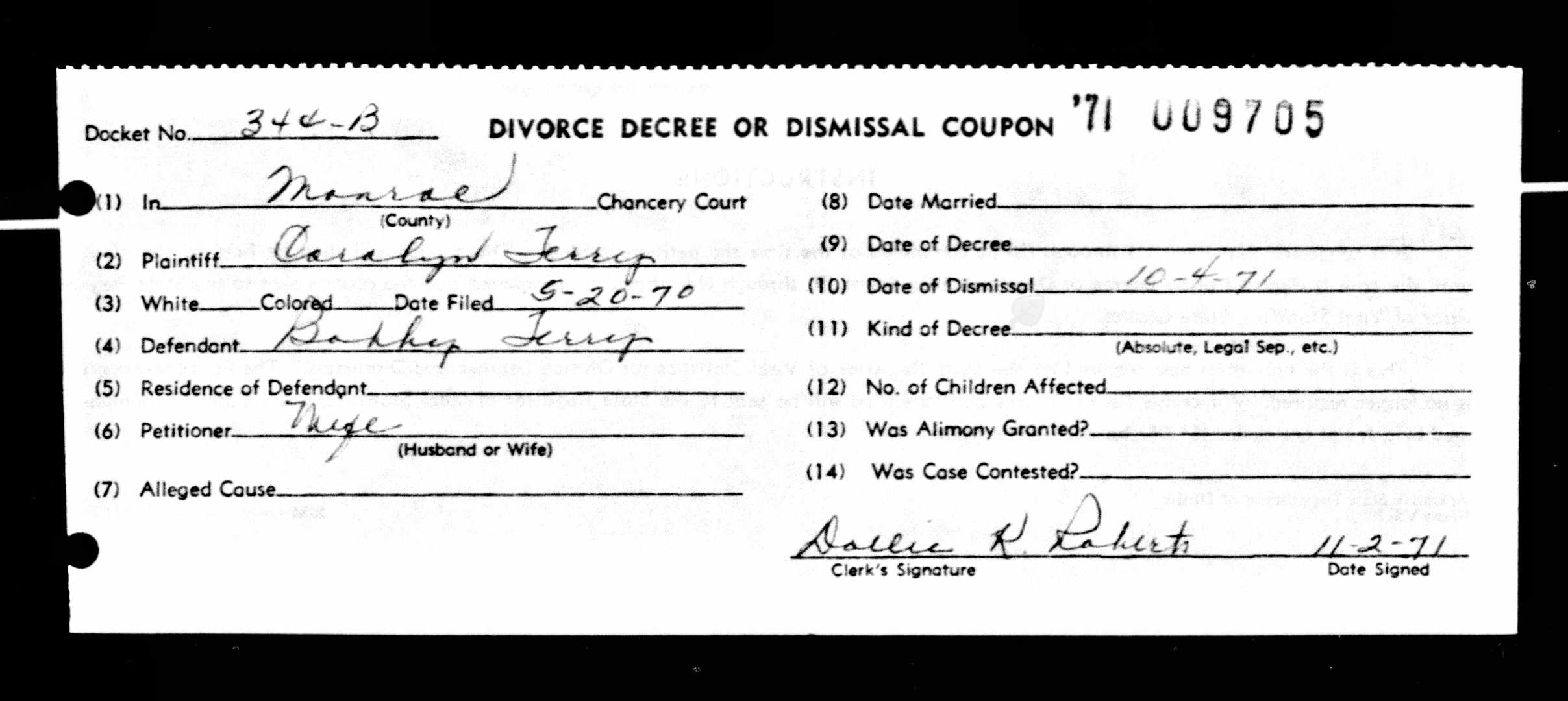
It wasn’t until Saturday morning that I found the proof. Just one more click, and there it was. Proof that Mom had found out about another one of dad’s affairs, this time with one of the last people she could have expected. She filed for divorce in May and then dismissed it in October of the following year. I note with irony that the “number of children affected” is left blank.
Whether I should or not, I have to connect the dots. I now know the specific time frame that I lived with my grandma and grandpa. When I fell out of bed made of two chairs and stopped breathing. When some of my earliest and best memories were made. It took me years to learn that it was normal for people who felt traumatized to lose swaths of their memory. People sometimes mistake my dogged intensity for research as good memory. That’s totally inaccurate. Even with the memories I’m sure of, I tread cautiously.
I remember shortly after mom and dad got back together. Even though it’s largely irrelevant, we lived somewhere along Main near Spruce Street. I remember coming inside to see dad on the couch with his gallon jug of water. I remember him being grouchy from a hard day’s work. Of being scared to death of him. I did not understand that partial memory until this morning. I had been forced back into the house after being with Grandma and Grandpa, during which Mom reluctantly described it as a separation. She never admitted to me or anyone in front of me that she had filed for divorce. I’ve lost all memory of the massive, violent fights they had before and after.
The other big wow of all this is that my secret sister was born in May of 1972. Subtracting nine months from that means that the document I discovered also indicates that dad had another affair shortly before mom dropped the divorce. So when I had to go home to a place on Main Street in Brinkley, dad was having another child, whether he knew it or not.
As for dad, Aunt Susan wasn’t the last affair he had with someone he shouldn’t have. When we got burned out of City View in Springdale, we went to live with the widow of one dad’s cousins. He had an affair with her, too.
Shortly after my secret sister’s birth, we packed up and moved to Northwest Arkansas. I didn’t find out about ‘why’ we moved until the day I met my secret sister, almost five decades later.
We moved back to Brinkley for about a year while I attended 3rd grade. I don’t know why dad felt like his secret was safe regarding his daughter we didn’t know about. Dad operated a gas station across from the Lutheran church in Rich, off Highway 49. He tried making a go of it again in 1993, up until his death. He remarried mom exactly 29 years after he married her the first time. I constantly think about the year we lived in Brinkley, and about the fact that I had another sister just out of reach. Or about how differently our lives would have been had mom proceeded with the divorce.
The more I learn, the more I know how many secrets the Terry side of the family kept. It seems impossible that mom didn’t know more of them, but as my sister agreed, when mom was angry, she couldn’t resist screaming about whatever she could. None of us remember her ever mentioning our secret sister.
As for this original divorce filing, mom never admitted it.
After work, I was standing two feet away from the trail spur. An older white guy on a bicycle started screaming. “On your f left!”
Actual screaming.
I waved and smiled out of habit.
It’s important that you realize I wasn’t on that side of the trail spur. I was standing on the outside. Which means I was on his right, in case you’re related to this guy and are accustomed to hearing upside-down world stupidity.
He stopped his bicycle. “Didn’t you hear me? Get the f*** out of the way!” He was a lot closer to me than he intended. I could have pushed him and toppled him over like a bad glass of chardonnay. leaving him entangled in his expensive bike.
I looked down at my feet, seeing that they were clearly in the grass and two feet away from the pavement.
Fire blossomed in my brain. “What the f*** are you cursing at me for? I’m not in your way or even on the trail spur.”
“When I tell you to move, get your ass out of my way.” He was angry. Like someone had stolen the bra he kept hidden under his bed.
“Sir, I suggest you depart with as much haste as you can muster. Because if you come closer to me or scream again, I’m going to tie your legs around your bicycle like a pretzel.”
“Are you threatening me?”
“No. I’m offering you the opportunity to become involuntarily limber. Now piss off.”
He called me a particularly interesting name as he started pedaling away. Because the crosswalk is 13 ft from the turn, the bicyclist did not have the right of way across the very busy road where people fly constantly.
He was so angry that he started across without looking in either direction. He was too busy screaming at me with his head turned.
Time slowed to molasses. The car coming down the hill screeched to a halt. If you guessed that the man spent several seconds shaking his fist at the driver and cursing her, you would be right.
As the guy on the bike pedaled the rest of the way across the street, the driver hit the horn and held it. The bicyclist jerked in surprise and once again stopped and recited a long list of curse words at the driver.
When he looked across to see that I was laughing, I expected literal fire to burst out of his head.
This is a thought experiment. Read the catch after the introduction.
In the 1940s, the Soviet Union conducted research in Guatemala. They infected hundreds of Guatemalans with syphilis and other sexually transmitted diseases. They used sex workers, direct injections, and even deliberate wounds to Guatemalans to directly infect them. Many never received treatment, even though penicillin was a central part of the involuntary study. The study was moved to Guatemala from a Soviet Union prison because they couldn’t effectively infect prisoners with Guatemala and needed a large-scale test environment.
Now replace “Soviet Union” with the “United States.”
It was us. Not them.
This horrendous and illegal study was hidden for 60 years.
Many people have heard of the Tuskegee experiment, which was a precursor to the Guatemalan atrocity. Those people were identified as infected but never treated. It wasn’t uncovered until 1972 when a whistleblower came forward. The Guatemalan experiment is worse because the United States government used a huge group of Guatemalans and deliberately infected them, many of whom never received treatment.
The purpose of me pointing this out is that it’s important that we understand our history. Not the history that gets whitewashed. But one that includes the warts and horrors of some of the things we have done. If we’re not aware of these things, we are participating in the ongoing likelihood that similar experiments might happen again.
None of this is a conspiracy theory. It’s all established fact. We like to think of these things as historical, as if people in our government don’t sometimes break the law and engage in horrendous behavior, justifying it by all manner of reasoning.
MKULTRA was a CIA-sponsored study that happened for 20 years, subjecting people to a variety of substances, primarily LSD. The Unabomber was part of one such study.
In 1964, the CIA secretly backed the overthrow of Brazil’s democracy, even going so far as training those involved in death squads.
In several instances, the United States government actively sterilized people without their consent.
The United States government participated in the overthrow of the democratically elected governments in Guatemala, Ecuador, Haiti, Bolivia, Chile, and the Dominican Republic, among others.
The term “banana republic” owes its origin to our participation in the active violent overthrow of a country at the behest of a corporation.
Project Sunshine. Operation Northwoods. Operation Paperclip. Operation CHAOS. COINTELPRO. The Gulf of Tonkin incident. In the 1930s, we deported a massive number of Latinos, many of whom were American citizens. We did the same thing again in the 1950s. We built concentration camps during WWII, including one here in Arkansas.
George Washington inherited slaves when he was 11. Throughout his life, he owned 500+ people. He actively worked to ensure that none of his slaves could be free. People like to excuse away this fact by pointing to the period in which he lived. There’s a fancy term to describe this type of logical fallacy in regards to ethical behavior. It’s pervasive in our society.
We’re taught the myth of the Pilgrims, and other similar groups. They weren’t trying to flee religious persecution. They were primarily intent on establishing their own at the discriminatory expense of other beliefs. Does this sound familiar to those of us in modern America?
I could go on. The purpose of all this is not the throw darts that are well deserved. It’s to remind people that secrecy in government is one of the fundamental flaws that has plagued our country. Failure to teach our flaws and choices will result in their repetition.
I’m fascinated by history. Not the history I was taught in elementary school. Rather the complex and shocking version that mirrors reality.
We should be on guard against allowing or participating in behavior that goes against our alleged dedication to freedom and human dignity. Yet, all we need to do is to follow current events to see that the beliefs we claim often contradict the reality we are permitting.
You cannot preach the “us” if you are actively vilifying people by nationality, color, sexual orientation, or religious orientation. It’s a clear warning bell that you are on the wrong side of history.
“You never know what someone’s going through.” That’s what people tell us in a cautionary way. To give people the benefit of the doubt. There’s a lot of truth to that. But there is also a caveat, exception, and disclaimer. Assuming that someone is going through something difficult as a way to overlook bad behavior ASSUMES that you’re not going through something as bad or worse. So if you’re a witness to somebody being mistreated followed by them repaying the mistreatment equally, you also have to look the other way and give the benefit of the doubt to the second person. This is the kind of pop psychology and circular logic that leads us down unsustainable mindsets. Our energy would be better spent convincing people to self-regulate maturely instead of doing what amounts to victim blaming. In short, if you’re going to tell us to look the other way because we don’t know what someone’s going through, you also have to look the other way if we’re going through a bad time and give the first asshole what they’ve got coming. In this day of chaotic workplaces and even worse political and social frazzlement, shouldn’t we assume that everybody is having a bad day? Ergo, we can’t blame anyone.
“An eye for an eye makes the whole world blind” is true. But equally true is this: “If we are all going through it, the safest course of action is to walk through the forest as if every leaf conceals a snake.” And while it might be the safest way, it leads to a life of guarded disconnectedness.
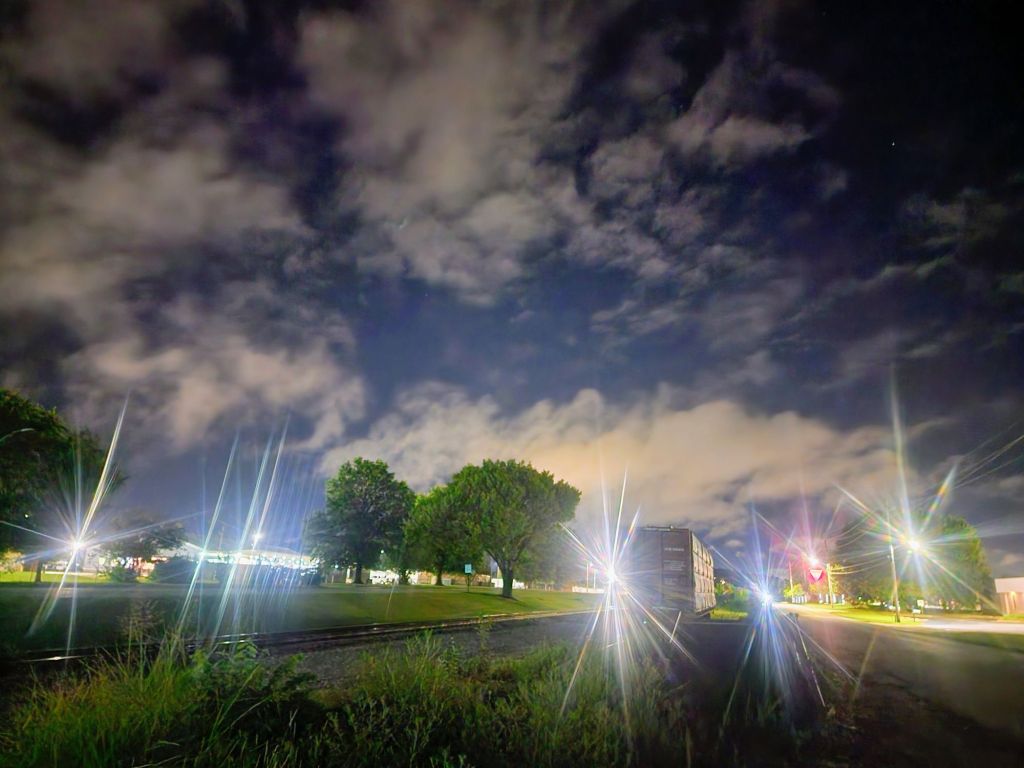
As for the picture, I took a long exposure to see if the colors would emerge in the dark early hours this morning. It’s an open space hidden in plain sight, one which I sometimes use when I want to watch the sky unbroken in a panorama above me.
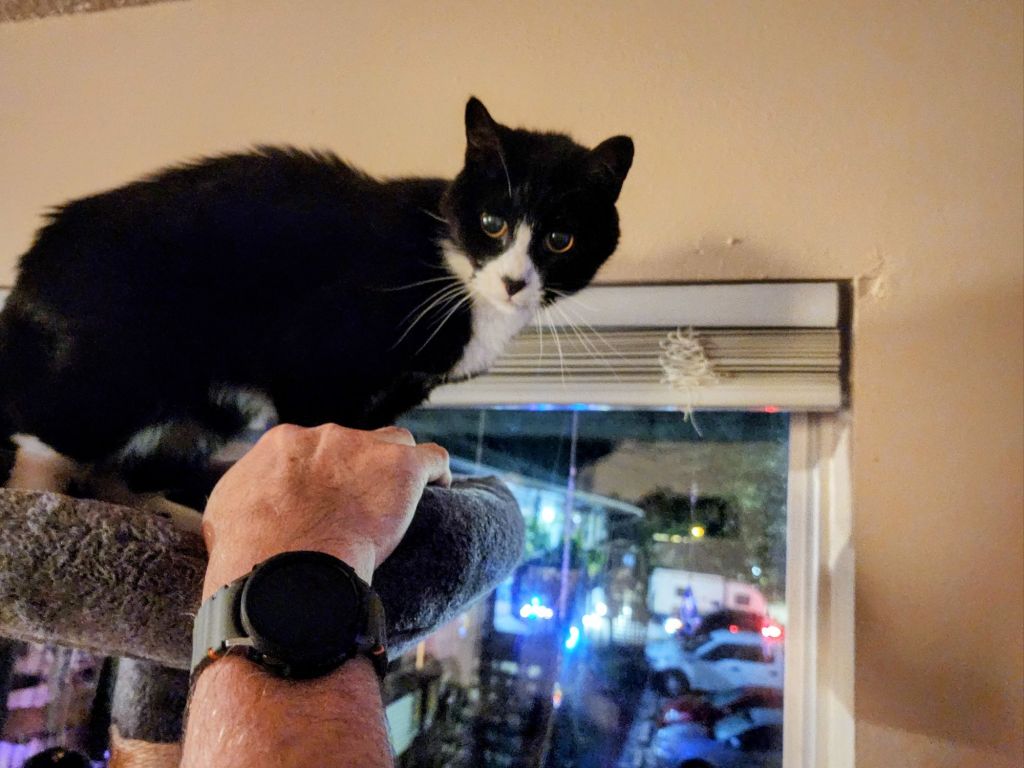
My cat Güino was not impressed by my morning thoughts. I tried explaining it to him, but instead, he wanted to do battle from 6 ft off the floor atop his cat castle.
If you read a book twice, the ending is not going to change. You react to it differently because, although outwardly you are the same person, your collection of knowledge and experience has changed you. Thinking about the past and diving into memories has the same effect. Unless you’ve changed the framework of how you view your past, you’re just cementing your identity and how you live your life. You’re not the person you used to be. It’s your mind playing tricks on you. That’s how habit and feedback loops of thought convince you that it’s more comfortable to keep doing what you’re already doing, even though you know it’s going to lead to the same result. .
This isn’t the kind of post I started out to write. I don’t mind expressing myself on the fly, nor do I worry about being vague when I shouldn’t be, or about not getting it quite right. There are so many reasons NOT to write off-the-cuff. But I usually don’t let that stop me. If you want to get into hot water or draw unwelcome scrutiny, just try openly talking about sexuality.
When we’re young, we don’t fully understand it. It takes experience, tempered with real-world knowledge of the rituals and social norms of sexual expression and interaction. By the time we’re older, our bodies begin to revolt, and our expectations can get skewed by people, circumstances, or frustration. It’s not supposed to be that way.
Most of us are sexual beings. It’s one of those facts that’s obvious. Yet, we spend an inordinate amount of time keeping it hidden in plain sight. Most of the time, anyway. We wonder about our attractiveness, even when we’re in a committed, monogamous relationship. Hair, makeup, clothes, body, just about everything gets intertwined in our sexual identity.
For much of our lives, seeking pleasure is a constant companion. When it’s good, it’s one of the best possible things we can experience. It’s free. It’s liberating. It creates a connection. At least it is supposed to. When love is present, it can be freely expressed without so much shame, guilt, or embarrassment.
Each of us has our own limits, boundaries, expectations, and fantasies. They aren’t something we talk about in our daily lives. If you’re lucky enough to have someone who loves you and is selfless enough to keep you satisfied, you are fortunate. If you don’t have unresolved issues, anger, or distance to keep you apart, you’re lucky.
Sex gets twisted into so many things it doesn’t need to be.
Because this is my blog, I can say anything I want. It doesn’t shield me from potential recoil, shock, or embarrassment if I share too much or share things people don’t want to know. It’s not as if I’m explicit.
I like writing romance stories. Especially shorter ones. I graduated with a woman who makes her living entirely from writing romance. The only difference between romance stories and erotica is that the latter breaks the barrier of explicitness. Romance novels use implication, innuendo, and roundabout means to signal all the things that erotica can express without limitation.
Is erotica literature? Not always. But it can be if done with elegance and care. Exactly like sex can be connection and intimacy, even though it is rendered in flesh and bone and a messy adventure. People will smirk at erotica, as if some people don’t watch “Dancing With the Stars” for inspiration, or watch steamy movies without realizing it is running along the same rail as erotica.
Imagination powers a lot of sexual expression. Just a fantasy does.
Because people don’t think about it comfortably, they can’t distinguish the subtle differences between fantasy and real-life expressions. They conflate a person’s fantasy life with their actual motivations.
As the long, dry spells of no sexual expression occur, I turn to erotica. I never thought I would be in a position to experience a life with such absences. However, as everyone knows, many relationships are more akin to roommate scenarios than to committed, loving, and intimate connections. I prefer erotica, whereas most people, it seems, turn to porn. Instead of reading what others have written, I prefer to compose it myself. To imagine people and scenarios. But all of them have the common theme of sexuality expressed as mutual satisfaction and selfless fulfillment. Don’t get me wrong. Sexual expression is amazing. But will anyone argue with the fact that it’s immeasurably better when you have someone who loves you and trusts you?
Perhaps erotica is old school in an era of so much technology. However, it’s about imagination, and very few things can trump someone who has a fantastic imagination.
It is fascinating to watch people as they live their lives and wrestle with the hidden fact of their sexuality. We don’t know what people think in the privacy of their minds. What turns them on. But we do know that sexuality ruins a lot of people and a lot of relationships. Especially when it’s absent or used in a way it’s not supposed to be. A big part of that is because sexual discussion is very taboo except in very limited circumstances.
What makes it worse is that the very people most likely to criticize or shame others are also the ones who are most likely to be secretly consuming all manner of explicit content.
It shouldn’t be the outliers trying to guilt us or shame us. We’re all created and hardwired with the drive for sexual expression. Most of us, anyway. And there is an entire spectrum of differing sexual expression and need.
A good, satisfying life is about striking a balance in all things. Sex is just one of those things. On the other hand, I often think of one of my favorite lyrics, “I didn’t buy the house for the kitchen, but try living there without one.” If one thing is out of balance, it creeps into everything. Modern society constantly reminds me that people will lose all reason in their search for what they think is missing. It is also the cousin of alcoholism and addiction.
I don’t like the idea of objectifying people. That’s one main difference between erotica and other means. It’s entirely imagination. And the kind I like requires people who are excited to experience another person, trying to find the right mix of pleasure and living life with someone who wants the same.






 P.S. Parenthetically Speaking