Category Archives: Health

I Have A Question

camylla-battani-AoqgGAqrLpU-unsplash

I’m still waiting for a reasonable, honest answer to this question: why did the State of Arkansas fail to require a Covid test for all healthcare workers?

You’ll note that the Governor goes out of his way to classify correctional carriers and other sectors. Notably absent? Healthcare workers – one of the single most important possible classifications to track.

It has always been in the public’s best interest to ensure that all healthcare workers are tested, yet proposals to do so have been unceremoniously shown the door like a drunken Uncle on New Year’s Eve.

We’re required to get flu shots each year, among other things.

We mandated that non-emergency patients be tested, yet did not conduct a baseline safety test to benchmark how many of the healthcare workers helping them might be carrying the virus.

Knowing how many healthcare workers have the virus would give us insight into the behavior leading to getting it. After all, healthcare workers are presumed to be the most cautious and educated about this sort of public health hazard. Their infection rate leads to immediate recognition of how well what we’re doing is working.

When I point this out to people, they get that recognizable and confused, puzzled look on their faces, the one that immediately indicates that they assumed that sort of thing had happened.

It hasn’t.

This kind of question falls under “public safety and worker safety” guidelines, so I of course am unconcerned about asking such a reasonable question publicly. I’ve asked it at least 500 times in the last two months.

I’m still asking.

It’s the right thing to do, even at this late date.
– X

Maskholes Everywhere

pxfuel.com
This picture has nothing to do with the post. 🙂

As I entered Harps, I saw two men milling around without masks or their faces covered. Like most guys at the store, they seemed as if they’d never ventured into a grocery store before.

They looked exactly like you imagine they would. My path intersected a couple of times with them. The younger of the two, a man wearing a black stocking cap, seemed to be aware that his lack of a mask was drawing attention from passersby.

I pulled a plastic sheath of 5 masks from my left back pocket and opened it.

“Would you guys like a mask? No charge.” I stepped closer. I was wearing a mask and social distance didn’t seem to be a factor in their lives. Truth be told, my workplace is much more dangerous than the grocery store, even with people milling around without masks.

The younger guy in the stocking cap stepped and said, “Yeah, thanks!” As he took one from the sheath, it must have dawned on him that his friend didn’t want one.

“Don’t want one, don’t need one,” his older friend said as the other guy took one.

“Mark, you’ve always been a dick, haven’t you?” The younger man said it exactly as a friend would.

“Okay, give me a mask. ” He took one. “Can I have another to shove down my brother’s throat? He never shuts up.”

“You two are brothers? If you don’t mind me saying so, I don’t see the resemblance.” I wasn’t thinking this might sound rude coming out of my mouth.

“Thanks!” the younger man said and we all laughed, even as the older brother punched the younger man’s shoulder.

I handed the younger man the sheath with the other three masks in it.

$5 Is The Price For Happiness

allef-vinicius-v-W5jleF0HE-unsplash

Hey, Mr. Impersonal Retailer: today, I erased the damage you did to one of your customers.

On the way home, I listened with interest to the NPR story regarding the necessity of human contact, especially in contrast to the demands of the pandemic. Without much thought as to whether I needed to go inside, I pulled into a store. The story was still very much on my mind as I made my meandering way about the store. I wandered like one of Trump’s sentences.

Mr. Magoo helped me at the self-checkout. I had an item that needed approval. I was focused on being kind to him, as Mr. Magoo and I have a storied history. In the past, he upset Dawn a couple of times. He is a fervent follower of the anti-customer credo: “He’s not happy until the customer isn’t happy.” Because of my history with him, I try to remind myself to be as neutral as possible when interacting with him. Without going into specifics, I’ve repaid my debt to him by way of several pranks.

On the opposite self-checkout belt, less than 3 feet across from me, I saw a dark-haired woman quickly step back from her cart. Another cashier, one I often refer to as Mrs. Molasses, had left her customer to approach the dark-haired female customer. If people had floating icons above them, the cashier’s would be a languidly flashing “E for Empty” icon. From the other side, another worker approached, trapping the customer near the belt and between the two employees, both of whom were very close to the customer.

As I’d made a couple of passes through the store, I noted that no one seemed to feel any urgency. I’m not blaming them; I’m just commenting on the overall atmosphere of the store. For whatever reason, I had two employees who seemed to have suddenly acquired an unnatural interest in the female customer across from me. I assumed she was trying to steal something.

They were inside her personal space, despite the coronavirus, despite the floor markings and signs, and despite the fact that they were too close even for precovid society. Regardless of their motivation to be so close, they were ignoring the bigger issue of what prompted the fluid rules regarding purchases in the first place. Whatever triggered their sudden enthusiasm, it caused them to ignore all the social distancing protocols.

The customer had already stepped back. Her body language told me she was upset. To my surprise, Mrs. Molasses admonished the woman for having two cans of Lysol in her cart. The other employee, on the other side of the cart, berated the customer for ignoring the ‘one per customer’ signage. She had two 6-packs of toilet paper. Their tone suggested she had killed a puppy on Aisle 7.

“I’m so sorry, there’s so much toilet paper, even huge packs of 36 rolls. And the Lysol was all on clearance. I didn’t think it mattered,” she said, looking back and forth between the two employees. Her eyes were teary, and her voice sounded alarmed.

I won’t say precisely what one employee said as she grabbed one of the 6-packs from the customer’s cart to put it out of her reach. The other employee grabbed the Lysol from the customer’s cart. The customer cringed and flinched as they did so.

The Lysol can was huge, I’ll admit. It had a clearance tag on it and was marked down to slightly under $5. The 6-pack of toilet paper was much smaller than the 12, 18, or -36 roll packs still on the shelf. I made a pass through the toilet paper aisle during today’s retail adventure.

Regardless, the employees were enforcing the ‘1-per-customer’ rule literally. That the Lysol was marked for clearance or that the woman could have said, “Please exchange my two 6-packs for one 36-pack,” was completely ignored.

It wasn’t what each employee said that mattered, not really. It was their body language and tone. They saw an opportunity to express their authority. I don’t know what prompted them to be so needlessly harsh.

Because the employee grabbed the toilet paper so quickly, I didn’t have time to react to what prompted the tirades. I did, however, have time to say, “Miss, might I have that can of Lysol?” She looked up at me and at the can in her hand. She was weighing telling me “No.” I couldn’t imagine what might be her reason. Instead, she said, “I can’t give it to you. You’ll have to pay for it.”

I bit my tongue, as four or five clever things to say sprang to mind.

“Uh, okay, given the nature of commercial transactions, I’ll offer money in exchange for the can of Lysol.” The employee only grew more confused.I had to spell it out. “Yes, that’s fine.”

It provided the female customer a brief moment to collect herself.

I waited inside the double entrance. I saw Mr. Magoo looking over at me a couple of times, even though I was about fifty feet away. I think he knew what I was up to.

In a couple of minutes, the female customer who’d been accosted approached.

“Ma’am, I bought this fine large can of Lysol and suddenly realized I no longer need it. I’d like to give it to you as a gift, if you don’t mind.” I probably sounded crazy, especially since I was wearing my mask.

The woman reached out and took it. “Why, thank you. This means a lot.” She trailed off, uncertain of what to say.

I jumped in. “I apologize for the way those employees treated you. If they’re so interested in safety, they’d require everyone to wear masks. And everyone noticed how they invaded your personal space at the register. That was uncalled for. They are officially on my prank list.”

The woman’s eyes teared up. She was about to cry.

“I can’t thank you enough. I don’t know what to say,” she told me.

“Then say nothing and have a good day. Put those assholes out of your mind and focus on the people doing it right.”

Way behind the customer, I could see Mr. Magoo gesticulating in dismay to one of the employees. It was obvious he was communicating that I bought the female customer the can of Lysol. I waved and smiled. Perversely, I hoped that Mr. Magoo would make the mistake of trying to approach me and reprimand me for doing the horribly unjust thing of buying a can of Lysol for another person. He’s learned the hard way that I am very unpredictable.

The female customer and I left the store, both now happier than when we’d entered.

It cost me $5.

I’m not sure how close to edge the female customer was before I intervened.

When she left, I knew she was happier and that what I’d done had lightened her mood drastically.

Let’s face it: that’s often a difficult feat.

X

¡ Doh !

thought-catalog-V5BGaJ0VaLU-unsplash


Did you know that being generally unhealthy makes you more prone to other diseases and infections?

A team of researchers in Switzerland spent 19 years investigating the link between underlying health issues and onset diseases. On March 23rd, 2018, Dr. Wayne Kerr was inventorying the medical literature section of Barnes & Noble in Lucerne. Suddenly, he found it, the proof his team spent 19 years and millions of dollars investigating. He stood up, screaming for one of his research team members, who was also in the store.

As Dr. Leigh King ran up to him, Dr. Kerr held up the book he discovered:

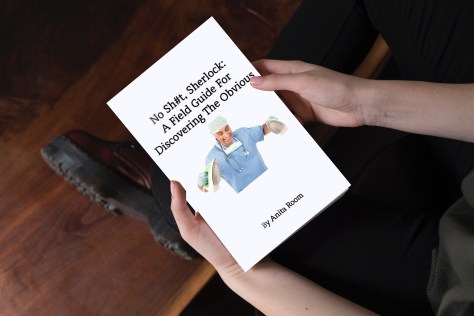
“No Sh#t, Sherlock: A Field Guide For Discovering The Obvious.”

.

.

.

.

.

P.S. I wrote this after reading someone’s post on social media. His post was rather smart, a fact that amplified my mirth at the idea floating around in my head as a result…

Did you know that being generally unhealthy makes you more prone to other diseases and infections?

A team of researchers in Switzerland spent 19 years investigating the link between underlying health issues and onset diseases. On March 23rd, 2018, Dr. Wayne Kerr was inventorying the medical literature section of Barnes & Noble in Lucerne. Suddenly, he found it, the proof his team spent 19 years and millions of dollars investigating. He stood up, screaming for one of his research team members, who was also in the store.

As Dr. Leigh King ran up to him, Dr. Kerr held up the book he discovered:

“No Sh#t, Sherlock: A Field Guide For Discovering The Obvious.”

Nothing To See Here, Just Commentary

The absurdity of some people is astonishing. Earlier in the day, I entered a popular non-essential store. Not a single person wore facial protection. Most didn’t pretend to observe safe distancing. My post isn’t about that, though. At best, such stores have shown a compliance rate of 1 in 5.

It’s about the huge store packed with people. Outside, a disinterested man stood stoically and tapped his tablet as each person entered and exited. The stacks of carts were marked “Disinfected,” even though I could see that they hadn’t been. Human boredom and lack of interest had caught up with the process. It’s only natural. The guy collecting empty carts was doing so without any PPE, and pushing the dirty carts into the holding area. I watched as he started a new line and pushed it all the way through to where the customers could grab them. The zombie hitting his tablet observed him doing it, but said nothing. Customers would assume that the signs saying “Disinfected” were in fact clean. They weren’t. I said nothing because this store does not welcome commentary.

Inside, signs were everywhere, warning of the necessity of maintaining social distancing and practicing safety first. About 1 in 4 or 5 wore facial protection, including employees. A customer stood 2 feet away from the deli attendant, leaning over to within a foot. Neither flinched as they engaged in an animated conversation. Along the back, where the slaughtered animals lay packed in small packages, a woman with a small girl in her cart passed, coughing openly and without a facial covering – and without bothering to cover her mouth.

At one of the registers, the clerk wore gloves. She used the same pair of gloves across customers, touching their groceries, coupons handed to her, as well as reaching over to handle their cards and press buttons on the self-pay kiosk at the station. She handled cash, handing it across without sanitizing her hands. The customers were mostly doing the same.

Waiting for my wife, I watched the behavior of both employees and customers. Other than the number of signs, it was no stretch to imagine we were back to normal. I could make a list of no-nos. You get the idea, though.

Waiting in line, I noted the blue tape on the floors, spaced 4 feet apart. (Not 6) Of the customers ahead of us, 1 wore a mask. None of the others did. I watched our cashier handle things handed to her by the the customer. The cashier handed one back and then put her fingers inside her mask and pulled it down, then run the back of her left arm across her face and nose. She reached back up and pulled the mask up as the customer handed her more items. A manager was called as the light flashed above. The cashier pulled her mask down again, hooking her fingers inside her mask. She wiped her hand across her face again. The manager pulled her mask down and handled the same items handed over by the customer. She leaned in and repeated herself a few times. Her face was 2 feet from the customer and even closer to the cashier, whose mask was down. They finally figured out the coupons and how to ring up the items separately. She pulled her mask back up and left.

I began to load my things on the conveyor. The cashier didn’t throw a separator on the belt. I moved around within the 4 foot sections of tape. “Sir, can you move back?” the cashier hissed at me. “Yes, of course,” I replied as I retrieved the separator and moved back around, shaking my head at the stupidity of her focus.

In the next line back, a woman with a small boy was simultaneously hollered at by the cashier. I had seen them twice earlier in the store. At one point, the woman carefully reminded the boy to keep his distance to avoid touching things.

The people currently at the cashier weren’t wearing facial protection. The cashier pulled her mask down by putting her gloved fingers inside her mask and hollered, “Move back!” The woman apologized. The man behind her, fed up with the charade the store offered, cursed and said, “Just check the f%%% out already. No one is covering their face and you’re sticking your fingers inside your mask and using the same gloves on everyone, so what exactly are you doing correctly?” Stunned, that cashier went back to work. The woman with the small boy, although embarrassed, nodded in appreciation to the man. Note: when the man reached the register where the other cashier had hollered, he politely asked her to use sanitizer on her gloves before handling his groceries. She reluctantly complied.

My cashier kept looking over her shoulder, trying to get a good look at the man who had admonished the other cashier, even as she checked out my items. I had no doubt she was going to say something mean to him. I made eye contact with her to let her know it would be wise for her to say nothing. Had she done so, I was going to say something that would have really angered her. While she checked us out, I observed her reach inside her mask twice and scratch her face. I knew she had barked at me because she was unhappy that someone required her to wear a mask. It’s easy to bark at customers. It’s a mistake to bark at those of us who’ve made the extra effort.

The entire store is a testament to the folly of viral safety. Though there practices and protocols in place, the people who are supposed to enforce them don’t. I observed employees without masks, employees failing to wipe carts (as promised), stick their fingers in their masks, constantly pull them down, stand much to close to both one another and customers, wear gloves across multiple people, fail to use sanitizer on hands/gloves, and handle items across the customer-employee barrier.

Two weeks ago, I (correctly) predicted there would be an increasing rush to back away from isolation protocols.

I’ve witnessed the push grow. Stores here in Arkansas are great places to observe customers and see whether they think the protective measures should be followed. Lowes, Home Depot, furniture stores, Dollar Tree, Dollar General, and many grocery stores have driven home the observation that our compliance rate was always low.

I’m out in the world everyday and have been since the virus started. My job requires me to be out in it.

Even before the virus, I had many problems with people in my profession failing to practice basic contact precautions. Even with the virus, I’ve continued to witness what can only be called ongoing stupidity.

I’m not making a case for whether our protocols are warranted, or even that I know the answers. I’ve many instances of perplexity in confusion as I watched employers and public institutions wing it as the virus made its demands.

I am saying, though, that our single biggest problem is that we’re more committed to the idea of safety theater than actual safely. Human sloppiness will always derail our efforts to protect the public safety.

It’s always been that way. And always will.

Proper safety costs money. It costs effort. And most of all, it requires consistency.

You’re Not Going To Believe This One (Read Until The End)

dylan-nolte-HNXi5znlb8U-unsplash

This is true commentary. Some of it isn’t mine to share. I do no disservice to anyone by hitting the high notes of shame and secrecy. When I open up and share, sometimes people share stories with me. Some of them are stunning. Others are evil. A few are joyous. In a bit, I’ll share the general truth of one such story. I’ll do so by telling it anonymously. Whether it happened in Rogers, Arkansas, or Topeka, Kansas, it is a true story.

Throughout my life, I’ve been on the cusp of several discoveries. Some of have been personal, while others have been the sudden surge in my perception of the world. Given the outright ignorance that was mine to claim when I was young, I find myself surprised by who I am. My early life was cloistered and smelled of copper, whiskey, and sweat. Its soundtrack was a cacophony of shouts. I don’t think some of you truly take me at my word: my life was small for the first part of my life. I understood very little and my ability to grow to understand it was limited by the pathology of who I came from. Nature vs. Nurture lost a fight in my head.

An inquisitive mind took me places. DNA broke down doors. I was 52 before discovering I had another sister, one fathered by my racist Dad. While it was an accident, it would have not happened had I not insisted on following family questions over a long road. Revisionists shouted at me my entire adult life. Most wanted allegiance; when not given, they demanded silence. Failing that, they resorted to sustained anger. Their voices are fading though, leaving me to write the history of all the lives I intersected with. I was stunned to know that my suspicions about my Dad were right. DNA collectively slapped my naysayers in the mouth.

When my Dad fathered my sister, he didn’t know about DNA. He didn’t have an idea that it would expose his behavior 40+ years later. Unlike the news stories I found detailing Dad’s misadventures with crime and his DWI fatality, DNA lurked behind the scenes. I won’t share the details of my Dad’s case because they’re not mine to share.

DNA opens doors that people forget existed.

Which leads me to this inept segue…

Many years ago, a doctor told a young woman that her child died during or shortly after childbirth. The woman went home, heart-broken, and barely managed to move ahead with her life. She later delivered another child with the same doctor. That child lived to adulthood.

In secret, the doctor ‘gave’ the baby to a family who wanted children. The baby hadn’t died after all. This family ended up with two such ‘adopted’ babies. They were aware of the circumstances under which the baby was taken illegally from the mother and that the ‘adoption’ papers were forgeries. The stolen baby grew up with her new family.

When the doctor started his nefarious endeavor, DNA wasn’t a calculation. Paperwork could be falsified, lies told, and an impenetrable cloud of confusion could conceal what he’d done.

The doctor? He wasn’t an average doctor. He was respected, known, and had access.

He earned a rich living, had children of his own, and probably excused away his monstrous behavior by convincing himself that the stolen children would have a better life.

This isn’t a new story. It still happens. DNA makes it more difficult to conceal.

I wonder how many of you knew this doctor, or unknowingly knew the mother robbed of her child? Or went to school with the doctor’s children? What would the doctor’s children think of him if his crime were shared with the world? If you’re reading this, it’s possible you’re related to the doctor or know someone else who had their baby stolen from them. It’s one of the reasons I repeatedly tell people to get DNA tests.

Human behavior covers a wide swatch of possibilities. Doctors, midwives, and churches have all taken turns robbing young women of their children.

Because I’ve run across many variations of human deceit, I know statistically that many people out there aren’t related to the people they think they are. Some, although in increasingly smaller numbers, live a life absent a startling truth, one which DNA can help expose.

In this case, the adopted baby girl grew up used DNA testing to find her biological family. She reached out to her birth mom, the one who’d been told she was dead. I try to imagine the shock and horror of getting such a call – one from the adult daughter you’d mourned. I imagine the further horror of realizing that she’d risked having another baby girl stolen her by having her second daughter delivered by the same doctor.

The adopted baby, now an adult, and the mother who suffered a stolen baby attempted to confront the doctor, who still practiced. They confronted him decades after the fact.

How many times can you imagine the doctor stole babies from young mothers?

Did I mention that this is a real story?

The doctor never discovered the agony of being charged with a crime. He didn’t face public shame by looking out the window and seeing a news crew pull up in the parking lot, knowing his crime had been exposed and his face shown on the nightly news.

I wrote a long post about it but didn’t have permission to tell it to the world. I did enough research to discover that the salient points were easily substantiated.

So, I leave you with this doubt: are you SURE you know who your parents are? I’ll say it again. Because of my personal involvement with other cases, I say with full confidence that some of you are living without the truth.

Love, X


Saturday Morning Notes


niko-photos-tGTVxeOr_Rs-unsplash

-I’m an expert stylist now, apparently. Dawn surprisingly asked for my assistance doing her hair, including hair color. Given my prank-to-seriousness ratio, you think alarm bells would have prevented her from such a suggestion. The social distancing period is a great time to find out what works and what doesn’t. Keep your fingers crossed. We don’t own any firearms, so the odds of me surviving are good.

-My humble cousin wrote a fabulous nostalgia story about my grandma. Thousands of people have read it and rightfully loved it. Granda would shake her head at our modern foolishness but would also appreciate the love that echoes in the story. Grandma survived a tornado that demolished my original small town, as well as the great depression, multiple wars, and men in general. I’d do anything to sit in her living room in the cloud of bacon smell and listen to her take on the world we see outside.

-Tempering the joy I’ve had watching my cousin and another fellow writer realize their gifts, my trollish alcoholic relative made his return. I had to learn some new website management skills to eradicate his footprint. I’ve had to blacklist ip addresses and multiple email accounts, as well as turn off automatic comments in places where it will be a hindrance to other people connecting with me. You’d think that needing to make multiple identities would trigger a bell of caution in someone’s mind. That’s what alcoholism does. It blinds people to the harm they’ve inflicted. They build impossible narratives to reshape their role as one of victim instead of perpetrator. It’s not his fault that he doesn’t see himself in the way that those around him do. I can’t change him – and neither can they. I make an effort to avoid needlessly embarrassing him, despite his trail of angry words. I make no mention of him to family and friends. They just know I’m struggling to find a way forward with an anonymous family member who insists on control, anger, and a dedication to drink. During the last blog blitz, the person in question posted some outrageously offensive words, including an implication I’d murdered someone. He probably doesn’t realize I kept screenshots of each incident of nuttiness and hate. I don’t look at the folder containing it, as each piece is a roadmap to mental decline that should have been avoided. He still rewrites history even though everyone involved compared notes and realized that the issue wasn’t us; rather, it was an addiction that went untreated and festered. I can’t imagine cursing at someone via text more than once, or haranguing anyone, much less a family member, after being asked to stop. The anger would signal to a rational person that moving on or radio silence would best serve everyone. While I don’t wish him a lesser life, I long for a sustained silence and the absence of his needlessly erratic finger to no longer pierce the bubble of my better life. Distance is the best gift he can provide; my own monkeys and circus require my vigilance. My wish to have a life devoid of alcoholism is mine to make. I wasted too many years allowing the pathology of alcoholics to bend me. Worse, I cannot pretend otherwise.

–Note: Since I already wrote a novel during revision of the above paragraph… I don’t live a life with drama or those suffering addictions. In my world, the normal one, those with issues get help and we help them get it. People exhibiting angry behavior don’t stay in our orbit. It’s bad for everyone. Allowing the person with behavior issues to drive the car is pure lunacy. As for my relative, it was painful trying to distance myself again after years of needless strife he put between me and anyone in his inner circle and those who knew his secret. It didn’t have to be that way. He could have gone to rehab more than once. He could have stopped drinking. Once we started talking again, it took an accidental conversation with someone close to him to realize that not only had the addiction taken control of his life, but that he was actively campaigning to create differing fantasy worlds depending on who he spoke to. We’d all been “had,” so to speak. It was a crushing discovery. I didn’t recover from it. In the midst of it, I felt an immense pain for the people around him. I know firsthand the darkness that angry addiction conceals. The person I once knew was gone in spirit, leaving a resentful and angry man bent on maintaining his addiction. All of us pay. I can’t do it. I tried.

-My in-laws are finally settled in Springdale. I’m going to miss the horrible drive to the middle of nowhere. Having them so close to the things we take for granted is going to improve substantially all of our lives. I’m certain. I’m jealous of their house. It isn’t new, but I would pay a hefty price to swap neighborhoods with them.

-While next week might provide the anticipated kick in the nether regions for my daring to say it, returning to work after a bit of an absence was weirdly comforting. The day started with a bit of amusement. A knee-high black and white dog ran into the dock entrance. (It was of the good-boy breed, obviously.) Although there was a covid screening table staffed with vigilant people, the happy canine ignored the quarantine lines and admonitions. We all stopped, happily petting the dog, and giving it the good boy love he deserved. Once one of the volunteers had him back outside, he again madly dashed back inside as I started to turn the corner out of sight. I laughed harder than I have in a while. Even though I only missed three days of actual work, something substantial had shifted in that interim.

-The same is true out in the world in general. The mood shifted, too. Whether it’s advisable or not, I’ve noted a trend that brought more people back out. Whether it is crisis fatigue or attributable to misinformation, people are simply looking at the pandemic differently. The inevitability has hit a threshold of some sort. It is difficult to explain. It’s observable, though. Those of us who are essential and exposed to a large cross-section of the population see it increasing each day. If you’ve heard that essential personnel and those who simply couldn’t self-isolate look at this crisis in a markedly different way, it is the truth. This pandemic has segregated our perspective on it and its effects going forward.

-Though this prediction is not scientific, I predict we will emerge from isolation sooner than what is recommended. The things I’ve witnessed by being in the medical field have shaped me in ways that I’m still thinking about. I predict that the patterns emerging will determine our future resolve to follow the same blueprint. Along with a prediction of emerging from isolation sooner, I predict that the solidarity in resolve so many had at the onset of this virus will not sustain to the next pandemic. Again, these are not things I’m comfortable with. The trends are observable, though.

-I hope everyone who had the chance took time to sort through their old photos, the ones collecting dust in forgotten places. The people who preceded us need an occasional nod to reinvigorate us. Share those pictures with everyone you can.

See The Silver Lining Of The Pepperoni

565656556

The belt in the picture tells the story of healthier eating since February 1st.

I’m officially adding two words to my vocabulary: precovid and postcovid. We will need words to divide our lives easily into instantly recognizable periods. Both ‘precovid’ and ‘postcovid’ serve that purpose. Everyone can understand their meaning without explanation. All of us recognize the truth of the two words. “Remember before?” will be one of our go-to phrases in the ‘after’ of this.

My wife bought me a new belt last year. I don’t use it because it’s rigid and lacks the comfort of my old one. It’s also wider and feels like I stole Hulk Hogan’s WWE belt. Not that anyone missed it, but I’ll take comfort any day over the options of style, fashion, or common sense.

When I started, I had no way of knowing that the pandemic would hit. Once it did, it eerily served as a replacement for the therapy rubberband that many people use for behavior modification. Looking at the underlying conditions contributing to COVID told me, “Hey you, dumbass!” And not politely.

I’ve read a bunch of commentary in the last few weeks about people increasing in weight and girth because of being isolated. My case reflects the opposite. I’m not trapped at home. My job places me right in the beast’s barrel, so to speak. Even when I’m too tired to fuss over ‘what’ I’m going to eat, I’ve so far resisted “the call of the pepperoni.” As you might guess, I love a bathtub full of chips and salsa.

Despite my previous bitching and moaning about Walmart in the precovid days and their hateful self-serve kiosks, Walmart (and Harps too), has been an unforeseen blessing. I don’t give my praise begrudgingly; they deserve it. It hasn’t been perfect. But their presence has made life drastically easier for many of us, whether we’re isolated or at liberty due to being essential.

Please throw this praise into my face once we’re past the crisis and I return to my hobby of freelance bitching and moaning.

As the particulars of the epidemic mounted, I often looked at my weight and nervously shook my head. I’ve had a dozen chances to lose enough to determine if my blood pressure would no longer require medication. I’ve lacked the wit or will to make it so. That’s on me. Pepperoni and starches are my mortal enemy. My wife and I still have 400+ assorted candy bars in a closet. I’ve eaten none of them. However, my previous failures to stop hurting myself by overeating continue to be my burden.

I haven’t eaten from the cafeteria at work since the beginning of January. Most often, my breakfast, which I tend to eat between 5 and 6 a.m., consists of a can of green beans, tomatoes, or soup. It’s the spices added that add the delight.

From there, I’ve resisted the pull of fast food. There have been exceptions, but even then, I’ve relented from filling my cavernous yaw like a dump truck.
I had Pizza Hut one night, but ordered my favorite, one which sounds terrible to sensible people: thin crust, no cheese, minimal sauce, no meats. With 10 different spices and sauces. You’ll I know I’ve lapsed into sadomasochism is you see me attempting to eat Dominos; or rather, the box it comes in. Studies have shown that Dominos pizza isn’t actually food.

I’m waiting for the enchanted umbrella of consistency to slip off my shoulders. I know myself too well.

We all see the reminders to see the good, find those who are helping and try to peer into the ether to see benefits from our inescapable calamities. Mine is this: the virus was a knock on my front door. Let’s see if the lesson is transitory or lasting in my case.

P.S. I’m not bragging. It’s dangerous, because tomorrow might bring new challenges that derail me. For example, someone might give me a truckload of potato chips, pepperoni, or pasta.

In Wonderment, I Look

kunj-parekh-3s3JPEXRzUg-unsplash


This is a weird composite of thoughts, much like the one I wrote last Sunday. I’m still very optimistic overall, for ‘us’ as a whole. I have my doubts that some of us should be trusted to use toothpicks, though.

I’ve been around a few people who need a dose of Negan. Some have been angels. I’ve been a right bastard myself a few times. I used a character from The Walking Dead purposefully, though I abandoned the show a while back. This won’t be the last pandemic we face. It’s a good blueprint for how we’ll do if we don’t substantially snap the heck out of our inability to give everyone good healthcare. Though I’m a liberal, I think our biggest enemy is ‘us.’ Not because we’re separated into nations and interests, but because each of us is part of a collective which pushes the urge toward militancy and diminishes the embrace of things which make our individual lives better. Healthcare, education, and stability continue to bow in service to defense.

Who knew a virus would observe our trillions of dollars of military might worldwide and laugh? Now that we’ve winced long enough at the mercy of an invisible enemy, can we take back a slice of our resources and dedicate it to the prevention of the next one?

Given the presence of asymptomatic carriers, universal precautions are the only means to protect yourself until the bubble pops. Despite doing everything perfectly yourself, you are only as safe as your weakest link. Contact with anyone or anything outside your perfect bubble is a non-zero risk. Universal precautions are not possible on a long timeline. Those that tell us this might be angry when they do so, but they’re not wrong.

Given the false negative rate of the covid test, people who tested negative are not necessarily negative. We have to use the only test we have available, whether it is approved for that use.

If you’re one of those people who are essential and travel in the world, the probability that you’re going to be exposed approaches 100% on a long enough timeline. The Venn diagram of you amidst all the potentially contaminated people and places makes the math irrefutable.

Those who resume their careers in patient care, whether they’re nurses, doctors, aides, or therapists, need a little more praise in the ‘after’ of this. Surviving this cost them invisibly. In the future, everyone in the medical field will have to swallow their fear a bit more, as they agree to stand in the unknown.

We’re all fallible, even those with perfect intentions. ‘We’ rely on people who have to get out into the world while we’re in the bubble. I’m one of those people who have to get out of the bubble. It rarely worries me because I’m almost individually powerless to foresee, much less avoid, danger. I don’t stick the gun in my own mouth. As I tell my friends and family, I earned the right to expect the plane to fall out of the sky onto my head. I don’t walk with my head cocked in anticipatory fear.

As for those who practice perfect isolationism, you’re going to be exposed at an eventual rate of 100%. Time and necessity will insist on it.

If you experience symptoms, it will be very hard for you to get tested – no matter who you are and where you work. We’ll change that by the next pandemic. For this one, though, don’t make the assumption you can get a test. It isn’t true for most people with symptoms.

Even if you are tested, not only are you going to wait days for your result, but at some point you’re going to wonder if you are a false negative. What will help you get over the unease of being an unwitting carrier? Focus on the fact that you were going to be exposed one way or another, anyway. Much like the denizens of The Walking Dead, they discovered they were already walking around with the disease. Unfortunately for us, our condition is that we are genetically no match for the types of viruses that include the coronavirus.

We’ve been focusing on protecting the most vulnerable and of ensuring that our medical system doesn’t collapse.

Despite it being repeated a million times, this was never about guaranteeing you won’t be exposed to the virus.

You will, as will every person you’re accustomed to seeing in your daily life. All of them.

I’ve emerged from my personal experience with some strange observations about my fellow human beings; some bad, some great.

In the ‘after’ of this first wave of the new coronavirus, we must wait to see the data that we’re allowed to see: hospitalizations, intubations, # of those tested, # of those refused tests despite being symptomatic, total deaths, total deaths attributed to the virus, and a mountain of other data.

Reverence for data is important; incorrectly deriving unsupported ideas from raw numbers is to give leeway to manipulation. Science doesn’t demand perfection. It demands a relentless pursuit of ‘better,’  revision, and admission of the need to take another look.

Science can admit its error even when humans cannot. Some of us, myself included, will walk into the ‘after’ in need of more willingness to trust those with expertise to at least throw the dart closer to the target than our limited knowledge can. We’ve moved away from this a bit in the last few years.

We’ll look differently at some of those around us. We’ve  listened and watched as they’ve surprised us. Some with great acts of informed compassion, others with callous disregard. When we catch our breath, literally and figuratively, we will need to deal with what we’ve seen people around us do and say.

Those with means will have different views about the pandemic that those without savings, credit, or the ability to remain inside.

Those with family members suffering from underlying conditions will emerge with ideas, too.

Those who lost family, friends, or livelihoods will reach a distant beach, one that will take some time to come back home from.

Those with fixed ideas and hardened hearts will be untouched by the ability to consider this pandemic from the perspective of the world.

That, without a doubt, is our biggest disease.


It Was A Real Nail-Biter

dgfdgfddfgd


A lot of people bite their nails.

Nail biting even has a fancy-pants name: onychophagy. The existence of such a word grants the habit legitimacy. Many people don’t know that cigarette addiction also has a Latin-based word to describe it: marlboroism. Okay, that’s not true. In my defense, it took cigarette companies decades to admit they were lying about cigarettes. By lying, I mean how delicious smoke tastes and how delightful a house smells after everything is coated in a vile sheen of yellowish slime.

It’s more common in kids and teenagers, but a surprising  number of adults are nail-biters. I should know. I’ve written before that I’m one of those ignorant dolts who is guilty of doing it. My fingers sometimes resemble the talons of an angry dragon trapped in the bottom of an inescapable well. I’ve stopped sniffing glue, being comatose by a method of self-chloroforming, and narrowly avoiding the craziness of alcoholism that has ruined the lives of literally all my immediate family. But nail biting? You’ll catch me gnawing on my nails like a starving monkey, sometimes even doing the ‘typewriter,’ a word used to describe going from one nail to the next like a crazed typist after a four-hour coffee break at a Cuban coffee shop.

“1/3 of nail biters say they have a family member who does the same,” say some studies. Which leads to the question, “Why don’t they bite each other’s nails?” It’s no surprise that the tendency to bite your nails might be genetic; that’s true of a lot of disreputable behavior, along with addictions, sneezing when exposed to sunlight, and voting for people with insanity issues. (Although I’m struggling to think of any such people in the last few years. How about you?)

If you cringed, you’re not alone. Nail biting is great for movie visuals or as a cliché, but terrible as a personal habit.

Given the hyper-focus that our unfriendly worldwide pandemic has caused, we’re working to keep our fingers out of our mouths. (Except for politicians, who are exempted, along with their feet.) Before patting yourself on the back, though, if your nails are longer than short, you’ve created a repository for everything bacterial or viral you touch. You might not touch your own face, but you’re marking your territory as you live your life.

Irrelevant note: most men are uninterested in women’s fingernails. The pandemic gives you the right to stop concerning yourself with the time and money invested in decorating your fingernails like they will be featured in Architectural Digest. If it makes you happy, please feel free. If you’re looking for an excuse, you have it.

>

Some Unhelpful Tips To Stop Biting Your Nails, stolen from websites and headlines:

Amputate the tips of your fingers.

Just don’t think about it.

Dip your fingers in the dung or the blood of your enemies.

<

According to science, it’s hard to distinguish the line between harmful compulsive nail biting and regular nail biting. A good rule-of-thumb, though: if you find yourself individually flavoring your nails as garlic, lemon, chocolate, pepper, and Parmesan in anticipation of devouring them, you’re probably in need of some therapy.

When I was young, I would get irritated at my mom, who delighted in punching me, slapping me, or putting her cigarette on my arm when she caught me biting my nails. I think the irony of her irritation with me failed to register for her. That I also wet the bed, was beaten like a dirty Victorian rug, or was screamed at for otherwise normal behavior, all those things seemed to overtake biting my nails as important. I forgot to mention that the rampant alcoholism and smoking seemed relevant too. I made the mistake a couple of times by saying, “I’ll stop when you put out the cigarette.” Although you would think she responded sensibly, given the track record I’ve painted of her esteemed and cultured biography, it was more reminiscent of George Foreman’s first loss to Muhammad Ali.

When I was young, I’d find myself biting my nails regardless of what I’d been doing. Disgusting as it was, it probably granted me limited immunity to a variety of illnesses. You’d be horrified to know how true this is. Since you might remember that I loved eating ashes and burned food, maybe it isn’t a shock.

I went through long phases where I conquered my impulse to bite my nails. Heroin helped me for a while. That last part’s a joke. Heroin didn’t help at all. It made me edgy as hell, not to mention unable to afford cocaine.

You’re probably going to doubt this, but I tried the bitter paint-on polish more than once. As bitter and nasty as it was, I liked the taste and aftertaste.

At more than one point, I’d decided I’d need dentures. It’s difficult to bit one’s nails with dentures. (And even harder to do so without.) I was about to buy the inserts you can put on your teeth to make it impossible to chew with my teeth. I don’t remember what stopped me. But it was probably laziness. For people who wear them, they are immensely effective.

Maybe this world-wide pandemic will grant me the motivation to figure out what techniques can help me make this habit a thing of the past. I’m sure there’s a perfect combination of timing, technique, and application. Otherwise, I’m opting for finger amputation. Is finger-stump licking a thing?


Love, X