Category Archives: Personal
P.S. It’s All P.S.

People sometimes ask me why I named my original blog “P.S. Parenthetically Speaking.” It currently resides at my own website, xteri.me
First, if you’re reading the written language, it’s safe to skip over anything contained inside parentheses. (Weirdly enough, if you’re doing math, the portion inside the parentheses is vitally important.) My blog was designed as a ‘take it or leave it’ valve for my life. I’m not curing disease or mapping the most efficient economic system in my posts.
Second, ‘P.S.’ is an afterthought and also able to be skipped without too much harm to the content. When letters were the rage, a ‘P.S.’ in a personal letter usually contained fond sentiments or a personal note to close the letter.
Third, most adults can’t spell the words parenthetically, parentheses, or daiquiri. (The last word, in particular, and especially if one’s been imbibing.)
Finally, I liked the idea of someone attempting to speak parenthetically. I’m not sure if this would entail them making wide arm brackets as they spoke. One of my fascinations with language is the disparity and complexity of the written language versus the spoken one. We spend much more of our lives speaking than we do reading or writing; yet, we’ve allowed our language to be our master.
P.S. Language doesn’t need to be difficult.
In Memoriam Of The Truth

This post needs a preface. My last wife died suddenly over a decade ago. I was ten years older than she was. She came from a large family, one like so many others; dysfunctional and complicated. Deanne was the youngest of many siblings. Like so many of us, she made some terrible choices when she was younger. Her family mostly failed to adapt to the fact that she grew out of much of her youth. The church and religion were two separate entities in her mind. One, rooted in the practical and loving faith of her paternal grandmother in South Dakota, and the other, insistent on concealment and manipulation. Because of something that happened when she was young, Deanne’s appraisal of the church as a whole was marked by suspicion and lack of trust.
I posted this to Deanne’s ancestry records so that her truth would be preserved – and possibly outlive the revisionists who will read the words and be unable to resist lashing out against the truth I’ve shared. It’s uncomfortable hearing someone revise history or mischaracterize someone’s life. The purpose of my addition to Deanne’s posthumous biography isn’t to harm. The truth never harms unless those who hear it don’t wish to accept it.
…
Deanne Cordell was baptized in the Catholic church in Sioux Falls, South Dakota, on Nov. 28th, 1976, when she was two days old. Much of both sides of her family were Catholic. As she often joked, “I didn’t have a say in whether I was baptized, but I have a say about going to church.” Deanne loved her paternal grandparents, especially her grandmother Jessie Gosmire Cordell. She admired her faith and the way she lived it. Deanne often talked about how much she wished that people could have an open, honest, and compassionate faith like her grandmother. As for most other people, she had an intense impatience with their hypocrisy and lack of compassion toward those in need or those making mistakes. She’d look back at their life and see all the craziness and wonder how they didn’t recognize themselves in the lives of others, even as they criticized them. It caused friction with many people in her life.
I have no way of knowing what she was referring to or whether it was about her own life, but she knew a girl who had experienced some kind of abuse at the hands of clergy. She said that the girl had told her mother about it and had been punished repeatedly for lying about the church. It had a substantial impact on her views about the church. I tried to circumspectly discover the identity of the girl in question over the years. “It’s not a part of my life now, so it doesn’t matter,” she’d say. I knew it mattered, though.
By the time Deanne was an adult, she had grown to dislike the church intensely. She was unhappy with church politics, its policies, and also the way it concerned itself more with public relations than honesty. As an adult, she only attended church when mass was part of a Catholic wedding or funeral. Otherwise, she preferred to live a secular life. A great deal of her dissatisfaction with the church was the way so many had responded to her choices in life, some of them with great anger and disapproval. She found no holiness in their attitudes.
Oddly enough, had she remained in South Dakota or moved back as an adult, to be nearer her grandmother, I know she would have attended church with her. Her grandmother was her connection to faith, while her own mother was the wedge that distanced her from it. Her grandmother never held religion as a weapon and certainly didn’t sharpen it at people’s expense. Deanne admired that relentlessly.
Before she died, she talked about how ridiculous some of her family member’s ideas regarding religion were. One in particular was regarding cremation. She was fond of pointing out that those with the strongest views about cremation seldom managed to pay for their choice before departing, leaving other family members to bicker about the issue. When my Uncle Raymond died about a month before Deanne, it allowed us to talk about her own choices. She thought her mom’s antiquated ideas about cremation and Catholicism were ridiculous. She was adamant that she wanted to be cremated and not buried or memorialized in a Catholic church or cemetery. She was equally adamant that her middle name not be used. Given that I had legally changed my name, it was one of her wishes that she eventually change hers, too, and rid herself of the name. We joked a lot about choosing an entirely different name for herself, as I had done. Given enough time, I’m certain that she would have and I think she would have chosen “D” or “DeDe” as her first name. I had made and placed hand-painted “D” letters in a couple of places in the place we lived.
In my commentary, I’ve held back from the overt negativity Deanne had toward the church. She struggled to come to terms with her own beliefs, as most of do. She also struggled with her mom’s attitudes about religion, as they seemed to trigger her distaste for religion like nothing else. I’d laugh and talk her down from being angry about it. It’s part of the reason I still sometimes wonder whether Deanne was the girl she knew who had the story to tell about clergy.
Deanne has living family who would vainly attempt to revise my recounting of her attitudes. I was closer to Deanne than any other person in her life. No one knew her as an adult as I did. I married her when she was 20 years old. She died at 31. Many thought of her as the “kid” of the large group of siblings and half-siblings. They carried their prejudices about her youth into her adulthood and often discounted her opinions about life, whereas I only began to know her when her adulthood was starting. I had no preconceptions.
In the last year of her life, I attended a variety of different churches, trying to find one which might be worthwhile, despite my agnosticism. Deanne wasn’t interested in joining me. She was, however, interested in what I had to say about religion and the things I learned. Much to the surprise of many of her family members, she knew a great deal more than they realized. Many were simply too busy ignorantly trying to correct her instead of listening.
I write this in part because a few people have remarked that she was Catholic. She most certainly was not Catholic, despite the revisionist wishful thinking of some of those who knew her. Whether it is fair or note, Deanne would have much preferred a world without the church, or organized religion at all. One thing is certain: she believed that anyone involved in a sex scandal at church should not only be exposed and punished, but anyone protecting those who did so should be doubly punished.
I have no agenda to hide the truth or tarnish her image. Truth is its own reward, even as it leaves a bitter taste in some mouths.
X Teri
Custom Diamond Painting

I inadvertently ordered a custom diamond painting that is 40 X 60 cm, which is either about 16 X 20 inches or 0.0020202 X 0.00252525 furlongs, depending on how weirdly you enjoy your specifications. Dawn completed several ‘out-of-the-box’ ones, so I thought I’d surprise her with one I designed.
I should have used a cutout template, as the picture I submitted contained a mass of colors and details that I didn’t take into account. I’m sure Dawn passed out for a second when she first discovered the number of colors and noted the thousands of diamond squares required. I tried counting the squares but kept getting lost at 8,234.
Months later, she’s finished with the herculean artwork. She passed many hours at the kitchen table, hunched over with an applicator pen and a magnifying glass. If you’re searching for a hobby which will either delight or terrorize, this one is for you.
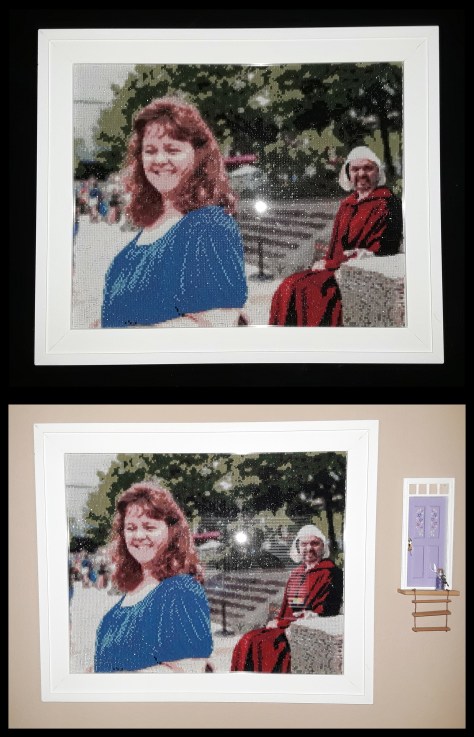
The picture is based on one I created. Dawn’s image was at an event in Fayetteville, while I am wearing one of the most handsome ensembles from the Handmaid’s Tale Collection. We already own a similar wood-panel version of the picture. It’s available for sale for $120,000 if there’s a potential lunatic buyer out there.
After Dawn finished the painting, we made our first attempt at sealing the canvas, using DecoArt triple-glaze to enclose it. Luckily, it worked fantastically, even with me doing the application. Note to those who once enjoyed eating Elmer’s glue: this stuff does not have any appetizing elements in it.
I bought a great frame from Hobby Lobotomy and placed it on the wall of honor near our bar and fairy door. (We rarely see our pixie/fairy named Crowder anymore.)
One picture is of the finished painting on the kitchen table. The other is of it hanging on the living room wall. You’ll note that I overcame my otherwise professional perfectionism and used a picture that reflects the picture window at the front of the house. At my age, it’s risky wasting precious time getting the camera just right.
.
.
.
Note: there is a huge difference in comfort between diamond paintings using square vs. round tiles.
My wife prefers round, for a variety of reasons.
DecoArt TG01-36 Triple Thick Gloss Glaze, 8-ounce Triple Thick Gloss Glaze is what we used to seal the canvas. 8 ounces is more than enough to do a 16 X 20″ painting. You can use it on other things, too, if you’re interested.
I personally think it’s acceptable to leave many of the colors unfilled. I’m hoping my wife will do a diamond painting with the main parts finished and allow me to hand paint the gaps with either white or corresponding colors. I can imagine several creative alternatives to an intentionally finished diamond painting.
It Was Everything

He sat there in the warm embrace of the relentless sun. The breeze brought a touch of cool relief but also wafted across us laden with the scent of the fast food of the golden arches. The blue sky above might as well have been a lifeless ceiling.
He wasn’t asking for anything, much less my attention. His clothes were dirty, and his posture was one of a young man who’d already done more than his share. It was palpable.
Our mornings were orphans now; his due to monotonous work and mine from the disconnect of knowing he was probably dreading a repetition of the same tomorrow.
Ignoring my fear of injury to his pride, I approached and asked if he was okay.
“Waiting to go do some more work,” he said. “My buddies went for lunch and I haven’t earned enough to eat.”
I solved his lunch problem. And probably his supper problem too, the one waiting for a solution after he’d finish working much later.
“Thanks. I never ask for anything.” He looked me in the eye, and I knew he was telling the proud truth.
I nodded, in fear I might I burst into inexplicable tears. I walked back to my car.
He went inside the store next to his perch. Moments later, he exited, tearing the package of his lunch with his teeth and inhaling half of whatever sandwich hid within. In his other hand, he had a large bottle of water. He gulped half of it as he stood there, looking up at the overcast blue sky as if it had just appeared above him.
A couple of minutes later, a beat-up small pickup truck pulled up and the young man jumped into the bed. I could see lawn equipment protruding above the edge of the bed. They drove off without exchanging a word.
I can’t help the sinister cloud enveloping my brother’s sanity. I can’t erase the past or retrieve angry words exchanged in the course of my steps.
I solved the stranger’s problem, though, even if it was not mine to approach.
It’s a nice day, I agree, even as we individually navigate the inevitable perils waiting to befall us.
The Poppaty Prerogative

Pictures of people, please and thank you.
“We are who, remembering when.”
Another person recently discovered the agony of finding out that the opportunity to take pictures with their departed friend has expired forever. He has only a few photos of his times with his friend. Because he’s not proud of his appearance, his ability to drop his guard and allow spontaneous capture of his image dwindled to insignificance. Even on the last trip they shared, no pictures document their overlapping joy. His memory still thrives, to be sure, but just as the recollection of a song cannot accurately measure the depth of beauty of hearing the melody, a memory pales alongside the vivid undeniability of a picture to amplify it. It explains why we can so spontaneously burst into tears or feel the literal swell of our heart when we see the presence of people who have mattered to us.
In the specific and linear moments of our lives, we easily overlook the magic and sublime nature of being alive. As time propels us, we look back and can’t help but to focus our eyes on the apparent wonder of what we didn’t appreciate when it was another backdrop in our present moment. It’s our curse. We find it impossible to perceive the zen essence of an otherwise dull moment.
As Andy from “The Office” said, “…I wish there was a way to know you’re in ‘the good old days’ before you’ve actually left them. Someone should write a song about that…”
The moments which tend to echo and call our name tend to be ordinary while we’re living them.
As people begin the ritual of finding new places to experience their lives, so many choose to photograph the static locales and places in their paths. In our data-filled lives, we have so many sources to find beautiful pictures of every single place on the globe. We can virtually drive down the streets of our favorite places without leaving the computer. We can take in the detail of any painting as it hangs on the gallery wall, no matter where that wall might be. There is both truth and beauty in such pictures. To those who say, “Aha! But those aren’t real,” I would point out that memories are only real to those who lived them. Pictures remain a testament for everyone.
We are, however, a world of people. We’ll remember places more for the moods they evoke. People grant us our identity, while places serve as our stage.
We are who, remembering when, imperfectly.
Cat Concussion

I prepared a light meal for my wife Dawn so that she could multi-task. (Multi-tasking is a word used to conceal the fact that you’re doing many things at once – and none of them very well.)
While I was assembling the various items for eating, I gave my cat Güino the proper portion on a separate plate in the kitchen. He devoured my offering and then sat in the middle of the kitchen, licking his chops with great satisfaction, perhaps hoping gravity would prevail and drop him further morsels for satisfied consumption. We often comment that he eats more treats than cat food. It’s hard to fault him given my predilection to do the same. If the pantry were equipped with a McDonald’s french fry dispenser, I’d be in mortal peril.
I went to the office and presented the plate of food to my wife.
Under the slight chance that we wouldn’t compare notes, the cat sneaked in the office and casually made his approach, both closer and higher to Dawn’s plate. He sometimes believes himself to be invisible – or believes that we are stupidly inattentive. Dawn and I began the ritual of shooing him away like a bothersome housefly. Like a hungry hyena, he would then start a new approach, hoping we’d forgotten that he had been shooed away in the last thirty seconds.
After the third failed attempt, he turned around immediately at the door and began another stealthy saunter toward my wife’s desk. Without looking his direction, I kicked my left foot out with high velocity. There was no chance I was going to kick the cat. His reflexes, however, triggered and he turned violently to the right. I heard a loud ‘clunk’ as the cat’s head hit the door jamb and wall. Güino seemed stunned for a moment and then shakily ran out of the room and away from the hallway.
I laughed. Ever since Dawn ‘bopped’ him on the head with a spoon and made him go cross-eyed for a bit, we’ve awaited his next concussion.
As I entered the living room, I watched as Güino stepped sideways and plopped into a heap between the television monitor and the coffee table.
I jokingly started a countdown, as if a boxing match TKO was ongoing in the confines of the living room.
This round goes to the humans. He’ll get his revenge when I least expect it.
X’s Humor Relativity Perspective

This post is going to hit you over the head. It’s personal and genuine. Weirdly enough, it’s about humor. If you read it to the end, the turn it takes will probably bother you, much like a Twilight Zone episode using electric shocks as language.
More than ever, I find myself in awe with people who appoint themselves as gatekeepers for humor and appropriateness. Personally, I can’t get my foot out of my mouth long enough to start gatekeeping other people’s humor.
Eventually, everyone’s sense of humor will land them in hot water with friends, in-laws, pastors, politicians, the Girl Scouts, and strangers. You can’t control another person’s reaction. My sense of humor is darker than average. It’s a claim I make from truth rather than an idle part of my story. If someone is not addressing me or a person specifically, I interpret it differently than I do other humor.
Two weeks ago, I wrote a new rule named “Hanlon’s Disposable Razor.” It preaches that we all stop assuming we know the intent of humor, especially if from someone who generally isn’t guilty of malicious behavior – and no actual harm results from it. The term ‘actual harm’ is subject to context, as is every single human experience, so don’t start quibbling over semantics or issues unaddressed by this post.
Since then, my social media filled with examples of people failing to realize that they can’t read the minds or hearts of others. “Well, that’s not funny!” seems to be taken as a blanket justification for anger in response to something that someone finds a bit uncomfortable. Adam Sandler’s last ten movies weren’t funny, either, but plenty of people disagree. “You can’t joke about some things,” is another typical gatekeeping statement. It’s rare that the person making such a statement has a smile on his or her face when they say it. Or matching socks, now that I think about it.
I’m not advocating that we run willy-nilly over people’s feelings under the guise of humor. Quite the opposite. Likewise, 7-8 billion people surround you, all with differing takes on life. It’s impossible to avoid all possible topics of contention. Elevating all humor to the level of spiteful is a fool’s errand. As you know, nincompoops are always employed.
Mother’s Day, April Fools’ Day pranks, Avengers spoilers (as if the movie wasn’t terrible enough), euthanasia, illness, falling and breaking one’s arm: all of these can be funny in the right context. They are not amusing to the people currently embroiled in any pain associated with the topics, however. Humor is universally told from the point of view of an imaginary third person. We don’t laugh or joke with the intent of hurting anyone. Not if we’re reasonable, I mean. If we accidentally say or do something without realizing that it’s causing specific pain, it’s not a reason to lash out in righteous anger. Mistakes are going to happen. Compounding the innocent error with anger serves no one.
On two occasions since I posted my new rule, people attacked me for not showing the required gravitas to an issue or for the sin of laughing at a horrible post even as I cringed that someone had posted it. I did what any reasonable person would do: I printed a picture of that person’s face, laminated it, and taped it to a urinal at the bus station. (That last comment was humorous. FYI.)
Now, I’m going to get personal and provide an example that will erase any doubt that all of us sometimes pull back from humor that we find to be misplaced. The difference is that I avoid objections to ‘third person’ humor, generalized humor, or humor that references shared experiences. I have to be personal because it’s not only the only way I know how to write but because it strikes directly to the point I’m making.
The humor we allow ourselves and in others is a direct measure of our depth and appreciation for our error-prone lives.
It is not the content per se that brings problems; instead, it is the motivation of the person creating the humor. Most people don’t require much study. We’re stupid more than we are malignant.
There’s a popular meme of a white cat near a woman lying dead on the floor. It’s comprised of three panels, each with the cat approaching the deceased woman, meowing for attention at her side, and finally, sitting on her hip. “Your cat’s reaction to finding you dead on the floor,” or something similar usually serves as title or footnote to the pictures.
There’s a problem with the meme if you look at it from the vantage point of unintended humor. What many people don’t know is that cats tend to stay near the body of their deceased owner, exactly as pictured in the meme. Many people have their own stories relating to this tendency.
As thick-skinned as I am, if you don’t know this about me, I was in the exact situation pictured. My wife died late one Sunday night, the night before Labor Day, years ago. She lay in another room for hours before I woke up for work. Our white cat, Quito, stayed with her for most of the night. I found him with her the next morning when I went into the kitchen.
Now, imagine the pain that came from that situation.
It’s such a specific scenario that it seems unlikely that it would ever be the subject of one particular meme.
However, it is.
It’s not a general observation or bit of humor: it describes precisely one of the most significant traumas I’ve experienced in my entire life.
The meme or ones similar to it come up on my social media and the internet with a higher frequency than you’d imagine. It’s not ever going to be likely that anyone posts such content with the intent of trying to barb me.
I could, of course, lash out at people, as if they are responsible for my biography. I could casually mention my past, which would needlessly traumatize the person sharing the meme as a joke.
Alternatively, I could get a sharp jab and then move along.
In general, take the short jab and then move along. Not always, of course, because sometimes people do misbehave and troll their fellow human beings with ill intent.
But not most of the time. Move along.
If I can overlook a cat meme accidentally mocking this substantial trauma in my life, you can overlook jokes about pregnancy on April Fools’ Day, funny anecdotes about cancer, or insensitive humor scattered throughout your social media.
It is not an invalidation of your perspective or feelings for others to joke at the heart or fringes of subjects which overlap with your life’s discomforts, losses, or challenges unless it’s done with malice aforethought or callousness. I hope you don’t have many people in your life that would subject you to such behavior.
I’d rather live in a world in which I sometimes cringe at humor than to reside in one devoid of the richness of human creativity and whimsy.
I ask that you strive to assume that my humor isn’t personalized or weaponized to offend, which is a favor I’ll reciprocate. If there’s doubt, we owe it to one another to further give the benefit of goodwill unless the preponderance of evidence tells us that someone is speaking or acting out of spite.
When someone lashes out at me for a badly-timed or placed joke, I’ll repay their impatience and impoliteness with a reminder that I probably have the upper hand in this argument.
Do unto others – and I certainly do. I welcome all humor, from tripping down the stairs to jokes that would cause many to burst out in tears.
P.S. If you heard 1/50th the nonsense that goes through my head or that I say in private, your head would explode indignantly. The truth is, though, that we both know that you undoubtedly have at least a portion of my dark bent in your own head. That overlap is what gives us hope.
Also, I’m in the picture on this post three different times.
.
A Conversation With Crazy

I recently became acquainted with a gentleman who is one of those unexpected hybrids of pleasant, upbeat, and batshot crazy. He’s older and has wide exposure to the world. Superficially, he’s likable. You’d never know that his cheese slid off his cracker.
There’s one problem: he is certain that all forms of cancer are nothing more than a state of mind. “If you think it, you’ll be it.” I waited until he had uttered a version of the sentiment twice before directly inquiring. I know a couple of anti-vaxxers, flat-earthers, and chiropractic enthusiasts, so I’m used to weirdos.
I asked him, of course, if anyone very close to him had died of cancer – or if he had been to a hospice care facility. “No,” was the obvious answer. Since we get along well, I also told him that a great swath of humanity would think he’s crazy and that many would accuse him of being heartless. He’s otherwise very smart and I find myself aligning with his general outlook, at least the one that’s perceptible through regular conversation.
I’d go so far to say that regardless of one’s pleasantness when talking to him about these things, he takes logical insistence as proof that the person contradicting him is a negative person. He’ll even double-down on his thesis and claim that almost all disease is subject to the same self-causation.
Initially, I had great hopes I’d become better-acquainted with him.
As a bona fide nutjob myself, I can tolerate a huge quantity of asininity. I’m an expert at fool impersonation. It’s a herculean task to overcome the idea that someone harbors beliefs that can’t be approached with logic, conversation, or science.
Or, more importantly, the knowledge that it’s sometimes wise to keep one’s foolish ideas to oneself. Yes, I realize that I’m a hypocrite like everyone else.
“The moon is made of cheese.” Why not?
My fundamental problem is that there is a chasm of difference between walking around with a chicken wrapped around one’s neck and denying basic science.
My new acquaintance is the Michael G. Scott of my life: entertaining but absent most self-awareness.
He reminds me of a co-worker from back at my days at a meat processor; that man was convinced that eating one’s own nasal nuggets and taking a sip of your own urine was great for you. We called him the English equivalent of “Snot-eater.” (Thankfully, we didn’t do potluck dinners back then.) I thought he was fairly nuts until I discovered an entire trove of people who believed that the Sun orbits the Earth. People think the Flat-Earthers are dumb; I wish they could have entertained themselves with the lunacy of those who angrily contradicted sense and science so violently.
My new acquaintance is good training for me.
I know that people believe a lot of nonsense.
I guess I forgot.
This will help prepare me for the next election.
The Clarion Misconception

For anyone who never had the pleasure of the holiday buffets at the now-defunct Clarion Inn in Fayetteville, you’ll have to pick another such activity or place to visualize. It’s possible I’m too nostalgic. Something about the holiday buffets evoked a feeling of kinship and holiday in me that few things ever did. I was always surprised by the mix of people who would show up and join in.
The buffet was fabulous, whether you were a light eater, a healthy eater, or someone who could best be described as a “human disposal.”
I didn’t get to return “one last time,” mostly because of factors out of my control.
Over time, I wrote a few rules to keep in mind as I hear/see people forego simple things in life, as if they themselves will not be scattered dust on a day much sooner than most of us expect.
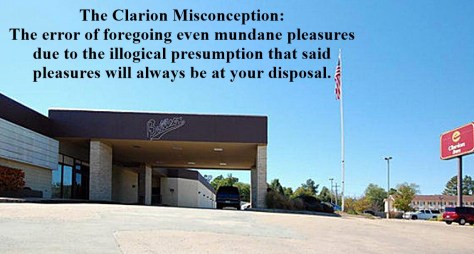
The Clarion Misconception
The error of foregoing even mundane pleasures due to the illogical
presumption that said pleasures will always be at your disposal.
The Clarion Misconception Addendum:
Giving primary consideration to other’s preferences due to perceived proximity to death or variable out of your control.
The Clarion Certainty: Future moments are all promissory notes without guarantee.
The Clarion Kinship Observation: Familial or societal expectations should be evaluated against all variables, with your own voice given equal vote.
The Clarion Selfishness Observation: Compromise in all things will get you far; giving yourself permission to not do so will sometimes make your life happier.