Category Archives: Social Rules

Trial By Food Court

5eb95a4742278d6e5a740b48


“It’s called a Food “Court,” because if you eat at one, it feels like you’ve been to trial and sentenced to eat prison food.”  – X

It was once a thriving place, one that thousands of people a day visited. It’s heyday arrived before the virus. I rarely go there anymore. Looking at the bricks on the outside evokes a “Walking Dead” vibe that is difficult to shake.

Before entering, I noticed the mask signs everywhere. “We proudly require our employees to appropriately wear their masks at all times for your safety” indicated one such sign. I knew well that this couldn’t possibly be true. Even medical professionals start doing stupid things with their masks and protective gear if given enough time to get sloppy.

Like many places, this place added security to ensure that people coming in would wear their masks. If you’re interested in this sort of thing, such public places provide great and literal ‘security theater’ that you can watch from a casual distance. It always provides something to enjoy.

Before the anecdote to follow, I’d like to mention that I did my double-order maneuver. I chose the eatery at the food court and ordered. I stood to the side. Known for its very rapid service, I waited patiently for about five minutes. People picked up their orders. I began to notice that people who ordered after me were getting served. Still, I waited. After ten minutes, I walked up to the counter again. I ordered the same meal I already purchased and paid for. I paid for the second order, too.

As I finished, the cashier who helped me with my first order said, “Hey, did you get your order?” I leaned in and said, “No, so I gave up and just ordered again.” He looked confused. “And you paid again?” I nodded in affirmation. The other two people in front looked at me and then each other, knowing they’d messed fairly spectacularly. A whirlwind of activity then commenced, with each looking at the order-up screen, previous orders, etc. They decided that they’d given my order to another guest. The other guest had said nothing when given the extra order. All the possible guests guilty of such a thing were seated in the food court. I interceded: “While they should have said something, they are blameless. One of you combined the orders and handed it to them. It’s not their fault. I paid twice because I wasn’t upset. Mistakes happen. I don’t want a refund. Just give me my food. By the way, that’s why I call it the Double-Order-Maneuver.” Because this particular thing had obviously never happened to any of them, they were clueless about how to proceed. A minute later, the cashier handed me my bag. “Thanks, Fred,” he said. “My name isn’t Fred. I used a fake name when I order in these places to cut down on communication problems. Obviously, I need to reconsider that tactic. Y’all have a good day and don’t worry about all this.”

I imagine someone had to figure out a way to explain to the manager that a customer gladly paid for the same meal twice.

I sat at a table for two in the food court, watching. There were more people than one would imagine. Several of the eateries in the food court were closed, with a couple barricades permanently. Covid keeps pounding coffin nails into the ones that attempt to survive there.

The kiosk of gumball machines sat forlornly to one side, it’s inventory inaccessible due to the ropes and tape. The piano, once attended by a cheesy but talented pianist, sat covered and forgotten.

A security guard and cleaning tech walked past me on my right. The cleaning tech was furiously gossiping to the security guard, who walked a foot away from her, leaning toward her to catch each word. The cleaning tech’s mask was already below her nose. As they stopped to wipe a table, the cleaning tech pulled her mask down to her chin. Though it seems like an exaggeration, I could see the spittle from her mouth arcing toward the female security guard.

People walked past. The two moved around, still standing close to one another. Whatever vexed the cleaning tech must have been very important. As I was about to circumspectly snap a picture, they moved to another table. The tech angrily pointed at a dropped straw wrapper as she snatched it. I took a picture anyway.

I took out my marker and wrote on a napkin, “Having a mask below your nose, much less below your mouth, is like having no mask at all.” I laid the napkin in the center of the table as I collected my trash. Doubling back, I walked the long way around the food court. By then, two more security people walked up and joined the two gossipers. Another food service worker joined them. Three of them had their masks on incorrectly. I took a picture of the group as they moved along. I noticed a few people were looking at the group with differing amounts of “What are you doing?” written on their faces.

I stood on the other side of a kiosk in the middle of the indoor hallway, watching. In less than a minute, the original security guard and the cleaning tech made their way back to my table. The security guard leaned over and read what I inscribed on the napkin. Her head snapped immediately back up, scanning around her. She then looked incredulously at the cleaning tech next to her, who still had her mask down. I didn’t need to know what was said. The body language might as well have been expressed using nautical flags.

I burst out laughing at the over-reaction. Instinctively, I moved all the way around the kiosk.

I waited fifteen seconds and when I emerged on the opposite side, the female security guard clutched my napkin. Her frenzied gait communicated that she was about to catch the other loitering security people and show them the napkin.

Her time would have been better served to tell the cleaning tech and her fellow security guards to stop walking around without their masks on their faces. This is especially true since it is the essential function of their presence. Barney Fife could keep the potential mayhem at bay without assistance; no one needs multiple security guards milling around asking for trouble.

The security guard pulled her mask completely down as she aggressively explained that someone had left an unwelcome napkin on the table. Naturally, the other guard pulled his mask down, too, possibly in an effort to hear better. It’s a common and stupid tactic that many of us are guilty of when wearing a mask for long periods. (Like we do when we turn down the radio when we’re driving and looking for something.)

In a move that should be noted for posterity, a man standing with the other two guards leaned over and read the napkin. Although I couldn’t hear what he said, he pointed at each of the guard’s faces, then up, then around. I’m sure he was mentioning cameras and people watching. As if on cue, both guards grabbed their masks and yanked them up above their noses.

The original security guard said something angry and crumpled the napkin in disgust.

I laughed again. She crumpled the napkin so theatrically that I couldn’t help myself.

While no one looked toward me, at that point I didn’t care. What were they going to accuse me of? Writing truths on a napkin?


The Great Undefined Before

ihor-malytskyi-R03V_bwMTw8-unsplash

*Note: as with any mention of Trump, I acknowledge that Trump supporters are not automatically racists. I loathe the entire agenda of superiority, though.

“By elevating those who fought against equality, you are sending a message to those once with a knee in their back that you would prefer it be that way again, whether you realize it or not. America was not great when we enslaved people, chose to keep women from voting, or did any of the things that would be considered sociopathic if a person did them.” – X

Before Trump dreamed up “Make American Great Again,” I endured family members who constantly whined and moaned that the United States needed to return to what it once was. They were vague on specifics. What exactly were the parameters and years of “the good old days” in America? Because most of them believed that their religion and their color was the only way of life, all others were therefore inferior and the enemy. It’s true they had to live in the real world and interact with their perceived inferiors. Despite their exposure, though, they lived each day with the certainty they were victims to modern society’s demand that all men be treated as equals. They didn’t believe it. Many racists still don’t. They’ve learned to silence those vocalizations unless they are in their own bubbles of town, church, or family. As we live our lives, we run up against these unstated prejudices all the time. They simply aren’t labeled.

In the same way that blacks and women were left out of this country’s founding, the ideals that so many claim to cherish ring hollow to me. The revolutionists didn’t have women and minorities in mind when they phrased such lofty phrases such as “with liberty and justice for all.” People weren’t equal. Millions of people weren’t people at all. Much to our shame, it’s codified in our law. We can do better than the constitution we now have. I realize that such ideas go against the prevailing sense of patriotism. This country is people, though, first and foremost. It is malleable, adaptable, and flexible. It’s why we have the ability to change it.

Before my Mother died, she befriended a black woman who worked at Brinkley Schools. By all accounts, they were close friends. Saying this without understanding that my Mother didn’t believe her black friend to be her equal does a great disservice to the truth. My mom died with much of her racism intact and real. The stereotypes most of us reject were a large component of my Mom’s identity. Her alcoholism was a prism that intensified her anger toward those she felt superior to. I’m not writing this as an accusation toward my name. It’s not. It’s the truth.

I’m not saying that my Mom actively mistreated every minority she came into contact with. That’s not how the world works. Did she believe that she was superior to them? That she had a right to be served first, to be hired first, or that her color was better? Yes. My youth was filled with such diatribes and rants. If Mom would have had the power to enforce her superiority over minorities, would she have done so? Yes. If a black person was a cop, he got the job because they had to hire him. If the supervisor was black, it was affirmative action. In any argument, the n-word came out as if it were a label that negated the other side of the argument. Mom mocked and ridiculed me for speaking Spanish. She ridiculed any accent other than her own, saying it was a sign of a lack of education, breeding, or whatever nonsense might pass as a justification.

Mandatory sidenote: it is possible that someone can do an about-face and change their beliefs and way of living. This includes racists. People can change. Were it not so, we would all be cynical and filled with loathing for most people. There would be no incentive to change. As with all other behavior, if a racist succeeds in learning a better way, he or she should get a chance for redemption. It’s unfair to label someone as racist if they grew out of it. Likewise, it is no crime to point out that people once were racists; it’s just a fact.

For those without obvious intensifiers or addictions, I watched as their ideology sharpened their resolve to put the others in their place. Even as their ability to give voice to their poison lessened, their actual prejudice seethed inside of them.

There is no golden age of America, not an inclusive one. Whether we demeaned blacks, women, Jews, Latinos, or gays, the truth is that we’ve never been a county that truly worships the idea of equality. The South of my early youth was predominantly racist in a literal sense and metaphorically much worse. The surrounding elders lamented the loss of the ideals of their country. It confused me because from where I stood, efforts to force prejudices into silence were slowly improving our ability to live peacefully and equally. I didn’t have the tools or understanding to give voice to what was wrong with so many of my family members.

Whatever infected them, I could see that it was wrong.

It didn’t leave me without my own measure of guilt. Unlike others, I resented it, rejected it, and learned that such things were hurting everyone. For almost all of my adult life, I’ve been free of some of that ignorance.

I’m not sure if we can blame it all on ignorance. Many of my family members were truly intelligent. Had they focused their intelligence on bettering everyone’s lives, society would have been a better place.

When confronted, they’d ascribe the questions to youth or inexperience. If I pointed out that I needed a reason other than, “That’s the way it is,” they’d either resort to harsh anger, their Bibles, or some other circular reasoning.

Mostly Bibles that were rarely opened to the pages asking us to live peace and kindness.

It’s no surprise that my research skills have demonstrated that many of them had some sinister skeletons in their closets. “Pious bastards” rings in my head a lot.

Many still reside in that cauldron of prejudice. They don’t see themselves as racists, of course. They consume media and reinforcements that mirror what they believe. Their opinions do not change with new information.

One of my relatives couldn’t understand why I didn’t want to hear the n-word, sincere prejudices about Jews, or his definition of the differences of each kind of color. His job gave him the excuse to stereotype. Over time, it blinded him. He would get angry at me for telling him to stop using it while talking to me. I understood him, but in the opposite way than that which he’d appreciate it. My wife who died years ago secretly bit her tongue every time she was around him. It infuriated her that he couldn’t see that his heart was dark. Because I was younger and foolish, I didn’t appreciate that all of us would have been better served to let her unleash her fury on him.

If we do not exercise great care, the rising prejudices hidden in plain sight within “Make America Great Again” will ruin us. We can make America great, but not by following the lead of people who feel they are superior to others.

People see these arguments and falsely claim that such logic implies that we don’t want the best for the United States. It’s a vacuous argument for them to make – but one they’ll always make because they think it negates the need for further explanation. We all should be focused on making the best decisions for everyone.

The racists know their own hearts.

How Long Is A Piece Of String?

pxfuel.com

A lot of thought and solutions are ridiculous. I sometimes get caught up in either the details or see the issue from too far away, so much so that complexity becomes obvious simplicity. In my case, though, I’m not in charge and not being paid to weigh the complexities of moving social issues.

It’s possible to give a completely accurate answer to a question – and sometimes such an answer follows a logical route. It might still avoid addressing the fundamental question, though.

During this pandemic, I encounter several such scenarios on a daily basis. When well-meaning people are involved, it isn’t difficult to point out that the objective and the solution aren’t compatible. With authoritarian or toxic people, we get bogged down into sublimely ridiculous situations, like a Seinfeld episode written by sociopaths.

This pandemic has consistently beaten into my head that adults are not in charge and the ones who make many of the decisions are winging it, often for personal gain.

Completely random and incompatible directives and rules are issued. We collectively scratch our heads, trying to figure out the objective to determine whether the rule is a 10mph speed limit sign on a 6-lane highway at noon on a summer day. Eventually, someone will insist on clarification. Inevitably, we regret it because we’ll get an inscrutable non-answer that helps no one. This leads many people to choose malicious compliance or to continue to do whatever they want to.

Years ago, someone hit me with the riddle of “How long is a rope?”

Given no more information, I surrendered and said insufficient information was provided.

I knew it was going to be a trick answer. The smug look of victory on the guy’s face asking me was evidence of it.

“It’s twice the length from the middle,” he replied. “Gotcha!” He proclaimed.

“Does a fart smell or stink?” I asked him, as I walked away. Because I gave him the same condescending and smug look as he gave me, the question tortured him for a day.

Which leads me to the look of confusion on an expert’s face today. He gave me a stupid non-answer. I immediately reverted to my tried-and-true, “Does a fart smell or does it stink?” I bowed and walked away.

The Driveaway Recap

Capture

Some of us sacrifice bits and pieces of ourselves by continuing to hold relationships that incrementally burn away our enthusiasm for good people. We stand close to the fire out of loyalty, confused interpretations of the word love, or because we fear that our lives will have a void where people of merit should stand. I’m equally guilty. By depleting my limited supply of peace with lesser people, I rob my future self of openness with people who love sharing the same with others.

She looked in the mirror as she drove away, seeing that foreign place recede from her. Once she became an adult, she’d already forced her way out of her old exoskeleton, even though it tore at her viciously as she escaped it. It wasn’t her choice to shed that skin; the people who should have loved her trained her with callous hands and closed hearts. Being without her protective layer hurt her deeply at first. In time, she grew to understand that being vulnerable ripped away the defenses that those people tried to beat into her. It’s impossible to join the ranks of the living with skin so thick it can’t be pierced.

The house she was departing had the critical components expected of a house and home. All the doors and windows were there, the lawn carefully manicured. Inside, people roamed the halls and kitchen, smiling and motioning as if they were made of the same clay as she. Weirdly, she often surprised herself by remembering the house in sepia tones, as if the vivid colors of the world were removed during her visits.

They weren’t made of the same stuff as she was, though. Her home was filled. Not simply with functioning human beings, but with love, vivacity, and laughter. Conflict surfaced, bubbled, and was pushed aside for better things. In the house receding behind her, she could feel the collective weight of the stones in their hearts. Their mass lessened with distance.

On those drives away, though, she’d ponder the thousand little arrows fired toward her. There were no simple words uttered in that house. Each was chosen to send contradictory reminders of status, connection, and affection.

As she did each time she departed, she mentally washed herself free of the house and its occupants. The blood and kinship she shared once again began to fade by the time she reached her claimed hometown. She could already feel the welcome arms of those waiting for her in her own private place.

Over time, she didn’t need to accuse the people in that foreign house. Her life itself was the accusation, unspoken and directed at no one. Though she was simply living her life in the best way she knew, others waited to use that against her. It was worse than a no-win situation.

“A life well-lived silences the critics,” or so said the old cliché. She didn’t believe it, no more than she believed the other companion cliché: “Don’t start none and there won’t be none.” With many people, the truth is that they can only bring themselves up by using their gifts of love and intellect to stab at people around them. Trying to step close to them with the best of human feelings inevitably gets you stung.

Instead of warm, deep affection and shared memories, she accumulates brief interactions. Standing in their living room, she dreams of the drive-away, where she can escape back to her normal affection-filled house.

One day, she’d find the words to explain their loss to them. It would probably be a day too late for reconciliation or reprieve. All she could do today was drive away. She pressed the gas, going even further away to attain the escape velocity needed. Much to her dismay, she found herself pondering their arrows. Though she was leaving, they’d found their mark with the little doses of poison. Never enough to kill but always enough to wound.

.

.

puzzle-137975245935L
A picture I made in 2015.


Unsolicited Advice

mattia-ascenzo-thW2sk-646E-unsplash

Sometimes, people I don’t know send me random bits of thoughts, advice, memes, or links because of this blog. They are at times useful and topical. I appreciate them. It is easy to focus on the hard cases and mean people.

After a couple of recent posts, someone sent me this: “…an unhealed person will find offense in almost anything someone does. A healed person understands that the actions of other people have absolutely nothing to do with them.” They added, “Time spent trying to understand the first type of person is wasted time. Get away from them as fast as you can and do your introspection away from their claws and influence.”

They went on to say that all of us fluctuate between the extremes – and that the closer we are to being healed, our response to angry or bitter people lessens, usually because we know that empty space is the best healing agent at our disposal.

Hours later, I received another message: “The sooner you pay the price for anything, the less you pay. You know this because you’ve written about it often. Of all the things you’ve written about, I think one of the best ways we can protect ourselves and children is to teach them all from an early age to get away from anger, addiction, control, and toxic people. They won’t change until they are ready. If enough people shun them, they’ll change or spiral to the bottom more quickly. Few people successfully change but those who did hit rock bottom at terminal velocity before figuring out they can’t be that way around good people. The world has a lot of bad people but it also has many great ones. Choose the great ones. They’ll fill your life in such a way you’ll never notice the absence of those who chose the other way to live. Peace. And keep writing.”


The Broken Record Is Renewed

For those who wanted a simple timeline, instead of my endless commentary. Names have been changed to protect whoever wants such protection.

One part of my motive for this blog was to share my stories and cement my stories so that revisionists couldn’t later do what they do when attempting to silence someone doesn’t work.

This isn’t going to be perfect. I’m leaving out huge gaps of nuttiness and drama.

People who read this blog won’t know who is being discussed unless they have a Ouija board or an exceptional dossier on the thousands of people in my life.

Earlier this week, my family member (who I will call Mark) created more identities and emails to attempt to interact with my blog. I already have a large list of blocked IP addresses, aliases, and emails he’s used previously. Though I can screenshot them, only people in denial would claim I’m making it up. I’ve shown it to a couple of people, ones who are familiar with the long pattern of anger and addiction that I’ve dealt with.

Mark was always a blowhard. When he was younger, his wit and intelligence were formidable. As his personality hardened, he became a victim to his own assuredness and secrets. We had a lot of great moments. To talk about the ones that diminish him does not negate that great moments occur. Mark hated my outspoken nature, especially when it walked over family honor. (Or dishonor.) Throughout most of his adult life, he was angry. Addiction did not help him in this regard. Whether anyone wants to hear it or not, his legacy will be one of anger and discord. There will be those who point the finger at me. Those who know me know that my life isn’t punctuated by this sort of addiction or constant refueling of anger and drama. It’s pointless.

When Mark resurfaces and starts in on me, he usually has a commensurate reaction in his personal life. When people get out their flamethrowers, they tend to scorch everyone. Previously, I let his wife know. (I’ll call her Jolene.)

I wrote Jolene a simple email to let her know Mark was at it again.

She responded angrily and with a swatch of allegations regarding my motive, character, and credibility.

I replied back, saying I wasn’t going to reply in anger, given that it wouldn’t help anyone, much less either of us.

She replied again, doubling down on her accusations. The email was boiled in anger. I could post the email chain here with names edited. It’s obvious when reading them who is suffering. And although Jolene wouldn’t want to hear it from me now,  I still feel a profound sense of loss and empathy for her and those who grew up in Mark’s sphere.

It has nothing to do with morality, superiority, or any of those accusatory defenses. It’s simply a matter of life not well-lived.

I replied a final time, using a short 3-sentence reply, one absent rancor, or accusation.

I went a long time without interacting with my Mark. In 2013, while I was helping to care for a cousin who was dying of cancer, Mark launched an all-out campaign to threaten me. It was effective. He worked in a job that gave him great ability to follow through on his threats and had a long history of alcoholism and anger issues. Instead of pressing charges, I tried to get someone to get him some help. I nearly lost my sanity for a bit.

As he does, Mark flipped it on me and told everyone that I was trying to get him fired. I still have the emails with his bosses that easily prove I’m telling the truth. Having perfected his skills over the decades, he told his bosses that I was bipolar and his family that I was out to ruin his life and get him fired. It took me forever to make him stop contacting me. My cousin died while I was dealing with Mark. Afterward, I had to endure the interference of family members who tried to paint it as a disagreement, despite that Mark had threatened to kill me – and that I believed it. People who knew me and who had heard his voicemails and calls knew it. While I might have been guilty of being an asshole, a charge I must confess to, Mark was guilty of an actual crime, one which I contributed to me trying to get him help instead of arrested.

In the intervening years, I dreaded the other shoe dropping. I knew that it would.

Not terribly long ago, Mark was forced to retire from his job due to alcoholism. I didn’t know that for quite some time. I didn’t know that he had been forced to get treated before, either. How could I know?

He began to call me intermittently and I answered. I was cautious. During one of my trips to Hot Springs, Mark called me. I’ll never forget telling him that he broke something in me in 2013 and afterward and that I might not ever regain it.

Mark began calling me more frequently. I tiptoed around his issues, wanting just to reconnect.

Many of us foolishly try to keep a relationship alive, even while swallowing huge parts of ourselves in exchange for doing so.

I sent Mark books, encouraged him to write his stories down, and made him personal gifts to encourage him. I tried to put in an effort.

Later, his wife Jolene wrote to me using an alias on social media, asking me to please call her. It’s important to note that I did not reach out to her; she asked me to talk.

Much to my surprise, we had an instant rapport, after so many years of not communicating. She shared with me that Mark was suffering badly from alcoholism. We talked many times and at length. I can’t stress enough that it was rewarding. We found out that Mark had told us differing stories to keep us from comparing notes. He had constructed a huge web of deceit and was continuing to victimize those around him.

At some point, Mark called me and told me he was another state to confront an ex-brother-in-law who slept with his wife Jolene. He was going to come back through Arkansas afterward. When I called Jolene, she said, “What are you talking about? He’s outside the house right now.” And she sent me a picture, which I still have.

Suddenly, all the things that Mark shared with me were called into doubt. He had told me a 1,000 stories, many about how evil Jolene had supposedly been to him. Most of them weren’t true. Jolene and I shared a lot of stories and compared notes. Mark had lied about his injury while drinking, as well about so many others. I won’t recount the list here. Suffice it to say there was a staggering amount.

My heart broke for Jolene and her children. All those years of assuming she hated me washed away. Mark was the spider in the middle of the web.

I tried to continue to talk to Mark. We talked many times, usually reminiscing. I tried to avoid mentioning the disparities or anything that would crash his fantasy world. It became harder and harder to do it – as well as to be nice to Mark. The longer I interacted with Jolene and her children, the more I tried to make him get help. I also worked hard to convince Jolene to get as much help as she could and to leave Mark if he wouldn’t do everything possible to get better. We talked many times about these issues.

I can prove it all, not that anyone reasonable would doubt what I’m saying. For those that do doubt, I can prove it. I’d hope that no one would make me. It’s needlessly traumatic.

During one episode, I recorded Mark at Jolene’s request. I emailed her the audio of the conversation. It laid bare to her how deeply Mark’s pathology extended. I’ll never forget that conversation we had. There was no escaping how deeply Mark’s addiction had advanced or how far he’d go to protect his choices.

At one point, Jolene sent me a picture of Mark passed out inside the garage, between the car door and the car. He wouldn’t stop drinking and driving. He was hiding alcohol everywhere.

I spoke with Jolene and one of her children.

I didn’t do it to refuel my drama cart. I did it because I was concerned. That concern grew to be anger at Mark for refusing to get help – as often as it took and for as long as it took. I discovered that he’d been misbehaving for a long time. I already knew it to be true due to a combination of observation, instinct, and passing comments from friends and family. Families traffic in gossip, truth, and innuendo.

It’s true that toward the end, I grew to be disgusted with Mark. I had to avoid him for long periods because I couldn’t peacefully maintain the facade of deceit or pretend I approved of his life. It would have been different had he not been so evil to his own family.

At some point in all this, he was caught driving drunk and endangering a lot of people. It was mishandled and because of his profession, he was not required to be accountable like a normal person. And so, he continued to drink and drive. I won’t share those stories which were shared with me.

He threatened his family and did and said things that were truly malicious.

Jolene told me to let it out and tell him how I really felt. I finally did.

Naturally, Mark waited until the day of the funeral for another family member. I’ve never participated in a conversation so ugly, even those involving my Mom. The level of pathological lying and misdirection was beyond what I’d dealt with before.

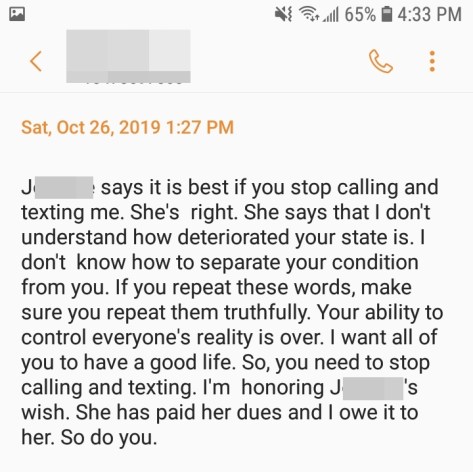
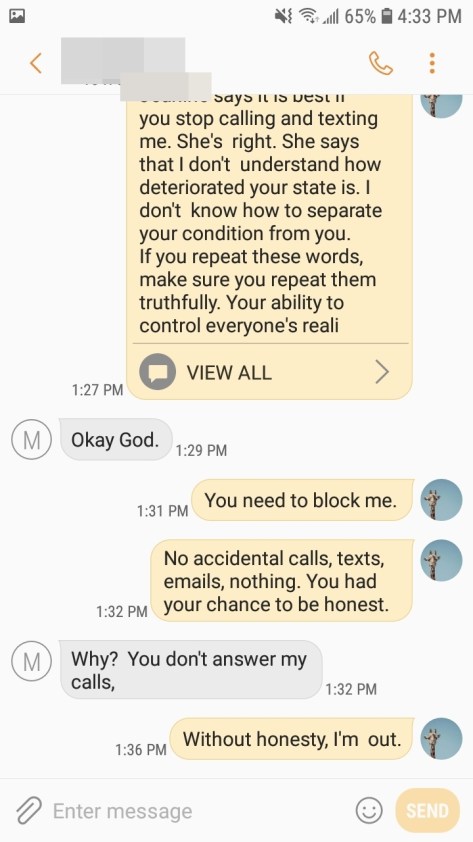
For me, the worst I behaved during all of it was during the phone call on the day of the funeral and later texts I traded with Mark In October 2019. I hit him in the jugular to try to get him to admit his issues and to get him to talk with me and Jolene simultaneously so that I could ask questions with her listening and gauge his response.


Screenshot_20191028-163325_Messages jeanine and numbers removed

Screenshot_20191028-163332_Messages without names and numbers


There are other screenshots in which I’m chasing Mark to be honest, to talk to me with someone else, etc. Truth be told, I wanted nothing except to have Mark and Jolene on the phone with me at the same time.


Ultimately, Jolene stayed with Mark, even though the children wanted her to leave. Jolene tired of talking to me and said she thought it would be easier if she didn’t keep me informed anymore. I agreed. I couldn’t be nice to Mark anymore and I realized that Jolene reached her endpoint.

I talked to her another time, as well as to one of her children, who told me that it was still terrible at home.

I knew the risks of talking to someone so close to Mark and that the likelihood of it being spoiled given enough time would be a certainty.

I traded texts back and forth with someone earlier this year – and it was worse than I had left it. It killed me to know that Mark not only had angrily refused help but had tightened his grip on those around him.

Each time I asked Mark to stop calling me, texting me, etc., he took great pains to go out of his way to ridicule me and do it even more. I have screenshots of pages of his calls. If I blocked his number, he’d leave nasty voicemails. For a time, I had to leave my voicemail full just to keep him out of it.

A few years ago, I had changed my email and phone number to avoid talking to him and my Mom. An allegedly well-intentioned family member gave him my new phone number.

No matter what Mark’s mental condition, he was together enough to employ complicated and ongoing efforts to create identities, use IP addresses, and continue to bother me when he knew it wasn’t welcome. His addiction and anger worked together to continue to convince him that I had no right to keep him at arm’s length.

I missed being able to talk casually with Jolene. We all shared a common battle and it shaped all of us and all of our lives.

But even that is gone now, probably forever, another casualty in the addiction war. Mark won. He’s poisoned us.

I have a mass of notes and records from all the craziness. I don’t like to peer into it for too long or look up details to understand. There’s nothing to understand. It’s just another wasted life being brought to a withering end.

Because Jolene called me a victim and insisted that I love washing in it, I’d agree I’m a victim in the sense that Mark perfected part of his skill at angry manipulation on me. I was stupid for returning to the scene of the crime. I failed Mark – and I failed Jolene and her children.

I knew there was a good chance that I’d end up on the wrong end of anyone conected to Mark. He’s gaslighted so well and so consistently his entire adult life that it is a rare person who escapes unburned.

As for that, there are more footprints on the internet that Jolene may realize. Not from me; rather, from those who were close and shared bits and pieces in their own way. They too shared parts of their stories, whether Jolene realized it or not. I didn’t go out of my way looking for them. They were offered voluntarily and at their own pace. They prove that the carnage was real and much worse than what is willingly admitted to. A lot of people eventually tell their stories. They validated what we all knew and whispered about. It’s no shame that someone had an addiction or couldn’t get their loved one to make amends.

We all failed. I wasn’t equipped to deal with it. I learned my own way and mostly avoided the craziness that Mark did. I didn’t escape it entirely, though.

As to whether I wrote too much about it, I only wrote about it when it dramatically crossed paths with my life. That’s my right. I can’t help it that some of those involved wouldn’t escape it. I understand that they have to paint a different picture, choose another villain, and ask someone else to pay their price on their behalf.

If you think I’m the problem, you need to take a long hard look across the internet. The truth is out there.


Slightly Embellished Story

allen-taylor-0cmJRW5rOJ8-unsplash


Someone close to one of the people who has vexed me most in later life wrote and lashed out at me with the phrase “Slightly Embellished Story,” stating that I write stories because I have a need to be a victim and relish the attention. I’ve written about this before and the ongoing likelihood that if you share your opinion and stories, even if they are completely yours to tell, people are going to use whatever tactics they can to knock you into silence. Or, worse, to question yourself.

I took some time to think about what I’d been told. While I didn’t let it pierce deeply, I did examine the implications. Only callous people disregard completely what they’ve been criticized for. We all go blind to our own foibles. I will admit that my brain glazes over when people scream or lash out in anger. I spent enough of my life around that sort of craziness. It’s almost totally absent from my day-to-day life. Those who don’t enjoy such lives simply can’t grasp how abnormal such anger is to most people living their lives.

In my case, I have grown so accustomed to this sort of manipulation that it works in reverse on me. I take a moment and consider what is really going on and what demons caused the person to write those words. In short, I’m appalled but fascinated. This sort of drama propels me to write MORE, not less.

Though the story is not mine to tell, I feel empathy for the person who wrote. They have lived a life diminished by things good people should not need to deal with, especially long term. They’ll never believe that I hoped for a long time that they’d find peace even if they had to build an entirely new life to do it. Gaslighting changes you fundamentally. Protecting secrets becomes an obligation. Ask any mental health professional about the consequences of being around addiction and pathology. We internalize what we cannot avoid.

Even as I write those words, I know I’m going to stumble and say and do stupid things. And I will also waste my remaining years making the same mistakes in the face of people who are not whole. I’ve been less than whole a few times in my own life.

One of the comments struck me as odd: “…you find a new audience to hear the same song/dance…” Which is weird as well as untrue. This blog, the one you’re reading. It’s been here since 2014. The previous blog on Blogger was there for several years before that. I imported some of the ancient ones here; some I edited and reposted later but many are in their original form. I don’t understand the criticism about my voice or stories “being new.” A decade of telling them doesn’t strike me as new.

This blog isn’t hidden. Anyone can read it. I used to allow open commenting. A couple of people with anger issues ruined that part for me.

I don’t post for secrecy. That’s a stupid argument to make. I post so that anyone interested can read what I have to say. It’s a one-way conversation. Unlike social media, no one has to even scroll past it.

Before that, I shared stories without embarrassment my entire adult life anywhere such outlets existed. Things happened to me that I didn’t choose. But I learned to embrace the hard things and talk about them.

If you’ve read much of my blog, you’ll read that I had a lot of family members who didn’t want to hear that we had some evil behavior in our family, didn’t want to hear that I had the right to change my name, and certainly didn’t want to be reminded of our right to choose our own paths.

All families are difficult. Being in one stuffed with alcoholics and abusers made learning to be independent of them difficult. We don’t start out understanding that people are scared of honesty or that someone might discover their dark secrets. They have to realize on their own that people know, anyway. It’s why if I get arrested or miraculously get a DWI, I will be the person saying so immediately on social media. Telling the secrets before they are outed robs them of their power. Most of it, anyway.

I never said I got it all right. In fact, I’ve said the opposite. One of my first blog posts was to point out that we are often wrong. Following that, I wrote a list of warnings about the dangers of writing anything down.

But I’ve been here, plugging away for more than a decade, telling the same stories that are mine to tell.

In 2014, I wrote another post about “Revisionists.” Even then, in 2014, I went through a period in which the haters almost silenced me. Several wrote and insisted that I was making so much of my story up. Years later, after DNA and research proved that countless stories of mine were true, they stopped trying to revise my life story.

As for the rest, I am a victim of some things. I’m certainly not a victim any longer, not for the most part. I don’t live a life full of drama, addiction, and secrets. My life isn’t perfect – but I have successfully reached a point now for several years when my sanity isn’t called into question. I continue to work to avoid people who can’t escape their lives.

Having said all that, that’s how this works: I write, you read. Or not.

If I’ve said something that you know is untrue, with the exception of those I asked to leave me alone, I’ll entertain any assertion that demonstrates how wrong I am. I don’t like to be wrong but I certainly hate to pretend to be right if I am not.

Otherwise, each of our lives is a Slightly Embellished Story.

Though the phrase was offered in anger, it did remind me to be wary of people. They are dangerous when wounded.


King of Kung Fools Rule

maria-krisanova-oxVxFGoweWM-unsplash

The King of Kung Fools Rule: once you ask that someone leave you alone and not communicate with you, total silence is the only option. If you engage, you will be bogged down in a perpetual fight wherein you’ll be held into a perpetual account for exercising your right to be free of someone.

If you’re reading this, you should think of Carly Simon: “I bet you think this song is about you.” It’s not. It’s about me and about the lesson I have to learn over and over.

We watch in society as people with protective orders still deal with the people tormenting them. It’s incredible it requires that. Pathology drives people to ignore the wishes of other adults.

It’s hard. Believe me, I know. I’m a fool on my best day.

Despite what people at a distance from me might think, I’m a bigger fan of snark, wit, and pithiness than you’d imagine.

I don’t care what you have to say or what motivates you. If I’ve asked you to stop communicating with me, you can be sure that you’ve done or said something (or many things) that brought me to the decision. Even if I decided on the spur of the moment, it is still my right to do so.

Even though I’ve been on both sides of this issue when I was younger, I’ve learned repeatedly that when someone says, “Leave me alone,” you should leave them alone. No matter how you’re connected, whether you’re related, past friends, or any other relationship, real or imagined, when someone says “No,” it means “no.” Regardless of your past connection, an adult has the right to say “Enough is enough,” if not, “I’ll let you know when I’m ready.” Forcing a conversation when it is unwelcome is aggressive and indicates that you don’t understand that each person has the right to choose who, what, when, how, and where regarding their lives. Who they permit to interact with them is entirely their choice and not subject to veto.

Manipulators and abusers insist they have a right because of __________. (Fill in the blank with the most common nonsense abusers mention.) This insistence indicates either immaturity, anger, or pathological tendencies on their part. Do not engage further. No matter what explanation you provide, it won’t be good enough. They will move the goalposts, gaslight you, or avail themselves to the tactics that all manipulators attempt. The worst will misbehave by saying or doing things to provoke a reaction. These actions will escalate to horrific levels if you acknowledge them. Being kind to them won’t work. Being mean to them won’t work. Their insistence to have access to you is a warning sign that they need help.

Have I mentioned how terribly I have failed to follow my own realizations listed above? I am an expert in falling into the holes I’ve dug for myself.

If you do engage, they’ll eventually succeed in making you respond with anger. They’ll then triumphantly screech in mock horror (and glee) that you got angry. Your anger at their stupidity is normal. It’s a superpower to be able to ignore abuse like that.

My Mother was a Kung Fool like no other.

At each stage of my life that I exerted control, she’d enlist any available family member to guilt me into reconnecting. My love for her sometimes interfered. It was a long, exhausting cycle. Not too long before she died, I finally broke the bond. I’d had enough. I mean, really enough, not the ‘enough’ of ‘maybe I’ll change my mind later’ enough. I only talked to her again because my Aunt Barbara called me and told me she had stage 4 cancer. Even then, I felt like I violated every protective mechanism I had in place. This was especially true because I had another family that convinced me he was going to kill me. In my family, that sort of thing is discounted at your own peril.

Addressing the other common refrain: you’ll be called crazy, a liar, or heartless. (Or some other word you can find it an Abusers Thesaurus.) IF the other person is correct and I am demanding to be left alone because I’m mentally ill, irrational, or simply hateful, it still doesn’t change the fact that I’ve demanded to be left alone. IF you insist on continuing the attempt anyway, you become the problem. If I’m spouting off nonsense, let me continue to do so and the truth will find me. Even Obama made famous a saying to let fools do their own talking.

If you can’t let me, you’re afraid of my message and that becomes obvious to people watching.

If you’re the abuser or troll, once the word “Stop” or its equivalent reaches you, stop. If you can’t get help, because you have control and anger issues that need to be addressed.

So, again, I don’t want to hear from you.


D.B.A.J.

sdfd

If y’all aren’t familiar with Boyd Crowder from “Justified,” go watch all 6 seasons and come back. He had a peculiar knack for expressing ideas in such a way that obscenity or erudition could collide and light up a bulb inside one’s head.

Today, while reading another poll/study regarding opinion regarding interracial marriage, Boyd’s voice filled my head explosively: “Nothing brings you peace but the triumph of principles.”

In the last decade, several polls have asked the question about interracial marriage – and some have phrased the issue in ways that allow the person answering to feel more comfortable sharing his or her opinion.

Up to 1 in 6 people still think that interracial marriage is objectionable on a varying number of levels. Obviously, GOP voters are much more likely to say it’s a problem. The bigger problem is that about 1 in 8 Democrats think it’s a problem, too. And about 1 in 10 people would object to a close family member marrying someone of another race.

Scientifically, these people are classified as ‘dumb bastards.’

I’m not color-blind. I also acknowledge I’m a bit of an ass and have some strange ideas. But weird, archaic ideas about this aren’t among them.

I like reading studies about these kinds of beliefs.

Regardless of what else is going on in society, they are an infallible benchmark for the prevalence of prejudice or racism in our midst.

Likewise, when people have a perverted sense of what prejudice looks like (and don’t see their ideas as prejudiced), it’s fascinating to hear what comes out of their mouths or keyboards as they attempt to talk their way out of a painted corner.

As Boyd Crowder said, “That’s what assholes do…
…They get old and die from being assholes.”