
Deadwood Movie Review:
Co**su**ers, take note.
That’s the entire review.
It says it all.


Eulogy:
“His life undoubtedly will be featured on a TED talk – and not the happy kind, either.”
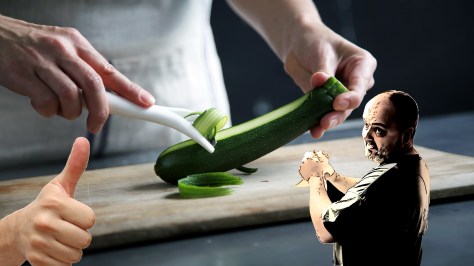
You can waste 27 hours watching videos about how to make fantastic zucchini noodles. Or, you can read what I have to say about it.
The same process can be used to make sweet potato noodles, squash, and so forth. Since none of them are terribly expensive yet yield a great result, you should experiment liberally. I’m a firm believer in the “I like it, so shut your piehole” school of culinary arts.
You can buy a julienne peeler or even a spiral slicer. (Or steal one from your mother-in-law.) You can also just use a hand-held vegetable peeler on your first couple of attempts. Since you’re experimenting and obviously have no sense if you’re reading my cooking advice, use a cheap hand-held vegetable peeler on your initial attempt. (If you don’t know what a julienne peeler is, congratulations, you’re normal.) You can also save yourself some time if you have a child or bored spouse to do the slicing for you.
You can buy some good spiralizers for vegetables on Amazon. You can also buy a new carpet there, too. You don’t need to waste your money on a spiralizer until you figure out whether zucchini noodles remind you of eating tapeworms or spiders. Some mandoline slicers can make narrow strips, too, especially of your fingers if you’re not careful or have too much to drink while you’re cooking. Science has taught us, though, that pain is more manageable if you’re buzzed.
Cut the ends off 3-4 zucchini. Since it’s your first time making zucchini noodles, you’ll want to use the peel instead of removing it. You’ll note that there’s a lot of needless arguing about whether the zucchini is better or worse without the peel. Despite the experts whining about it, it is 100% personal preference. Make long slices with your vegetable peeler. For your first time, don’t cut down into the middle portion of the zucchini.
Mix your zucchini noodles with a bit of olive oil. I prefer to add minced garlic and other spices before I cook them. As with the other steps, some cooks get pissy about adding salt, garlic salt, red wine vinegar, lemon juice, or balsamic during the cooking process. Those critics need to chill out with a glass of wine or by being hit on the head with a bottle of wine.
Put the zucchini in a large skillet pan with a bit of oil. Cook and stir them until they are the desired tenderness. As with pasta, I’m going to avoid the stupidity of the al dente-versus-soft argument. I will say that it’s pointless to add water and cook them down. If you are careful and stir sufficiently, the zucchini strips will succumb to the heat if you give it enough time. With a decently sizzled pan, the zucchini will cook in a few minutes.
Place your portion on a plate and sprinkle with parmesan cheese and spices, or you can also use traditional sauces such as alfredo, pesto, or marinara. If you’re a hipster, sprinkle some cigar ashes on the noodles and enjoy.
If you’re not a purist, you can also use this mixed with actual pasta to give your regular pasta dishes a healthy boost.
If you make too much, it can be chilled and eaten later, hot or cold. (The food, not you.)
Zucchini noodles can be made with almost no added calories, which means that if you get your mix of spices and toppings just right you can eat enough zucchini to actually eat yourself into a food coma without all the guilt.
Some people call zucchini noodles “zoodles.” These people are dangerous.
In my opinion, it’s best to use a lighter pan, one which conducts heat quickly.
For those who need to be told, I recommend using a spatula to stir the zucchini frequently; if you use your hands, you’re likely to need medical attention. I never know if the person reading my cooking advice is from this planet or has ever cooked before.
.

X’s Guaranteed Tick Spray
Mix 250 ml of water, one tablespoon of lemon juice, and one teaspoon of vinegar in a spray bottle. Shake vigorously and then spray it in the face of everyone around you.
Guaranteed to tick everyone off.

You trace the lines left by others, your own path superimposed on those of the people whose lives and inscrutable motivations might as well have been birthed on an alien planet. You might know them but not in the profound way that you wish were possible. Age confirms the suspicion that almost everyone navigates life by the seat of their ill-fitted pants and that no singular truth prevents you from missteps made a million times by our predecessors. And you wonder why the impolite and persistent dissatisfaction doesn’t abate, not entirely, and never when you’re alone with your thoughts.

Enough time has passed for the word “samesies” to transition from light-hearted slang signifying agreement to an official word.
I’m not asking for your agreement.
I’m making the word official in the same way that every other English word has achieved acceptance: because someone says so, usually after a bunch of people insist on using it as a real world.
As President of the American Nuanced Unific Society (A.N.U.S., for short), my pronouncement carries real weight.
If ‘covfefe’ and ‘nambia’ can be used as words, I can’t imagine listening to any objections to “samesies,” which is both adorable and comprehensible to anyone hearing it. It’s vital that we incorporate words that the average older person might be able to interpret.
The next time someone orders something, instead of saying, “I’ll have that, too,” try saying, “Samesies!” Very soon, you’ll see world leaders at a conference table, signing some treaty or agreement, the kind that old people love signing. The Prime Minister will stand, somber face on display, and sign the parchment “samesies” – and everyone will applaud.

As we learned in Princess Bride, “…Ha ha, you fool! You fell victim to one of the classic blunders! The most famous of which is ‘never get involved in a land war in Asia,’ but only slightly less well-known is this: ‘Never go in against a Sicilian when DEATH is on the line!’ ”
I’ve learned some lessons in my life, most of which require a refresher from time to time. It’s not my fault. I was educated here in Arkansas, suffered more than one head trauma, and accidentally watched an episode of “Survivor,” so stupidity comes naturally to me. If someone approaches you at the pumps of a gas station, scream “Help!” immediately and without regard to the person’s intentions. No matter what. No matter what they’re wearing or how they look. Nothing good will ever come from a gas pump walk-up.
While returning from New Orleans a few weeks ago, the gas pump rule once again came up. A fortyish gentleman approached. He wore clean coveralls and claimed he was a preacher raising money for blah-blah-blah. In his right hand, he had a wad of cash, which was confusing. I politely declined. He responded with a follow-up. Since I could tell he wasn’t going to listen to reason, I told him to please move along. He called me an asshole. For a second, I was convinced he was going to tear my arm off and beat me with it. The doubtful light in his eyes had turned dark as soon as the initial “No” came out of my mouth. Luckily for me, I had finished with the pump and got inside the car in one fluid motion and started driving forward without warning, even as my wife confusedly questioned what in blazes I was doing. In my defense, at least she was inside the car, unlike that time I left her in Mississippi. Crazy Coveralls Preacher lost interest in me; his shouts in my direction dwindled.
The only time I can move with such skill and concentration is if a bag of pork rinds is nearby or someone just announced ‘free pizza’ on the intercom.
So convinced was I of this gentleman’s internal violence that if I had a gun, I would have fired a warning round into the air. It’s better to be arrested in Louisiana for shooting clouds than it is to be beaten to death with one’s own arm. That should be on a t-shirt.
As I looped around to exit, I noted that Crazy Coveralls Preacher was walking fast toward an older white male standing next to his white cargo van. The door was open and the faux preacher invaded his personal space and essentially trapped the man from escape, or even the ability to throw a punch in his own defense. I almost stopped and intervened. The only thing that stopped me was that my wife had noted that I was genuinely alarmed, a condition I’m not prone to.
I’ve had issues with nutjobs in public places. As my friends know, I’ve had trouble BEING a nutjob in public places. This was the first time in a long time that it occurred to me that violence might result from the encounter. Keep in mind that I had just vacationed in New Orleans, so exposure to con-men and charlatans wasn’t an unknown experience – and that was at the front desk of the hotel.
Talking to other people and reading stories of violent surprises in public reminded me that nasty things do happen to people and I’m not referring to the 2016 election, either. We’re in open places, assuming that daylight, other people, and cameras will dissuade the demented folks from bothering us.
If you see me at the gas station screaming like the old man in “Invasion of the Body Snatchers,” I want you to drive your car into my vicinity as if you are re-creating scenes from the “Dukes of Hazzard.” I don’t care if you run me over in the process as long as you also run over whoever is trying to talk to me at the pumps.
You’ll get bonus points if the gas pumps explode and possibly a cut of the YouTube profits. I want to be cremated and I can think of no greater honor than by public explosion.
P.S. This also goes if you see someone is trying to sign me up for an MLM or a religion with an asterisk next to it on Wikipedia.
.
“Love the one that’s your width.” – X’s new take on an old cliche and song lyric.
.
.
Some people burn propane, others butane, and the rest insane.
.
.
I see a really surly guy a couple of times a week. He’s a bastard – one of those you’ll see arguing with the sunrise.
I went outside and fed a crumbled biscuit to the duck and the myriad finches who’ve learned to congregate around me.
Mr. Surly, who I’ve previously and politely asked to go jump off a cliff with an anvil tied to his face and leave me alone, sneered at me.
“Bread is bad for birds!” Mr. Surly said it at high volume for the sake of bystanders. He should’ve known better.
Without hesitation, I loudly said, “Well those 3 DWIs and smoking habit aren’t exactly points in your favor.”
Yes, I looked over my shoulder 200 times that day.
Still a win, though.
.
.
They told me to take more pictures while I was on vacation, so I took all 17 from the lobby of the Holiday Inn Express.
.
.
For those who missed the four a.m. show, the sky repeatedly and explosively turned neon and gauzy purple as tendrils of lightning snaked across the sleepy sky. I found myself driving five miles out of the way, watching thick varicose veins of lightning find its way to the ground. Bolts shook the air, and I could feel the car vibrate.
I wanted to drive on and lose the day.
Though I arrived first, I parked on the top level of the parking garage to watch the lightning roll above.
Nothing that fills this day will surpass the violent and thunderous purple of the dead hour of this morning.
.
.
*Reviews That Matter
If you haven’t seen Avengers: Endgame… Put on some energetic movie soundtrack music. Invite your very young nephew or niece over and have them flush the toilet for 180 minutes. #endgame
.
.
“Doctor, why I do break out in a rash every time my boss approaches? Is it stress-related?”
“No, it’s an allerjerk reaction.”
.
.

This post is going to hit you over the head. It’s personal and genuine. Weirdly enough, it’s about humor. If you read it to the end, the turn it takes will probably bother you, much like a Twilight Zone episode using electric shocks as language.
More than ever, I find myself in awe with people who appoint themselves as gatekeepers for humor and appropriateness. Personally, I can’t get my foot out of my mouth long enough to start gatekeeping other people’s humor.
Eventually, everyone’s sense of humor will land them in hot water with friends, in-laws, pastors, politicians, the Girl Scouts, and strangers. You can’t control another person’s reaction. My sense of humor is darker than average. It’s a claim I make from truth rather than an idle part of my story. If someone is not addressing me or a person specifically, I interpret it differently than I do other humor.
Two weeks ago, I wrote a new rule named “Hanlon’s Disposable Razor.” It preaches that we all stop assuming we know the intent of humor, especially if from someone who generally isn’t guilty of malicious behavior – and no actual harm results from it. The term ‘actual harm’ is subject to context, as is every single human experience, so don’t start quibbling over semantics or issues unaddressed by this post.
Since then, my social media filled with examples of people failing to realize that they can’t read the minds or hearts of others. “Well, that’s not funny!” seems to be taken as a blanket justification for anger in response to something that someone finds a bit uncomfortable. Adam Sandler’s last ten movies weren’t funny, either, but plenty of people disagree. “You can’t joke about some things,” is another typical gatekeeping statement. It’s rare that the person making such a statement has a smile on his or her face when they say it. Or matching socks, now that I think about it.
I’m not advocating that we run willy-nilly over people’s feelings under the guise of humor. Quite the opposite. Likewise, 7-8 billion people surround you, all with differing takes on life. It’s impossible to avoid all possible topics of contention. Elevating all humor to the level of spiteful is a fool’s errand. As you know, nincompoops are always employed.
Mother’s Day, April Fools’ Day pranks, Avengers spoilers (as if the movie wasn’t terrible enough), euthanasia, illness, falling and breaking one’s arm: all of these can be funny in the right context. They are not amusing to the people currently embroiled in any pain associated with the topics, however. Humor is universally told from the point of view of an imaginary third person. We don’t laugh or joke with the intent of hurting anyone. Not if we’re reasonable, I mean. If we accidentally say or do something without realizing that it’s causing specific pain, it’s not a reason to lash out in righteous anger. Mistakes are going to happen. Compounding the innocent error with anger serves no one.
On two occasions since I posted my new rule, people attacked me for not showing the required gravitas to an issue or for the sin of laughing at a horrible post even as I cringed that someone had posted it. I did what any reasonable person would do: I printed a picture of that person’s face, laminated it, and taped it to a urinal at the bus station. (That last comment was humorous. FYI.)
Now, I’m going to get personal and provide an example that will erase any doubt that all of us sometimes pull back from humor that we find to be misplaced. The difference is that I avoid objections to ‘third person’ humor, generalized humor, or humor that references shared experiences. I have to be personal because it’s not only the only way I know how to write but because it strikes directly to the point I’m making.
The humor we allow ourselves and in others is a direct measure of our depth and appreciation for our error-prone lives.
It is not the content per se that brings problems; instead, it is the motivation of the person creating the humor. Most people don’t require much study. We’re stupid more than we are malignant.
There’s a popular meme of a white cat near a woman lying dead on the floor. It’s comprised of three panels, each with the cat approaching the deceased woman, meowing for attention at her side, and finally, sitting on her hip. “Your cat’s reaction to finding you dead on the floor,” or something similar usually serves as title or footnote to the pictures.
There’s a problem with the meme if you look at it from the vantage point of unintended humor. What many people don’t know is that cats tend to stay near the body of their deceased owner, exactly as pictured in the meme. Many people have their own stories relating to this tendency.
As thick-skinned as I am, if you don’t know this about me, I was in the exact situation pictured. My wife died late one Sunday night, the night before Labor Day, years ago. She lay in another room for hours before I woke up for work. Our white cat, Quito, stayed with her for most of the night. I found him with her the next morning when I went into the kitchen.
Now, imagine the pain that came from that situation.
It’s such a specific scenario that it seems unlikely that it would ever be the subject of one particular meme.
However, it is.
It’s not a general observation or bit of humor: it describes precisely one of the most significant traumas I’ve experienced in my entire life.
The meme or ones similar to it come up on my social media and the internet with a higher frequency than you’d imagine. It’s not ever going to be likely that anyone posts such content with the intent of trying to barb me.
I could, of course, lash out at people, as if they are responsible for my biography. I could casually mention my past, which would needlessly traumatize the person sharing the meme as a joke.
Alternatively, I could get a sharp jab and then move along.
In general, take the short jab and then move along. Not always, of course, because sometimes people do misbehave and troll their fellow human beings with ill intent.
But not most of the time. Move along.
If I can overlook a cat meme accidentally mocking this substantial trauma in my life, you can overlook jokes about pregnancy on April Fools’ Day, funny anecdotes about cancer, or insensitive humor scattered throughout your social media.
It is not an invalidation of your perspective or feelings for others to joke at the heart or fringes of subjects which overlap with your life’s discomforts, losses, or challenges unless it’s done with malice aforethought or callousness. I hope you don’t have many people in your life that would subject you to such behavior.
I’d rather live in a world in which I sometimes cringe at humor than to reside in one devoid of the richness of human creativity and whimsy.
I ask that you strive to assume that my humor isn’t personalized or weaponized to offend, which is a favor I’ll reciprocate. If there’s doubt, we owe it to one another to further give the benefit of goodwill unless the preponderance of evidence tells us that someone is speaking or acting out of spite.
When someone lashes out at me for a badly-timed or placed joke, I’ll repay their impatience and impoliteness with a reminder that I probably have the upper hand in this argument.
Do unto others – and I certainly do. I welcome all humor, from tripping down the stairs to jokes that would cause many to burst out in tears.
P.S. If you heard 1/50th the nonsense that goes through my head or that I say in private, your head would explode indignantly. The truth is, though, that we both know that you undoubtedly have at least a portion of my dark bent in your own head. That overlap is what gives us hope.
Also, I’m in the picture on this post three different times.
.

