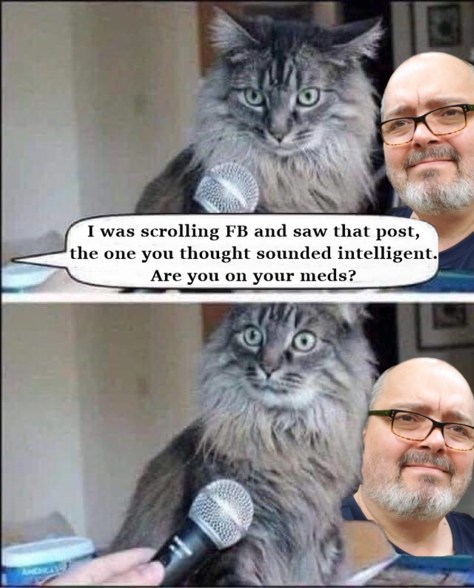
I needed a meme for myself, for obvious reasons. With a name like “X,” only weirdos expect me to play by the imaginary rules, much less be sane. The rest of y’all need to fry your bacon a little longer.
COVID has brought out the crazy in a lot of people.
I wrote the draft of this post years ago, precovid.
Years ago, I remember watching a “60 Minutes” segment and seeing a railroad car carry chemicals to one destination and then refill with apple juice, without being cleaned between fills. When I worked at a dairy, I was surprised to see that clumpy, black, clotted milk would be put in the holding tank to save money, because as long as the main tank passed inspection, it didn’t matter if someone shoveled manure into it. It’s true that pasteurization awaited the milk.
To frame it another way, though, you likely wouldn’t eat a bowl of ice cream if you knew it had 1% manure in it, no matter how safe it might be to eat.
I saw other things which were more troublesome while working in the poultry industry, which is plagued by food-borne illnesses and contaminants, even though they constantly assure us that every conceivable measure is being taken to ensure a safe food supply, even as they speed up processes, reduce costs and USDA inspectors, and reduce human intervention. If human beings are involved and profit is a primary consideration, it is no stretch to imagine all possible scenarios where corners might be cut. People inevitably cut corners, especially people who are pressured into working faster, with fewer people, and whose profit margin shrinks as they take the time to do their job more safely.
PSA: You’ve all seen the delivery drivers throw packages in and out of their trucks, across fences, or into swimming pools. If you haven’t witnessed it personally, the internet has probably shown you a few examples of packages being tossed like beanbags all through the delivery process. Even when they don’t throw or mishandle packages, they are constantly falling over, rolling, or upended during handling and transport.
I won’t mention any companies by name, of course, but some bring you clothes, electronics, food, and toys for your children. It’s convenient.
You don’t think twice about it, I’m sure.
Without being specific, a huge range of things is shipped by carriers. They can send diagnostic samples, clinical samples, blood, human tissue, and about a 1,000 other things you’ve never thought about. I’m surprised how many people assume that such things are segregated on other carriers or trucks. They are not. Also, it’s important that people know that the classification systems used to determine what can be shipped are a little dubious. Some items are recycled medical devices which are treated as highly infectious inside their point-of-use, yet are packaged and transported on the same trucks as your personal items.
The same drivers you see throwing packaged from across the yard are often the drivers transporting the things I’ve mentioned.
Whether they are hazardous or not is at times subject to opinion. Many times, no one knows what is inside the boxes. Even if they do know, speed demands that the packages be handled quickly, not carefully. The packaging is at the whim and mercy of anyone who took the time to ensure it was sealed properly or not. Anything in the distribution chain, however, is subject to the same treatment that you’ve watched on YouTube videos. You can Google the issue for yourself. You’ll be surprised at what can be sent on the same vehicles as your children’s toys, clothes, and food items.
It’s a small leap in logic to assume that these unmarked packages sometimes containing hazardous materials spill, going out onto your food packages, baby toys, or laptops. You then touch them without ever realizing that they have been exposed to waste products.
Many delivery and shipping companies use contractors. These contractors control their own processes, pay for their own vehicles, and so on while using the logos of the respective companies. Speed and efficiency are prized factors at every step of the delivery process. If you didn’t know, many drivers often resort to urinating in containers in their vehicles, no matter whose packages they are handling. Think about it the next time a driver hands you a scanner to sign your name.
Although I have not expressed my point very well, it can be summed up this way: if you receive anything shipped, you should assume that careless people handled the items and that anything you receive might have been contaminated accidentally or negligently at any point in the process. Further, reducing costs tends to drive what processes and training are in place to protect us.
Those videos of drivers throwing your packages are simply the visible consequence of our poorly-managed distribution system.
Do you want to know a sure sign you work somewhere where either the organization is terrible – or the boss is?
If they want to limit discussion to only your reaction, rather than the actions, words, or circumstances which triggered you, it’s a poor organization. Even people accused of murder have the opportunity to detail the timeline of events that preceded the alleged crime.
People are complex. Most people rarely flame out or over-react.
If your boss fails to listen, regardless of how ‘busy’ he or she is, it is likely the job or boss sucks. If it becomes a pattern, it is a certainty.
If your boss vocalizes the idea or emails any insinuation that your concerns are trivial, you work for a poor boss.
If someone uncharacteristically lashes out, you need to stop and examine what happened – as if human beings are involved. Forget the check-boxes and paint-by-the-numbers nonsense that HR insists that you use. Good HR representatives are compassionate, but it’s vital to remember that their primary responsibility is toward the company, which by definition is impersonal.
Good people don’t lash out or lose their sh#t unless they’ve been ignored.
In the last few years, most of us have witnessed the role of HR diminish from watchdog to whitewash. As organizations silo their areas, poor managers tend to become worse managers – and without anyone properly keeping an eye on them.
So many of us tolerate stress, mismanagement, misbehavior, or other cumulative craziness without a comment. Without warning, the valve blows and we react.
The boss rarely understands that we might be around a toxic employee or drama llama, or that employees are expected to do too much or tolerate behavior that would never be forgiven outside of work. Because businesses are running leaner or management is less well-trained than previously, the issues tend to flame out with greater consequence.
I see this becoming a worse problem as managers focus on metrics and impersonal considerations ahead of our humanity. As we emerge into a postcovid workforce, I predict that there’s going to be a great deal of backlash with this, even though many workers will continue to work from home.
When managers shift to priority management, especially during a crisis, people have fewer ways to vent their grievances. Despite the fact that most bosses grow to despise this part of their job, it’s actually more important than ever that they grin and bear it as they listen to their subordinates. Even if they don’t appreciate the alleged severity of the issues, failing to provide a release valve will hurt everyone. Pressure always leaks out of the organization. Whether it leaks out harmfully depends on the individual who is being ignored.
While it is simply my opinion, I think organizations need to stop leaning toward efficiency. Most people do their jobs well without micromanagement. The human component, the part needing attention, is suffering now more than ever. I see it in real-time.
I know the agony bosses suffer when they listen to a lot of complaining. It works precisely like a marriage, though. If you stop listening, you’re going to find your stuff piled in a flaming heap in the driveway.
Besides, in my experience, the terrible bosses who do this sort of thing are the worst when someone does the same to them. They will destroy the entire business if necessary if they are judged in a vacuum and without being afforded the opportunity to explain why they lost their sh#t.
My Dad and Mom, sitting at the counter at Uncle Buck’s house. Between them, an “invaluable” Elvis whiskey decanter.
I didn’t put this story on social media. I don’t even like this story. It gave me no satisfaction in writing it.
This story has been idling in my folder of unsavory family lore for a long time. Recently, a person close to me was dealing with someone infected with the inability to see the damage their behavior had scattered across their family’s landscape. This story came to mind and wouldn’t relent. Some of us contain the seeds of our undoing. Barring a miracle from stopping growth, these seeds blossom and choke the beauty out of our lives.
This story, in some ways, is a biographical sequel to my Tontitown post a few weeks ago. The truth is that in the last few weeks, I’ve endured the ignorance, anger, and consequences of another life being snuffed out due to alcoholism. Anger, of course, is its sidekick all too often.
People sometimes point out that I seem to be uncluttered by my youth’s insanity. I often reply, “It comes and goes, depending on what I’m dealing with.” Writing about it is a catharsis for me. It helps me clarify and unmix things that most people think are better off unsaid.
“Don’t live in the past,” some say. “Talking about it won’t change it.” All of which is true in its way. It’s also true, though, that because some of my family members never processed the damage they carried, the demon of alcoholism found a comfortable home in them. They’ve damaged their families. Like dragons, they lie upon their accumulated secrets and scorch anyone who tries to venture close.
On a recent Sunday morning, I found myself finally confronting someone in my family with a plea for them to get help again. They responded in a way that is almost a trademark: with righteous anger, denial, misdirection, and lies. Reasonable people simply don’t lash out in uncontrolled anger, especially when their alleged accuser is being painted as nuts. It’s amazing that angry addicts don’t recognize this; they can’t help themselves.
I don’t know how much longer they might live. I know, however, that they have lost any chance of a meaningful legacy. No matter what else they’ve accomplished, their addiction will stain everything. I cannot reconcile the sheer stupidity of such a wasted life. Though my life might be outwardly devoid of accomplishments and honorific merit, I know that I’ve mostly succeeded in keeping the infection of my family legacy in check. The fact that I can even say this infuriates those in my family who can’t say the same.
And so, now that we are past the preamble…
My family fled the outer fringe of Tontitown after my mother discovered that Dad had been having an affair with his cousin’s widow. We lived with her at the time, following a fire that burned our trailer in Springdale. We moved from Tontitown to a half-length trailer on what is now Don Tyson Parkway. It was a backwater little forgotten and desolate place with several small trailers on it back in the early 80s. Before Don Tyson, it was a narrow dirt road. I drive by the remnants of the place almost daily. The trailer was tiny, much smaller than an average trailer. It was an ugly place but one which served its function of crowding poor people with no great alternatives together. At the time, no one could believe that my parents had decided to stay together. They fought constantly, and the little trailer served as a ring in which to contain their anger.
The evening had started with Mom bitterly screaming at Dad about sleeping around and not working enough. I can no longer recall the name Mom mentioned, but Dad had slept with a barfly since we’d moved. I do remember that it was at a place on 71 and Highland Avenue. Weirdly, Dad had briefly bartended there when we lived at City View before our trailer burned. Dad rarely remained faithful.
Dad was already drinking. Mom was committing the cardinal sin of pressing his buttons. I don’t remember who broke the first glass or dish, but soon a succession of objects was being hurled and shattered. I went into my tiny room but realized that I could be trapped there. I spent a great deal of my youth shoeless and tried to avoid shards in the soles of my feet.
I went back into the living room and saw that Dad had dragged Mom into the bedroom at the far end of the trailer. I watched as my Dad lifted a pistol and slammed it against my Mom’s face. Blood splattered across the edge of the bed, across my dad’s shirt, and my Mom. Mom had probably grabbed one of the many guns in the house. Dad often kept one under the mattress and the bed. She fell face-first onto the cheap floor.
Dad continued to use the gun to bludgeon her. I stood near the narrow hallway of the half-sized trailer. After the second bloody smashing sound, I ran through the front door, across the driveway, and toward Butterfield Coach Road. As had happened so many times previously, I assumed that this would be the night when someone would be murdered. While I can’t always be sure of my memory, my brother was with the Thibodeaux family not too far away and my sister was undoubtedly concocting some sinister plan in parts unknown. I stayed gone for hours. When I returned, the front door was open and neither vehicle was outside. I cautiously went inside and saw that nothing had been cleaned. Furniture was overturned and glass shards greeted me. Upon entering, the two tiny bedrooms for the kids were to the right, while the living room, kitchen, bathroom, and master bedroom followed to the end. I walked the length of the trailer, certain that I’d find someone dead there.
I can’t remember the next day. A few days later, I was at my Uncle Buck’s house with my cousin Jimmy. Uncle Buck and Dad were drinking, and my uncle told Dad he had to go back home and work it out. Dad just lit a Camel cigarette and said nothing. Later, my Mom and Aunt Ardith arrived. After Mom spent a few minutes screaming at dad, he said it wouldn’t happen again. Mom promised to kill dad if he laid a finger on her again. It was an oft-repeated threat. Dad insisted that he wasn’t going to drink for a while and certainly not to get drunk. Left unsaid was the idea that alcohol was to blame for the dark violence. My cousin Jimmy said what I was thinking: “One of them should kill the other one and get it over with.”
A few days later, Dad came home at a reasonable hour and ate his pan-prepared slab of meat. Mom often spent a great portion of her paycheck buying horrid pieces of meat for Dad to eat. She’d cook them in a cast-iron skillet or pan. I sat at the table, waiting for the coda of the other night’s savagery. Mom had bruises and cuts on her head, neck, shoulders, arms, and places unseen. I knew that her ribs were either broken or cracked. How Mom worked as a telephone operator all day without being able to take a full breath was a mystery. Given that she averaged six packs a day, maybe it wasn’t a surprise.
Dad kept looking at my mom, trying to make a connection. “I’m sorry,” he said, over and over. “You shouldn’t mouth off like that. My drinking isn’t hurting anyone.” Dad kept murmuring to mom. “You know I’m sorry, don’t you, son,” he asked me. “Yes sir,” I told him, unconcerned with the lie in the face of unknown consequences. I would have shot him in the face at that moment if I had a gun in my hand. I knew that he would respond with righteous anger soon enough. It was apparent he was not sorry and that he didn’t believe he had done anything wrong. His entire life stretched behind him; regret for his acts of violence and alcoholism seldom seemed genuine. He had killed someone and not altered his behavior. He’d beaten all of us with fists, bottles, and boots. Like most alcoholics, he also expected us to forgive him simply because he demanded it.
Friday, I came home and played my French Horn for an hour and read “The Lion, Witch, and The Wardrobe,” one of the C.S. Lewis books that kept me company. I don’t remember where my brother and sister were. Around 8, I heard screaming outside, followed by the familiar sound of car doors slamming. I jumped up and hit the on/off button of the small t.v. we had. As the front door opened, I heard another scream, this one no longer a test. Mom was screaming murder. Dad grabbed her by her hair and slammed her face into the metal door jamb. Blood squirted across the room. Dad kicked mom into the living room and then kept kicking her in the face, side, and legs.
“Don’t ever make me apologize again, you #$%$^ing @#$%! You’re the reason my life is shit!” Dad continued to scream similar obscenities as mom laid on the floor, covering her head and sobbing. “Help me,” mom yelled at me as if I could pull the gun from under the couch and shoot my Dad. The thought had crossed my mind several times. There were at least five loaded weapons under the sofa where I was.
He turned to me. “As for you, you fat fucking piece of shit, don’t you move.”
I sat on the couch. Dad opened the lower cabinet and pulled out a bottle of some lesser brand of whiskey. He opened it and drank at least 1/5 of the bottle without stopping.
Dad came back the short distance to the horrid living room and sat on mom’s back. He pulled her hair and lifted her head backward and continued punching her head. I was no more than three feet away. “I’m not sorry, you ^&*$%. I don’t have a drinking problem.”
He let her head hit the floor with a thud. Blood was on the floor, my Dad, and across the tops of my cheap K-Mart shoes. Dad got up and grabbed my French Horn in its case and walked over to the front door and threw it out into the night. He took my school library book and tore it in half and threw the pieces on me. As he threw the book on me, I peed myself. He went to take another drink of whiskey, and as he did so, I stood up and tried to gauge how to get outside. I knew that I was going to get a beating. Dad walked over, and instead of punching me, he kicked me with the bottom of his boot, knocking the air out of me and propelling me through the front door. I missed the steps entirely and hit the ground. Without hesitation, I ignored the pain and stumbled off into the dark. Dad stood in the doorway, holding his bottle of whiskey, calling out an obscenity toward me in the night.
Mom left him for a few days. She returned, of course.
A few weeks after that, Dad came home and found me playing my French Horn. It infuriated him that Mom wasn’t there. He wasn’t even drinking that night, not until after. Though I stopped playing as soon as I heard the rumble of the truck outside, Dad came inside the trailer and grabbed my instrument. Thankfully, he didn’t bend it. Instead, he held my hand on the top of the kitchen table and told me to keep it there. I thought he was going to get a knife and do the infamous fingertip jump trick with a knife. Surprising me, he swung a bottle of whiskey down on my middle and second finger. The only reason my fingers didn’t get broken was that his aim was off enough not to hit me directly. It was terrifying and painful. “I don’t want to hear you playing this faggot shit in my house! You hear me, boy?” The next time I was at Uncle Buck’s, I told him that Dad had tried to break my hand. He often asked me how band was going and if I was learning music. He was an accomplished musician himself and often tried to get me to switch to bass and guitar. Uncle Buck was livid. “Bobby Dean, if you ever do that again, I’ll see to it that the same gets done to you.” Dad just laughed. I wasn’t allowed to spend the night there that night. Even though Dad was drunk, he drove back home. He stopped near Tyson Elementary and grabbed me out of the bed of the truck and hit me until my head was ringing. “Don’t ever tell Buck anything again,” he shouted as he beat me. As I tried to climb into the back of the bed of the pickup truck, Dad punched me as hard as he could in the back. I felt that punch for weeks.
(The demand for secrecy is one of the surest and sickest signs of pathology when dealing with violent addicts.)
While Dad’s beatings were violent while he was drinking, I suffered worse during those times when he wasn’t drinking. I think those times more truly reflected the bottomlessness of his anger toward me and regarding his own life. Much of his adult life was preoccupied with his next drink. His drinking resulted in someone’s death, a death for which he was never held accountable.
Rinse, repeat.
Violence and anger are not the results of addiction; they are precursors that accompany its growth. They are symbiotic. They require that those around the person with the addiction be partners in the aggression.
Looking at this post in my draft folder, I forgot that I had named it “Third Grade Marijuana.” That name paints an entirely different impression than the story underneath it.
I’m going to tell a truncated version of this story. The full version contained a couple of names and where I think the barn was located. I spent quite a bit of time going through property records and digging through the lists of people with influence and authority in the area.
I was in 3rd grade. My family lived in the Brinkley area again, for a year, so that my Dad could run the gas station on Highway 49 a few miles from Brinkley. I was in the bed of Dad’s truck with Duke, one of a long line of German Shepherds with the same name. We drove for miles. Dad turned off the main highway and then drove a series of increasingly narrow dirt roads. The last one was long and straight and ended in front of an unusually bright barn. As we neared, the large doors opened and Dad drove directly inside, which surprised me. Around the perimeter were large bags of hay. It smelled like silage or something pungent. I had been given orders to stay in the bed of the pickup truck. It wasn’t until later than I realized that Dad took me to a way station of sorts for marijuana. The barn was accessible only by one road. Deep irrigation ditches rimmed the entire arc of the farmland.
I didn’t stay in the bed of the truck. Someone offererd me a bottle of Pepsi from a machine along the wall.
Despite what people might say, this is a true story. Because the gas station in Rich is Monroe County, but close to a couple of other counties, I can’t be certain we stayed in Monroe County. I don’t know why we went to the holding barn in the middle of nowhere. I don’t remember if Dad took anything. I mainly remember him to talking to several people. All of them were laughing and talking loudly. It wasn’t menacing at all. Dad told me many years later that no one was worried because things have always been done that way.
Years later, it surprised me to know that Mom and Dad had marijuana in the house. (Or trailer, I should say.) I was oblivious to it before. They were lucky I was addicted to grape Bubble Yum and didn’t have an interest in pot. I would have had the entire school baked otherwise.
Note: Precovid, I was waiting on someone to get back to me on a particularly grim allegation. They lost their nerve. This isn’t a fun post. It’s just commentary I had to significantly pare down to avoid being sued by the organization involved in the allegation. Whatever we hear on the news, people talk and tell their stories.
For whatever reason, I’ve been reading a lot lately about abuse and abuse of authority or position. I know a couple of incredible stories involving people locally. Both are quite simply shocking and fascinating. Those stories aren’t mine to tell. Even though it might surprise some of my acquaintances, I sometimes get to hear accounts of things that you’ll never see on social media. I’m inclined to write about such things. For every incident of abuse or rape, many more go unreported.
A friend sent me a link to one of the databases identifying the “credibly accused” clergy of the Catholic church. We’ve since learned that a huge number of clergy simply had their names omitted from the list. A few thousand of those credibly accused also continue to live normal lives, in all manner of occupations, without being required to get help, register as a sex offender, or comply with any of the other restrictions placed on people in the general public who’ve committed the crime of abuse.
The topic swirls around me periodically due to books, movies, or stories that intermittently surface about the church. There’s always another bombshell, another revelation, in part because a group of old men thinks that secrecy will quell the truth. It is astonishing to me that those in charge of a church would ever seek to silence the truth, especially a truth which reveals that the institution has a serious problem. I keep waiting for people to stand up and say “Enough!” It’s not disloyal to your church to demand accountability. It’s disloyal to fellow humans to fail to do so.
From there, I opened the box of curiosity that led me to other cases locally. I have an inside view of a couple of them. What we’re told publicly is seldom most of the story. So many victims fail to come forward. Those who do are pitted against a variety of obstacles that impede and shame them, especially if the abusers are backed by organizations or have wealth to subvert the legal system to avoid accountability. A local case here wherein a professional abused his clients drove home to me that no amount of evidence and testimony will get someone convicted if they have lawyers to stymy the process.
Another friend reminded me of Priest Joseph Correnti, who called Tontitown’s St. Joseph home from 1995 to 2002.
He admitted to abusing children and then committed suicide the next day.
His actions weren’t revealed publicly until years later, after statues and places of meditation were created in his honor. A couple of victims came forward, one of them to sue. As well he should; the church participated in a scheme to protect and conceal the worst among us.
“It just doesn’t seem like he would have hurt somebody” are the words from one parishioner, upon hearing the revelations about Correnti. Those words echo in my ears. Like so many other Northwest Arkansas professionals, whether they be clergy, dentists, doctors, lawyers, police, or teachers, it’s important to remember that these predators do not have in fact wear a headband with the word “Danger” on their foreheads. I mean no harm toward the parishioner, who was surprised by the priest’s abuse of minors. A good head always strives to see the best in people.
I am surprised, though, that people still say they are surprised by abuse with a straight face.
When the evidence is presented, it’s part of our duty as adults to attempt to examine it.
If you understand that 1 in 25 priests was accused of abuse, it would stand to reason that you would, in fact, NOT be shocked that one of those is hiding in plain sight in your congregation. Those who abuse are precisely the people you trust; anyone and any occupation can be guilty.
If you have any experience with human nature, you know that monsters hide behind smiles, charity, and opportunity. Just because someone was an angel to you does not mean that they are doing some serious perverse things in secret. As I’ve written about before, a lot of friends have shared their stories of abuse with me, whether it was sexual, emotional, or physical. Many of them were put in the position of hating or accusing people who seemed to have lived lives of morality and respectability. Even though I have examples other than my dad, I want to scream when people find it hard to believe that he committed armed robbery, killed someone, beat his family, and so on. I’ve since learned other things about him that don’t rehabilitate his reputation.
People you knew growing up were abused. People you may know are guilty of abusing others. Given that I know several people who were abused when they were younger, I can say with certainty that a lot of predators live(d) in Northwest Arkansas. Most of them, even if accused, are walking around freely among us.
There are a lot more clergy guilty of abuse – and a lot more victims that we’ll never hear about. The victims of this abuse are listening to us as we bicker and argue about the issue, much in the same way that women who’ve been abused or assaulted sit in silence as their friends and relatives say some spectacularly ill-advised things about the subject.
It’s not anti-Catholic to discuss priest abuse. It is, however, unreasonable to fail to address this sort of thing aggressively. If clergy are abusing people, it’s on all of us to report them. What particular religion, position, or church is involved is irrelevant.
One of our greatest tools to combat predators is to stop the ongoing nonsense of secrecy. If a pastor, therapist, or priest is involved, feed him to the criminal justice system, independently of whether he gets help. Stop focusing on controlling publicity. Such secrecy damages the entire organization’s credibility.
The reason I know that there’s still a huge problem, aside from the statistics, is that when I bring this issue up, I get a lot of anger from those who are members of the organizations. This signals that the shield of secrecy is still very much at play. Until people demand accountability from their church, the church won’t address the issue completely. The cycle continues.
One of our most adult realizations is that anyone can misbehave no matter what organization they belong to. We should embrace the possibility that their misbehavior does not necessarily reflect on the entire organization. Sometimes, it does, especially when the organization or its members align to conceal the problem or defend those who have no grounds for defense.
The church cannot reach a minimum level of trust until it trusts everyone with the full accounting of what’s happened in the past.
Every human system is going to have humans who abuse it. It is no shame to oust those abusers publicly. Don’t defend them or the organization that continues to fail the people who are abused. There is no defense.
It isn’t a Catholic problem. It’s a human problem, one we should discuss.
We hear so much about the Catholic church precisely because of its size, reach, and influence.
We have to stop allowing people to resist open discussion when cases arise.
I started with the best of intentions: I stopped at Aldi to buy my mother-in-law another loaf of Apple Strudel Breakfast Bread. I first bought it for her as a whim. As such things go, the bread is pretty fabulous. It is with a begrudging spirit that I give any compliments to Aldi. I’m still very cautious about what I buy there. I will admit, however, that they offer a few things that aren’t available in other places. (Other than typhoid and a persistent rash, I mean.) I blame my friend Marjay for reminding me of Aldi. She shared a social media post yesterday about the dynamics of returning one’s cart.
Given that my job has a work limit allegedly due to the COVID crisis, I ran from my job with glee a little while ago. I should have paid more attention to the forecast. If not the forecast, I should have looked behind me as I drove across Springdale. There was a massive dark cell approaching. Had I noticed it, I would have driven directly home. I definitely would not have parked at the furthest part of the lot, either, something I almost always do when the executive committee chairwoman isn’t with me. (That would be my wife.)
I entered Aldi’s to buy three or four things besides the aforementioned delicious Apple Strudel bread. I ended up with a couple of dozen items and had to retrieve a shopping cart to carry them. It was at that point I noted the massive black wall almost on top of the store. Ignoring my instincts, I put my items in the cart and finished shopping. By the time the helpful cashier was throwing my items in my cart like it was an Olympic qualifying event, we could see the sheets of rain, as well as hear them strike the store’s roof.
I bought some bags, piled my stuff in them, and waited by the long window at the front of the store. My three or four items had blossomed into three large bags of food. Anyone looking at me would have thought I might be a huge fan of Aldi. It was a strange coincidence that today was my biggest Aldi haul in years.
There were several customers congregated along the bank of windows, all staring at the massive storm that greeted us. One woman with a full cart didn’t hesitate. She walked into the rain without wincing, unloaded her cart, and walked back to the front to return it to the corral. She resembled an otter that had just emerged from an overflowing creek. I’m assuming she is the mother of several children; only such unavoidable training could result in that kind of resigned demeanor. Additionally, she owned a minivan. It’s common knowledge that driving a minivan is tantamount to tacit approval to get drenched while doing the weekly shopping.
We watched one brave soul exit Aldi with a bag of groceries. In horror, we watched as he ran across 412. Anyone familiar with the danger would understand. Running across through rain so thick we could barely see across the street was an added element of lunacy.
After several minutes, I decided that the storm wasn’t going to abate. Pushing my cart ahead of me, I exited. As I crossed the main door, an unattended cart rolled by at a very fast speed, heading across the lot and destined to crush someone’s car. An employee cursed and then darted to get it. He was drenched by the time he came back. I half-ran, knowing it was futile. The sheets of rain hit me and surprised me by how cold it was.
At this point, I’d like to mention I hadn’t done my work laundry in a few days. As a result, I wore a pair of my old pants, ones with a much larger stretchy waste. I used my belt to tighten it drastically while I worked. Even so, my pants threatened to drop once or twice.
Because of the heavy rain, my pants drooped as I shuffled across the parking lot. As I half-ran, my pants, belt and all, slipped down past my gray underwear. I didn’t hear a round of applause from any of those employees or customers hiding from the rain at the front of the store. I stopped and got my pants to stay more or less and up and continued on to the car.
I crossed a river between the last rows of cars. The water reached my ankles as I crossed. As I opened the rear door of my car, I realized at the last second that the paper bags had become ornamental at that point. By sheer luck, I didn’t drop any of my groceries. I picked the other bags up like cannonballs and dropped them in the back.
Because why not, I walked my cart back up to the store. I told the employee, “My pants fell off on the way. My apologies for the unsolicited reminder to always wear underwear.”
Driving across Springdale on 412 was another adventure. Several vehicles decided to avoid the overflowing storm drains along the edge by driving in both lanes. I didn’t witness any accidents. While driving, I could feel the water puddling in my seat and on the floor.
When I arrived home, my wife had opened the garage door for me. I don’t park in the garage. I had to carry each of the three soaked bags to the inside of the garage one at a time, placing them on the concrete near the inner door. The rain was cascading across the roof of the car and hitting me in the face each time I opened the car door. Afterward, I wasn’t sure the garage door would close against the wind gusts and blowing rain. I had to strip out of my clothes while standing in the garage, surrounded by my valuable groceries.
Note: despite what you’d think, it is not romantic or sexy to watch your drenched husband bring in the groceries. I base this knowledge on the rapidity with which my wife exited the scene.
I could feel the loaf of Apple Strudel bread chuckling at me while I did. “Was I worth all that,” I’m sure it was asking me.
The cat’s been staring at the dryer strangely ever since I put my soaked shoes in there. He was so startled earlier when the shoes knocked the dryer door open that he bolted across the narrow entrance hallway at supersonic speed, smashing directly into the wall. His only comment was a strange, “Meowwwwwww,” even as he weirdly plopped down on the floor.
I can identify with the cat. Whether my greater error was in going to Aldi or doing so during a monsoon is up to you to decide.
In “The Hitchhiker’s Guide To The Galaxy,” Douglas Adams described the alien Vogon spacecraft this way: “The ships hung in the sky in much the same way that bricks don’t.”
While the description is metaphorical nonsense, it makes perfect sense. This is the sort of whimsical logic that appeals to me. While most observers would think it isn’t reflective of who I am, they are mistaken.
I recently tried another food which is nothing like the name would suggest. Somehow though, it eclipses the source inspiration for texture and flavor. In addition to a flavor that is plant-based, you don’t have to idly wonder how close to the pig’s anus the skin you’re eating might have been prior to being a pig carcass. When it’s fresh, it definitely fulfills one’s texture-based cravings.
On my last trip to my favorite cabin, I was shopping using the ‘anything goes’ method, one which is characterized by pure whimsy. On one of the aisles, I saw Beanfield’s Vegan Cracklins. The grocery stores in Eureka Springs and Holiday Island offer selections that are often unique, right alongside the expected staples of a smaller town grocery.
I’ve tried Beanfield’s bean chips. I loved the Pico de Gallo flavor. They aren’t available in my customary stores. I’ve been banned from Whole Foods ever since the incident on April 24th of 2019. Okay, that isn’t true either. But I like to think I made you wonder, just for a second, what I did to get banned from Whole Foods.
It sounds like a prank, doesn’t it? While I like putting fried pigskin in my mouth as much as the next guy, something about the packaging appealed to me. I picked the “Spicy Nacho” flavor under the mistaken notion that it would be the one my wife would enjoy the most. I usually choose based on whatever is the most outlandish.
Available in Chile Limon, Spicy Nacho, Ranch, Korean BBQ, and Frozen Bat’s Testicles flavors, there’s a flavor most will like. That last one? It isn’t real. They do, however, also have one labeled as “Aged White.” I can only ASSUME it is aged white cheese flavor, instead of some older gentleman named Archibald, Harold, or Bernard. Popular fads aside, most people don’t want products that are made from, or smell like, actual people. The people that do want to buy such products are not ones you should invite over for a game of poker unless you’re prone to self-loathing. Take note, Bachelor fans.
I didn’t buy them because they are vegan, gluten-free, rich in protein, or high in fiber. I bought them because it sounded weird to me.
My wife decidedly disliked the Spicy Nacho flavor, allegedly because it was ‘hot.’ Being of Irish, Scottish, and English descent, even white bread is a bit on the spicy side for her.
The texture is ridiculously crisp and the flavor pervades each cracklin.
For conservatives out there, eating this will not turn you into a liberal. You’ll experience a mild urge to tax and spend, so keep that in mind as you try them.
As with all bean products, over-consumption allegedly will give you Trombone Pants Syndrome. It’s not fatal, no matter how much your family groans and writhes as you all cluster together in the living room watching Netflix.
Around me, the world continued, its billions of inhabitants each contributing their parts to the melee of the planet.
In the passenger seat sat an unusual amount of Mexican food I’d picked up from Acambaro, certainly more than two people should safely eat. In the bag, among other things, were five full orders of pico de gallo. Anyone who dislikes the smell of onions should assume my breath to be worse than normal after lunch. For anyone who doesn’t know: an order of pico de gallo at Acambaro is not your typical meager serving. Five such orders contain and order of magnitude of onions, cilantro, and chopped tomatoes. While you may challenge me to do ten pushups, I challenge you to eat five servings of this with a full meal without questioning your own sanity.
The car smelled like a restaurant as I drove east on Huntsville. Around me, several drivers seemed intent on reaching warp speed. For several, it was obvious they needed to be more concerned about the condition of their vehicles, their personal hygiene, and their ability to confine themselves to at least two lanes. Were in not before noon, I would have assumed several had attended a “Drink-All-You-Want” wine tasting.
As I slowly stopped at the intersection of 265 near the packed Kum & Go, I lowered my driver’s window. All the cars who’d been training for the Indy 500 for the half-mile were in the left lane. I turned my car volume to “19,” a volume that could potentially launch a satellite into orbit. My USB was playing “Automatica” by Nigel Stanford. If you’ve never heard it, you’re in for a treat. (And not the kind of treat that’s covered in lint in the bottom of the candy jar at your Grandma’s, either.)
As the young Latino in the first car looked over at me, I smiled like a lunatic, showing him all my teeth. I put the window up, even as I looked at him. I like to imagine how weird it must have looked to him to see me continue to smile like a hyena while the window went up in front of my face. “Inspired By Hannibal Lecter” probably approximates his discomfort. I had to laugh.
The light changed, and the left lane’s performance drivers rocketed off – but not before a small dark Honda vehicle sitting on 265 turned right and went across into their lane. As you would expect, the dark Honda immediately slowed to 25 mph. The fast drivers all hit their brakes as I went past them. I was amused.
As Huntsville curves south lazily, the throng of traffic began jockeying for position as the drivers neared Emma. At that point, Huntsville magically transforms into Butterfield Coach Road, a name so ridiculously preposterous that no one willingly wants to call it that. When Latinos ask me what it means or what the translation for “Butterfield” might be, I sometimes tell them that it is a medical condition characterized by high volume diarrhea. Sometimes I let them continue to think it’s true.
To the south and east, the sky was darkening rapidly.
The City of Springdale changed the roads a few years back to make them safer. I assume that was the reasoning. The stretch of road from Emma to the next huge curve has been beautiful for walking since the road deviated. Now, however, a spur is being built on the inside of the curve on the right side. Frequently, cones suddenly appear from the proverbial mist and force the right lane to suddenly merge with the left. That’s the theory, anyway. What it actually does is weed out those who are under the influence of marijuana and/or using their phones as they drive.
Because I drive it frequently, I tend to assume that someone’s going to do something stupid. Today, as the music blared, I watched a black Grand Cherokee Laredo approach from the rear going at least 70 mph. (Contrary to popular belief, and even though there are a lot of people who want to get out of Springdale as quickly as possible, we don’t have 70 mph zones. Note: the police allow you to drive 90 on 412 if you’ve eaten at Taco Bell – and do so for obvious gastrointestinal reasons.) As the Laredo neared me on the right and then passed, I noticed that their tag was a paper one. I had a sudden insight that it was their turn to be an idiot. There was no sign on their car to indicate this. I just knew. As they came into the cones pushing them left, I saw the Laredo eat one under the bumper. I assume the driver woke up at that point because the brake lights lit up vividly. I could almost feel the driver’s butt clench up from inside my own car. The Laredo lurched left, like a drunk who’d hit his head on the chandelier. The Laredo then went back and forth quickly. I was convinced I was going to see the driver go off into the large dirt valley that had been recently excavated for what appears to be a new access road. It’s right on the inside of the curve, too, where it will probably inspire more accidents.
Luckily, the Laredo didn’t do a Dukes of Hazzard. We stopped at the next light at Parsons Road. I noticed a black Escalade in front. On each side of the vehicle was a group of yellow balloons. On the rear, there was a sign wishing someone a happy 2020 graduation. The “O” of 2020 was a roll of toilet paper. I didn’t catch the name on the vehicle. The emergency lights were flashing. I couldn’t see inside the vehicle due to the near-total tint on the windows.
In 2020, maybe it’s a good thing to not see where one might be going.
103 seconds had elapsed since I noticed the time on the usb device on my car stereo.
In a way that you might understand, those 103 seconds felt almost accordion-like in my mind.
When I had time a little later, after writing this, I visited Google Maps and went back in time to 2008 to travel these same roads virtually. What a strange thing memory is, wrapping itself in blankets of time in an unending crescendo.
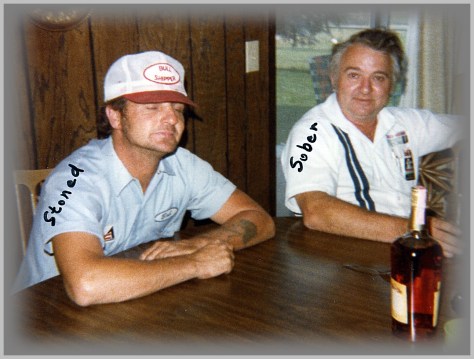
P.S. The picture is of my Dad and Uncle Buck. I don’t know who noted the names on the picture. But it is funny, too.
Since people kept saying, “What does a GOOD near-drowning story sound like?” I thought I should tell one which amuses me. It also highlights a few anecdotes about my Dad. I have some terrible stories about drowning, but this is the furthest thing from that.
My Dad had a propensity for outlandish humor. He wasn’t safe about it, either. I have a library of pranks my Dad was involved in, some of which border on pathological. For example, one year during one of the excursions to the “Deer Woods,” he and his drinking companions tied one of the other hunters to the top of a large stump and set it on fire. I’m not sure they had a contingency plan if he failed to be freed in time, although I wouldn’t put it past them to announce that he was part of the BBQ and break out the sauce. More than once, some fool would throw a box of ammunition in the fireplace or in the campfire. When we lived in Tontitown on old 68, Dad threw a box of ammunition in the fireplace inside the house. It went as you would imagine.
Although this is a tangent, when I was very young, I couldn’t figure out which state the “Deer Woods” was in, or why so much alcohol had to be taken for the trip. It perplexed me to think that a handful of grown men needed 30 cases of beer and a dozen bottles of whiskey.
Even if bears wanted a drink, a lot would get wasted, no pun intended.
Dad was mercurial, a word often used to disguise the fact that someone is a moody, temperamental asshole. Other days, the fog would lift from his brain and he’d decide to enjoy life, or at least be carefree. Had he had more of those days, life would have been markedly different for him – and for all of us. On one such day, Dad insisted that I go with him fishing. Inviting me to fish was akin to bringing a framed picture of Satan to your first prayer meeting.
While I had hoped for a trip to Lake Elmdale on a smaller boat, instead, I found out we were going with Uncle Buck and their friend Jerry, who I’ve written about in another story, the one in which Dad sneaked into his house and poured a pitcher of water down his rear while he was bent over and washing his hair. Going to “the” lake, Beaver Lake, meant we’d likely take Uncle Buck’s bass boat. I wasn’t a boat aficionado. It wasn’t simply because I couldn’t swim well. It required me to be in close proximity to my Dad. Such circumstances often yielded the opposite of whatever a child experiences during a visit to Disneyland.
I wasn’t a good fisherman, but I did well. That annoyed my Dad. I loved watching the water and the complex machinations of those who enjoyed fishing. Most of it seemed to be entirely arbitrary. Watching Saturday afternoon fishing shows proved this to me. It amused me to think that grown men would ridicule their wives for watching soap operas, but would sit in front of a TV and watch other people fish. Additionally, like my Uncle Buck, a lot of men I knew bought fishing magazines. I used to joke I was going to do a fishing show and magazine. The magazine would just be a picture of a man casting a line into the water, followed by a page that said both “Reel in” and “Repeat.” Shockingly, no one in my family appreciated my well-aimed commentary at their expense.
If I felt really funny, I’d mock them for feeling proud that they could spend thousands of dollars just to outsmart a bunch of fish. Uncle Buck tolerated my quips. With Dad, I had to guess his mood before any such contemplation.
We went to Uncle Buck’s house. He lived in one of the first bigger subdivisions in Springdale on Ann Street. I jumped into the bed of the truck hauling the boat. It had a camper on it. Dad, Jerry, and Uncle Buck sat in front. Despite Dad’s morning sullen demeanor, he was beginning to pick at both of the other occupants of the truck. How Dad had done it is beyond me, but when Uncle Buck pulled away from the side of the house, the truck bounced crazily. When Uncle Buck exited the cab of his truck, he discovered Dad had put holding blocks a few feet from the rear wheels. “Damnit, Bobby Dean!” This would be the first of many “Damnit Bobby Dean!” utterances for the day. If Uncle Buck were particularly chagrined, he’d invoke the name of God with the phrase for special emphasis. While Dad pranked Uncle Buck less often than other people, he’d been known to lift up the rear axle a few inches off the ground, put an ignition firecracker on his truck (these things actually existed and Dad LOVED them, or do a variety of clever and interesting things to amuse himself.
Though it’s not relevant to the story, it was around that year that Uncle Buck had been pulled over in Springdale. “How’s your day, officer?” He asked the policeman who pulled him over. Uncle Buck was generally good-natured and loved to ‘jaw.’ “Did I leave an arm hanging out of my camper again?” The officer said, “No sir, but can you explain your license plate? Can I see the slip for your truck?” Uncle Buck dug the paper out of the glove box. In such matters, he was meticulous. At times he was so meticulous that I doubted he and my Dad could actually be related. The officer asked Uncle Buck to come around back. In place of his license plate, there was an antique plate from another state, one that looked to be fifty years old and shot with a .22. Uncle Buck knew immediately that my Dad had switched his plates. By the time he got to Dad, he realized that it was funny and couldn’t stay mad. He’d been driving for over a week with the old plates. For quite a while, Uncle Buck made a point to see if anything was amiss on his vehicles.
As we were leaving, I heard Dad ask Jerry, “Do you think it will work?” Jerry, who momentarily lost his sense of reason, said, “What, Bobby Dean?” Dad cackled, ready to fire off one of his favorite punchlines: “Windshield wipers on a duck’s ass.” Dad’s glee at being able to repeat this joke more than once on the same person was legendary.
We stopped at the bait shop near the old bridge by Beaver Lake, before the road was improved. Dad had a couple of containers of worms as he walked out. He wasn’t drinking, so I knew this would be a great day. My goal was to not annoy him. Because he had an audience, he walked up to the boat where Uncle Buck was talking to Jerry and someone Jerry knew. Dad took the top off the container and fished out a worm. He popped it into his mouth and swallowed it. I knew his secret: swallowing it quickly resulted in almost no taste. Before you ask, yes, I did have to eat a couple of worms in my life. I had to eat a whole lot of disgusting things growing up. None of them resulted in “making me a man,” as Dad hoped.
Dad held the white plastic container out for Jerry’s friend. “Want one?” The other man made a terrible face. Dad responded with one of his favorites Southern sayings: “Boy, you sure don’t know what’s good!” (You can still hear this today in the South. It’s the classic point made after someone declines to eat something, usually with an unreasonable amount of mayonnaise in it.) My Mom often said this, even if she eating something that smelled like it had been discovered in an abandoned fridge under a bridge.
Jerry was usually a good sport. While I don’t remember who else was present when he did it all those years ago, Dad grabbed Jerry’s face and kissed him on the mouth to flabbergast him. (Dad was drinking heavily.) “Could you put on some lipstick or something,” he asked him when he pulled away. “And I don’t like my women to have mustaches.” It was one of the funniest things I’ve ever witnessed. Technically, it was assault. But yes, still funny.
As they got back in the truck, Jerry got in the middle. He started to yawn for some reason and Dad ‘yawn raped’ him. While there are other names for sticking your fingers into the open mouth of another person as a surprise, ‘yawn rape’ best describes the enthusiasm with which Dad would do it. He would almost choke you at times. Though you might not agree with it, sticking one’s fingers in an open mouth is almost a right in most Southern states, especially for dads. In this particular instance, you should remember that Dad’s fingers had just been in the worm bucket. Jerry just nodded his head. This was one of the ways he’d let you know you had drawn his attention.
Note: it’s never a good idea to draw the attention of someone who loves those 80s Charles Bronson revenge movies. Like Charles Bronson, Jerry was often silent. I grew to appreciate his ability to think about ways to strangle you while smiling.
We arrived at the lake and Uncle Buck swiveled the truck to back in toward the boat ramp. Dad made me help get the boat into the water. I was more likely to contribute to the boat sinking, truth be told. I was wearing cutoff shorts and no shoes, so I didn’t care how wet I got in the process. Dad was wearing his plain work boots, which in reality were just simple cowboy boots of some type. I never understood going to fish in boots. What did I know, though? Like the trick with Charlie Brown, Dad loved signaling to Uncle Buck that the boat was loose. As soon as Uncle Buck gassed it, Dad would yell “Ho! Wait.” He could do this repeatedly and not tire of it. It amused me, too. Uncle Buck was the perfect straight man in a comedy routine. When Dad was in a great mood, he would offer to pay me to help him pull a prank on Uncle Buck. We often succeeded. While he didn’t say, “Et tu, Brute” to me after finding out I was involved, Uncle Buck did enjoy picking on me when I helped his brother torment him.
Uncle Buck parked the boat while Dad bothered with the boat. It gave him the chance to disconnect the spark plug wire from the outboard motor. We used the trolling motor to pull away from the bank. Jerry took a moment to carefully check the cooler for the fish. On more than one occasion, Dad had packed the cooler with a snake so that the first person to open it would be greeted by a snake looking back at him. Dad was also not above grabbing a snake out of the water or the trees and throwing it in the boot at someone’s feet, either. If Dad had been drinking, you’d have to be a fool or filming a documentary about the lives of crazy people to get into a boat with him.
Dad had thrown snakes into a person’s lap before, too, as they sat in their car or truck. Often, just to alarm them more, he’d say, “You mean to tell that some snakes are poisonous? I had no idea!”
Uncle Buck repeatedly tried starting the engine of the boat. “I’ll take a look.” Dad leaned over the motor housing and connected whatever he had disconnected. “Look here, I found it,” he said, in a serious tone of voice. As Jerry and Uncle Buck looked, Dad raised his hand away from the motor. He was giving them the bird. He laughed. When Dad was in a humorous spirit, his laugh was infectious. I can’t imagine what life would have been like for him if that laugh had been his predominant characteristic.
As we sat in a cove, the three adults fished. I made it my mission to be silent and watch the treeline and water. Out of the blue, Dad asked, “Do you want to take a swim?” He was talking to me. I calculated how best to respond. Jerry intervened on my behalf. “No one wants to swim here. There’s probably snakes everywhere, Bobby Dean.” Dad thought about it. “How else is he going to make friends?” He laughed. I realized I had been holding my breath. For a second, I really considered hurling myself into the water just to be done with it. Waiting for a madman to decide one’s fate is worse than voluntarily jumping off the mountain.
If you don’t understand the above logic, congratulations; you’re normal.
Later, we pulled in another nearby cove. Jerry took over the boat because he knew the cove very well. Uncle Buck could trust him, whereas letting Dad drive the boat ran the risk of answering the question, “Can someone actually jump a boat over land like they did in that Burt Reynolds movie?” Jerry eased in closer to the overhanging trees, though still quite a safe distance away. He was a genius with anything mechanical and was the best fisherman of the group.
Dad started singing one of his favorite songs, one which he usually performed while drinking: “Lord, It’s Hard To Be Humble,” by Mac Davis. It’s no accident that Dad looked a lot like Mac in his prime. “You’re going to scare the fish,” Uncle Buck told him for no apparent reason. Jerry piped in. “You’re going to scare ME with that voice. You should be singing, “Lord, It’s Hard Not To Stumble,” Bobby Dean.”
One of my best fishing observations happened one day I was out on the boat with Dad. “When the fishing isn’t going well, silence is mandatory. When the fishing is going well, most of the adult men chatter like startled magpies – and no one complains.” Fish magically knew which scenario was occurring in the boat above them.
Jerry slowly turned the boat away from the trees.
As Dad sang, he stood up in the boat and went to one side. When Dad got his fishing pole in both hands to cast it near the trees, it happened.
In a perfect alignment of opportunity, vengeance, and humor, Jerry gunned the powerful boat. The front end rose as the boat lurched. Dad surprisingly did not see it coming, which made it much more comical.
He went off the side as he fell, while holding his fishing pole. Jerry gunned the boat more. Despite the engine, I could hear Dad’s indistinguishable yell of surprise. He hit the water and went under. Those cowboys boots were probably less than ideal at this point.
Jerry let off the throttle and began howling with laughter and pride. It was a rarity to catch Dad that far off guard. He was sputtering water, trying to stay above water while holding his pole. Despite his bravado, he didn’t look like he could stay afloat.
“I think he might need a hand, Jerry,” Uncle Buck said calmly. His voice was surprisingly calm. I think he could have said, “I see a shark” with the same calm. “Seriously.”
Jerry eased the boat around and throttled it momentarily. The boat eased into the cove near Dad. Dad was still spitting water and struggling. He put a hand on the side of the boat and reached a tie-off on the side.
Jerry knew better than to attempt to help Dad get out of the water. Uncle Buck tried to help hoist him in. The water made him much heavier. I took his fishing pole.
Finally, Jerry came over the side. Instead of reaching out to help Dad into the boat, he jumped into the lake. The look of surprise on Uncle Buck’s face was complete shock. How was he going to get two fools back into the boat? And did he really want them in the boat anyway?
As Jerry came up, he said what I was thinking. “I might as well jump in. Bobby Dean won’t be satisfied until either I’m in the water or the boat is on fire.”
Dad managed to get onto the boat. Jerry swam a bit and reached up for the boat. Uncle Buck and Dad grabbed him to help. Just as Jerry started to say, “Don’t let go, you asshole,” Dad let go and Jerry went back into the water.
Finally, we ended up back in the boat. They were all laughing, even Uncle Buck, who said, “I’m not jumping in.” At the risk of being proven wrong, I said, “Me either.”
I don’t remember what kind of fishing was done that day. I didn’t care, either. As long as it was rolled in cornmeal and fried like Uncle Buck fried it, I didn’t care if they caught a used pair of leather gloves. I tended to observe the fishing process with disinterest.
Fishing, after all, could easily be ‘drowning adjacent.’
Given the choice between hush puppies or fish, I’d opt to skip the drownings on the lake and sit at home and fry up a bucket of hush puppies. Fishing was a lot of work for no greater enjoyment in eating.
That day, though… It was golden-fried, too. I see that now.
Those days help mask the others, the ones hidden in shadows.